Form library
Health and safety forms and templates
Risk assessments, method statements, toolbox talks, permits, incident reports and safety inspections for site and workplace teams. See every question, try the live form, then use it in SiteSurvey.
What health and safety forms does a UK business need?
Every employer must assess the risks to workers and others, and once you have five or more employees the significant findings must be written down. On top of a risk assessment, most businesses need records for the hazards they actually have: COSHH assessments, equipment inspections, permits to work and incident reports.
Sources: Management of Health and Safety at Work Regulations 1999, regulation 3 and HSE: steps needed to manage risk.
- Forms
- 100 forms in 9 types
- Main UK rules
- Management Regulations 1999, LOLER 1998, PUWER 1998, Work at Height Regulations 2005
- Used by
- Safety managers, site supervisors, contractors and small employers
- Every form
- See every question and try it live before you sign up, then edit it to suit your team.
Most used
Start with the most used health and safety forms
All health and safety forms by type
Search by name or topic, or jump to a type. Open any form to see every question and try it live.
100 forms
Risk assessments 14
Task, hazard and premises risk assessments, from a general five-step template to COSHH, DSEAR, noise, legionella and confined spaces. Each one records the hazard, who could be harmed, the controls in place and what still needs doing.
- Health and safety
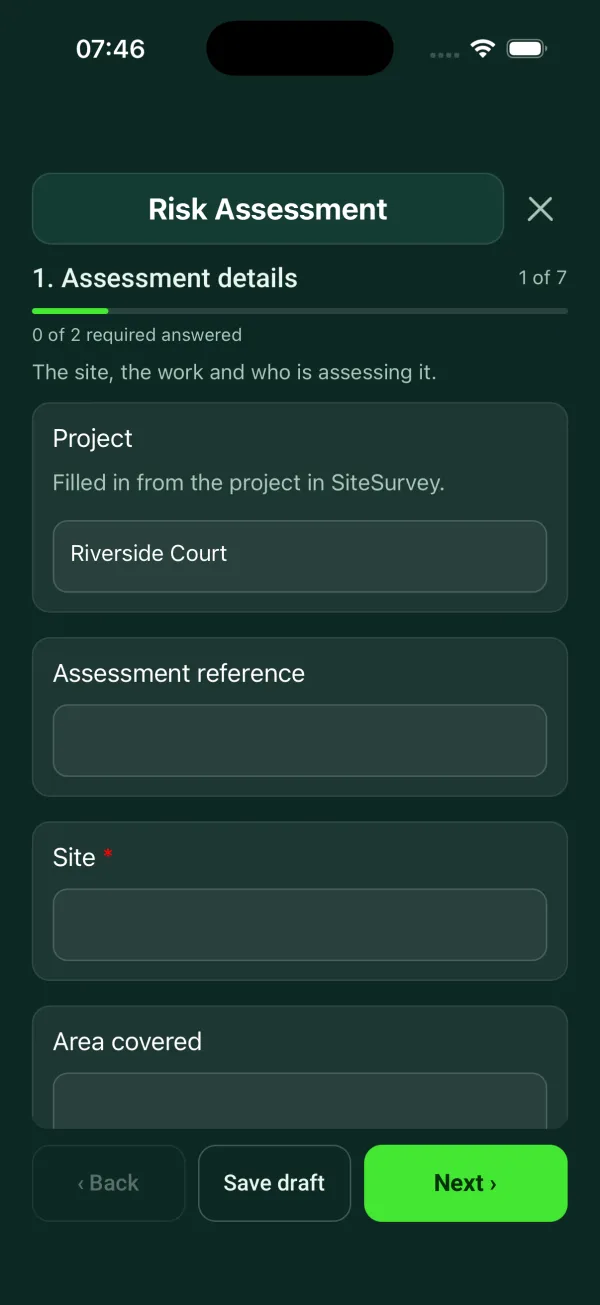
Risk assessment template
Hazards, who might be harmed, controls and risk scores, with a briefing record and review date.
7 sections88 questionsPhotosSignaturesSee every question → - Health and safety
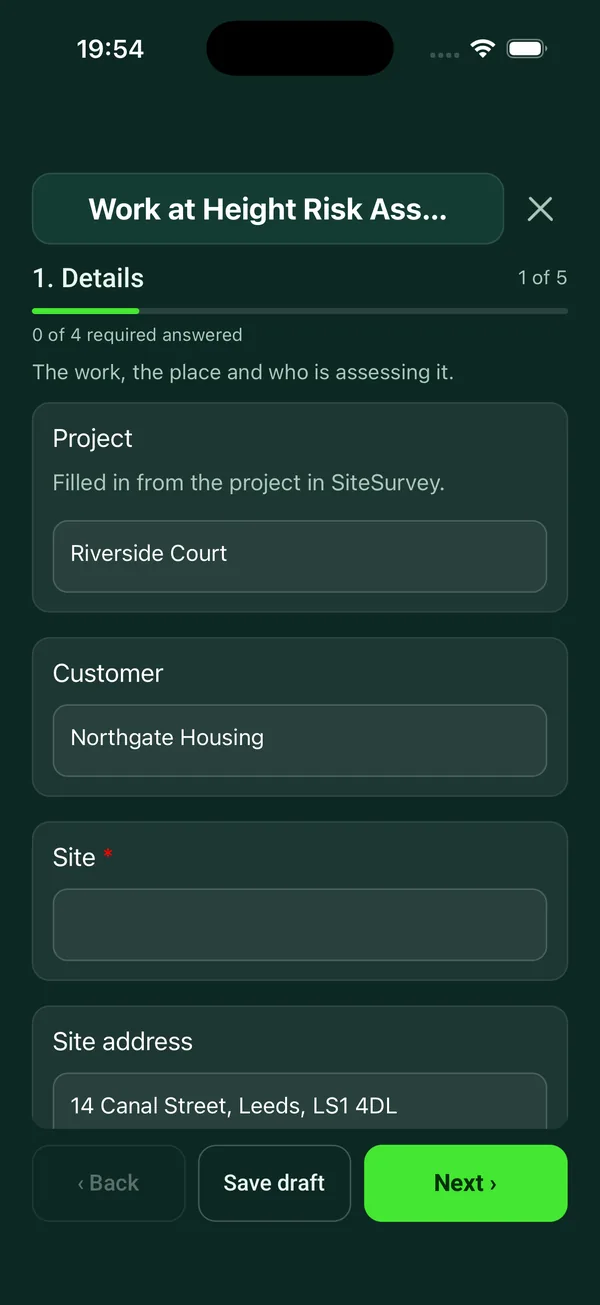
Working at height risk assessment template
Risk assessment for a task at height: can it be avoided, how falls are prevented, access equipment, fragile surfaces, falling objects, rescue and scored hazards.
5 sections45 questionsPhotosSignaturesSee every question → - Health and safety
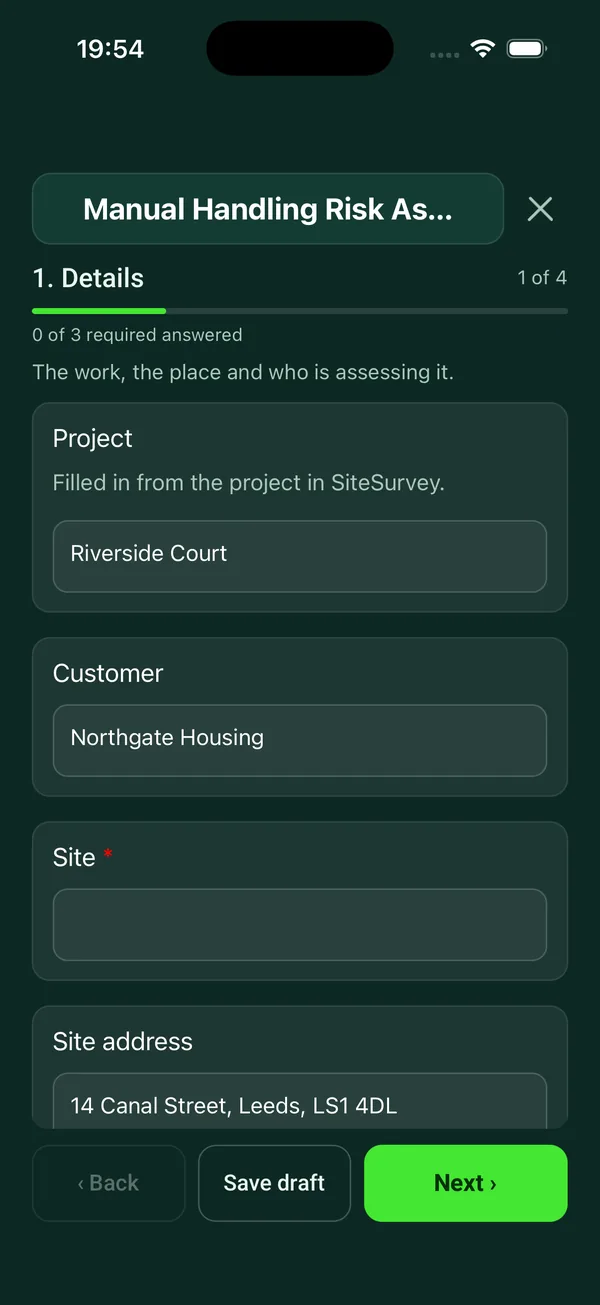
Manual handling risk assessment template
Manual handling assessment using task, individual, load and environment: can it be avoided, risk factors, handling aids, controls and actions.
4 sections39 questionsPhotosSignaturesSee every question → - Health and safety
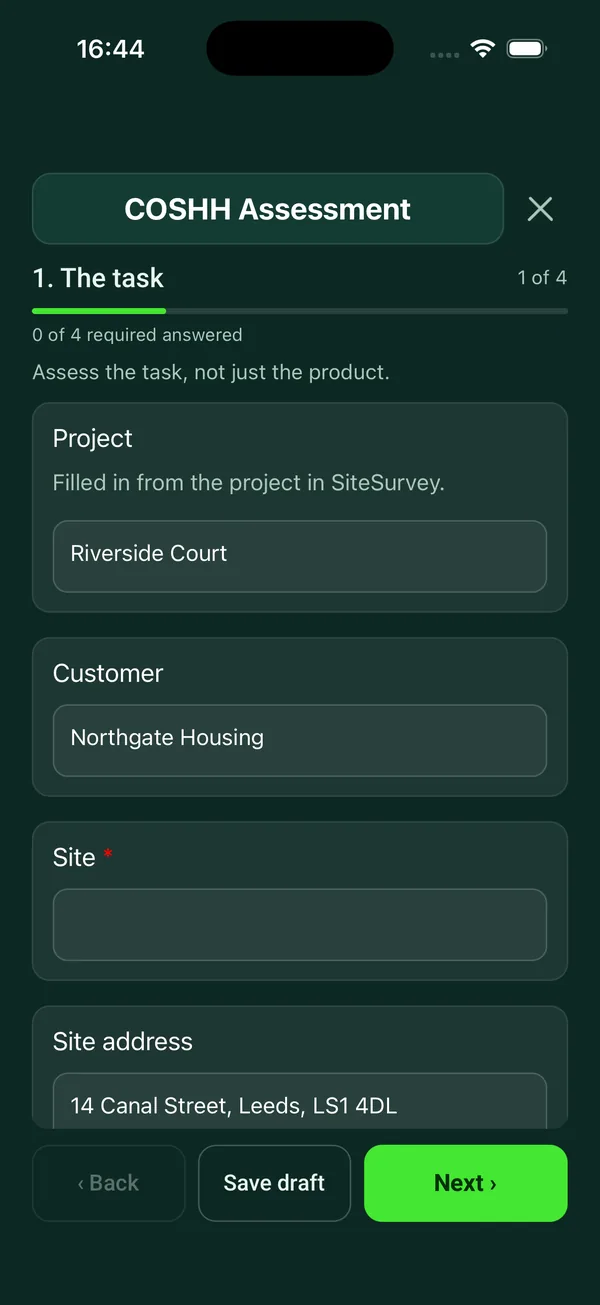
COSHH assessment template
Assessment for a task that uses or creates hazardous substances: products and hazard symbols, who is exposed and how, controls, PPE, emergencies and review.
4 sections54 questionsPhotosSignaturesSee every question → - Health and safety
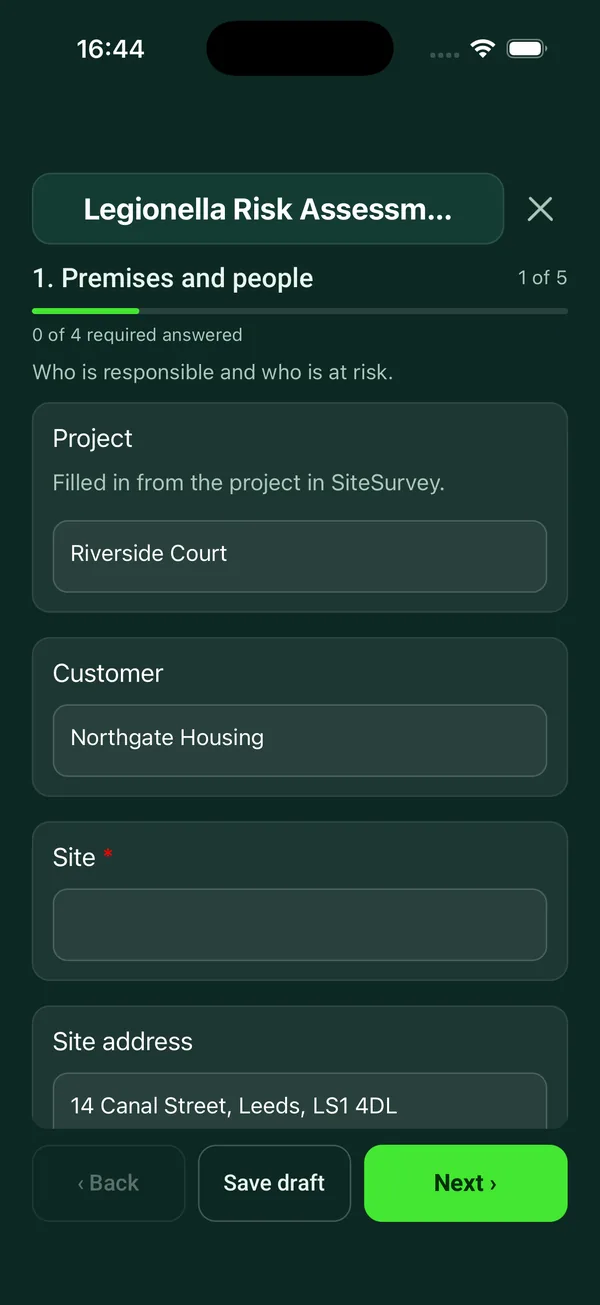
Legionella risk assessment template
Legionella risk assessment for a hot and cold water system: who is responsible, tanks and heaters, outlet temperatures, little-used outlets, findings and actions.
5 sections69 questionsPhotosSignaturesSee every question → - Health and safety
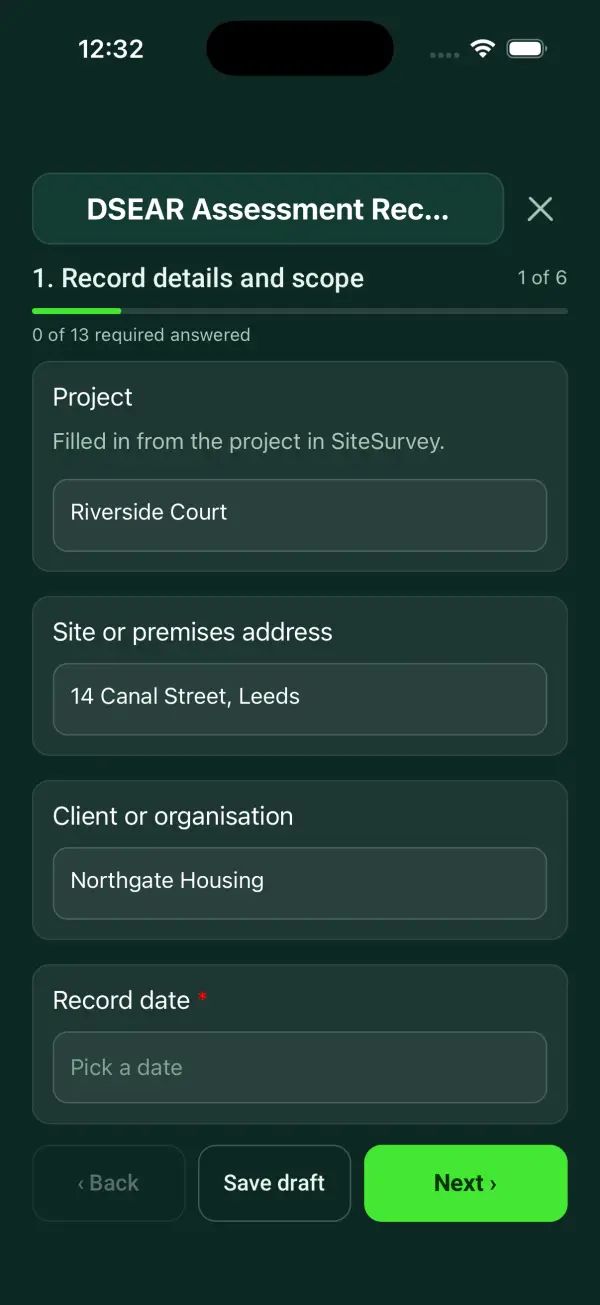
DSEAR risk assessment template
A DSEAR assessment record with dangerous substances, release scenarios, ignition sources, existing controls, specialist references and action priorities.
6 sections53 questionsPhotosSignaturesSee every question → - Health and safety
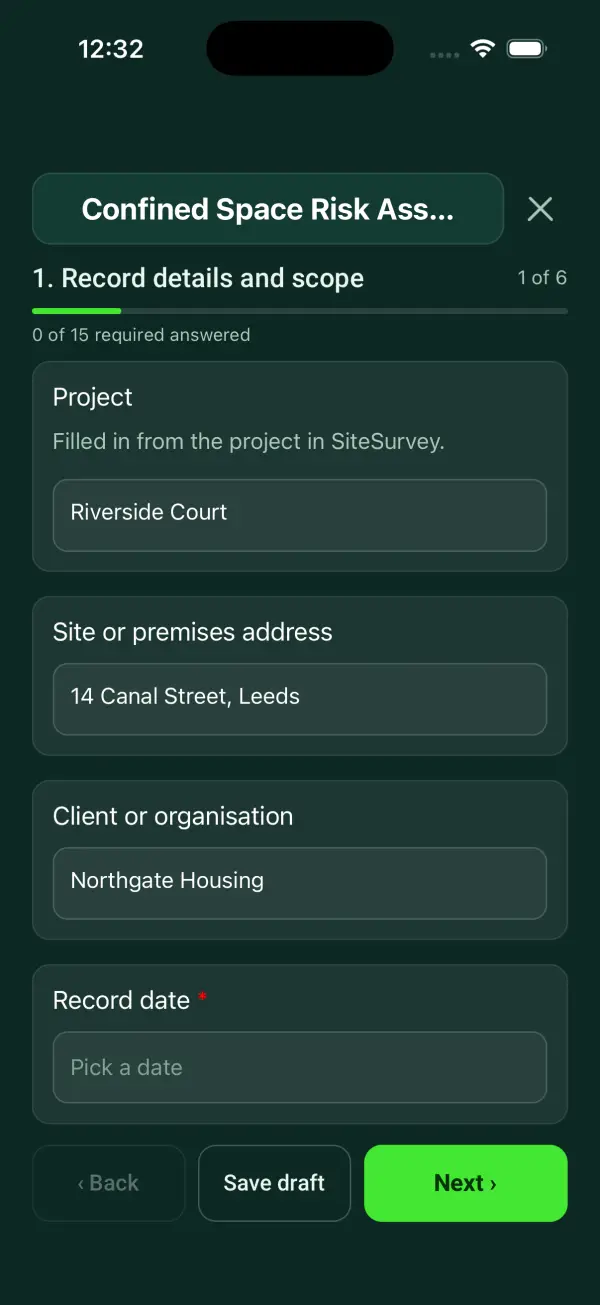
Confined space risk assessment template
A confined space assessment recording the task, alternatives to entry, specified hazards, controls, safe-system references and rescue planning requirements.
6 sections35 questionsSignaturesSee every question → - Health and safety
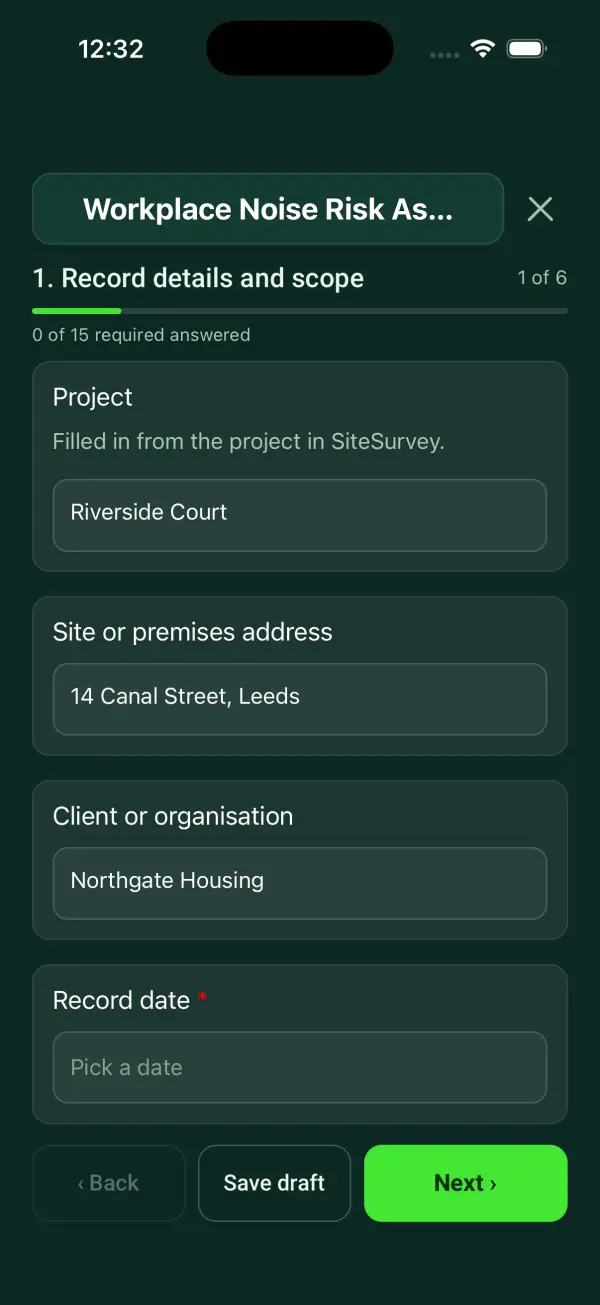
Noise risk assessment template
A workplace noise assessment recording affected tasks, exposure evidence, comparison with applicable values, control decisions and review arrangements.
6 sections42 questionsSignaturesSee every question → - Health and safety
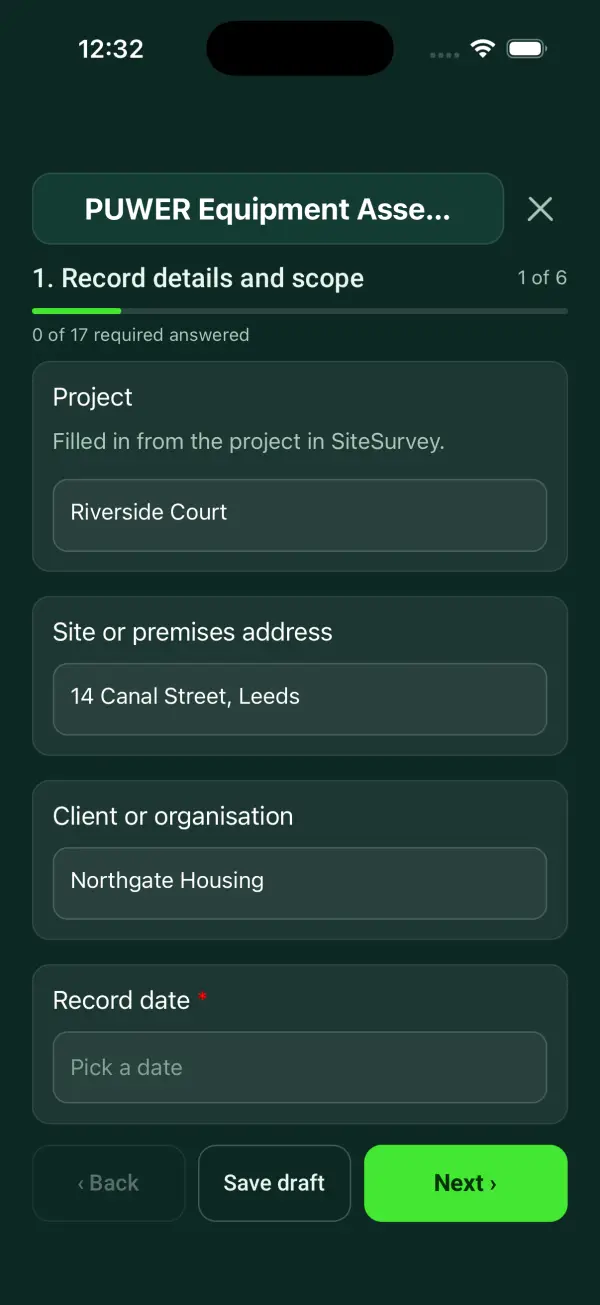
PUWER risk assessment template
A PUWER assessment record covering intended use, equipment hazards, safeguarding evidence, maintenance arrangements, competence and risk-control decisions.
6 sections45 questionsPhotosSignaturesSee every question → - Health and safety
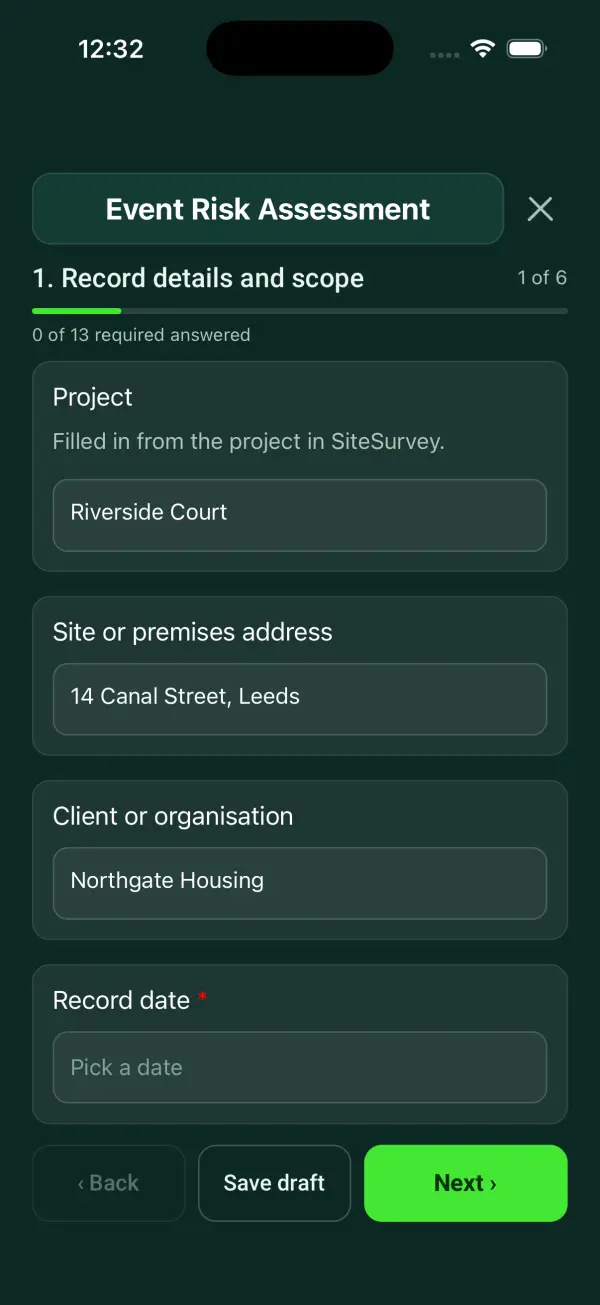
Event risk assessment template
An event risk assessment covering setup, public opening and breakdown, crowd movement, contractors, weather, emergency arrangements and review.
6 sections48 questionsPhotosSignaturesSee every question → - Health and safety
Office risk assessment
An office risk assessment on HSE's five steps for a business in Great Britain: a 16-point office health and safety checklist (walkways and cables, stairs, fire exits, electrics, workstations, temperature with a thermometer reading, ventilation, lighting, toilets and washing, drinking water, rest and eating, kitchen, cleaning chemicals, storage, first aid), then each area as a space with its hazards: who might be harmed and how, existing controls, a risk level on your own low, medium or high scale, further action with owner and due date. Ends with the significant findings record, groups especially at risk, review triggers, actions and sign-off.
5 sections99 questionsPhotosSignaturesSee every question → - Health and safety
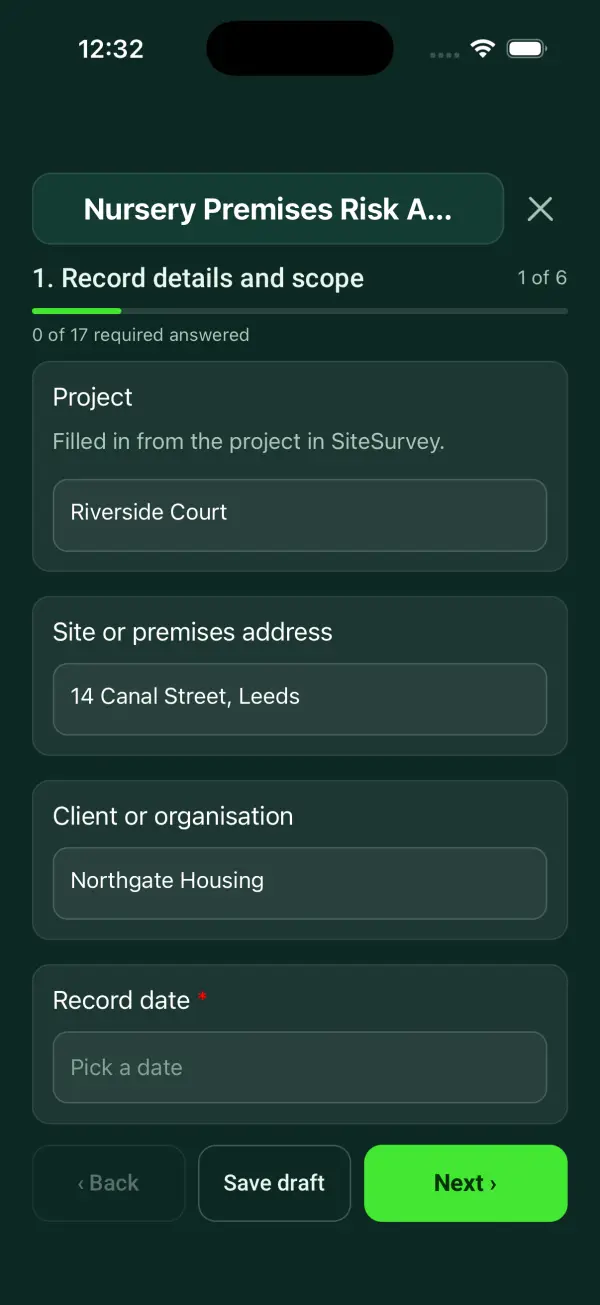
Nursery risk assessment template
A nursery premises assessment recording rooms, outdoor areas, access, age-related hazards, supervision controls, actions and review of changes.
6 sections45 questionsPhotosSignaturesSee every question → - Health and safety
Indoor air quality assessment
An indoor air quality (IAQ) assessment for offices, schools and healthcare buildings: why it was done, the meter used and outdoor readings, your own targets and where they come from, complaints reported by area (no names, no medical judgement), ventilation and HVAC checks (outdoor air intakes, filters, drain pans, dampers, grilles, extract, hours of running), measurements by area as spaces (CO2, temperature, relative humidity, PM2.5, VOCs and carbon monoxide) with a pass or fail against your targets, sources found (moisture, mould, chemicals, printers, vehicle exhaust and more), and recommendations with priority, owner and due date, with two signatures.
7 sections121 questionsPhotosSignaturesSee every question → - Health and safety
Martyn's Law checklist
A Martyn's Law (Terrorism (Protection of Premises) Act 2025) record: premises and capacity tier, SIA notification, evacuation, invacuation, lockdown and communication procedures, staff briefing, exercises and review.
4 sections39 questionsPhotosSignaturesSee every question →

Risk assessments for people and wellbeing 7
Assessments built around a person rather than a task: lone workers, new and expectant mothers, young workers, screen users and staff under pressure. Use these alongside the general risk assessment, not instead of it.
- Health and safety
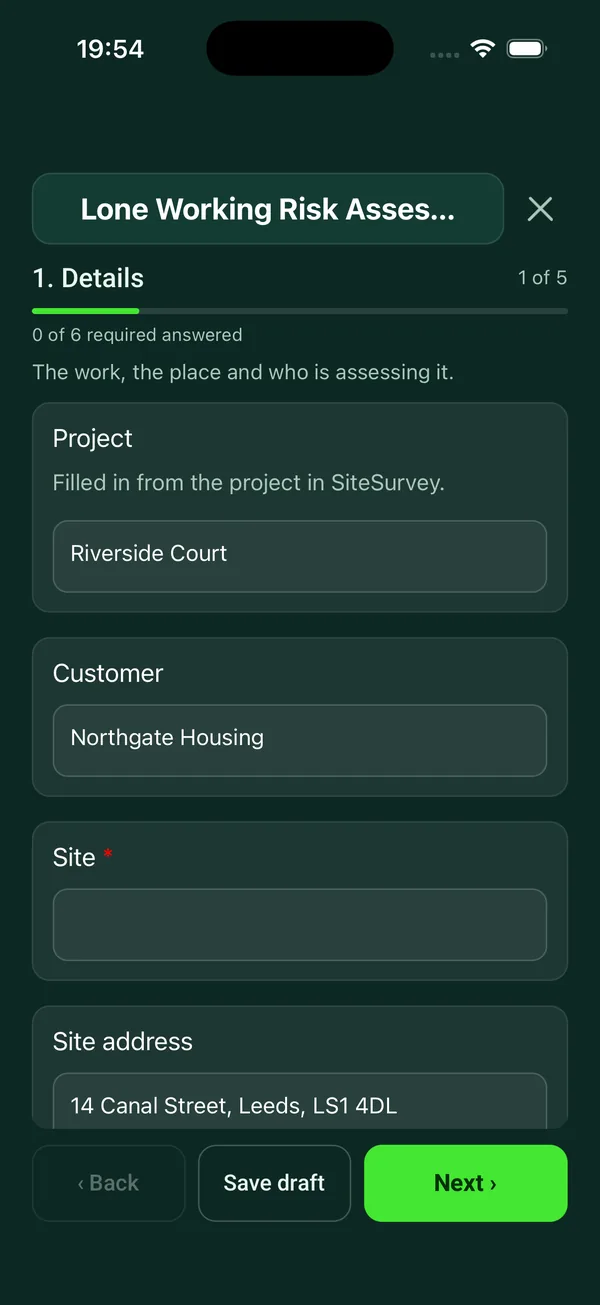
Lone working risk assessment template
Risk assessment for someone working alone: the work and place, violence, health, high risk tasks, check-in arrangements, what happens if contact is lost and scored hazards.
5 sections49 questionsPhotosSignaturesSee every question → - Health and safety
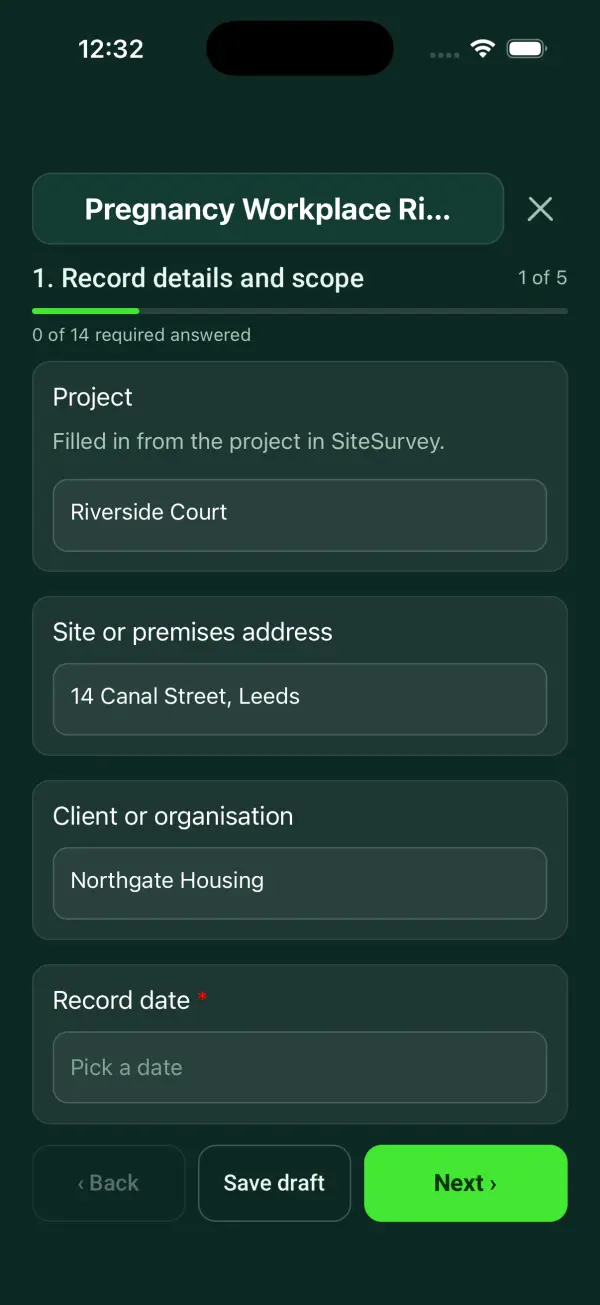
Pregnancy risk assessment template
An individual workplace assessment recording job demands, consultation, pregnancy-related work adjustments, responsible people and review arrangements.
5 sections35 questionsSignaturesSee every question → - Health and safety
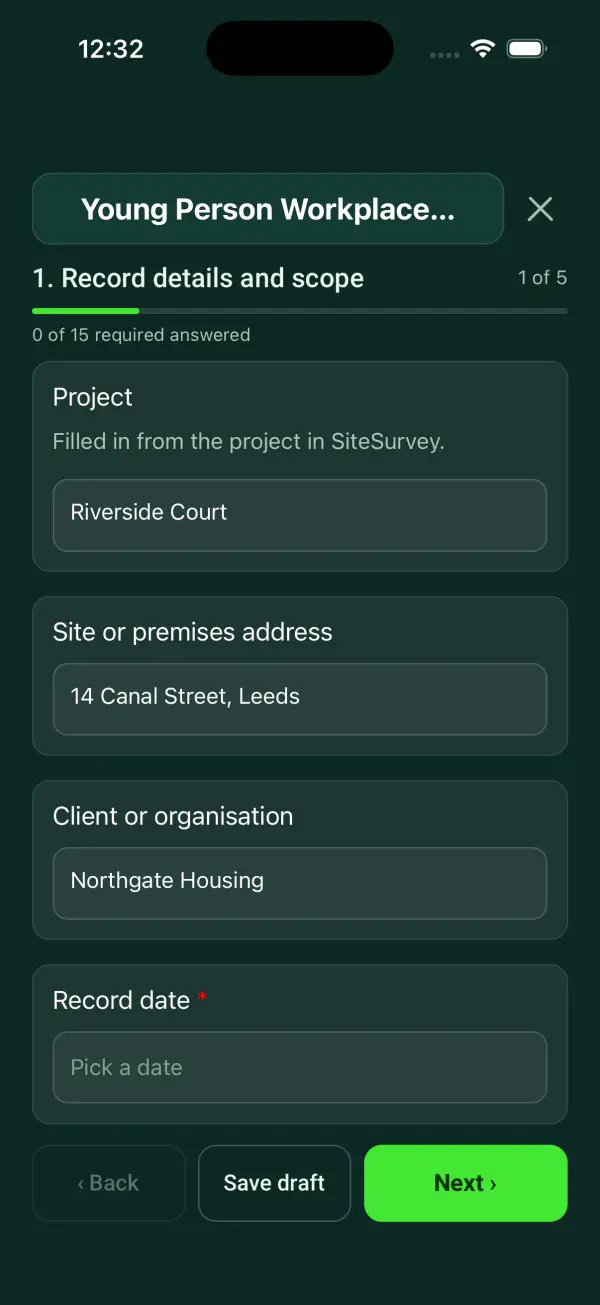
Young person risk assessment template
A young worker assessment recording tasks, experience, supervision, training, task restrictions, communication and review before and during placement.
5 sections32 questionsSignaturesSee every question → - Health and safety
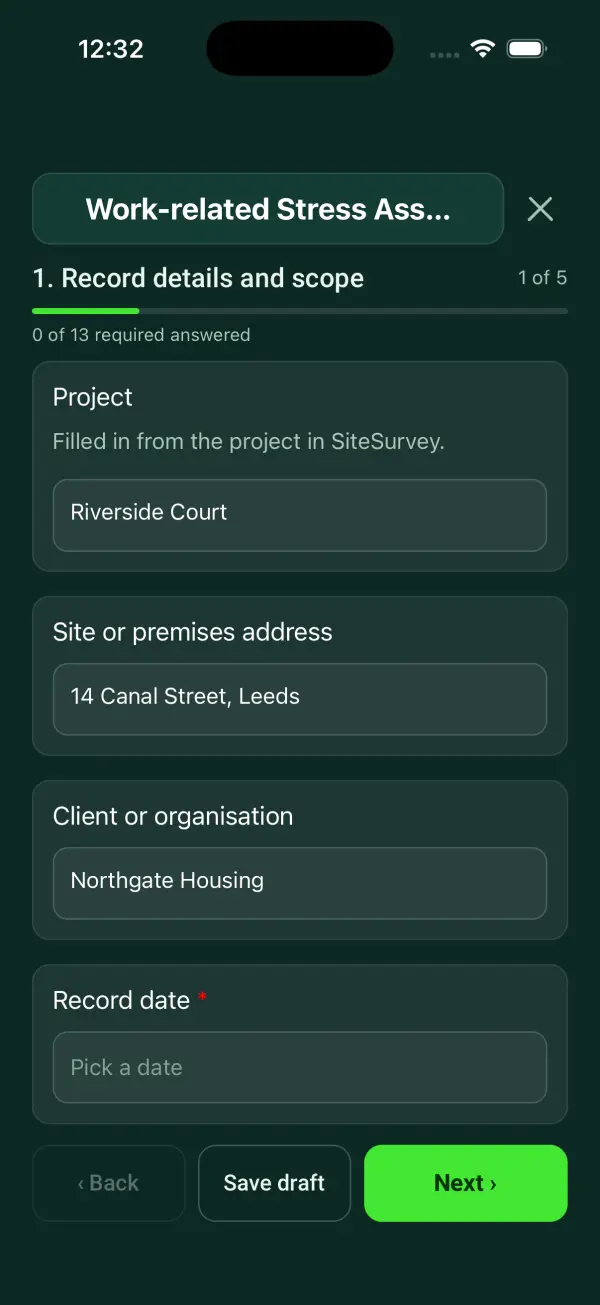
Stress risk assessment template
A work-related stress assessment with team consultation, six work-design areas, evidence, organisational controls and a documented review of actions.
5 sections31 questionsSignaturesSee every question → - Health and safety
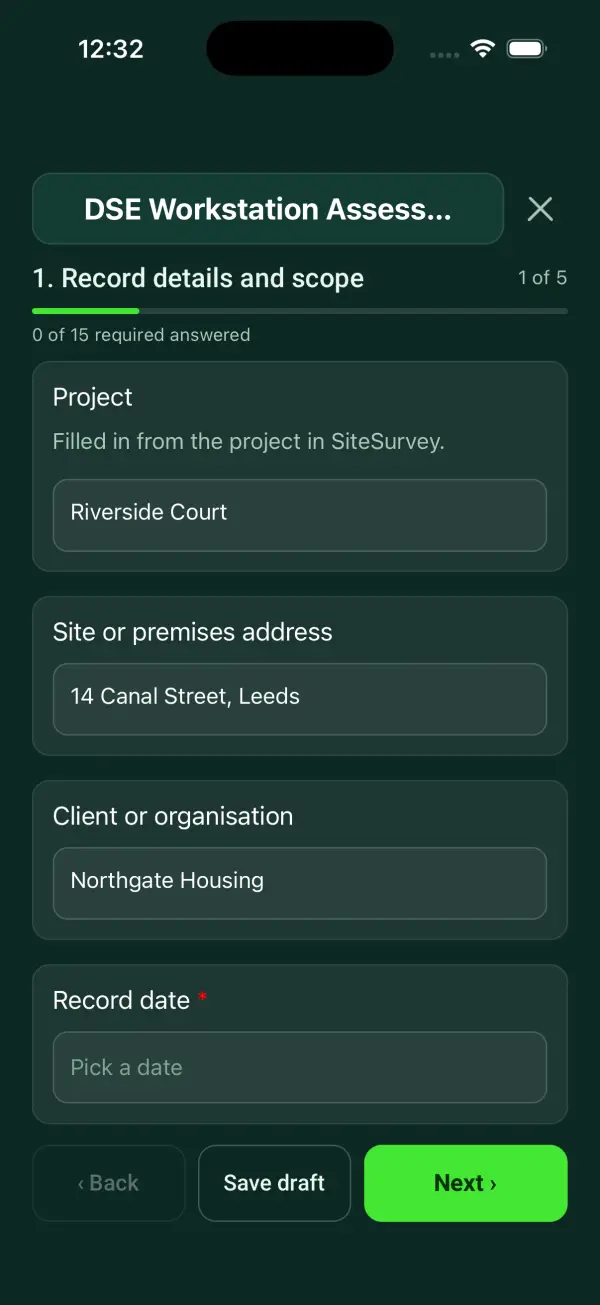
DSE assessment template
A workstation assessment with equipment, posture and work-pattern checks, user concerns, assessor review, adjustments and follow-up evidence.
5 sections44 questionsPhotosSignaturesSee every question → - Health and safety
Ergonomic risk assessment
An ergonomic risk assessment for physical tasks in warehouses, production and packing lines, labs and kitchens. Each task is a space: what it involves, workers, hours and repeats per shift, then posture (overhead reach, bending, twisting), force and the heaviest item, repetition and duration, vibration, workstation and reach heights (with measure from photo as an estimate), tools and grips, environment, what the workers say and any symptoms reported, a rating per factor on your own low, medium or high scale, and controls (eliminate, redesign, aids, rotation) with priority, owner and status. Notes for UK law and the US general duty clause.
4 sections79 questionsPhotosSignaturesSee every question → - Health and safety
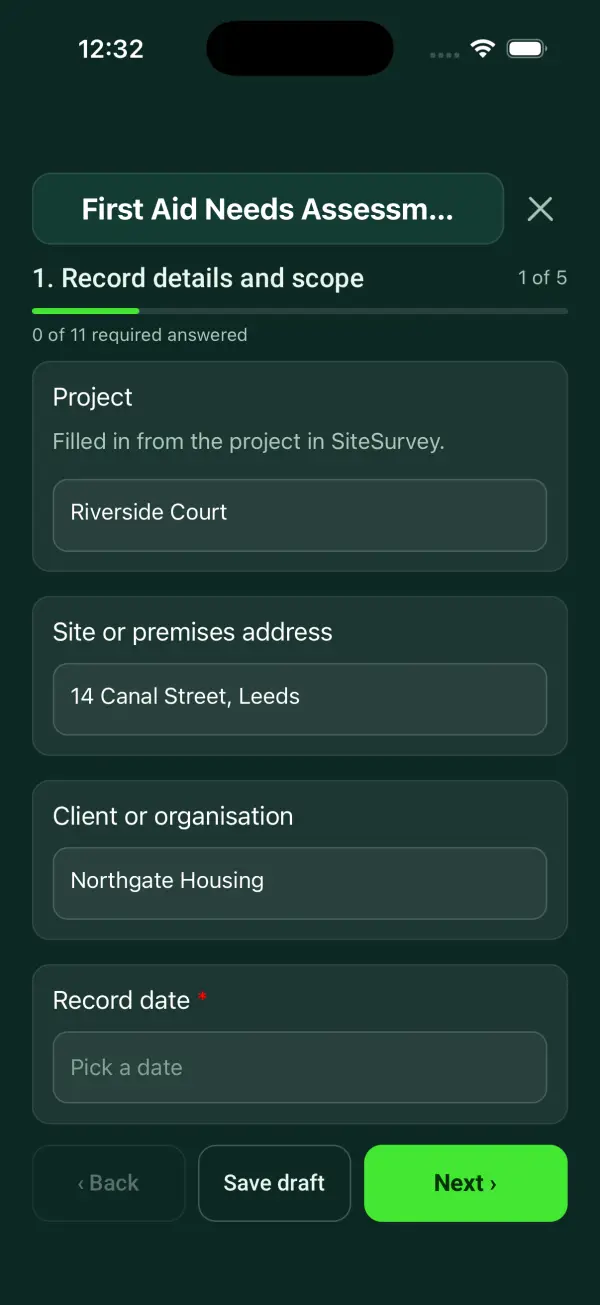
First aid needs assessment template
A first aid needs record covering work hazards, staffing and shifts, absence cover, remote work, equipment, facilities and agreed provision.
5 sections32 questionsSignaturesSee every question →
Method statements, permits and safe systems of work 12
RAMS, method statements, permits and rescue plans for higher-risk jobs. These are the forms that say how the work will be done, who signs it off and what happens if it goes wrong.
- Health and safety
RAMS template
One document for the job: hazards with suggested controls and 1 to 5 scores, the sequence of work with hold points, crew cards and competence, plant, COSHH, permits, emergency and rescue, briefing signatures and approval. Tailored to construction, electrical, AV and IT, roofing, facilities, events or grounds work.
8 sections151 questionsPhotosSignaturesSee every question → - Health and safety
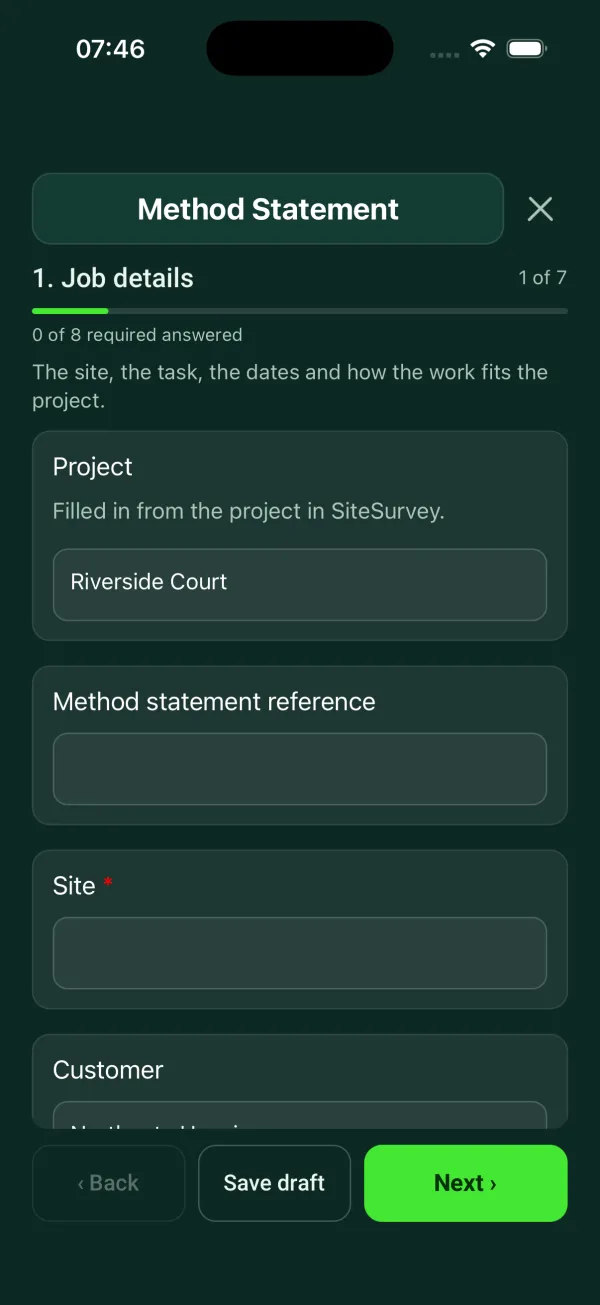
Method statement template
How a task will be done safely: scope, crew and competence, numbered work steps with hazards and controls, permits, emergency arrangements, briefing and approval. Links to the risk assessment by reference.
7 sections93 questionsPhotosSignaturesSee every question → - Health and safety
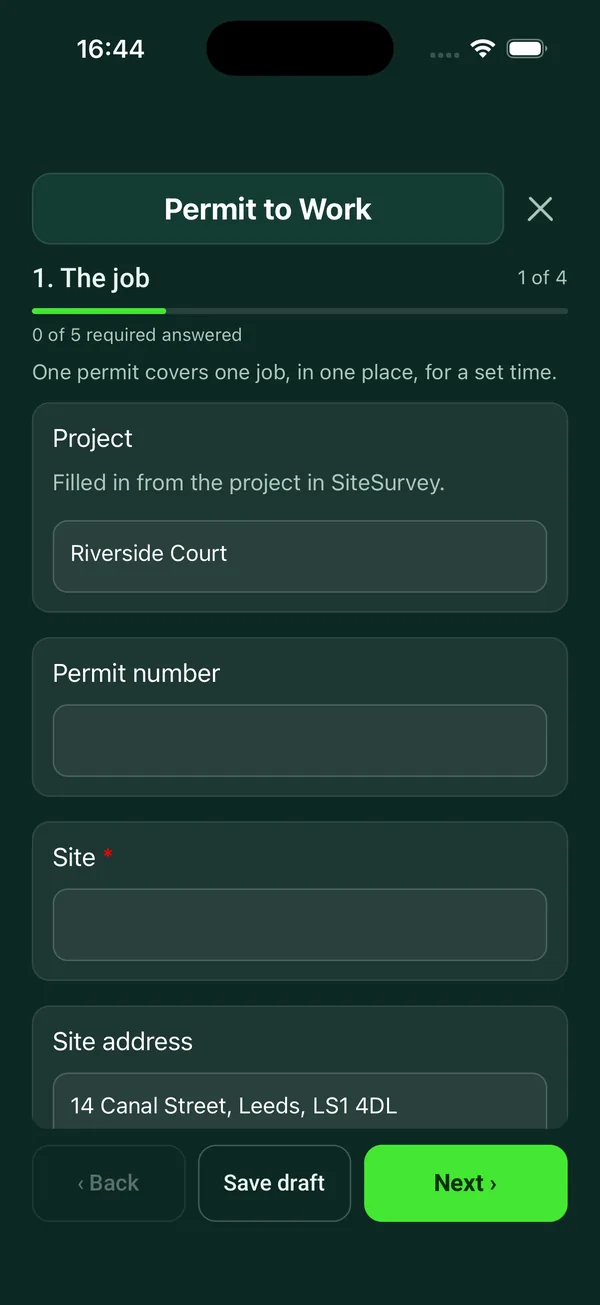
Permit to work template
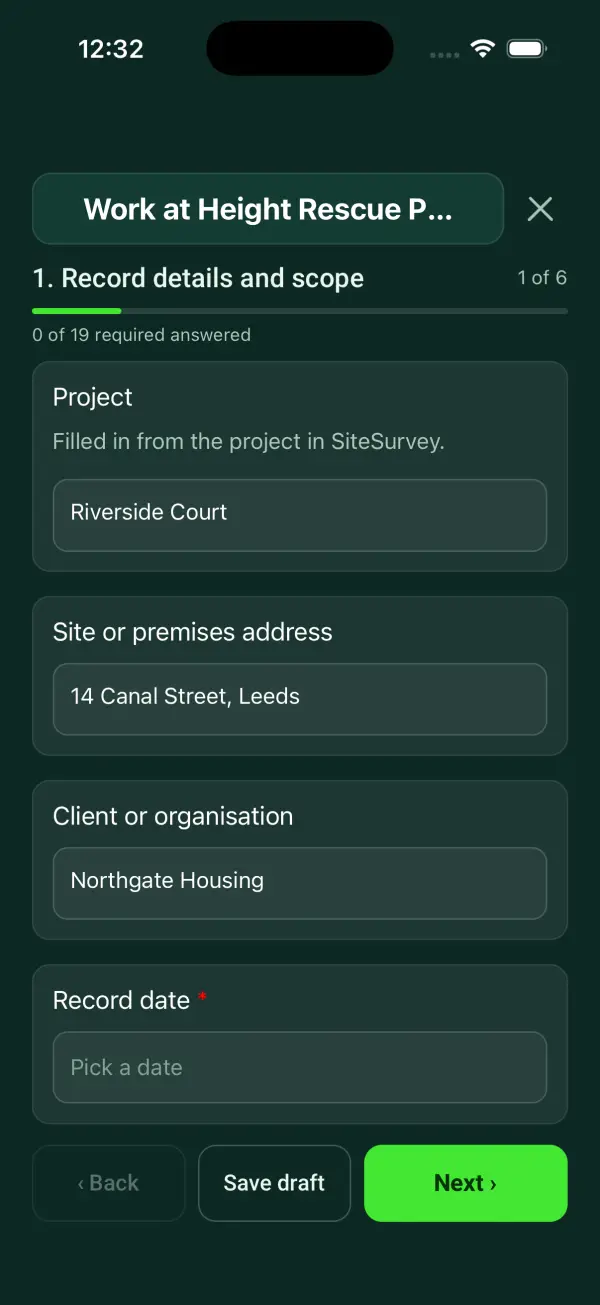
Permit for hot work, work at height, confined space entry and other high risk jobs: precautions, isolations, authorisation, hand-back and close-out.
4 sections68 questionsSignaturesSee every question → - Health and safety
Hot works permit template
A hot works permit for welding, cutting, grinding and torch-on roofing: precautions before the work, extinguishers and fire watcher, issue and acceptance signatures, the fire watch after the work with timed checks, and hand-back and cancellation.
5 sections77 questionsPhotosSignaturesSee every question → - Health and safety
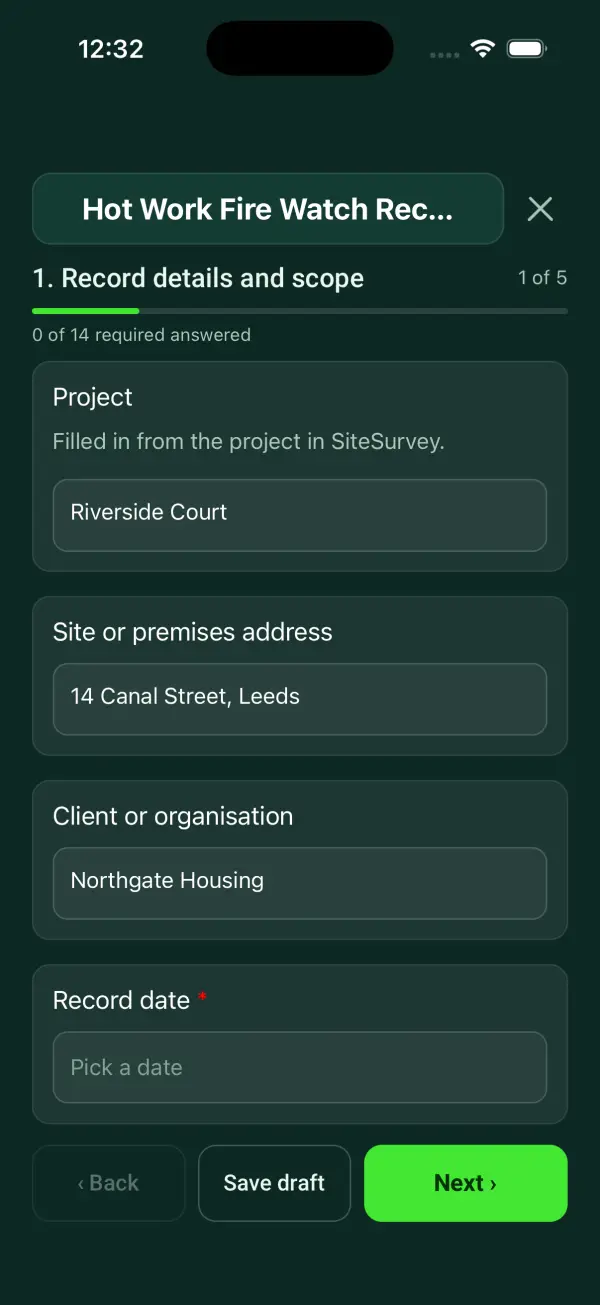
Fire watch log template
A hot-work fire watch log recording the permit, watch area, responsible watchers, timed observations, handovers, incidents and authorised close-out.
5 sections32 questionsPhotosSignaturesSee every question → - Health and safety
Permit to dig template
A permit to dig following HSE HSG47: service plans, CAT and signal generator scan, services found and marked, trial holes, safe digging precautions, authorisation, and close-out with backfill.
4 sections42 questionsPhotosSignaturesSee every question → - Health and safety
Confined space entry permit template
A confined space entry permit filled in at the entry point: the space, purpose, date and duration, entry supervisor, attendants and entrants with times in and out, hazards, isolation and controls, acceptable entry conditions, atmospheric readings checked against them, rescue, communication, equipment, other permits, authorization and cancellation. US (29 CFR 1926 subpart AA and 1910.146) and Great Britain (Confined Spaces Regulations 1997, HSE L101) notes.
7 sections130 questionsPhotosSignaturesSee every question → - Health and safety
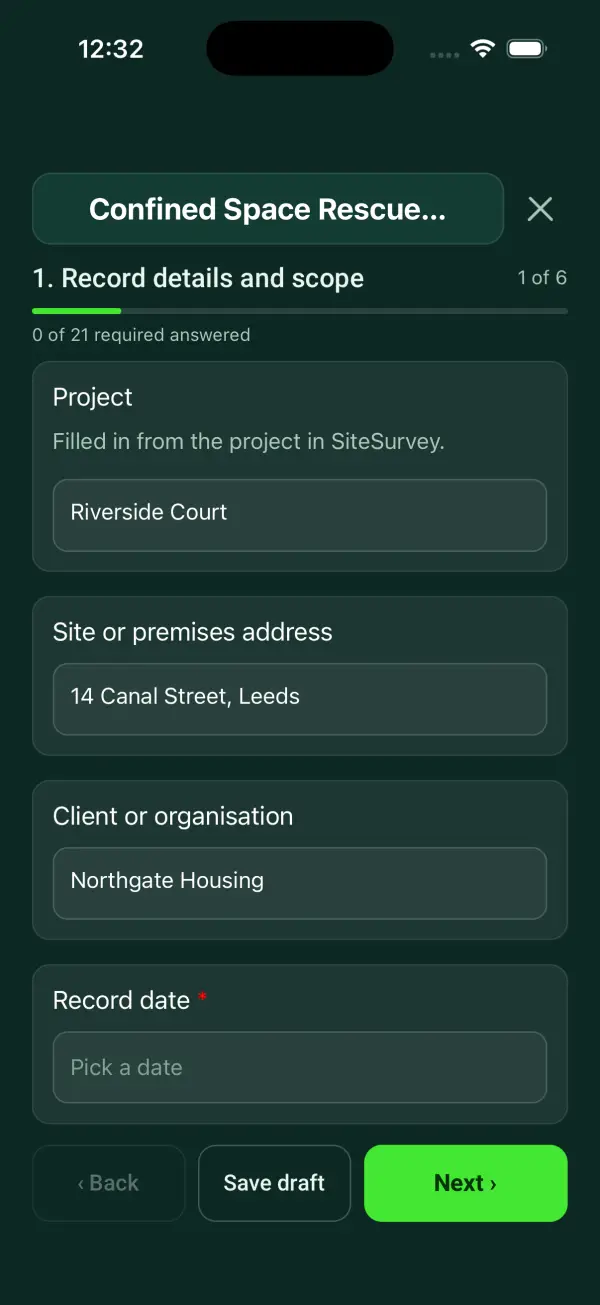
Confined space rescue plan template
A site-specific rescue planning record covering the space, credible emergencies, isolation, rescuers, communications, equipment readiness and practice.
6 sections44 questionsSignaturesSee every question → - Health and safety
Working at height rescue plan template
A work-at-height rescue planning record linking credible scenarios, competent responders, approved methods, equipment readiness and briefing evidence.
6 sections36 questionsSignaturesSee every question → - Health and safety
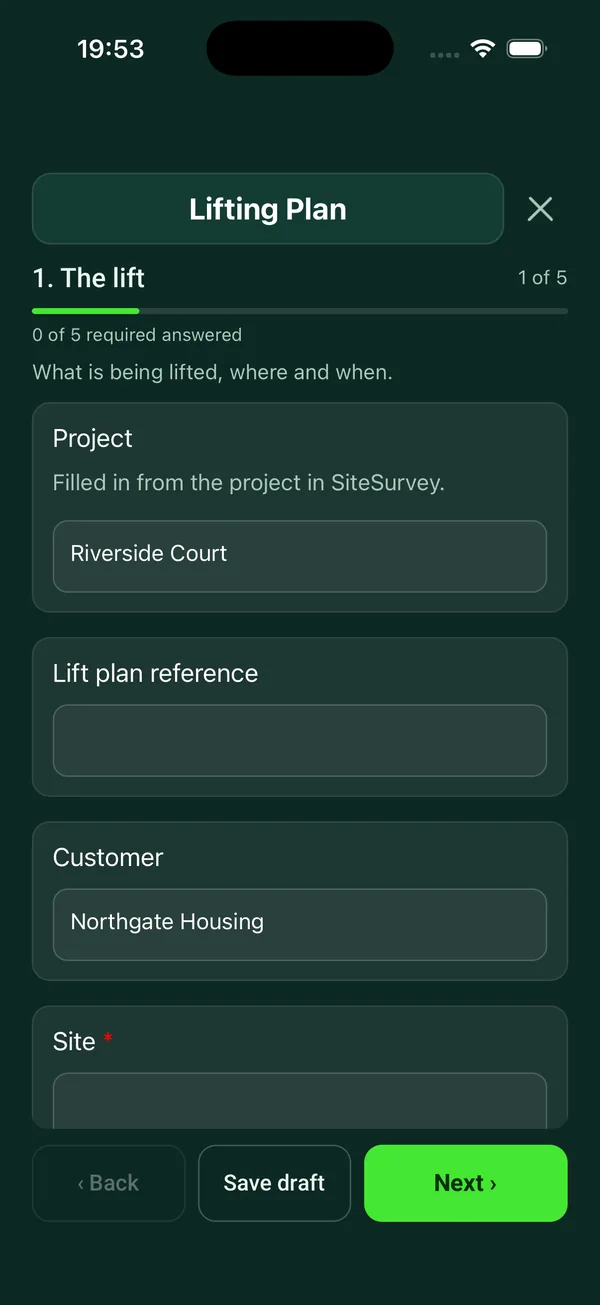
Lifting plan template for UK construction sites
Lift plan for a crane or other lifting operation: the load, equipment and capacity, accessories, ground and site hazards, the lifting team, sequence and briefing.
5 sections55 questionsPhotosSignaturesSee every question → - Health and safety
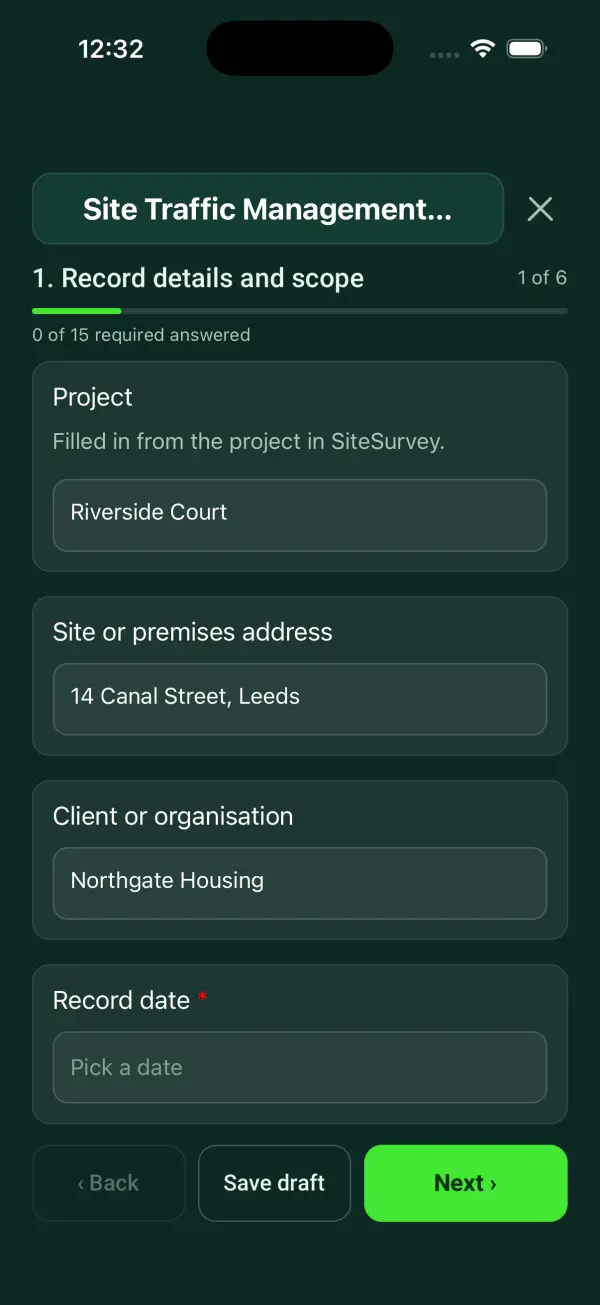
Traffic management plan template
A site traffic plan record with vehicle routes, pedestrian separation, delivery controls, reversing arrangements and a briefing record.
6 sections46 questionsPhotosSignaturesSee every question → - Health and safety
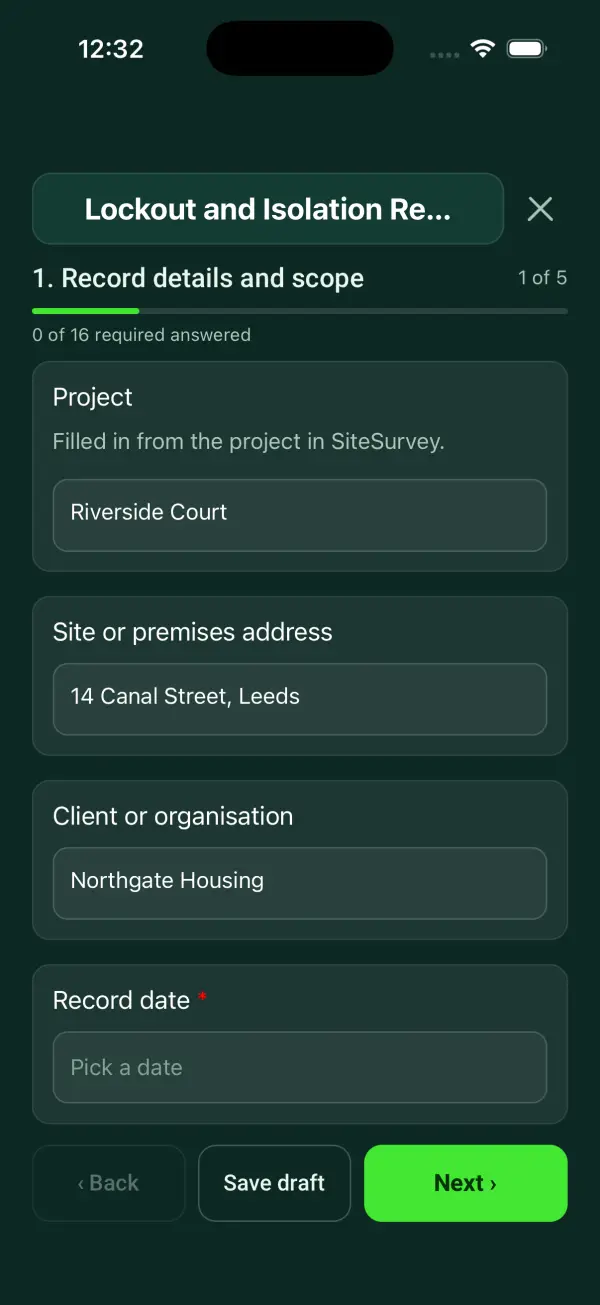
Lockout tagout checklist
An isolation record linking equipment, energy sources, isolation points, locks, verification evidence, handovers and authorised restoration of service.
5 sections36 questionsPhotosSignaturesSee every question →




Lifting equipment and work at height 12
Inspections for cranes, hoists, slings and lifting accessories under LOLER, plus the access equipment people work from: MEWPs, scissor and boom lifts, scaffolds, ladders, harnesses and roof anchors.
- Health and safety
LOLER inspection checklist
A LOLER thorough examination record: each item of lifting equipment with its identity, SWL, the basis of the examination, defects, whether they are dangerous, the next examination date and the examiner's declaration.
3 sections56 questionsPhotosSignaturesSee every question → - Health and safety
Crane inspection checklist
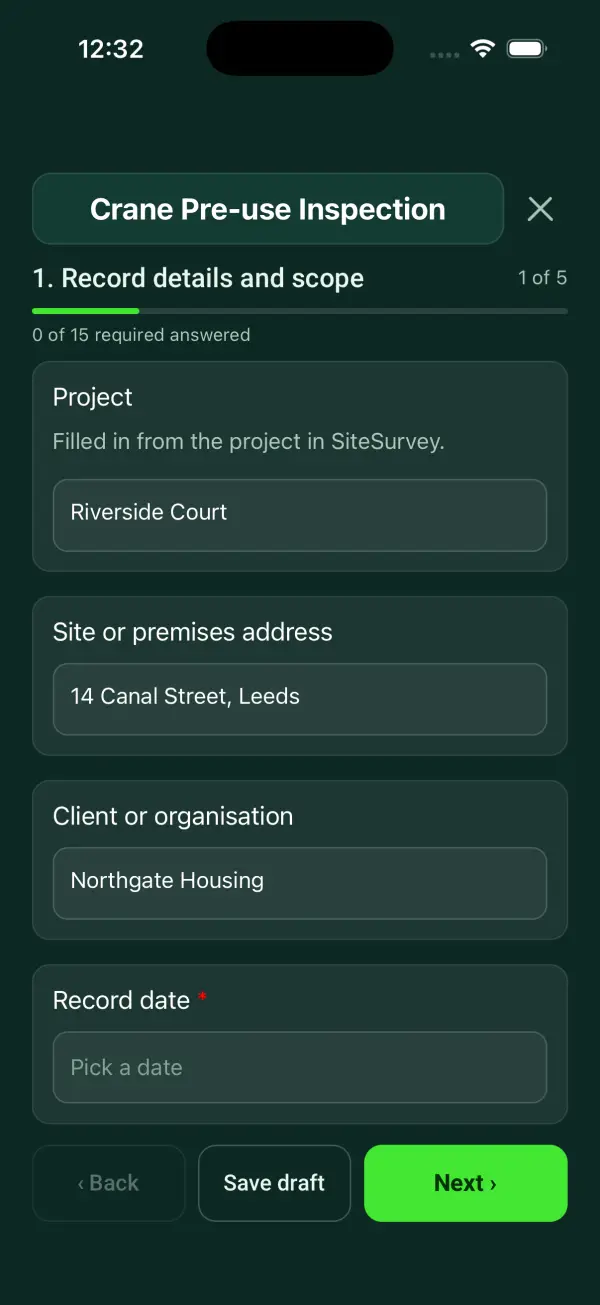
A crane operator pre-use record covering machine identification, manufacturer checks, visible condition, safety devices, defects and handover.
5 sections53 questionsPhotosSignaturesSee every question → - Health and safety
Tower crane inspection checklist
A tower crane daily or weekly inspection for the operator or appointed person, for the UK (LOLER 1998) and the US (29 CFR 1926 subpart CC): crane details with a data plate scan and the configuration (type, base, jib length, height under hook, tie-ins), the last thorough examination or annual inspection with the days since and the post-erection report, fourteen structure, access and cab checks from the base and mast ties to the counter-jib ballast, eight rope and hook checks, thirteen safety device tests including the rated capacity indicator, hoist, trolley and slew limits, the anemometer and the brakes, the wind reading against the maker's in-service limit, the result (in service or out of service), defects, actions and sign-off.
8 sections153 questionsPhotosSignaturesSee every question → - Health and safety
Hoist inspection checklist
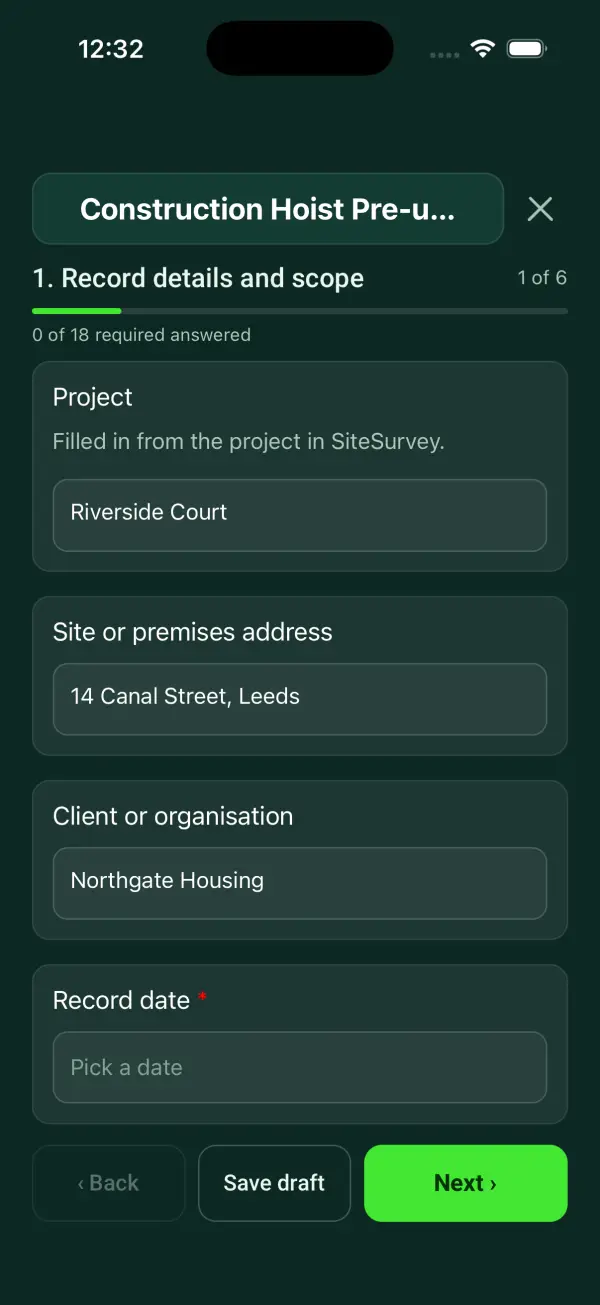
A construction hoist pre-use record covering equipment identity, landing protection, visible condition, authorised function checks and defect handover.
6 sections50 questionsPhotosSignaturesSee every question → - Health and safety
Lifting accessories inspection checklist
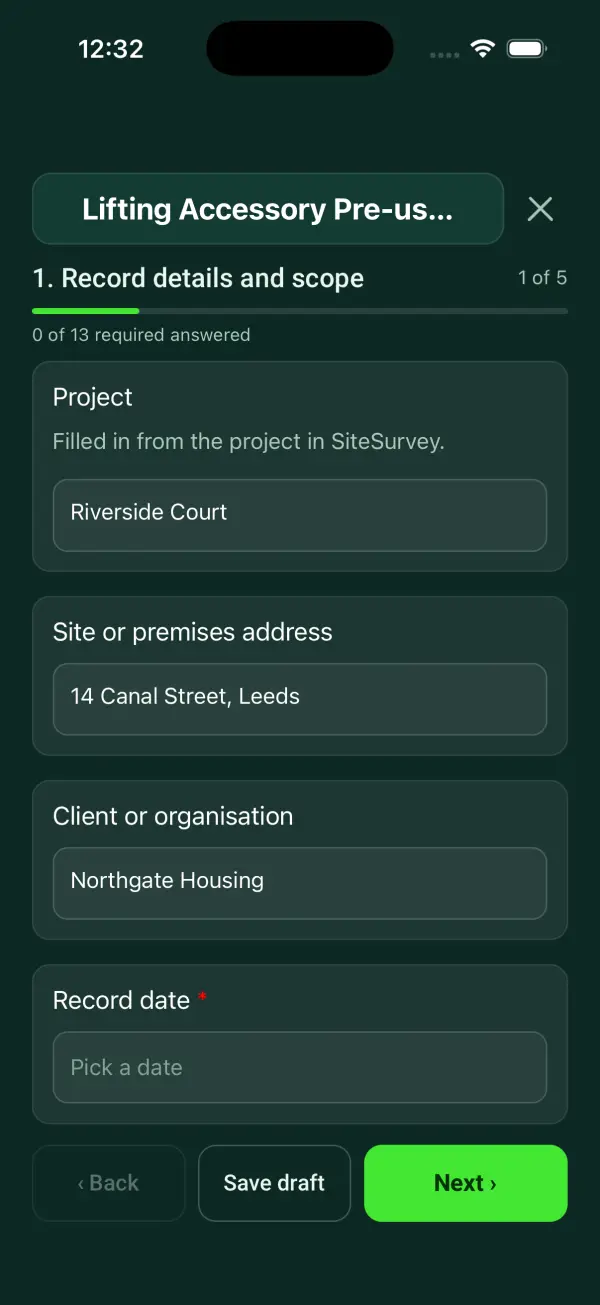
A lifting accessory pre-use record with identification, capacity markings, examination references, condition findings, quarantine and handover details.
5 sections48 questionsPhotosSignaturesSee every question → - Health and safety
MEWP inspection checklist
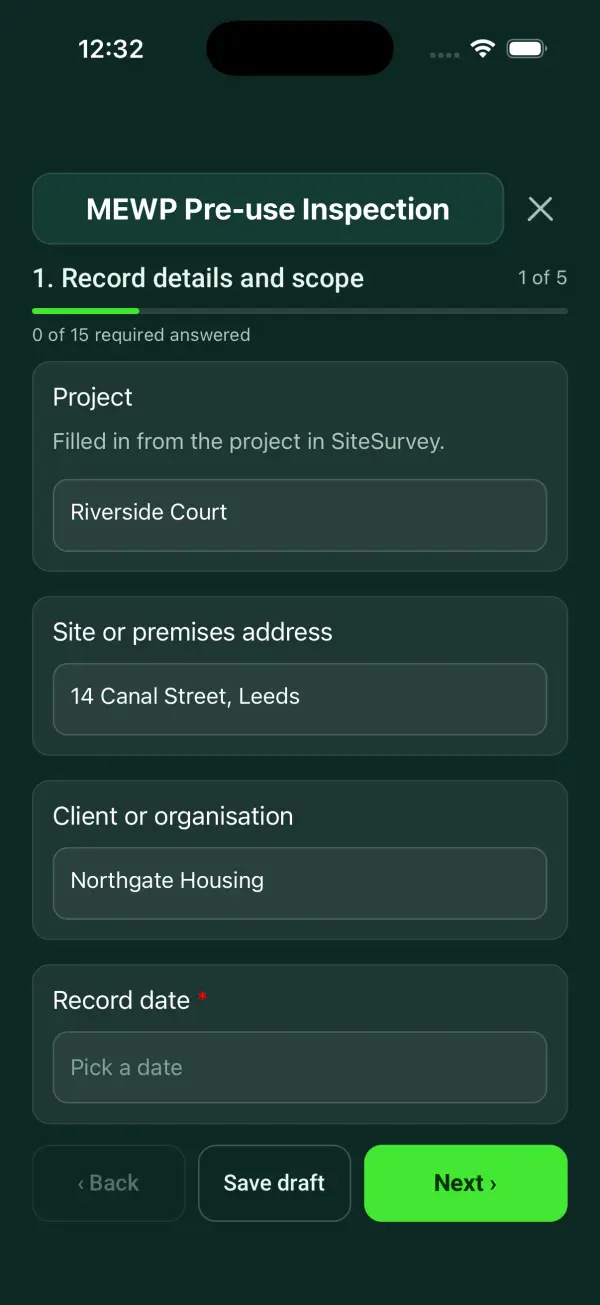
A MEWP pre-use record with machine and operator details, visual and functional checks, operating-area constraints, rescue arrangements and defects.
5 sections55 questionsPhotosSignaturesSee every question → - Health and safety
Scissor lift inspection checklist
A scissor lift pre-use inspection for the US and UK: machine details with a data plate scan, the date of the last thorough examination or frequent or annual inspection, ten visual checks from the scissor arms and pothole guards to the battery and hydraulics, eleven function tests from the ground and platform controls, worksite checks with wind against the maker's limit, the result (safe to use or tagged out), actions and sign-off.
7 sections126 questionsPhotosSignaturesSee every question → - Health and safety
Boom lift inspection checklist
A boom lift (cherry picker) pre-use inspection for articulating and telescopic booms, for the US and UK: machine details with a data plate scan, the date of the last thorough examination or annual inspection and the days since, fourteen visual checks from the boom sections, pins and wear pads to the turntable, counterweight and platform anchorage points, thirteen function tests from the ground and platform controls including emergency lowering, the foot switch and the tilt alarm, worksite checks with wind against the maker's limit, the people in the platform with harness and lanyard, the planned load, the result (safe to use or tagged out), actions and sign-off.
8 sections158 questionsPhotosSignaturesSee every question → - Health and safety
Scaffold inspection checklist
A scaffold inspection register and report: each scaffold or lift with its tag, the 7-day and after-event checks, defects with photos, the result and the regulation 12 report details.
4 sections75 questionsPhotosSignaturesSee every question → - Health and safety
Ladder inspection checklist
A ladder and stepladder inspection register: pre-use and detailed inspections for each ladder with its ID, the HSE checks, defects with photos and a keep or remove result.
4 sections55 questionsPhotosSignaturesSee every question → - Health and safety
Harness inspection checklist
Inspection record for a scaffold, ladder, harness and lanyard or pallet racking. The checks change with the equipment, with defects, photos and a result.
6 sections78 questionsPhotosSignaturesSee every question → - Health and safety
Roof anchor and eyebolt inspection
A roof anchor, eyebolt and safety line inspection: each anchor device with its type and location, visual and fixing checks, test where required, label, pass or withdrawn, and the next examination date.
3 sections58 questionsPhotosSignaturesSee every question →





Vehicles, plant and workplace transport 11
Daily and pre-use checks for forklifts, telehandlers, excavators and other plant, walkaround checks for HGVs, buses and trailers, and the loading and plant hire checks that sit around them.
- Health and safety
Forklift inspection checklist
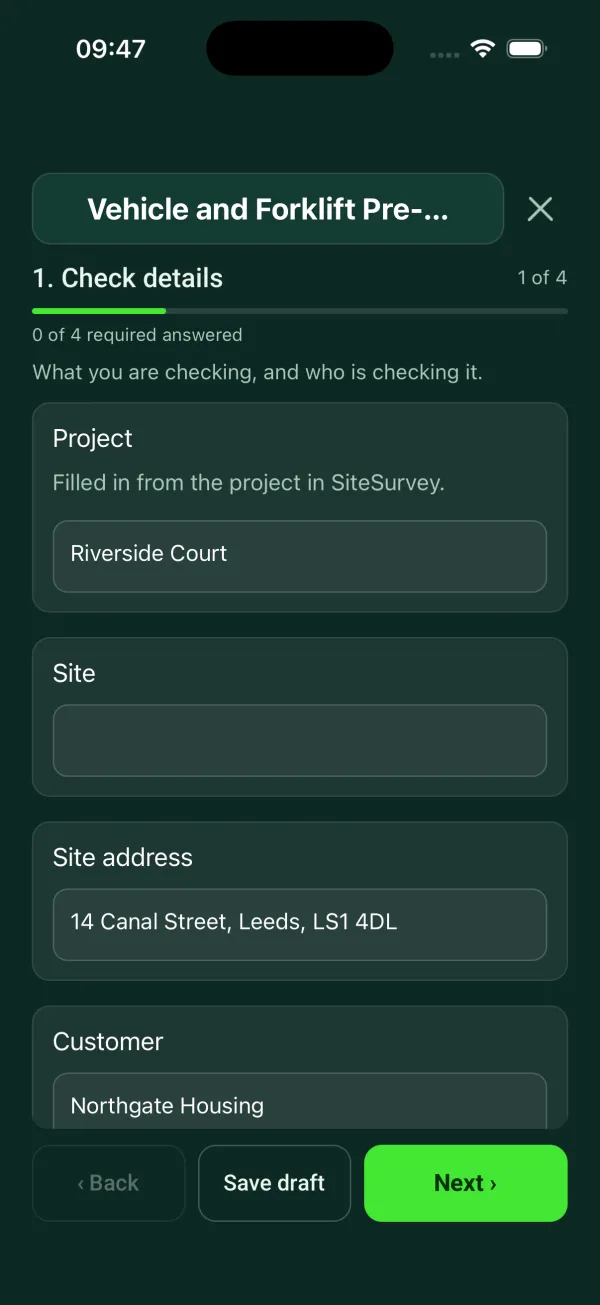
Daily check before using a van, car, forklift or other mobile plant. Failed items get a photo and a note, with the result, who it was reported to and a supervisor sign-off.
6 sections71 questionsPhotosSignaturesSee every question → - Health and safety
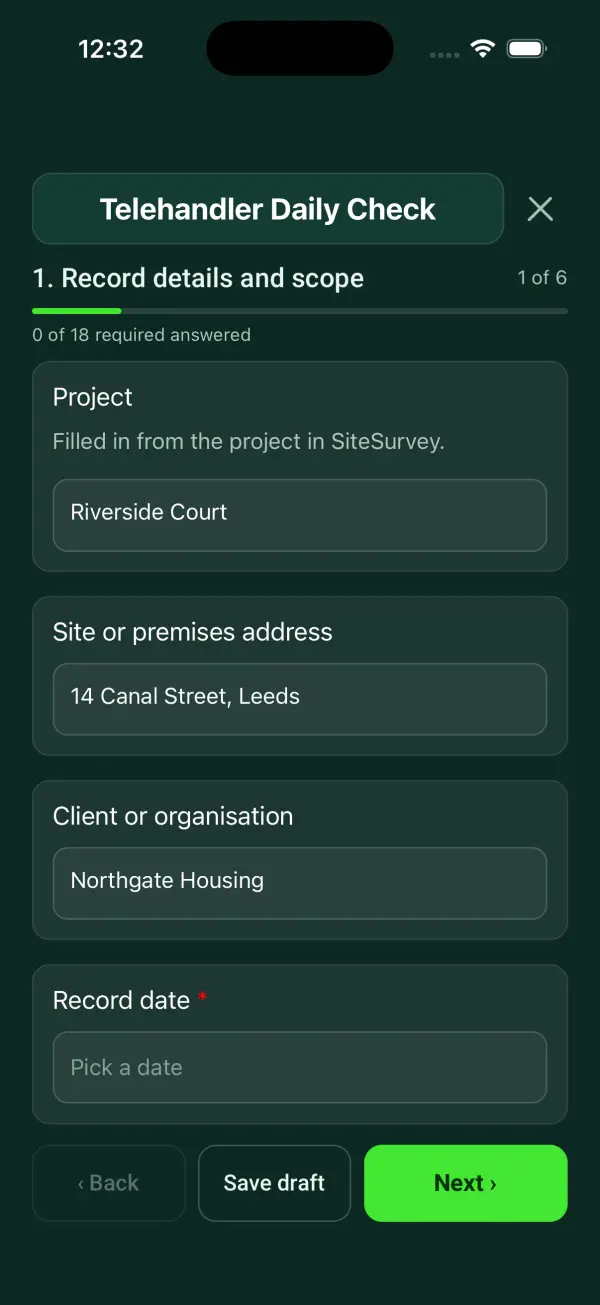
Telehandler checklist
A telehandler daily record covering configuration, attachment compatibility, tyres, visibility, stabilisers, approved function checks and defect handover.
6 sections52 questionsPhotosSignaturesSee every question → - Health and safety
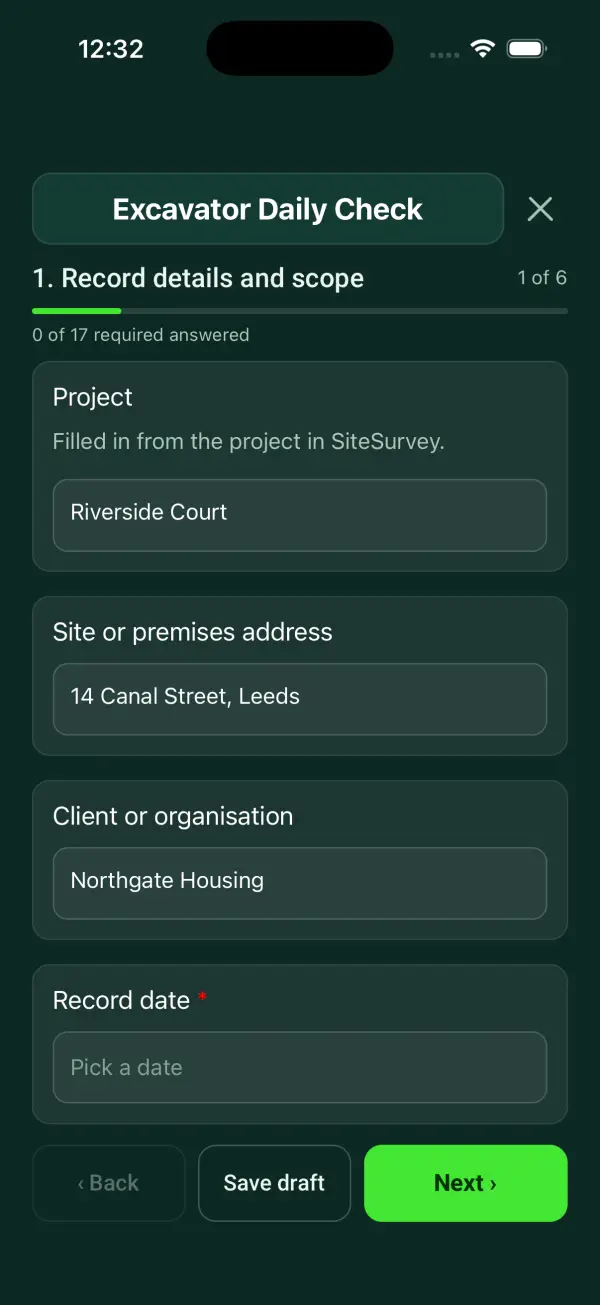
Excavator daily checklist
An excavator pre-use record covering machine identity, attachment security, visibility, visible leaks, authorised function checks and defect restrictions.
6 sections48 questionsPhotosSignaturesSee every question → - Health and safety
Heavy equipment inspection checklist
A daily heavy equipment inspection for a mixed fleet of earthmoving machines, for the US and UK: each machine by work area with a data plate scan, the hour meter and hours to the next service, a machine type choice (excavator, wheel loader, backhoe loader, skid steer or compact track loader, dozer, dump truck or articulated hauler, roller, motor grader) that shows its own checks, eleven walk-round checks, eight cab and operation tests including the seat belt, horn, reverse alarm and brakes, the result for each machine (in service, restricted or tagged out), site checks, actions and sign-off.
4 sections191 questionsPhotosSignaturesSee every question → - Health and safety
Plant hire checklist
A plant and tool hire check-out and return record: item and serial scan, hours, fuel, condition photos at check-out and return, safety checks, damage and missing parts, and both signatures.
3 sections36 questionsPhotosSignaturesSee every question → - Health and safety
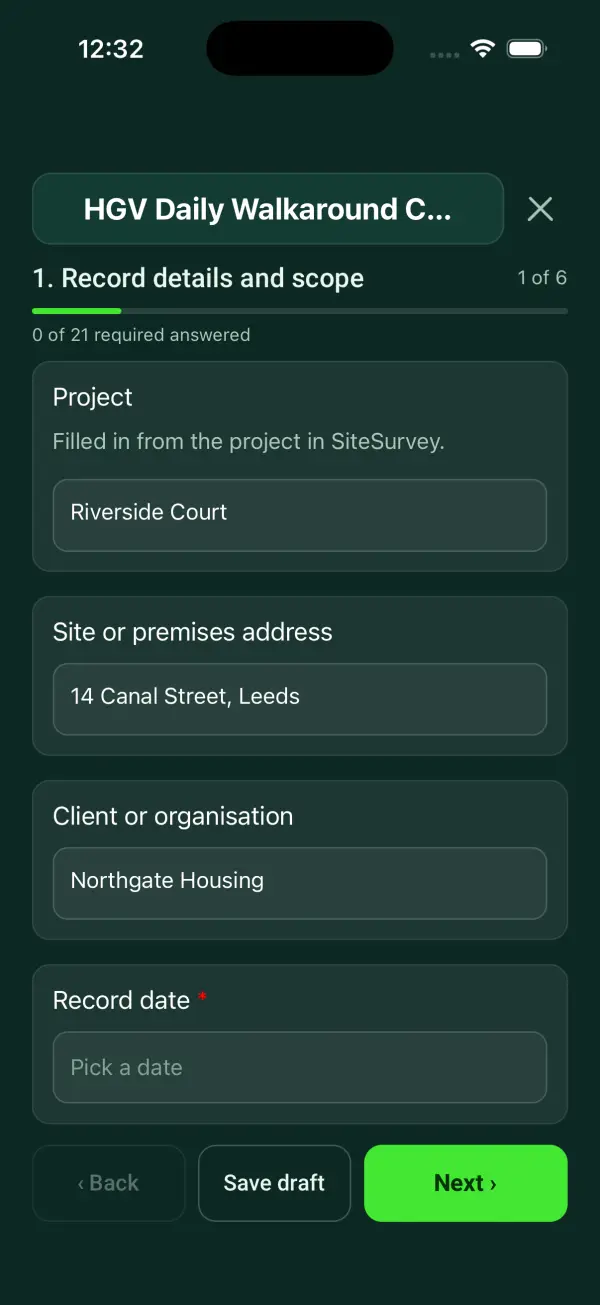
HGV daily check sheet
An HGV walkaround record covering vehicle and trailer identification, driver checks, defect reporting, restrictions and authorised rectification references.
6 sections52 questionsPhotosSignaturesSee every question → - Health and safety
Bus inspection: walkaround check
A bus and coach (PSV) daily walkaround check and defect report: the 29 DVSA checks from the driver's seat, inside and outside, tyre tread, each defect graded dangerous or not with photos, who it was reported to, and repair.
6 sections91 questionsPhotosSignaturesSee every question → - Health and safety
Trailer inspection checklist
A trailer walkaround record covering identification, coupling, braking connections, wheels, lights, bodywork, loading and defect reporting.
5 sections50 questionsPhotosSignaturesSee every question → - Health and safety
Vehicle inspection checklist
A daily vehicle inspection checklist and defect report for vans and cars: walkaround checks, mileage, tyre tread, photos of each side, defects graded safe or not to drive, and fleet sign-off.
4 sections68 questionsPhotosSignaturesSee every question → - Health and safety
Bicycle inspection checklist
A bicycle inspection for pool, hire and fleet bikes: each bike by fleet number with the M check of tyres, wheels, brakes, gears, steering and frame, lights and reflectors, defects with photos, and bikes taken out of use.
3 sections58 questionsPhotosSignaturesSee every question → - Health and safety
Loading unloading checklist
A loading and unloading readiness record covering vehicle position, segregation, load information, equipment, communication and controlled departure.
5 sections42 questionsPhotosSignaturesSee every question →



Warehouse, machinery and electrical checks 10
Inspections for racking, pallets, loading bays, conveyors and machine guards, plus statutory-style records for pressure systems and LEV, and everyday electrical and power tool checks.
- Health and safety
Warehouse safety checklist
A warehouse walk-through covering aisles, storage, pedestrian routes, loading areas, handling, emergency access and corrective actions.
5 sections61 questionsPhotosSignaturesSee every question → - Health and safety
Pallet racking inspection checklist
A pallet racking inspection: damage by aisle, bay and level with green, amber and red ratings, offload actions, general checks and the date of the last expert inspection.
4 sections67 questionsPhotosSignaturesSee every question → - Health and safety
Damaged pallets inspection checklist
A pallet inspection record: the stock or bay checked, each damaged pallet with its type, faults such as broken or missing boards, split blocks and protruding nails, the decision, photos, the withdrawn area and actions.
3 sections29 questionsPhotosSignaturesSee every question → - Health and safety
Dock leveller and loading bay inspection
A dock leveller and loading bay inspection: each bay's leveller, lip, hydraulics, toe guards, dock shelter and door, vehicle restraint or chocks, lights and signals, bumpers, markings, result and photos.
3 sections46 questionsPhotosSignaturesSee every question → - Health and safety
Conveyor belt inspection checklist
A belt conveyor inspection: whether it was running or isolated, belt surface, edges, tracking and joints, rollers and drums, spillage, guards, pull cords and emergency stops, result, photos and repair actions.
3 sections54 questionsPhotosSignaturesSee every question → - Health and safety
Machine guarding checklist
A machine guarding record covering guard identity, visible condition, approved interlock checks, access risks, defects and restrictions on machine use.
6 sections45 questionsPhotosSignaturesSee every question → - Health and safety
Pressure system inspection record
A pressure system examination record under PSSR: the written scheme, each item with its safe operating limit, protective devices, condition, repairs and dates, the next examination and the competent person's report.
3 sections52 questionsPhotosSignaturesSee every question → - Health and safety
LEV inspection checklist and test report
The LEV examiner's thorough examination and test record under COSHH reg 9, laid out along HSE HSG258: client and site, information used, then each LEV system by area with process and substance, hood type, Schedule 4 interval, visual and structural checks, face, capture and duct velocity and static pressure readings against the design values you enter with pass or fail, smoke and dust lamp tests with photos, operator use, repairs, defects, result and label per system, the next due date, actions and signatures.
4 sections99 questionsPhotosSignaturesSee every question → - Health and safety
Electrical safety checklist
A visual workplace electrical safety inspection for offices, factories, warehouses and schools: each area with its distribution boards and panels (label scan, access, cover, circuit chart, heat marks, RCD or GFCI test buttons), sockets and adaptors, extension leads, portable equipment, cables, wet areas and isolation, the last fixed installation inspection with a due date warning, and findings with priority, owner and date. Written for the Electricity at Work Regulations 1989 and OSHA 1910 subpart S. Not a test certificate.
4 sections103 questionsPhotosSignaturesSee every question → - Health and safety
Power tool inspection checklist
A condition inspection of hand-held power tools on site, for US OSHA 29 CFR 1926 subpart I or GB PUWER 1998: each tool by location with its ID and rating plate, type and power source, the checks for that type (guards, discs and blades against the tool markings, switches, cords, batteries, hoses, powder-actuated tool daily test), the result, the tag and where it went, with counts of tools OK, for repair and withdrawn.
3 sections94 questionsPhotosSignaturesSee every question →






First aid, PPE and incident reporting 10
Checks on first aid kits, eyewash stations, emergency showers, AEDs and PPE, and the forms you reach for after something happens: incident reports, accident investigations, hazard reports and safety observations.
- Health and safety
First aid kit checklist
Check of a first aid box against its contents list: each item present and in date, expiry dates, restocking, the box itself and the next check date.
3 sections35 questionsPhotosSignaturesSee every question → - Health and safety
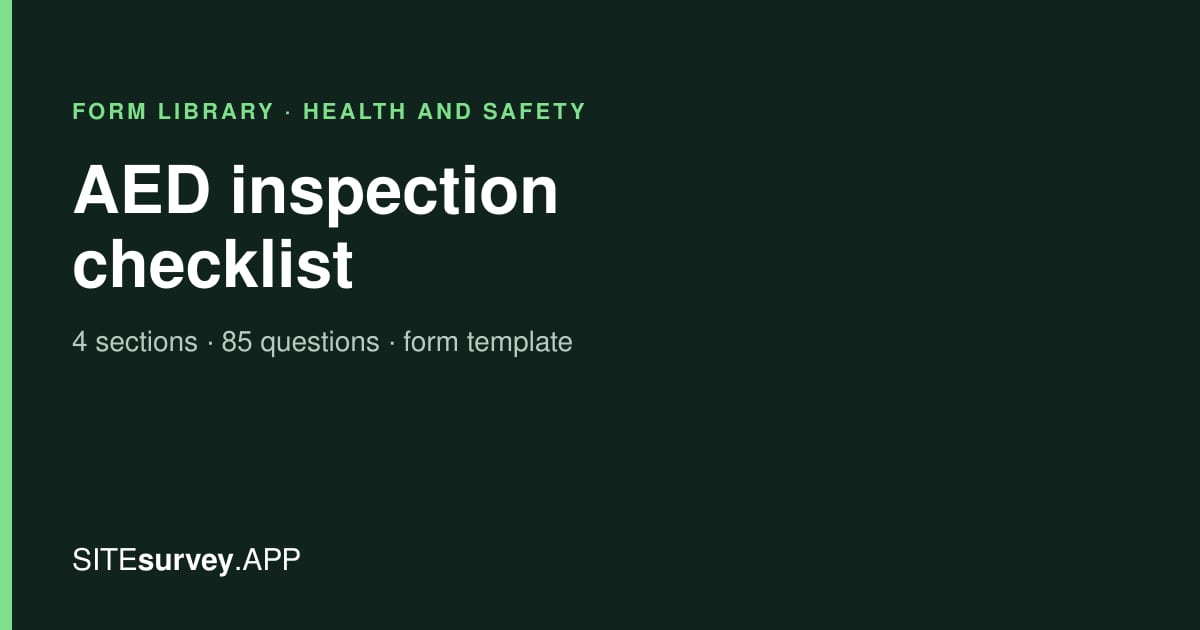
AED inspection checklist
A routine check of every automated external defibrillator (AED) on a site. Each location is a space and each AED in it an item: ID and label scan (make, model, serial, UDI), position and sign, cabinet and alarm, status indicator, visible damage, pads sealed, pad and battery or cartridge expiry with days to expiry against your own warning period, paediatric pads or key, rescue kit, recall and software notices, and whether it stays in service. Then use since the last check, spares, registration, actions and sign-off. The maker's instructions set the checks and how often.
4 sections85 questionsPhotosSignaturesSee every question → - Health and safety
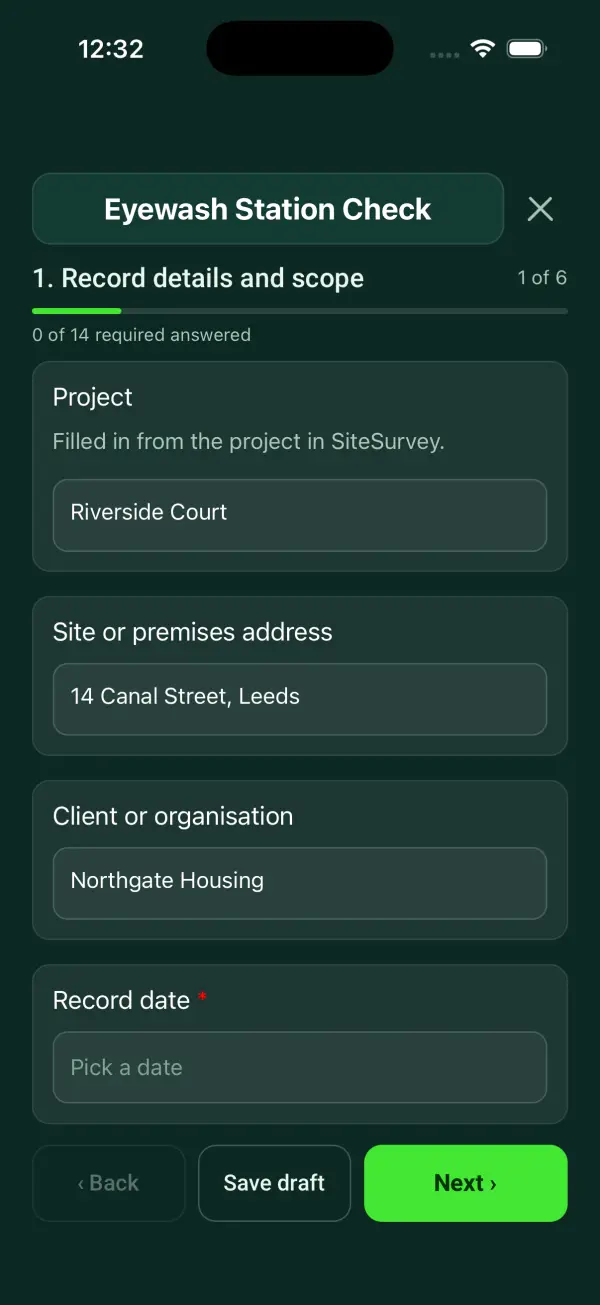
Eyewash station checklist
An eyewash readiness record covering station identity, access, equipment condition, fluid dates, authorised checks and arrangements for defects.
6 sections42 questionsPhotosSignaturesSee every question → - Health and safety
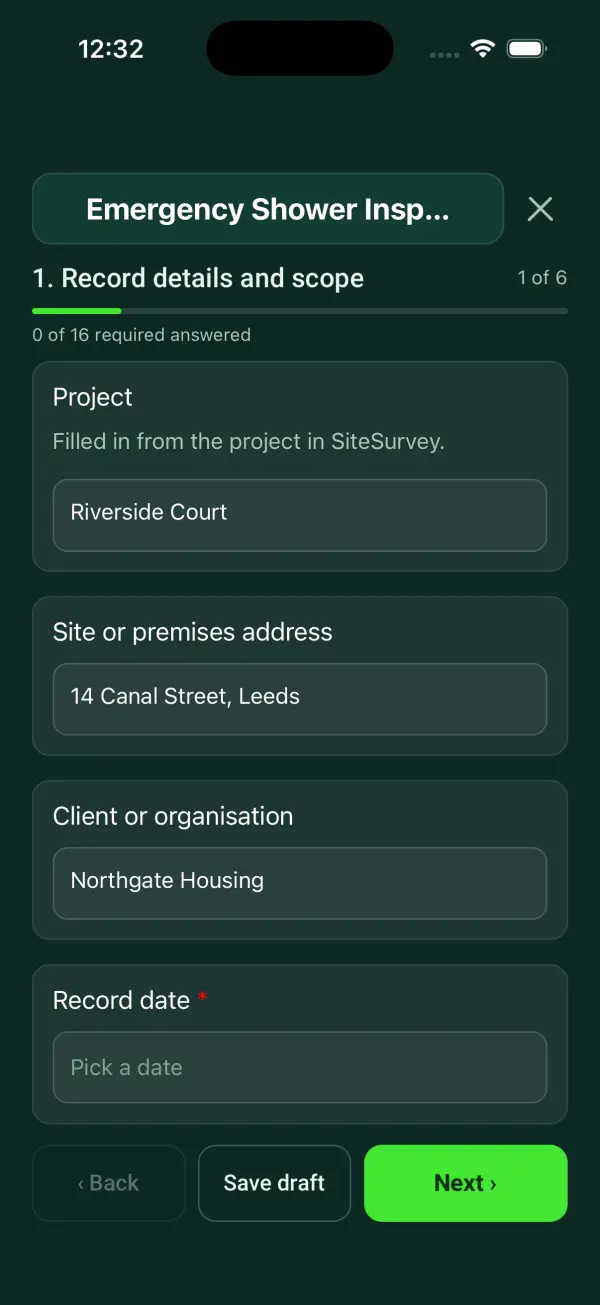
Emergency shower inspection checklist
An emergency shower readiness record covering station access, condition, approved test results, water-supply concerns, defects and follow-up actions.
6 sections52 questionsPhotosSignaturesSee every question → - Health and safety
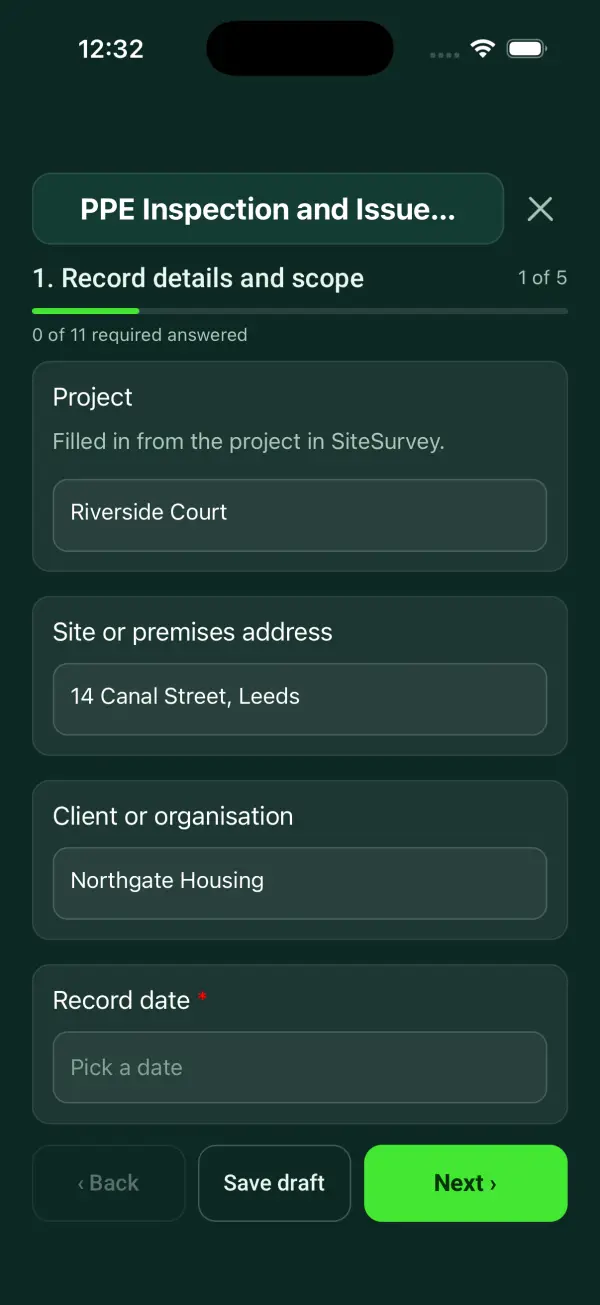
PPE inspection checklist
A record of PPE selection, issue, condition, wearer instruction, defects and replacements, with item-level photos and acknowledgement.
5 sections40 questionsPhotosSignaturesSee every question → - Health and safety
Sharps disposal record
A record of needles and sharps found on site: where and what was found, how it was made safe and disposed of, any needlestick injury and the first aid and medical advice given, and follow-up actions.
4 sections30 questionsPhotosSignaturesSee every question → - Health and safety
Incident report template
Record an accident, injury, near miss, dangerous occurrence, ill health or damage, with people involved, witness statements, RIDDOR checks, investigation and actions.
7 sections96 questionsPhotosSignaturesSee every question → - Health and safety
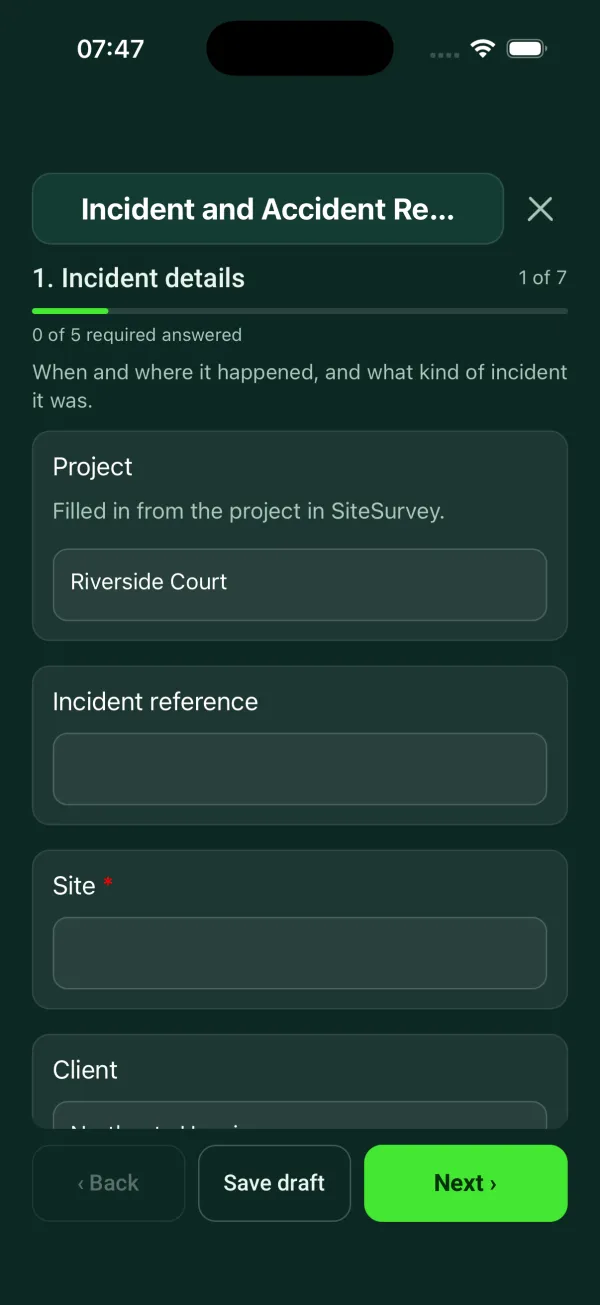
Accident investigation form
An accident investigation form for the follow-up after a significant accident, near miss or dangerous occurrence: the original incident report reference, the investigation team and level, scene examination with GPS, photos, measurements (measure from photo as an estimate), equipment and Walk Cam film, evidence gathered and who holds it, witness interviews, a timed sequence of events, immediate, underlying and root causes with your own method (5 whys or similar), the risk assessment review, RIDDOR (UK) or OSHA (US) reporting status with deadline checks, corrective and preventive actions with owner, due date and verification, lessons shared and two signatures.
6 sections106 questionsPhotosSignaturesSee every question → - Health and safety
Hazard report form
A hazard report form anyone can fill in, in any workplace: date, time and place with GPS, with or without the reporter's name, the kind of hazard, a description and photos, who could be harmed, what was done straight away, how serious it seems on your own low, medium or high scale, and what would fix it. The manager records what they found, the risk and the risk assessment, actions with an owner and due date, and the feedback given to the reporter. An optional hazard identification walk-round checks each area for common workplace hazards, from trip hazards and stairs to fire exits and chemicals.
5 sections88 questionsPhotosSignaturesSee every question → - Health and safety
Safety observation report
A safety observation report for construction sites, raised by anyone on site: observer and role, date, time and place with GPS, the company and trade observed, the category (PPE, work at height, housekeeping, plant, electrical, excavation, lifting, behaviour, welfare, environment or other), the type (at-risk condition, at-risk act, safe act or good practice), what was seen with photos, what was done straight away, the potential severity on the site's own low, medium or high scale, why it happened, follow-up actions with an owner and due date, and close-out with evidence and two signatures.
4 sections54 questionsPhotosSignaturesSee every question →



Site safety, audits and inductions 10
The routine paperwork of a safe site: inductions, toolbox talks, safety meetings, site and excavation inspections, audits, emergency plans, contractor vetting and your written health and safety policy.
- Health and safety
Construction site safety checklist
Construction site safety walk: perimeter, work at height, welfare, housekeeping, plant, hazards and actions.
8 sections92 questionsPhotosSignaturesSee every question → - Health and safety
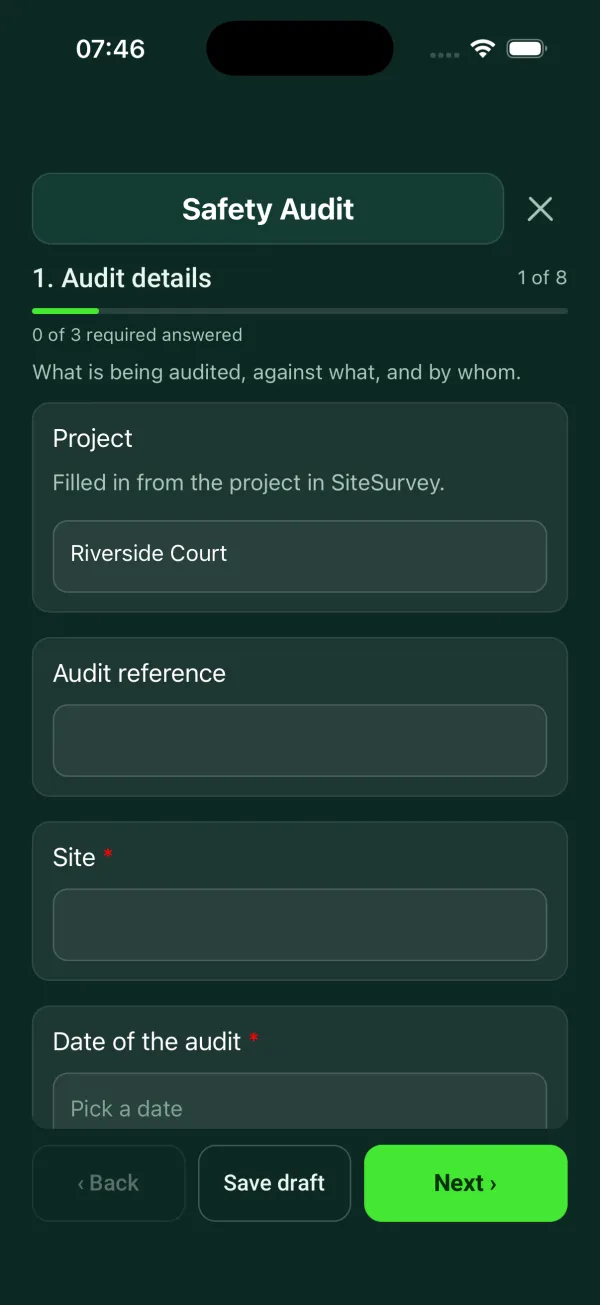
Safety audit checklist
Workplace audit with walkways, first aid, fire equipment and records, findings and corrective actions, closing meeting.
8 sections119 questionsPhotosSignaturesSee every question → - Health and safety
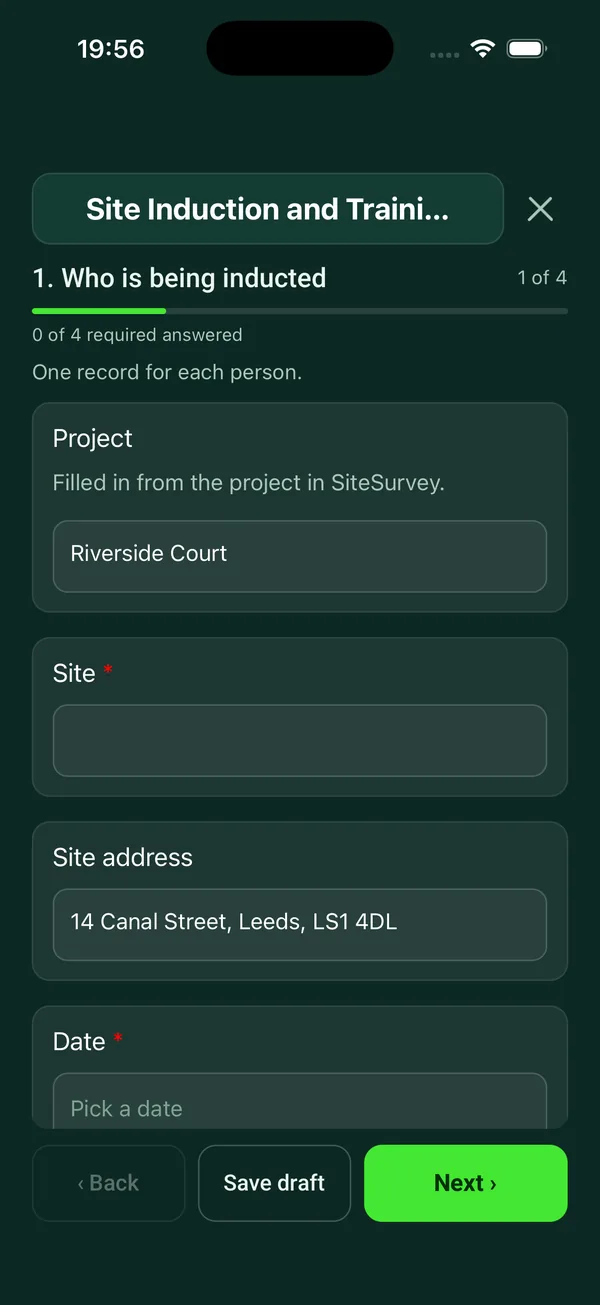
Site induction form
Site induction for a worker, contractor or new starter: topics covered, competence cards and training with expiry dates, PPE issued, questions and signatures.
4 sections31 questionsPhotosSignaturesSee every question → - Health and safety
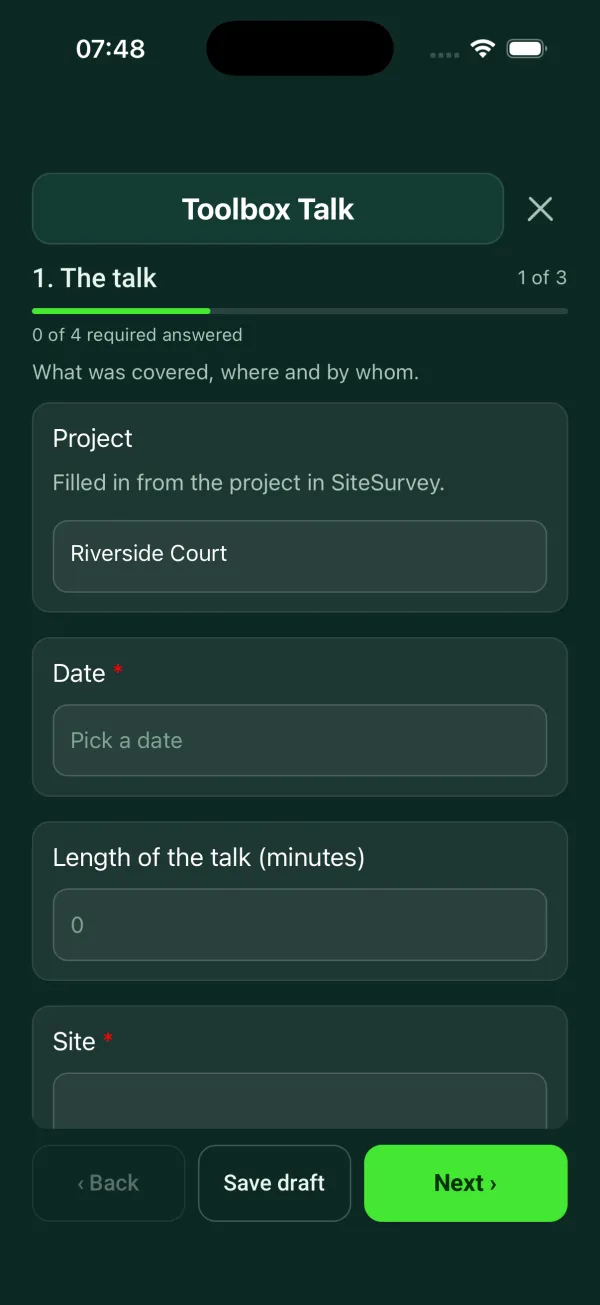
Toolbox talk template
Record a toolbox talk: topic, key points, attendees with signatures.
3 sections23 questionsPhotosSignaturesSee every question → - Health and safety
Safety meeting sign in sheet and minutes
A site safety meeting record with a sign-in sheet: meeting details and chair, the topics covered, incidents and near misses reviewed since the last meeting, site inspection findings, hazards raised by workers with an action, owner and due date, the attendance sign-in with a count, the language used and any interpreter, actions and the next meeting. The sign-in records attendance only, not training.
7 sections89 questionsPhotosSignaturesSee every question → - Health and safety
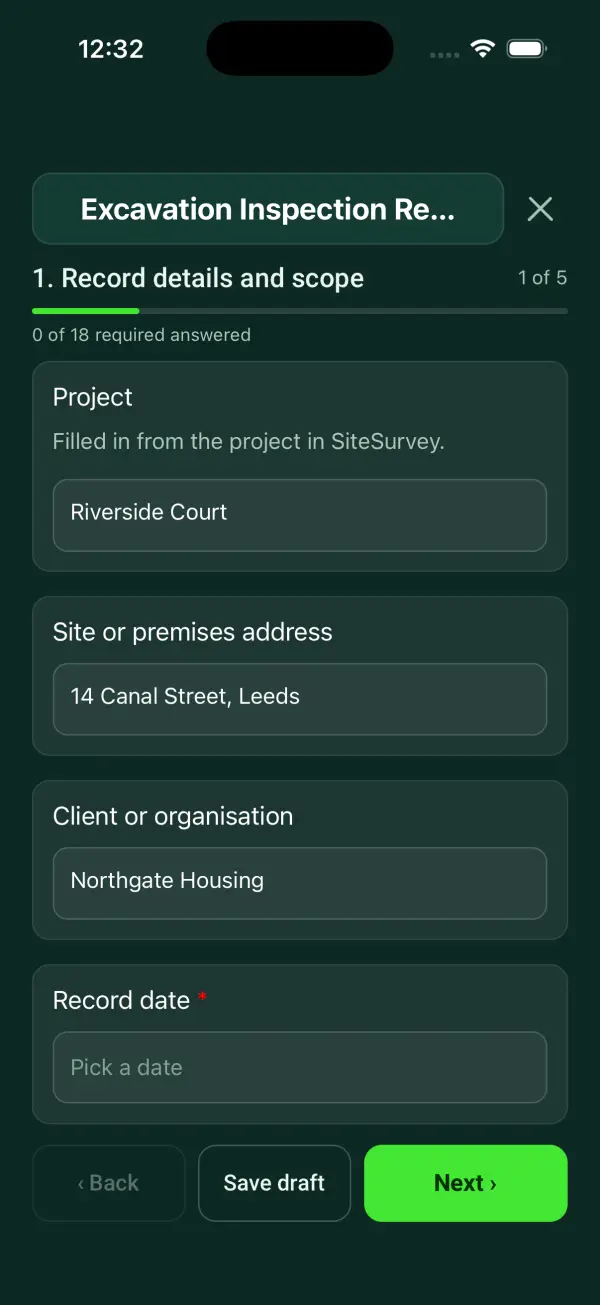
Excavation inspection checklist
An excavation inspection record with scope, shift or event trigger, ground and support observations, hazards, actions and competent inspector details.
5 sections55 questionsPhotosSignaturesSee every question → - Health and safety
Emergency action plan for construction sites
An emergency action plan for one construction site: site and access points with GPS, emergency contacts and the location to give the dispatcher, how the alarm is raised and what each signal means, evacuation routes and muster points with GPS and photos, critical operations before leaving, roll call, the emergencies covered (fire, medical, structural collapse, trench collapse, utility strike, severe weather, hazardous release) with what to do and who leads, rescue arrangements, the nearest hospital and directions, first aid and AED points, plan reviews, a drill log with time to muster and lessons, actions and sign-off. Written around 29 CFR 1926.35 and 1926.50, with the CDM 2015 regulation 30 and 31 points for Great Britain.
10 sections148 questionsPhotosSignaturesSee every question → - Health and safety
Subcontractor prequalification form
A subcontractor prequalification form for main contractors: company details, trade and scope, insurance with limits, certificates and days to expiry (flagged within 30 days), licences and how each was checked, health and safety documents and statistics (OSHA 300A and EMR for US work, RIDDOR and enforcement for UK work), quality, environment, references, financial figures, weighted section scores against your own pass marks, and a decision with conditions and a review date.
9 sections160 questionsPhotosSignaturesSee every question → - Health and safety
Health and safety policy template
A health and safety policy for a business in Great Britain, in the three parts HSE describes: a statement of intent signed by the most senior person, responsibilities with names, positions and roles, and the arrangements by topic (risk assessment, consultation, training, first aid, accidents and RIDDOR, fire and emergencies, equipment, COSHH, work at height, display screen equipment, lone working, contractors and visitors, welfare, monitoring) with who, how, where the record is kept, status and a review date. Then the review history, how it was brought to employees' notice, gaps as actions and sign-off. Notes cite section 2(3) of the Health and Safety at Work etc. Act 1974 and the exception for fewer than five employees.
6 sections76 questionsPhotosSignaturesSee every question → - Health and safety
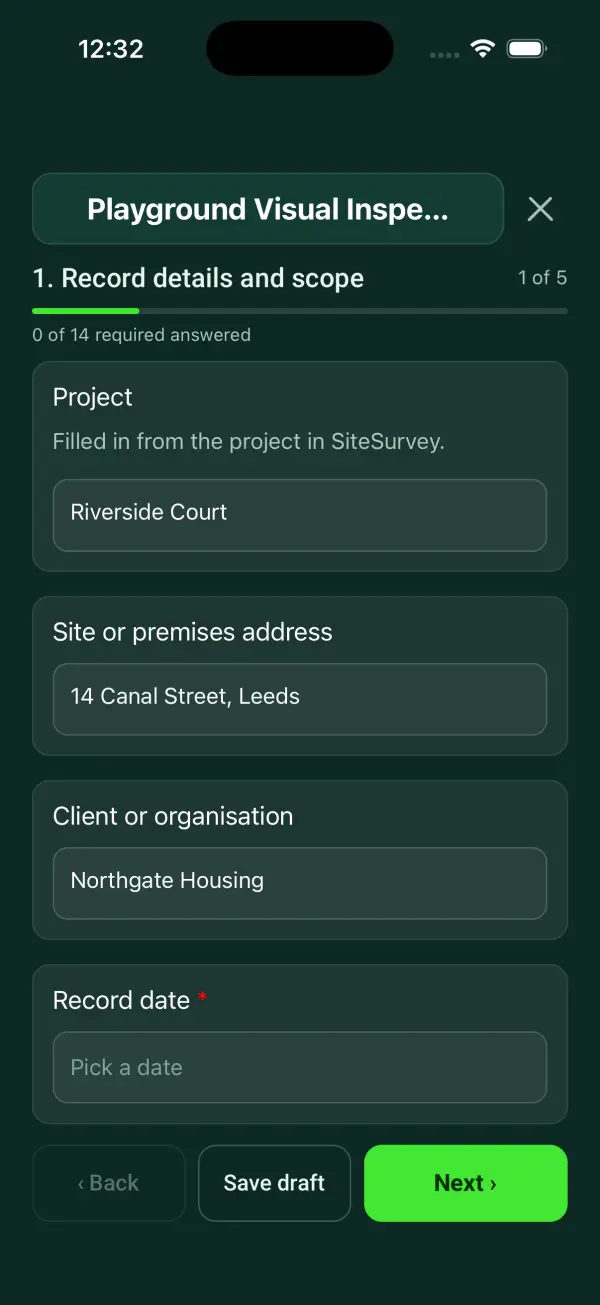
Playground inspection checklist
A routine playground visual inspection: area checks, then each item pinned by GPS with its fall height measured from a photo against the surfacing's rated critical fall height, loose-fill depth against the minimum, restrictions and repair follow-up, with counts.
5 sections55 questionsPhotosSignaturesSee every question →



US, Canada, Australia and Ireland formats 14
Forms laid out the way other countries expect them: JHA and OSHA-style written programs for the US, FLHA for Canada, SWMS for Australia and the safety statement for Ireland.
- Health and safety
Job hazard analysis (JHA) and job safety analysis (JSA) template
A job hazard analysis, also called a job safety analysis: each step of the job with its hazards and controls, PPE, permits, emergency plan, crew sign-on and review. Written for US work to OSHA guidance, with an Activity Hazard Analysis mode for USACE EM 385-1-1 contracts.
7 sections89 questionsPhotosSignaturesSee every question → - Health and safety
Site-specific safety plan template
A written site-specific safety plan for one US construction job: project and contacts, competent persons by topic, each site hazard (falls, excavations, electrical, struck-by, caught-in, cranes, scaffolds, silica, heat, hazardous materials) with its controls, the programs it relies on, orientation and training, PPE, inspections with the frequencies you set, incident reporting and OSHA recordkeeping, subcontractor requirements, emergency information with the nearest hospital, actions and sign-off, and a worker acknowledgement.
12 sections153 questionsPhotosSignaturesSee every question → - Health and safety
Fall protection plan template
A US construction fall protection plan under OSHA subpart M: each work area at height with its height, edge and the protection chosen (guardrails, nets, personal fall arrest, covers, warning lines, safety monitoring, controlled access zones) with checks, anchorage points with their rated strength, the rescue plan, the training certification record and equipment inspections. Adds the 1926.502(k) written plan for leading edge, precast and residential work where conventional protection is infeasible.
7 sections141 questionsPhotosSignaturesSee every question → - Health and safety
Emergency action plan template
An emergency action plan for one workplace building (office, warehouse, factory, retail store, clinic or school): the workplace and who is in it, how a fire or other emergency is reported, the alarm and what each signal means, the plan contact and emergency contacts, each floor or area as a space with its exits, assigned route and checks, assembly points with GPS and photos, critical operations before leaving, evacuation wardens, people who need help to evacuate (by reference), accounting for everyone, the emergencies covered (fire, medical, severe weather or tornado, active threat, chemical release, utility failure, bomb threat, flood) with what to do and who leads, rescue and medical duties, plan reviews and a drill log, actions and sign-off. Written around 29 CFR 1910.38 and 1910.165, with MHSWR 1999 regulations 8 and 9 for Great Britain.
9 sections157 questionsPhotosSignaturesSee every question → - Health and safety
PPE hazard assessment form
A US workplace PPE hazard assessment under OSHA 29 CFR 1910.132(d): each area or task with a walk-through of hazard sources, hazards by body area (eyes and face, head, hands, feet, body, hearing, respiratory) with the source, the PPE selected and whether it was worn, fit and communication checks, the written certification of hazard assessment, the PPE training record under 1910.132(f) and actions.
5 sections97 questionsPhotosSignaturesSee every question → - Health and safety
Hearing conservation program template
A US hearing conservation program record under OSHA 29 CFR 1910.95: noise monitoring by area and job against the 85 dBA action level and the 90 dBA Table G-16 limit, results given to employees, hearing protectors with an Appendix B estimate of the level under them, each employee in the program with baseline and most recent audiogram dates and days since, standard threshold shift follow-up, protectors offered, training sessions, records and actions.
6 sections127 questionsPhotosSignaturesSee every question → - Health and safety
Respiratory protection program template
A US written respiratory protection program under OSHA 29 CFR 1910.134: program administrator, PLHCP and voluntary use, work areas with contaminants, exposure estimates and the respirators used (NIOSH approval, ESLI or your cartridge change schedule and its basis, Grade D air for supplied air), wearers with medical evaluation and fit test dates and days since, fit test results, an inspection log, program evaluation, training topics, records and actions.
6 sections138 questionsPhotosSignaturesSee every question → - Health and safety
Silica exposure control plan template
A US written exposure control plan for respirable crystalline silica under OSHA 29 CFR 1926.1153(g): each task with its equipment and either the Table 1 entry used or the exposure assessment result against the action level and PEL, the controls and respirators for each task, housekeeping, access restriction, the competent person with a dated inspection log, the medical surveillance trigger, training and the annual review.
6 sections107 questionsPhotosSignaturesSee every question → - Health and safety
Heat illness prevention plan template
A written heat illness prevention plan for a California site under title 8 section 3395 (and 3396 for indoor work): water with the quantity worked out, shade and cool-down rests, high-heat procedures at 95°F, acclimatization, emergency response with directions to the site, a training record, then a daily heat log and a record of each cool-down rest.
9 sections109 questionsPhotosSignaturesSee every question → - Health and safety
Workplace violence prevention plan template
A written workplace violence prevention plan for one workplace, built on the elements of California Labor Code section 6401.9 (SB 553): people responsible, employee involvement, coordination with other employers, reporting and no retaliation, communication, emergency response, training with training records, hazard inspection records for each work area, correcting hazards, the violent incident log with the fields the law lists and no personal identifying information, post-incident investigation, plan review, actions and sign-off.
8 sections111 questionsPhotosSignaturesSee every question → - Health and safety
Extension cord inspection checklist
A US construction site record of temporary power under OSHA 29 CFR 1926.404(b)(1): the GFCI or assured equipment grounding conductor program choice, each temporary panel and spider box with its GFCIs tested, then every cord, cord set and cord-and-plug tool by area with the visual check, continuity and grounding terminal tests, the color or tag for the period if you use one, and the count of cords removed from service.
4 sections109 questionsPhotosSignaturesSee every question → - Health and safety
Field level hazard assessment (FLHA) form
A field level hazard assessment card for the start of a shift or task: the task, the hazards present today, controls, PPE, crew sign-on, re-assessment when conditions change and end-of-shift close-out. Written for Canadian work sites, following the Alberta OHS Code hazard assessment rules.
2 sections37 questionsPhotosSignaturesSee every question → - Health and safety
SWMS template (safe work method statement)
A SWMS for high risk construction work in Australia: the 18 types of high risk construction work to tick, each task with its hazards, control measures and who monitors them, licences, PPE, emergency, worker consultation and sign-on, and review. Written to the model WHS Regulations 2011.
7 sections68 questionsPhotosSignaturesSee every question → - Health and safety
Safety statement template (Ireland)
A safety statement for employers in Ireland under section 20 of the Safety, Health and Welfare at Work Act 2005: policy, the section 19 risk assessment rated Low, Medium or High, protective and preventive measures, emergency plans, named responsible people, consultation and the safety representative, how it is brought to employees’ attention, and review. Optional construction section with the PSDP, PSCS, Safe Pass and Safe System of Work Plans.
10 sections116 questionsPhotosSignaturesSee every question →









Smart fields
Smart fields in these health and safety forms
These forms do more than tick boxes. Each field type below is already built into the forms listed, and you can add it to any form you edit.
Calculated tiles
Totals, scores and pass rates work themselves out as you fill the form in, shown as live tiles.
In 93 forms, including construction site safety checklist, risk assessment template and working at height risk assessment template.
How calculated fields work →GPS location
One tap fills in latitude, longitude, OS grid reference and accuracy.
In 56 forms, including construction site safety checklist, method statement template and incident report template.
How GPS location works →Walk Cam
A guided video route: one short clip per inspection point, with live voice-to-text into the answer.
In 36 forms, including construction site safety checklist, risk assessment template and safety audit checklist.
How Walk Cam works →Label scanner
Scan equipment labels, serial numbers and barcodes straight into the form.
In 29 forms, including crane inspection checklist, MEWP inspection checklist and lifting accessories inspection checklist.
How the label scanner works →Size from photo
Tap a known reference and the thing you are measuring in one photo, and the height or width fills in.
In 22 forms, including construction site safety checklist, working at height risk assessment template and method statement template.
How size from photo works →Rooms as spaces
Add a room, area or item as many times as you need, and each one becomes its own space with its photos and answers.
In 22 forms, including event risk assessment template, nursery risk assessment template and LOLER inspection checklist.
How rooms become spaces →Products and assets
Each asset you list on the form is saved as a product in its space, so the next visit starts from the same list.
In 12 forms, including LOLER inspection checklist, pressure system inspection record and roof anchor and eyebolt inspection.
How products and assets work →AI inspector
Film a Walk Cam point and the AI suggests pass, fail or cannot assess, with the defect boxed on a still. You confirm it.
In 1 form, including ladder inspection checklist.
How the AI inspector works →
Guide
What is a health and safety form?
A health and safety form is the written record that a hazard was looked at, a check was done or a job was planned before anyone started it. In practice that covers four kinds of document: risk assessments (what could go wrong and what you are doing about it), safe systems of work such as RAMS and permits to work, equipment inspections, and records of what happened, such as an incident report.
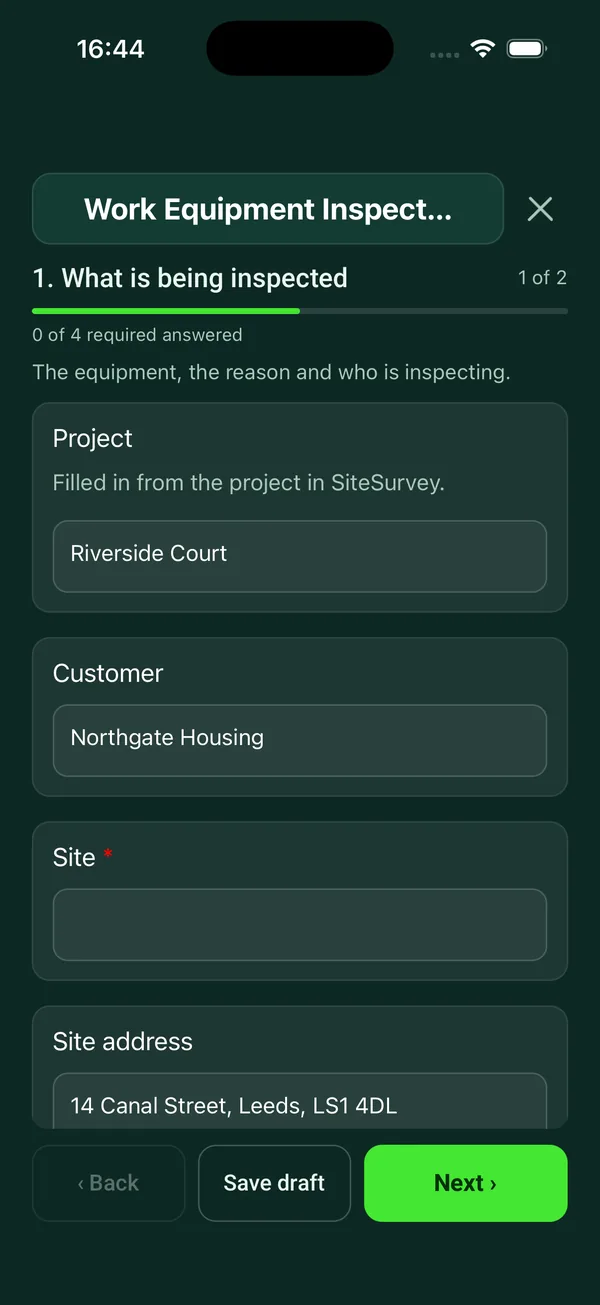
The forms on this page are working forms, built to be filled in on site on a phone or tablet rather than typed up later. Each one captures photos (with annotation), readings, notes and signatures, and each completed form becomes a branded PDF report you can send to a client, a principal contractor or your own safety manager.
If your work is mainly fire safety or building handover, look at the fire safety forms and construction and handover forms as well, since some site checks sit across both. Teams outside the UK will find local formats too, such as the safety statement Irish employers must keep, the Australian SWMS and the US job hazard analysis.
Sources: Irish Statute Book: Safety, Health and Welfare at Work Act 2005, section 20 and HSA (Ireland): Safety statement and risk assessment.
Which health and safety records are a legal requirement in the UK?
Very few UK health and safety laws tell you to use a particular form, but many tell you to assess, inspect or examine something and keep a record. The main ones behind the forms in this category are:
- Risk assessment
- The Management of Health and Safety at Work Regulations 1999 require every employer to make a suitable and sufficient assessment of risks to employees and others. If you employ 5 or more people you must record the significant findings. Start with the risk assessment template.
- Health and safety policy
- If you have 5 or more employees your policy must be written down. The health and safety policy template sets out who does what.
- Hazardous substances
- COSHH requires an assessment of the risks from hazardous substances you use or create. Use the COSHH assessment template.
- Pregnant workers
- You must carry out an individual risk assessment for workers who are pregnant, have given birth in the last 6 months or are breastfeeding. See the pregnancy risk assessment.
- Screen users
- Workers who use DSE daily for an hour or more at a time need a workstation assessment, which the DSE assessment covers.
- First aid
- Employers should assess their first aid needs to decide what to provide. Record it on the first aid needs assessment.
- Construction sites
- Under CDM 2015 the principal contractor must prepare a written construction phase plan and make sure every worker has a site-specific induction. The site induction form records who was inducted and when.
Sources: legislation.gov.uk: Management of Health and Safety at Work Regulations 1999, regulation 3, HSE: Steps needed to manage risk, HSE: Health and safety policy, HSE: How to carry out a COSHH risk assessment, HSE: Protecting pregnant workers and new mothers, HSE: DSE workstations and assessment, HSE: First aid legislation and HSE: CDM 2015, principal contractors.
How often do lifting, access and work equipment need inspecting?
Inspection frequencies are where most teams get caught out, because different regulations set different clocks. These are the intervals written into UK law, and your own risk assessment or the manufacturer may ask for more frequent checks.
- Every 6 months
- LOLER requires a thorough examination of lifting equipment for lifting people, and of every lifting accessory (slings, shackles, eyebolts), at least every 6 months. That covers MEWPs, scissor lifts, passenger hoists and lifting accessories.
- Every 12 months
- Other lifting equipment, such as cranes and goods hoists, needs a thorough examination at least every 12 months, unless an examination scheme sets a different interval. Record it on the LOLER inspection checklist.
- Every 7 days
- A scaffold used for construction work, where someone could fall 2 metres or more, must be inspected after it is put up and then every 7 days, with the result recorded. Use the scaffold inspection checklist.
- Every shift
- A competent person should inspect excavation supports or battering at the start of each shift. The excavation inspection checklist gives that check a record.
- Every 14 months
- Local exhaust ventilation should have a thorough examination and test at least every 14 months, and the record kept for at least 5 years. See the LEV inspection checklist.
- At suitable intervals
- PUWER requires work equipment exposed to conditions that cause deterioration to be inspected at suitable intervals and after anything exceptional, with the result recorded. That is the basis for daily checks such as the forklift inspection checklist and telehandler checklist.
Sources: legislation.gov.uk: LOLER 1998, regulation 9 (thorough examination), HSE: LOLER, HSE: Scaffolding, legislation.gov.uk: Work at Height Regulations 2005, regulation 12, HSE: Excavations, HSE: LEV frequently asked questions and legislation.gov.uk: PUWER 1998, regulation 6 (inspection).
What a good risk assessment or RAMS records
A risk assessment that will stand up to a client review or an HSE visit names the specific task and location, the hazards, who could be harmed and how, the controls already in place, any further action with a named owner and a date, and who carried out the assessment. Generic wording such as "take care" or "use common sense" is the most common weakness: say which barrier, which PPE, which permit.
A method statement then turns those controls into a sequence of steps for the crew. Put together, the two make RAMS. For work where a mistake could be fatal, such as hot works, confined space entry, digging near services or isolation of machinery, a permit adds a formal authorisation, a time limit and a hand-back. HSE describes a permit to work as part of a safe system of work, not a replacement for a risk assessment.
Rescue is the gap that shows up most often. If people are working at height or in a confined space, write the rescue plan before work starts using the working at height rescue plan or confined space rescue plan, rather than relying on calling the emergency services.
Sources: HSE: Steps needed to manage risk and HSE: Permit to work systems.
How to run a site safety inspection
Walk the site with the form open on your phone, in the same order each time, so nothing gets skipped. The construction site safety checklist and safety audit checklist are laid out by area: access and welfare, housekeeping, work at height, plant, electrics, fire and first aid.
Take a photo of every failed item and annotate it so the person fixing it knows exactly what you saw. Add an action, an owner and a date, then capture signatures from the site manager before you leave. Because the app works offline, you can finish the inspection in a basement or on a remote site and it syncs when you are back in signal.
Pair inspections with the conversation. A toolbox talk or safety meeting record is a simple way to show you have consulted workers on the risks they face, which UK employers are required to do. Encourage the crew to raise a hazard report or safety observation between inspections too.
After an incident: reports, investigations and RIDDOR
Record every accident and near miss, however minor, on an incident report while the details are fresh: what happened, where, who was involved, injuries, witnesses and photos of the scene. For anything serious, follow up with an accident investigation that looks for the underlying cause and the actions that will stop it happening again.
Some incidents must also be reported to HSE under RIDDOR, including deaths, specified injuries, dangerous occurrences and injuries that leave a worker unable to do their normal work for more than 7 consecutive days after the day of the accident. Your form is your evidence; the RIDDOR report itself is made to HSE separately.
Sources: HSE: RIDDOR and HSE: RIDDOR key definitions.
Facts checked by the SiteSurvey team, 27 October 2026.
Health and safety forms FAQs
Do I need to write down my risk assessment?
If you employ 5 or more people, yes: you must record the significant findings, including the hazards, who might be harmed and the controls. With fewer employees you still have to assess the risks, and writing it down is the easiest way to show you did.
Source: HSE: Steps needed to manage risk.
What is the difference between a risk assessment and a method statement?
A risk assessment identifies hazards and decides on controls. A method statement describes, step by step, how the job will be done safely using those controls. Together they are often called RAMS, and the RAMS template holds both in one document.
Does PAT testing have to be done every year?
No. HSE says the Electricity at Work Regulations 1989 do not make annual testing a legal requirement; the frequency depends on the type of equipment and where it is used. Regular visual checks, recorded on a form such as the electrical safety checklist, catch most faults.
Source: HSE: Portable appliance testing FAQs.
How often should forklifts be checked?
Do a pre-use check at the start of each shift so damage is found before the truck is used. A forklift is also lifting equipment, so it needs a thorough examination at least every 12 months under LOLER, or every 6 months if it lifts people or under an examination scheme.
Sources: legislation.gov.uk: LOLER 1998, regulation 9 (thorough examination) and legislation.gov.uk: PUWER 1998, regulation 6 (inspection).
What are the noise action values for a noise risk assessment?
The lower exposure action value is a daily or weekly exposure of 80 dB(A), where you must assess the risk and give information and training. At the upper value of 85 dB(A) you must provide hearing protection and hearing protection zones. Record this on the noise risk assessment.
What should a stress risk assessment cover?
HSE groups the causes of work-related stress into six areas: demands, control, support, relationships, role and change. The stress risk assessment works through each one with the team.
Source: HSE: Causes of stress at work.
Do HGV drivers have to do a daily walkaround check?
Daily checks before a vehicle is used are part of keeping HGVs and buses roadworthy, and the DVSA's roadworthiness guide covers daily checks and how to record and report defects. The HGV daily check sheet and bus walkaround check follow that pattern.
Who needs a Martyn's Law checklist?
The Terrorism (Protection of Premises) Act 2025 applies to qualifying premises where 200 or more people may be present at the same time, with further duties at 800 or more. The Martyn's Law checklist helps you work out your tier and record your procedures.
Source: GOV.UK: Terrorism (Protection of Premises) Act 2025, scope (premises) factsheet.
Other categories
Put these forms in your team's hands
Works on iPhone, iPad and Android, offline on site, with every completed form turned into a branded PDF report.
Start your trial →