Form library
Fire safety inspection forms
Fire door inspections, fire safety checks and fire risk forms for responsible persons, landlords and fire contractors. See every question, try the live form, then use it in SiteSurvey.
Most used
Start with the most used fire safety forms
All fire safety forms by type
Search by name or topic, or jump to a type. Open any form to see every question and try it live.
18 forms
Fire risk assessment and evacuation planning 6
The assessment that every other fire check hangs off, plus the plans for getting people out: evacuation plans, PEEPs and the walk-rounds fire wardens and HMO managers do between assessments.
- Fire safety
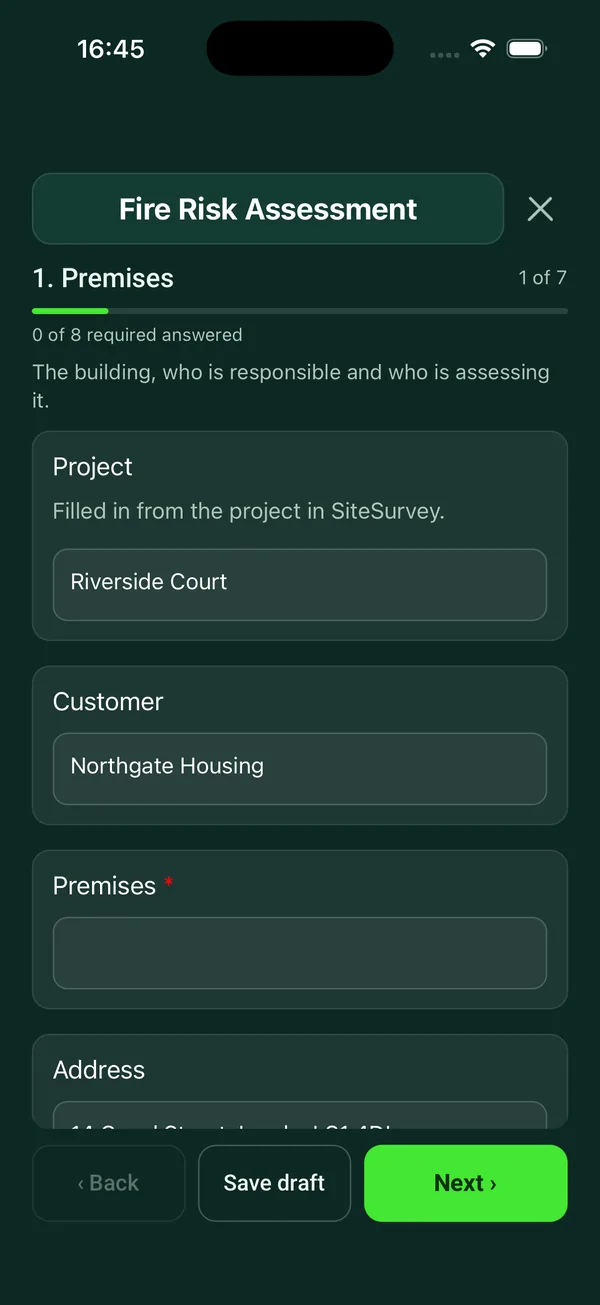
Fire risk assessment template
Fire risk assessment following the five steps in GOV.UK guidance: hazards, people at risk, fire precautions, emergency plan and training, findings with actions and review.
7 sections89 questionsPhotosSignaturesSee every question → - Fire safety
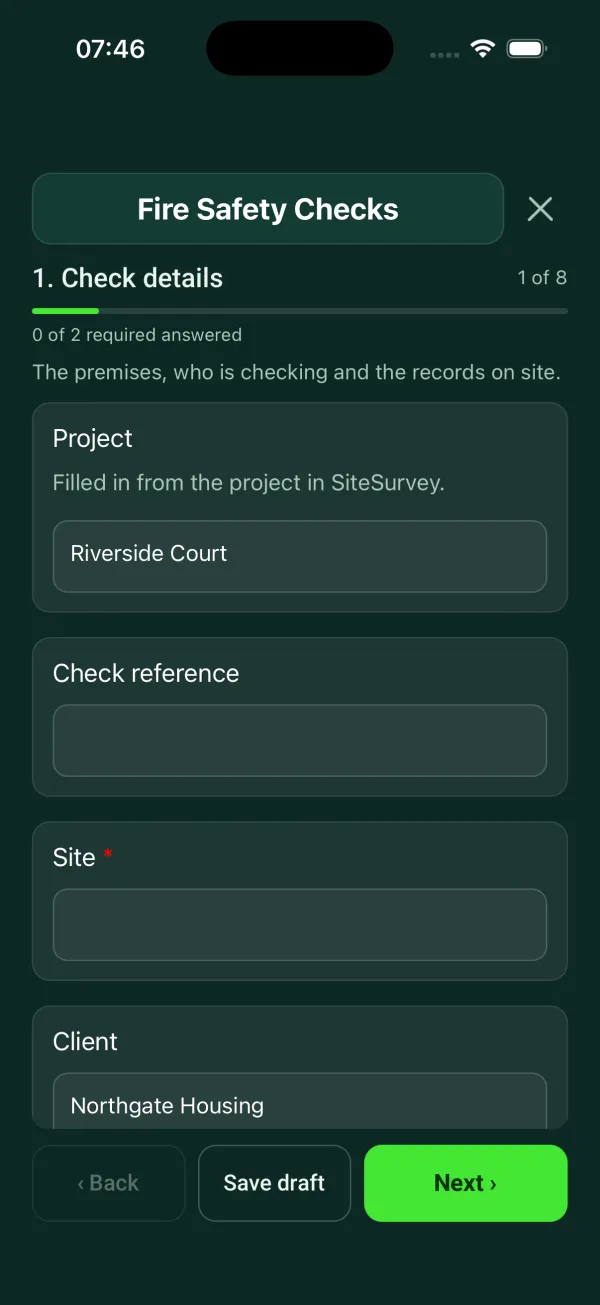
Fire safety checklist
Routine fire safety checks: extinguishers, emergency lighting tests, the weekly alarm test, escape routes, signs and fire drills, with actions.
8 sections107 questionsPhotosSignaturesSee every question → - Fire safety
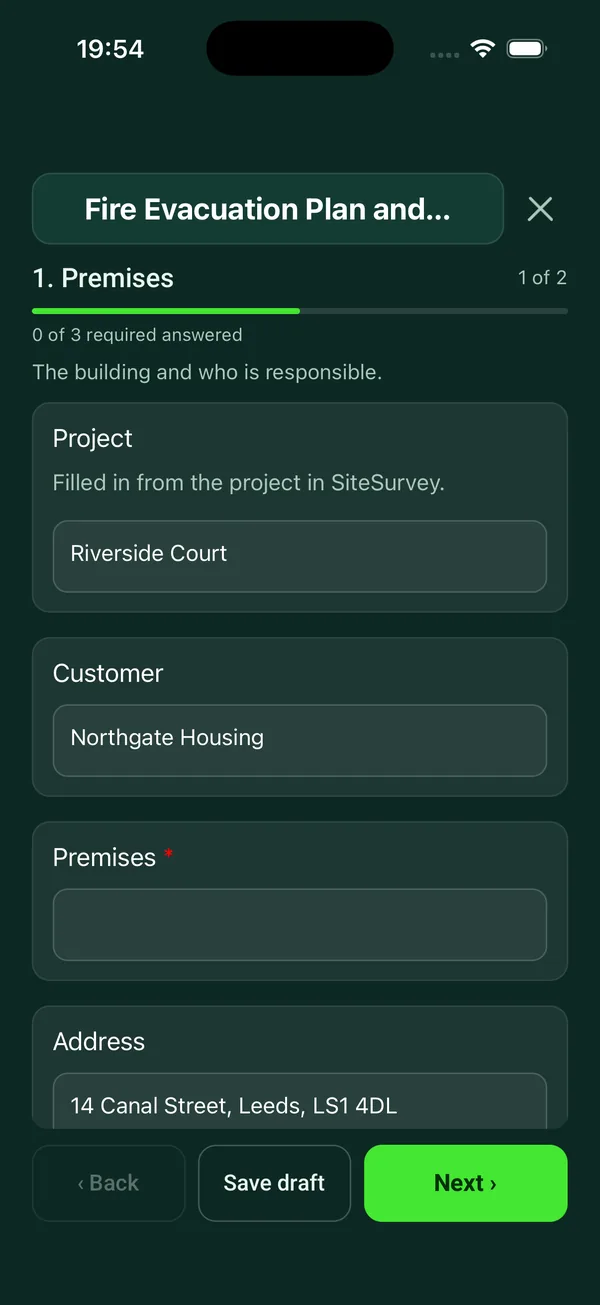
Fire evacuation plan template
Fire emergency plan for a building and a record of each drill: raising the alarm, escape routes, wardens, people who need help, evacuation time and actions.
4 sections48 questionsPhotosSignaturesSee every question → - Fire safety
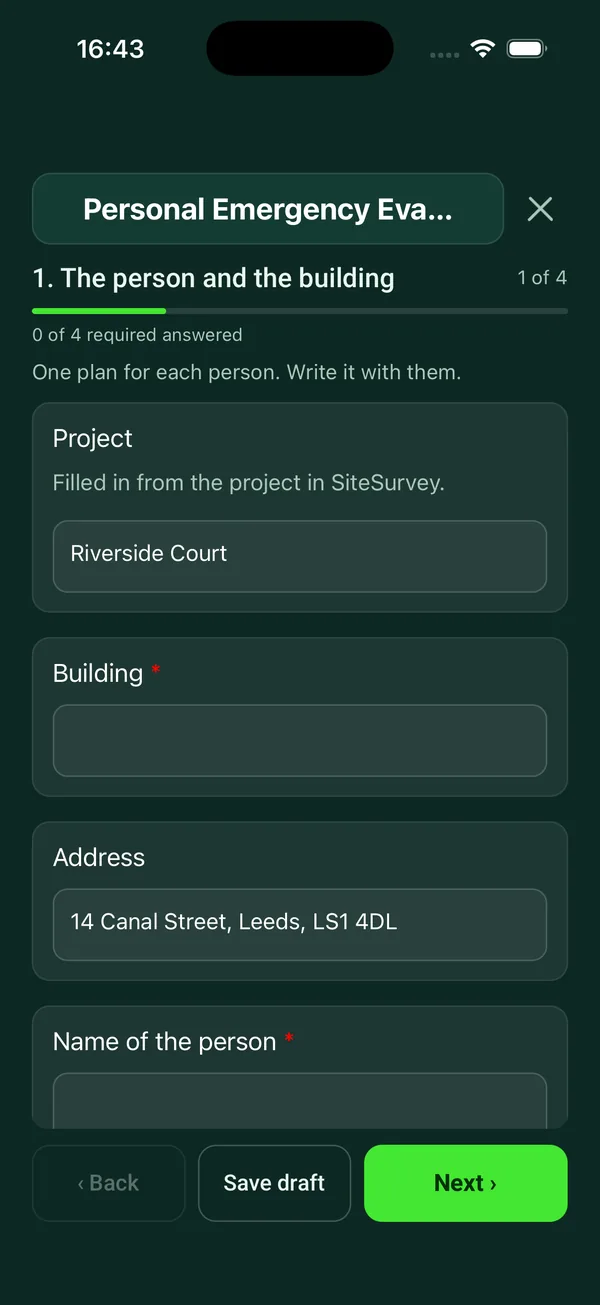
PEEP template
A PEEP for one person who would need help to leave a building in a fire: how they are warned, their route, refuges, equipment, helpers, practice and review.
4 sections47 questionsPhotosSignaturesSee every question → - Fire safety
Fire warden checklist
A fire warden or fire marshal walk-round: area, exits and escape routes, fire doors, call points, extinguishers, signs, emergency lighting, housekeeping, PEEPs and wardens on shift, with photos and actions.
4 sections57 questionsPhotosSignaturesSee every question → - Fire safety
HMO fire safety check
An HMO fire safety check against the LACORS housing fire safety guide: escape route, fire doors, detection and alarms, emergency lighting, fire-fighting equipment, kitchens, each room, and the fire risk assessment.
4 sections62 questionsPhotosSignaturesSee every question →
Fire doors, compartmentation and fire stopping 5
Checks on the passive protection that keeps fire and smoke in one place: fire doors, compartment walls and floors, penetration seals and fire dampers.
- Fire safety
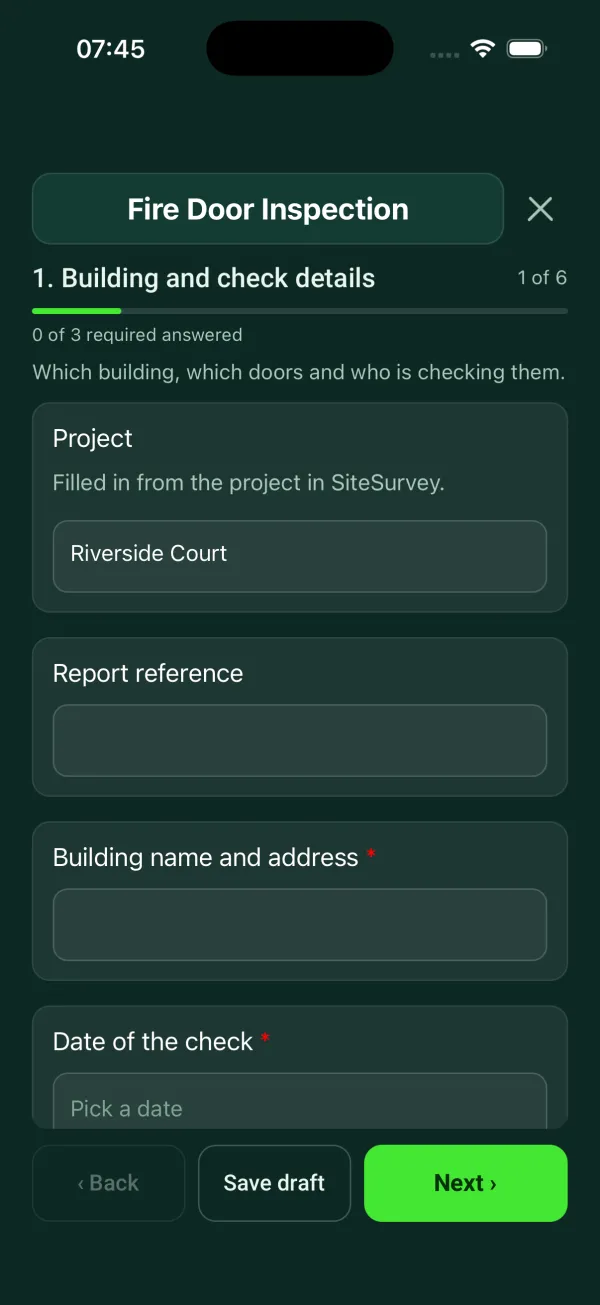
Fire door inspection checklist
Door by door checks (gaps, seals, closers, signage, glazing), 12 month flat entrance door record and remedial work list.
7 sections89 questionsPhotosSignaturesSee every question → - Fire safety
Communal and flat entrance fire door checks
Fire door checks for blocks of flats under the Fire Safety (England) Regulations 2022: the building's top storey height, quarterly communal and annual flat entrance door checks, self-closers, gaps, seals and damage, counts of doors passed and needing repair, access attempts and resident information.
3 sections52 questionsPhotosSignaturesSee every question → - Fire safety
Fire compartmentation survey
A fire compartmentation survey: every breach in compartment walls, floors, risers and cavity barriers with its location, required fire resistance, services, size, photos, priority and the remedy.
3 sections50 questionsPhotosSignaturesSee every question → - Fire safety
Fire stopping installation record
A fire stopping installation record: certification scheme, drawings, each penetration seal with its label, element, fire rating, services, product and tested detail, before and after photos, and sign-off.
3 sections54 questionsPhotosSignaturesSee every question → - Fire safety
Fire damper drop test record
A fire damper drop test record: each damper with its location, type and access, visual check, drop test, reset, result and photos, with failed dampers counted and the annual testing guidance.
3 sections43 questionsPhotosSignaturesSee every question →

Alarm, emergency lighting and extinguisher tests 3
The routine weekly, monthly and annual test records building managers keep for alarms, emergency lights and portable extinguishers.
- Fire safety
Fire alarm test log
A fire alarm test record: the weekly call point test with the call point used, sounders and reset, and the service visit with each device tested, faults, photos and the date of the last service.
5 sections72 questionsPhotosSignaturesSee every question → - Fire safety
Emergency lighting test log
An emergency lighting test record: monthly function tests and the annual full duration test for each luminaire or circuit, with charge indicators, faults, photos and a warning when a test ends early.
3 sections58 questionsPhotosSignaturesSee every question → - Fire safety
Fire extinguisher inspection checklist
A fire extinguisher inspection record: each extinguisher with its ID, location, type and service dates, the monthly checks, overdue service and extended service warnings, and pass or fail.
3 sections64 questionsPhotosSignaturesSee every question →
Smoke control, risers and suppression 4
Inspection records for the systems firefighters and the building rely on in a fire: AOVs and smoke vents, dry risers and fixed suppression systems.
- Fire safety
AOV and smoke vent inspection checklist
A smoke vent and AOV inspection: control panel and power, detector and switch activation, each vent opening fully and resetting, obstructions, faults and the reporting rules for high-rise residential buildings.
3 sections53 questionsPhotosSignaturesSee every question → - Fire safety
Dry riser inspection and testing checklist
A dry riser inspection and test record: building and check type, inlet box, each outlet's valve, cap, strap and signage, the annual pressure test, faults, and the 24-hour reporting rule for high-rise residential buildings.
4 sections55 questionsPhotosSignaturesSee every question → - Fire safety
Fire suppression system inspection checklist
An inspection record for fixed fire suppression systems: kitchen hood wet or dry chemical, clean agent, CO2, foam and water mist. Each protected area with its systems: data plate scan, cylinder gauge, weight and pressure readings against the label (OSHA 1910.160 loss limits flagged), nozzles, detection and fusible link dates, pull station, fuel or power shut-off, alarm interface, hood and duct, signs, last service, next due and tag status, then actions and sign-off.
4 sections100 questionsPhotosSignaturesSee every question → - Fire safety
Fire pump inspection checklist
An inspection and test record for electric and diesel fire pumps and jockey pumps. Each pump room with heat, ventilation, access, valves and suction supply, and each pump with a nameplate scan, controller, gauges, packing gland, diesel engine checks, churn test readings against your acceptance values, annual flow test points against the pump curve, tag and status, then defects, impairments, actions and sign-off.
3 sections147 questionsPhotosSignaturesSee every question →
Guide
What is a fire safety checklist?
A fire safety checklist is the record of a walk-round or test of a building's fire precautions: escape routes, fire doors, alarms, emergency lighting, extinguishers, signs and housekeeping. It is not the same as a fire risk assessment. The fire risk assessment decides what precautions a building needs; the checklists on this page show that those precautions are still in place and working.
In practice a building has one assessment, reviewed regularly, and a set of logs underneath it: a fire alarm test log, an emergency lighting test log, fire door inspections and a general fire safety checklist or fire warden checklist. When an inspector or the fire and rescue service visits, those logs are what they ask to see.
Which fire safety checks are a legal requirement in the UK?
In England and Wales the main law is the Regulatory Reform (Fire Safety) Order 2005. It applies to workplaces and other non-domestic premises, to the structure, external walls and common parts of blocks of flats, and to paying guest accommodation such as B&Bs and holiday lets. Scotland and Northern Ireland have their own rules.
- The responsible person
- The employer, owner, landlord, occupier or anyone else in control of the premises, such as a facilities manager or managing agent. Where there is more than one, they must work together.
- Fire risk assessment
- The responsible person must carry out and regularly review a fire risk assessment, and record it, including the significant findings, the measures taken and any group of people especially at risk.
- Maintenance
- Article 17 requires the premises and any fire safety facilities, equipment and devices to be subject to a suitable system of maintenance and kept in efficient working order and good repair. Test logs are how you show this.
- Drills and training
- Staff must be trained, and GOV.UK guidance says to carry out at least one fire drill a year and record the results.
- Flats
- Since the Fire Safety Act 2021, the Order covers a multi-occupied residential building's structure, external walls, common parts and the doors between flats and common parts.
Sources: GOV.UK: fire safety in the workplace, who's responsible, GOV.UK: fire risk assessments, legislation.gov.uk: Regulatory Reform (Fire Safety) Order 2005, article 9, legislation.gov.uk: Regulatory Reform (Fire Safety) Order 2005, article 17, GOV.UK: fire safety equipment, drills and training and legislation.gov.uk: Fire Safety Act 2021, section 1.
How often should fire alarms, emergency lighting and extinguishers be tested?
The GOV.UK fire safety risk assessment guide for offices and shops sets out a typical routine. Follow the manufacturer's or installer's instructions and the relevant British Standard for your system, and record every test and fault.
- Daily
- Remove security devices from fire exits, check doors on escape routes swing freely and close fully, routes are clear, and the alarm panel shows the system is active.
- Weekly
- Test the fire detection and warning system and manual call points, and check extinguishers and hose reels are in place and in apparent working order. Use the fire alarm test log.
- Monthly
- Test all emergency lighting, check fire doors close correctly with frames and seals intact, and give extinguishers a brief check. Use the emergency lighting test log and extinguisher checklist.
- Six-monthly
- A competent person tests and maintains the fire detection and warning system.
- Annually
- A competent person tests and maintains emergency lighting, extinguishers and other installed systems, and all structural fire protection and compartmentation is inspected. The fire compartmentation survey records that inspection.
Sources: GOV.UK: fire safety risk assessment, offices and shops and GOV.UK: fire safety equipment, drills and training.
Fire safety in blocks of flats: the extra checks
The Fire Safety (England) Regulations 2022 added duties for multi-occupied residential buildings from 23 January 2023. Where a building has storeys over 11 metres, the responsible person must check communal fire doors, including self-closers, every three months, and use best endeavours to check flat entrance doors every year. If a resident will not give access, keep evidence of the attempts. The communal and flat entrance fire door checks form is set up for those rounds.
In high-rise residential buildings (at least 18 metres or at least seven storeys), the responsible person must also check firefighting lifts, evacuation lifts and essential fire-fighting equipment every month, including dry and wet riser inlets and outlets, smoke control, suppression, detection and alarm systems. Faults that cannot be fixed within 24 hours must be reported to the fire and rescue service, and results must be made available to residents. See the dry riser, AOV and smoke vent and suppression system forms.
Since 6 April 2026, the Fire Safety (Residential Evacuation Plans) (England) Regulations 2025 require responsible persons in buildings of at least 18 metres or seven storeys, and in buildings over 11 metres with a simultaneous evacuation strategy, to use reasonable endeavours to identify residents who may need help to evacuate. Taking part is the resident's choice. A PEEP template written with the person records how they will get out.
Sources: GOV.UK: fact sheet, fire doors (regulation 10), legislation.gov.uk: Fire Safety (England) Regulations 2022, regulation 10, GOV.UK: fact sheet, lifts and essential fire-fighting equipment (regulation 7), legislation.gov.uk: Fire Safety (England) Regulations 2022, regulation 7, GOV.UK: Residential PEEPs factsheet and legislation.gov.uk: Fire Safety (Residential Evacuation Plans) (England) Regulations 2025.
What a good fire inspection record shows
A fire log is only useful if someone reading it later can tell what was checked, where, by whom and what happened about the faults.
- Location of every item
- The door, call point, light or damper by its reference and floor, so a fault can be found again. Scanning a label or asset tag saves retyping.
- Photos of defects
- A gap around a fire door, a missing intumescent strip or an unsealed penetration is far clearer in an annotated photo than in a sentence. For fire stopping, before and after photos of each seal show what is hidden once the ceiling goes back.
- Pass, fail and what happens next
- Every failed item needs an action, a priority and an owner, and the next visit should check it was closed.
- Who is at risk
- People who may need help to leave, such as those with a PEEP, and any changes since the last assessment.
- Signature and date
- The person who did the check, so the record stands as evidence of the maintenance article 17 asks for.
Source: legislation.gov.uk: Regulatory Reform (Fire Safety) Order 2005, article 17.
Running fire checks on a phone
In the SiteSurvey app on iPhone, iPad or Android, each form works offline, so you can complete a riser check in a basement or a door round on a stairwell with no signal. Photos with annotations, readings, notes and signatures stay with the item they relate to, and each completed check becomes a branded PDF report for the responsible person, client or resident noticeboard.
Every form here can be edited to match your building, contract or fire strategy, or you can build your own in the form builder. Open any form to see every question and try it live. For HMOs and rented homes, see housing and property forms; for wider workplace checks, see health and safety forms.
Facts checked by the SiteSurvey team, 27 October 2026.
Fire safety forms FAQs
Who can carry out a fire risk assessment?
The responsible person can do it themselves using the government's guides. If they do not have the expertise or time, they should appoint a competent person to help, such as a professional fire risk assessor. The fire and rescue service can advise but cannot do it for you.
Source: GOV.UK: fire risk assessments.
Does a fire risk assessment have to be written down?
Yes. The Fire Safety Order requires the responsible person to record the assessment and each review as soon as practicable, including the significant findings, the measures taken or planned and any group of people especially at risk.
Sources: legislation.gov.uk: Regulatory Reform (Fire Safety) Order 2005, article 9 and GOV.UK: fire risk assessments.
How often should communal fire doors be checked?
In England, in multi-occupied residential buildings with storeys over 11 metres, communal fire doors must be checked at least every three months and flat entrance doors annually on a best endeavours basis. In lower buildings the general maintenance duty still applies, so the frequency should come from your fire risk assessment.
Sources: GOV.UK: fact sheet, fire doors (regulation 10) and legislation.gov.uk: Fire Safety (England) Regulations 2022, regulation 10.
Is a fire safety checklist the same as a fire risk assessment?
No. A fire risk assessment identifies the hazards and people at risk and decides what precautions are needed. A fire safety checklist is a routine check that those precautions are still in place and working.
What fire safety does an HMO landlord have to maintain?
Under the Management of HMOs (England) Regulations 2006, the manager must keep means of escape free from obstruction and in good repair, keep fire fighting equipment and fire alarms in good working order, and display notices showing the escape routes. The HMO fire safety check covers these between fire risk assessments.
Source: legislation.gov.uk: Management of HMOs (England) Regulations 2006, regulation 4.
Do I need a PEEP for every disabled employee or resident?
Not automatically. In workplaces, GOV.UK guidance says staff and regular visitors who need one get an individual plan tailored to them, and a standard plan covers occasional visitors. For residents of in-scope blocks in England, the 2025 Regulations require the responsible person to use reasonable endeavours to identify those who need help, but residents cannot be made to take part.
Sources: GOV.UK: fire safety risk assessment, means of escape for disabled people, GOV.UK: Residential PEEPs factsheet and legislation.gov.uk: Fire Safety (Residential Evacuation Plans) (England) Regulations 2025.
How often should fire extinguishers be serviced?
GOV.UK guidance says a brief check monthly is usually enough in normal conditions, with maintenance by a competent person every year. Extinguishers in areas prone to damage or vandalism may need checking more often.
Source: GOV.UK: fire safety risk assessment, offices and shops.
Other categories
Put these forms in your team's hands
Works on iPhone, iPad and Android, offline on site, with every completed form turned into a branded PDF report.
Start your trial →