Form library · Fire safety
Fire door inspection checklist
A fire door inspection form for blocks of flats. Check each door for damage, glazing, hinges, seals, gaps and whether it closes fully, then record the round totals, the 12 month flat entrance door record, remedial work and the information given to residents. Every question is listed below, and you can fill the live form in on this page.
Ready to use from the form library, and editable. Trial from £1, cancel any time.
What should a fire door inspection checklist include?
A fire door inspection checklist should record each door's location and type, any damage or alteration, glazing, hinges, intumescent strips and smoke seals, the gaps around the door and whether it closes fully into the frame. GOV.UK guidance says the gap between door and frame should never be more than 4 mm, except at the bottom. Failed doors need a remedial action and date.
Last updated . Facts checked on 26 September 2026 against regulation 10 of the Fire Safety (England) Regulations 2022, GOV.UK fire door guidance and the regulation 10 fact sheet.
Try the fire door inspection form live
Answer a few questions and watch it adapt. Your answers are not saved, and any photos you add are deleted within the hour.
This is the real form as your team would use it: questions appear as you answer, scores work themselves out and you can add photos and signatures. No sign-up needed.
Fill it in on a phone or tablet
Your team completes the fire door inspection on site in the SiteSurvey app on iPhone, iPad and Android phones and tablets. The project name and address fill in for them, it works without signal, and it syncs when the device is back online with photos kept against the question they answer.
Customers and subcontractors do not need the app: send them a link and they can fill it in from any browser.
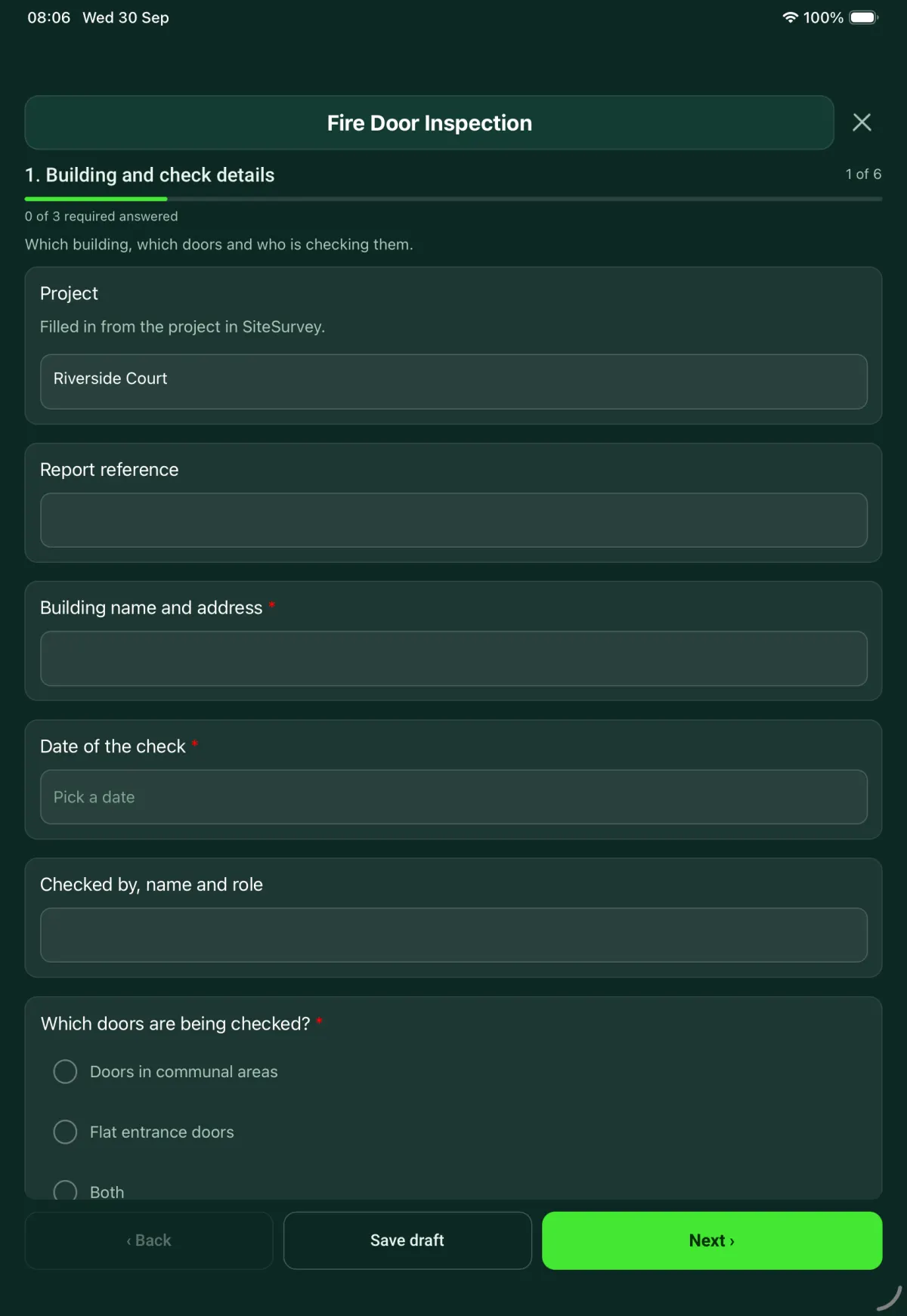
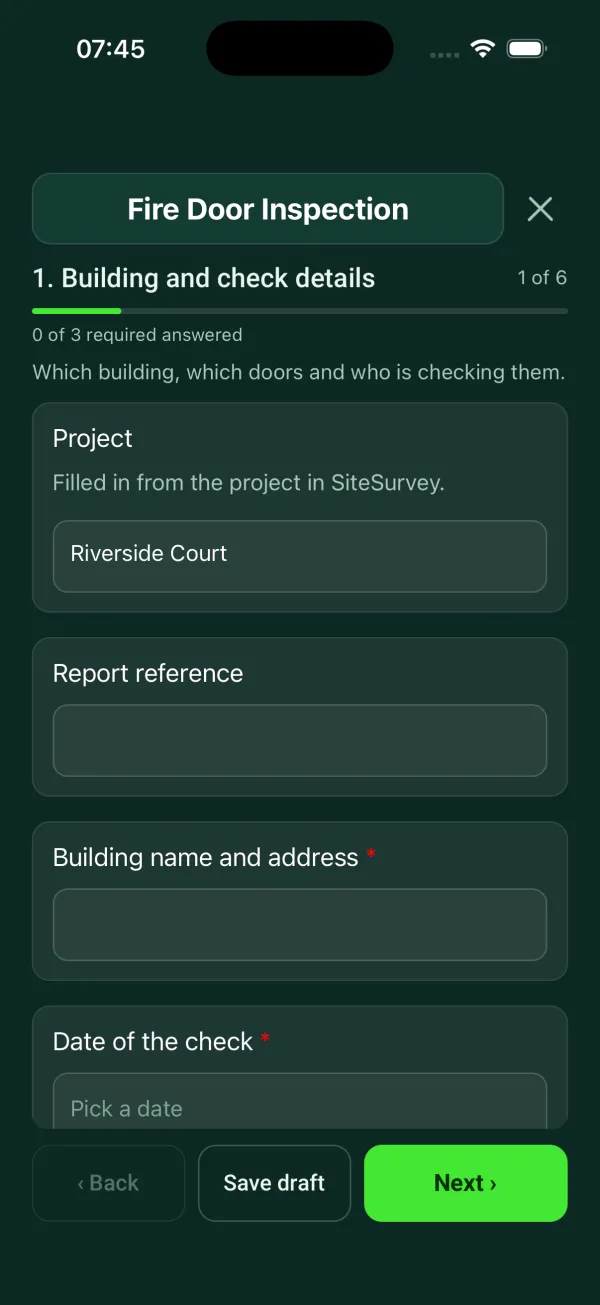
Every question in the fire door inspection template
Door by door checks (gaps, seals, closers, signage, glazing), 12 month flat entrance door record and remedial work list. 7 sections and 73 questions. Follow-up questions and guidance appear only when an answer calls for them, so the person on site never sees the ones that do not apply.
Details you only enter once
Add this form to a project in SiteSurvey and it fills in what the project already knows, so nobody on site retypes it and every form on the job uses the same names. Anything filled in can still be changed.
- Project: the project name
Building and check details
Which building, which doors and who is checking them.
- ProjectShort answerFills in from the project name
- Report referenceShort answer
- Building name and address*Short answer
- Date of the check*Date
- Checked by, name and roleShort answer
- Which doors are being checked?*Choose one
- Doors in communal areas
- Flat entrance doors
- Both
- Is the top storey of the building more than 11 metres above ground?Yes or No
- GuidanceDoors in communal areas. In a block of flats above 11 metres in height, in England, these must be checked at least every 3 months.Shown only when the answers above make it relevant
- GuidanceFlat entrance doors. In a block of flats above 11 metres in height, in England, the responsible person must use best endeavours to check these at least every 12 months, and keep a record of the steps taken.Shown only when the answers above make it relevant
- CheckRegulation 10 sets no check frequency for this building. The Fire Safety Order still requires a suitable system of maintenance, so follow the fire risk assessment.Shown when “Is the top storey of the building more than 11 metres above ground?” is No
- Date of the previous check of these doorsDate
- Is there a fire risk assessment that covers the doors?Yes or No
- CheckThese checks are simple and visual. Whether each door is the right type for its location is a matter for the fire risk assessment. Tell the responsible person that you could not find one.Shown when “Is there a fire risk assessment that covers the doors?” is No
- Can you reach every door on the schedule today?Yes or No
- Which doors can you not reach, and why?NotesShown when “Can you reach every door on the schedule today?” is No
- Walk Cam: Fire door inspectionWalk Cam video with voice-to-text
Door records
One entry for each door. The checks are visual and need no tools.
- GuidanceWhat a good photo shows. The gap with a gauge or tape in shot, the strip or seal along the edge, and the closer with its fixings.
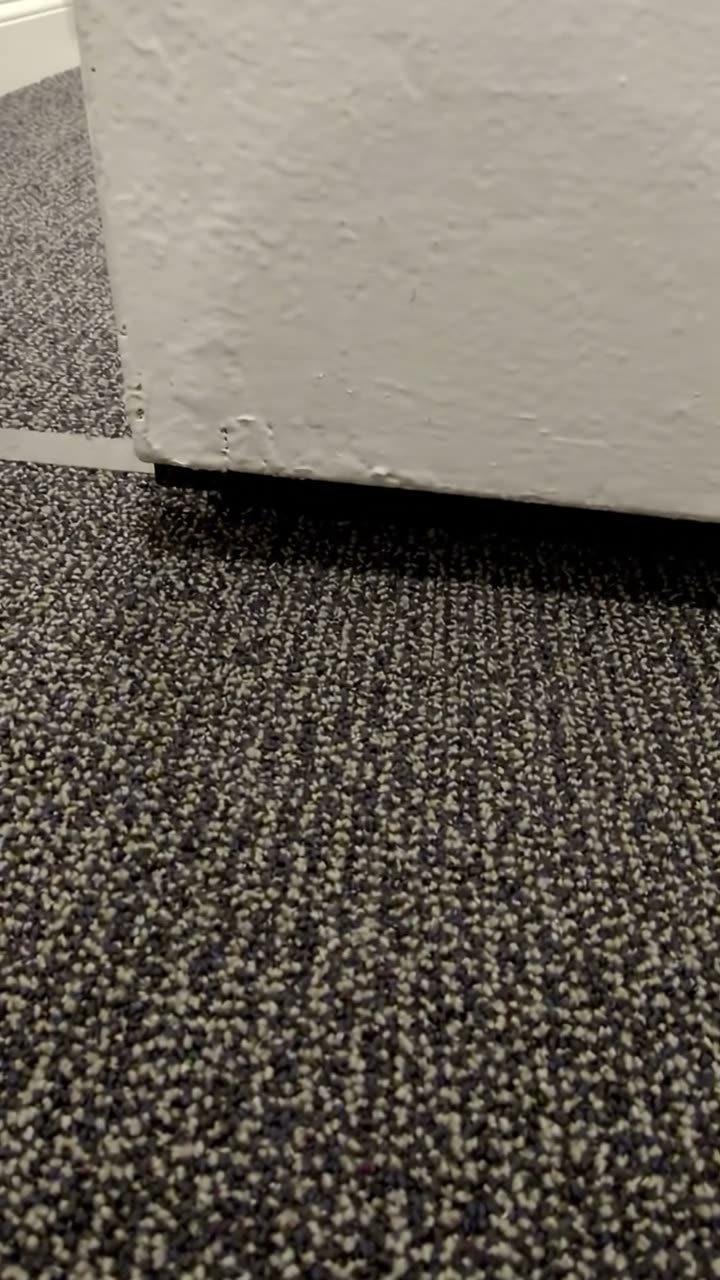
The gap under a fire door above a carpeted floor 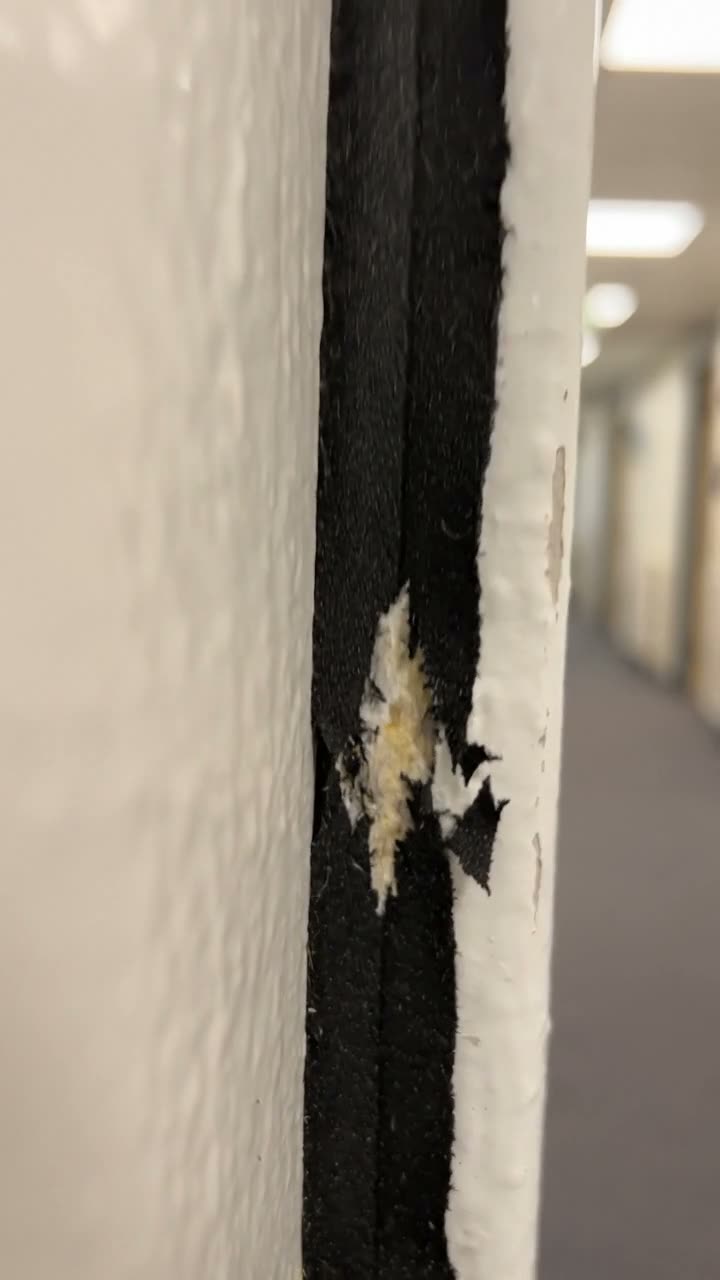
A torn intumescent strip on the edge of a fire door 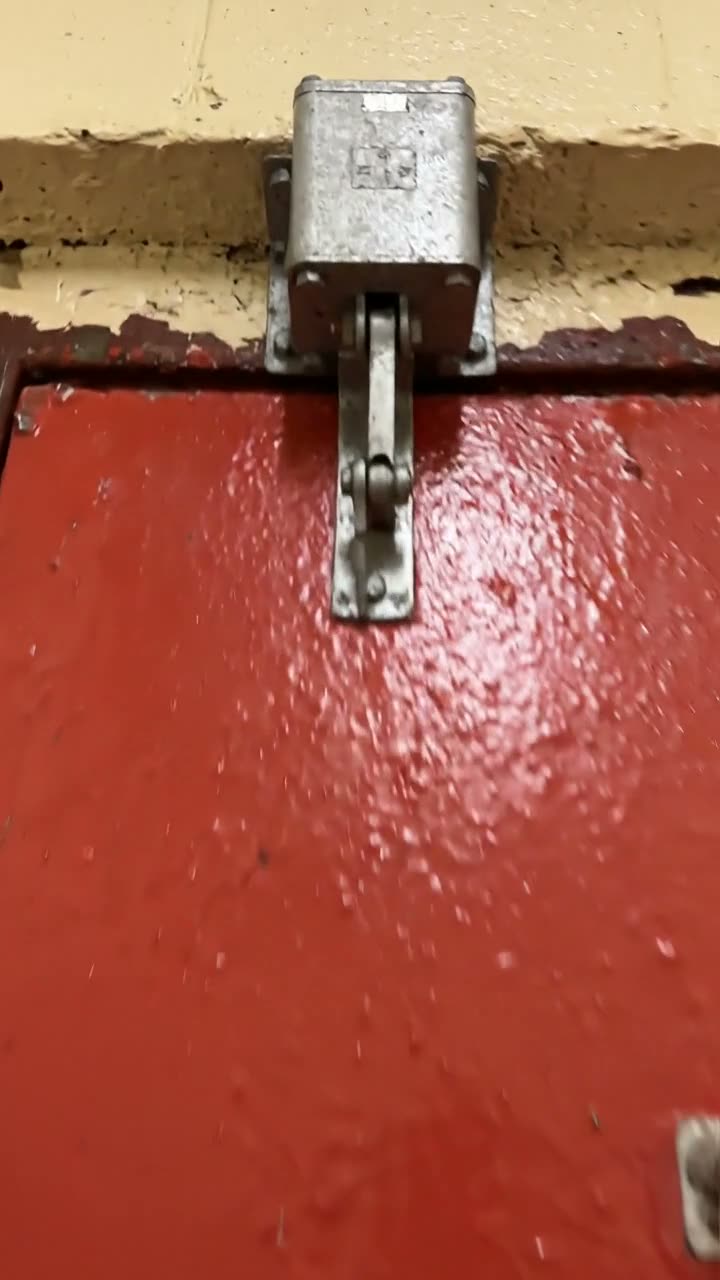
An overhead closer fixed above a red fire door - Doors checkedRepeat for each door. Each one asks:
- Door referenceShort answer
- Floor and locationShort answer
- Type of doorChoose one
- Flat entrance door
- Stairway or lobby door
- Corridor door
- Plant room, service cupboard or riser door
- Fire resistance rating shown on the door, if anyShort answer
- Was access to the flat given, so both sides of the door could be checked?Yes or NoShown when “Type of door” is “Flat entrance door”
- Steps taken to gain accessTick all that apply
- Letter or email to the resident
- Visit, with a card left
- Phone call or text
- A choice of times offered
- Other (describe)
Shown when “Type of door” is “Flat entrance door” and “Was access to the flat given, so both sides of the door could be checked?” is No - CheckAccess not granted. Regulation 10 requires a record of the steps taken to check flat entrance doors, including the steps taken to try to gain access.Shown when “Type of door” is “Flat entrance door” and “Was access to the flat given, so both sides of the door could be checked?” is No
- Has the door been replaced with one that may not be fire resisting?Yes or NoShown when “Type of door” is “Flat entrance door” and “Was access to the flat given, so both sides of the door could be checked?” is Yes
- CheckWhere there is any doubt, the guidance says the resident will need to confirm that the new door is fire resisting and was installed by a competent person.Shown when “Type of door” is “Flat entrance door” and “Has the door been replaced with one that may not be fire resisting?” is Yes
- LetterboxChoose one
- Closes firmly
- Jammed open or damaged
- No letterbox
Shown when “Type of door” is “Flat entrance door” and “Was access to the flat given, so both sides of the door could be checked?” is Yes - Any damage or alteration to the door, frame or surrounding wall?Yes or NoShown only when the answers above make it relevant
- What is damaged or altered, and where?NotesShown when “Any damage or alteration to the door, frame or surrounding wall?” is Yes
- Glass and glazing in the door or side panelsChoose one
- No glazing
- Sound
- Cracked, loose or damaged
Shown only when the answers above make it relevant - Hinges and other ironmongery free of obvious defects?Yes or NoShown only when the answers above make it relevant
- What is wrong? For example missing or loose screwsShort answerShown when “Hinges and other ironmongery free of obvious defects?” is No
- Air transfer grillesChoose one
- None fitted
- Undamaged
- Damaged
Shown when “Type of door” is “Plant room, service cupboard or riser door” - Intumescent strips and smoke sealsChoose one
- Undamaged and in contact
- Damaged or missing in places
- Painted over
- None fitted
Shown only when the answers above make it relevant - Where is the damage?Tick all that apply
- Hinge side
- Latch side
- Top
- Bottom
Shown only when the answers above make it relevant - GuidanceIf strips and seals were not originally fitted, this may be acceptable. It depends on the findings of the fire risk assessment, so refer it to the assessor.Shown when “Intumescent strips and smoke seals” is “None fitted”
- Gap at the top (mm)NumberShown only when the answers above make it relevant
- Gap, hinge side (mm)NumberShown only when the answers above make it relevant
- Gap, latch side (mm)NumberShown only when the answers above make it relevant
- CheckGap over 4 mm. GOV.UK guidance gives the industry standard: the gap between the door and the frame should never be more than 4 mm, except at the bottom of the door.Shown only when the answers above make it relevant
- Gap under the door (mm)NumberShown only when the answers above make it relevant
- Limit for this door, from its own documents (mm)NumberShown only when the answers above make it relevant
- GuidanceGOV.UK guidance gives no figure for the gap under a door. It should be as small as practicable, without the door catching on the floor. Take the limit from the door's own documents or the fire risk assessment.Shown only when the answers above make it relevant
- Over the limit by (mm)Worked out by the formShown only when the answers above make it relevant
- CheckThe gap under this door is larger than the limit you entered for it. Record the remedial action below.Shown only when the answers above make it relevant
- How is the door kept closed?Choose one
- Self-closing device
- Held open on a magnetic device
- Kept locked shut
Shown only when the answers above make it relevant - GuidanceUse the test button, where there is one, to release the door. Do not pull the door from its magnet.Shown when “How is the door kept closed?” is “Held open on a magnetic device”
- Opened fully and let go: did it close fully into the frame?Yes or NoShown only when the answers above make it relevant
- Opened to about 15 degrees and let go: did it close fully into the frame?Yes or NoShown only when the answers above make it relevant
- WarningThe door does not close fully. A fire door that does not close fully into its frame will not adequately hold back fire and smoke. Regulation 10 requires the check to make sure the self-closing device is working.Shown only when the answers above make it relevant
- What stops it closing?NotesShown only when the answers above make it relevant
- ResultChoose one
- Pass
- Fail
- Not checked
- Which looks most like the main defect?Choose one
- Large gap under the door
- Damaged strip or seal
- Closer loose or not closing
Shown when “Result” is “Fail” - Photos of the defectPhotosShown when “Result” is “Fail”
- Remedial actionNotesShown when “Result” is “Fail”
- PriorityChoose one
- Today
- This week
- This month
Shown when “Result” is “Fail” - Why was the door not checked?Short answerShown when “Result” is “Not checked”
- Photos of the doorPhotos
Round totals
Count the doors so the record shows what was and was not checked.
- Doors on the schedule for this roundNumber
- Doors checkedNumber
- Doors that failedNumber
- Doors passedWorked out by the formShown only when the answers above make it relevant
- Share of checked doors that passed (%)Worked out by the formShown only when the answers above make it relevant
- Doors not checkedWorked out by the formShown only when the answers above make it relevant
- CheckSome doors on the schedule were not checked. List them and say when they will be checked.Shown only when the answers above make it relevant
- Doors not checked, and the date planned for themNotesShown only when the answers above make it relevant
Flat entrance doors: 12 month record
The running total for the block over the last 12 months.
- Flats in the blockNumber
- Flat entrance doors checked in the last 12 monthsNumber
- Share checked (%)Worked out by the formShown only when the answers above make it relevant
- Flats still to checkWorked out by the formShown only when the answers above make it relevant
- Were there flats where access was not granted?Yes or No
- Which flats, and what steps were taken to gain access?NotesShown when “Were there flats where access was not granted?” is Yes
- What will be tried next?NotesShown when “Were there flats where access was not granted?” is Yes
Remedial work
What needs repair, who will do it and by when.
- Did any door fail?Yes or No
- WarningGOV.UK guidance says that where a check finds a fire door needs repair or replacement, the work must be done by a competent contractor as soon as reasonably practicable.Shown when “Did any door fail?” is Yes
- Doors and the work neededNotesShown when “Did any door fail?” is Yes
- Who will do the work?Short answerShown when “Did any door fail?” is Yes
- Target dateDateShown when “Did any door fail?” is Yes
- Anything done on the dayNotesShown when “Did any door fail?” is Yes
- Will each door be checked again after the repair?Yes or NoShown when “Did any door fail?” is Yes
- Does anything need to go to the fire risk assessor?Yes or No
- What, and why?NotesShown when “Does anything need to go to the fire risk assessor?” is Yes
Information for residents
Residents must be told how to look after fire doors.
- GuidanceRegulation 10 requires residents to be told that fire doors should be kept shut when not in use, that self-closing devices should not be tampered with, and that faults or damage should be reported immediately.
- Has this information been given to all residents in the current 12 month period?Yes or No
- Date it was givenDateShown when “Has this information been given to all residents in the current 12 month period?” is Yes
- How was it given?Choose one
- Letter to each flat
- Noticeboard and letter
- Handed to residents
- Other (describe)
Shown when “Has this information been given to all residents in the current 12 month period?” is Yes - CheckThe information must be given to all residents within each period of 12 months, and to a new resident as soon as reasonably practicable after they move in.Shown when “Has this information been given to all residents in the current 12 month period?” is No
- How residents report a faultShort answer
Inspector sign-off
- WarningYou recorded that at least one door failed. Check that the remedial work and its target date are filled in.Shown when “Did any door fail?” is Yes
- NameShort answer
- Inspector signatureSignature
Fire door inspection template questions
How often must fire doors be checked?
In England, regulation 10 of the Fire Safety (England) Regulations 2022 applies to multi-occupied residential buildings with a top storey more than 11 metres above ground. There, communal fire doors must be checked at least every 3 months, and the responsible person must use best endeavours to check flat entrance doors at least every 12 months. For other buildings the regulation sets no frequency, so follow the fire risk assessment.
What if a resident will not let me in to check their door?
Record the steps you took. For each flat entrance door the form asks whether access was given, and if not, whether you wrote, visited, phoned or offered a choice of times. The 12 month record then lists the flats where access was not granted and what will be tried next.
What is the maximum gap on a fire door?
GOV.UK guidance gives the industry standard that the gap between the door and the frame should never be more than 4 mm, except at the bottom. It gives no figure for the gap under the door, so the form asks for the limit from the door's own documents or the fire risk assessment and flags any gap over it.
What must residents be told about fire doors?
Regulation 10 requires residents to be told that fire doors should be kept shut when not in use, that self-closing devices should not be tampered with, and that faults or damage should be reported immediately. The form records whether this was given to all residents in the current 12 month period, when and how.
Does the checker need to be a specialist?
No. GOV.UK guidance says the checks should be simple and basic, and the form's door checks are visual and need no tools. Whether each door is the right type for its location is a matter for the fire risk assessment, and the form lets you refer anything to the assessor.
Can I record the checks offline?
In the SiteSurvey app, yes. The form works offline, takes photos of each door and defect, collects the inspector's signature and produces a PDF report or share link when it syncs.
Related
Related templates
Templates that go with the fire door inspection form
Workplace audit with walkways, first aid, fire equipment and records, findings and corrective actions, closing meeting.
Planned maintenance visit: records seen, asset by asset tasks, water temperatures, work done and next visit.
Elements, lifecycles and renewal years, kitchen and bathroom, heating and electrics, hazards and recommended work for each property.
Routine fire safety checks: extinguishers, emergency lighting tests, the weekly alarm test, escape routes, signs and fire drills, with actions.
Use this fire door inspection form with your team
Add it from the form library in one click, change any question, and every completed form becomes a branded PDF report.
Start your trial →