Form library
Care home and care service forms
Environment, safety and audit checks for care homes and care services. See every question, try the live form, then use it in SiteSurvey.
Most used
Start with the most used care forms
All care forms
Search by name or topic. Open any form to see every question and try it live.
5 forms
- Care
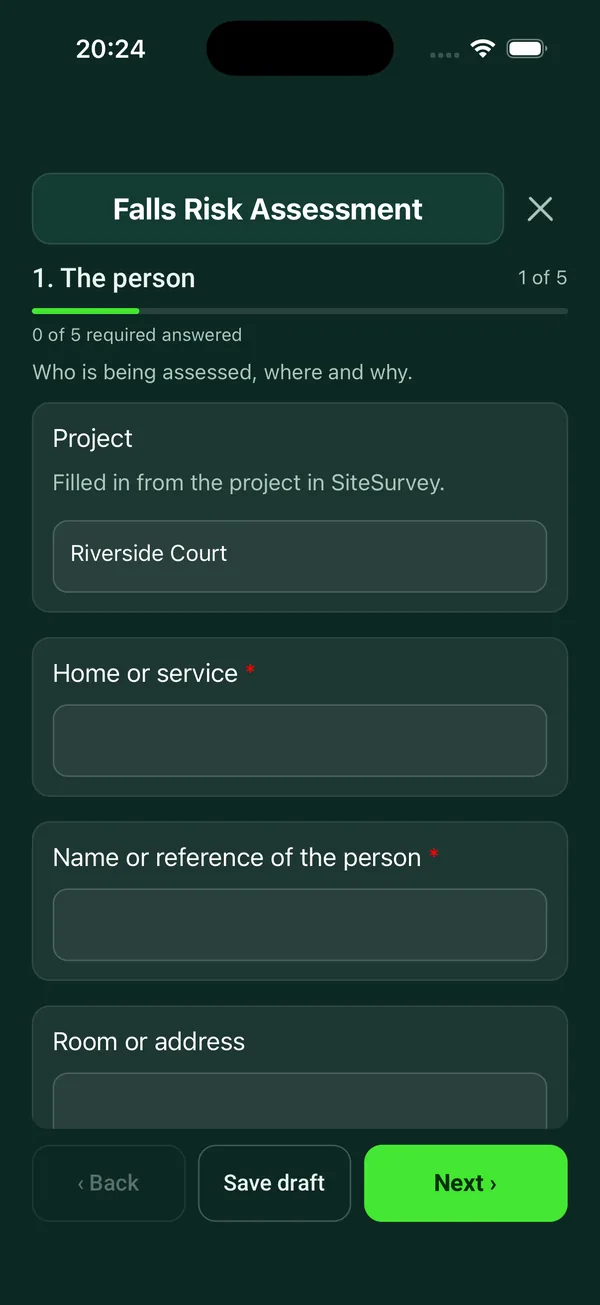
Falls risk assessment template
Falls assessment record for an older person in a care home or at home: falls history, the risk factors NICE lists, the environment, and actions with referrals. No score.
6 sections80 questionsSignaturesSee every question → - Care
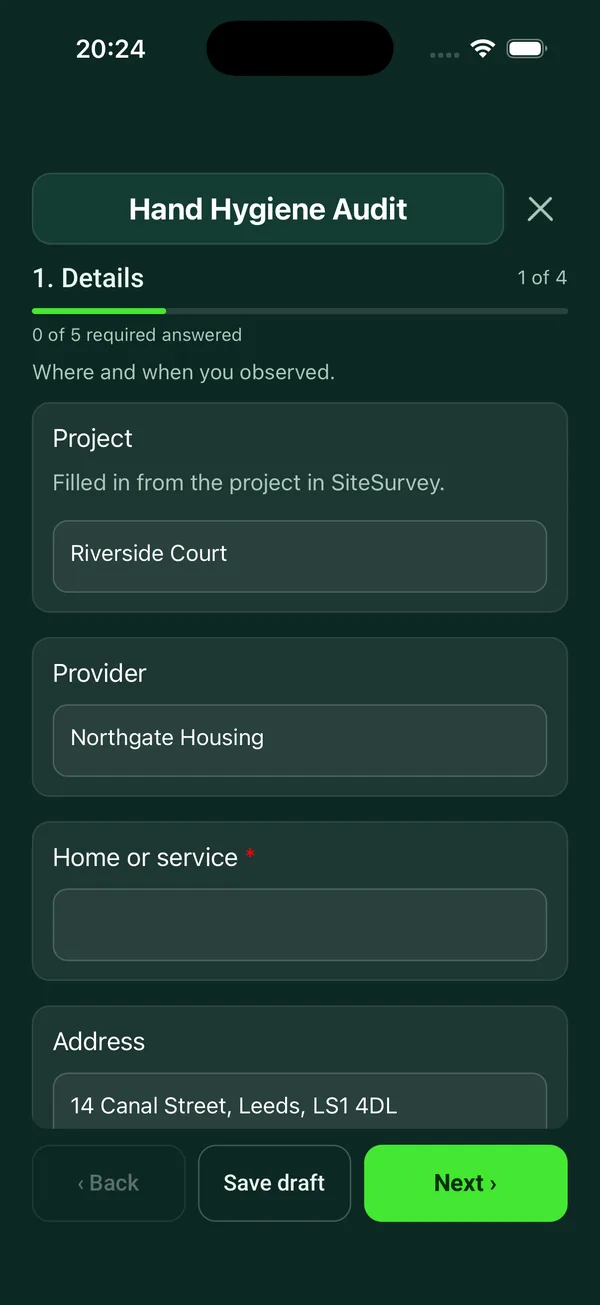
Hand hygiene audit tool
Observation audit using WHO's five moments: each opportunity, the staff group, what was done, a compliance percentage, facilities and feedback to the team.
4 sections54 questionsPhotosSignaturesSee every question → - Care
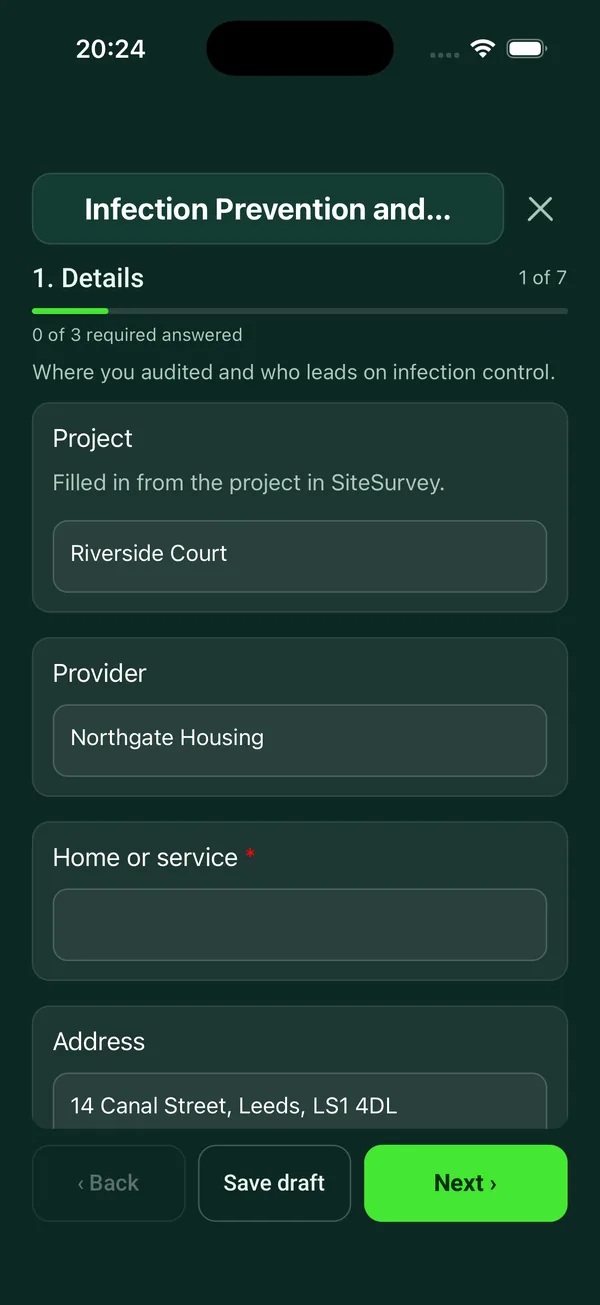
Infection control audit checklist
Infection control audit for a care home or clinic: management, cleanliness, hand hygiene, protective equipment, sharps and waste, laundry, equipment and outbreaks.
7 sections84 questionsPhotosSignaturesSee every question → - Care
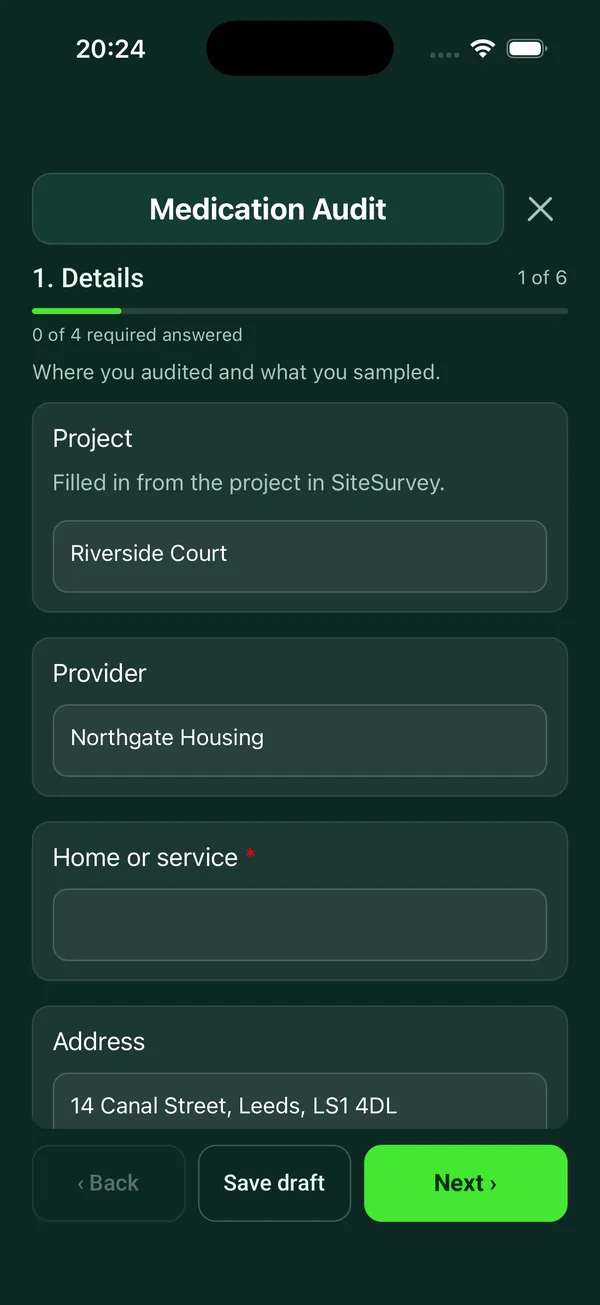
Medication audit template
Medicines audit for a care home: storage, a sample of administration records, controlled drugs, staff training and competence, incidents and findings with actions.
6 sections82 questionsPhotosSignaturesSee every question → - Care
Care home audit tool and template
Manager's quality audit of a care home, set out under CQC's five key questions: safe, effective, caring, responsive and well-led, with findings and actions.
7 sections82 questionsPhotosSignaturesSee every question →
Guide
What is a care home audit?
A care home audit is a structured check of how the home is actually running, done by the registered manager, a deputy, a quality lead or the provider's own visiting team. It looks at records, the building, equipment and day-to-day practice, finds gaps, and turns them into an action plan with owners and dates.
Audits matter because the law expects you to check your own service. Regulation 17 of the Health and Social Care Act 2008 (Regulated Activities) Regulations 2014 (good governance) requires providers to have systems to assess, monitor and improve the quality and safety of the service, and to keep accurate records. An audit programme, with evidence that actions were followed up, is one of the clearest ways to show that system working.
CQC judges services against five key questions: are they safe, effective, caring, responsive and well-led? Under each key question sit quality statements describing what good care looks like. A good care home audit is organised the same way, so findings line up with how an inspector will look at the home.
Sources: regulation 17 of the Health and Social Care Act 2008 (Regulated Activities) Regulations 2014 (good governance), CQC: the five key questions we ask and CQC: how we assess quality and performance (assessment framework).
Which care home checks are a legal requirement in the UK?
In England, the fundamental standards in the 2014 Regulations set the baseline, and CQC enforces them. Most audits trace back to a small number of regulations. The list below covers the ones care home checks are most often built around. Wales, Scotland and Northern Ireland have their own regulators and rules, so check locally if you operate there.
- Safe care and treatment (regulation 12)
- Includes assessing risks to people's health and safety, making sure equipment and premises are safe, the proper and safe management of medicines, and assessing, preventing and controlling the spread of infections.
- Premises and equipment (regulation 15)
- Premises and equipment must be clean, secure, suitable, properly used and properly maintained.
- Good governance (regulation 17)
- Systems to assess, monitor and improve quality and safety, and accurate, complete records for each person.
- Notifications to CQC
- Registered providers must notify CQC of certain incidents without delay, including some injuries to people using the service. Your incident and falls records are the evidence behind those notifications.
- Infection prevention code of practice
- The Health and Social Care Act 2008 code of practice on the prevention and control of infections sets out how CQC expects providers to meet the infection control requirement.
- Lifting equipment
- Hoists and slings are lifting equipment for lifting people, so under LOLER they need a thorough examination at least every 6 months (or under an examination scheme).
Sources: regulation 12 of the 2014 Regulations (safe care and treatment), regulation 15 of the 2014 Regulations (premises and equipment), regulation 18 of the Care Quality Commission (Registration) Regulations 2009 (notification of other incidents), CQC: statutory notifications, Health and Social Care Act 2008: code of practice on the prevention and control of infections and regulation 9 of the Lifting Operations and Lifting Equipment Regulations 1998 (thorough examination).
How to run an infection control and hand hygiene audit
NHS England's National infection prevention and control manual sets out 10 standard infection control precautions (SICPs) that apply to everyone, every time: patient placement and assessment of infection risk, hand hygiene, respiratory and cough hygiene, personal protective equipment, safe management of the care environment, safe management of care equipment, safe management of healthcare linen, safe management of blood and body fluid spills, safe disposal of waste (including sharps), and occupational safety and managing exposure. An infection control audit checklist built on those headings covers the ground an IPC lead needs.
Walk the home rather than auditing from the office. Look under commodes and inside drawers, check sluice rooms, clinical waste bins, linen trolleys, mattress covers and the dates on opened creams and cleaning products. Photograph what you find, good and bad, so the action plan shows the actual problem.
Hand hygiene is best audited by observation. The WHO five moments (before touching a resident, before a clean or aseptic procedure, after body fluid exposure risk, after touching a resident, and after touching their surroundings) give you a consistent set of opportunities to watch for. The hand hygiene audit tool records each observed opportunity so you can report a compliance percentage by unit or shift and re-audit after training.
Sources: NHS England: National infection prevention and control manual, chapter 1 (standard infection control precautions) and WHO: five moments for hand hygiene.
What a good medication audit checks
Regulation 12 names the proper and safe management of medicines directly, and it is one of the areas inspectors look at closely under the safe key question. A medication audit works best as a sample: pick a number of residents each month, and follow their medicines from the prescription through to the record of administration.
Covert administration (hiding medicines in food or drink) needs particular care. CQC says it is only likely to be appropriate where a person refuses an essential medicine and has been assessed under the Mental Capacity Act 2005 as lacking capacity to understand the consequences; it must be the least restrictive option, follow the best interests process, and be recorded in a management plan. If your audit finds covert medicines without that paperwork, treat it as a priority action.
- Medication administration records (MAR)
- Gaps, unexplained codes, handwritten entries without a second signature, and allergies recorded on the chart.
- When required (PRN) medicines
- A protocol for each one, with the reason given and the effect recorded.
- Storage
- Locked trolleys and cupboards, fridge temperatures recorded daily, opened dates on liquids, creams and eye drops.
- Controlled drugs
- Register entries, running balances checked against stock and two signatures where your policy requires them.
- Stock and disposal
- Over-ordering, out-of-date stock and a record of medicines returned or destroyed.
Sources: regulation 12 of the 2014 Regulations (safe care and treatment), CQC: covert administration of medicines and CQC: medicines information for adult social care services.
Falls risk assessments and the care home environment
A falls risk assessment should be done when someone moves in, after any fall, and whenever their health or medicines change. It looks at history of falls, mobility and walking aids, eyesight, continence, medicines that cause dizziness or low blood pressure, footwear, and the room itself, and the result should change the care plan, not sit in a folder.
The building is part of the picture. HSE warns that poorly fitting bed rails have caused deaths where a person's neck, chest or limbs became trapped, so bed rails need their own risk assessment, the right rail for the bed and mattress, and regular inspection. HSE also sets out how to manage the risk of scalding from hot water and burns from hot surfaces in health and social care, which in practice means checking thermostatic mixing valves and outlet temperatures and covering hot radiators and pipes where vulnerable people could fall against them.
For the wider building, use the fire safety forms (care homes are sleeping premises with people who may need help to evacuate) and a legionella risk assessment for the water system.
Sources: HSE: bed rails, HSE: scalding and burning in health and social care and HSE HSIS6: managing the risk from hot water and surfaces in health and social care.
Turning audits into evidence for CQC
An audit that finds problems is not a failure; an audit that finds the same problems every month with no action is. Each finding should have an owner, a target date and a note of how it was closed, and the next audit should check that the fix held. That cycle (audit, act, re-audit) is what good governance looks like on paper.
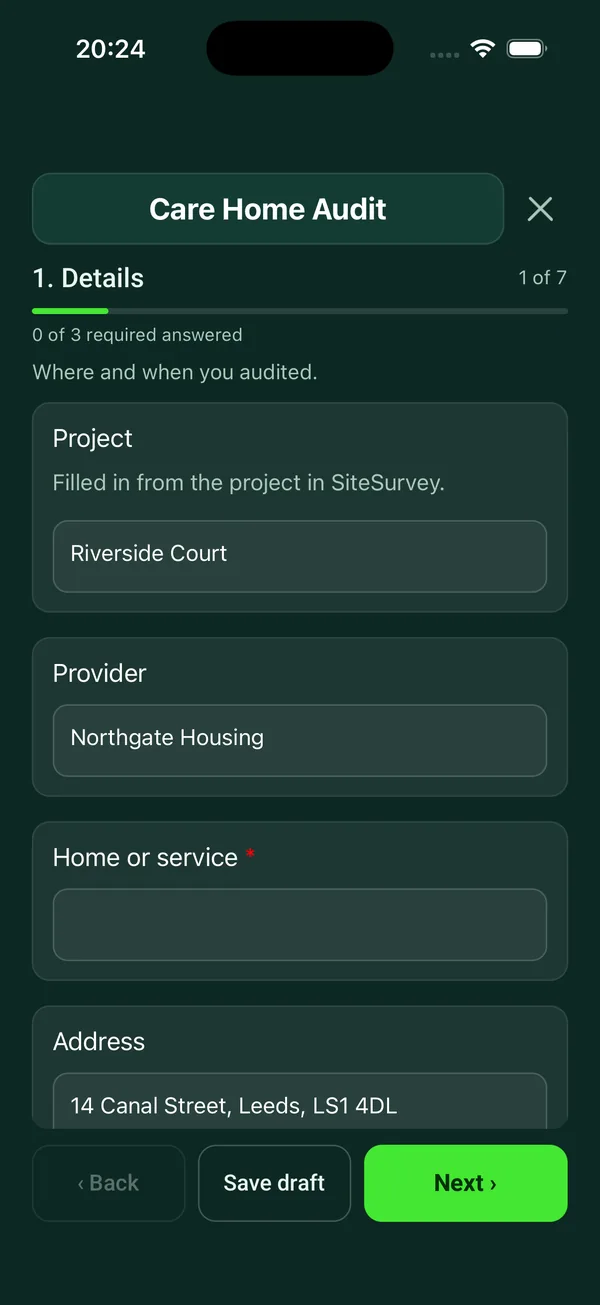
Doing audits on a phone or tablet makes this easier. SiteSurvey runs on iPhone, iPad and Android and works offline, which matters in homes with poor Wi-Fi in the bedrooms. Photos, annotations, signatures and notes are captured against each question, and every completed audit becomes a branded PDF report you can file, share with the provider or show an inspector. You can edit any library form or build your own, and each form page lets you see every question and try it live first.
Facts checked by the SiteSurvey team, 27 October 2026.
Care forms FAQs
How often should a care home do audits?
There is no single legal frequency. Regulation 17 requires systems to assess, monitor and improve quality, and most homes set a monthly or quarterly calendar (for example medicines and IPC monthly, a full home audit quarterly), with extra audits after incidents or poor results.
Source: regulation 17 of the 2014 Regulations (good governance).
What are CQC's five key questions?
Is the service safe, effective, caring, responsive to people's needs, and well-led? Every CQC assessment and rating is organised around them.
Source: CQC: the five key questions we ask.
Who should carry out a care home audit?
Usually the registered manager or a deputy, with specialist audits done by leads (IPC, medicines). Many providers also have someone from outside the home audit it, because fresh eyes spot things staff have stopped noticing.
How often do care home hoists need inspecting?
Hoists and slings used to lift people need a thorough examination by a competent person at least every 6 months, or in line with a written examination scheme. Staff should still check slings for wear before each use.
Source: regulation 9 of LOLER 1998.
What should happen after a resident falls?
Check for injury and get medical help where needed, record the fall, review the falls risk assessment and care plan, and look at the environment. If the injury meets the threshold in the notification rules, the provider must notify CQC.
Source: CQC: statutory notifications.
Is a hand hygiene audit the same as an infection control audit?
No. A hand hygiene audit observes staff practice at the moments hand hygiene is needed. An infection control audit is wider and covers the environment, equipment, linen, waste and PPE as well.
Can we use these forms for domiciliary care or supported living?
Yes, with edits. The medication, hand hygiene and falls forms work in people's own homes, and you can remove building questions that do not apply in the form builder.
Other categories
Put these forms in your team's hands
Works on iPhone, iPad and Android, offline on site, with every completed form turned into a branded PDF report.
Start your trial →