Form library · Care
Care home audit template
A manager's quality audit of a care home, set out under the five key questions CQC asks: is the service safe, effective, caring, responsive and well-led. Each heading has a short set of checks answered from what you see, read and hear on the day, followed by findings with a risk, an action and an owner. Every question is listed below, and you can fill the live form in on this page.
Ready to use from the form library, and every question is yours to edit. Trial from £1, cancel any time.
Try it on your phone
Try it on this phone
Fill in the care home audit on your phone now
See how the care home audit looks on your phone
Scan the code with your phone camera. It opens the real form, no sign-up needed.
Open the live example and fill it in, just as your team would on site. No sign-up needed.
See it on this phoneEvery question is editable. Add this form to your account, then change the wording, add or remove questions and options, and make it fit your own jobs.
Prefer paper? Download a printable copy: PDF or Word
Use the blank PDF or editable Word copy for your manager audit. The completed example is fictional and is not an official inspection report. View the completed example (PDF)
What should a care home audit cover?
A care home audit template helps a manager record the areas reviewed, evidence sampled, findings and follow-up actions. This form groups checks under safe, effective, caring, responsive and well-led, with space for observations and feedback. It is a manager’s own audit record, not an official regulator inspection or a guarantee of compliance.
Last updated . Facts checked by the SiteSurvey team on 5 October 2026 against CQC: the five key questions we ask and regulation 17 of the Health and Social Care Act 2008 (Regulated Activities) Regulations 2014.
How to make this record useful
Finding, evidence and action owner
Dining room observation, 10:30: the manager records which checks were sampled and the evidence supporting each answer. Finding CH-007 references the relevant observation, names the person responsible for follow-up and records the agreed review date.
Fictional example. Record the actual evidence and approved arrangements for your job.
A common recording mistake
Marking every item “yes” without identifying the evidence makes follow-up difficult. State the sample and limitations, and avoid putting unnecessary resident-identifying information in a shared example or report.
What happens next
Review unresolved findings with the responsible team and retain evidence of follow-up. Link specialist medication, infection-control or other audit records where they support a finding rather than duplicating them in a general checklist.
Try the care home audit form live
Answer a few questions and watch it adapt. Your answers are not saved, and any photos you add are deleted within the hour.
This is the real form as your team would use it: questions appear as you answer, scores work themselves out and you can add photos and signatures. No sign-up needed.
Want to see one filled in? See a completed care home audit report (PDF), made by SiteSurvey from a fictional site visit.
Fill it in on a phone or tablet
Your team completes the care home audit on site in the SiteSurvey app on iPhone, iPad and Android phones and tablets. The project name and address fill in for them, it works without signal, and it syncs when the device is back online with photos kept against the question they answer.
Customers and subcontractors do not need the app: send them a link and they can fill it in from any browser.
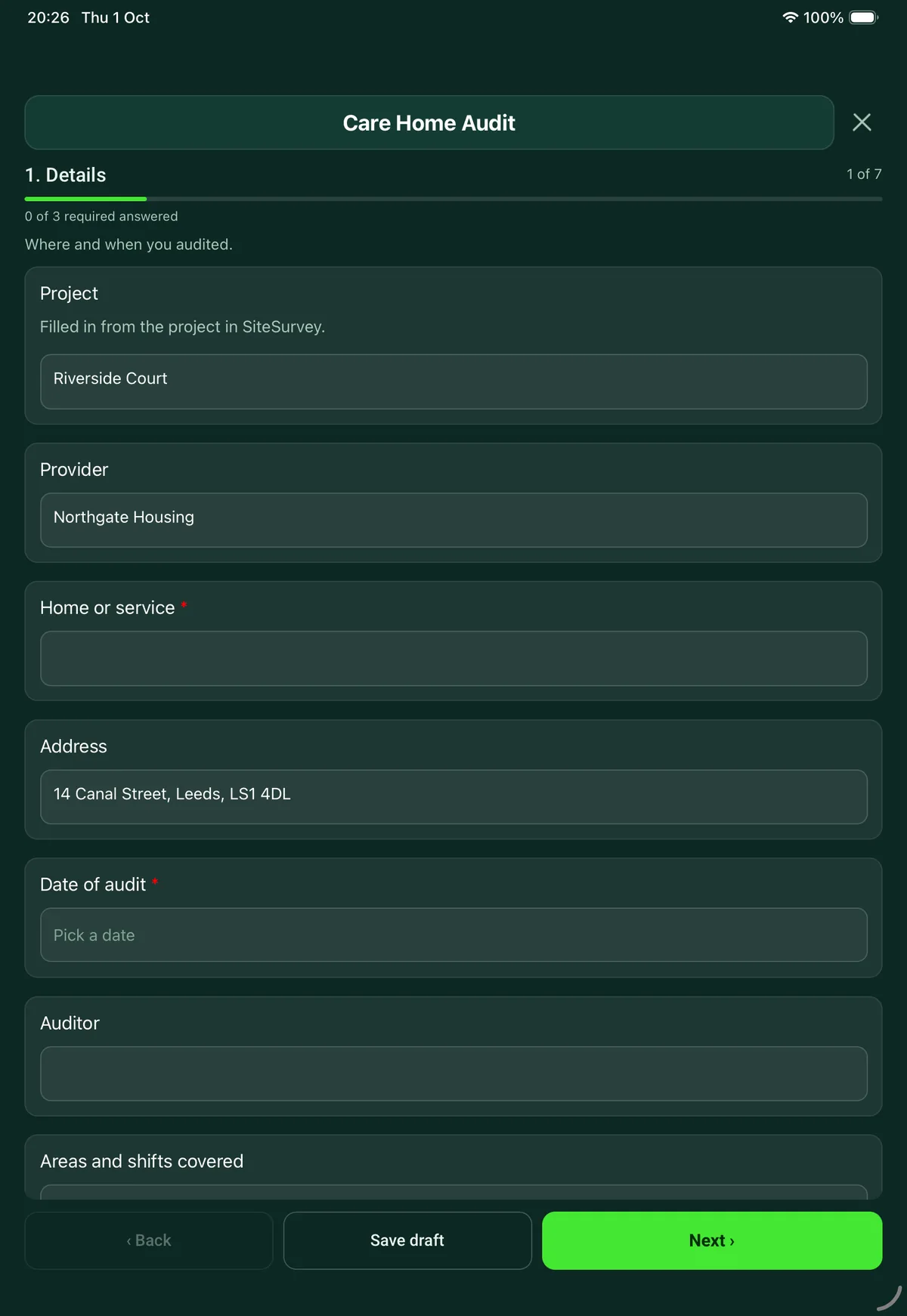
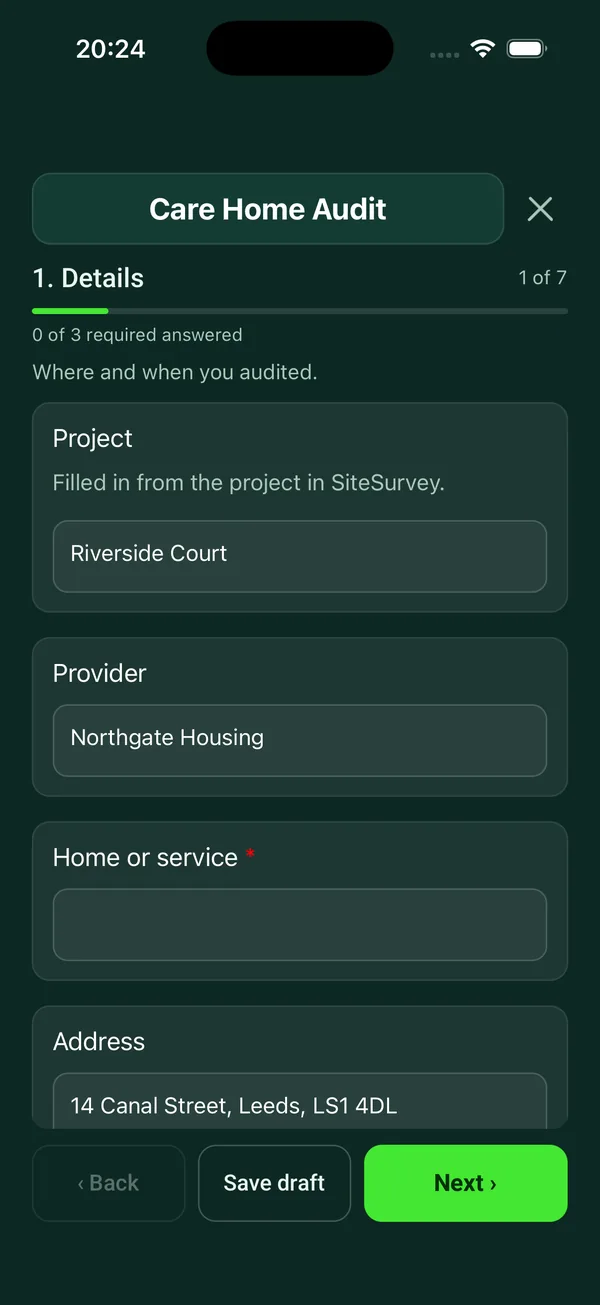
Every question in the care home audit template
Manager's quality audit of a care home, set out under CQC's five key questions: safe, effective, caring, responsive and well-led, with findings and actions. 7 sections and 62 questions. Follow-up questions and guidance appear only when an answer calls for them, so the person on site never sees the ones that do not apply.
Make it your own: every question is editable
This is a starting point, not a fixed form. Once it is in your SiteSurvey account you can reword any question, add or remove questions, sections and answer options, and add your own logo, so it fits the way your team works and the jobs you do.
Details you only enter once
Add this form to a project in SiteSurvey and it fills in what the project already knows, so nobody on site retypes it and every form on the job uses the same names. Anything filled in can still be changed.
- Project: the project name
- Provider: the project's customer
- Home or service: the site, when the form is opened for a space or a product
- Address: the site address, from the space or the project
Details
Where and when you audited.
- ProjectShort answer
Filled in from the project in SiteSurvey.
Fills in from the project name - ProviderShort answerFills in from the project's customer
- Home or service*Short answerFills in from the site, when the form is opened for a space or a product
- AddressShort answerFills in from the site address, from the space or the project
- Date of audit*Date
- AuditorShort answer
- Areas and shifts coveredShort answer
- Residents spoken toNumber
- Staff spoken toNumber
- Care plans and records sampled (room or reference only)Notes
- GuidanceCQC's five key questions are whether a service is safe, effective, caring, responsive to people's needs and well-led. This audit is a manager's own check under those headings. It is not a CQC assessment, and it does not list every regulation. In Scotland, Wales and Northern Ireland care homes have their own regulators.
Safe
CQC: you are protected from abuse and avoidable harm.
- Enough staff are on duty for the needs of the people living here todayChoose one
- Yes
- Partly
- No
- Not applicable
- Staff can say what abuse is and how to report a concernChoose one
- Yes
- Partly
- No
- Not applicable
- Risk assessments, such as falls, skin and choking, are up to date in the care plans sampledChoose one
- Yes
- Partly
- No
- Not applicable
- Medicines are stored and recorded correctly on the round observedChoose one
- Yes
- Partly
- No
- Not applicable
- The building is clean, safe and free of hazards, with call bells in reachChoose one
- Yes
- Partly
- No
- Not applicable
- Accidents and incidents are recorded, reviewed and acted onChoose one
- Yes
- Partly
- No
- Not applicable
- NotesNotes
Effective
CQC: care achieves good outcomes and is based on the best available evidence.
- Care plans sampled are current and reflect the person's needsChoose one
- Yes
- Partly
- No
- Not applicable
- Consent and mental capacity are recorded where decisions are made for someoneChoose one
- Yes
- Partly
- No
- Not applicable
- People are offered enough to eat and drink, and weights are monitored where neededChoose one
- Yes
- Partly
- No
- Not applicable
- People see the GP, nurse and other professionals when they need toChoose one
- Yes
- Partly
- No
- Not applicable
- Staff training and supervision are up to dateChoose one
- Yes
- Partly
- No
- Not applicable
- NotesNotes
Caring
CQC: staff involve and treat you with compassion, kindness, dignity and respect.
- Staff speak to people kindly, by the name they prefer, and without rushingChoose one
- Yes
- Partly
- No
- Not applicable
- Personal care is given in private, with doors and curtains closedChoose one
- Yes
- Partly
- No
- Not applicable
- People are offered choices about their day, food and clothesChoose one
- Yes
- Partly
- No
- Not applicable
- People look well cared for: clean clothes, hair, nails, glasses and hearing aidsChoose one
- Yes
- Partly
- No
- Not applicable
- Families and friends are welcomed and kept informedChoose one
- Yes
- Partly
- No
- Not applicable
- What did residents and families say?Notes
Responsive
CQC: services are organised so that they meet your needs.
- There are activities today that people chose and are taking part inChoose one
- Yes
- Partly
- No
- Not applicable
- Care plans record preferences, life history and what matters to the personChoose one
- Yes
- Partly
- No
- Not applicable
- Complaints are recorded, answered and learnt fromChoose one
- Yes
- Partly
- No
- Not applicable
- End of life wishes are recorded where people want to give themChoose one
- Yes
- Partly
- No
- Not applicable
- Call bells are answered promptly on the checks madeChoose one
- Yes
- Partly
- No
- Not applicable
- NotesNotes
Well-led
CQC: leadership, management and governance make sure the service provides high-quality care.
- The programme of audits is up to date and actions are completedChoose one
- Yes
- Partly
- No
- Not applicable
- Staff say they are listened to and know who to go toChoose one
- Yes
- Partly
- No
- Not applicable
- Records are accurate, secure and up to dateChoose one
- Yes
- Partly
- No
- Not applicable
- Notifications to the regulator have been made when requiredChoose one
- Yes
- Partly
- No
- Not applicable
- Feedback from residents, families and staff is collected and acted onChoose one
- Yes
- Partly
- No
- Not applicable
- The latest inspection rating is displayedChoose one
- Yes
- Partly
- No
- Not applicable
- NotesNotes
Findings and actions
One entry for each thing to put right.
- Are there findings to record?Yes or No
- FindingsRepeat for each finding. Each one asks:Shown when “Are there findings to record?” is Yes
- Area*Choose one
- Safe
- Effective
- Caring
- Responsive
- Well-led
- Other (describe)
- RiskChoose one
- High
- Medium
- Low
- What did you find?*Notes
- ActionNotes
- WhoShort answer
- By whenDate
- PhotosPhotos
Do not photograph residents or anything that identifies them.
- Date completedDate
- Checked byShort answer
- FindingsWorked out by the formShown when “Are there findings to record?” is Yes
- High riskWorked out by the formShown when “Are there findings to record?” is Yes
- Overall*Choose one
- Good: minor points only
- Needs improvement
- Serious concerns: act now
- SummaryNotes
- Next audit dueDate
- Auditor nameShort answer
- Auditor signatureSignature
- Manager nameShort answer
- Date reviewed by managerDate
- Manager signatureSignature
See it filled in
A completed care home audit report, made by SiteSurvey from a fictional site visit: every answer, the photos, the guidance that applied and the sign-off, ready to send as a PDF.
Care home audit FAQs
What are CQC's five key questions?
CQC asks whether a service is safe, effective, caring, responsive to people's needs and well-led. Safe means people are protected from abuse and avoidable harm. Caring means staff involve and treat people with compassion, kindness, dignity and respect. Well-led means leadership, management and governance make sure the service provides high-quality care.
Is this a CQC inspection checklist?
No. It is a manager's own audit under CQC's headings, useful as a regular walk round or before an inspection. It is not a CQC assessment and does not list every regulation. CQC regulates care in England: Scotland, Wales and Northern Ireland have their own regulators.
How are the checks answered?
Each check is yes, partly, no or not applicable, from evidence on the day: what you saw, the care plans and records you sampled, and what residents, families and staff told you. The form records how many residents and staff you spoke to.
Does it record what residents say?
Yes. The caring section has a box for what residents and families said, alongside checks on how staff speak to people, privacy during personal care, choice, appearance and how families are kept informed.
What happens to the findings?
Each finding is filed under one of the five headings with a High, Medium or Low risk, the action, who will do it, by when and who checked it, with photos but not of residents. The form counts the findings and the high risk ones and asks for an overall result. The auditor and the manager sign on the device, with the date the next audit is due.
Do care homes have to audit their own service?
In England, regulation 17 of the Health and Social Care Act 2008 (Regulated Activities) Regulations 2014 requires systems or processes that assess, monitor and improve the quality and safety of the service, and assess, monitor and mitigate risks to the people using it. A regular audit like this is one way to show that. In the SiteSurvey app it works offline and syncs when the device is back online, and the record goes out as a PDF or a share link.
Related
Related templates
Templates that go with the care home audit form
Medicines audit for a care home: storage, a sample of administration records, controlled drugs, staff training and competence, incidents and findings with actions.
Infection control audit for a care home or clinic: management, cleanliness, hand hygiene, protective equipment, sharps and waste, laundry, equipment and outbreaks.
Falls assessment record for an older person in a care home or at home: falls history, the risk factors NICE lists, the environment, and actions with referrals. No score.
Internal audit of a quality, health and safety or environmental management system, a 5S area or a procedure, with findings, corrective actions and sign-off.
Use this care home audit form with your team
Add it from the form library in one click, change any question, and every completed form becomes a branded PDF report.
Start your trial →