Form library · Quality and compliance
Internal audit checklist
An internal audit form for a quality, health and safety or environmental management system, a 5S workplace audit or a single process or procedure. It records the scope and criteria, who was interviewed and what was sampled, checks for the type of audit, each finding with its evidence and corrective action, and the closing meeting. Every question is listed below, and you can fill the live form in on this page.
Ready to use from the form library, and editable. Trial from £1, cancel any time.
What should an internal audit checklist include?
An internal audit checklist should record the scope, the criteria the evidence is compared with, the auditors and the auditee, the people interviewed and the documents sampled. Checks are answered from evidence seen on the day. Each finding needs the requirement, the evidence, its type, the root cause and a corrective action with an owner and a due date, followed by a conclusion and a closing meeting.
Last updated . Facts checked on 30 September 2026 against HSE Managing for health and safety (HSG65) and the ISO 9001 Auditing Practices Group.
Try the internal audit form live
Answer a few questions and watch it adapt. Your answers are not saved, and any photos you add are deleted within the hour.
This is the real form as your team would use it: questions appear as you answer, scores work themselves out and you can add photos and signatures. No sign-up needed.
Fill it in on a phone or tablet
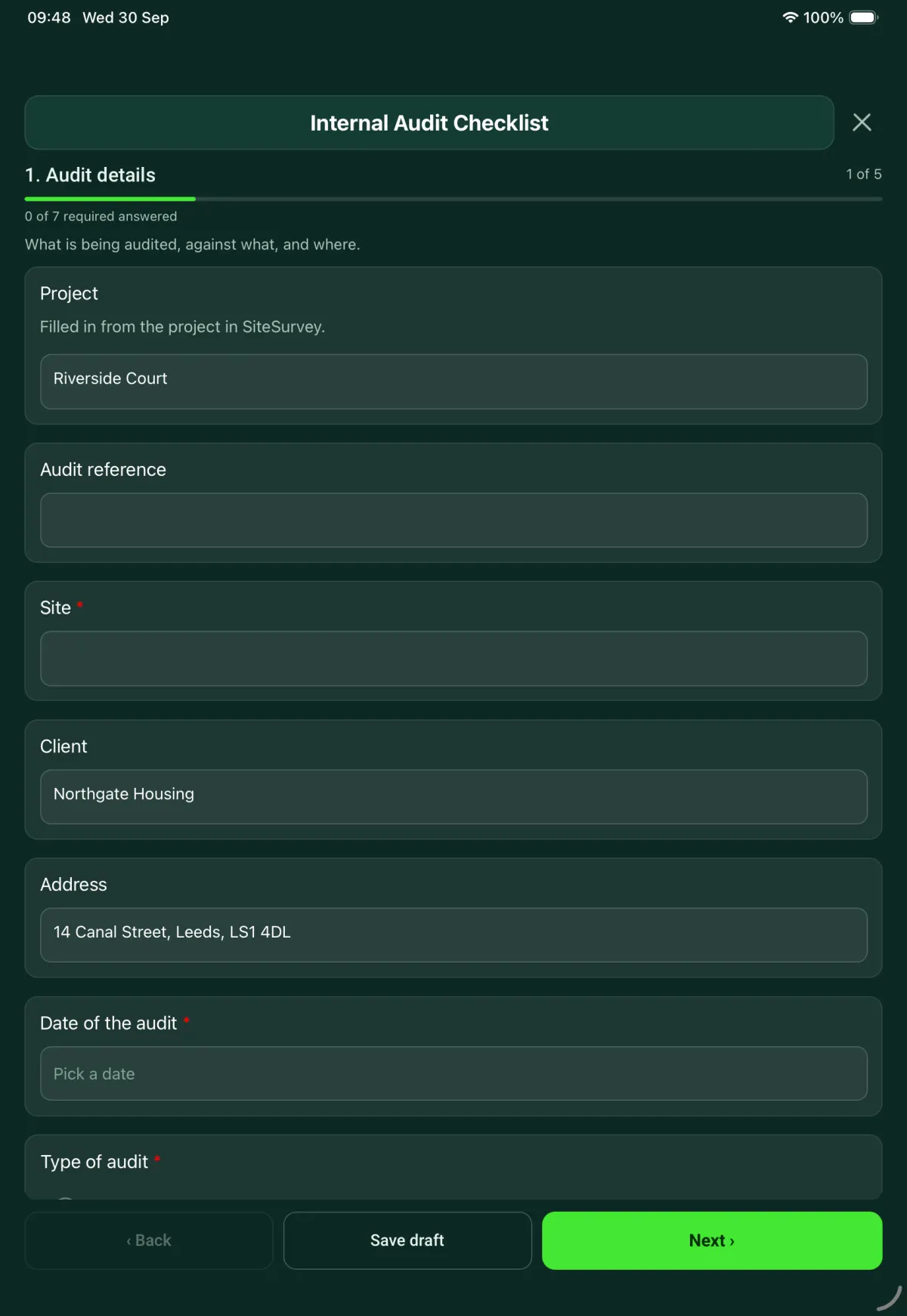
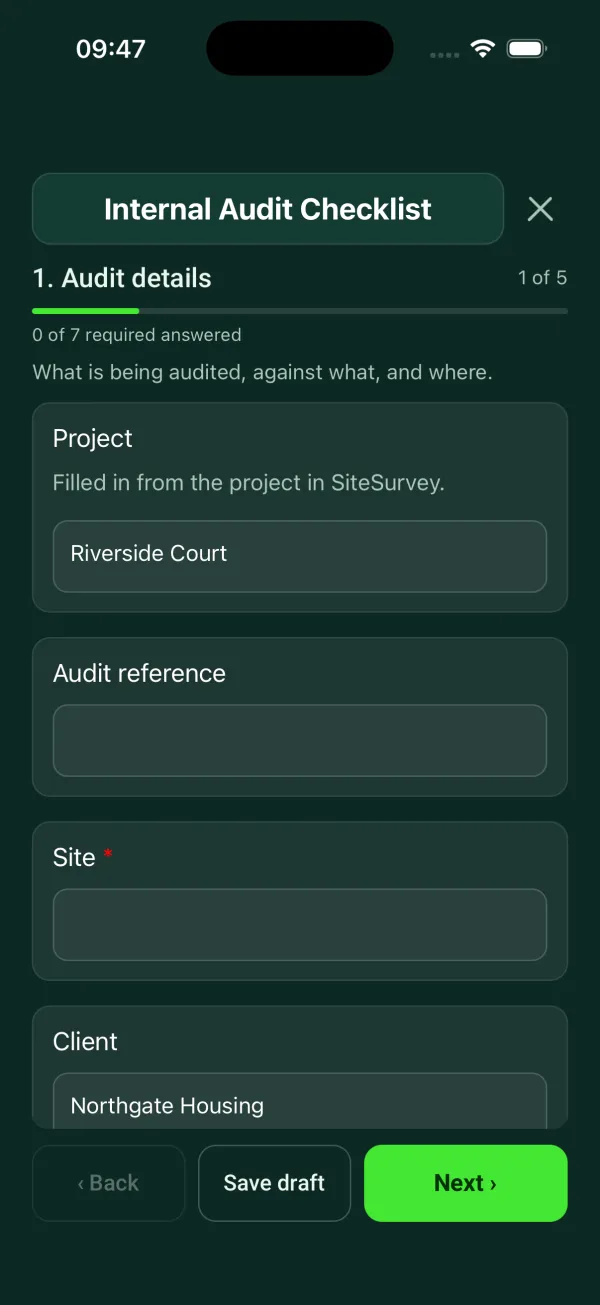
Your team completes the internal audit checklist on site in the SiteSurvey app on iPhone, iPad and Android phones and tablets. The project name and address fill in for them, it works without signal, and it syncs when the device is back online with photos kept against the question they answer.
Customers and subcontractors do not need the app: send them a link and they can fill it in from any browser.
Every question in the internal audit template
Internal audit of a quality, health and safety or environmental management system, a 5S area or a procedure, with findings, corrective actions and sign-off. 7 sections and 91 questions. Follow-up questions and guidance appear only when an answer calls for them, so the person on site never sees the ones that do not apply.
Details you only enter once
Add this form to a project in SiteSurvey and it fills in what the project already knows, so nobody on site retypes it and every form on the job uses the same names. Anything filled in can still be changed.
- Project: the project name
- Site: the site, when the form is opened for a space or a product
- Client: the project's customer
- Address: the site address, from the space or the project
Audit details
What is being audited, against what, and where.
- ProjectShort answerFills in from the project name
- Audit referenceShort answer
- Site*Short answerFills in from the site, when the form is opened for a space or a product
- ClientShort answerFills in from the project's customer
- AddressShort answerFills in from the site address, from the space or the project
- Date of the audit*Date
- Type of audit*Choose one
- Quality management (ISO 9001)
- Health and safety management (ISO 45001)
- Environmental management (ISO 14001)
- 5S workplace audit
- Process or procedure audit
- Standard and edition audited againstShort answerShown only when the answers above make it relevant
- CheckClause numbers. ISO standards are sold, not free, and new editions can renumber clauses. Quote clause numbers from the copy of the standard your organisation holds, not from memory.Shown only when the answers above make it relevant
- GuidancePlan, Do, Check, Act. HSE guidance Managing for health and safety (HSG65) describes managing health and safety as Plan, Do, Check, Act. Under Check it says to make sure your plan has been implemented, as paperwork on its own is not a good performance measure, and that in some circumstances formal audits may be useful.Shown only when the answers above make it relevant
- Process or procedure auditedShort answerShown when “Type of audit” is “Process or procedure audit”
- Document reference and versionShort answerShown when “Type of audit” is “Process or procedure audit”
- Work area auditedShort answerShown when “Type of audit” is “5S workplace audit”
- Audit scope*Notes
- Audit criteriaNotes
- Why is this audit taking place?Choose one
- Planned audit in the audit programme
- Follow-up of an earlier audit
- Triggered by an incident, complaint or change
- Reference of the audit being followed upShort answerShown when “Why is this audit taking place?” is “Follow-up of an earlier audit”
- What happened, and when?NotesShown when “Why is this audit taking place?” is “Triggered by an incident, complaint or change”
- GuidancePlanning the audit programme. ISO 9001 Auditing Practices Group guidance says ISO 9001 does not specify the frequency, duration or scope of internal audits. The organisation defines them, and processes with higher risk or past nonconformities should have priority.Shown when “Why is this audit taking place?” is “Planned audit in the audit programme”
Auditors, people and documents
Who audited, who was interviewed and what was sampled.
- Lead auditor name and role*Short answer
- Other auditorsShort answer
- Auditee, the person responsible for the area auditedShort answer
- Did any auditor audit work they do, manage or are responsible for?Yes or No
- CheckIndependence. ISO 9004 guidance, as quoted by the ISO 9001 Auditing Practices Group, is that audits should be conducted by people who are not involved in the activity being examined, to give an independent view. Swap auditors where you can.Shown when “Did any auditor audit work they do, manage or are responsible for?” is Yes
- Which part, and how was bias kept out?NotesShown when “Did any auditor audit work they do, manage or are responsible for?” is Yes
- Was an opening meeting held to agree the scope and timings?Yes or No
- People interviewedRepeat for each person. Each one asks:
- NameShort answer
- RoleShort answer
- What were they asked about?Short answer
- Documents and records sampledRepeat for each document. Each one asks:
- Document or recordShort answer
- Reference and versionShort answer
- ResultChoose one
- Matched practice
- Did not match practice
- Out of date or not approved
- Documents and records sampledWorked out by the form
Management system checks
Questions for the type of audit chosen on page 1.
- GuidanceAnswer from evidence seen today: records, observation and interviews. Anything answered No or Partly should also be written up on the Findings page.
- Customer and product requirements are reviewed before orders or contracts are acceptedChoose one
- Yes
- Partly
- No
- Not checked
Shown when “Type of audit” is “Quality management (ISO 9001)” - Nonconforming products or services are identified and kept from unintended useChoose one
- Yes
- Partly
- No
- Not checked
Shown when “Type of audit” is “Quality management (ISO 9001)” - Measuring equipment used for acceptance is identified and in date for calibration or verificationChoose one
- Yes
- Partly
- No
- Not checked
Shown when “Type of audit” is “Quality management (ISO 9001)” - Customer feedback and complaints are recorded and acted onChoose one
- Yes
- Partly
- No
- Not checked
Shown when “Type of audit” is “Quality management (ISO 9001)” - Corrective actions from earlier audits were closed and workedChoose one
- Yes
- Partly
- No
- Not checked
Shown when “Type of audit” is “Quality management (ISO 9001)” - CheckAt least one answer is No. Raise a finding for each one on the Findings page.Shown only when the answers above make it relevant
- Risk assessments exist for the activities seen, and match how the work is doneChoose one
- Yes
- Partly
- No
- Not checked
Shown only when the answers above make it relevant - Workers are involved and consulted on health and safetyChoose one
- Yes
- Partly
- No
- Not checked
Shown only when the answers above make it relevant - Accidents, incidents and near misses are reported and investigatedChoose one
- Yes
- Partly
- No
- Not checked
Shown only when the answers above make it relevant - What people do on the floor matches the written arrangementsChoose one
- Yes
- Partly
- No
- Not checked
Shown only when the answers above make it relevant - Actions from inspections and earlier audits are closedChoose one
- Yes
- Partly
- No
- Not checked
Shown only when the answers above make it relevant - CheckAt least one answer is No. Raise a finding for each one on the Findings page. If anyone is at immediate risk, stop and deal with it before carrying on.Shown only when the answers above make it relevant
- Environmental aspects of the activities seen are identified and currentChoose one
- Yes
- Partly
- No
- Not checked
Shown when “Type of audit” is “Environmental management (ISO 14001)” - Waste is segregated, stored securely and records of transfers are keptChoose one
- Yes
- Partly
- No
- Not checked
Shown when “Type of audit” is “Environmental management (ISO 14001)” - Spill kits and controls for fuels and chemicals are in place and people know how to use themChoose one
- Yes
- Partly
- No
- Not checked
Shown when “Type of audit” is “Environmental management (ISO 14001)” - The organisation has checked it meets its environmental legal and other requirementsChoose one
- Yes
- Partly
- No
- Not checked
Shown when “Type of audit” is “Environmental management (ISO 14001)” - Corrective actions from earlier audits were closed and workedChoose one
- Yes
- Partly
- No
- Not checked
Shown when “Type of audit” is “Environmental management (ISO 14001)” - CheckAt least one answer is No. Raise a finding for each one on the Findings page.Shown only when the answers above make it relevant
- The people doing the work use the current version of the procedureChoose one
- Yes
- Partly
- No
- Not checked
Shown when “Type of audit” is “Process or procedure audit” - The work seen followed the procedure step by stepChoose one
- Yes
- Partly
- No
- Not checked
Shown when “Type of audit” is “Process or procedure audit” - Staff could explain the procedure and why it mattersChoose one
- Yes
- Partly
- No
- Not checked
Shown when “Type of audit” is “Process or procedure audit” - Records required by the procedure are completeChoose one
- Yes
- Partly
- No
- Not checked
Shown when “Type of audit” is “Process or procedure audit” - Where did practice differ from the procedure, and is the procedure or the practice wrong?NotesShown only when the answers above make it relevant
- CheckAt least one answer is No. Raise a finding for each one on the Findings page.Shown only when the answers above make it relevant
5S workplace audit
Sort, Set in order, Shine, Standardise, Sustain.
- GuidanceScore each S from 1 (poor) to 5 (excellent) for the area as you find it. Take photos from the same spots each time so audits can be compared.
- Sort: only what is needed is in the areaRating 1 to 5 (Poor to Excellent)
- Set in order: everything has a marked place and is in itRating 1 to 5 (Poor to Excellent)
- Shine: the area and equipment are clean and checked while cleaningRating 1 to 5 (Poor to Excellent)
- Standardise: the standards for the area are written, visible and the same across shiftsRating 1 to 5 (Poor to Excellent)
- Sustain: the standards are kept to and audits happen as plannedRating 1 to 5 (Poor to Excellent)
- 5S score (out of 25)Worked out by the formShown when “Sort: only what is needed is in the area” is answered and “Set in order: everything has a marked place and is in it” is answered and “Shine: the area and equipment are clean and checked while cleaning” is answered and “Standardise: the standards for the area are written, visible and the same across shifts” is answered and “Sustain: the standards are kept to and audits happen as planned” is answered
- 5S score (%)Worked out by the formShown when “Sort: only what is needed is in the area” is answered and “Set in order: everything has a marked place and is in it” is answered and “Shine: the area and equipment are clean and checked while cleaning” is answered and “Standardise: the standards for the area are written, visible and the same across shifts” is answered and “Sustain: the standards are kept to and audits happen as planned” is answered
- CheckAt least one S scored 2 or less. Raise a finding for it on the Findings page with an owner and date.Shown only when the answers above make it relevant
- Notes on the areaNotes
- Photos of the areaPhotos
Findings
One entry for each finding, including good practice seen.
- GuidanceWrite each finding so someone who was not there can understand it: the requirement, what you saw, and where. Record conformities too, so the report shows what was checked.
- FindingsRepeat for each finding. Each one asks:
- Clause, process or areaShort answer
- Requirement checkedNotes
- Evidence seenNotes
- PhotosPhotos
- Finding type*Choose one
- Conformity
- Observation
- Opportunity for improvement
- Minor nonconformity
- Major nonconformity
- WarningMajor nonconformity. This form uses major for a requirement not met at all, or a failure that puts products, services, people or the environment at risk. Agree containment with the auditee before you leave.Shown when “Finding type” is “Major nonconformity”
- What was done straight away to contain it?NotesShown when “Finding type” is “Major nonconformity”
- Root causeNotesShown only when the answers above make it relevant
- Corrective actionNotesShown only when the answers above make it relevant
- OwnerShort answerShown only when the answers above make it relevant
- Due dateDateShown only when the answers above make it relevant
- CheckA nonconformity needs a named owner and a due date, or it is unlikely to be closed.Shown only when the answers above make it relevant
- CheckThe due date is before the audit date. Check the date.Shown only when the answers above make it relevant
- Has the auditee seen and agreed the finding?Yes or No
- What does the auditee say?NotesShown when “Has the auditee seen and agreed the finding?” is No
Summary and conclusion
Counts are worked out from the findings.
- Findings recordedWorked out by the form
- Major nonconformitiesWorked out by the form
- Minor nonconformitiesWorked out by the form
- Nonconformities in totalWorked out by the form
- ObservationsWorked out by the form
- Opportunities for improvementWorked out by the form
- ConformitiesWorked out by the form
- WarningMajor nonconformity raised. Report it to the person who owns the audit programme and top management, and plan a follow-up audit to check the correction.Shown only when the answers above make it relevant
- CheckNo findings are recorded. Every audit should show what was checked, so record conformities as well.Shown only when the answers above make it relevant
- Audit conclusion*Choose one
- Conforms and is effective
- Conforms, with nonconformities to correct
- Does not conform in the areas audited
- Audit could not be completed
- CheckNonconformities are recorded but the conclusion says the area conforms with none to correct. Check the conclusion.Shown only when the answers above make it relevant
- Summary of the audit for the reportNotes
- Good practice seenNotes
- Is a follow-up audit needed?Yes or No
- Follow-up byDateShown when “Is a follow-up audit needed?” is Yes
Closing meeting and sign-off
- Were the findings presented at a closing meeting?Yes or No
- Auditee response to the findingsChoose one
- All findings accepted
- Some findings disputed
- Not yet seen by the auditee
- Which findings are disputed, and why?NotesShown when “Auditee response to the findings” is “Some findings disputed”
- Lead auditor nameShort answer
- DateDate
- Lead auditor signatureSignature
- Auditee nameShort answer
- DateDate
- Auditee signatureSignature
Internal audit template questions
Can I use it as an ISO 9001, ISO 45001 or ISO 14001 audit checklist?
Yes. Choose the type of audit and record the standard and edition you audit against. Each type has its own checks, such as nonconforming products and calibration for quality, risk assessments and worker consultation for health and safety, and waste and spill controls for environmental audits. The form does not quote clause numbers: ISO standards are sold, not free, and new editions can renumber clauses, so take them from the copy your organisation holds.
How often should internal audits be carried out?
ISO 9001 Auditing Practices Group guidance says ISO 9001 does not specify the frequency, duration or scope of internal audits. The organisation defines them, and processes with higher risk or past nonconformities should have priority. The form records whether the audit is planned in the audit programme, a follow-up of an earlier audit, or triggered by an incident, complaint or change.
How does the 5S audit checklist score an area?
Sort, Set in order, Shine, Standardise and Sustain are each scored from 1, poor, to 5, excellent, for the area as you find it. The form works out a score out of 25 and a percentage, and any S scored 2 or less prompts a finding with an owner and a date. Take photos from the same spots each time so audits can be compared.
What is the difference between a major and a minor nonconformity?
Each finding is a conformity, an observation, an opportunity for improvement, a minor nonconformity or a major nonconformity. This form uses major for a requirement not met at all, or a failure that puts products, services, people or the environment at risk, and asks what was done straight away to contain it. A nonconformity needs a root cause, a named owner and a due date, and a major one prompts a follow-up audit.
How does it fit with HSE's Plan, Do, Check, Act?
HSE guidance Managing for health and safety (HSG65) describes managing health and safety as Plan, Do, Check, Act. Under Check it says to make sure your plan has been implemented, as paperwork on its own is not a good performance measure, and that in some circumstances formal audits may be useful. The health and safety checks ask whether what people do on the floor matches the written arrangements.
Can auditors audit their own area, and who signs the report?
The form asks whether any auditor audited work they do, manage or are responsible for, and how bias was kept out. ISO 9004 guidance, as quoted by the ISO 9001 Auditing Practices Group, is that audits should be done by people not involved in the activity. The lead auditor and the auditee sign on the device after the closing meeting, and disputed findings are recorded. The report goes out as a PDF or a share link.
Related
Related templates
Templates that go with the internal audit form
Workplace audit with walkways, first aid, fire equipment and records, findings and corrective actions, closing meeting.
A cleaning quality audit and housekeeping inspection, area by area, with a pass score, chemical and waste checks, actions and sign-off by the auditor and the cleaning supervisor.
Construction site safety walk: perimeter, work at height, welfare, housekeeping, plant, hazards and actions.
Use this internal audit form with your team
Add it from the form library in one click, change any question, and every completed form becomes a branded PDF report.
Start your trial →