Form library · Health and safety
Construction site safety checklist
A site safety inspection form for construction sites. Walk the perimeter, edges and scaffolds, welfare, housekeeping, plant and excavations, then score each hazard and give the action an owner. Every question is listed below, and you can fill the live form in on this page.
Ready to use from the form library, and editable. Trial from £1, cancel any time.
What should a construction site safety checklist include?
A construction site safety checklist should cover the perimeter and gates, work at height and edge protection, scaffold inspections, welfare and first aid, housekeeping, plant and excavations. For each hazard, record where it is, a photo, a risk score, what was done on the walk and who owns the further action by when. It should end with who received the report and the next inspection date.
Last updated . Facts checked on 26 September 2026 against regulation 5 of the Management of Health and Safety at Work Regulations 1999 and HSE on safety representatives' inspections.
Try the site safety inspection form live
Answer a few questions and watch it adapt. Your answers are not saved, and any photos you add are deleted within the hour.
This is the real form as your team would use it: questions appear as you answer, scores work themselves out and you can add photos and signatures. No sign-up needed.
Fill it in on a phone or tablet
Your team completes the site safety inspection on site in the SiteSurvey app on iPhone, iPad and Android phones and tablets. The project name and address fill in for them, it works without signal, and it syncs when the device is back online with photos kept against the question they answer.
Customers and subcontractors do not need the app: send them a link and they can fill it in from any browser.
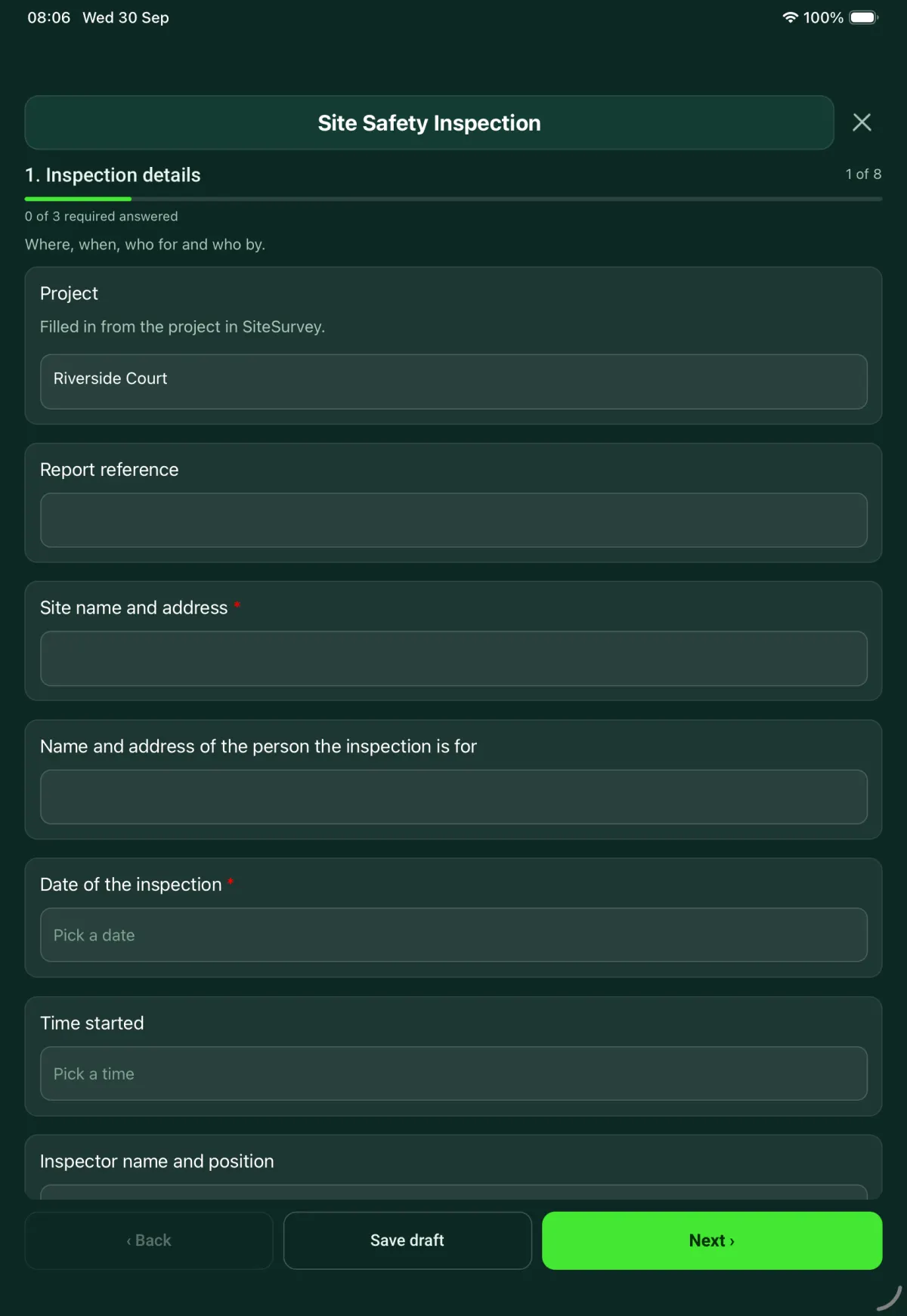
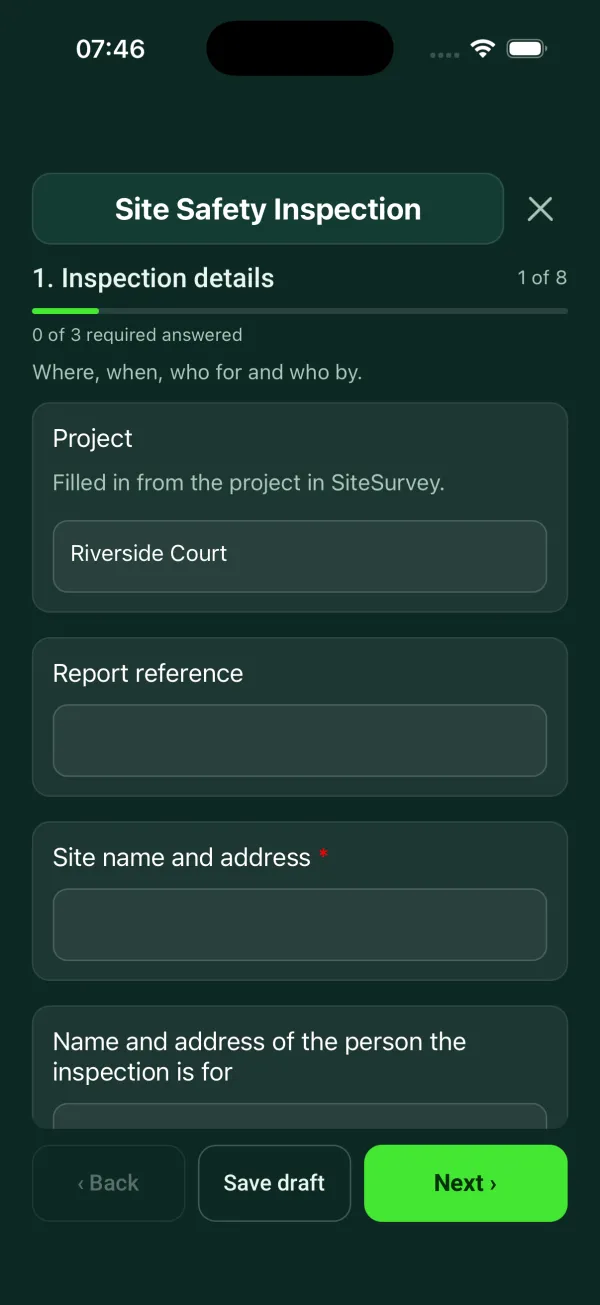
Every question in the site safety inspection template
Construction site safety walk: perimeter, work at height, welfare, housekeeping, plant, hazards and actions. 8 sections and 83 questions. Follow-up questions and guidance appear only when an answer calls for them, so the person on site never sees the ones that do not apply.
Details you only enter once
Add this form to a project in SiteSurvey and it fills in what the project already knows, so nobody on site retypes it and every form on the job uses the same names. Anything filled in can still be changed.
- Project: the project name
- Site name and address: the site, when the form is opened for a space or a product
Inspection details
Where, when, who for and who by.
- ProjectShort answerFills in from the project name
- Report referenceShort answer
- Site name and address*Short answerFills in from the site, when the form is opened for a space or a product
- Name and address of the person the inspection is forShort answer
- Date of the inspection*Date
- Time startedTime
- Inspector name and positionShort answer
- Type of inspection*Choose one
- Routine walk-round
- After bad weather or another event
- After an incident or near miss
- Follow-up on earlier actions
- What happened, and when?NotesShown when “Type of inspection” is “After bad weather or another event”
- CheckWork equipment for work at height that is exposed to conditions that can cause deterioration must be inspected each time exceptional circumstances could have put its safety at risk. Include scaffolds and edge protection in this inspection.Shown when “Type of inspection” is “After bad weather or another event”
- Incident or near miss referenceShort answerShown when “Type of inspection” is “After an incident or near miss”
- Reference of the earlier inspectionShort answerShown when “Type of inspection” is “Follow-up on earlier actions”
- WeatherChoose one
- Dry
- Rain
- High wind
- Ice or snow
- Fog
- People on siteNumber
- Were all working areas inspected?Yes or No
- Which areas were not inspected, and why?NotesShown when “Were all working areas inspected?” is No
- Walk Cam: Site safety inspectionWalk Cam video with voice-to-text
Perimeter and access
Walk the boundary. Check fencing, gates and signs.
- GuidanceThe principal contractor must make sure the necessary steps are taken to prevent access by unauthorised persons to the construction site.
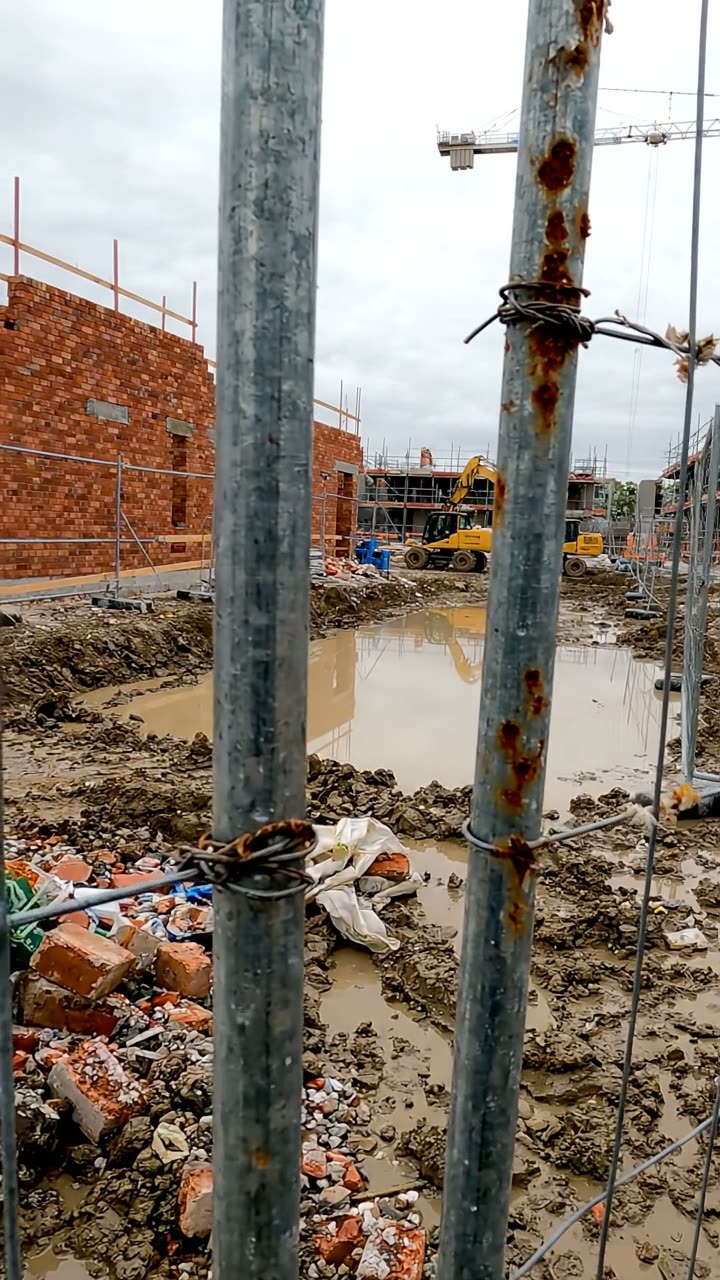
Mesh fence panels on block feet at the edge of a construction site - How is the perimeter marked?Choose one
- Fenced or hoarded all round
- Signs and barriers only
- Not marked
- WarningThe boundary is not marked. Where it is needed for health and safety, a site must have its perimeter identified by suitable signs or be fenced off, so far as is reasonably practicable.Shown when “How is the perimeter marked?” is “Not marked”
- Condition of the fence or hoardingChoose one
- Secure all round
- Loose, damaged or missing in places
Shown when “How is the perimeter marked?” is “Fenced or hoarded all round” - Where is it loose, damaged or missing?Short answerShown when “Condition of the fence or hoarding” is “Loose, damaged or missing in places”
- Was it made secure during the walk?Yes or NoShown when “Condition of the fence or hoarding” is “Loose, damaged or missing in places”
- WarningThe perimeter is still open. Record it as a hazard in section 6, with an owner and a due date.Shown when “Condition of the fence or hoarding” is “Loose, damaged or missing in places” and “Was it made secure during the walk?” is No
- Photos of the fence or hoardingPhotosShown when “Condition of the fence or hoarding” is “Loose, damaged or missing in places”
- Are all gates staffed or locked?Yes or No
- Which gate is not controlled?Short answerShown when “Are all gates staffed or locked?” is No
- Do members of the public pass close to the site?Yes or No
- Who?Tick all that apply
- People on a footpath or road
- Neighbours
- Children, for example near a school or play area
- Occupiers of a building in use
- Other (describe)
Shown when “Do members of the public pass close to the site?” is Yes - CheckChildren are nearby. HSE guidance says to secure the site when work finishes for the day, and to barrier off or cover excavations and pits.Shown when “Who?” includes “Children, for example near a school or play area”
Work at height and edge protection
Slab edges, openings, guardrails, toe boards and scaffolds.
- Is anyone working at height, or near an edge or opening?Yes or No
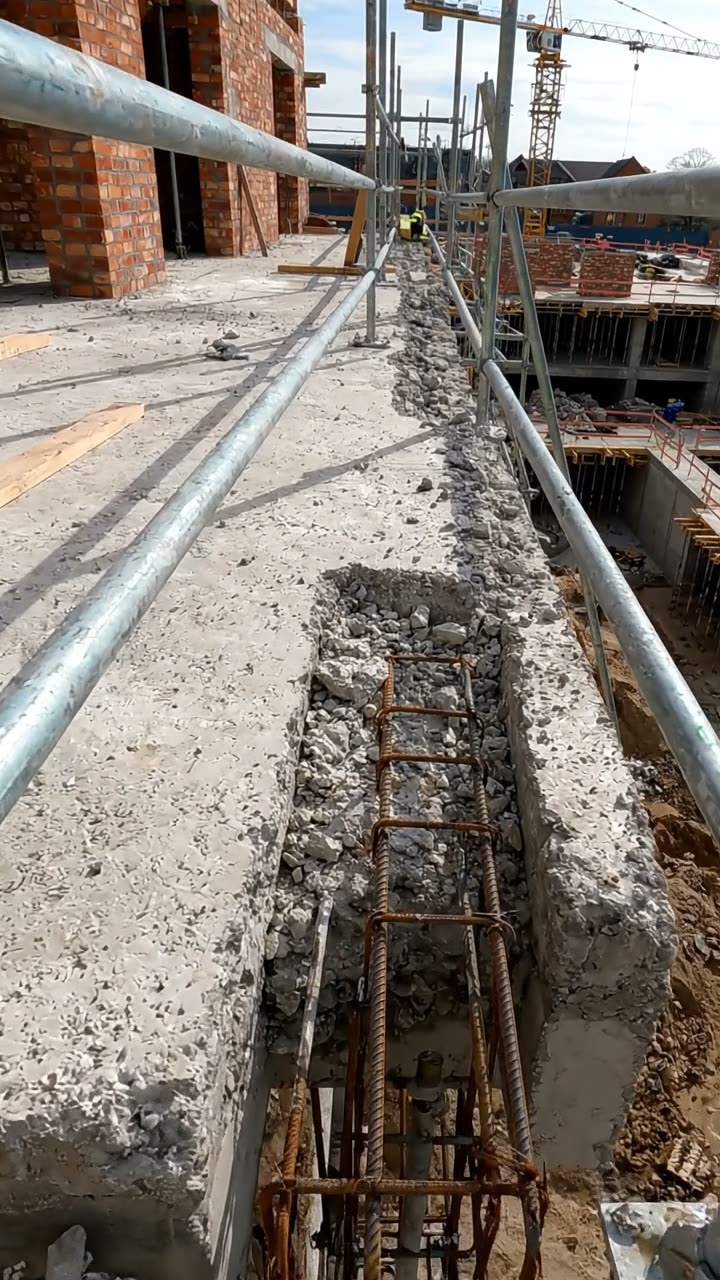
Tube guardrails along the edge of a concrete floor slab - GuidanceFor construction work, the top guardrail must be at least 950 mm above the edge, and no gap between rails or toe board may be more than 470 mm. These are legal minimum and maximum sizes.Shown when “Is anyone working at height, or near an edge or opening?” is Yes
- Edge protectionChoose one
- In place on every edge and opening
- Missing or incomplete in places
- None
Shown when “Is anyone working at height, or near an edge or opening?” is Yes - Where is it missing or incomplete?Short answerShown only when the answers above make it relevant
- Has work been stopped in that area?Yes or NoShown only when the answers above make it relevant
- WarningPeople can fall from an unprotected edge. Record why work is carrying on, and what other measures are in place to prevent a fall.Shown only when the answers above make it relevant
- Other measures in placeNotesShown only when the answers above make it relevant
- Top guardrail height above the edge (mm)NumberShown only when the answers above make it relevant
- Largest gap between rails or toe board (mm)NumberShown only when the answers above make it relevant
- Top guardrail, height above the 950 mm minimum (mm)Worked out by the formShown only when the answers above make it relevant
- WarningThe top guardrail is lower than 950 mm. That is below the legal minimum for construction work.Shown only when the answers above make it relevant
- WarningThe gap is more than 470 mm. That is above the legal maximum for construction work.Shown only when the answers above make it relevant
- GuidanceThese sizes meet the minimum height and maximum gap. Check that the rails are also strong, rigid and fixed so they cannot be knocked out of place.Shown only when the answers above make it relevant
- Are there any open holes or pockets in the floor?Yes or NoShown when “Is anyone working at height, or near an edge or opening?” is Yes
- Where, and are they covered or guarded?Short answerShown when “Are there any open holes or pockets in the floor?” is Yes
- Is a scaffold or other working platform in use?Yes or NoShown when “Is anyone working at height, or near an edge or opening?” is Yes
- Could a person fall 2 metres or more from it?Yes or NoShown when “Is a scaffold or other working platform in use?” is Yes
- Days since its last recorded inspectionNumberShown when “Is a scaffold or other working platform in use?” is Yes
- WarningA working platform used for construction work, from which a person could fall 2 metres or more, must not be used unless it has been inspected in that position within the previous 7 days.Shown only when the answers above make it relevant
- GuidanceThe last recorded inspection is within the previous 7 days. It must also be inspected again after any event that could have affected its safety.Shown only when the answers above make it relevant
- Did you see the report of that inspection?Yes or NoShown when “Is a scaffold or other working platform in use?” is Yes
Welfare and first aid
Toilets, washing, drinking water, rest and first aid.
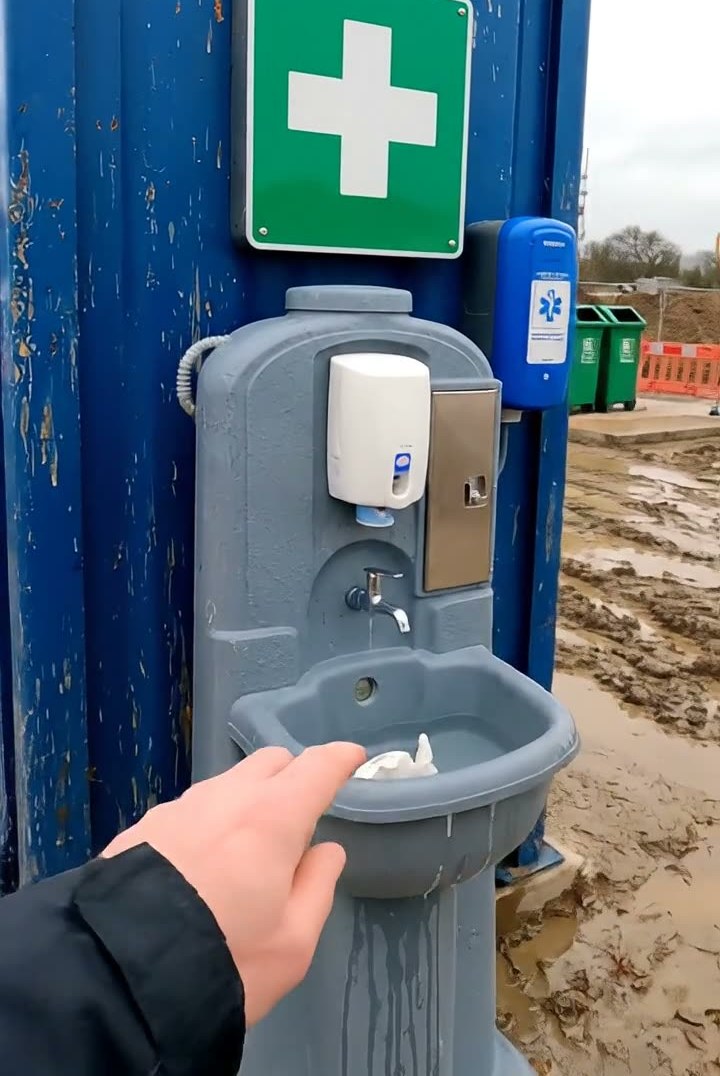
A hand wash station and first aid sign on the side of a site welfare cabin - ToiletsChoose one
- Provided, clean and working
- Provided, need attention
- None
- What needs attention?Short answerShown when “Toilets” is “Provided, need attention”
- Washing facilities haveTick all that apply
- Hot and cold, or warm, water
- Soap or other means of cleaning
- Towels or other means of drying
- Clean and orderly condition
- CheckWashing facilities must include clean hot and cold, or warm, water, soap or another means of cleaning, and towels or another means of drying. Something is missing here.Shown only when the answers above make it relevant
- Are the washing facilities next to the toilets?Yes or No
- Is there a supply of drinking water?Yes or No
- Are there cups, or a jet to drink from?Yes or NoShown when “Is there a supply of drinking water?” is Yes
- WarningAn adequate supply of wholesome drinking water must be provided or made available on a construction site.Shown when “Is there a supply of drinking water?” is No
- The rest area hasTick all that apply
- Tables and seats with backs
- A way to prepare and eat meals
- A way to boil water
- Heating
- Is there a stocked first aid kit, with a sign?Yes or No
- What is missing?Short answerShown when “Is there a stocked first aid kit, with a sign?” is No
- Is a first aider or appointed person on site today?Yes or No
- CheckNobody is on site today to give first aid or take charge. Employers must provide people for first aid, as is adequate and appropriate in the circumstances.Shown when “Is a first aider or appointed person on site today?” is No
Housekeeping, plant and excavations
Walkways, materials, plant and open ground.
- Walkways and work areasChoose one
- Clear and in good order
- Obstructed, wet or untidy in places
- What did you find?Tick all that apply
- Standing water or mud
- Rubble or waste
- Stored materials in the way
- Trailing cables or hoses
- Timber with projecting nails
- Other (describe)
Shown when “Walkways and work areas” is “Obstructed, wet or untidy in places” - CheckTimber or other material with projecting nails must not be left where the nails may be a source of danger.Shown when “What did you find?” includes “Timber with projecting nails”
- Is mobile plant working on site?Yes or No
- Are people kept apart from moving plant?Yes or NoShown when “Is mobile plant working on site?” is Yes
- Where are people and plant mixing?NotesShown when “Is mobile plant working on site?” is Yes and “Are people kept apart from moving plant?” is No
- Are there any open excavations?Yes or No
- Is the excavation supported or battered?Yes or NoShown when “Are there any open excavations?” is Yes
- Was it inspected at the start of this shift?Yes or NoShown when “Is the excavation supported or battered?” is Yes
- WarningConstruction work must not be carried out in a supported or battered excavation unless a competent person has inspected it at the start of the shift and is satisfied that work can be carried out safely.Shown when “Is the excavation supported or battered?” is Yes and “Was it inspected at the start of this shift?” is No
- Are there barriers or covers to stop people, plant or materials falling in?Yes or NoShown when “Are there any open excavations?” is Yes
Hazards and actions
One entry for each hazard. Photograph it before it is put right.
- Did you find any hazards?Yes or No
- GuidanceScore each hazard for likelihood and severity, from 1 to 5. The form multiplies them. 1 to 6 is low, 8 to 12 is medium and 15 to 25 is high. This scale is an example. Use your own organisation's scale.Shown when “Did you find any hazards?” is Yes
- HazardsRepeat for each hazard. Each one asks:Shown when “Did you find any hazards?” is Yes
- Which area is it in?Choose one
- Perimeter and access
- Slab edge or work at height
- Welfare area
- HazardChoose one
- Loose or missing fencing
- Missing guardrail or toe board
- Open hole or excavation
- Slip or trip
- Falling materials
- People and plant mixing
- Electrical
- Fire
- Other (describe)
- Exact locationShort answer
- What you can see, and who could be harmedNotes
- Photos of the hazardPhotos
- Likelihood (1 unlikely, 5 very likely)Rating 1 to 5
- Severity (1 minor, 5 fatal)Rating 1 to 5
- Risk scoreWorked out by the formShown when “Likelihood (1 unlikely, 5 very likely)” is answered and “Severity (1 minor, 5 fatal)” is answered
- WarningHigh risk. Make it safe or stop the work before you move on.Shown only when the answers above make it relevant
- CheckMedium risk. Give the action an owner and a due date.Shown only when the answers above make it relevant
- GuidanceLow risk. Record the action and check it at the next inspection.Shown only when the answers above make it relevant
- Was anything done on the walk?Yes or No
- What was done, and at what time?Short answerShown when “Was anything done on the walk?” is Yes
- Is further action needed?Yes or No
- Further actionNotesShown when “Is further action needed?” is Yes
- OwnerShort answerShown when “Is further action needed?” is Yes
- Due dateDateShown when “Is further action needed?” is Yes
Summary
Totals for the inspection, and who the report goes to.
- Hazards raisedNumber
- Closed during the walk, with no further actionNumber
- Hazards with actions still openWorked out by the formShown when “Hazards raised” is answered
- Share closed during the walk (%)Worked out by the formShown only when the answers above make it relevant
- CheckMore hazards are shown as closed than were raised. Check the numbers.Shown only when the answers above make it relevant
- Was any work stopped?Yes or No
- Where, and what must happen before it restarts?NotesShown when “Was any work stopped?” is Yes
- Report given to (name and position)Short answer
- GuidanceA report of a working platform inspection must be written before the end of the working period and given to the person it was carried out for within 24 hours.Shown when “Is a scaffold or other working platform in use?” is Yes
- Date of the next inspectionDate
Inspector sign-off
- WarningWork was stopped on this inspection. Check that the site manager knows where, and why.Shown only when the answers above make it relevant
- Name and positionShort answer
- Inspector signatureSignature
Site safety inspection template questions
What guardrail sizes does the checklist check?
For construction work, the top guardrail must be at least 950 mm above the edge, and no gap between rails or toe board may be more than 470 mm. The form asks for both measurements and flags either one that is out. It also reminds the inspector that the rails must be strong, rigid and fixed so they cannot be knocked out of place.
When does a scaffold need to have been inspected?
A working platform used for construction work, from which a person could fall 2 metres or more, must not be used unless it has been inspected in that position within the previous 7 days. It must also be inspected again after any event that could have affected its safety, such as bad weather. The report of that inspection must be written before the end of the working period and given to the person it was carried out for within 24 hours.
How often should a site safety inspection be done?
The law does not set one fixed frequency for this walk. Regulation 5 of the Management of Health and Safety at Work Regulations 1999 requires employers to have arrangements for monitoring and reviewing their preventive and protective measures. HSE guidance on safety representatives' inspections says high-risk or rapidly changing work, such as a construction project, needs inspecting more often than a low-risk office.
How are hazards scored?
Each hazard gets a likelihood and a severity from 1 to 5, and the form multiplies them. 1 to 6 is low, 8 to 12 is medium and 15 to 25 is high. A high score tells the inspector to make it safe or stop the work before moving on. The scale is an example, so you can use your own organisation's.
What welfare facilities does it check?
It checks the toilets, washing facilities, drinking water, the rest area, the first aid kit and whether a first aider or appointed person is on site. Washing facilities must have hot and cold, or warm, water, soap or another means of cleaning, and towels or another means of drying. An adequate supply of wholesome drinking water must be provided or made available on a construction site.
Does it work without signal?
In the SiteSurvey app, yes. The form works offline, photos attach to the hazard they belong to, and you can film an optional Walk Cam walk-through. The inspector signs on the device and the report goes out as a PDF or a share link.
Related
Related templates
Templates that go with the site safety inspection form
Site visit report: weather, labour, progress against programme, area by area record, tests, queries and instructions.
Hazards, who might be harmed, controls and risk scores, with a briefing record and review date.
Record a toolbox talk: topic, key points, attendees with signatures.
Workplace audit with walkways, first aid, fire equipment and records, findings and corrective actions, closing meeting.
Use this site safety inspection form with your team
Add it from the form library in one click, change any question, and every completed form becomes a branded PDF report.
Start your trial →