Stock condition and HHSRS
Stock condition survey appwith an HHSRS record for every home.
Survey each home against the same form, room by room: the condition of every element, the hazards you find and a photograph of each. The result is a property-level record you can keep up to date, not a spreadsheet that is out of date the day it is finished.
7-day free trial · full access · no card required
9
Rooms
34
Elements
1
Record
One home on a stock condition programme
Every home, surveyed the same way, and kept current.
The Regulator of Social Housing expects an accurate record of the condition of every home, based on a physical assessment, and kept up to date. Most landlords get there by surveying around a fifth of their stock each year. That only works if every surveyor records every home the same way, and if what they find is still usable when the next survey comes round five years later.
Surveys that don't compare
Different surveyors, different wording, different ratings. A home surveyed in 2022 cannot be read against the same home today.
Hazards buried in notes
An HHSRS hazard written into a free-text comment is easy to miss and impossible to report on across the stock.
Photos with no home
Evidence sits in a camera roll or a shared drive, detached from the property, the room and the date it was taken.
From the front door to a property-level record.
Walk Cam, point by point
One home, surveyed the same way every time.
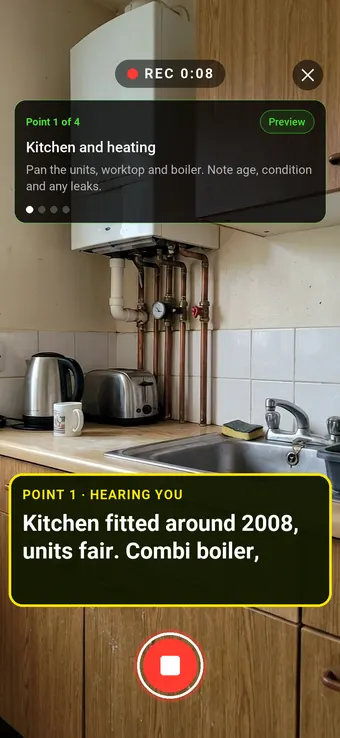
Walk Cam takes every surveyor through the same points in the same order, films each one and writes down what they say, so every home's record is built the same way.
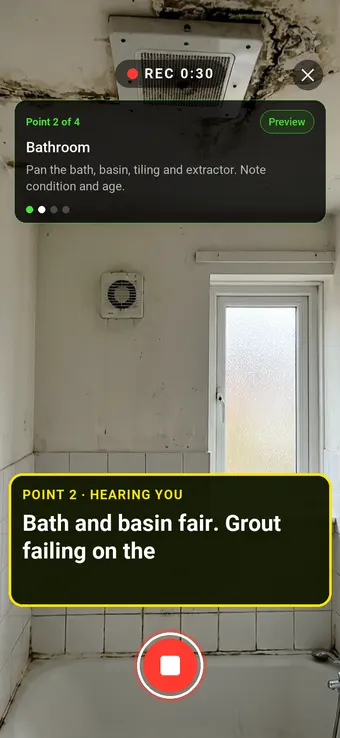
Point 2 of 4
Bathroom
Bath, basin, tiling and extraction, with their condition in the surveyor's own words.
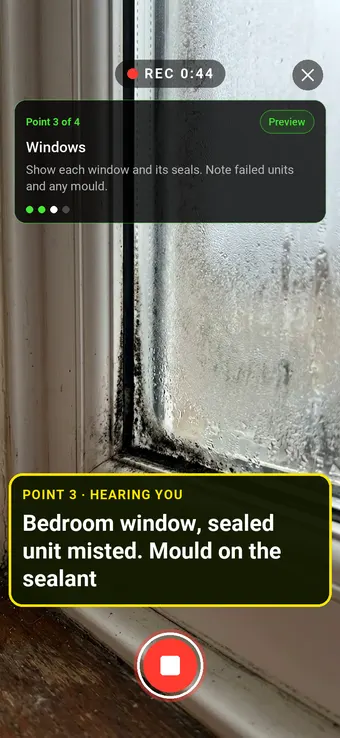
Point 3 of 4
Windows
Each window and its seals, with failed units and mould called out as they are found.
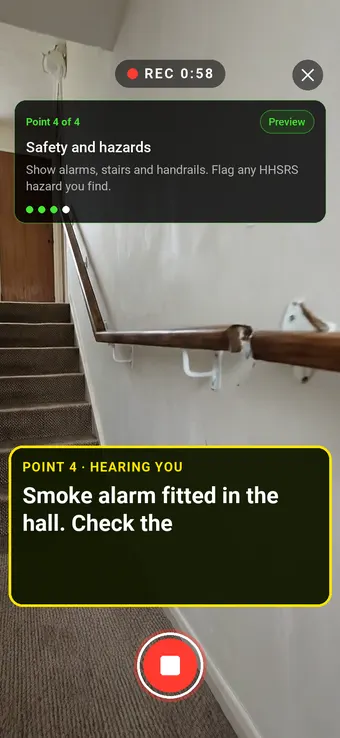
Point 4 of 4
Safety and hazards
Alarms, stairs and handrails, with any HHSRS hazard flagged on the spot.
What the report looks like
A property-level record, written as you walk.
Every room and element comes out in the same format, with photographs, spoken notes and ratings together, so one home's record reads like the next.
- 1Stills from the videoFrames from the Walk Cam clip sit against each point, so every finding has its pictures without stopping to take them.
- 2Your words, transcribedWhat you said while filming becomes the written note, so the write-up is done before you leave.
- 3The form answersRatings, readings and choices from the form come through as a clean table, laid out the same on every inspection.
- 4Signed and datedThe sign-off shows who carried out the inspection and when. Export it as a PDF or share it as a link.
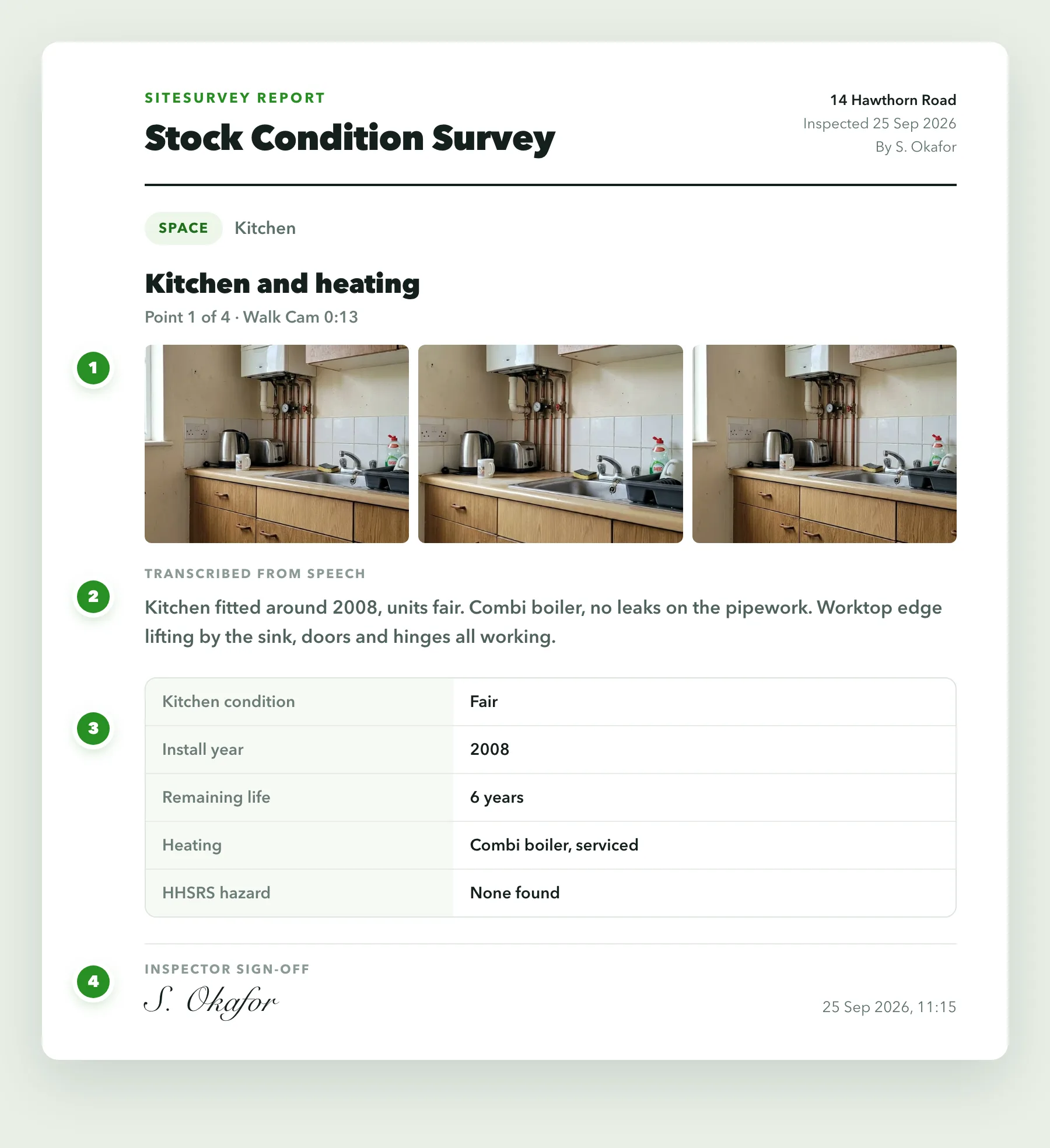
Built for surveying a whole stock, not one building.
Consistency is the point of a stock condition survey. Structured fields, the same form in every home and evidence tied to each room give you data you can compare across the stock and over time.
✓The same form everywhere
Every surveyor opens the same stock condition form, so condition ratings mean the same thing in every home.
✓Typed fields, not prose
Condition ratings, install years and remaining life are choice and number fields, so they can be counted and compared.
✓Hazards that ask for more
Mark a hazard as present and the form asks for its location, a photograph and the action needed. Clear homes stay quick.
✓Room by room evidence
Photographs sit against the room they were taken in, with markup and on-image measurement where the extent matters.
✓Dated and attributed
Every entry records who surveyed it and when, so the age and source of each record is never in doubt.
✓Offline in the block
Basements, stairwells and older blocks with no signal are no obstacle. Everything captures on the device and syncs later.
Start from a stock condition checklist.
Use this list as the starting point for your own stock condition form, or describe your survey to the AI form builder and let it draft one. Every field is editable, in chat or visually.
✓Property reference, archetype and year built
✓Element: kitchen, bathroom, windows, doors, roof
✓Condition rating and install year per element
✓Estimated remaining life, in years
✓Heating, electrics and smoke and CO alarms
✓HHSRS hazard present, with location
✓Photo of each hazard or failed element, required
✓Surveyor sign-off and date
What is a stock condition survey?+
A stock condition survey is a physical inspection of a landlord's homes that records the condition of each building element, such as kitchens, bathrooms, windows, roofs, heating and electrics, along with any health and safety hazards. The results tell the landlord which homes need work, what it will involve and roughly when, and they are the evidence behind reporting on the Decent Homes Standard. A common approach is to survey around 20% of homes each year, so every home is inspected roughly every five years.
What is HHSRS?+
The Housing Health and Safety Rating System is the risk-based method, introduced under the Housing Act 2004, for assessing hazards to health and safety in homes in England and Wales. It covers 29 hazards, from damp and mould growth and excess cold to falls, fire and structural collapse. Local authorities use it for enforcement: a hazard that scores 1,000 or more is a Category 1 hazard, which the council must act on, and lower scores are Category 2 hazards, where action is discretionary. Landlords use the same framework to assess their own homes.
Do social landlords have to carry out stock condition surveys?+
The Regulator of Social Housing's Safety and Quality Standard requires registered providers to have an accurate record of the condition of their homes at individual property level, based on a physical assessment of all homes, and to keep it up to date. The standard does not prescribe a single method, but a rolling programme of stock condition surveys is how most landlords meet it. Check the standard and the regulator's guidance for the full expectations.
How does this connect to Awaab's Law?+
Awaab's Law started with damp and mould and emergency hazards in October 2025. From 30 November 2026 its second phase extends to more HHSRS hazards, including excess cold and heat, falls, structural collapse, fire and electrical hazards. A stock condition survey that already records HHSRS hazards room by room gives you the evidence base those investigations will draw on. For damp and mould inspections specifically, see our damp and mould page.
Does SiteSurvey calculate HHSRS scores?+
No. SiteSurvey records the inspection: the hazard, where it is, what it looks like and what needs doing, with photographs and a date and name against every entry. Scoring a hazard under HHSRS is a professional judgement for a competent assessor, and any score you use can be recorded as a field on the form.
Can the survey be updated rather than redone?+
Yes. Each home is its own project with its rooms and records, so a follow-up visit adds to and updates that record rather than starting a new spreadsheet. Because each entry is dated and attributed, you can see how current each part of the record is.
Does it work in homes with no signal?+
Yes. The whole survey runs on the device, including photographs and video, and syncs to the project when the connection returns. That matters for housing surveys in particular, because blocks, basements and older stock are where the signal is weakest.
See it on your next job