Form library
Food safety checklists and records
Temperature logs, opening and closing checks, cleaning records and food safety audits for kitchens and food businesses. See every question, try the live form, then use it in SiteSurvey.
What food safety records does a UK food business need?
UK food businesses must have food safety procedures based on HACCP principles and keep records that show they are followed. In practice that means a HACCP plan, daily fridge and food temperature logs, opening and closing checks, allergen information and pest control records.
Sources: FSA: HACCP and Regulation (EC) No 852/2004, Article 5.
- Forms
- 12 forms in 4 types
- Main UK rules
- Regulation 852/2004 (retained), Food Safety and Hygiene (England) Regulations 2013, allergen rules
- Used by
- Kitchens, cafes, pubs, caterers and food producers
- Every form
- See every question and try it live before you sign up, then edit it to suit your team.
Most used
Start with the most used food safety forms
All food safety forms by type
Search by name or topic, or jump to a type. Open any form to see every question and try it live.
12 forms
HACCP and daily kitchen checks 4
Your food safety management system and the checks that prove it is working every day: the HACCP plan, fridge and food temperatures, opening and closing checks and deliveries at goods in.
- Food safety
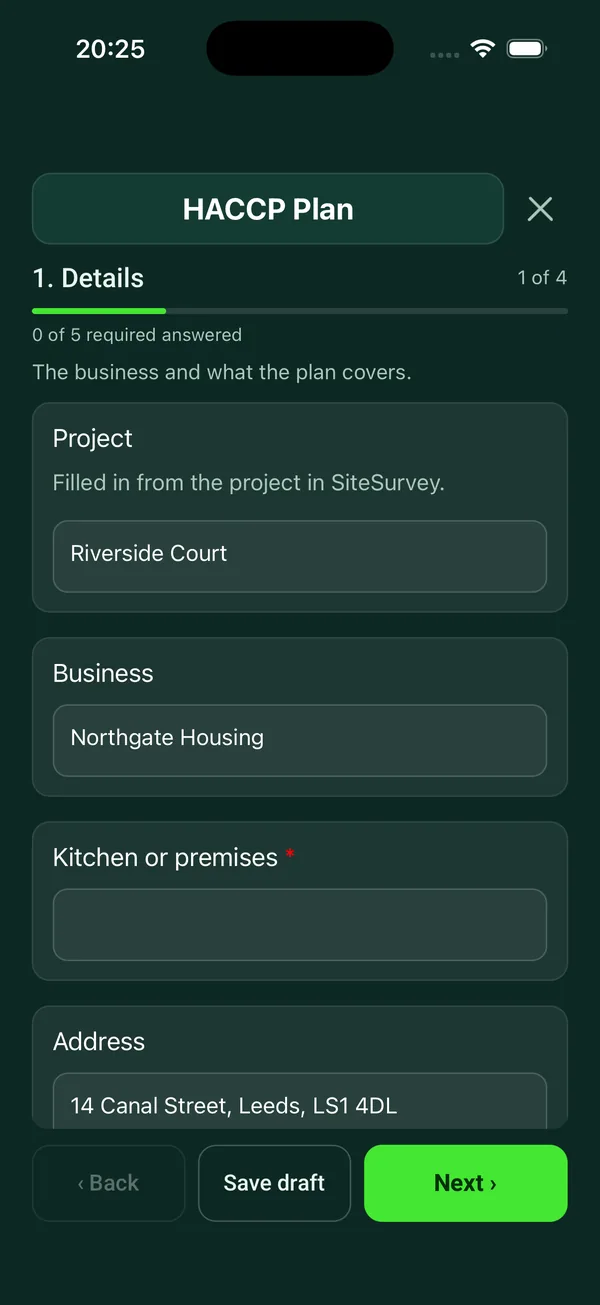
HACCP plan template
HACCP plan for a food business: each process step with its hazards and controls, critical control points with limits, monitoring and corrective action, checks and review.
4 sections41 questionsSignaturesSee every question → - Food safety
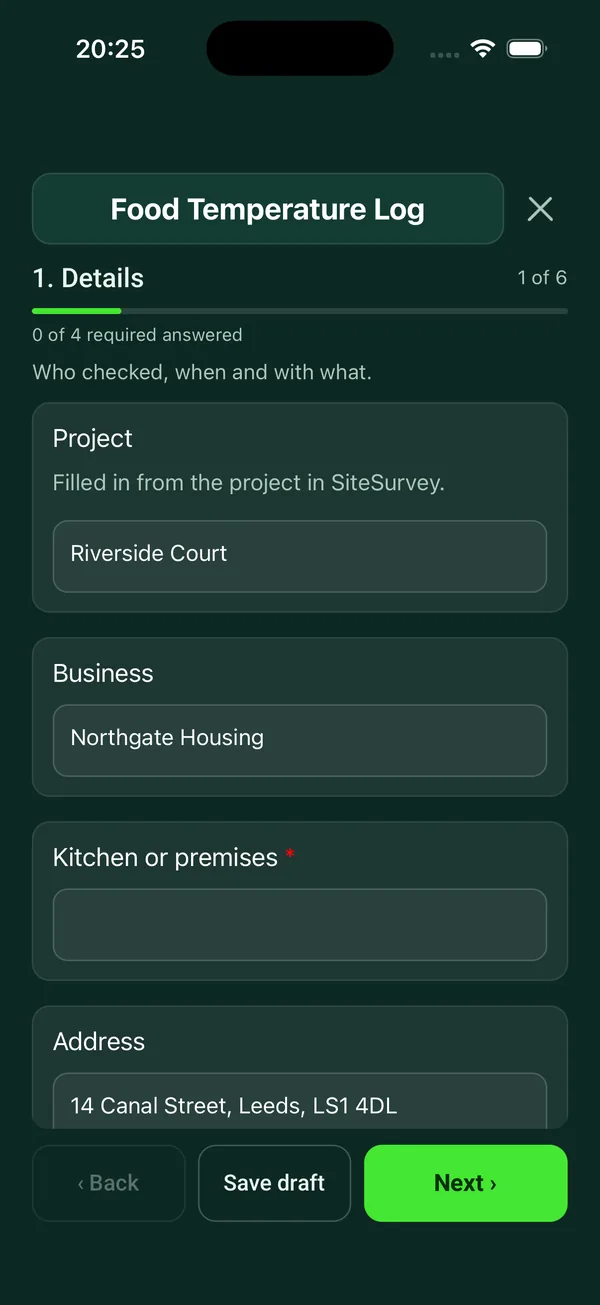
Fridge and food temperature log
Daily temperature record for a kitchen: fridges and freezers, cooking and reheating, hot holding and cold display, cooling and deliveries, with corrective actions.
6 sections53 questionsPhotosSignaturesSee every question → - Food safety
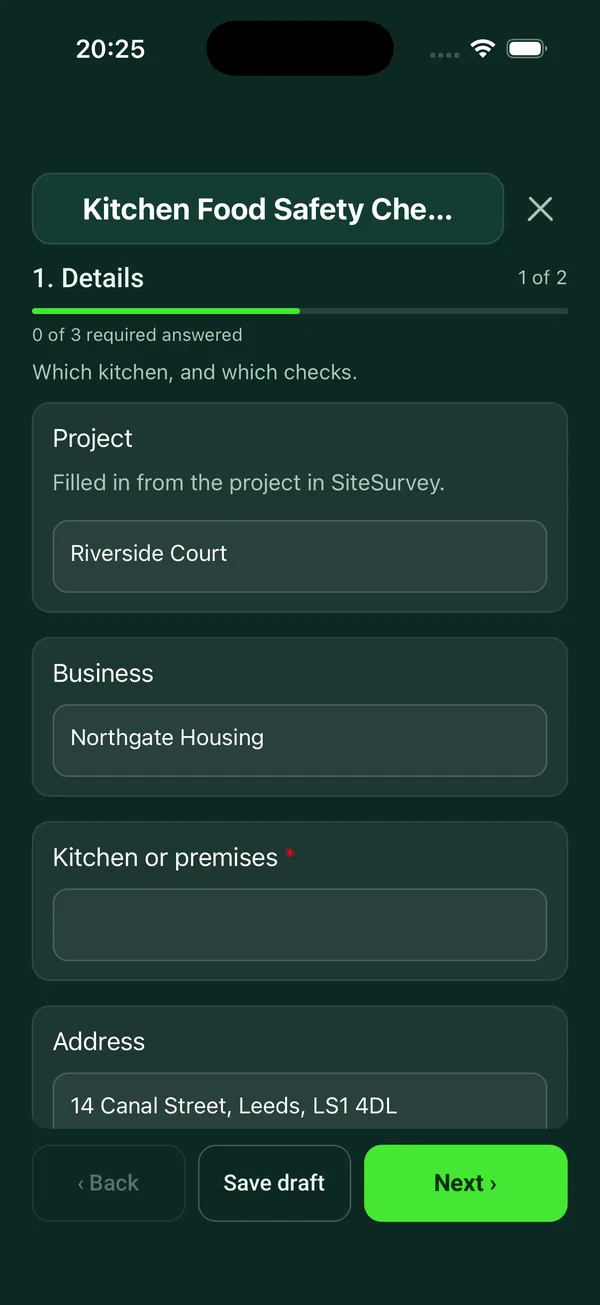
Kitchen opening and closing checklist
Opening and closing checks for a commercial kitchen: fridges, handwashing, cleanliness, pests, allergens, date labels, waste and close-down, with problems and sign-off.
4 sections52 questionsPhotosSignaturesSee every question → - Food safety
Goods-in inspection checklist
A goods-in and delivery inspection: each delivery with supplier, temperature, packaging, date codes, vehicle condition and accept or reject, with an 8°C warning for chilled food.
3 sections26 questionsPhotosSignaturesSee every question →
Allergens, traceability and recalls 3
Know what is in every dish, where every ingredient came from and what you do when a product has to come off sale.
- Food safety
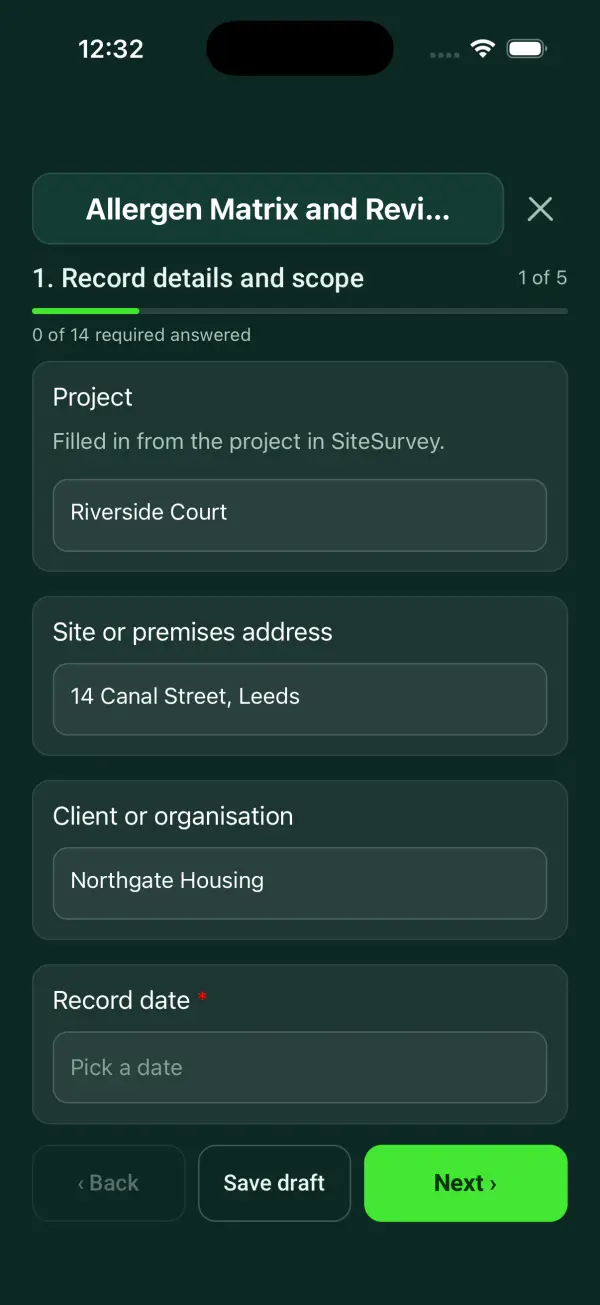
Allergen matrix template
A dish-level allergen record with ingredient evidence, the 14 regulated allergen groups, cross-contact controls, recipe changes and reviewer sign-off.
5 sections38 questionsPhotosSignaturesSee every question → - Food safety
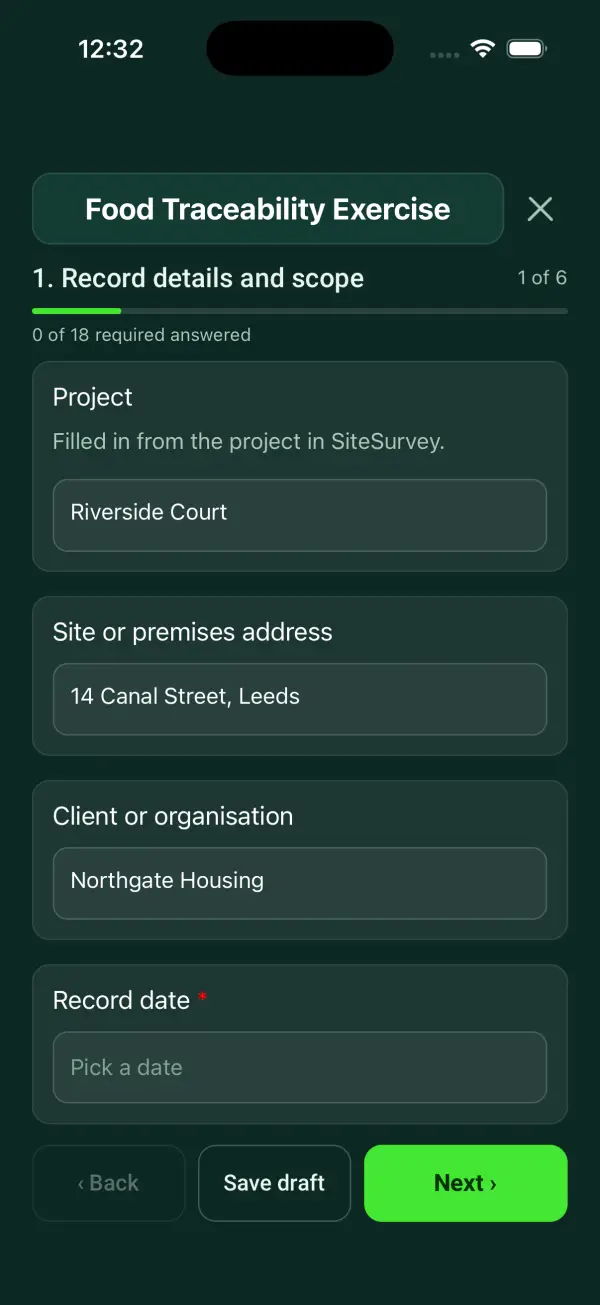
Food traceability template
A food traceability exercise linking selected batches, suppliers, production records, customer destinations, quantity reconciliation and information gaps.
6 sections34 questionsSignaturesSee every question → - Food safety
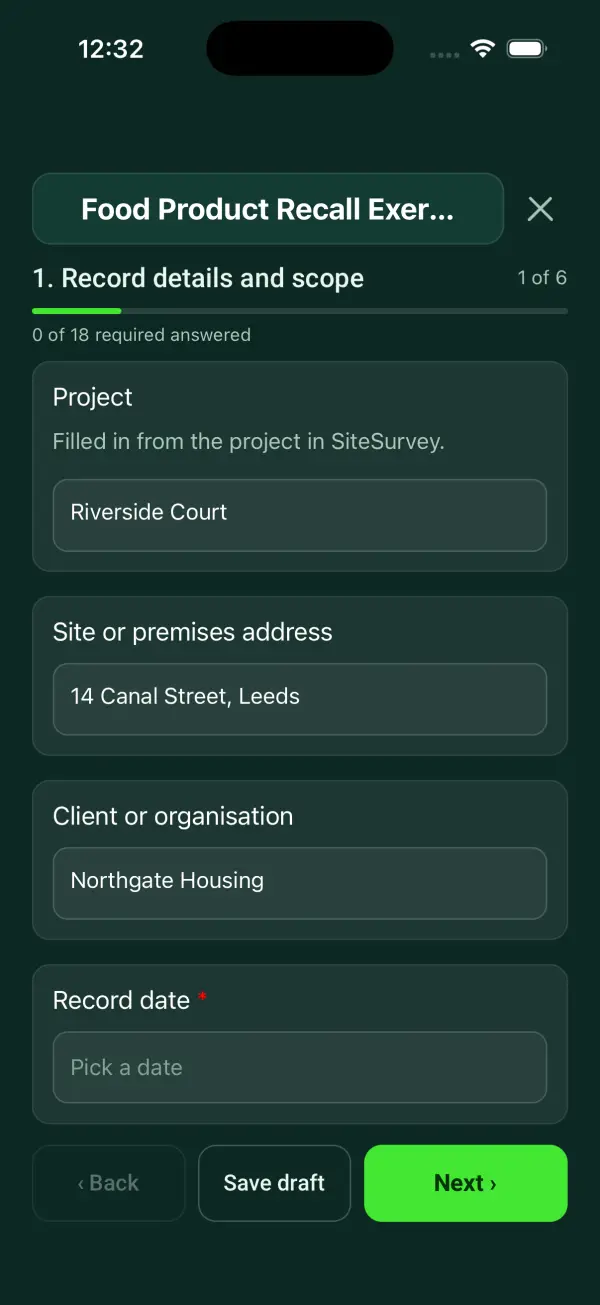
Product recall template
A food recall exercise record covering the simulated issue, affected batches, traceability evidence, contact routes, reconciliation and improvement actions.
6 sections34 questionsSignaturesSee every question →
Pest control 2
Pest control contractor visit reports and the station by station bait log that shows activity over time.
- Food safety
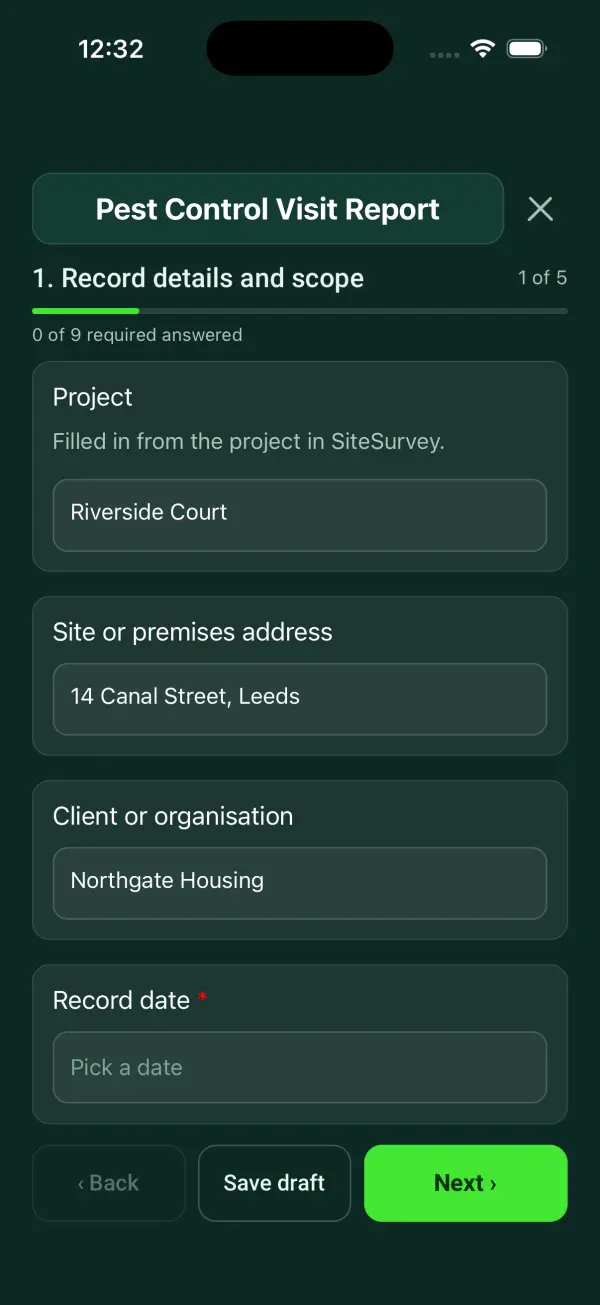
Pest control report template
A pest-control visit record with observed evidence, monitoring locations, proofing and hygiene findings, treatment details and follow-up recommendations.
5 sections46 questionsPhotosSignaturesSee every question → - Food safety
Rodent bait station inspection log
A rodent bait station inspection log: each station scanned by its number, with location, type, activity, bait taken and replaced, condition and photos, activity counts, recommendations and sign-off.
3 sections59 questionsPhotosSignaturesSee every question →
Kitchen gas, extract and cellar 3
The plant behind the kitchen and bar: gas appliance and interlock checks, TR19 extract cleaning records and pub cellar management.
- Food safety
Commercial kitchen gas safety checklist
A commercial kitchen gas safety site record: each appliance checked, gas tightness, ventilation and the gas interlock, flues and flame supervision, emergency isolation, unsafe situations and the engineer's sign-off.
4 sections44 questionsPhotosSignaturesSee every question → - Food safety
TR19 kitchen extract cleaning record
A kitchen extract cleaning record to TR19 Grease: usage band and frequency, canopy, filters, ductwork and fan, deposit thickness tests before and after, access panels, photos and the post-clean report.
3 sections42 questionsPhotosSignaturesSee every question → - Food safety
Cellar management checklist
A pub cellar management check: cellar temperature, line cleaning, cask and keg stock rotation, gas cylinders, cleanliness, cooling and pests, with a warning outside 11 to 13°C.
3 sections35 questionsPhotosSignaturesSee every question →
Smart fields
Smart fields in these food safety forms
These forms do more than tick boxes. Each field type below is already built into the forms listed, and you can add it to any form you edit.
Calculated tiles
Totals, scores and pass rates work themselves out as you fill the form in, shown as live tiles.
In 12 forms, including fridge and food temperature log, HACCP plan template and kitchen opening and closing checklist.
How calculated fields work →Label scanner
Scan equipment labels, serial numbers and barcodes straight into the form.
In 2 forms, including rodent bait station inspection log and commercial kitchen gas safety checklist.
How the label scanner works →GPS location
One tap fills in latitude, longitude, OS grid reference and accuracy.
In 2 forms, including pest control report template and rodent bait station inspection log.
How GPS location works →Rooms as spaces
Add a room, area or item as many times as you need, and each one becomes its own space with its photos and answers.
In 2 forms, including rodent bait station inspection log and commercial kitchen gas safety checklist.
How rooms become spaces →Products and assets
Each asset you list on the form is saved as a product in its space, so the next visit starts from the same list.
In 2 forms, including rodent bait station inspection log and commercial kitchen gas safety checklist.
How products and assets work →Walk Cam
A guided video route: one short clip per inspection point, with live voice-to-text into the answer.
In 1 form, including pest control report template.
How Walk Cam works →
Guide
What is a food safety checklist?
A food safety checklist is the record a kitchen, factory or bar keeps to show that the controls in its food safety management system are being carried out: temperatures checked, deliveries inspected, surfaces cleaned, allergens controlled and pests kept out. The Food Standards Agency describes a food safety management system as a written set of processes, checks, rules and records, and says it must be based on the HACCP principles.
The forms in this category cover that whole cycle. The HACCP plan sets out the hazards and the critical control points. Day to day, the fridge and food temperature log, kitchen opening and closing checklist and goods-in inspection checklist prove the plan is being followed. The allergen matrix, traceability record and product recall template cover what you sell and how you act when something goes wrong.
Kitchen equipment servicing sits under retail and hospitality, for example the kitchen equipment maintenance checklist.
Source: FSA: HACCP.
Which food safety records are a legal requirement in the UK?
Food businesses must put in place, implement and maintain a permanent procedure based on the HACCP principles. That is Article 5 of retained Regulation (EC) No 852/2004, and keeping records proportionate to the size of the business is part of it. Small caterers in England and Wales often meet this with the FSA's Safer food, better business pack, which includes its own diary of checks. Larger operations write a full HACCP plan. Either way, an environmental health officer will ask to see your records on inspection, and they feed your food hygiene rating.
The rules that most often turn up in these forms are:
- Cold holding
- In England, food that needs temperature control must not be kept above 8°C. Most kitchens set their fridge target lower so there is a margin.
- Hot holding
- Cooked or reheated food kept hot for service must be held at or above 63°C.
- Allergens
- You must tell customers if food contains any of the 14 listed allergens. Food prepacked for direct sale (PPDS) needs a label with a full ingredients list and the allergens emphasised, under Natasha's Law.
- Traceability
- You must be able to identify who supplied you with a food and which businesses you supplied, one step back and one step forward.
- Withdrawals and recalls
- If you believe food you have supplied is unsafe, you must start to withdraw it and inform the authorities, and recall it from consumers if it may have reached them.
- Pests
- Adequate procedures must be in place to control pests.
Sources: Regulation (EC) No 852/2004, Article 5, Food Safety and Hygiene (England) Regulations 2013, Schedule 4, GOV.UK: Allergen guidance for food businesses, FSA: Introduction to allergen labelling for PPDS food, Regulation (EC) No 178/2002, Article 18, Regulation (EC) No 178/2002, Article 19, Regulation (EC) No 852/2004, Annex II Chapter IX, GOV.UK: Safer food, better business and FSA: Food hygiene rating scheme.
How to write a HACCP plan that works on the line
A HACCP plan goes wrong when it is written once for the inspector and never matches what the kitchen does. Build it from a walk through the real process, from delivery to service, and keep the steps in the order food actually moves. The FSA lists what the HACCP principles ask of you:
- Identify hazards
- What could go wrong at each step: bacteria growing in the chiller, allergen cross contact at the prep bench, glass or metal in a product.
- Find the critical control points
- The steps where a check stops the hazard, such as cooking to temperature or chilling within a set time.
- Set limits
- A number you can measure, such as a core temperature or a maximum time out of the fridge.
- Monitor
- Who checks, how and how often, written on the form they will fill in.
- Corrective action
- What you do when a limit is missed, decided in advance so staff do not improvise.
- Verify and keep records
- Check the system is working and keep records of the checks and how you put things right.
Source: FSA: HACCP.
What a good temperature log and goods-in check record
The most common gap an inspector finds is not a warm fridge, it is a log with no corrective action next to the warm reading. A useful temperature log records the unit, the reading, the time, who took it and, if it is out of range, what was done with the food and the unit. Probe checks on cooked and reheated food sit on the same record, so cooking, cooling and hot holding are all in one place.
At goods in, check and record the temperature of chilled and frozen deliveries, the condition of the packaging, use by and best before dates, and the supplier and batch details you need for traceability. Reject anything that fails and photograph it, so the credit note is not a debate. The opening and closing checklist then picks up the daily routine: hand wash basins stocked, probes cleaned and checked, food covered and labelled, bins emptied and the cleaning schedule signed. The FSA's guidance on cleaning effectively covers the two stage clean and disinfect process these checks rely on.
Sources: Food Safety and Hygiene (England) Regulations 2013, Schedule 4 and FSA: Cleaning effectively in your business.
Gas, extract and cellar checks in commercial kitchens and bars
Food safety inspections tend to stop at the food, but the plant behind it is where kitchens most often have serious incidents. Gas work, including inspection and maintenance, must be done by a Gas Safe registered engineer. HSE's catering guidance says annual inspections are a reasonable minimum, and where a type B appliance relies on extraction there should be an interlock that cuts the gas if the airflow fails. The commercial kitchen gas safety checklist records the appliances, the interlock test and the engineer's details, and it complements your fire risk assessment.
HSE notes that kitchen fires in extract systems usually start when heat or flame ignites a build-up of grease and fat in the ductwork. TR19 Grease, published by BESA, is the UK specification for cleaning kitchen extract systems, with the cleaning interval set by how heavily the kitchen is used. A TR19 kitchen extract cleaning record captures the parts cleaned, the deposit thickness tests and before and after photos for each visit.
For pubs and bars, a cellar management checklist covers cellar temperature, line cleaning, stock rotation, cooling equipment and the security of gas cylinders. Set the temperature and line cleaning interval your brewer or supplier asks for; the form's defaults are a starting point you can edit.
Sources: HSE: Gas safety in catering and hospitality (CAIS23), HSE: Ventilation of kitchens in catering establishments (CAIS10), Gas Safety (Installation and Use) Regulations 1998, regulation 3 and BESA: TR19 Air and Grease toolkit.
Pest control records and bait station logs
Most food businesses use a pest control contractor, and the visit report is the evidence an officer will look for. A good pest control report records the areas inspected, any signs of activity, proofing defects found (gaps under doors, open drains, holes around pipes), the treatments used and the recommendations for you to act on. Biocides such as rodenticides are regulated products, so the report should name what was used and where.
The rodent bait station inspection log adds the station by station picture: each station pinned on a plan, the activity found, the bait laid and any signs of non-target animals, so you can see whether activity is rising or falling between visits.
Sources: Regulation (EC) No 852/2004, Annex II Chapter IX and HSE: Using biocides.
Keeping food safety records on a phone or tablet
Paper diaries get wet, go missing and are filled in at the end of a shift from memory. With SiteSurvey, staff complete each check on an iPhone, iPad or Android device, offline in a cellar or walk-in chiller if there is no signal, with the reading, a photo with annotation where something is wrong, a note on the corrective action and a signature. Each completed check becomes a branded PDF report you can show an inspector, an area manager or a client.
You can edit any form here to match your own HACCP plan, add your own units and limits, or build your own form in the form builder. Every form page shows every question and lets you try the form live first.
Facts checked by the SiteSurvey team, 27 October 2026.
Food safety forms FAQs
What temperature should a commercial fridge be?
In England the legal maximum for chilled food that needs temperature control is 8°C. Most kitchens set fridges to run lower than that so there is a margin, and record readings at fixed times each day as their HACCP plan sets out.
Source: Food Safety and Hygiene (England) Regulations 2013, Schedule 4.
Do small food businesses need a HACCP plan?
Every food business needs a food safety management system based on the HACCP principles, but it can be proportionate to the business. Many small caterers use the FSA's Safer food, better business pack instead of writing a full plan from scratch.
Sources: FSA: HACCP and GOV.UK: Safer food, better business.
What are the 14 allergens?
Celery, cereals containing gluten, crustaceans, eggs, fish, lupin, milk, molluscs, mustard, tree nuts, peanuts, sesame, soya and sulphur dioxide or sulphites above 10 parts per million. An allergen matrix records which of these are in each dish.
What is the difference between a product withdrawal and a recall?
A withdrawal takes unsafe food out of the supply chain before it reaches consumers. A recall is needed when it may already have reached them, and consumers are told to return or throw it away.
Source: GOV.UK: Food incidents, product withdrawals and recalls.
How often should kitchen gas appliances be checked?
HSE guidance says annual inspection by a Gas Safe registered engineer is a reasonable minimum for catering gas appliances, following the manufacturer's recommendations, with repairs as needed. Interlocks and ventilation should be checked as part of that service.
Source: HSE: Gas safety in catering and hospitality (CAIS23).
What does an environmental health officer look for in food safety records?
That checks are done when your system says they are, that out of range results have a corrective action next to them, and that records match what they see in the kitchen. Gaps, identical readings every day and missing signatures are the usual problems.
Other categories
Put these forms in your team's hands
Works on iPhone, iPad and Android, offline on site, with every completed form turned into a branded PDF report.
Start your trial →