Form library · Food safety
Fridge and food temperature log
A daily temperature record for a commercial kitchen. Log each fridge and freezer, probe cooked and reheated food, check hot holding and cold display, record cooling and deliveries, and note what was done about any problem. The form flags readings outside the legal and recommended limits as you enter them. Every question is listed below, and you can fill the live form in on this page.
Ready to use from the form library, and every question is yours to edit. Trial from £1, cancel any time.
Try it on your phone
Try it on this phone
Fill in the food temperature log on your phone now
See how the food temperature log looks on your phone
Scan the code with your phone camera. It opens the real form, no sign-up needed.
Open the live example and fill it in, just as your team would on site. No sign-up needed.
See it on this phoneEvery question is editable. Add this form to your account, then change the wording, add or remove questions and options, and make it fit your own jobs.
What temperature should a fridge be in a commercial kitchen?
The Food Standards Agency recommends setting fridges between 0 and 5 °C and freezers at around -18 °C. In England it is an offence, under Schedule 4 of the Food Safety and Hygiene (England) Regulations 2013, to keep food that needs chilling above 8 °C. A temperature log should record each unit's reading, who checked it and when, and the action taken if it was too warm.
Last updated . Facts checked by the SiteSurvey team on 5 October 2026 against Schedule 4 of the Food Safety and Hygiene (England) Regulations 2013, Food Standards Agency: how to chill, freeze and defrost food safely, Food Standards Agency: food hygiene for businesses, chilling and freezing, Food Standards Agency: food hygiene for businesses, cooking food safely and Food Standards Agency: cooking your food.
Try the food temperature log form live
Answer a few questions and watch it adapt. Your answers are not saved, and any photos you add are deleted within the hour.
This is the real form as your team would use it: questions appear as you answer, scores work themselves out and you can add photos and signatures. No sign-up needed.
Want to see one filled in? See a completed food temperature log report (PDF), made by SiteSurvey from a fictional site visit.
Fill it in on a phone or tablet
Your team completes the food temperature log on site in the SiteSurvey app on iPhone, iPad and Android phones and tablets. The project name and address fill in for them, it works without signal, and it syncs when the device is back online with photos kept against the question they answer.
Customers and subcontractors do not need the app: send them a link and they can fill it in from any browser.
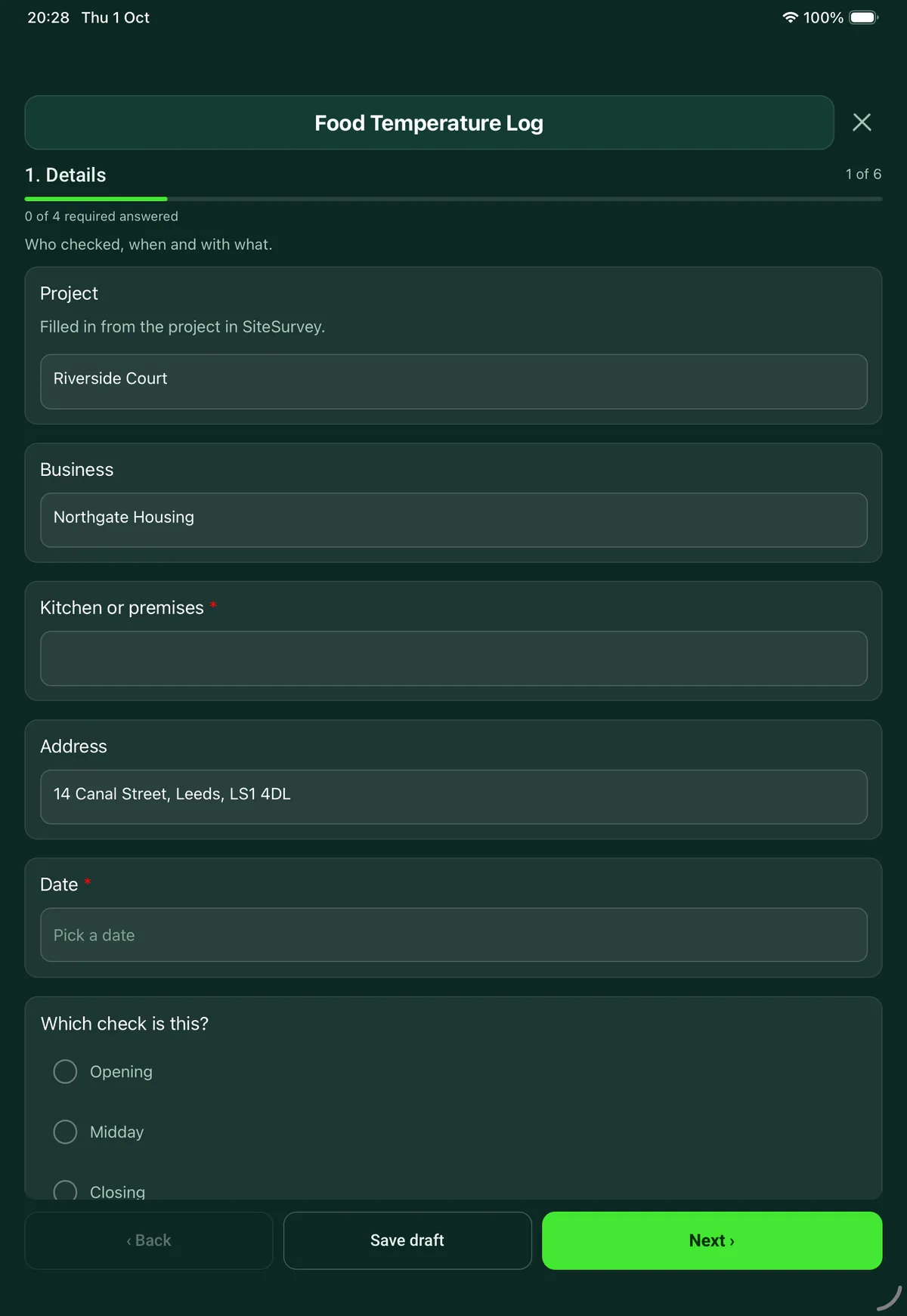
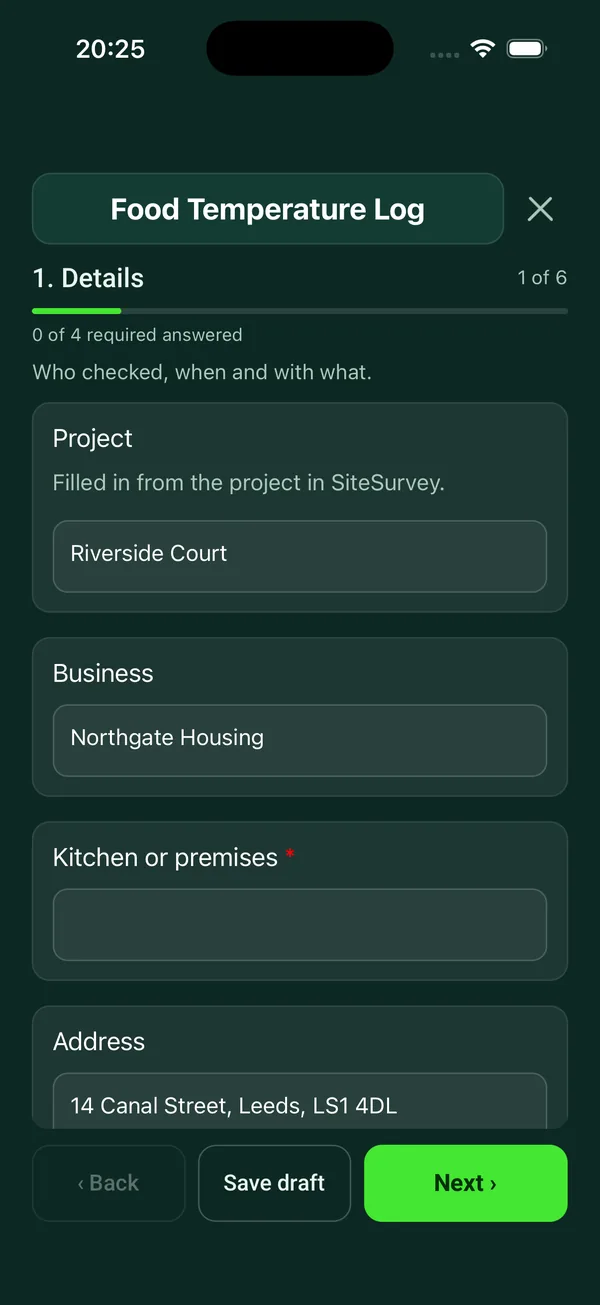
Every question in the food temperature log template
Daily temperature record for a kitchen: fridges and freezers, cooking and reheating, hot holding and cold display, cooling and deliveries, with corrective actions. 6 sections and 47 questions. Follow-up questions and guidance appear only when an answer calls for them, so the person on site never sees the ones that do not apply.
Make it your own: every question is editable
This is a starting point, not a fixed form. Once it is in your SiteSurvey account you can reword any question, add or remove questions, sections and answer options, and add your own logo, so it fits the way your team works and the jobs you do.
Details you only enter once
Add this form to a project in SiteSurvey and it fills in what the project already knows, so nobody on site retypes it and every form on the job uses the same names. Anything filled in can still be changed.
- Project: the project name
- Business: the project's customer
- Kitchen or premises: the site, when the form is opened for a space or a product
- Address: the site address, from the space or the project
Details
Who checked, when and with what.
- ProjectShort answer
Filled in from the project in SiteSurvey.
Fills in from the project name - BusinessShort answerFills in from the project's customer
- Kitchen or premises*Short answerFills in from the site, when the form is opened for a space or a product
- AddressShort answerFills in from the site address, from the space or the project
- Date*Date
- Which check is this?Choose one
- Opening
- Midday
- Closing
- Other
- Checked byShort answer
- Probe thermometer usedShort answer
- Was the probe cleaned and disinfected before use and between foods?Yes or No
- Has the probe been checked in iced water and boiling water this week?Choose one
- Yes, within ±1 °C
- No
- Not due
- GuidanceEngland. Under Schedule 4 of the Food Safety and Hygiene (England) Regulations 2013 it is an offence to keep food that needs chilling above 8 °C, or to keep cooked or reheated food for hot holding below 63 °C. The other UK nations have their own regulations. The Food Standards Agency recommends setting fridges between 0 and 5 °C and freezers at around -18 °C.
Fridges and freezers
One entry for each unit.
- Fridges and freezersRepeat for each unit. Each one asks:
- Unit*Short answer
- TypeChoose one
- Fridge
- Freezer
- Display chiller
- Cold room
- Temperature (°C)*Number
- TimeTime
- WarningAbove 8 °C. Check the food with a probe, find out how long it has been above 8 °C, move it to a working unit and decide what must be thrown away. Record what you did.Shown only when the answers above make it relevant
- CheckAbove the 0 to 5 °C the Food Standards Agency recommends, though within the 8 °C legal limit. Check the door seal, how full the unit is and the setting, and check again in an hour.Shown only when the answers above make it relevant
- CheckWarmer than -18 °C. Check the door, the defrost cycle and whether the food is still hard frozen.Shown only when the answers above make it relevant
- Action takenShort answer
- Units checkedWorked out by the form
Cooking and reheating
Probe the thickest part of the food.
- Did you probe any cooked or reheated food?Yes or No
- Cooked and reheated foodRepeat for each food. Each one asks:Shown when “Did you probe any cooked or reheated food?” is Yes
- Food*Short answer
- Cooked or reheatedChoose one
- Cooked
- Reheated
- Core temperature (°C)*Number
- TimeTime
- CheckBelow 75 °C. Unless it has been held at one of the equivalent times and temperatures below, keep cooking and probe again.Shown only when the answers above make it relevant
- GuidanceThe Food Standards Agency says food is fully cooked when the middle reaches 70 °C for 2 minutes, or an equivalent: 60 °C for 45 minutes, 65 °C for 10 minutes, 75 °C for 30 seconds or 80 °C for 6 seconds.Shown when “Did you probe any cooked or reheated food?” is Yes
Hot holding and cold display
Food kept hot for service, or cold food out of the fridge.
- Is any food being hot held or displayed out of chill?Yes or No
- Food on display or heldRepeat for each food. Each one asks:Shown when “Is any food being hot held or displayed out of chill?” is Yes
- Food*Short answer
- How is it kept?Choose one
- Hot holding
- Cold, out of the fridge
- Temperature (°C)Number
- Out sinceTime
- CheckBelow 63 °C. The England regulations allow food for service to be below 63 °C for a single period of less than two hours. Food Standards Agency guidance for businesses is that after 2 hours it should be cooled as quickly as possible to 8 °C or below, or thrown away. Food can only be reheated once.Shown only when the answers above make it relevant
- CheckAbove 8 °C. The England regulations allow food for service or on display to be above 8 °C for a single period of less than four hours. Food Standards Agency guidance for businesses is that food out of the fridge for less than 4 hours can go back in the fridge, and after 4 hours it must be thrown away.Shown only when the answers above make it relevant
- Action takenShort answer
Cooling and deliveries
Food cooled for later, and food arriving.
- Was any cooked food cooled for later use?Yes or No
- Food cooledRepeat for each food. Each one asks:Shown when “Was any cooked food cooled for later use?” is Yes
- Food*Short answer
- Cooking finishedTime
- Into the fridgeTime
- Temperature into the fridge (°C)Number
- How was it cooled?Choose one
- Smaller portions
- Shallow trays
- Blast chiller
- Cold water or ice bath
- Left to stand
- GuidanceCool cooked food as quickly as possible, ideally within 90 minutes, using shallow trays, smaller portions or a blast chiller, then put it in the fridge.Shown when “Was any cooked food cooled for later use?” is Yes
- Were there any deliveries of chilled or frozen food?Yes or No
- DeliveriesRepeat for each delivery. Each one asks:Shown when “Were there any deliveries of chilled or frozen food?” is Yes
- Supplier*Short answer
- What was deliveredShort answer
- Chilled food temperature (°C)Number
- Frozen foodChoose one
- Hard frozen
- Soft or thawing
- None in this delivery
- Result*Choose one
- Accepted
- Part rejected
- Rejected
- Why?Short answerShown only when the answers above make it relevant
Problems and sign-off
What went wrong and what was done.
- Were there any problems today?Yes or No
- What happened, what was done and who was told?NotesShown when “Were there any problems today?” is Yes
- PhotosPhotosShown when “Were there any problems today?” is Yes
- NameShort answer
- SignatureSignature
- Checked by managerShort answer
- Manager signatureSignature
See it filled in
A completed food temperature log report, made by SiteSurvey from a fictional site visit: every answer, the photos, the guidance that applied and the sign-off, ready to send as a PDF.
Food temperature log FAQs
What does the log do when a fridge is too warm?
Above 5 °C and up to 8 °C it shows an amber note: within the legal limit but above the Food Standards Agency's recommended range, so check the seal, how full the unit is and the setting. Above 8 °C it shows a red note to probe the food, find out how long it has been warm, move it and decide what must be thrown away. A freezer warmer than -18 °C is flagged too.
What temperature must cooked food reach?
The Food Standards Agency says food is fully cooked when the middle reaches 70 °C for 2 minutes, or an equivalent: 60 °C for 45 minutes, 65 °C for 10 minutes, 75 °C for 30 seconds or 80 °C for 6 seconds. The form shows these when a probe reading is under 75 °C.
What are the rules for hot holding and cold display?
In England, food kept hot must be at 63 °C or above, though food for service may be below 63 °C for a single period of less than two hours, and chilled food on display may be above 8 °C for a single period of less than four hours. Food Standards Agency guidance for businesses is to cool hot food to 8 °C or below, or throw it away, after 2 hours, to return chilled food to the fridge only if it has been out for less than 4 hours, and to reheat food only once. The form records the temperature and the time the food was put out, and shows the rule when a reading is outside it.
How quickly should cooked food be cooled?
The form's guidance is to cool cooked food as quickly as possible, ideally within 90 minutes, using shallow trays, smaller portions or a blast chiller, then put it in the fridge. It records when cooking finished, when the food went into the fridge, its temperature going in and how it was cooled.
Does it cover deliveries?
Yes. Each chilled or frozen delivery is recorded with the supplier, the temperature of chilled food, whether frozen food is hard frozen, and whether it was accepted, part rejected or rejected, with the reason.
Do the same rules apply across the UK?
No. The figures quoted are from the England regulations and Food Standards Agency guidance. Scotland, Wales and Northern Ireland have their own regulations, so check the rules where you trade. In the SiteSurvey app it works offline and syncs when the device is back online, and the record goes out as a PDF or a share link.
Related
Related templates
Templates that go with the food temperature log form
HACCP plan for a food business: each process step with its hazards and controls, critical control points with limits, monitoring and corrective action, checks and review.
Opening and closing checks for a commercial kitchen: fridges, handwashing, cleanliness, pests, allergens, date labels, waste and close-down, with problems and sign-off.
Daily, weekly or deep clean record: each area with the tasks done, anything missed and why, issues with photos, supplies to reorder and a supervisor check.
A dish-level allergen record with ingredient evidence, the 14 regulated allergen groups, cross-contact controls, recipe changes and reviewer sign-off.
Use this food temperature log form with your team
Add it from the form library in one click, change any question, and every completed form becomes a branded PDF report.
Start your trial →