Form library · Food safety
HACCP plan template
A HACCP plan for a restaurant, takeaway, caterer, care or school kitchen, retailer or small manufacturer. Work through each step food takes through the business, record what could go wrong and how it is controlled, mark the critical control points with a limit, a check and a corrective action, then set how the plan itself is checked and reviewed. Every question is listed below, and you can fill the live form in on this page.
Ready to use from the form library, and every question is yours to edit. Trial from £1, cancel any time.
Try it on your phone
Try it on this phone
Fill in the HACCP plan on your phone now
See how the HACCP plan looks on your phone
Scan the code with your phone camera. It opens the real form, no sign-up needed.
Open the live example and fill it in, just as your team would on site. No sign-up needed.
See it on this phoneEvery question is editable. Add this form to your account, then change the wording, add or remove questions and options, and make it fit your own jobs.
What should a HACCP plan include?
A HACCP plan should follow the HACCP principles: identify the food hazards to avoid, remove or reduce; identify the critical control points; set limits for them; monitor them; establish checks to verify the system works; correct problems when they occur; and keep records. GOV.UK says that if you run a food business you need a food safety management system that meets these principles.
Last updated . Facts checked by the SiteSurvey team on 5 October 2026 against GOV.UK: food safety management systems, Food Standards Agency: allergen guidance for food businesses and Food Standards Agency: Safer food, better business.
Try the HACCP plan form live
Answer a few questions and watch it adapt. Your answers are not saved, and any photos you add are deleted within the hour.
This is the real form as your team would use it: questions appear as you answer, scores work themselves out and you can add photos and signatures. No sign-up needed.
Want to see one filled in? See a completed HACCP plan report (PDF), made by SiteSurvey from a fictional site visit.
Fill it in on a phone or tablet
Your team completes the haccp plan on site in the SiteSurvey app on iPhone, iPad and Android phones and tablets. The project name and address fill in for them, it works without signal, and it syncs when the device is back online with photos kept against the question they answer.
Customers and subcontractors do not need the app: send them a link and they can fill it in from any browser.
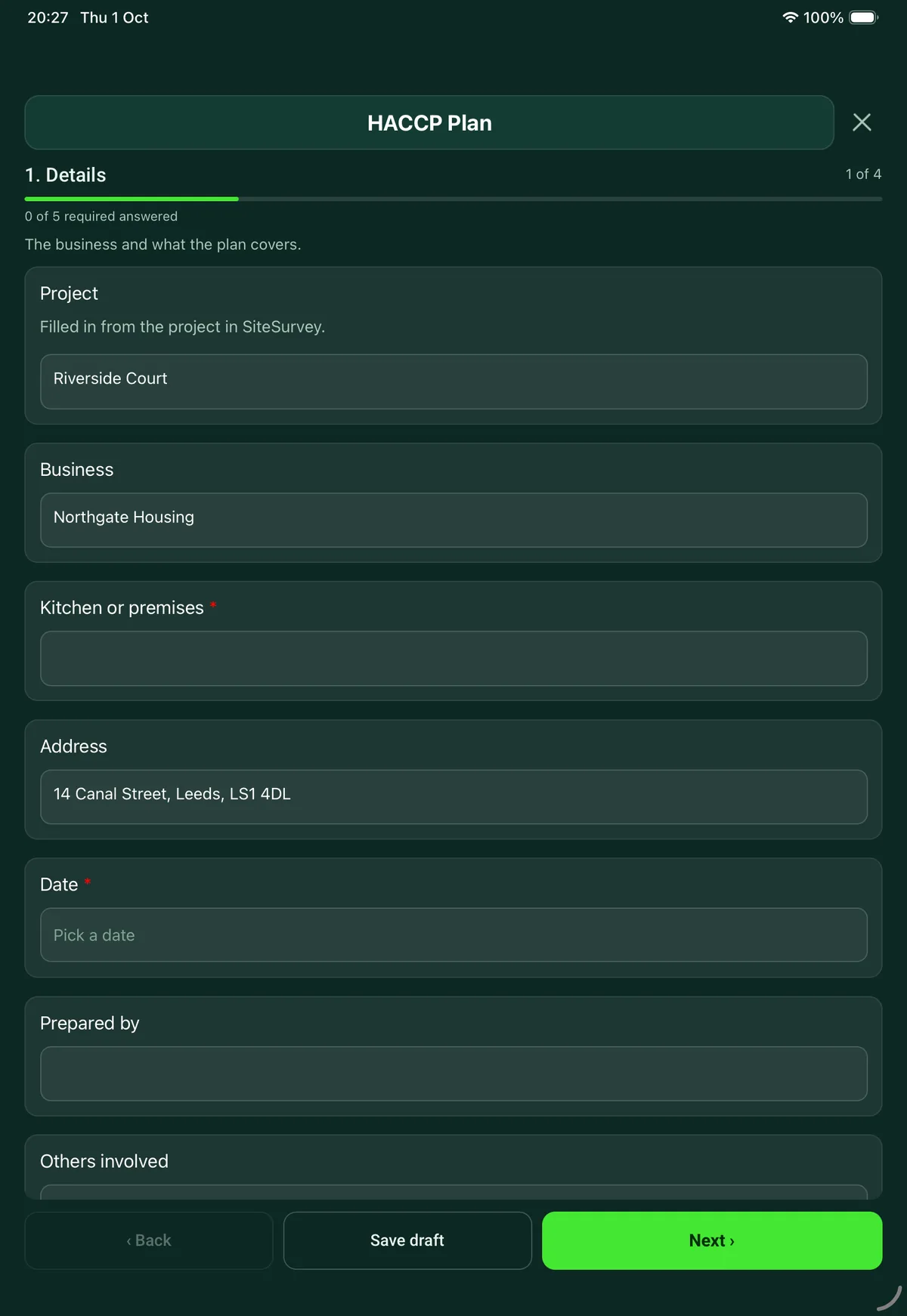
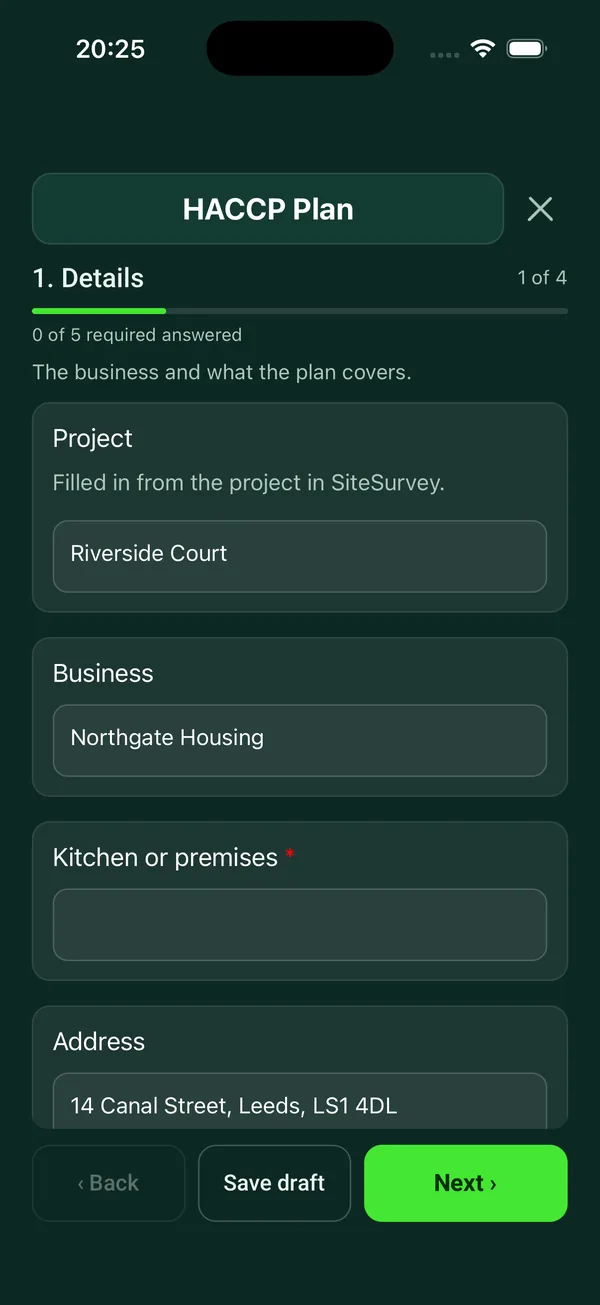
Every question in the HACCP plan template
HACCP plan for a food business: each process step with its hazards and controls, critical control points with limits, monitoring and corrective action, checks and review. 4 sections and 41 questions. Follow-up questions and guidance appear only when an answer calls for them, so the person on site never sees the ones that do not apply.
Make it your own: every question is editable
This is a starting point, not a fixed form. Once it is in your SiteSurvey account you can reword any question, add or remove questions, sections and answer options, and add your own logo, so it fits the way your team works and the jobs you do.
Details you only enter once
Add this form to a project in SiteSurvey and it fills in what the project already knows, so nobody on site retypes it and every form on the job uses the same names. Anything filled in can still be changed.
- Project: the project name
- Business: the project's customer
- Kitchen or premises: the site, when the form is opened for a space or a product
- Address: the site address, from the space or the project
Details
The business and what the plan covers.
- ProjectShort answer
Filled in from the project in SiteSurvey.
Fills in from the project name - BusinessShort answerFills in from the project's customer
- Kitchen or premises*Short answerFills in from the site, when the form is opened for a space or a product
- AddressShort answerFills in from the site address, from the space or the project
- Date*Date
- Prepared byShort answer
- Others involvedShort answer
- Type of businessChoose one
- Restaurant or cafe
- Takeaway
- Pub or bar
- Hotel
- Care home or hospital kitchen
- School or nursery kitchen
- Caterer
- Retailer
- Manufacturer
- Other (describe)
- What food and which processes does this plan cover?*Notes
- GuidanceGOV.UK says that if you run a food business you need a food safety management system, and it must meet the Hazard Analysis and Critical Control Point (HACCP) principles: identify the hazards to avoid, remove or reduce; identify the critical control points; set limits for them; monitor them; establish checks to verify the system works; correct problems when they occur; and keep records.
- GuidanceSmall caterers and retailers can use the Food Standards Agency's Safer food, better business packs to meet this. This form suits a business that wants its own plan, step by step.
Steps, hazards and controls
One entry for each hazard at each step, in the order food moves through the business.
- GuidanceGOV.UK lists three main types of hazard: microbiological (harmful bacteria), chemical (including cleaning chemicals, allergens and other contamination) and physical (objects getting into food).
- Process stepsRepeat for each step. Each one asks:
- Step*Choose one
- Purchase and delivery
- Chilled storage
- Frozen storage
- Dry storage
- Defrosting
- Preparation
- Cooking
- Cooling
- Reheating
- Hot holding
- Cold display or service
- Packing and labelling
- Transport and delivery
- Other (describe)
- Type of hazardChoose one
- Microbiological
- Chemical, including allergens
- Physical
- What could go wrong?*Notes
- How is it controlled?Notes
- Is this a critical control point?Yes or No
A step where control is essential to prevent or remove a hazard, or reduce it to a safe level.
- Critical limitShort answer
A figure you can check, such as a temperature and a time.
Shown when “Is this a critical control point?” is Yes - How is it checked, how often and by whom?Short answerShown when “Is this a critical control point?” is Yes
- What happens if the limit is not met?Short answerShown when “Is this a critical control point?” is Yes
- Where is it recorded?Short answerShown when “Is this a critical control point?” is Yes
- EntriesWorked out by the form
- Critical control pointsWorked out by the form
What the plan relies on
The everyday practices that sit under the plan.
- Cleaning scheduleChoose one
- In place
- Needs work
- Not in place
- Pest controlChoose one
- In place
- Needs work
- Not in place
- Staff training in food hygieneChoose one
- In place
- Needs work
- Not in place
- Personal hygiene and fitness to work rulesChoose one
- In place
- Needs work
- Not in place
- Allergen information and control of cross-contaminationChoose one
- In place
- Needs work
- Not in place
- Approved suppliers and delivery checksChoose one
- In place
- Needs work
- Not in place
- Maintenance of equipment and premisesChoose one
- In place
- Needs work
- Not in place
- Probe thermometer checksChoose one
- In place
- Needs work
- Not in place
- GuidanceFood businesses must tell customers if food contains any of the 14 allergens named in food law: celery, cereals containing gluten, crustaceans, eggs, fish, lupin, milk, molluscs, mustard, peanuts, sesame, soybeans, sulphur dioxide and sulphites (above 10 mg per kg or per litre), and tree nuts.
- What needs work, who will do it and by when?Notes
Checks, review and sign-off
How you know the plan is working.
- How is the plan checked?Tick all that apply
- Manager reviews the records
- Probe thermometers checked for accuracy
- Internal audit or walk round
- Complaints and incidents reviewed
- Environmental health visit findings acted on
- Product or surface testing
- Other (describe)
- How often?Short answer
- Last verification done on, and by whomShort answer
- Review dateDate
- GuidanceReview the plan whenever the menu, a recipe, a supplier, the equipment or the way you work changes, and after anything goes wrong.
- Past reviewsRepeat for each review. Each one asks:
- Date*Date
- Why reviewedShort answer
- What changedShort answer
- Reviewed byShort answer
- Prepared byShort answer
- SignatureSignature
- Approved by the owner or managerShort answer
- Owner or manager signatureSignature
See it filled in
A completed HACCP plan report, made by SiteSurvey from a fictional site visit: every answer, the photos, the guidance that applied and the sign-off, ready to send as a PDF.
HACCP plan FAQs
Is a HACCP plan a legal requirement?
GOV.UK says that if you run a food business you need to have a food safety management system, and it must meet the Hazard Analysis and Critical Control Point (HACCP) principles. How detailed it is depends on the business. Small caterers and retailers can use the Food Standards Agency's Safer food, better business packs to meet it.
What types of hazard does the plan cover?
GOV.UK lists three main types: microbiological (harmful bacteria), chemical (including cleaning chemicals, allergens and other contamination) and physical (objects getting into food). Each entry in the plan records the step, the type of hazard, what could go wrong and how it is controlled.
What is a critical control point?
The form describes it as a step where control is essential to prevent or remove a hazard, or reduce it to a safe level, and GOV.UK calls critical control points the points when you need to prevent, remove or reduce a hazard. Marking an entry as one opens the critical limit, how it is checked, how often and by whom, what happens if the limit is not met, and where it is recorded. The form counts the critical control points.
Does it cover allergens?
Yes. Allergens sit under chemical hazards, and the supporting practices page asks whether allergen information and control of cross-contamination are in place. Food businesses must tell customers if food contains any of the 14 allergens named in food law.
What else does the plan rely on?
The everyday practices under it: a cleaning schedule, pest control, staff training, personal hygiene and fitness to work rules, allergen control, approved suppliers, maintenance and probe thermometer checks. Each is marked in place, needs work or not in place.
When should a HACCP plan be reviewed?
The form's advice is to review it whenever the menu, a recipe, a supplier, the equipment or the way you work changes, and after anything goes wrong. It records how the plan is checked, a review date, a log of past reviews and what changed, and two signatures. In the SiteSurvey app it works offline and syncs when the device is back online, and the record goes out as a PDF or a share link.
Related
Related templates
Templates that go with the HACCP plan form
Daily temperature record for a kitchen: fridges and freezers, cooking and reheating, hot holding and cold display, cooling and deliveries, with corrective actions.
Opening and closing checks for a commercial kitchen: fridges, handwashing, cleanliness, pests, allergens, date labels, waste and close-down, with problems and sign-off.
Daily, weekly or deep clean record: each area with the tasks done, anything missed and why, issues with photos, supplies to reorder and a supervisor check.
Assessment for a task that uses or creates hazardous substances: products and hazard symbols, who is exposed and how, controls, PPE, emergencies and review.
Use this HACCP plan form with your team
Add it from the form library in one click, change any question, and every completed form becomes a branded PDF report.
Start your trial →