Awaab's Law and social housing
Damp and mould inspection appwith the record Awaab's Law asks for.
Inspect every room against the same form, photograph and measure each patch of damp or mould where you find it, and keep a record that shows what was found, by whom and when. Built for the timeframes social landlords in England now work to.
7-day free trial · full access · no card required
6
Rooms
21
Photos
0
Retyped
One damp and mould inspection
The inspection is the easy part. Proving it happened in time is not.
Since 27 October 2025, social landlords in England have had fixed deadlines for damp and mould: investigate a significant hazard within 10 working days, give the resident a written summary within 3 working days of finishing, and complete safety work within 5 working days after that. Meeting those deadlines is one job. Being able to show you met them, with evidence of what was found in which room, is another, and it is the one that usually fails.
Evidence in a camera roll
Photos on an inspector's phone are not attached to the property, the room or the date, so they cannot show what was found where, or when.
Findings with no location
"Mould in the bedroom" is not a finding anyone can act on. Which wall, how extensive, and what is causing it is what the works depend on.
No signal in the flat
Tower blocks, basements and older stock are exactly where damp is worst and exactly where a phone connection drops out.
From the report of damp to the resident's summary.
Walk Cam, point by point
The rest of the inspection, one point at a time.
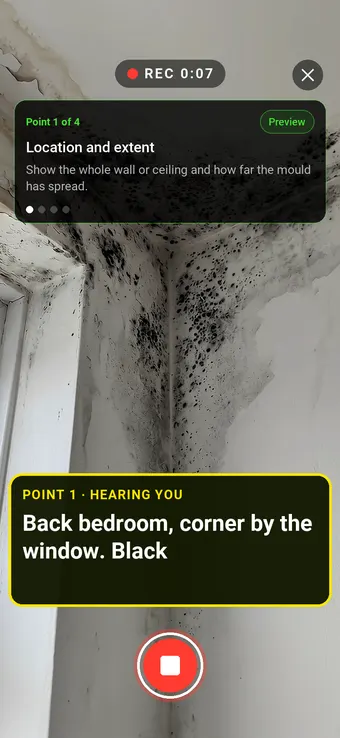
Walk Cam guides the inspector through each point in turn, films it and writes down what they say. Point 1 is in the video at the top of the page; this is the rest of the same visit.
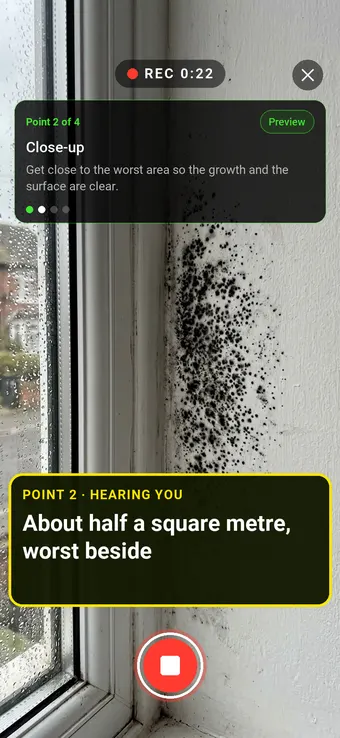
Point 2 of 4
Close-up
Get close to the worst of it, so the growth and the surface it is on are clear.
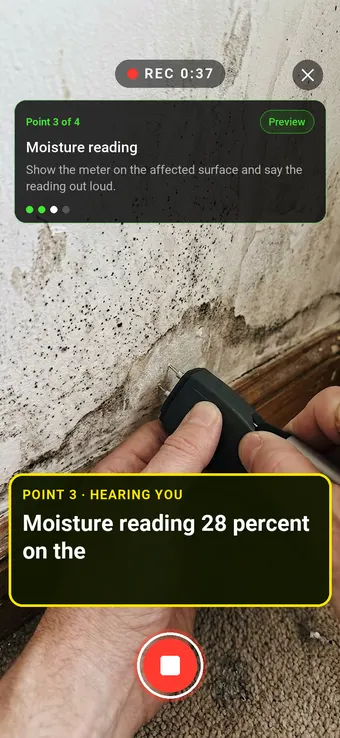
Point 3 of 4
Moisture reading
Show the meter on the wall and say the reading, so it lands in the notes as you speak.
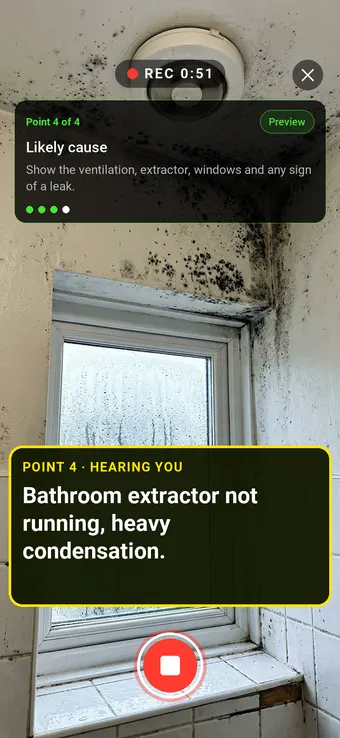
Point 4 of 4
Likely cause
Show what is causing it: ventilation, extraction, condensation or a leak.
What the report looks like
The report the resident's summary starts from.
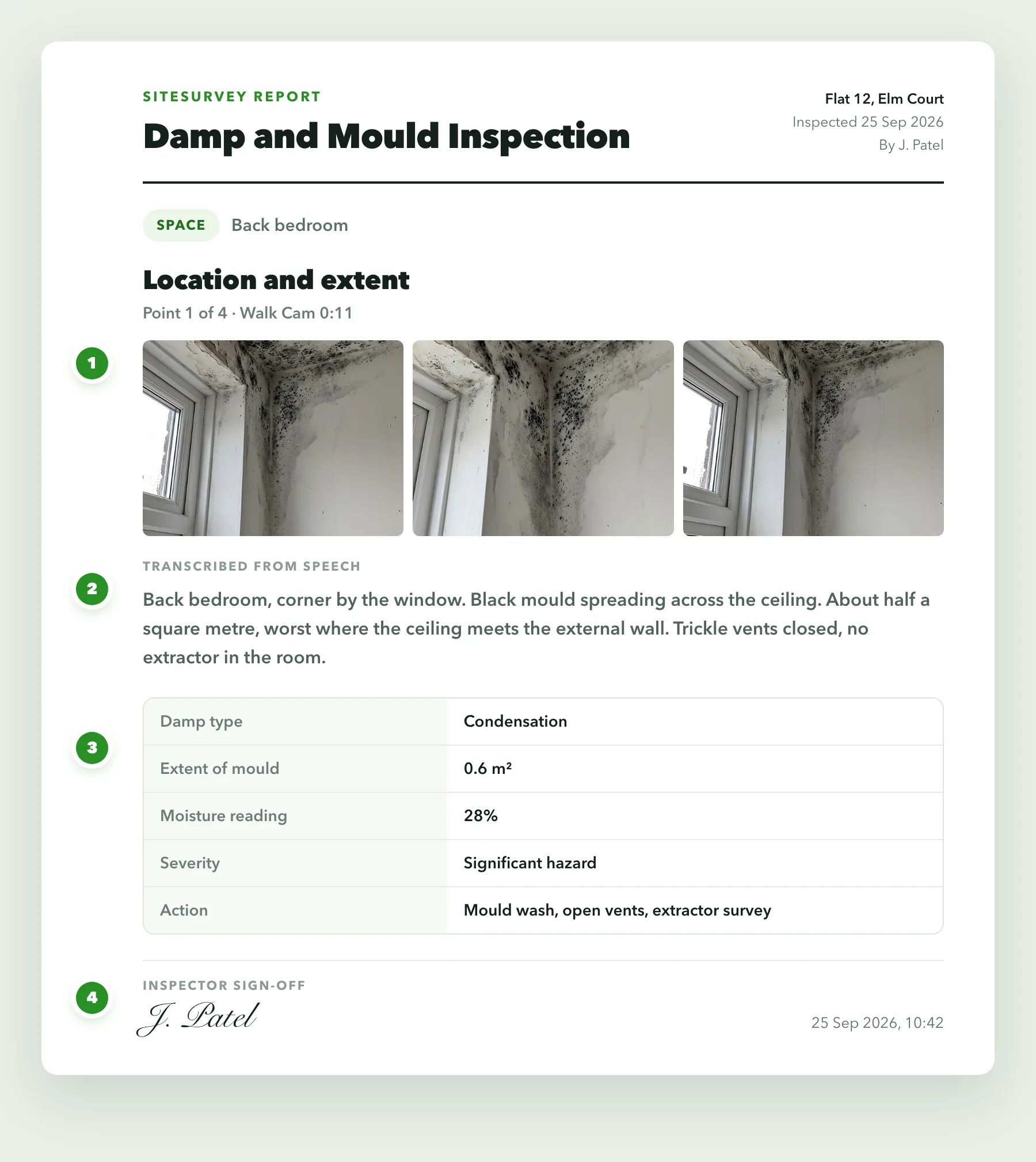
The inspection is written up as you film it. Each room comes out with its photographs, your spoken notes and the form answers, ready to base the written summary on.
- 1Stills from the videoFrames from the Walk Cam clip sit against each point, so every finding has its pictures without stopping to take them.
- 2Your words, transcribedWhat you said while filming becomes the written note, so the write-up is done before you leave.
- 3The form answersRatings, readings and choices from the form come through as a clean table, laid out the same on every inspection.
- 4Signed and datedThe sign-off shows who carried out the inspection and when. Export it as a PDF or share it as a link.
Built for evidence that has to stand up later.
Under Awaab's Law the record matters as much as the repair. Every finding needs a room, a photograph, a date and a name.
✓Room by room record
Every finding sits against the room it was found in, so the report reads the way the home is laid out.
✓Photos with markup
Draw round the affected area, label it, and measure it directly on the photograph so the extent is recorded, not estimated.
✓A form you control
Use a damp and mould template or build your own, with the fields your policy and your contractors need.
✓Dated and attributed
Every entry records who captured it and when, which is the question a complaint or an ombudsman case turns on.
✓Walk Cam video
Film the whole inspection with live voice notes, so there is a continuous record of the home as you found it.
✓Works offline
Capture everything with no signal at all and sync when you are back in range.
Start from a damp and mould template.
Open a ready-made inspection form, adjust it to your own policy, and use it in every room you visit. Every field is editable, in chat or visually.
✓Room and exact location in the home
✓Extent and severity of damp or mould
✓Likely cause: condensation, penetrating or rising damp
✓Moisture and humidity readings
✓Ventilation and extraction, present and working
✓Resident circumstances and vulnerability
✓Recommended works, and whether the home can be made safe
What is Awaab's Law?+
Awaab's Law is named after Awaab Ishak, a two year old who died in December 2020 after prolonged exposure to mould in his family's social housing flat in Rochdale. It is implemented through the Hazards in Social Housing (Prescribed Requirements) (England) Regulations 2025, which came into force on 27 October 2025. It requires social landlords in England to investigate and fix hazards within fixed timeframes, starting with damp and mould and emergency hazards.
What are the Awaab's Law timeframes for damp and mould?+
For a potential significant hazard, the landlord must investigate within 10 working days of becoming aware of it, give the resident a written summary of the findings within 3 working days of the investigation concluding, and carry out the relevant safety work within 5 working days of that. Emergency hazards must be investigated and made safe within 24 hours. If a home cannot be made safe in time, the landlord must offer suitable alternative accommodation. GOV.UK's guidance for social landlords is the authoritative source and should be checked for the full requirements.
What changes on 30 November 2026?+
From 30 November 2026, Phase 2 extends Awaab's Law beyond damp and mould to a wider range of hazards where they present a significant risk of harm, including excess cold and excess heat, falls, structural collapse, fire and explosions, and electrical and hygiene hazards. The government's stated aim is for it to cover every Housing Health and Safety Rating System hazard except overcrowding. Inspections that currently cover damp and mould will need to cover much more.
Does SiteSurvey make us compliant with Awaab's Law?+
No software makes a landlord compliant. Compliance means investigating and acting within the legal timeframes, and that depends on your people and your processes. What SiteSurvey gives you is the record: a room by room account of what was found, with photographs, measurements, and who inspected it and when. That is the evidence you need to show the work was done, and done in time.
Does it work in flats with no signal?+
Yes. Forms, photographs, measurements and video are all captured on the device and sync once you are back in coverage. That matters for this work in particular, because the homes with the worst damp are often in the places with the weakest signal.
Can different inspectors record findings consistently?+
Yes, and it is the main reason to use a form rather than notes. Every inspector opens the same damp and mould form for every room, so findings across a whole stock can be compared and reported on, rather than read one free-text note at a time.
See it on your next job