Form library · Housing and property
Damp and mould inspection form
A room by room damp and mould inspection checklist built around the Awaab's Law timeframes. It records the case timeline, what the resident reports, the building, readings and photos for each room, the cause, the hazard decision and the work needed. Every question is listed below, and you can fill the live form in on this page.
Ready to use from the form library, and editable. Trial from £1, cancel any time.
What should a damp and mould inspection form record?
A damp and mould inspection checklist should record when the landlord became aware, who lives in the home and who is at greater risk, outside defects and leaks, each affected room with photos and readings, ventilation and heating, the type of damp and its cause, whether there is a hazard, the work needed with target dates, and the written summary given to the resident.
Last updated . Facts checked on 27 September 2026 against GOV.UK Awaab's Law guidance for social landlords, the Awaab's Law Phase 2 guidance and the Regulations (SI 2025 No. 1042).
Try the damp and mould inspection form live
Answer a few questions and watch it adapt. Your answers are not saved, and any photos you add are deleted within the hour.
This is the real form as your team would use it: questions appear as you answer, scores work themselves out and you can add photos and signatures. No sign-up needed.
Fill it in on a phone or tablet
Your team completes the damp and mould inspection on site in the SiteSurvey app on iPhone, iPad and Android phones and tablets. The project name and address fill in for them, it works without signal, and it syncs when the device is back online with photos kept against the question they answer.
Customers and subcontractors do not need the app: send them a link and they can fill it in from any browser.
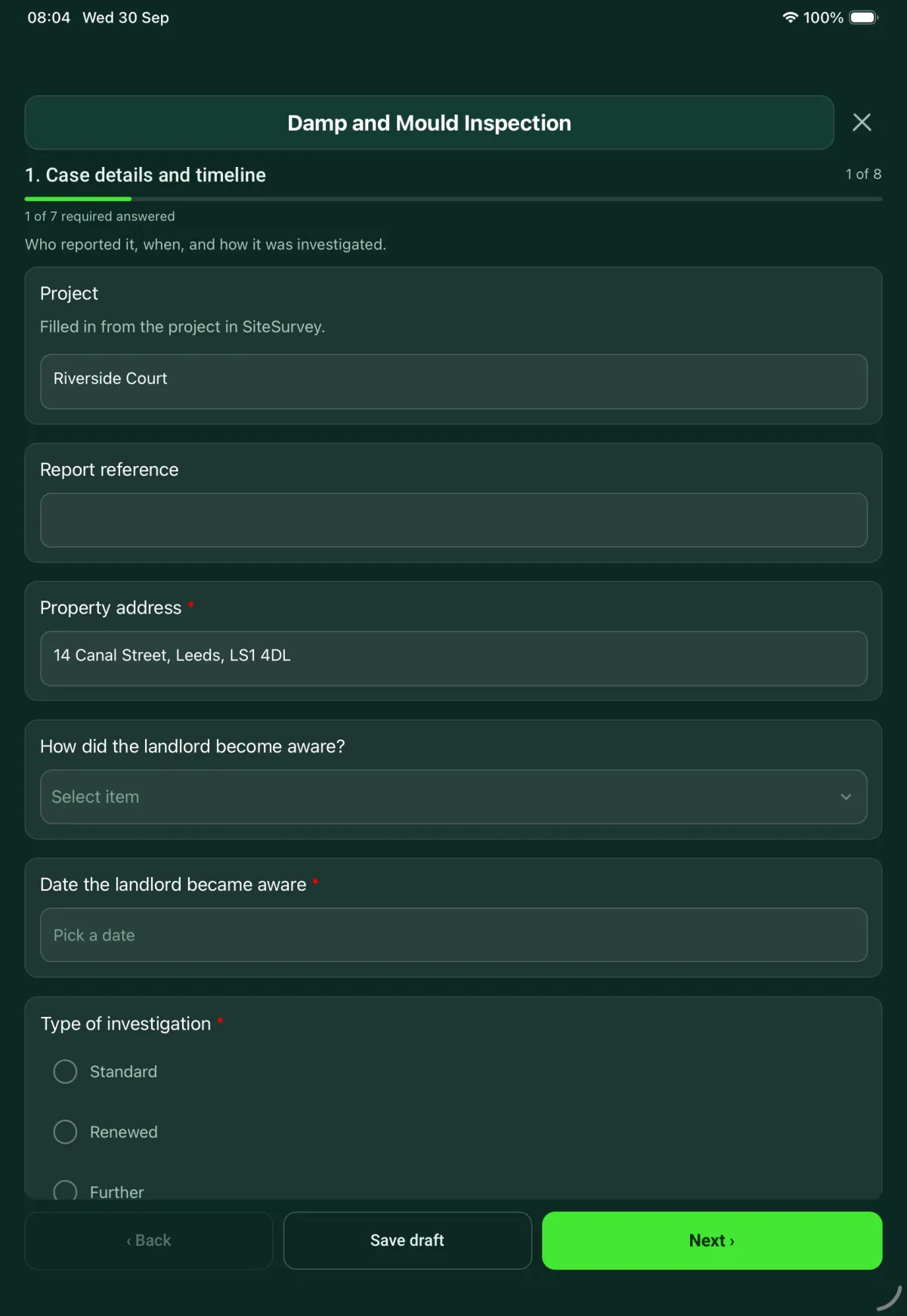
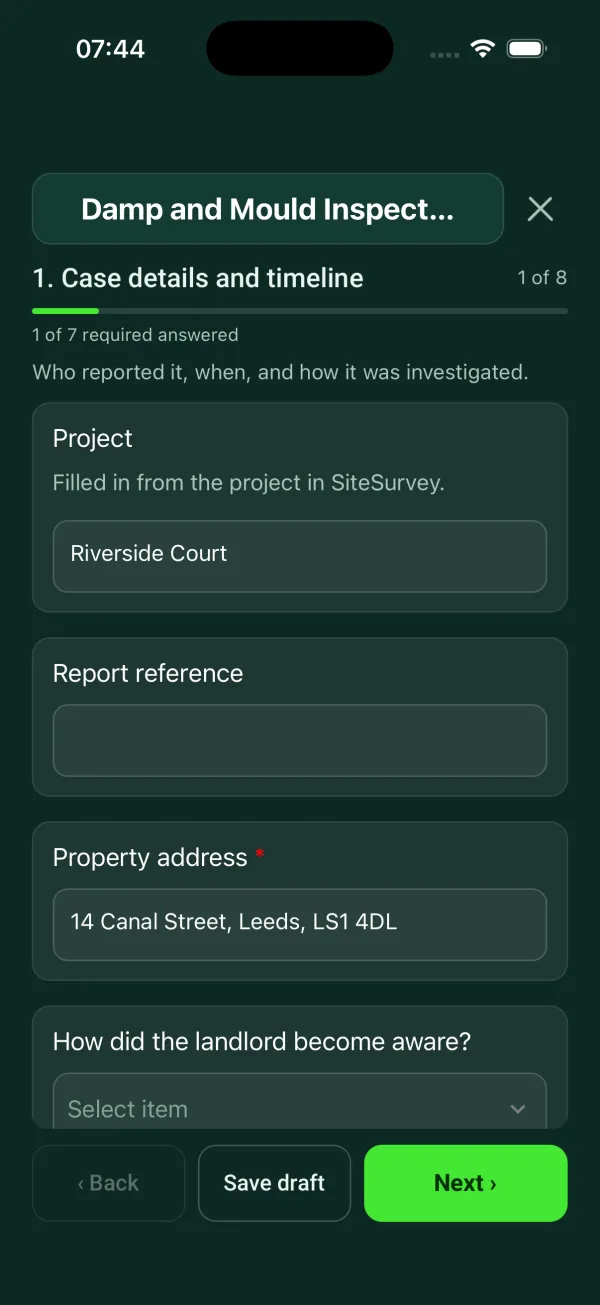
Every question in the damp and mould inspection template
Room by room damp and mould inspection with causes, HHSRS hazard check, photos and remedial actions. Built for Awaab's Law timescales. 9 sections and 94 questions. Follow-up questions and guidance appear only when an answer calls for them, so the person on site never sees the ones that do not apply.
Details you only enter once
Add this form to a project in SiteSurvey and it fills in what the project already knows, so nobody on site retypes it and every form on the job uses the same names. Anything filled in can still be changed.
- Project: the project name
- Property address: the site address, from the space or the project
Case details and timeline
Who reported it, when, and how it was investigated.
- ProjectShort answerFills in from the project name
- Report referenceShort answer
- Property address*Short answerFills in from the site address, from the space or the project
- How did the landlord become aware?Choose one
- Reported by the resident
- Reported by someone else
- Found on a visit
- Other (describe)
- Date the landlord became aware*Date
- Type of investigation*Choose one
- Standard
- Renewed
- Further
- Emergency
- GuidanceStandard investigation. It must be completed within 10 working days, starting the day after the landlord became aware.Shown when “Type of investigation” is “Standard”
- Date the resident asked for an inspection in personDateShown when “Type of investigation” is “Renewed”
- GuidanceRenewed investigation. It must be completed within 10 working days, starting the day after the resident asked for it.Shown when “Type of investigation” is “Renewed”
- WarningEmergency. The investigation and the work to make the home safe must both happen as soon as possible, and within 24 hours.Shown when “Type of investigation” is “Emergency”
- Time the landlord became awareShort answerShown when “Type of investigation” is “Emergency”
- How was the investigation carried out?*Choose one
- In person
- Remote, from photos or video
- What was it based on?Tick all that apply
- Photos from the resident
- Video from the resident
- Video call
- Records of an earlier visit
Shown when “How was the investigation carried out?” is “Remote, from photos or video” - Has the resident asked for an inspection in person?Yes or NoShown when “How was the investigation carried out?” is “Remote, from photos or video”
- CheckThe resident has asked for an inspection in person, so the investigation must include one.Shown when “How was the investigation carried out?” is “Remote, from photos or video” and “Has the resident asked for an inspection in person?” is Yes
- Investigator name and roleShort answer
- Date the investigation was completedDate
- Were all affected areas inspected?Yes or No
- Which areas were not inspected, and why?NotesShown when “Were all affected areas inspected?” is No
- Walk Cam: Damp and mould inspectionWalk Cam video with voice-to-text
Household and resident account
Record what the resident tells you. Medical evidence is not needed.
- Who lives in the home?Short answer
- Has the resident told you about anyone whose health could be affected?Yes or No
- Who?Tick all that apply
- Baby or child
- Older person
- Someone with a breathing condition such as asthma
- Someone with a skin condition
- Someone with a weakened immune system
- Someone who is pregnant
- Someone with a mental health condition
- Other (describe)
Shown when “Has the resident told you about anyone whose health could be affected?” is Yes - Do any of them sleep in an affected room?Yes or NoShown when “Has the resident told you about anyone whose health could be affected?” is Yes
- CheckTake this into account in the hazard decision in section 6. The decision depends on who actually lives in the home.Shown when “Has the resident told you about anyone whose health could be affected?” is Yes and “Do any of them sleep in an affected room?” is Yes
- How long has the resident noticed it?Choose one
- Less than a month
- 1 to 6 months
- 6 to 12 months
- More than a year
- What has the resident seen or tried?Notes
- Has it been reported before?Yes or No
- When, and what was done?NotesShown when “Has it been reported before?” is Yes
- Does the resident have language, access or contact needs?Yes or No
- What do they need?Short answerShown when “Does the resident have language, access or contact needs?” is Yes
Building and outside
Work from the roof down. Look for water getting in from outside.
- Property typeChoose one
- House
- Bungalow
- Flat
- Maisonette
- Which floor?Choose one
- Basement
- Ground floor
- Upper floor
- Top floor
Shown only when the answers above make it relevant - Construction and approximate ageShort answer
- How was the outside inspected?Choose one
- Inspected up close
- Viewed from ground level
- Not inspected
- Why was the outside not inspected?Short answerShown when “How was the outside inspected?” is “Not inspected”
- Defects found outsideTick all that apply
- Blocked or leaking gutters
- Damaged downpipes
- Cracked render or pointing
- Roof defects
- High ground levels
- Failed window seals
- None found
Shown only when the answers above make it relevant - Describe the defects and where they areNotesShown only when the answers above make it relevant
- Photos of the defectsPhotosShown only when the answers above make it relevant
- Any sign of a plumbing leak?Yes or No
- Where is it coming from?Choose one
- Bath or shower
- Basin or sink
- Toilet
- Heating pipework
- Water supply pipework
- The home above
- Not yet known
Shown when “Any sign of a plumbing leak?” is Yes - Photos of the leakPhotosShown when “Any sign of a plumbing leak?” is Yes
Room record
One entry for each room affected. Photograph it before anything is cleaned.
- GuidanceWhat a good photo shows. Step back to show how far it spreads, then get close to the worst of it. Put the meter in shot when you take a reading.
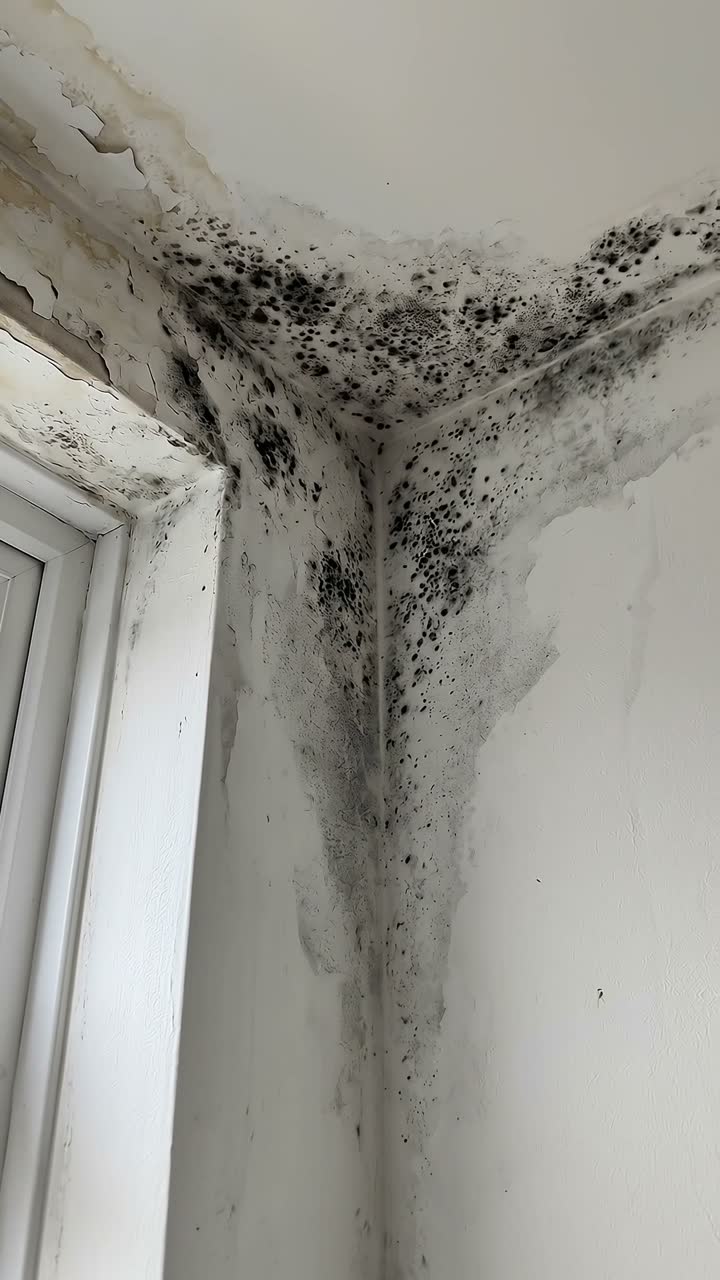
Mould spreading from a ceiling corner beside a window 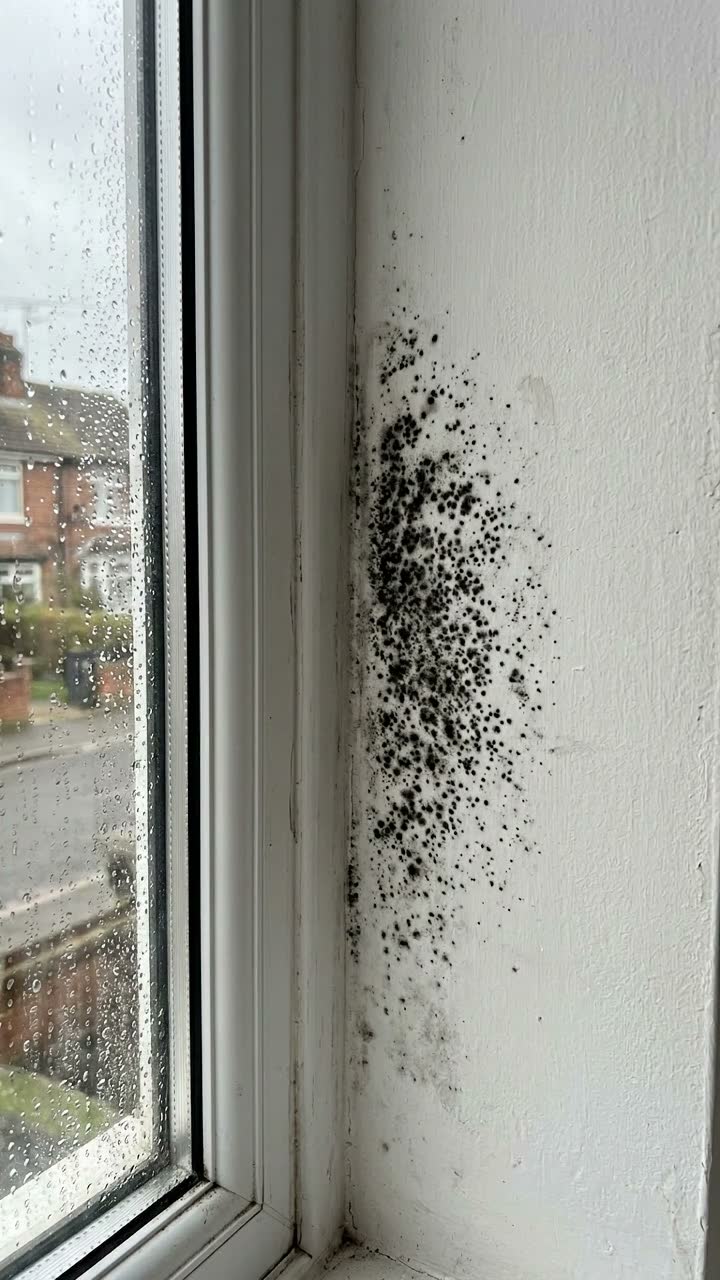
Close-up of mould spotting beside a window frame 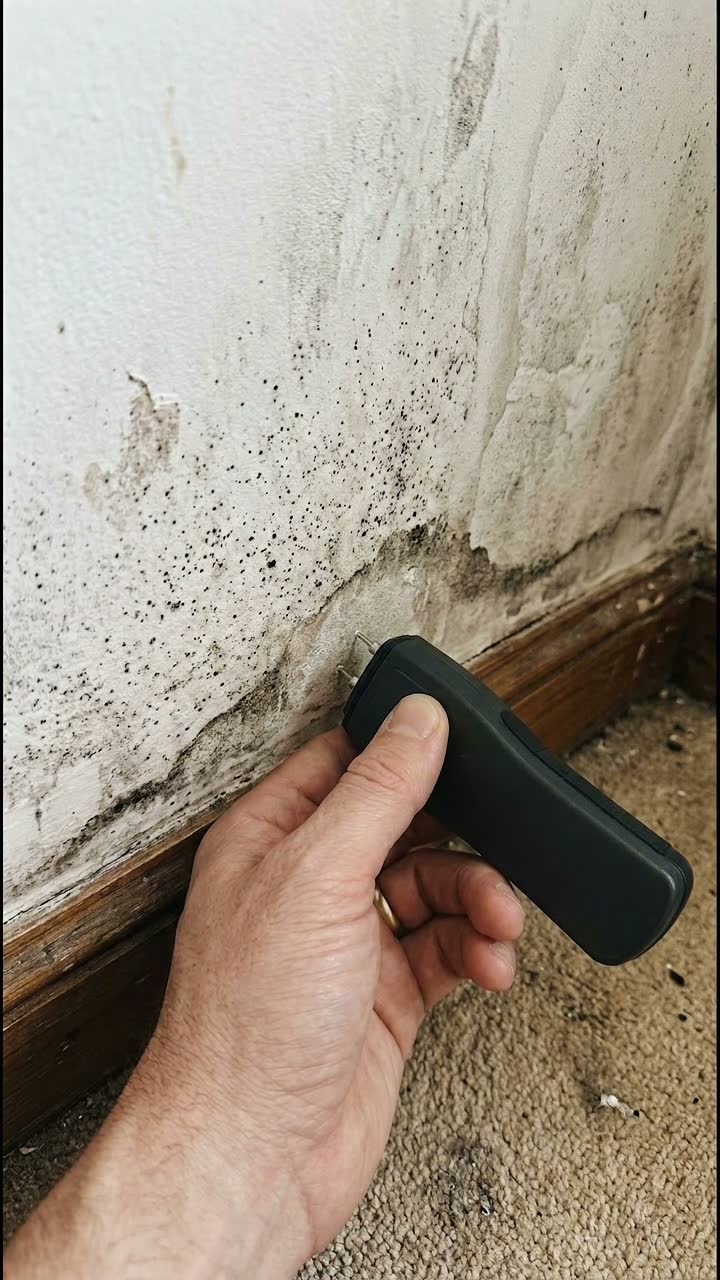
A moisture meter held against a stained wall above the skirting - Rooms affectedRepeat for each room. Each one asks:
- Room*Choose one
- Living room
- Kitchen
- Bathroom
- Bedroom
- Hallway
- Other (describe)
- Which one, and where in the room?Short answer
- Where is the damp or mould?Tick all that apply
- Ceiling
- External wall
- Internal wall
- Window reveal or frame
- Behind furniture
- Skirting or floor
- Sealant or tiles
- Which looks most like what you can see?Choose one
- Spotting in a ceiling corner
- Spotting beside a window
- Staining above the skirting
- Growth across a bathroom ceiling
- Photos of the damp or mouldPhotos
- Area affected (m²)Number
- Size of that wall or ceiling (m²)Number
- Share of the surface affected (%)Worked out by the formShown only when the answers above make it relevant
- CheckMore than 5% of this surface is affected. That is above the indicator in the housing health and safety guidance. It is guidance, not a legal limit.Shown only when the answers above make it relevant
- Air temperature (°C)Number
- Relative humidity (%)Number
- Coldest surface (°C)Number
- Estimated dew point (°C)Worked out by the formShown only when the answers above make it relevant
- CheckThe coldest surface is at or close to the dew point, so condensation is likely to form on it.Shown only when the answers above make it relevant
- CheckHumidity is high. Mould can grow where humidity stays at around 70% for long periods. One reading shows the conditions at this visit only.Shown only when the answers above make it relevant
- Moisture meter, affected areaNumber
- Moisture meter, dry area nearbyNumber
- GuidanceMeter readings on plaster and masonry are a relative scale. Record them for comparison, not as a moisture content.Shown when “Moisture meter, affected area” is answered
- What you can seeNotes
Ventilation and heating
Check that the home can be ventilated and heated.
- Bathroom extractor fanChoose one
- Working
- Fitted, not working
- None
- What is wrong with it?Short answerShown when “Bathroom extractor fan” is “Fitted, not working”
- Does the bathroom have a window that opens?Yes or NoShown when “Bathroom extractor fan” is “None”
- WarningThis bathroom has no fan and no window that opens, so moisture has no way out.Shown when “Bathroom extractor fan” is “None” and “Does the bathroom have a window that opens?” is No
- Kitchen extractionChoose one
- Ducted outside and working
- Recirculating only
- Fitted, not working
- None
- Trickle vents in the affected roomsChoose one
- Fitted and open
- Fitted, blocked or shut
- None
- Do the windows open?Yes or No
- Which windows do not open, and why?Short answerShown when “Do the windows open?” is No
- HeatingChoose one
- Gas boiler and radiators
- Electric storage heaters
- Electric panel heaters
- Heat pump
- District or communal heating
- None
- Is the heating working in the affected rooms?Yes or NoShown only when the answers above make it relevant
- What is wrong with it?NotesShown when “Is the heating working in the affected rooms?” is No
- CheckThe affected rooms cannot be heated. Include the repair in the required work.Shown only when the answers above make it relevant
Findings and hazard decision
Describe the cause in the building. The decision depends on who lives in the home.
- Type of damp*Choose one
- Condensation
- Penetrating damp
- Rising damp
- Leak
- Not yet known
- What is causing the condensation?Tick all that apply
- Extractor fan missing or not working
- Background ventilation blocked or missing
- Room cannot be heated
- Cold surface or missing insulation
- Other (describe)
Shown when “Type of damp” is “Condensation” - Where is the water getting in?NotesShown when “Type of damp” is “Penetrating damp”
- What shows that it is rising damp?NotesShown when “Type of damp” is “Rising damp”
- What is leaking, and has it been stopped?NotesShown when “Type of damp” is “Leak”
- What further investigation is needed, and when?NotesShown when “Type of damp” is “Not yet known”
- Other causes ruled out, and howNotes
- Hazard identified*Choose one
- No hazard
- Significant hazard
- Emergency hazard
- WarningEmergency hazard. The home must be made safe as soon as possible, and within 24 hours.Shown when “Hazard identified” is “Emergency hazard”
- Has the home been made safe?Yes or NoShown when “Hazard identified” is “Emergency hazard”
- Date and time it was made safeShort answerShown when “Hazard identified” is “Emergency hazard” and “Has the home been made safe?” is Yes
- CheckSignificant hazard. Safety work must be completed within 5 working days, starting the day after the investigation was completed.Shown when “Hazard identified” is “Significant hazard”
- Reason for the decisionNotesShown when “Hazard identified” is answered
- CheckYou recorded someone at greater risk sleeping in an affected room. Say how that was taken into account.Shown when “Hazard identified” is answered and “Do any of them sleep in an affected room?” is Yes
Required work and target dates
Each piece of work needs a target start and finish.
- Safety workTick all that apply
- Clean and treat the mould
- Repair or replace the extractor fan
- Repair the heating
- Stop the leak
- Clear or reinstate the vents
- Other (describe)
- Safety work, target startDate
- Safety work, target finishDate
- Can the safety work be finished in time?Yes or No
- WarningIf the safety work cannot be finished in time, the landlord must arrange somewhere suitable for the household to stay, at no cost to them.Shown when “Can the safety work be finished in time?” is No
- Has somewhere to stay been offered?Yes or NoShown when “Can the safety work be finished in time?” is No
- Is more work needed to stop it coming back?Yes or No
- Work to stop it coming backNotesShown when “Is more work needed to stop it coming back?” is Yes
- Target startDateShown when “Is more work needed to stop it coming back?” is Yes
- Target finishDateShown when “Is more work needed to stop it coming back?” is Yes
- Anything done on the visitNotes
- Follow-up visit dateDate
- GuidanceGo back at least 6 weeks after the treatment to check that it has worked.
Written summary for the resident
Plain words. Say what was found, what happens next and when.
- GuidanceThe summary is due within 3 working days, starting the day after the investigation was completed. It must say whether a hazard was found, what will be done and by when, and how to contact the landlord.
- What we foundNotes
- Fixing the problemNotesShown only when the answers above make it relevant
- Stopping the problem coming backNotesShown only when the answers above make it relevant
- Why no further action is neededNotesShown when “Hazard identified” is “No hazard”
- How the resident can contact the landlordShort answer
- How was the summary given?Choose one
- Handed to the resident
- Left at the home
- First class post
- Text message
- Did the resident give this email address or number for contact from the landlord?Yes or NoShown only when the answers above make it relevant
- CheckEmail and text only count if the resident gave that address or number for contact from the landlord. Use another way as well.Shown only when the answers above make it relevant
- Date the summary was givenDate
Inspector sign-off
- WarningThis case was recorded as an emergency. Check that the time the home was made safe is filled in.Shown only when the answers above make it relevant
- NameShort answer
- Inspector signatureSignature
Damp and mould inspection template questions
What are the Awaab's Law timeframes for damp and mould?
A standard investigation must be completed within 10 working days, starting the day after the landlord became aware. If a significant hazard is found, safety work must be completed within 5 working days and the resident's written summary is due within 3 working days, both starting the day after the investigation was completed. An emergency must be investigated and made safe within 24 hours.
Who does Awaab's Law apply to?
Social landlords in England. It came into force on 27 October 2025 through the Hazards in Social Housing (Prescribed Requirements) (England) Regulations 2025. From 30 November 2026 Phase 2 extends it to more hazards, including excess cold and heat, falls, fire and electrical hazards.
What readings does the form take in each room?
For each affected room it asks for the area affected and the size of that wall or ceiling, the air temperature, relative humidity, the coldest surface temperature and moisture meter readings on the affected area and a dry area nearby. It works out the share of the surface affected and an estimated dew point, and flags when the coldest surface is close to the dew point.
Is more than 5% of a wall covered in mould a legal limit?
No. The form flags a surface where more than 5% is affected because that is the indicator in the housing health and safety guidance. It is guidance, not a legal limit, and the hazard decision still depends on who lives in the home.
Does the form track the Awaab's Law deadlines for me?
No. It shows the relevant timeframe when you choose the type of investigation or hazard, and records the dates you need to show the work was done in time. It does not track or chase deadlines, and no software makes a landlord compliant.
Can I use it without signal?
In the SiteSurvey app, yes. The form works offline, photos stay attached to the room they belong to, and the inspector signs on the device. The finished inspection is a PDF report or a share link.
Related
Related templates
Templates that go with the damp and mould inspection form
Elements, lifecycles and renewal years, kitchen and bathroom, heating and electrics, hazards and recommended work for each property.
Periodic tenancy inspection: tenant's account, alarms and safety records, room by room condition, repairs with priorities.
Door by door checks (gaps, seals, closers, signage, glazing), 12 month flat entrance door record and remedial work list.
Check-in or check-out inventory with meter readings, keys, cleanliness and room by room condition, signed by both parties.
Use this damp and mould inspection form with your team
Add it from the form library in one click, change any question, and every completed form becomes a branded PDF report.
Start your trial →