Form library
Housing and property inspection forms
Damp and mould, stock condition, void, inventory, check in and check out and tenancy inspections for landlords and housing teams. See every question, try the live form, then use it in SiteSurvey.
Which inspection forms do landlords and housing teams use?
Each kind of visit has its own form: a property inspection checklist for routine visits, an inventory at check-in and check-out, a stock condition survey to plan investment, and damp and mould inspections for Awaab's Law. In England, landlords also need a gas safety record every 12 months and an electrical inspection at least every 5 years.
Sources: HSE: landlords' gas safety record, GOV.UK: electrical safety standards in the private and social rented sectors and GOV.UK: Awaab's Law guidance for social landlords.
- Forms
- 46 forms in 7 types
- Main UK rules
- HHSRS (revised June 2026), Awaab's Law, Gas Safety Regulations 1998, electrical safety standards
- Used by
- Letting agents, private and social landlords, surveyors and housing officers
- Every form
- See every question and try it live before you sign up, then edit it to suit your team.
Most used
Start with the most used housing and property forms
All housing and property forms by type
Search by name or topic, or jump to a type. Open any form to see every question and try it live.
46 forms
Damp, mould and housing hazards 7
Forms for investigating damp, mould, rot and disrepair, and for recording hazards against the HHSRS and Awaab's Law. Regional versions cover US mold inspections and New Zealand healthy homes.
- Housing and property
Damp and mould inspection form
Room by room damp and mould inspection with causes, HHSRS hazard check, photos and remedial actions. Built for Awaab's Law timescales.
10 sections131 questionsPhotosSignaturesSee every question → - Housing and property
HHSRS inspection form
An HHSRS hazard assessment on the June 2026 scheme: each of the 21 hazards with its deficiencies, likelihood, spread of harm, the reasons for the scores and the hazard score worked out by the formula, banded high, medium or low.
3 sections39 questionsPhotosSignaturesSee every question → - Housing and property
Awaab's Law repair record
An Awaab's Law hazard record for social landlords: the report, triage, investigation, rooms affected with the measured damp or mould, the written summary, safety and preventative work and every update to the tenant, with working days counted against the fixed timeframes.
6 sections60 questionsPhotosSignaturesSee every question → - Housing and property
Housing disrepair inspection
A housing disrepair inspection for landlords responding to a claim: claim dates, access, each room as a space with defects, repairing obligation, likely cause, damp readings and photos, a schedule of works and actions.
3 sections55 questionsPhotosSignaturesSee every question → - Housing and property
Dry rot inspection checklist
A dry rot and timber decay inspection: moisture sources, each room or area with the timbers checked, signs of rot or wood-boring insects, meter readings, access limits, photos, and whether a specialist survey is needed.
3 sections44 questionsPhotosSignaturesSee every question → - Housing and property
Mold inspection checklist
A US visual mold inspection of a home or building: the outside, plumbing and HVAC checks EPA lists for moisture control, then each room with visible growth measured with a tape or from a photo and its EPA size category, moisture sources, moisture meter readings against a dry reference, humidity, odor and exhaust fans, materials affected and photos, whether sampling was done, EPA-based recommendations, actions and sign-off.
6 sections104 questionsPhotosSignaturesSee every question → - Housing and property
Healthy homes assessment template
A healthy homes assessment for a New Zealand rental home: the main living room heating against the required capacity, ceiling and underfloor insulation against the zone R-values, each room's openable windows and fans, drainage and the ground moisture barrier, draught stopping, exemptions, and the details for the compliance statement.
7 sections128 questionsPhotosSignaturesSee every question →

Condition surveys, dilapidations and claims 8
Element by element records of what a building is like now, what it will need and what has been damaged. Used by surveyors, asset managers, loss adjusters and landlords at the start and end of a lease.
- Housing and property
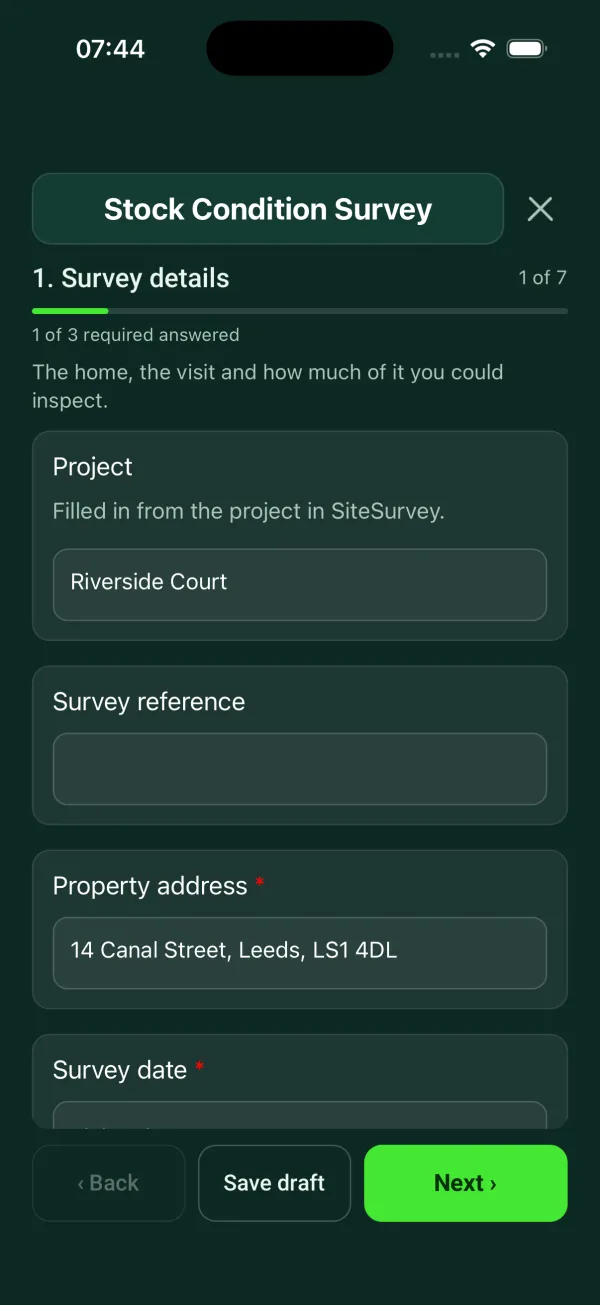
Stock condition survey template
Elements, lifecycles and renewal years, kitchen and bathroom, heating and electrics, hazards and recommended work for each property.
7 sections102 questionsPhotosSignaturesSee every question → - Housing and property
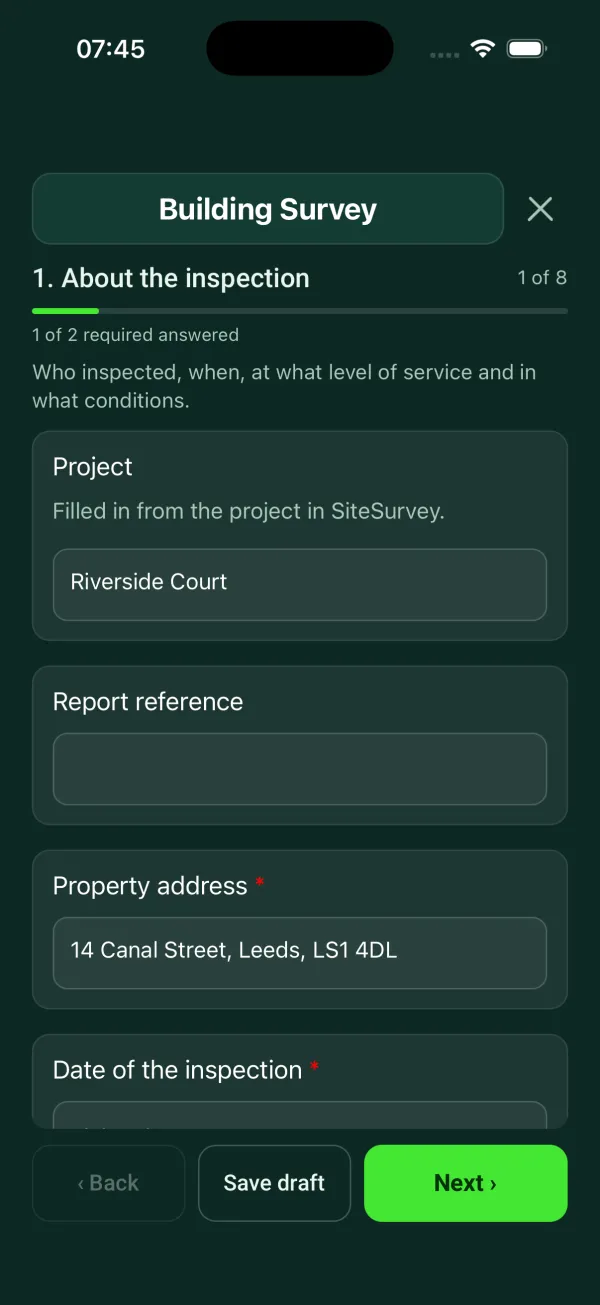
Building inspection checklist
Condition survey of a building: limits of inspection, element by element record, services and risks, further investigations.
8 sections111 questionsPhotosSignaturesSee every question → - Housing and property
Property condition assessment template
A property or facility condition assessment for owners, buyers, lenders and facility managers: scope, documents and interviews, each building system with its components, condition ratings on your own scale, remaining useful life, recommended action, priority and opinion of cost, then immediate costs, a 10-year cost table, an optional facility condition index and an executive summary.
6 sections116 questionsPhotosSignaturesSee every question → - Housing and property
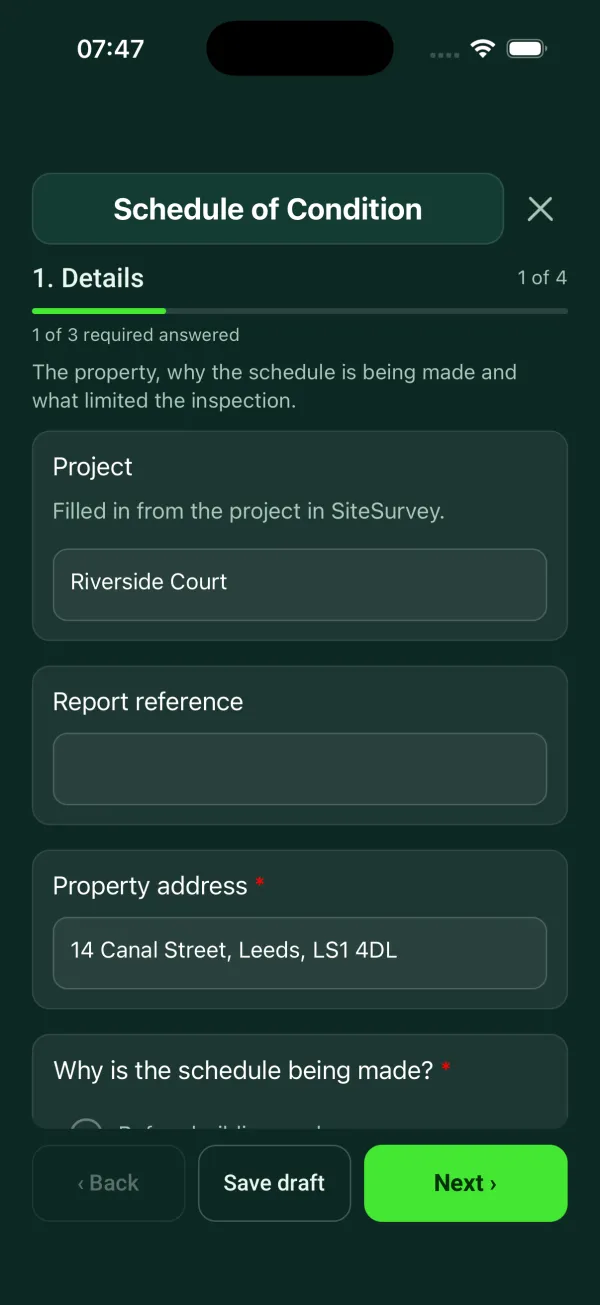
Schedule of condition template
Photographic record of condition before works or at the start of a lease, room by room.
4 sections65 questionsPhotosSignaturesSee every question → - Housing and property
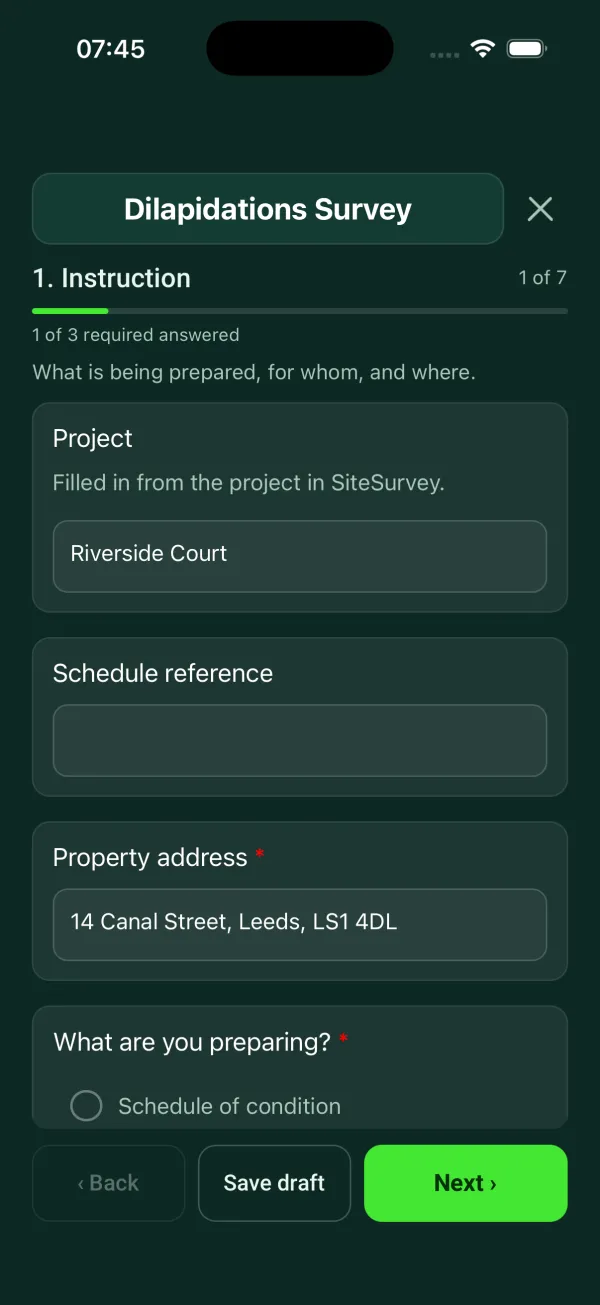
Dilapidations survey template
Schedule of dilapidations against the lease: item record with remedy and cost, summary of costs, intentions and timing.
7 sections81 questionsPhotosSignaturesSee every question → - Housing and property
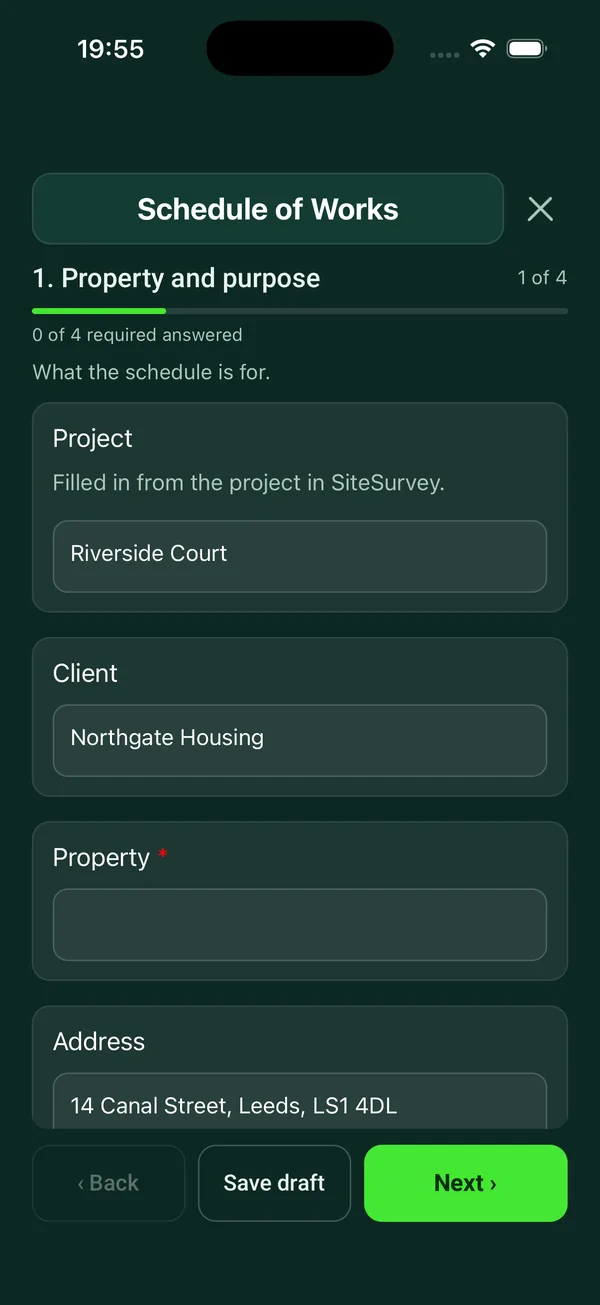
Schedule of works template
Room by room list of the work needed on a property: each item with its location, description, quantity, trade, priority, estimated cost and photos, with totals.
4 sections51 questionsPhotosSignaturesSee every question → - Housing and property
Insurance inspection report
An insurance claim inspection: policy and claim details, the property pinned by GPS, cause and peril, each area of damage as a space with photos, measured size, water line and cost, contents, emergency works, cover notes and the reserve against the estimate.
3 sections45 questionsPhotosSignaturesSee every question → - Housing and property
Property damage report template
A property damage report for insurers, landlords and contractors: what happened and when, the cause, each area of damage with photos, measured size and estimated cost, totals by severity, making safe, police and insurer references.
4 sections42 questionsPhotosSignaturesSee every question →


Lettings, tenancies and voids 9
Everything from taking on a property and checking a tenant in, through routine visits, to checking out, cleaning and looking after the home while it stands empty.
- Housing and property
Property management onboarding checklist
Record the transfer of a property into management: authority, records, access, each document and certificate with its expiry, meter readings, keys and unresolved handover tasks.
3 sections49 questionsPhotosSignaturesSee every question → - Housing and property
Right to rent check form
A right to rent check record for landlords and agents in England: each adult occupier, how they were checked, documents seen, share code, DVSP or Landlord Checking Service result, copies kept and follow-up check dates.
3 sections26 questionsSignaturesSee every question → - Housing and property
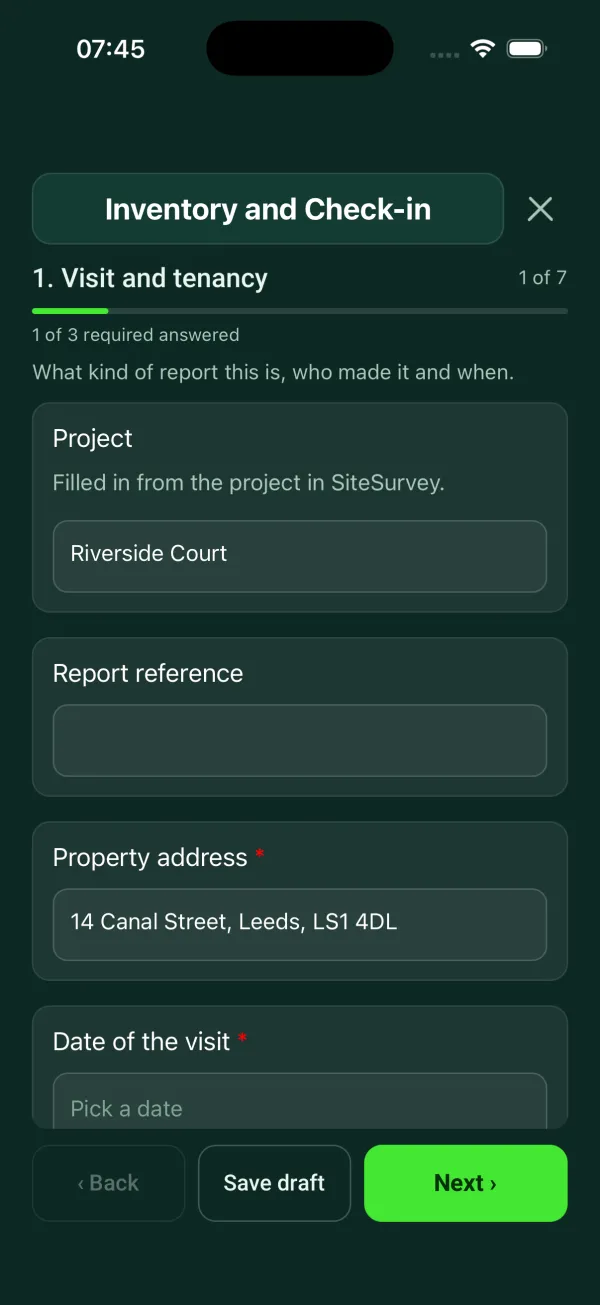
Tenancy inventory template for check-in and check-out
Check-in or check-out inventory with meter readings, keys, cleanliness and room by room condition, signed by both parties.
8 sections117 questionsPhotosSignaturesSee every question → - Housing and property
Meter reading form
A meter reading record with photos: reason, each gas, electricity, water or heat meter with serial scan, reference numbers, readings and smart status, who was told, and signatures.
3 sections20 questionsPhotosSignaturesSee every question → - Housing and property
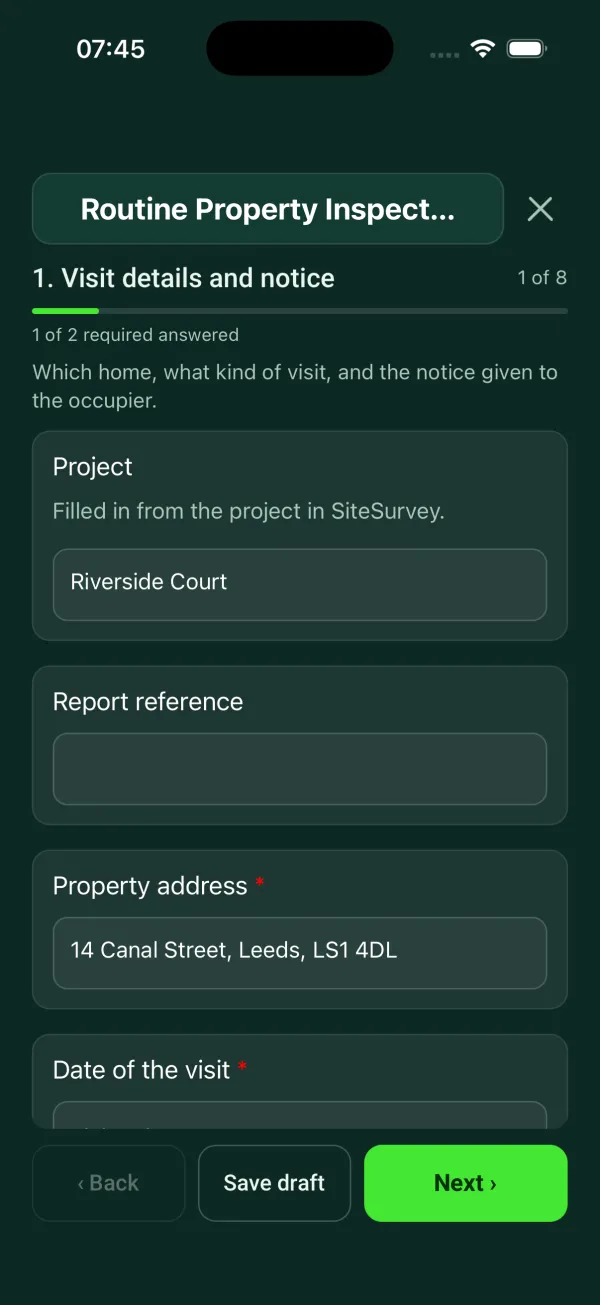
Property inspection checklist
Periodic tenancy inspection: tenant's account, alarms and safety records, room by room condition, repairs with priorities.
8 sections108 questionsPhotosSignaturesSee every question → - Housing and property
Noise diary template
A noise and anti-social behaviour diary: each incident with date, start and end time, what happened, where it came from, the effect, witnesses and recordings, for evidence to a landlord or council.
3 sections23 questionsPhotosSignaturesSee every question → - Housing and property
End of tenancy cleaning checklist
An end of tenancy cleaning checklist: each room as a space with the tasks done, before and after photos and anything that needs more work, plus the kitchen appliances, keys, meter readings and sign-off.
3 sections41 questionsPhotosSignaturesSee every question → - Housing and property
Void property inspection
A void property inspection: keys, meter readings, gas and electrical safety dates, smoke and CO alarms, damp and mould, room-by-room condition and the works list to bring the home up to the lettable standard.
5 sections53 questionsPhotosSignaturesSee every question → - Housing and property
Unoccupied property inspection checklist
A vacant and unoccupied property inspection for insurers' conditions: days empty, inspection interval, security, signs of entry, roof and gutters, water drained or heating on, leaks and damp, post, meter readings and photos.
4 sections64 questionsPhotosSignaturesSee every question →
Landlord gas, electrical and alarm checks 5
The safety records a landlord is most often asked for, plus HMO and chimney checks. The gas record and EICR themselves must come from a registered engineer or qualified electrician.
- Housing and property
Landlord gas safety record template
A landlord gas safety site record: every appliance and flue room by room with its checks, analyser readings against the manufacturer's limit, defects and remedial action, counts of unsafe appliances, the installation checks, the engineer's Gas Safe number and the details regulation 36 requires.
3 sections61 questionsPhotosSignaturesSee every question → - Housing and property
Landlord electrical inspection checklist
A landlord's electrical visual check between EICRs, not an EICR: the last EICR date and code and the days until the next one is due, sockets, switches, lights, consumer unit, RCD test, flexes, bathroom and outside fittings counted, photos and actions.
3 sections47 questionsPhotosSignaturesSee every question → - Housing and property
Smoke and CO alarm check record
A smoke and carbon monoxide alarm check for rented homes: each storey's smoke alarm and each room with a fixed combustion appliance, tested and working, replacements and the tenant's signature.
4 sections31 questionsPhotosSignaturesSee every question → - Housing and property
HMO inspection checklist
An HMO inspection against the HMO management regulations: licence details, the house pinned by GPS, fire safety and escape with the defects counted, gas and electrical safety dates, each room as a space with its floor area against the licence room sizes, and actions.
4 sections81 questionsPhotosSignaturesSee every question → - Housing and property
Chimney inspection checklist
A chimney sweep and inspection record: appliance, fuel and flue, sweeping method, smoke test, condition checks, CO alarm, debris found, the next sweep date and the customer's signature.
3 sections51 questionsPhotosSignaturesSee every question →
Roofs, structure and outside 8
Inspections of the roof, rainwater goods, cracks, foundations, basements and the garden, including decking, pools and invasive plants.
- Housing and property
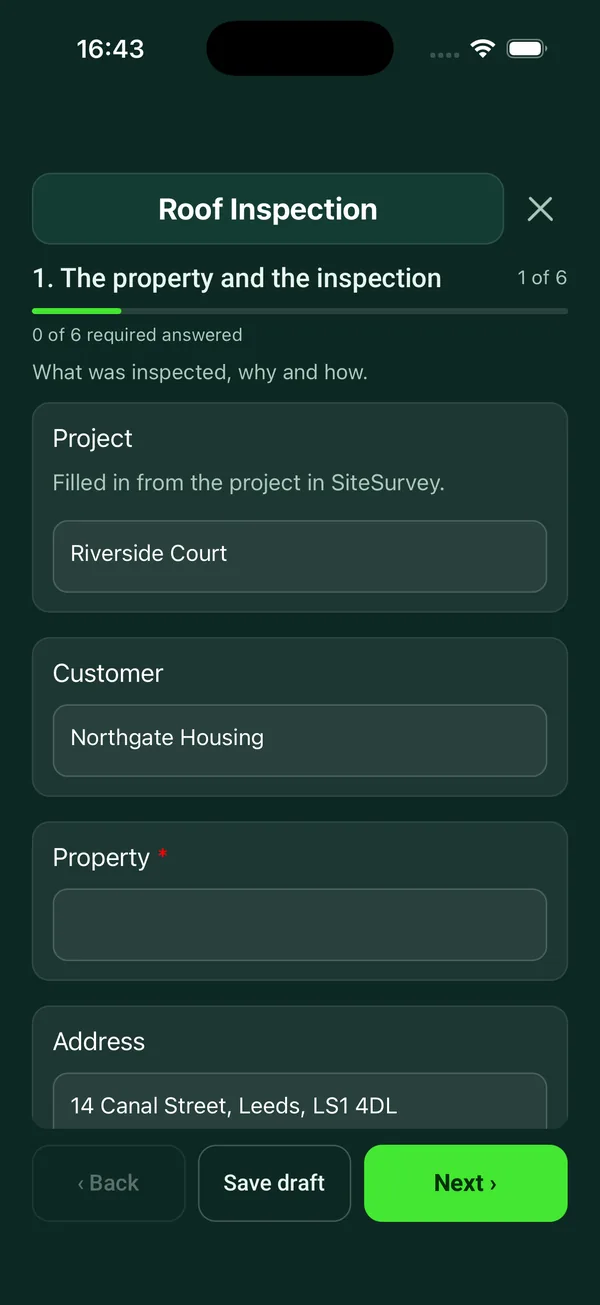
Roof inspection checklist
Roof inspection report: safe access, coverings by area, flashings, chimneys, gutters and rooflights, the roof space, defects with priorities, costs and photos.
6 sections68 questionsPhotosSignaturesSee every question → - Housing and property
Gutter clearance report
A gutter clearance report with before and after photos: access method, each elevation's length and blockage, downpipes flushed, defects found, recommendations and the customer's signature.
3 sections34 questionsPhotosSignaturesSee every question → - Housing and property
Crack monitoring record
A crack monitoring record for walls: each crack with its location, pattern, width at a marked point against the last reading, how it was measured, photos with a scale, BRE Digest 251 category if assessed, and next steps.
3 sections51 questionsPhotosSignaturesSee every question → - Housing and property
Foundation crack and settlement inspection
A foundation crack and settlement inspection for an existing building: building details, foundation and soil if known, crack history and previous repairs, an external walk-round by elevation with each crack measured and photographed, signs of movement, drainage and trees near the building with distances, an internal inspection by room with floor level readings, the inspector's own view, recommendations, actions and sign-off.
7 sections127 questionsPhotosSignaturesSee every question → - Housing and property
Basement inspection checklist
A basement and cellar condition inspection: access, waterproofing type, each area's walls, tide marks, floor and standing water, where water gets in, sump and pump, services and storage at risk, likely cause and next steps.
3 sections53 questionsPhotosSignaturesSee every question → - Housing and property
Decking inspection checklist
A decking inspection checklist: deck type, material and height, boards, fixings, surface, steps, balustrade and handrail, joists, posts and footings, guarding height and gaps, each defect with risk and photos, and the result.
3 sections68 questionsPhotosSignaturesSee every question → - Housing and property
Swimming pool inspection checklist
A US residential pool and spa inspection: barrier height and gaps, gates (self-closing, self-latching, latch height), door alarms and covers, drains and entrapment with the drain cover label, a visual electrical check (GFCI, bonding), deck, coping and shell, equipment pad with data plates, water clarity, photos and findings with priority. Notes cite the CPSC barrier guidelines and the Virginia Graeme Baker Act.
9 sections179 questionsPhotosSignaturesSee every question → - Housing and property
Japanese knotweed survey
A Japanese knotweed survey: stands found with location, size, distance to buildings and boundaries, growth stage, damage, spread from or to neighbours, management plan and waste disposal.
3 sections46 questionsPhotosSignaturesSee every question →


Measured surveys and retrofit 6
Site measures for replacement kitchens, bathrooms, windows and roofs, and the records behind insulation and whole-house retrofit work.
- Housing and property
Kitchen survey and measure template
A kitchen measure survey: room height, every wall with its length and features, windows and doors, gas, water, waste and electrics, extraction, floor, appliances wanted and delivery access.
4 sections32 questionsPhotosSignaturesSee every question → - Housing and property
Bathroom survey and measure template
A bathroom measure survey: room size and height, every wall with its features, window and door, existing suite, water, waste, soil stack and electrics, extraction, floor, the new layout wanted and the customer's signature.
4 sections44 questionsPhotosSignaturesSee every question → - Housing and property
Window survey template
A window and door survey: each opening with its room, elevation, measurements, existing and new style, glazing, safety glass, escape window sizes and trickle vents, plus photos inside and out.
4 sections67 questionsPhotosSignaturesSee every question → - Housing and property
Roof survey and measurement template
A roof survey and measure for quoting: each slope with its covering, eaves and rafter lengths, area and pitch, ridges, hips, valleys and rainwater goods, access, fragile surfaces and asbestos.
4 sections44 questionsPhotosSignaturesSee every question → - Housing and property
Loft insulation survey
A loft insulation pre-install survey: access, existing insulation depth, joists, ventilation and condensation, cables and downlights, tanks and pipes, boarding and storage, area and the work proposed.
3 sections43 questionsPhotosSignaturesSee every question → - Housing and property
Retrofit assessment template
A whole-house retrofit assessment data record (PAS 2035 style): dwelling, construction, condition, ventilation, heating and hot water, existing measures, occupancy, defects to fix first and photos.
3 sections51 questionsPhotosSignaturesSee every question →




Estates and neighbourhood 3
Walkabouts of communal areas and grounds, and reports of fly-tipping and abandoned vehicles for housing officers and estate teams.
- Housing and property
Estate inspection checklist
An estate inspection or walkabout for social landlords: who attended, communal entrances, lighting, bin stores, fly-tipping, paths, grounds and play areas, each issue with photos and who is responsible, and an action plan.
3 sections77 questionsPhotosSignaturesSee every question → - Housing and property
Fly-tipping report form
A fly-tipping report for land and estate managers: location, waste types and size, hazards, evidence, photos, council or Environment Agency reports, and clearance by a registered waste carrier with the transfer note.
3 sections27 questionsPhotosSignaturesSee every question → - Housing and property
Abandoned vehicle report form
An abandoned vehicle report for estates, car parks and private land: location, vehicle details and plate scan, tax and MOT status, condition, hazards, how long it has been there, notices, council and police references.
4 sections34 questionsPhotosSignaturesSee every question →

Smart fields
Smart fields in these housing and property forms
These forms do more than tick boxes. Each field type below is already built into the forms listed, and you can add it to any form you edit.
Calculated tiles
Totals, scores and pass rates work themselves out as you fill the form in, shown as live tiles.
In 46 forms, including damp and mould inspection form, stock condition survey template and property inspection checklist.
How calculated fields work →Walk Cam
A guided video route: one short clip per inspection point, with live voice-to-text into the answer.
In 33 forms, including damp and mould inspection form, stock condition survey template and property inspection checklist.
How Walk Cam works →Size from photo
Tap a known reference and the thing you are measuring in one photo, and the height or width fills in.
In 33 forms, including damp and mould inspection form, stock condition survey template and property inspection checklist.
How size from photo works →GPS location
One tap fills in latitude, longitude, OS grid reference and accuracy.
In 28 forms, including damp and mould inspection form, stock condition survey template and property inspection checklist.
How GPS location works →Rooms as spaces
Add a room, area or item as many times as you need, and each one becomes its own space with its photos and answers.
In 22 forms, including damp and mould inspection form, property inspection checklist and tenancy inventory template for check-in and check-out.
How rooms become spaces →Label scanner
Scan equipment labels, serial numbers and barcodes straight into the form.
In 4 forms, including landlord gas safety record template, abandoned vehicle report form and meter reading form.
How the label scanner works →Products and assets
Each asset you list on the form is saved as a product in its space, so the next visit starts from the same list.
In 3 forms, including landlord gas safety record template, foundation crack and settlement inspection and property condition assessment template.
How products and assets work →
Guide
Property inspection forms: one visit, one record
A property inspection checklist is the record of one visit to one home or building: who went, when, what they could and could not get into, what condition each room or element is in, and what needs doing. The same idea runs through every form on this page, from a routine property inspection by a letting agent to a full stock condition survey by a social landlord.
What changes is the purpose. A tenancy inventory fixes the condition at check-in so it can be compared at check-out. A schedule of condition does the same before building work or a commercial lease. A damp and mould inspection or HHSRS inspection is looking for hazards to the people living there. Pick the form that matches the decision someone will make from it, then edit the questions to fit your stock.
Which property checks are a legal requirement in the UK?
Most of the law below applies to rented homes in England. Wales, Scotland and Northern Ireland have their own rules, so check the version that covers your properties.
- Gas safety
- Landlords must have an annual gas safety check by a Gas Safe registered engineer, give existing tenants a copy of the record within 28 days and new tenants a copy before they move in, and keep records for at least two years. Our landlord gas safety record template follows that layout.
- Electrical safety
- The electrical installation must be inspected and tested by a qualified person at least every 5 years, with the report given to existing tenants within 28 days. This now covers social landlords as well as private ones. A landlord electrical inspection checklist is a visual check between tests, not a replacement for the EICR.
- Smoke and carbon monoxide alarms
- At least one smoke alarm on each storey used as living accommodation, a carbon monoxide alarm in any room with a fixed combustion appliance (gas cookers excluded), and every alarm checked on the day a new tenancy begins. The smoke and CO alarm check record records that check.
- HMOs
- A large HMO (5 or more people forming more than 1 household and sharing facilities) needs a licence, valid for up to 5 years. The manager must keep means of escape free and in good repair, and fire fighting equipment and alarms in good working order. See the HMO inspection checklist and HMO fire safety check.
- Right to rent and deposits
- Landlords and agents in England must check that every adult occupier has the right to rent before letting the home to them, and must protect a deposit in a government-backed scheme within 30 days. Use the right to rent check form and an inventory to support any deposit dispute.
Sources: HSE: landlords' gas safety record, HSE: gas safety check, who can do it, GOV.UK: electrical safety standards in the private and social rented sectors, GOV.UK: smoke and carbon monoxide alarm regulations Q&A for landlords, GOV.UK: house in multiple occupation licence, legislation.gov.uk: Management of HMOs (England) Regulations 2006, regulation 4, GOV.UK: landlord's guide to right to rent checks (1 October 2026) and GOV.UK: tenancy deposit protection.
HHSRS and Awaab's Law: what changed in 2026
The Housing Health and Safety Rating System is how hazards in homes are assessed under the Housing Act 2004. From 23 June 2026 the HHSRS (England) (Amendment) Regulations 2026 cut the list of hazards from 29 to 21 by merging several of them, replaced the lettered bands A to J with three bands, and renamed the four classes of harm Extreme, Severe, Serious and Moderate. A score of 1,000 or more is High and is a Category 1 hazard; Medium (100 to 999) and Low (under 100) are Category 2.
For council inspections under section 4 of the Housing Act, the new rules apply to inspections started on or after 22 June 2026. If your forms, reports or training still use the old 29 hazards and bands A to J, update them. Our HHSRS inspection form and stock condition survey list the 21 hazards.
Awaab's Law sets fixed timeframes for social landlords in England. Since 27 October 2025 it covers emergency hazards and significant damp and mould: emergencies must be investigated and made safe within 24 hours, significant hazards investigated within 10 working days, a written summary given to the tenant within 3 working days of the investigation, and relevant safety work done within 5 working days of the investigation concluding. Government guidance says the rules are amended from 30 November 2026 to extend to more hazards, including excess cold and heat, falls, structural collapse, fire and explosions, and electrical and hygiene hazards. The Awaab's Law repair record records each date so you can show what was done and when.
Sources: legislation.gov.uk: HHSRS (England) (Amendment) Regulations 2026 (SI 2026/571), GOV.UK: landlord and agent guide to the HHSRS, GOV.UK: Awaab's Law guidance for social landlords and GOV.UK: Awaab's Law Phase 2 guidance for social landlords.
What a good property inspection form records
The forms that hold up later, at a deposit dispute, a disrepair claim or a regulator's visit, all record the same things well.
- Access
- Which rooms, roof spaces and outbuildings were seen and which were not, and why. A missed room is the gap a claim gets through.
- Photos tied to the item
- A photo of each defect taken against the room or element it belongs to, with an annotation showing where the problem is. Wide shots of every room at check-in and check-out.
- Readings, not adjectives
- Moisture and humidity readings for damp, crack widths with a gauge for crack monitoring, meter readings with a photo of the display. Numbers can be compared at the next visit.
- Who lives there
- Vulnerable residents change how urgent a hazard is under the HHSRS and Awaab's Law, so record them where the form asks.
- Actions with owners and dates
- Each defect should end with what needs doing, by whom and by when, so a schedule of works can be built from it.
- Signatures
- The tenant's signature on an inventory or alarm check, and the inspector's on every report.
How often should rented homes and buildings be inspected?
Some frequencies are set in law: an annual gas safety check, an electrical inspection at least every 5 years, and alarm checks on the first day of each new tenancy. Social landlords must also hold an accurate, up to date record of the condition of every home based on a physical assessment, which is why many survey a share of their stock every year with a stock condition survey.
Other visits are set by the tenancy, the insurer or your own policy. Agents set their own interval for routine property inspections, giving the tenant the notice the tenancy agreement requires. Insurers can set conditions for unoccupied properties, so check the policy wording for how often someone must visit. Seasonal jobs such as gutter clearance and roof inspections are best done in autumn, before the worst weather.
Sources: HSE: landlords' gas safety record, GOV.UK: electrical safety standards in the private and social rented sectors, GOV.UK: smoke and carbon monoxide alarm regulations Q&A for landlords and GOV.UK: RSH Safety and Quality Standard.
Turning a property inspection into a report
In the SiteSurvey app on iPhone, iPad or Android, the inspector fills the form in room by room, even with no signal in a basement or a void. Photos, annotations, readings, notes and signatures stay attached to the question they answer, and the finished form becomes a branded PDF report you can send to the landlord, tenant or client.
Every form on this page can be edited, so you can add your own lifecycle table, rename rooms or remove questions that do not apply. Open any form to see every question and try it live before you use it. For fire doors, alarms and fire risk assessments, see fire safety forms; for legionella, asbestos and plant, see facilities and maintenance forms.
Facts checked by the SiteSurvey team, 27 October 2026.
Housing and property forms FAQs
How many hazards are in the HHSRS now?
21. The HHSRS (England) (Amendment) Regulations 2026 came into force on 23 June 2026 and merged several of the original 29 hazards. The bands are now High, Medium and Low, and a High score (1,000 or more) is a Category 1 hazard.
Sources: legislation.gov.uk: HHSRS (England) (Amendment) Regulations 2026 (SI 2026/571) and GOV.UK: landlord and agent guide to the HHSRS.
Does Awaab's Law apply to private landlords?
Not yet. Awaab's Law applies to social landlords in England. The government's HHSRS guide says it will consult on how to apply Awaab's Law to private rented housing.
Sources: GOV.UK: Awaab's Law guidance for social landlords and GOV.UK: landlord and agent guide to the HHSRS.
What is the difference between a schedule of condition and a dilapidations survey?
A schedule of condition records the state of a building at a point in time, usually at the start of a lease or before nearby works. A dilapidations survey is done near the end of a lease to list the repairs the tenant is liable for, and often relies on the schedule of condition taken at the start.
Can a landlord do their own gas safety check or EICR?
No. The annual gas safety check must be done by a Gas Safe registered engineer, and the electrical inspection and test by a qualified person. A landlord can do visual checks between those visits and keep records of them.
Sources: HSE: gas safety check, who can do it and GOV.UK: electrical safety standards in the private and social rented sectors.
Do I have to remove Japanese knotweed from my land?
Not unless it is causing a nuisance, but you can be prosecuted for causing it to spread into the wild, and contaminated soil may be controlled waste. A Japanese knotweed survey records where it is, how far it extends and what treatment is planned.
Is a stock condition survey a legal requirement?
For registered providers of social housing in England, the Regulator of Social Housing's Safety and Quality Standard requires an accurate, up to date record of the condition of each home, based on a physical assessment. It does not prescribe a particular form, so you can adapt ours to your own elements and lifetimes.
What should a check-in inventory include?
Each room with its fixtures, fittings and contents, their condition and cleanliness, photos, meter readings, keys handed over and the alarm check, signed by the tenant. The tenancy inventory template is set up so the same form is reused at check-out for a side by side comparison.
Other categories
Put these forms in your team's hands
Works on iPhone, iPad and Android, offline on site, with every completed form turned into a branded PDF report.
Start your trial →