Form library · Housing and property
Schedule of condition template
A photographic schedule of condition, recorded room by room before building works, at the start of a lease or for a party wall award. It records the ceiling, walls, floor, doors, windows and fittings in each room, any existing damage measured in millimetres, the outside if included, and a counter-signature. Every question is listed below, and you can fill the live form in on this page.
Ready to use from the form library, and editable. Trial from £1, cancel any time.
What should a schedule of condition include?
A schedule of condition should record the property, why it is being made, the date and weather, anything that could not be inspected, and for each room the condition of the ceiling, walls, floor, doors, windows and fittings with photos. Existing damage should be described with its position and size in millimetres, and the other party can counter-sign.
Last updated . Facts checked on 30 September 2026.
Try the schedule of condition form live
Answer a few questions and watch it adapt. Your answers are not saved, and any photos you add are deleted within the hour.
This is the real form as your team would use it: questions appear as you answer, scores work themselves out and you can add photos and signatures. No sign-up needed.
Fill it in on a phone or tablet
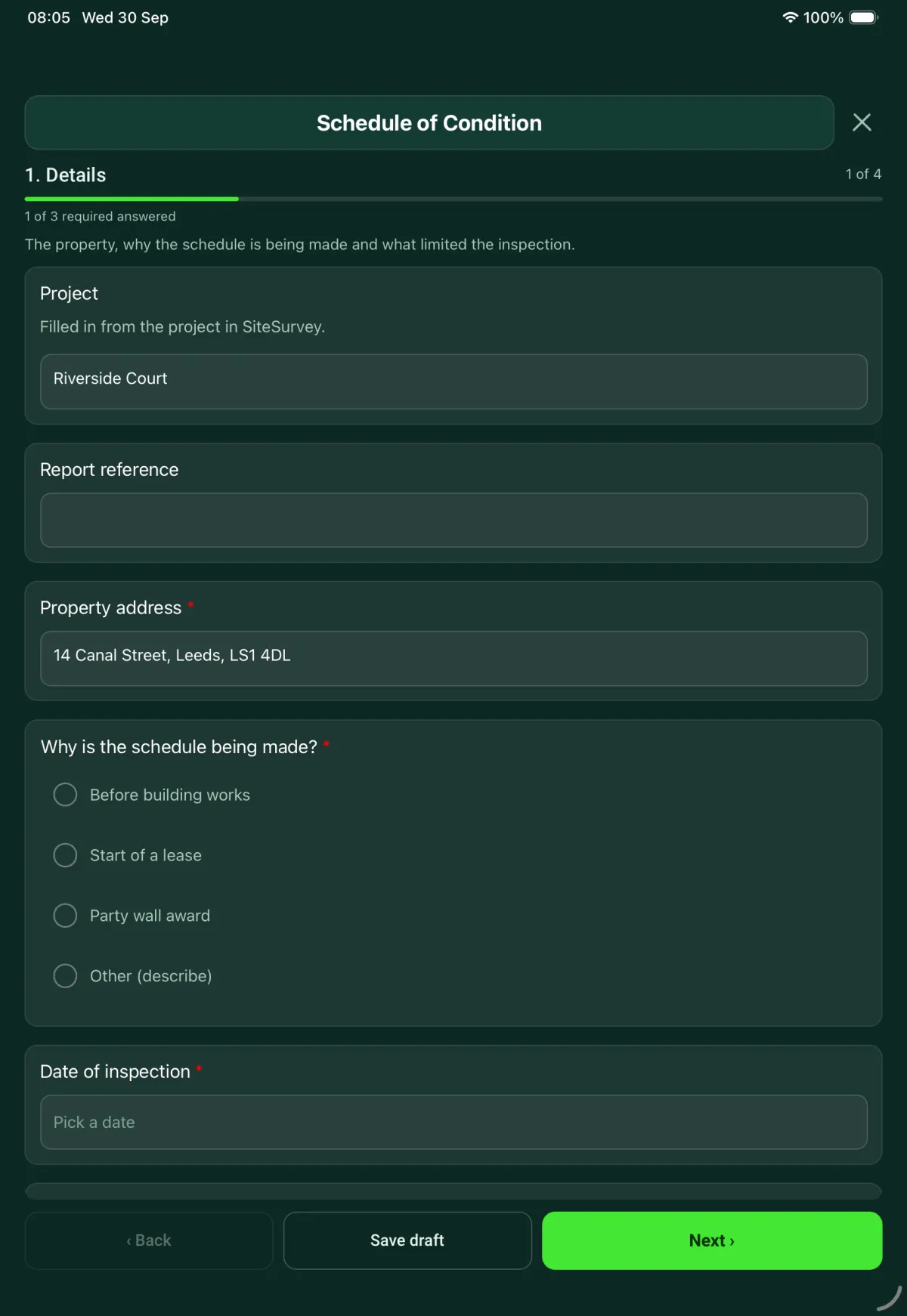
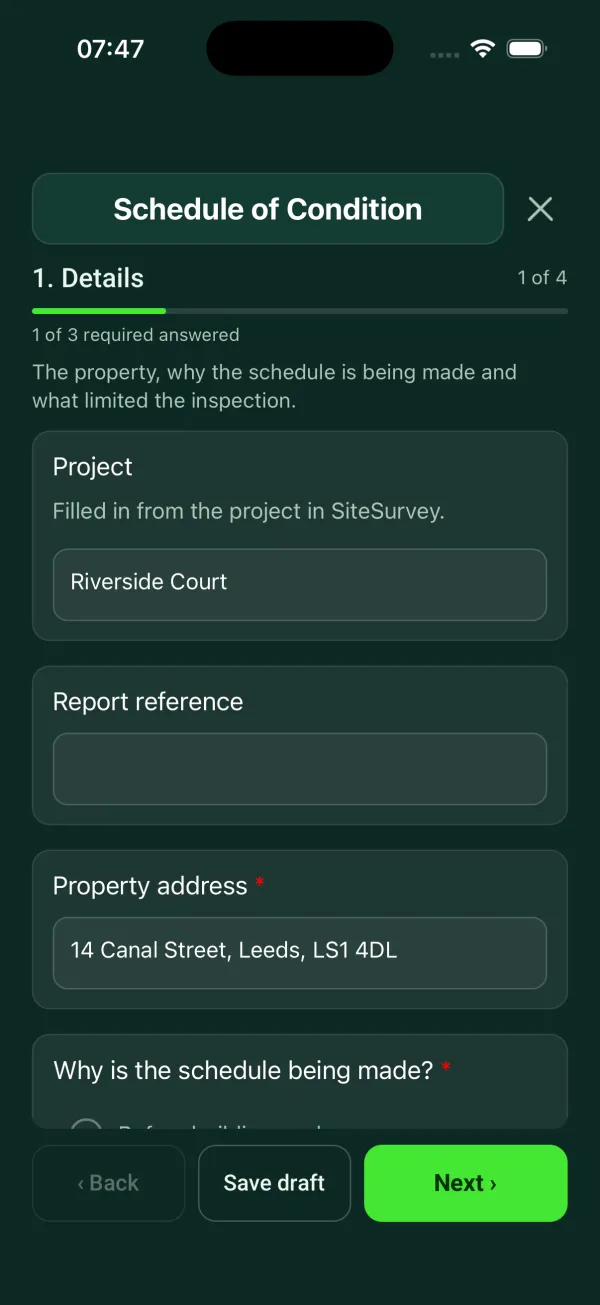
Your team completes the schedule of condition on site in the SiteSurvey app on iPhone, iPad and Android phones and tablets. The project name and address fill in for them, it works without signal, and it syncs when the device is back online with photos kept against the question they answer.
Customers and subcontractors do not need the app: send them a link and they can fill it in from any browser.
Every question in the schedule of condition template
Photographic record of condition before works or at the start of a lease, room by room. 4 sections and 45 questions. Follow-up questions and guidance appear only when an answer calls for them, so the person on site never sees the ones that do not apply.
Details you only enter once
Add this form to a project in SiteSurvey and it fills in what the project already knows, so nobody on site retypes it and every form on the job uses the same names. Anything filled in can still be changed.
- Project: the project name
- Property address: the site address, from the space or the project
Details
The property, why the schedule is being made and what limited the inspection.
- ProjectShort answerFills in from the project name
- Report referenceShort answer
- Property address*Short answerFills in from the site address, from the space or the project
- Why is the schedule being made?*Choose one
- Before building works
- Start of a lease
- Party wall award
- Other (describe)
- What work is planned, and where?NotesShown only when the answers above make it relevant
- Other partyShort answerShown only when the answers above make it relevant
- GuidanceParty wall schedules. Record what you can see, not what caused it. The schedule is usually shared with the other surveyor, so describe each crack or defect so that someone else could find it again.Shown when “Why is the schedule being made?” is “Party wall award”
- Date of inspection*Date
- WeatherChoose one
- Dry
- Rain during the inspection
- Rain earlier in the day
- Frost or snow
- Anything that could not be inspected, and whyNotes
Rooms
One entry for each room. Work round the room in the same order every time.
- GuidancePhotos that stand up later. Take an overview of each wall from the opposite side of the room, then close-ups of anything damaged with a tape in the shot. Give crack widths and lengths in mm.
- RoomsRepeat for each room. Each one asks:
- Floor and roomShort answer
- CeilingChoose one
- Good
- Fair
- Poor
- Not inspected
- Ceiling: notesShort answerShown only when the answers above make it relevant
- Photos of the ceilingPhotosShown only when the answers above make it relevant
- WallsChoose one
- Good
- Fair
- Poor
- Not inspected
- Walls: notesShort answerShown only when the answers above make it relevant
- Photos of the wallsPhotosShown only when the answers above make it relevant
- FloorChoose one
- Good
- Fair
- Poor
- Not inspected
- Floor: notesShort answerShown only when the answers above make it relevant
- Photos of the floorPhotosShown only when the answers above make it relevant
- DoorsChoose one
- Good
- Fair
- Poor
- Not inspected
- Doors: notesShort answerShown only when the answers above make it relevant
- Photos of the doorsPhotosShown only when the answers above make it relevant
- WindowsChoose one
- Good
- Fair
- Poor
- Not inspected
- Windows: notesShort answerShown only when the answers above make it relevant
- Photos of the windowsPhotosShown only when the answers above make it relevant
- FittingsChoose one
- Good
- Fair
- Poor
- Not inspected
- Fittings: notesShort answerShown only when the answers above make it relevant
- Photos of the fittingsPhotosShown only when the answers above make it relevant
- Is there existing damage in this room?Yes or No
- Describe the damage: what, where, and its size in mmNotesShown when “Is there existing damage in this room?” is Yes
- Close-up photos of the damagePhotosShown when “Is there existing damage in this room?” is Yes
Outside
Only if the outside is part of the schedule.
- Is the outside included in this schedule?Yes or No
- Outside areasRepeat for each area. Each one asks:Shown when “Is the outside included in this schedule?” is Yes
- AreaChoose one
- Front elevation
- Rear elevation
- Side elevation
- Roof
- Chimney
- Rainwater goods
- Boundary walls and fences
- Paths and drive
- Outbuildings
- Other (describe)
- ConditionChoose one
- Good
- Fair
- Poor
- Not inspected
- NotesNotes
- Photos of the areaPhotos
- Is there existing damage here?Yes or No
- Describe the damage: what, where, and its size in mmNotesShown when “Is there existing damage in this room?” is Yes
- Close-up photos of the damagePhotosShown when “Is there existing damage in this room?” is Yes
Sign-off
The surveyor signs. The other party can counter-sign to agree the record.
- Surveyor nameShort answer
- DateDate
- Surveyor signatureSignature
- Is the other party counter-signing?Yes or No
- Name and role of the person counter-signingShort answerShown when “Is the other party counter-signing?” is Yes
- Counter-signatureSignatureShown when “Is the other party counter-signing?” is Yes
Schedule of condition template questions
When is a schedule of condition used?
The form covers three reasons: before building works, at the start of a lease, and for a party wall award. For building works and party wall awards it asks what work is planned and where, and for a lease or award it records the other party.
How should photos be taken for a schedule of condition?
Take an overview of each wall from the opposite side of the room, then close-ups of anything damaged with a tape or crack gauge in the shot. Give crack widths and lengths in millimetres, and work round each room in the same order every time.
What should a party wall schedule record?
Record what you can see, not what caused it. The schedule is usually shared with the other surveyor, so describe each crack or defect so that someone else could find it again.
What if part of the property cannot be inspected?
The form asks what could not be inspected and why, such as furniture against walls, fitted carpets not lifted or a loft not entered. Each room element can also be marked as not inspected rather than given a condition.
Does the other party have to sign it?
The surveyor signs, and the form asks whether the other party is counter-signing to agree the record. If they are, it records their name, role and signature on the device.
Can I use it on site without signal?
In the SiteSurvey app, yes. The form works offline, photos stay with the room and element they belong to, and the schedule becomes a PDF report or a share link. It is an editable form from the library, so you can add rooms, elements or questions.
Related
Related templates
Templates that go with the schedule of condition form
Schedule of dilapidations against the lease: item record with remedy and cost, summary of costs, intentions and timing.
Condition survey of a building: limits of inspection, element by element record, services and risks, further investigations.
Check-in or check-out inventory with meter readings, keys, cleanliness and room by room condition, signed by both parties.
Room by room damp and mould inspection with causes, HHSRS hazard check, photos and remedial actions. Built for Awaab's Law timescales.
Use this schedule of condition form with your team
Add it from the form library in one click, change any question, and every completed form becomes a branded PDF report.
Start your trial →