Form library
Facilities and maintenance checklists
Planned maintenance, plant and equipment checks, building walk rounds and work orders for facilities and estates teams. See every question, try the live form, then use it in SiteSurvey.
Most used
Start with the most used facilities and maintenance forms
All facilities and maintenance forms by type
Search by name or topic, or jump to a type. Open any form to see every question and try it live.
84 forms
Planned maintenance, assets and work orders 9
The forms that run a maintenance operation day to day: the PPM visit, the asset register it works from, work orders for reactive jobs and the handover between shifts.
- Facilities and maintenance
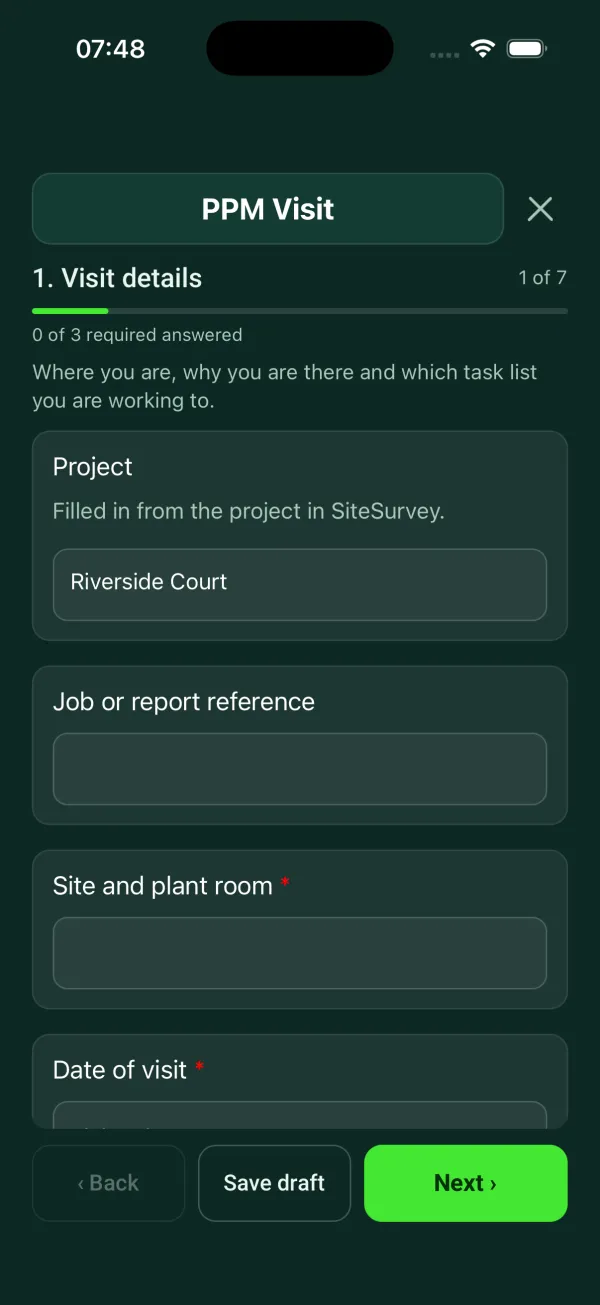
PPM checklist
Planned maintenance visit: records seen, asset by asset tasks, water temperatures, work done and next visit.
7 sections121 questionsPhotosSignaturesSee every question → - Facilities and maintenance
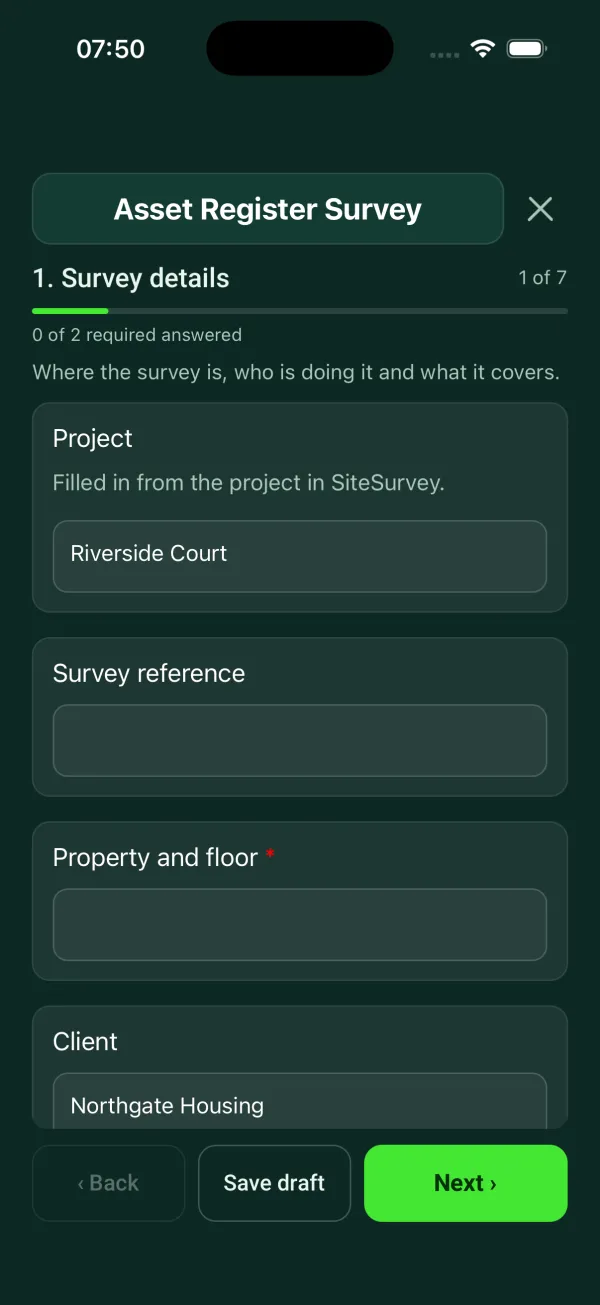
Asset register template
Build or update an asset register: each asset with its tag, make, model, serial, position (GPS outside), condition, life and photos, totals by condition and life, and changes to the register.
7 sections96 questionsPhotosSignaturesSee every question → - Facilities and maintenance
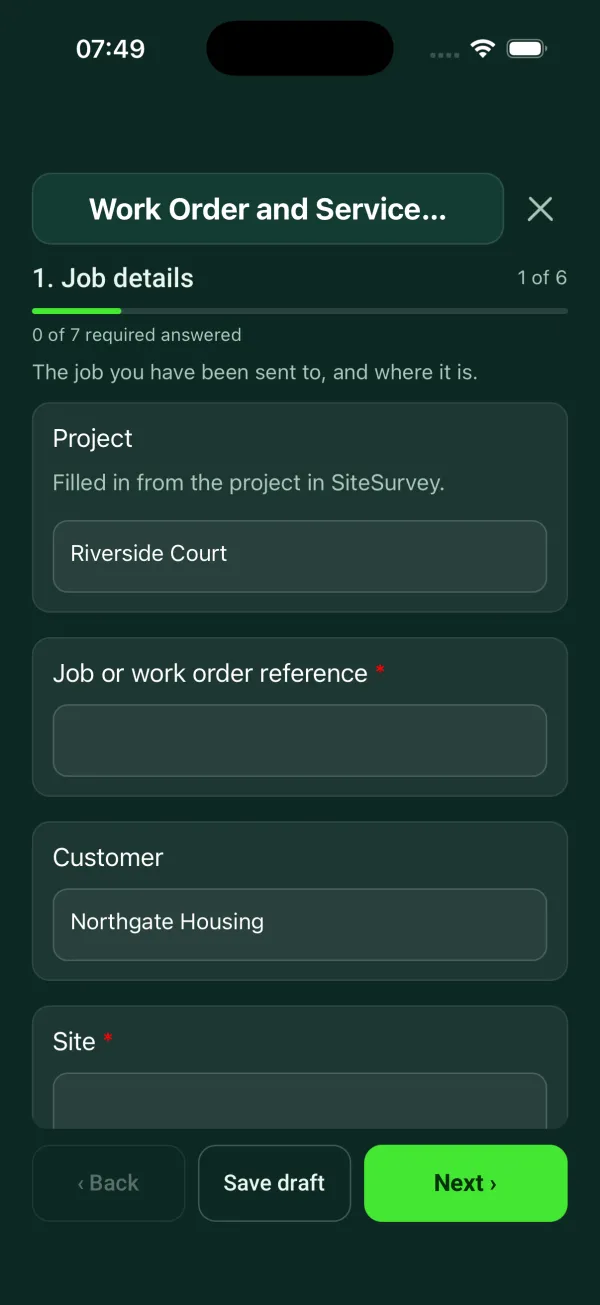
Work order template
Job sheet for a reactive or planned job: safety before starting, work done, parts used, tests, outcome and customer sign-off.
6 sections71 questionsPhotosSignaturesSee every question → - Facilities and maintenance
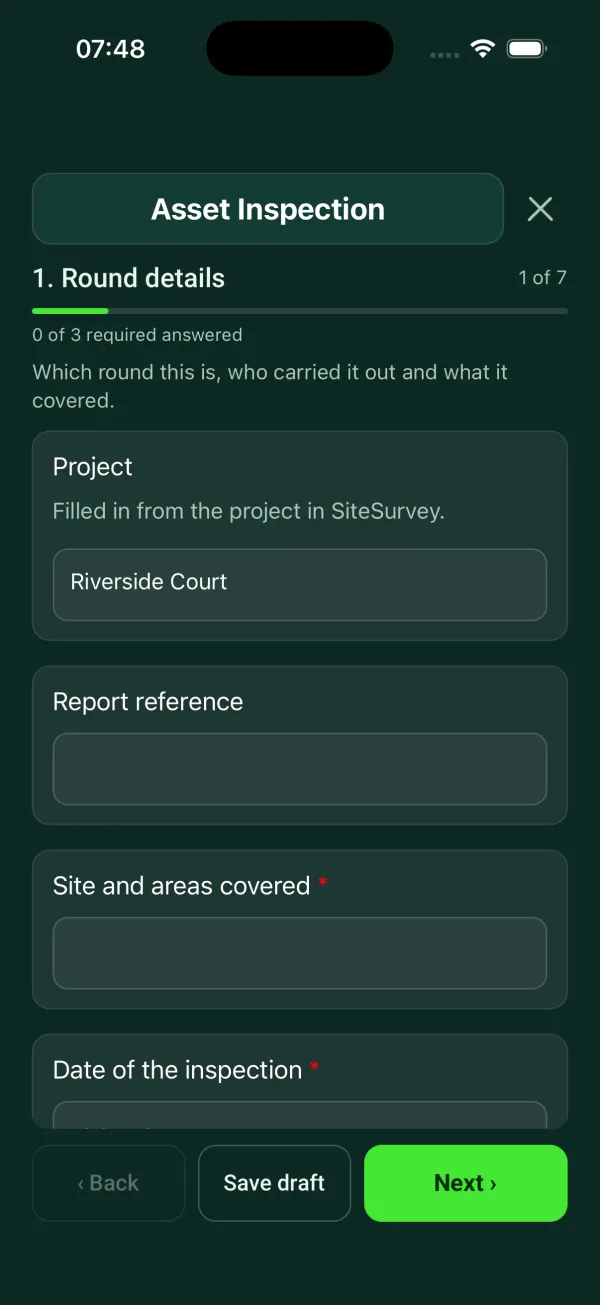
Equipment inspection checklist
Inspection round for plant: asset condition, refrigerant and leak checks, pressure vessels, next due dates.
7 sections107 questionsPhotosSignaturesSee every question → - Facilities and maintenance
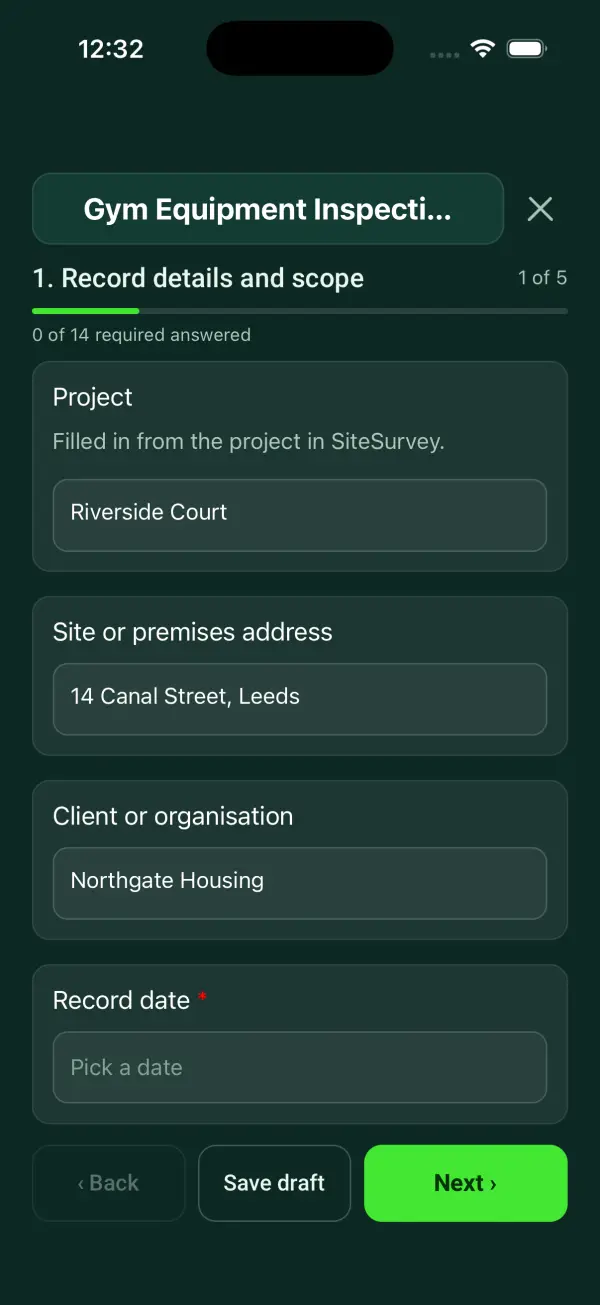
Gym equipment inspection checklist
A gym equipment inspection for the whole gym floor: each item checked pass or fail, treadmill run-off space against the manufacturer's figure, a use decision per item, and counts of failures and equipment out of service.
5 sections58 questionsPhotosSignaturesSee every question → - Facilities and maintenance
Maintenance shift handover template
Transfer the current condition of assets and unfinished maintenance from the outgoing shift to the incoming team.
3 sections31 questionsPhotosSignaturesSee every question → - Facilities and maintenance
RMA form template
Record equipment return authorisation, reported faults, arrival condition and the proposed resolution in one traceable record.
4 sections31 questionsPhotosSignaturesSee every question → - Facilities and maintenance
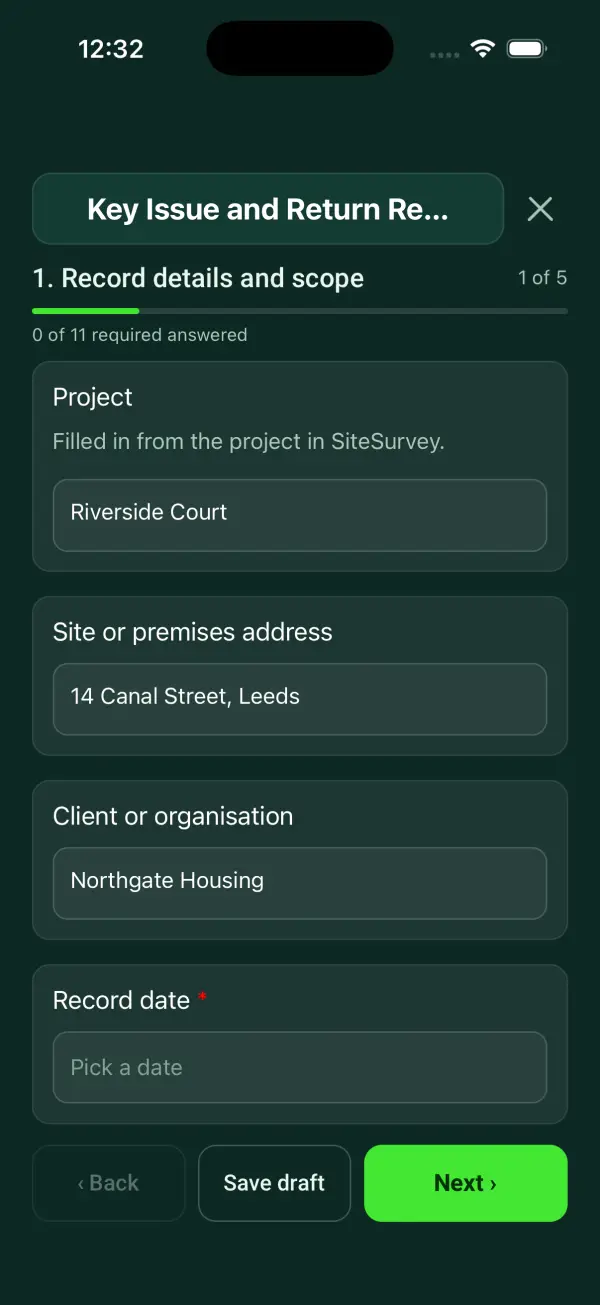
Key register template
A key and access-token register with item references, authorised holders, issue and return dates, acknowledgement and missing-item actions.
5 sections41 questionsSignaturesSee every question → - Facilities and maintenance
Office move checklist
An office move and relocation survey: both sites and access, each room's furniture, IT and crates, IT disconnection and reconnection, confidential waste, the move plan and workstation set-up at the new site.
4 sections41 questionsPhotosSignaturesSee every question →
Building registers and audits 4
Whole-building surveys that facilities managers keep on file and review: where the asbestos is, how accessible the building is and where energy is being wasted.
- Facilities and maintenance
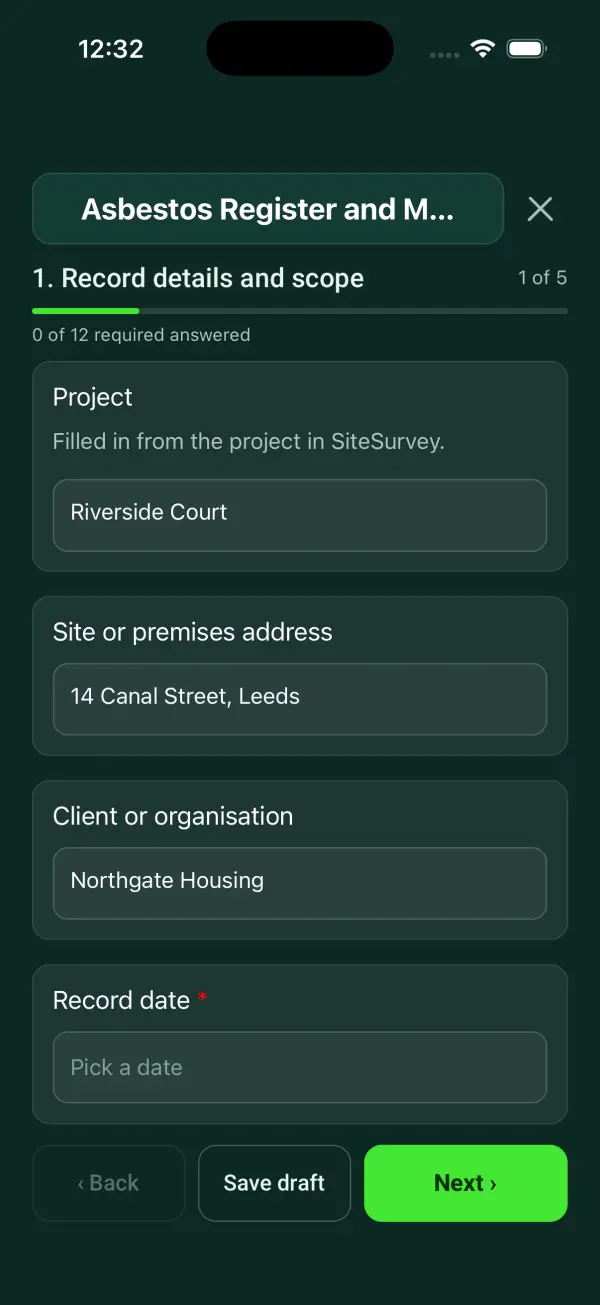
Asbestos register and management plan template
An asbestos management record linking known or presumed materials to survey evidence, condition observations, controls, communication and review actions.
5 sections51 questionsPhotosSignaturesSee every question → - Facilities and maintenance
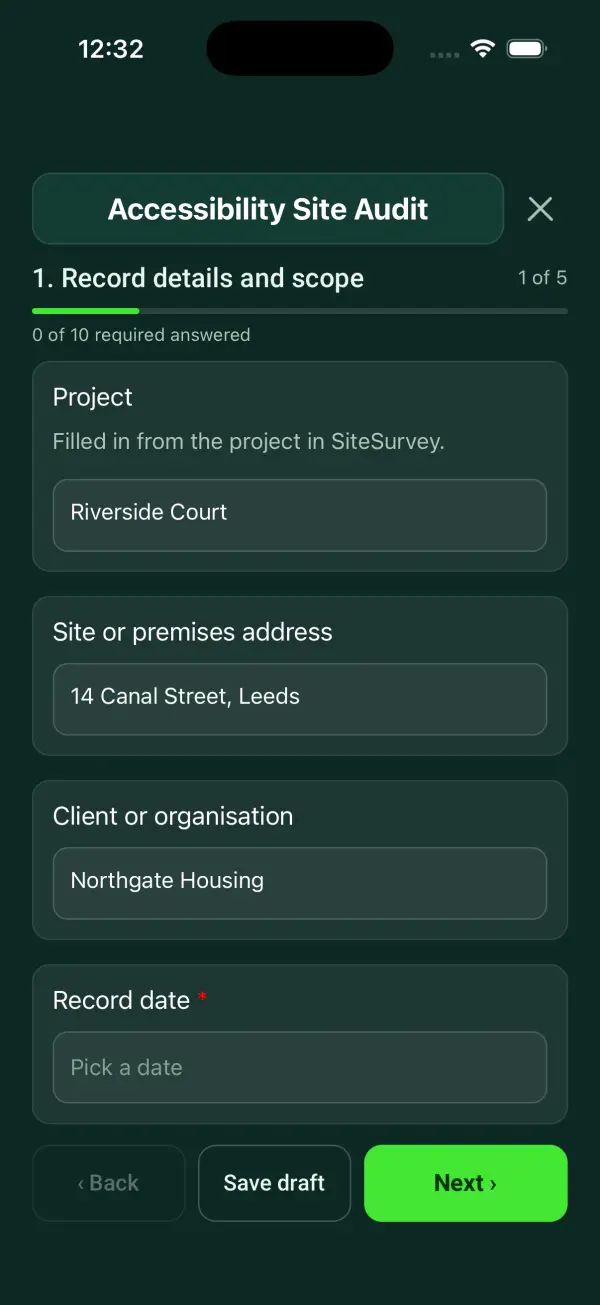
Access audit template
An access audit record of arrival routes, entrances, circulation, facilities, communication barriers and proposed reasonable adjustments.
5 sections46 questionsPhotosSignaturesSee every question → - Facilities and maintenance
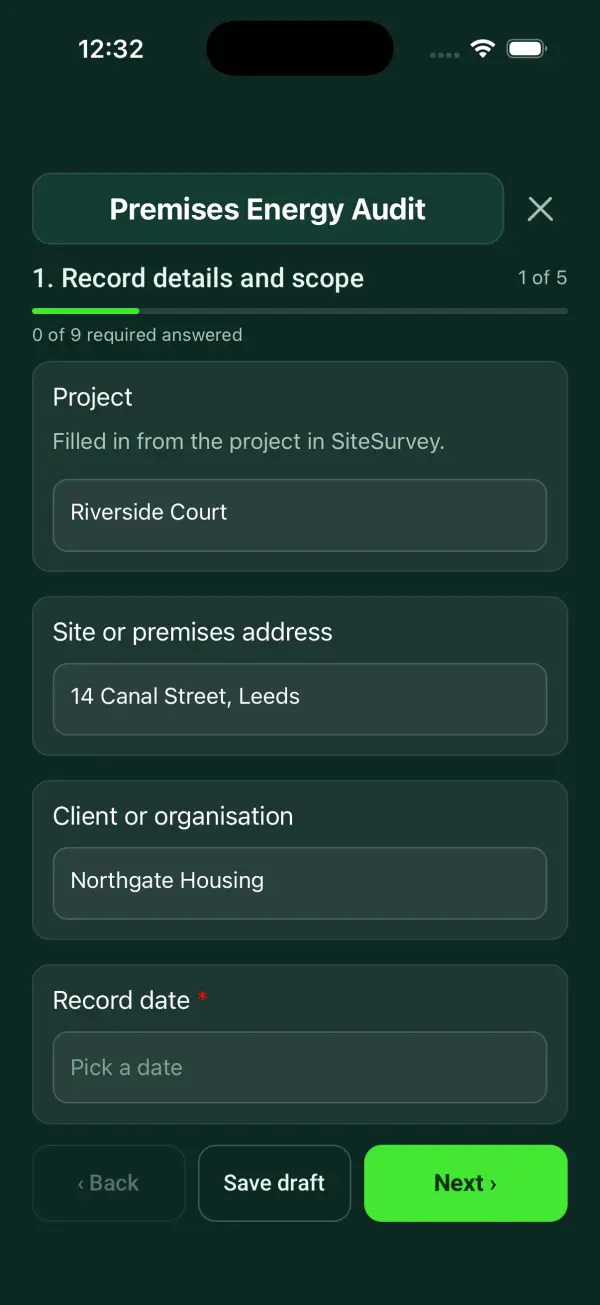
Energy audit checklist
A premises energy walk-through with consumption evidence, occupancy, plant and controls, observed opportunities, estimates and follow-up ownership.
5 sections54 questionsPhotosSignaturesSee every question → - Facilities and maintenance
Facility inspection checklist
A facility manager's routine building walk-round: each area with ten checks for fabric, doors, lighting, signage, cleanliness, leaks, pests, escape routes, fire doors and access, a statutory compliance tracker with due dates, optional meter readings, and findings raised as reactive jobs with priority, owner and cost.
5 sections86 questionsPhotosSignaturesSee every question →
HVAC, heating and plant 18
Service, commissioning and survey records for boilers, heat pumps, air conditioning, air handling, chillers and the pumps, compressors and generators in the plant room.
- Facilities and maintenance
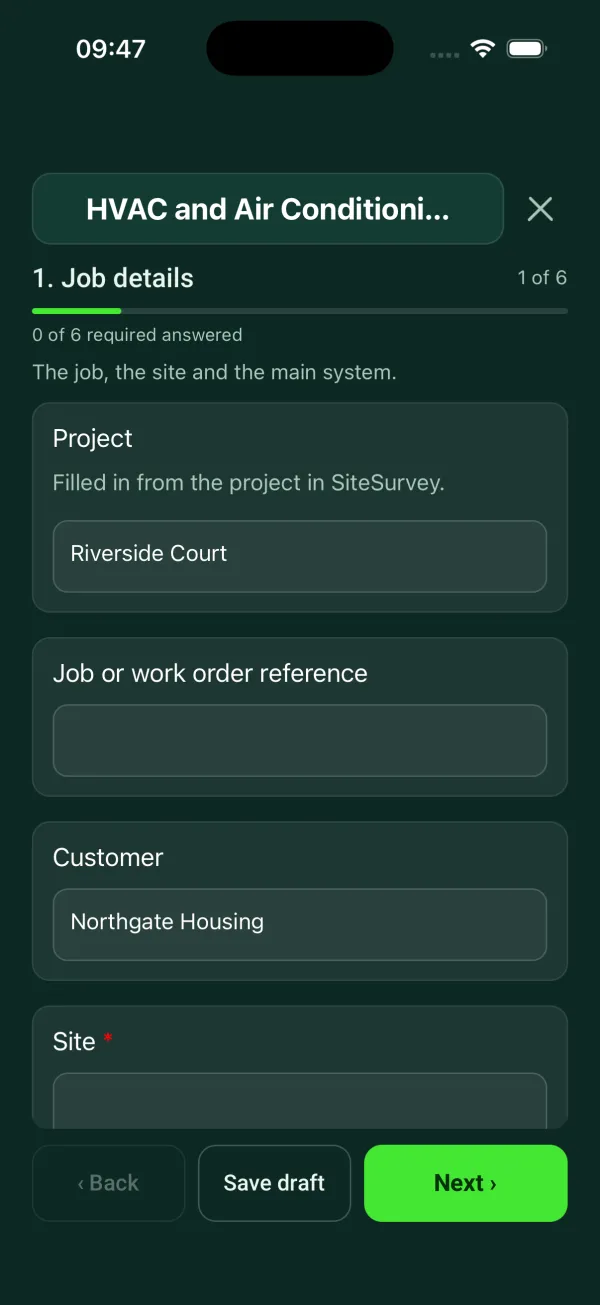
HVAC maintenance checklist
Service visit record for air conditioning, heat pumps, ventilation and air handling units. Unit by unit checks, refrigerant and F gas leak checks, parts used and sign-off.
6 sections99 questionsPhotosSignaturesSee every question → - Facilities and maintenance
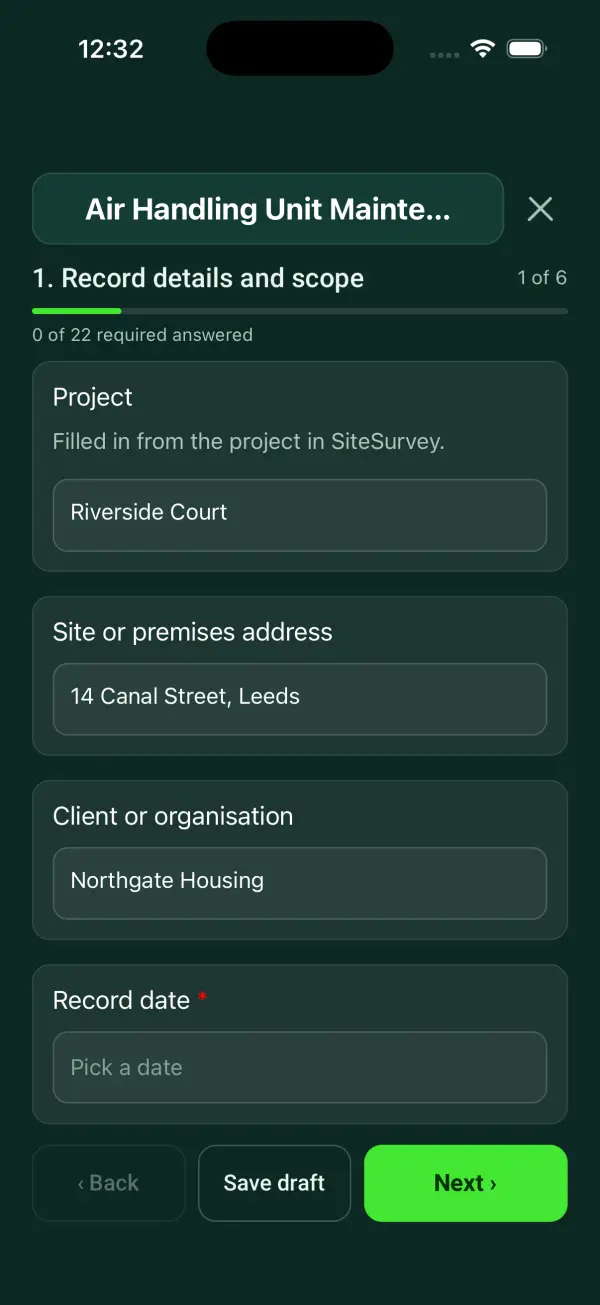
AHU maintenance checklist
An AHU maintenance record covering filters, fans, belts, coils, dampers, condensate, controls, operating readings and the condition at handback.
6 sections81 questionsPhotosSignaturesSee every question → - Facilities and maintenance
Water heater maintenance checklist
A water heater maintenance and inspection record for tank and tankless heaters, gas and electric: each heater by location with a label scan and age, relief valve and discharge, venting, gas and combustion air, anode rod, flushing, expansion tank against your figure, outlet temperature against your target, seismic straps, leaks and drain pan, descaling, a recommendation per heater, actions and sign-off.
3 sections96 questionsPhotosSignaturesSee every question → - Facilities and maintenance
Boiler log and inspection checklist
A boiler room log and inspection for commercial steam and hot water boilers: plant rooms and boilers with data plate scans, a shift log per boiler (pressure, temperature, water level, stack temperature, fuel, blowdown, low water cutoff test, initials) against operating limits you enter, periodic inspection checks, water treatment and combustion readings against your contractors' targets, the US certificate or UK PSSR written scheme and examination, actions and sign-off.
6 sections161 questionsPhotosSignaturesSee every question → - Facilities and maintenance
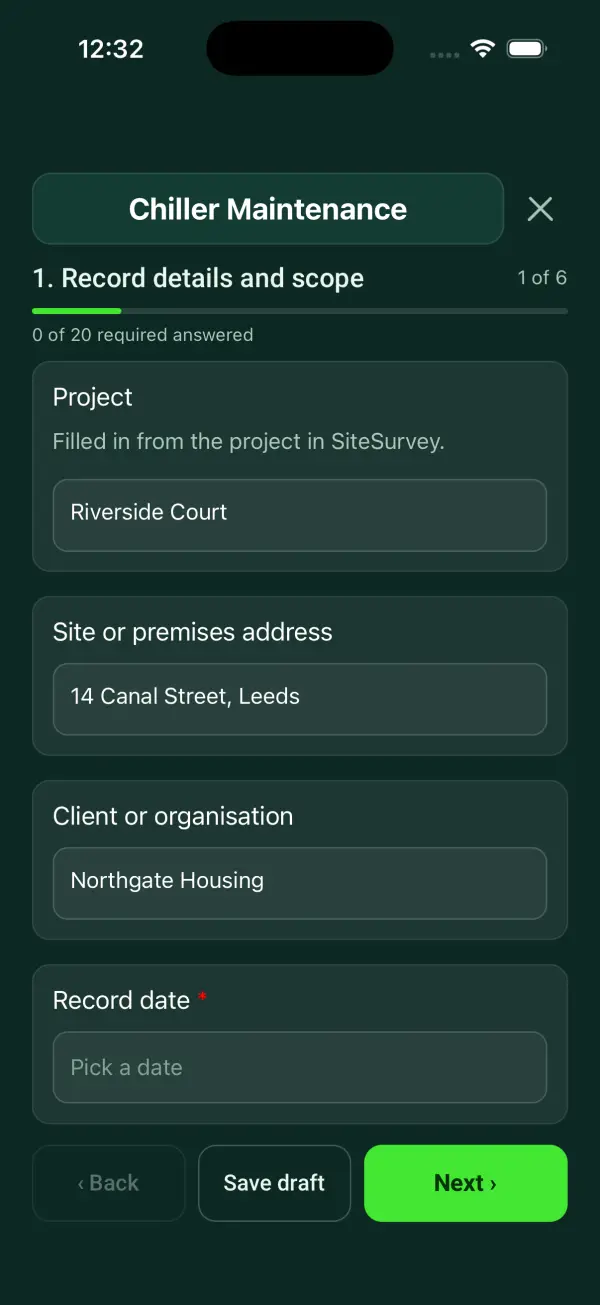
Chiller maintenance checklist
A chiller maintenance record with equipment details, water circuit and refrigerant observations, operating readings, service work and handback limits.
6 sections78 questionsPhotosSignaturesSee every question → - Facilities and maintenance
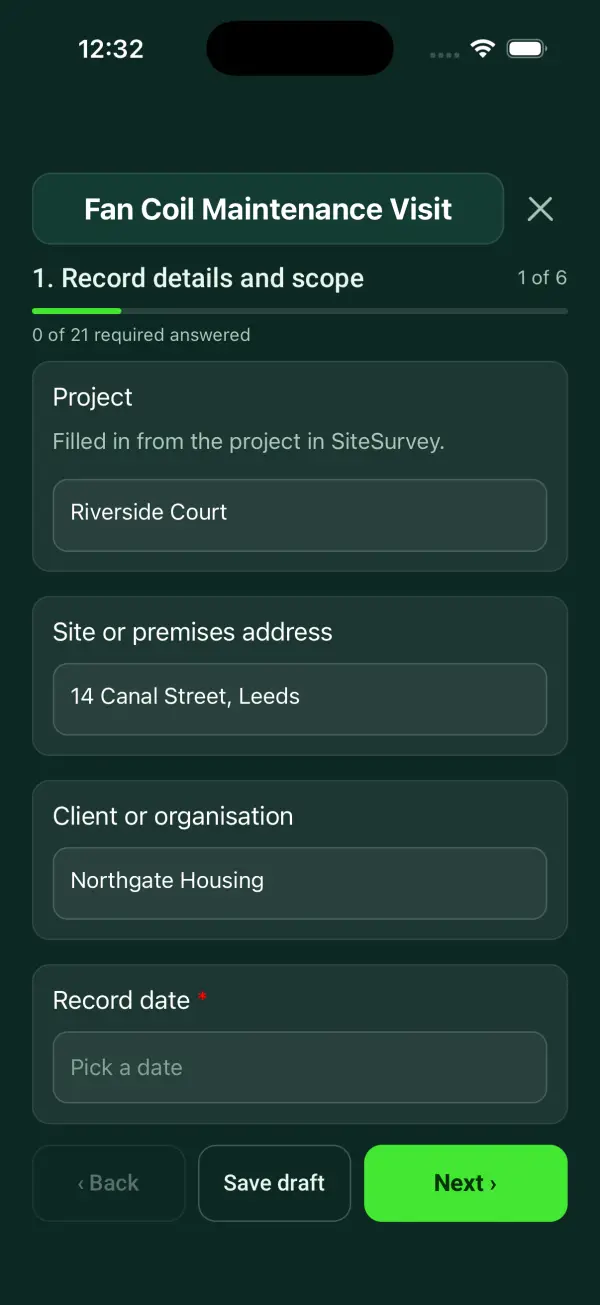
Fan coil unit maintenance checklist
A fan coil maintenance record covering unit identity, isolation, filters, coil and condensate observations, controls, service work and handover evidence.
7 sections72 questionsPhotosSignaturesSee every question → - Facilities and maintenance
Air conditioning commissioning checklist
An air conditioning installation and commissioning record: F-gas certification, units with label scan, refrigerant type and charge, CO2 equivalent and leak check frequency, strength test, vacuum, leak test, temperatures, drains and controls, and handover.
4 sections63 questionsPhotosSignaturesSee every question → - Facilities and maintenance
Air balancing report template
Record ventilation terminal design flows, measured readings, test conditions and outstanding work against project criteria.
4 sections53 questionsPhotosSignaturesSee every question → - Facilities and maintenance
Ductwork cleaning record
A ventilation ductwork inspection and cleaning record (TR19 Air): system and hygiene grade, visual inspection, deposit tests before and after, sections cleaned, access panels, filters, fire dampers, photos and report.
3 sections43 questionsPhotosSignaturesSee every question → - Facilities and maintenance
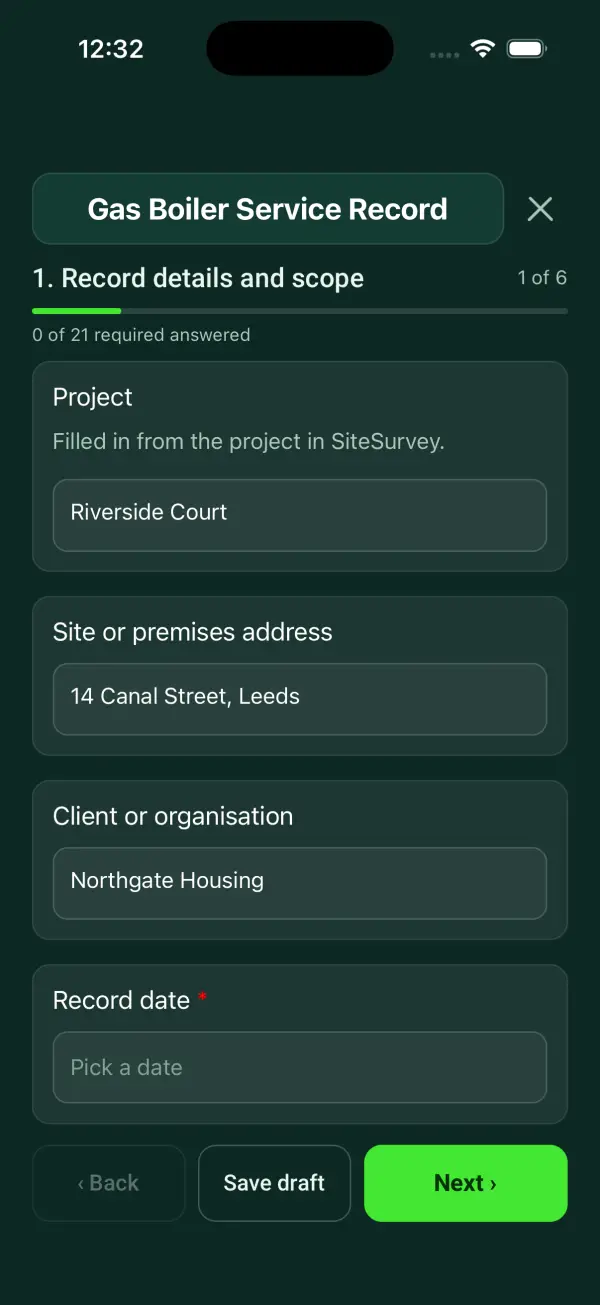
Boiler service checklist
A gas boiler service record with appliance identity, engineer scope, manufacturer checks, measured results, defects, remedial work and customer handover.
6 sections56 questionsPhotosSignaturesSee every question → - Facilities and maintenance
Boiler commissioning checklist
A gas boiler installation and commissioning record: boiler and flue, gas pressure and rate, tightness, combustion at maximum and minimum rate, system cleaning and inhibitor, controls, CO alarm, Gas Safe notification and Benchmark.
4 sections56 questionsPhotosSignaturesSee every question → - Facilities and maintenance
Unvented cylinder service checklist
An unvented hot water cylinder (G3) annual service: cylinder and heat source, inlet pressure, expansion vessel charge, relief valves, energy cut-out, tundish and discharge, temperature setting and the next service.
3 sections45 questionsPhotosSignaturesSee every question → - Facilities and maintenance
Heat pump survey
A heat pump site survey: property, current heating and insulation, room-by-room measurements and emitters for the heat loss calculation, outdoor unit position, hot water cylinder space and electrics.
6 sections69 questionsPhotosSignaturesSee every question → - Facilities and maintenance
Heat pump commissioning checklist
A heat pump commissioning record: unit and refrigerant, system pressure and flushing, flow and return temperatures, weather compensation, hot water and pasteurisation, MCS certificate, DNO and handover.
5 sections59 questionsPhotosSignaturesSee every question → - Facilities and maintenance
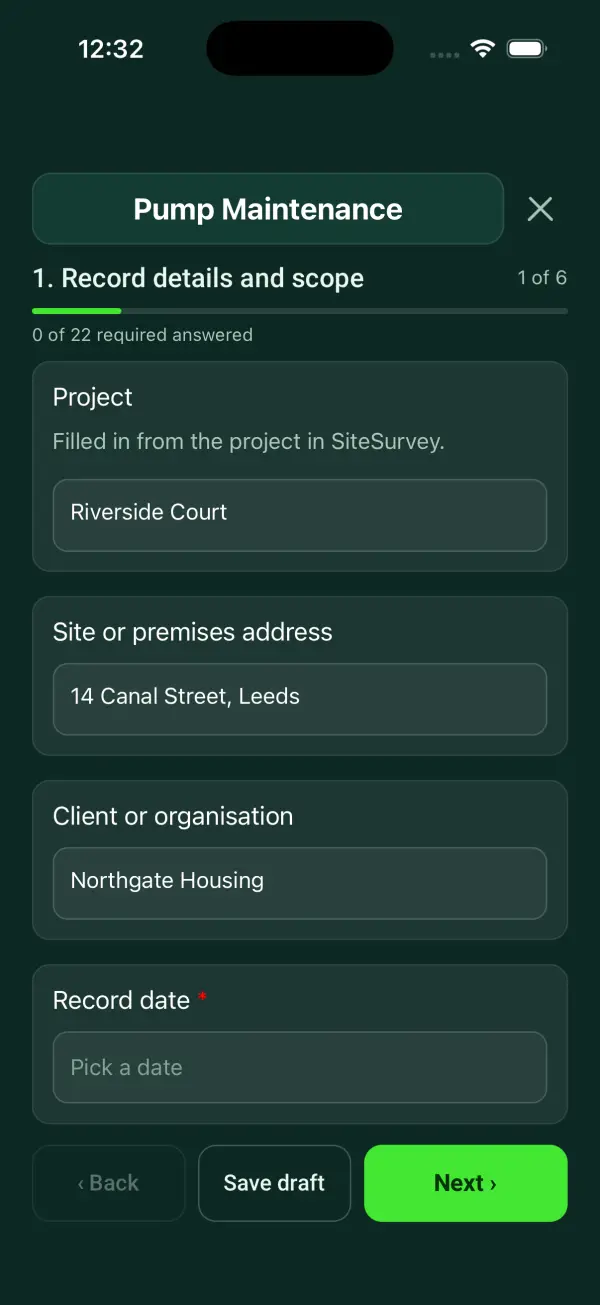
Pump maintenance checklist
A pump maintenance record covering duty, seals, bearings, coupling, suction and discharge readings, service work, defects and return-to-service limits.
6 sections78 questionsPhotosSignaturesSee every question → - Facilities and maintenance
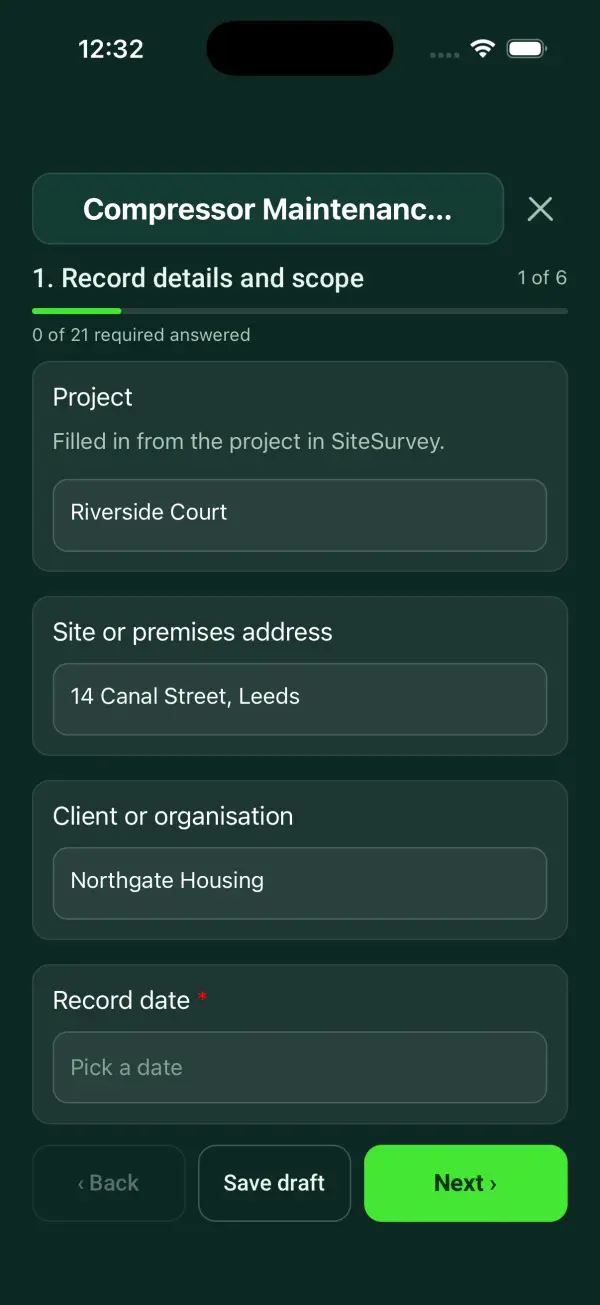
Compressor maintenance checklist
A compressed-air maintenance record with compressor and receiver details, isolation, visible checks, operating readings, service work and handback.
6 sections74 questionsPhotosSignaturesSee every question → - Facilities and maintenance
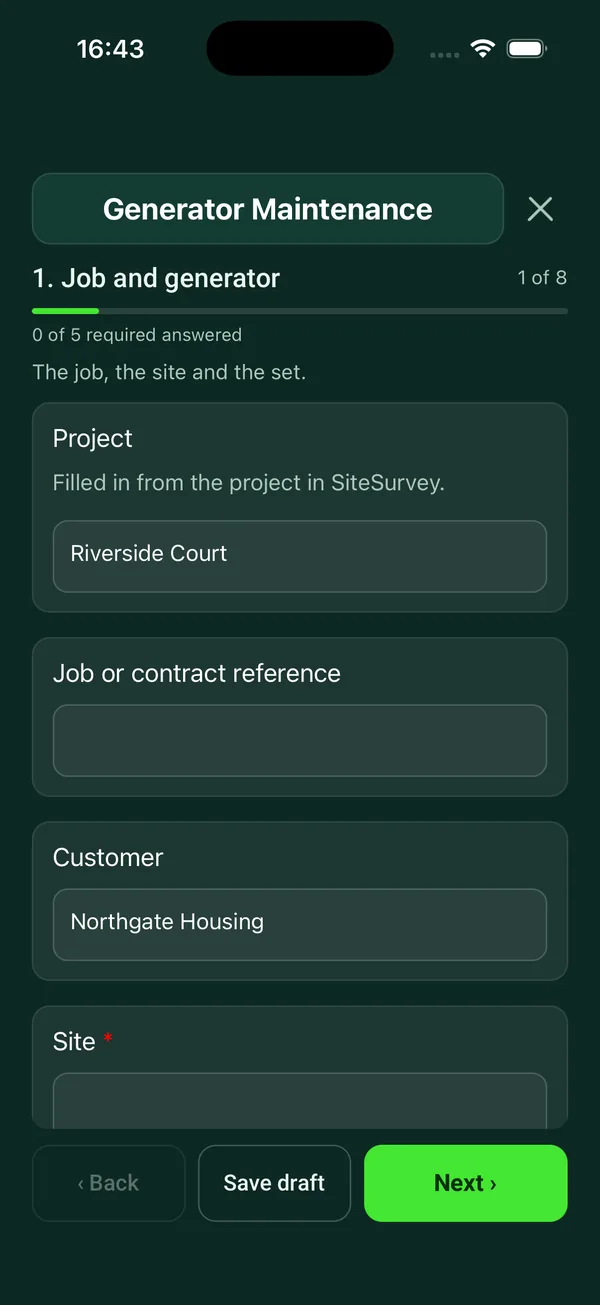
Generator maintenance checklist
Service visit for a standby or prime power generator: engine, fuel, battery and controls checks, a recorded run test, defects, parts and sign-off.
8 sections85 questionsPhotosSignaturesSee every question → - Facilities and maintenance
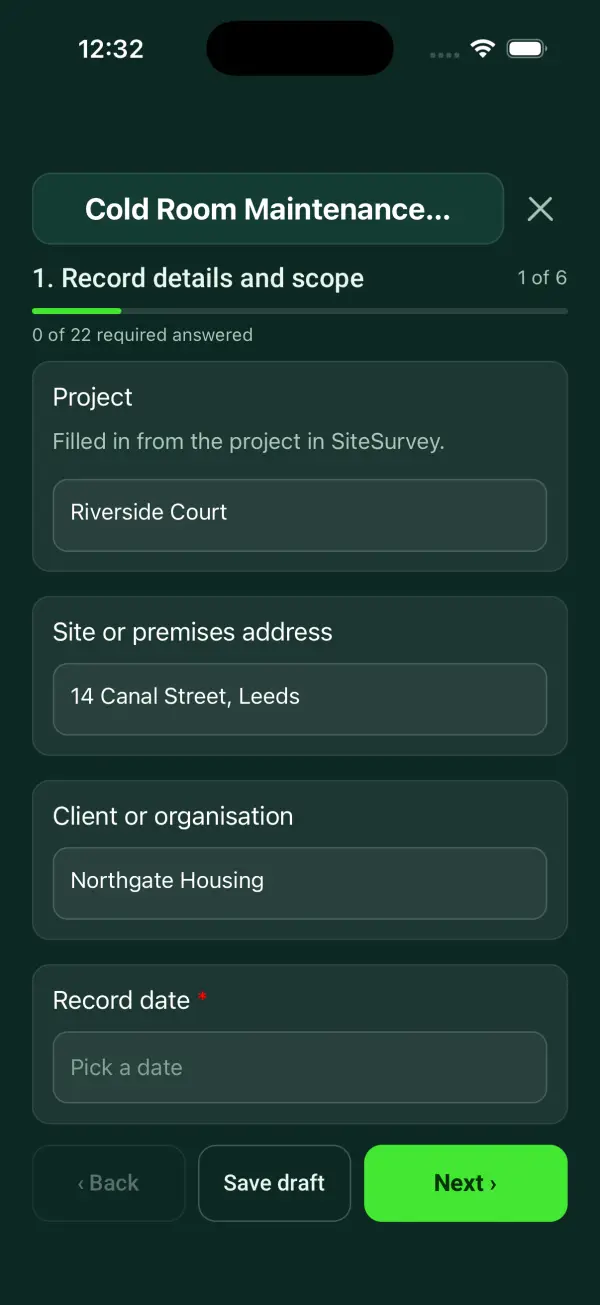
Cold room maintenance checklist
A cold room maintenance record covering room condition, escape arrangements, approved operational checks, temperatures, defects and service handover.
7 sections79 questionsPhotosSignaturesSee every question →
Electrical testing, solar and EV charging 14
Certificates and test records for fixed wiring and portable appliances, plus the survey, installation and maintenance forms for solar PV, battery storage and EV chargers.
- Facilities and maintenance
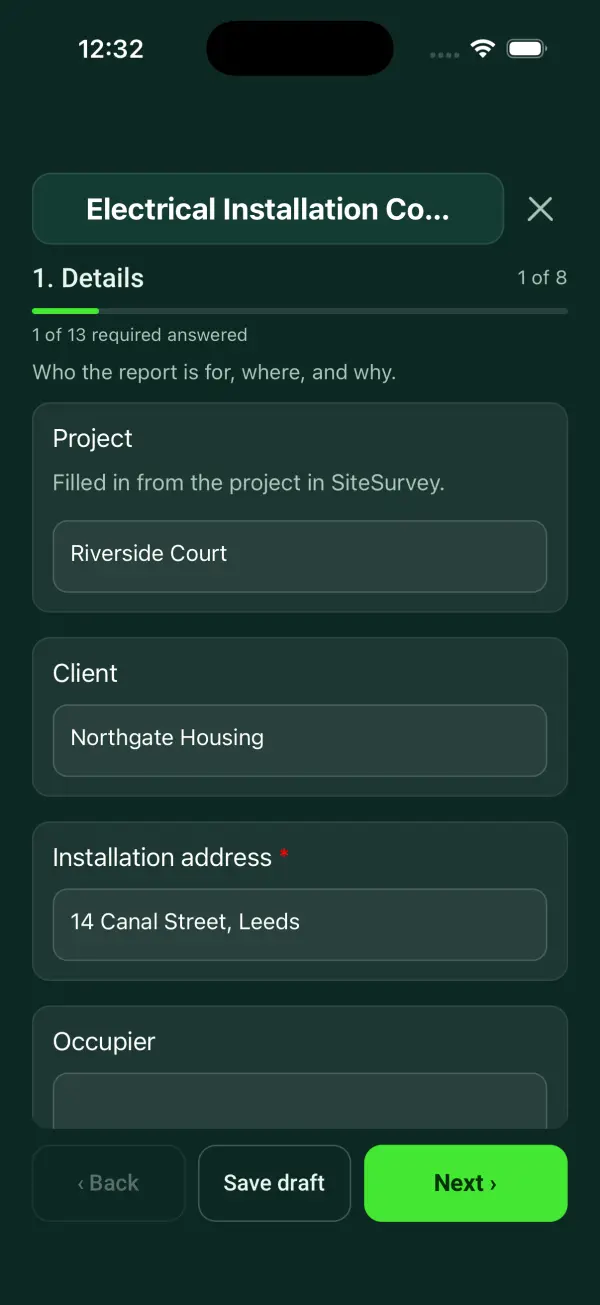
EICR template
Site record for a periodic inspection: installation details, extent and limitations, supply and earthing, boards, schedule of circuits and test results, coded observations with photos, and the overall assessment.
8 sections119 questionsPhotosSignaturesSee every question → - Facilities and maintenance
Electrical preventive maintenance checklist
Planned maintenance of electrical distribution equipment: switchrooms and risers with each switchboard, distribution board, MCC, VFD, UPS, transfer switch, transformer and busbar as an item with a rating plate scan, visual and cleaning, torque, protective device, thermography and insulation resistance results against your own figures, equipment-specific checks, isolation and lockout, defects with priority and sign-off.
4 sections122 questionsPhotosSignaturesSee every question → - Facilities and maintenance
Schedule of test results template
An electrical test results schedule for a distribution board: every circuit with its device, cables, continuity, insulation resistance, polarity, Zs and RCD times, with warnings on readings that fail.
3 sections61 questionsPhotosSignaturesSee every question → - Facilities and maintenance
Electrical installation certificate template
A site record for new electrical work that needs an Electrical Installation Certificate: scope, supply and earthing, bonding, each new circuit with its tests, inspection items, departures and the three sign-offs.
5 sections65 questionsPhotosSignaturesSee every question → - Facilities and maintenance
Minor works certificate template
An electrical minor works site record: the work done, the circuit it was on, earthing and protection, continuity, insulation resistance, polarity, Zs and RCD tests, departures and Part P notification.
3 sections41 questionsPhotosSignaturesSee every question → - Facilities and maintenance
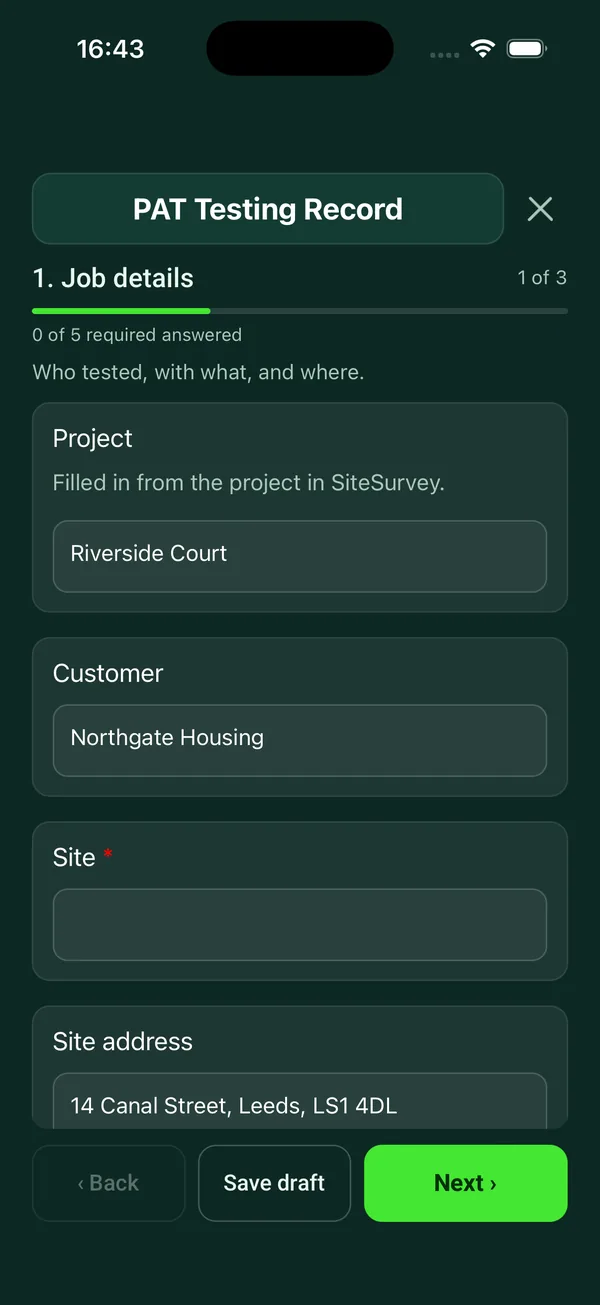
PAT testing sheet and record template
Portable appliance inspection and test record: each appliance with its ID, location, class, visual checks, test readings, pass or fail and the action taken.
3 sections52 questionsPhotosSignaturesSee every question → - Facilities and maintenance
Lightning protection inspection and testing record
A lightning protection inspection and test record: system and protection level, air terminations, down conductors, bonds and joints, each earth electrode's resistance, surge protection, damage and repairs.
3 sections57 questionsPhotosSignaturesSee every question → - Facilities and maintenance
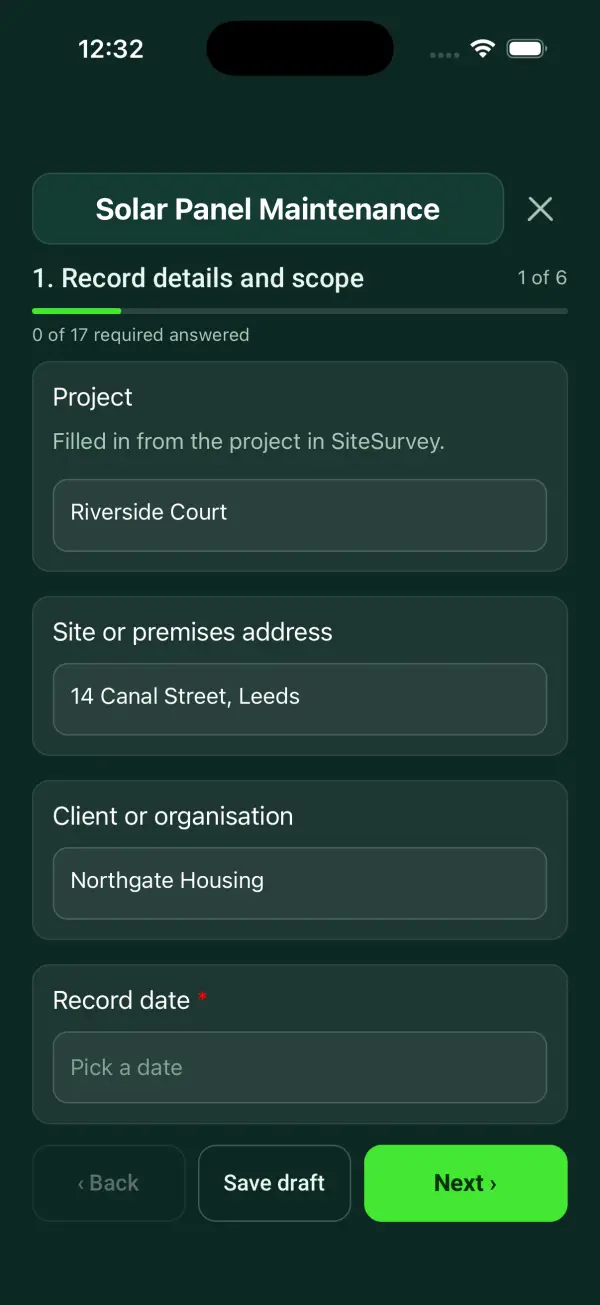
Solar panel maintenance checklist
A solar PV maintenance record with array identification, safe access, visible module and cable condition, inverter information and specialist test references.
6 sections59 questionsPhotosSignaturesSee every question → - Facilities and maintenance
Solar panel installation certificate and commissioning record
A solar PV commissioning record: panels, inverter, string tests (Voc, Isc, insulation resistance, polarity), isolators and labels, the G98 or G99 route, MCS certificate, generation meter and handover.
4 sections66 questionsPhotosSignaturesSee every question → - Facilities and maintenance
Battery maintenance checklist
A stationary lead-acid battery maintenance record covering bank identity, ventilation, visible condition, approved readings, defects and handback limits.
6 sections60 questionsPhotosSignaturesSee every question → - Facilities and maintenance
Battery storage installation checklist
A home battery storage installation record: battery and inverter, location and fire safety against PAS 63100, separation, detection, ventilation, isolation, tests, backup, DNO route and handover.
4 sections51 questionsPhotosSignaturesSee every question → - Facilities and maintenance
EV charger site survey
An EV charger site survey: customer and grant eligibility, parking and charger position, supply, earthing, consumer unit and existing loads, cable route, Wi-Fi signal for a smart charger and photos.
5 sections54 questionsPhotosSignaturesSee every question → - Facilities and maintenance
EV charger installation certificate and checklist
An EV charger installation and commissioning record: the charger, circuit, RCD and DC protection, PME method, tests, load management, smart set-up, DNO notification, handover and photos.
5 sections54 questionsPhotosSignaturesSee every question → - Facilities and maintenance
EV charger maintenance checklist
Record an EV charging unit maintenance visit, visible condition, manufacturer procedure references, functional-check evidence and unresolved faults.
3 sections51 questionsPhotosSignaturesSee every question →
Legionella and water hygiene 7
The routine records a written legionella scheme asks for: outlet temperatures, flushing of little-used outlets, shower descaling, TMV servicing and tank inspections.
- Facilities and maintenance
Legionella temperature log
A legionella monthly temperature log: hot and cold sentinel outlet readings, cylinder flow and return temperatures and TMV inlets, with warnings when a reading misses the HSE target.
4 sections44 questionsPhotosSignaturesSee every question → - Facilities and maintenance
Legionella flushing record
A weekly flushing record for little-used outlets: each tap, shower and hose with how long it was flushed, whether it was done without spray, the temperature reached and showerhead cleaning dates.
3 sections39 questionsSignaturesSee every question → - Facilities and maintenance
Shower head descaling record
A shower head and hose descaling record for legionella control: each outlet with its location, condition, descale and disinfection, temperatures and result, against the HSG274 quarterly frequency.
3 sections29 questionsPhotosSignaturesSee every question → - Facilities and maintenance
TMV servicing and testing record
A thermostatic mixing valve (TMV) service record: each valve with its location, outlet and type, set and measured mixed temperatures, fail-safe test, strainers and result, with a warning above 44°C.
3 sections55 questionsPhotosSignaturesSee every question → - Facilities and maintenance
Backflow test report
A field test report for backflow prevention assemblies (RP, DC, PVB, SVB and detector assemblies). Tester certification, test kit serial and calibration date (flagged past your interval), and your local minimum readings. Each location with its assemblies: data plate scan, make, model, size and serial, GPS, protection type, initial readings by type, flags for low readings, pass or fail, repairs, retest, shut-off valves and final result. Cross-connections seen, report to the water purveyor, actions and signatures.
4 sections104 questionsPhotosSignaturesSee every question → - Facilities and maintenance
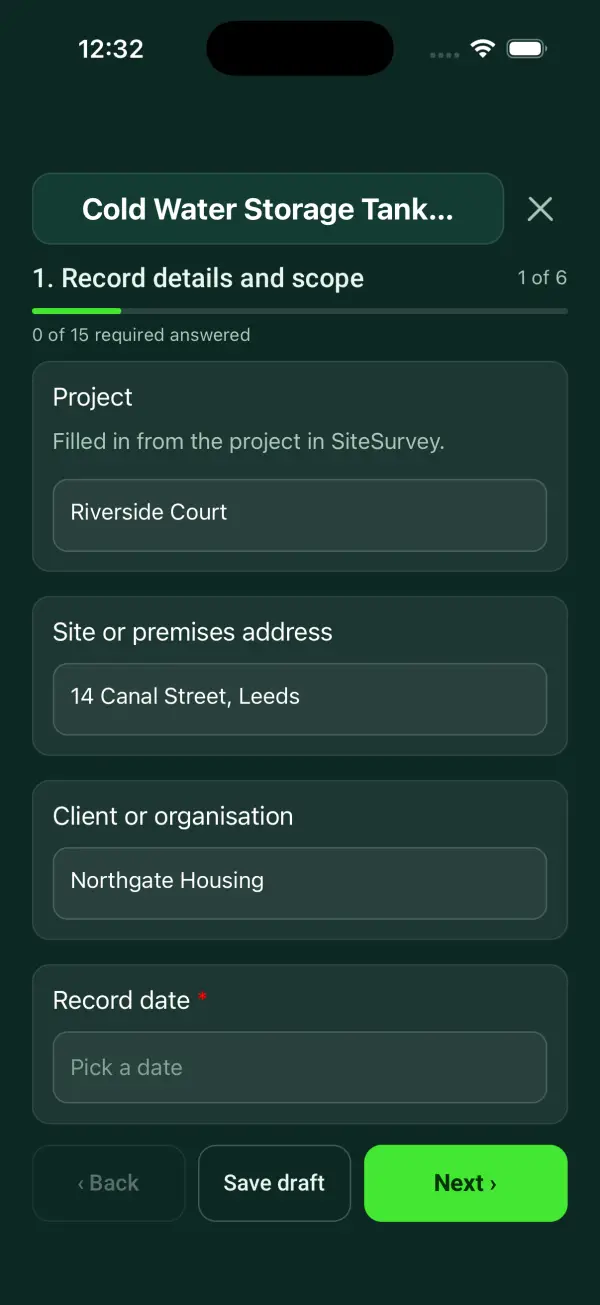
Water tank inspection checklist
A cold water storage tank record covering tank identity, safe access, visible hygiene condition, monitoring references, defects and remedial follow-up.
6 sections53 questionsPhotosSignaturesSee every question → - Facilities and maintenance
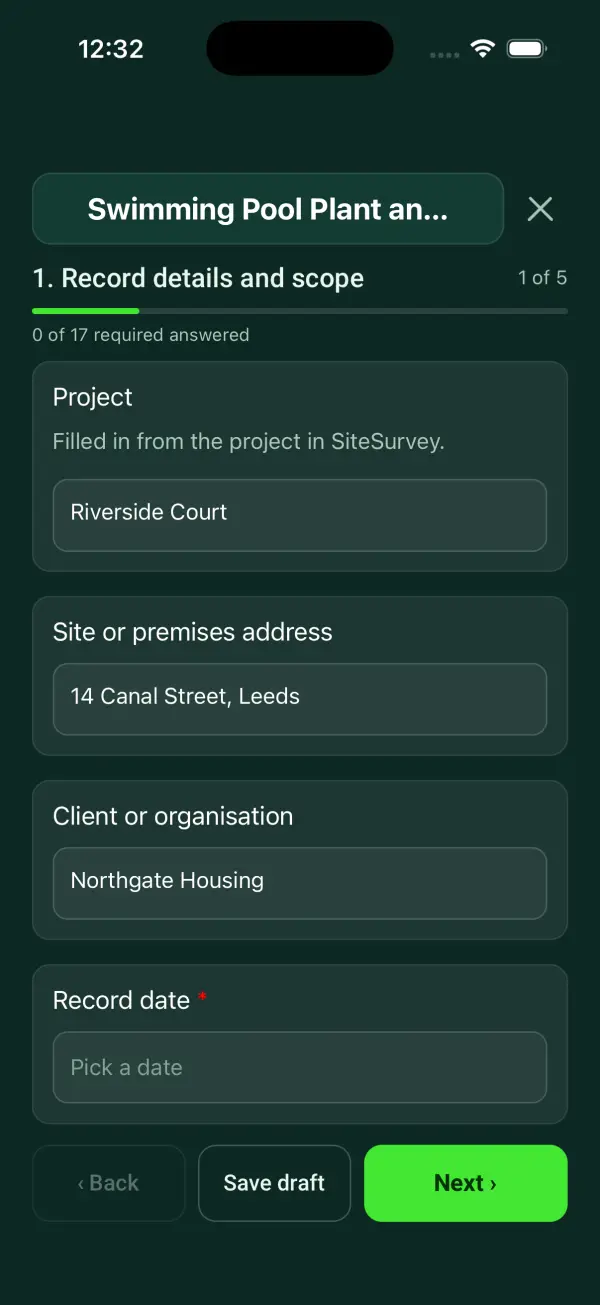
Swimming pool checklist
A pool operator check record covering pool identity, operating procedures, water-test results, plant observations, exceptions and reopening decisions.
5 sections51 questionsPhotosSignaturesSee every question →
Lifts, doors, sprinklers and security systems 8
Maintenance and service records for the systems people rely on to get in, move around and stay safe: lifts, automatic doors, access control, alarms, intercoms, sprinklers and hydrants.
- Facilities and maintenance
Lift maintenance checklist
A lift maintenance visit record with asset details, service scope, manufacturer checks, fault findings, examination references and handback restrictions.
6 sections71 questionsPhotosSignaturesSee every question → - Facilities and maintenance
Automatic door maintenance checklist
An automatic door and gate service record: each door with type and label scan, activation and safety sensors, obstruction stop, manual opening on power failure, emergency break-out, signage, result and recommendations.
3 sections53 questionsPhotosSignaturesSee every question → - Facilities and maintenance
Access control maintenance checklist
An access control service record covering authorised scope, door hardware, approved functional checks, event evidence, defects and secure handover.
7 sections68 questionsPhotosSignaturesSee every question → - Facilities and maintenance
Intruder alarm maintenance checklist
An intruder alarm service record covering system scope, authorised tests, detector and power observations, faults, restoration and customer handover.
7 sections62 questionsPhotosSignaturesSee every question → - Facilities and maintenance
Intercom and door entry service record
An intercom and door entry service record: system, entrance panels, lock release, door closer, power and battery backup, fire alarm door release, handsets sampled, faults and sign-off.
3 sections47 questionsPhotosSignaturesSee every question → - Facilities and maintenance
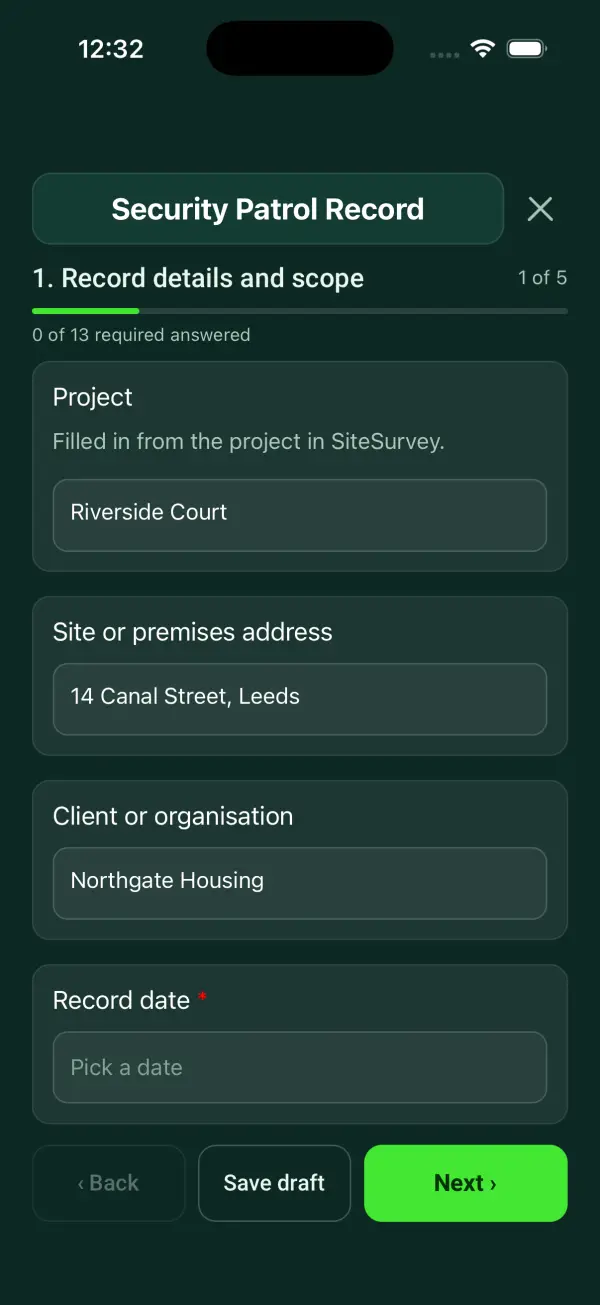
Security patrol report template
A security patrol record covering the assigned route, timed checkpoint observations, access restrictions, incidents, escalation and shift handover.
5 sections40 questionsPhotosSignaturesSee every question → - Facilities and maintenance
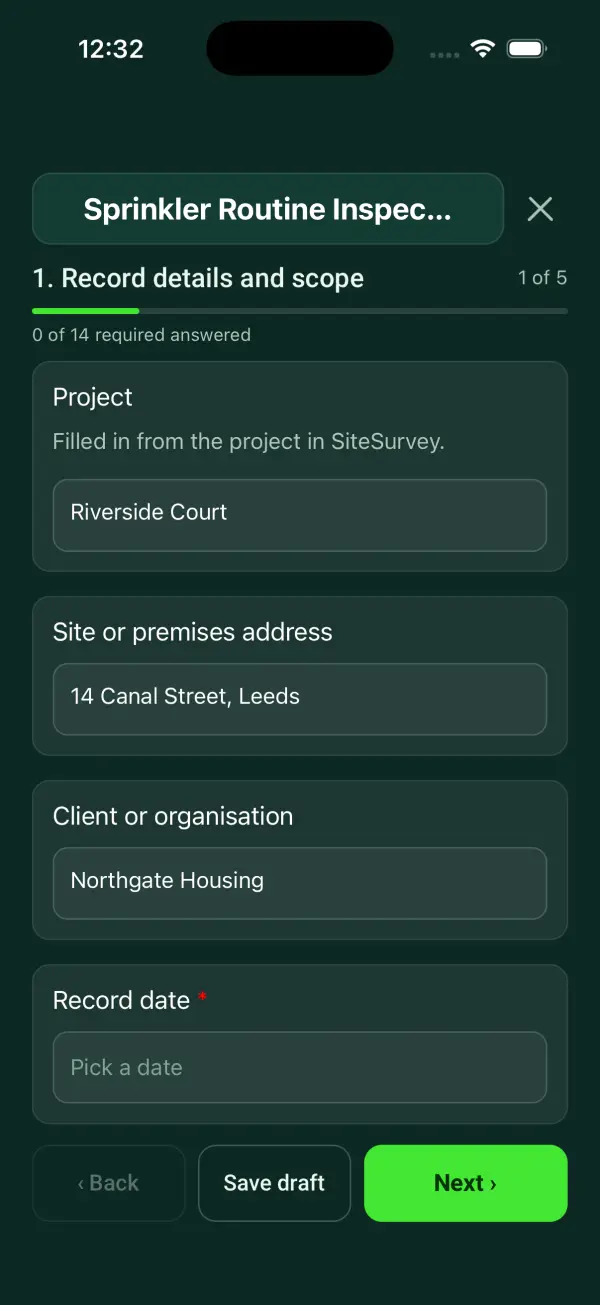
Sprinkler inspection checklist
A sprinkler routine-check record with system identity, approved schedule, visual observations, authorised test references and impairment notifications.
6 sections59 questionsPhotosSignaturesSee every question → - Facilities and maintenance
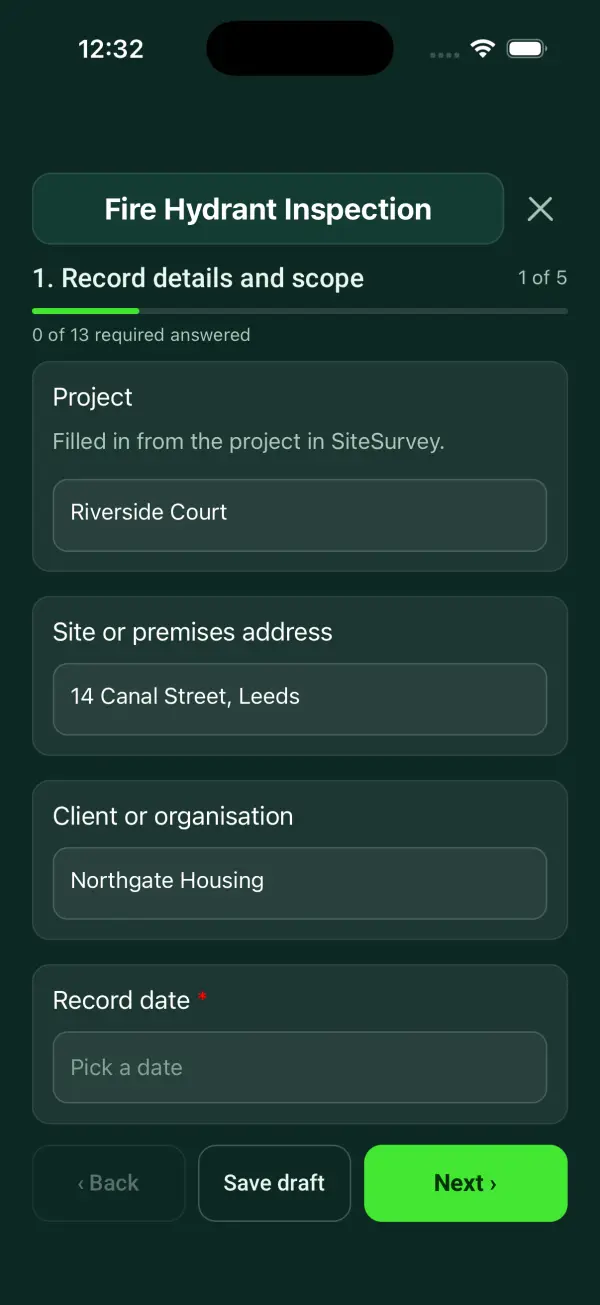
Fire hydrant inspection checklist
A private fire hydrant record covering identification, access, visible condition, authorised test references, defects and impairment notifications.
5 sections52 questionsPhotosSignaturesSee every question →
Drainage, tanks, leaks and spills 9
Below-ground and wet-side checks: drains and manholes, septic tanks and grease traps, fuel tanks, spill kits, leak detection and drying out after a leak.
- Facilities and maintenance
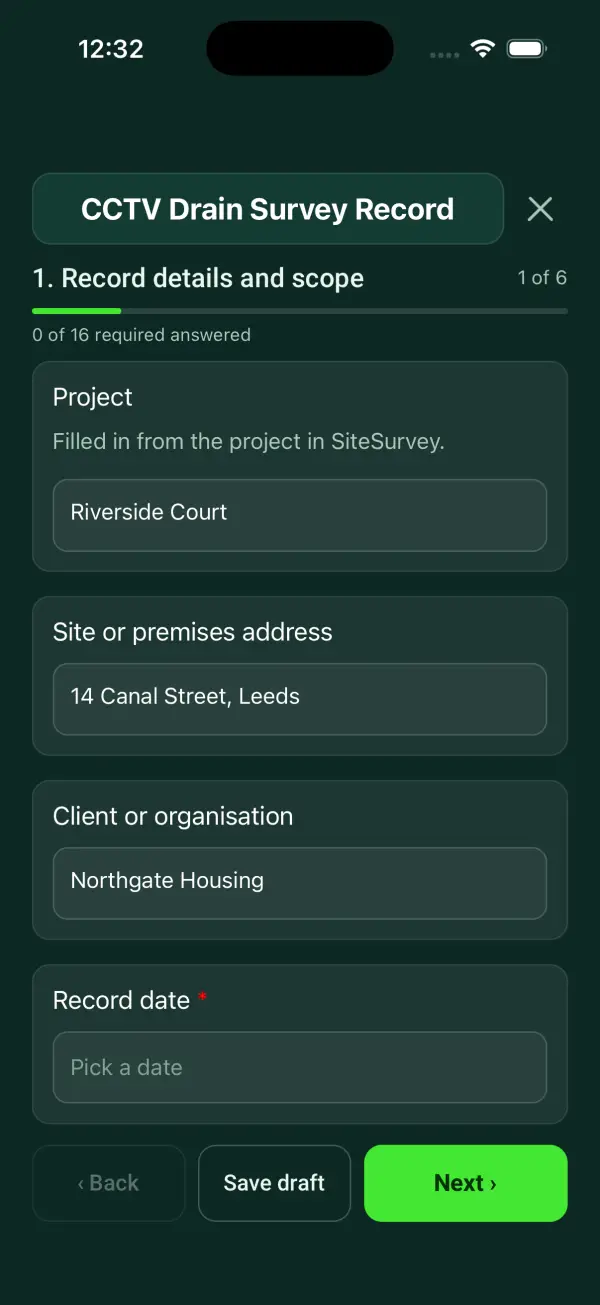
CCTV drain survey report
A CCTV drain survey record linking pipe runs, access points, footage, chainage, observed defects, survey limits and recommendations for further review.
6 sections54 questionsPhotosSignaturesSee every question → - Facilities and maintenance
Manhole inspection checklist
A surface inspection of manhole and inspection chamber covers: location and use, cover, seating, frame and surround, signs of blockage or flooding, who is responsible, risk, photos and actions. No covers lifted.
3 sections55 questionsPhotosSignaturesSee every question → - Facilities and maintenance
Culvert inspection checklist
A culvert and trash screen inspection from the bank: watercourse and water level, flow, screen and debris, headwall, wing walls, banks and outlet, debris cleared, photos, who was told and actions. Never enter a culvert.
3 sections55 questionsPhotosSignaturesSee every question → - Facilities and maintenance
Septic tank inspection checklist
A septic tank and sewage treatment plant inspection: system and discharge, tank and lid, sludge, desludging date and waste carrier, baffles, pumps and alarms, the drainage field and signs of pollution.
4 sections40 questionsPhotosSignaturesSee every question → - Facilities and maintenance
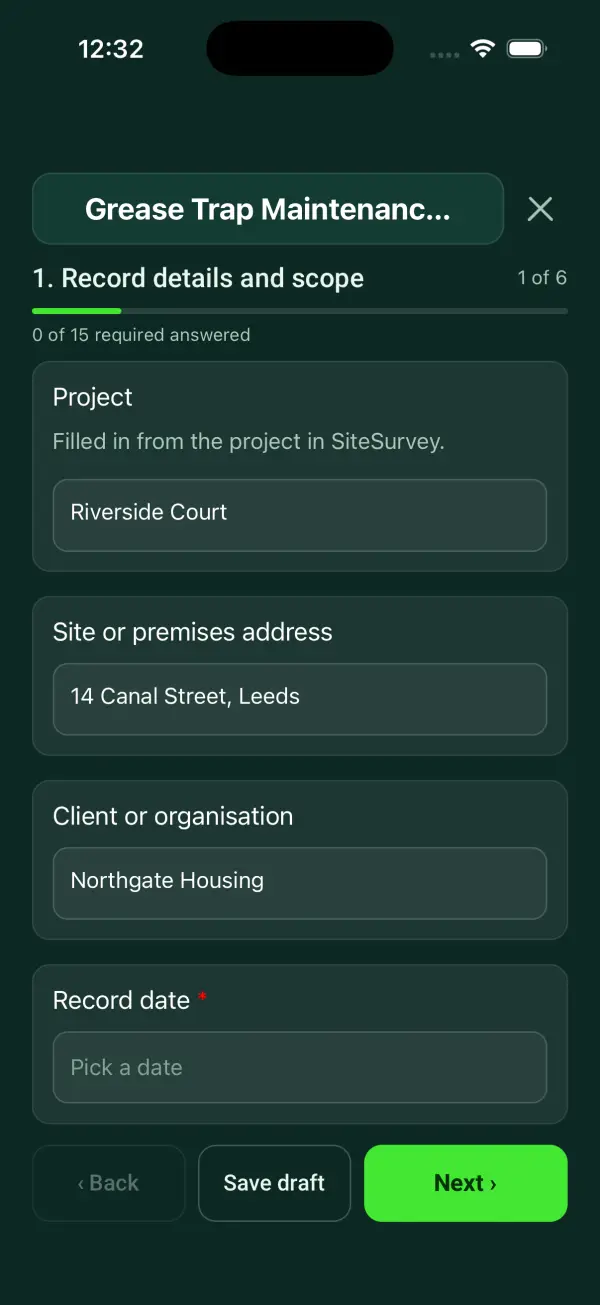
Grease trap cleaning log
A grease trap service log recording asset condition, cleaning and removal work, waste handling references, restored operation and maintenance follow-up.
6 sections43 questionsPhotosSignaturesSee every question → - Facilities and maintenance
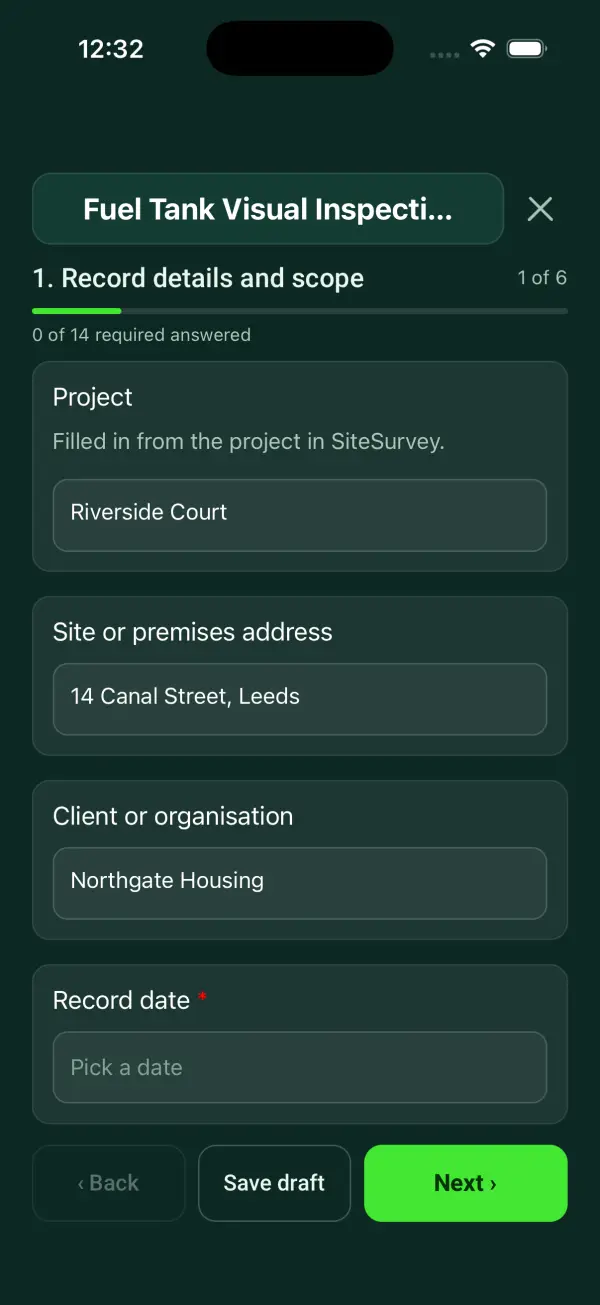
Fuel tank inspection checklist
A fuel tank visual record covering tank identity, visible condition, containment, pipework, spill indicators, local requirements and defect response.
6 sections52 questionsPhotosSignaturesSee every question → - Facilities and maintenance
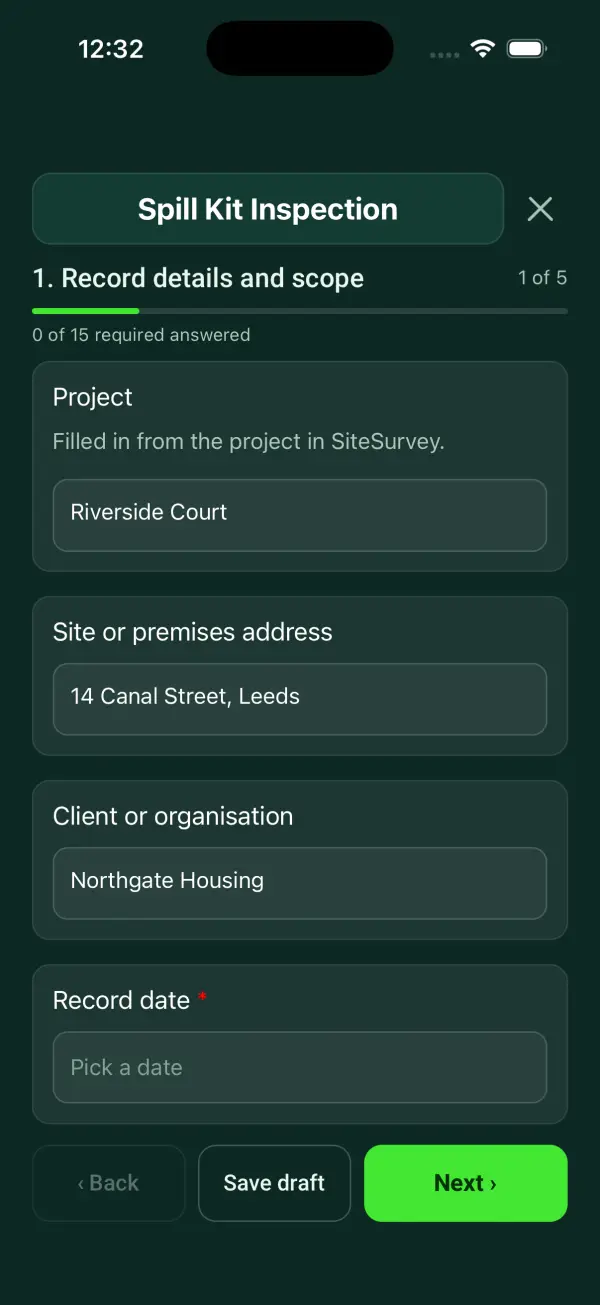
Spill kit checklist
A spill kit inspection with location, substance suitability, contents, access, restocking needs, response information and photos.
5 sections46 questionsPhotosSignaturesSee every question → - Facilities and maintenance
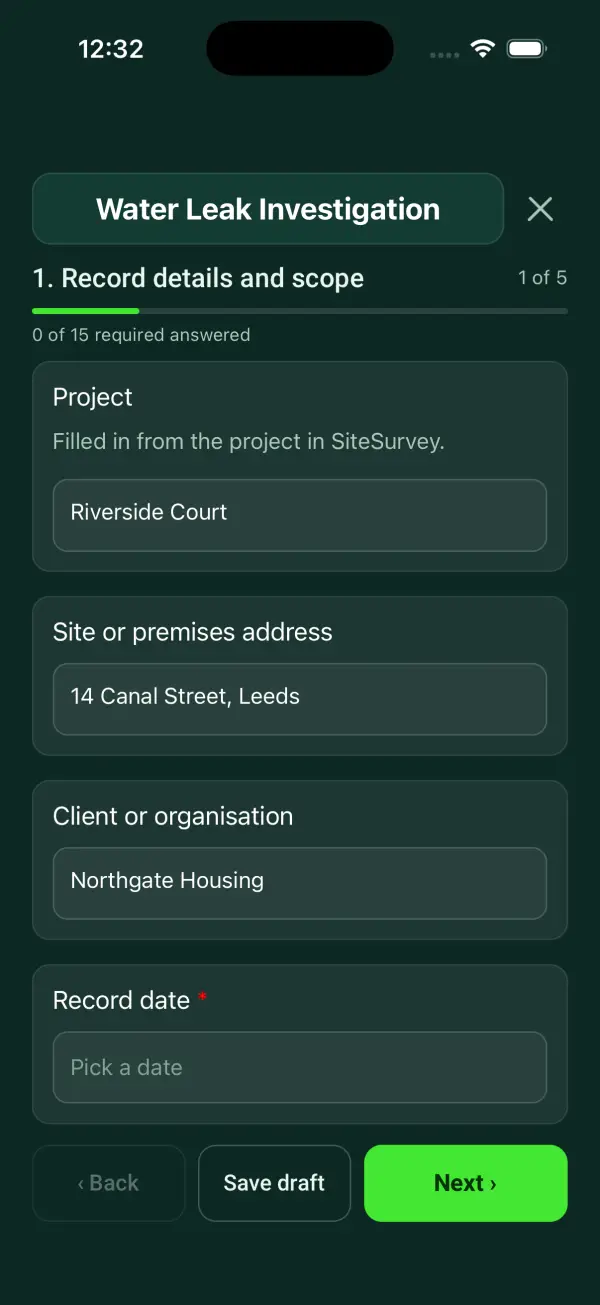
Leak detection report template
A water leak investigation record linking reported symptoms, accessible observations, authorised test evidence, probable sources, uncertainty and next actions.
5 sections49 questionsPhotosSignaturesSee every question → - Facilities and maintenance
Drying log template
Record repeat moisture readings at identified monitoring points against a dry standard, change since the last visit, days drying, air moisture in g/kg, and drying equipment changes on a restoration visit.
3 sections45 questionsPhotosSignaturesSee every question →
Cleaning and hygiene 6
Cleaning schedules, audits and deep cleans for offices, washrooms and commercial sites, for in-house teams and cleaning contractors.
- Facilities and maintenance
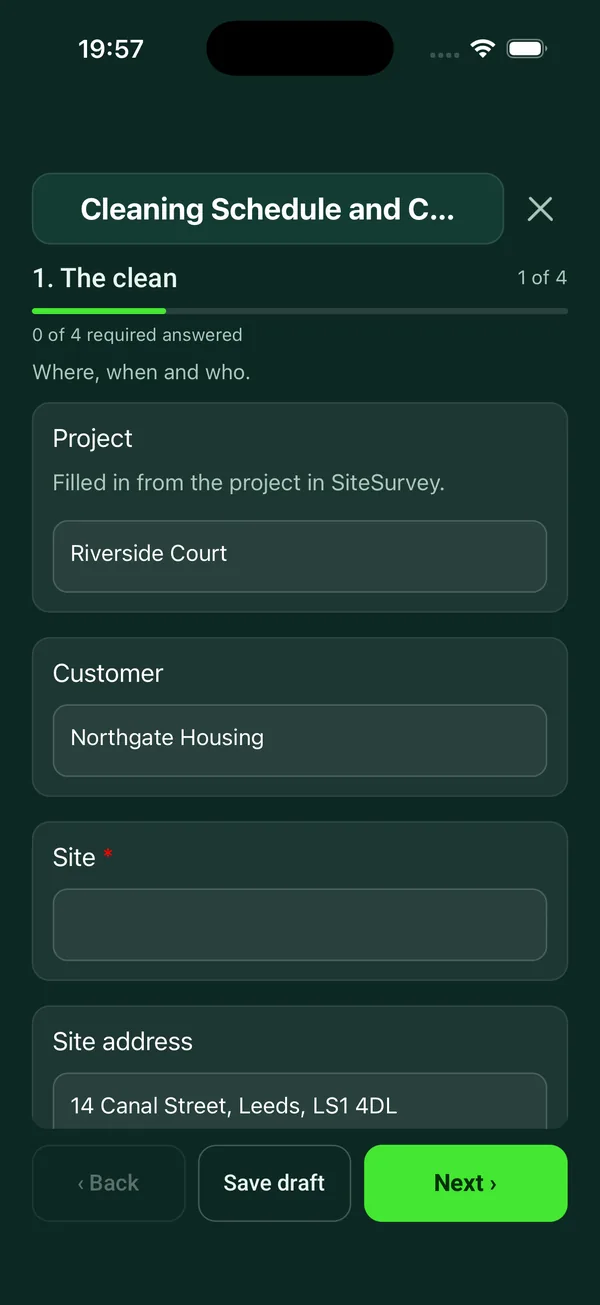
Cleaning schedule template
Daily, weekly or deep clean record: each area with the tasks done, anything missed and why, issues with photos, supplies to reorder and a supervisor check.
4 sections29 questionsPhotosSignaturesSee every question → - Facilities and maintenance
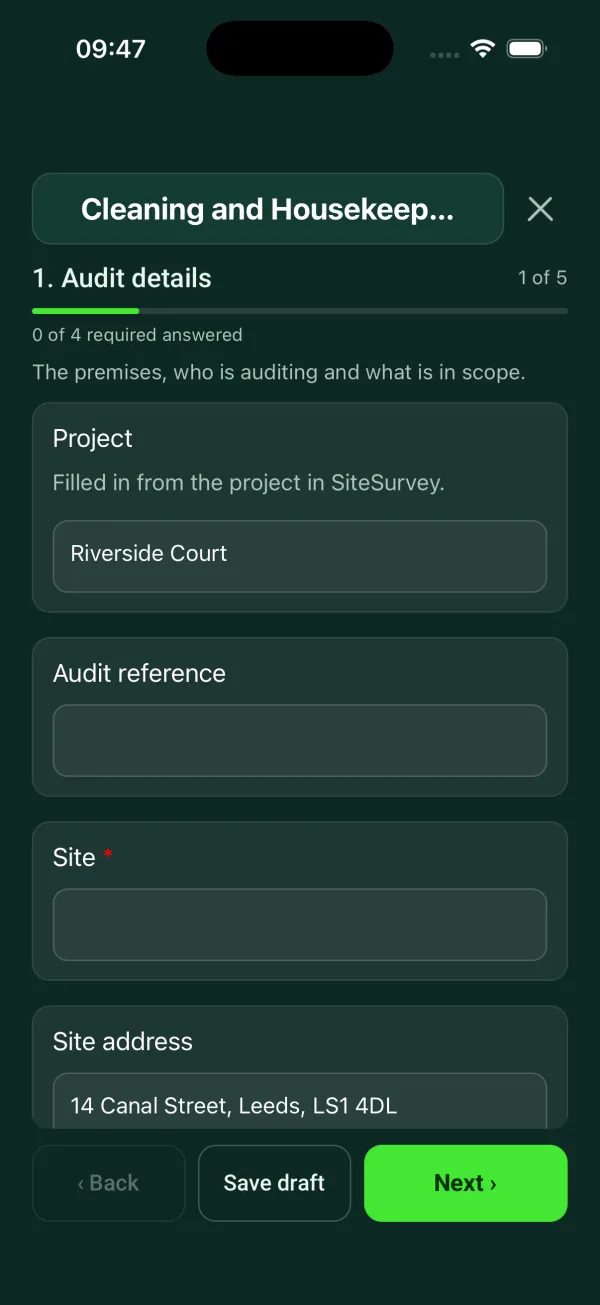
Cleaning audit checklist
A cleaning quality audit and housekeeping inspection, area by area, with a pass score, chemical and waste checks, actions and sign-off by the auditor and the cleaning supervisor.
5 sections89 questionsPhotosSignaturesSee every question → - Facilities and maintenance
Hospital cleaning checklist
A technical cleaning audit for a hospital ward, theatre suite, clinic or department. Set the functional risk (FR) category and target, add each room as a space and score each element in it (bed, rails, call bell, locker, commode, basin, floor, low, middle and high surfaces) pass or fail with the responsible group, reason and photo. Room and area scores against the target, NHS England 2025 star rating or your own bands, rectification times, an optional observed-clean (efficacy) check, actions and sign-off with the ward.
5 sections97 questionsPhotosSignaturesSee every question → - Facilities and maintenance
Commercial cleaning checklist
A commercial and office cleaning visit report: each area with the tasks done, a rating against the standard, issues and photos, consumables, COSHH, client comments and sign-off.
3 sections38 questionsPhotosSignaturesSee every question → - Facilities and maintenance
Washroom cleaning checklist
A washroom and toilet cleaning log: each check with time, who cleaned, tasks done, consumables restocked, issues and photos, and a supervisor check.
3 sections19 questionsPhotosSignaturesSee every question → - Facilities and maintenance
Deep cleaning checklist
A deep clean report: every area with before and after photos, the tasks done, products used and anything found, plus COSHH and PPE checks and the client's sign-off.
4 sections45 questionsPhotosSignaturesSee every question →
Grounds, external areas and structures 9
Outside the building: grounds and irrigation, trees, parks, car parks and roads, fences, retaining walls and balconies, plus records of any pesticide applied.
- Facilities and maintenance
Grounds maintenance checklist
A grounds maintenance visit record: each area with tasks done, photos and issues, weed control, nesting bird checks before hedge work, waste removed, and the client's sign-off as proof of visit.
3 sections39 questionsPhotosSignaturesSee every question → - Facilities and maintenance
Irrigation inspection checklist
Record irrigation zones, controller references, visible leakage, coverage observations and follow-up work for an irrigation visit.
3 sections57 questionsPhotosSignaturesSee every question → - Facilities and maintenance
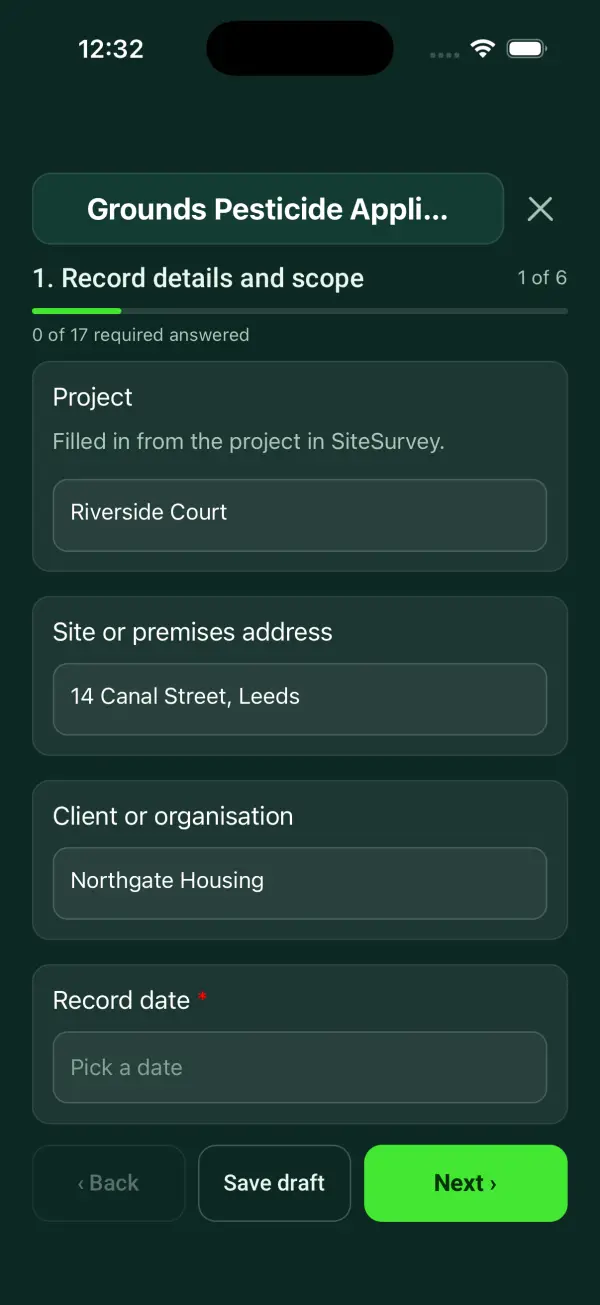
Pesticide application record template
A professional grounds pesticide application record: authorised product and label, each treated area pinned by GPS with its area and product used, the dose applied per hectare against the label maximum, weather, exposure controls and follow-up.
6 sections53 questionsPhotosSignaturesSee every question → - Facilities and maintenance
Tree survey template
A tree condition survey: every tree with its tag, species, size, condition, defects, the people or property it could hit, risk, recommended work and urgency, plus TPO and conservation area checks.
3 sections41 questionsPhotosSignaturesSee every question → - Facilities and maintenance
Park and open space inspection checklist
A park and open space inspection: paths, benches, bins, signs, fencing and gates, trees, water features, lighting, litter and hazards, each issue with risk, photos and action.
3 sections52 questionsPhotosSignaturesSee every question → - Facilities and maintenance
Highway and car park safety inspection checklist
A highway, footway and car park safety inspection: route, hierarchy and inspection type, each defect with its type, size, response category and photos, made safe, and actions.
3 sections49 questionsPhotosSignaturesSee every question → - Facilities and maintenance
Fence damage inspection checklist
A fence and boundary inspection: what the boundary is for, each section with its type, posts, panels, gaps and climbing aids, gates with hinges, latches and locks, breaches made safe, photos and repair actions.
3 sections60 questionsPhotosSignaturesSee every question → - Facilities and maintenance
Retaining wall inspection checklist
A retaining wall inspection checklist: wall, construction, height and what it holds back, line and level, cracks, missing stones, voids, base, water and drainage, each defect with risk and photos, highway notes and actions.
3 sections72 questionsPhotosSignaturesSee every question → - Facilities and maintenance
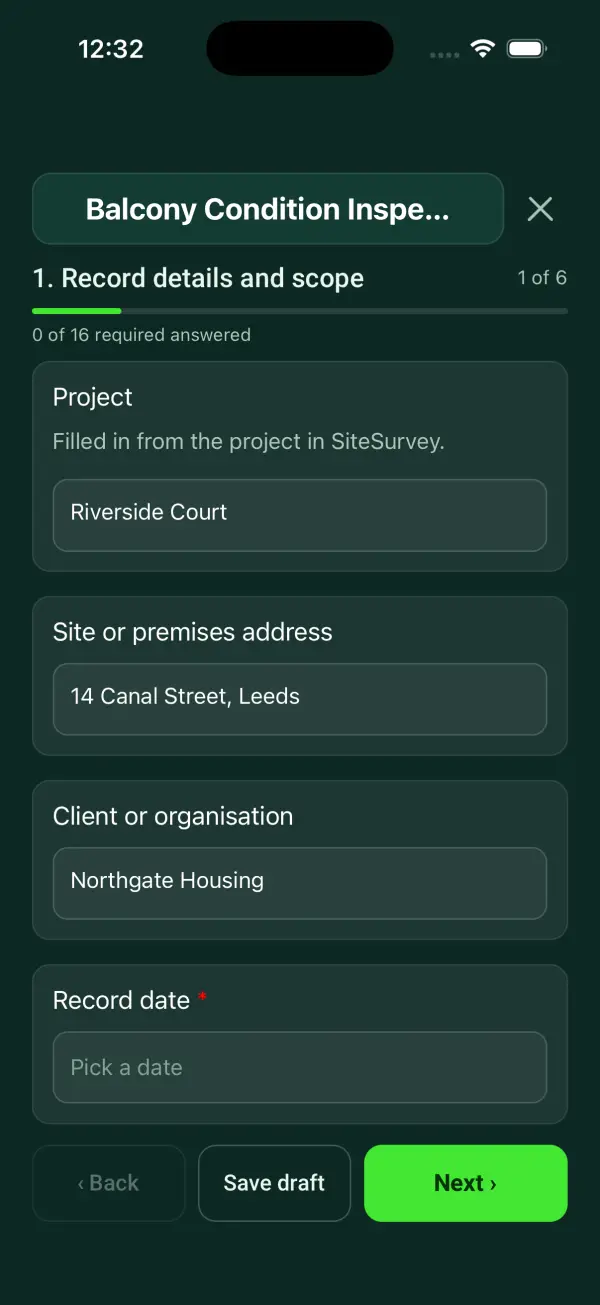
Balcony inspection checklist
A balcony condition record covering safe access, visible surfaces, balustrades, drainage, distress indicators, evidence and referral for specialist review.
6 sections58 questionsPhotosSignaturesSee every question →
Guide
What is a facility inspection checklist?
A facility inspection checklist is the list of things a facilities manager, maintenance engineer or contractor checks on a building and the equipment in it, with space to record what was found. It covers the fabric of the building, its services (heating, ventilation, water, electrics, lifts), its safety systems and the areas around it. Done on a schedule, it becomes planned preventive maintenance (PPM): you inspect and service before things fail, rather than waiting for a fault and raising a work order.
In the UK the starting point is the Workplace (Health, Safety and Welfare) Regulations 1992. Regulation 5 says the workplace and its equipment, devices and systems must be maintained, including cleaned as appropriate, in an efficient state, in efficient working order and in good repair, and where appropriate be subject to a suitable system of maintenance. A checklist with a date, a name and the result for each item is how you show that system exists.
Many UK maintenance teams build their PPM schedules from SFG20, the maintenance specification standard created by BESA (the Building Engineering Services Association). It turns legislation and codes of practice into maintenance tasks for each type of asset. If you hold an SFG20 licence, the PPM checklist records the schedule reference and tasks done against each asset in your asset register.
Sources: Workplace (Health, Safety and Welfare) Regulations 1992, regulation 5 and SFG20: what is SFG20.
Types of facilities inspections: by building, purpose and frequency
Most facilities teams run several kinds of inspection side by side. It helps to sort them three ways, because each answers a different question about the same building.
- By building
- An office, a school, a care home, a warehouse and a block of flats share the basics (water, electrics, fire, access) but differ in the detail. A gym needs gym equipment inspections, a leisure centre a swimming pool checklist, a kitchen a grease trap log, a site with grounds a tree survey. Housing providers will find more in housing and property forms.
- By purpose
- Statutory checks the law requires (gas, lifting equipment, pressure systems, legionella control), PPM servicing to keep plant running, condition surveys that feed budgets, commissioning when something new is installed (such as a heat pump or air conditioning), and reactive visits after a fault, leak or complaint.
- By frequency
- Daily and weekly checks are short walk-rounds and logs, such as flushing little-used outlets or a security patrol. Monthly and quarterly checks are typically temperature monitoring, descaling and plant servicing. Annual and five-yearly visits are the formal inspections and certificates, such as gas safety checks and the EICR.
- By who does it
- Some checks suit a caretaker or site manager. Others need a competent person: a Gas Safe registered engineer for gas, an electrician for fixed wiring testing, an F gas certified technician for refrigerant leak checks, and a competent examiner for lifts.
Which facilities checks are a legal requirement in the UK?
Most of the law sets a duty to maintain, not a checklist, and leaves the frequency to risk assessment and the maker's instructions. A few duties do set intervals or a written scheme. These are the ones facilities teams are most often asked about.
- Legionella
- HSE's approved code of practice L8 applies to water systems at work. HSG274 Part 2 gives the hot and cold water figures: store hot water at 60 °C or above, reach 50 °C at outlets within one minute (55 °C in healthcare premises) and keep cold water below 20 °C. Record them on a legionella temperature log.
- Gas
- Employers must keep gas appliances, pipework and flues at work in a safe condition (regulation 35). Landlords must have each appliance and flue checked for safety at intervals of not more than 12 months (regulation 36). Use the boiler service checklist for the service record.
- Electrical installations
- The Electricity at Work Regulations 1989 require systems to be maintained to prevent danger, without setting an interval. In England, private and social landlords must have the installation inspected and tested at least every 5 years, recorded on an EICR with a schedule of test results.
- Lifts
- Under LOLER regulation 9, lifting equipment for lifting people must be thoroughly examined at least every 6 months, other lifting equipment at least every 12 months, or in either case to an examination scheme. The examination is separate from routine lift maintenance.
- Pressure systems
- Systems such as air receivers and steam boilers need a written scheme of examination by a competent person before they are operated (Pressure Systems Safety Regulations 2000, regulation 8). The compressor maintenance checklist covers the routine side.
- F gas and air conditioning
- Equipment containing F gas equivalent to 5 tonnes of CO2 or more needs regular leak checks, at least every 12 months at the lowest band. In England and Wales, air conditioning systems over 12kW must also be inspected by an energy assessor at intervals of no more than five years.
- Asbestos and fire
- The duty holder for non-domestic premises must manage asbestos, which in practice means an asbestos register and plan. Fire safety systems must be kept in efficient working order and good repair under article 17 of the Fire Safety Order; those checks are in the fire safety forms.
Sources: HSE: L8, Legionnaires' disease approved code of practice, HSE: HSG274 Part 2, hot and cold water systems, Gas Safety (Installation and Use) Regulations 1998, regulation 35, Gas Safety (Installation and Use) Regulations 1998, regulation 36, Electricity at Work Regulations 1989, regulation 4, GOV.UK: electrical safety standards in the private and social rented sectors, LOLER 1998, regulation 9: thorough examination, HSE INDG339: thorough examination and testing of lifts, Pressure Systems Safety Regulations 2000, regulation 8, GOV.UK: checking F gas equipment for leaks, Energy Performance of Buildings (England and Wales) Regulations 2012, regulation 18, Control of Asbestos Regulations 2012, regulation 4 and Regulatory Reform (Fire Safety) Order 2005, article 17.
What a facility inspection checklist covers
A good facilities checklist is organised the way you walk the building, so nothing is missed between areas. Each item gets a result (pass, fail, action or not applicable), a note and a photo where something is wrong.
- Exteriors
- Roofs, gutters and drainage, walls and render, windows, external doors, balconies, fences, retaining walls, lighting, car parks and footways (highway and car park inspection), grounds, bin stores and signage.
- Interiors
- Floors and trip hazards, ceilings, stairs and handrails, doors and ironmongery, washrooms, kitchens and tea points, and cleanliness. Regulation 9 of the Workplace Regulations requires workplaces, furniture and fittings to be kept sufficiently clean, which is what a cleaning audit checks.
- Building systems
- Heating and hot water, ventilation and air handling units, cooling and chillers, water storage, electrical distribution, generators, pumps, lifts, automatic doors and access control.
- Safety
- Fire alarm, emergency lighting and escape routes, sprinklers, spill kits, fuel tanks, asbestos condition, and work equipment. PUWER regulation 6 requires inspection of work equipment where its safety depends on how it is installed or where conditions cause it to deteriorate. Wider workplace risks sit in the health and safety forms.
- Access and energy
- An access audit supports the Equality Act duty to make reasonable adjustments for disabled people, and an energy audit finds lighting, heating and controls that waste money.
Sources: Workplace (Health, Safety and Welfare) Regulations 1992, regulation 9, PUWER 1998, regulation 6: inspection, HSE: inspection of work equipment and Equality Act 2010, section 20: duty to make adjustments.
How to run a facilities inspection on site
Start from the asset register, not from memory. Each plant item, water outlet and distribution board should have an ID and a location, so the person on site knows exactly what to check and the record ties back to one asset. Labels or QR tags on plant make this quicker and stop the same unit being recorded under three names.
Walk the building in a fixed order and record as you go rather than writing up later. Take a photo of every defect, with an annotation showing exactly where the problem is, and take readings (temperatures, pressures, test results) straight into the form so nobody has to copy them from a notepad. SiteSurvey forms run on iPhone, iPad and Android and work offline, so plant rooms and basements without signal are not a problem.
Grade what you find. A simple scale (safe, monitor, repair within a set time, make safe now) lets you sort a long list of findings into what goes on today's work order and what goes into next year's budget. Anything dangerous should be made safe or isolated before you leave, and recorded as such. HSE's guidance on electrical equipment makes the same point for testing generally: the type and frequency of checks should follow the equipment, where it is used and what earlier checks found.
Finish with a signature from the engineer and, where the contract needs it, the client or site contact. A maintenance shift handover passes open faults to the next shift so nothing is lost overnight.
Turning inspections into a report and a maintenance plan
An inspection is only useful if someone acts on it. Each completed SiteSurvey form becomes a branded PDF report with the photos, readings, signatures and notes in place, ready to send to a client, landlord or insurer, or to file against the building.
Read the reports together, not one at a time. The same fan coil failing every quarter, outlet temperatures drifting down month after month, or a drain that needs jetting twice a year are the patterns that justify a replacement or a change of schedule. Raise a work order for each action, close it with a photo of the finished repair, and update the asset register when equipment is replaced.
Every form in this library can be edited to match your sites, your contract or your SFG20 schedule, and you can build your own in the form builder. Open any form page to see every question and try the form live before you use it. For installation and handover paperwork on new work, see the construction and handover forms.
Facts checked by the SiteSurvey team, 27 October 2026.
Facilities and maintenance forms FAQs
What is the difference between PPM and reactive maintenance?
PPM (planned preventive maintenance) is scheduled inspection and servicing done before equipment fails, such as a quarterly AHU service. Reactive maintenance is work raised after something breaks or is reported. Most sites need both: a PPM schedule built from the asset register, and work orders for faults.
Do portable appliances have to be PAT tested every year?
No. HSE says the law requires electrical equipment that could cause injury to be maintained in a safe condition, but does not make testing a legal requirement or say it must be annual. How often you test depends on the type of equipment and where it is used, and for most portable equipment in a low-risk workplace a portable appliance test is not needed: looking for signs of damage is a good way to maintain it.
Sources: HSE: portable appliance testing FAQs and Electricity at Work Regulations 1989, regulation 4.
How often does a lift need a thorough examination?
Under LOLER, a lift that carries people must be thoroughly examined at least every 6 months, or to an examination scheme drawn up by a competent person. Goods-only lifting equipment is at least every 12 months. Routine servicing by the lift contractor does not replace the thorough examination.
Sources: LOLER 1998, regulation 9: thorough examination and HSE INDG339: thorough examination and testing of lifts.
What water temperatures should a legionella log record?
HSG274 Part 2 says hot water should be stored at 60 °C or above and reach 50 °C at the outlet within one minute (55 °C in healthcare premises), and cold water should be kept below 20 °C. Your written scheme sets which outlets are checked and how often.
How often do landlords need gas and electrical safety checks?
Landlords must have each gas appliance and flue checked for safety at intervals of not more than 12 months. In England, private and social landlords must have the electrical installation inspected and tested at least every 5 years and give tenants a copy of the report.
Sources: Gas Safety (Installation and Use) Regulations 1998, regulation 36 and GOV.UK: electrical safety standards in the private and social rented sectors.
Does an air conditioning system need a separate inspection?
Yes, in England and Wales, systems with an effective rated output over 12kW must be inspected by an energy assessor at intervals of no more than five years, separate from routine servicing. Equipment above the F gas thresholds also needs regular leak checks by a certified technician.
Sources: Energy Performance of Buildings (England and Wales) Regulations 2012, regulation 18 and GOV.UK: checking F gas equipment for leaks.
Can we use our own SFG20 schedules or contract checklists?
Yes. Every form in the library can be edited, so you can add your SFG20 references, asset IDs or client-specific tasks, or build a new form from scratch in the form builder. SFG20 content itself needs your own SFG20 licence.
Source: SFG20: what is SFG20.
Other categories
Put these forms in your team's hands
Works on iPhone, iPad and Android, offline on site, with every completed form turned into a branded PDF report.
Start your trial →