Form library · Facilities and maintenance
Cleaning audit checklist
A cleaning quality audit and housekeeping inspection for workplaces and communal areas: offices, housing block communal areas, warehouses, site welfare, schools and retail. It checks cleaning against your specification rather than listing chores for a home. Each area is scored against a pass mark, then chemicals, equipment and waste are checked and every failure gets an action. Every question is listed below, and you can fill the live form in on this page.
Ready to use from the form library, and editable. Trial from £1, cancel any time.
What should a cleaning audit checklist include?
A cleaning audit checklist should record the premises, the cleaning team, the areas in scope and the pass mark. Each area is checked for floors, touch points, bins, glass, washroom fixtures, soap, hand drying, toilet roll, kitchens, walkways, cables, spillages and storage, with photos of failures. It then covers chemical storage, COSHH, colour coding, schedules and waste, an overall score, and actions with an owner and a due date.
Last updated . Facts checked on 30 September 2026 against regulation 9 of the Workplace (Health, Safety and Welfare) Regulations 1992, regulation 12 of the Workplace (Health, Safety and Welfare) Regulations 1992, regulation 20 of the Workplace (Health, Safety and Welfare) Regulations 1992, regulation 21 of the Workplace (Health, Safety and Welfare) Regulations 1992, regulation 6 of the Control of Substances Hazardous to Health Regulations 2002, HSE COSHH essentials SR4 for manual cleaning, HSE on cleaning and slips and Schedule 2 of the Construction (Design and Management) Regulations 2015.
Try the cleaning audit form live
Answer a few questions and watch it adapt. Your answers are not saved, and any photos you add are deleted within the hour.
This is the real form as your team would use it: questions appear as you answer, scores work themselves out and you can add photos and signatures. No sign-up needed.
Fill it in on a phone or tablet
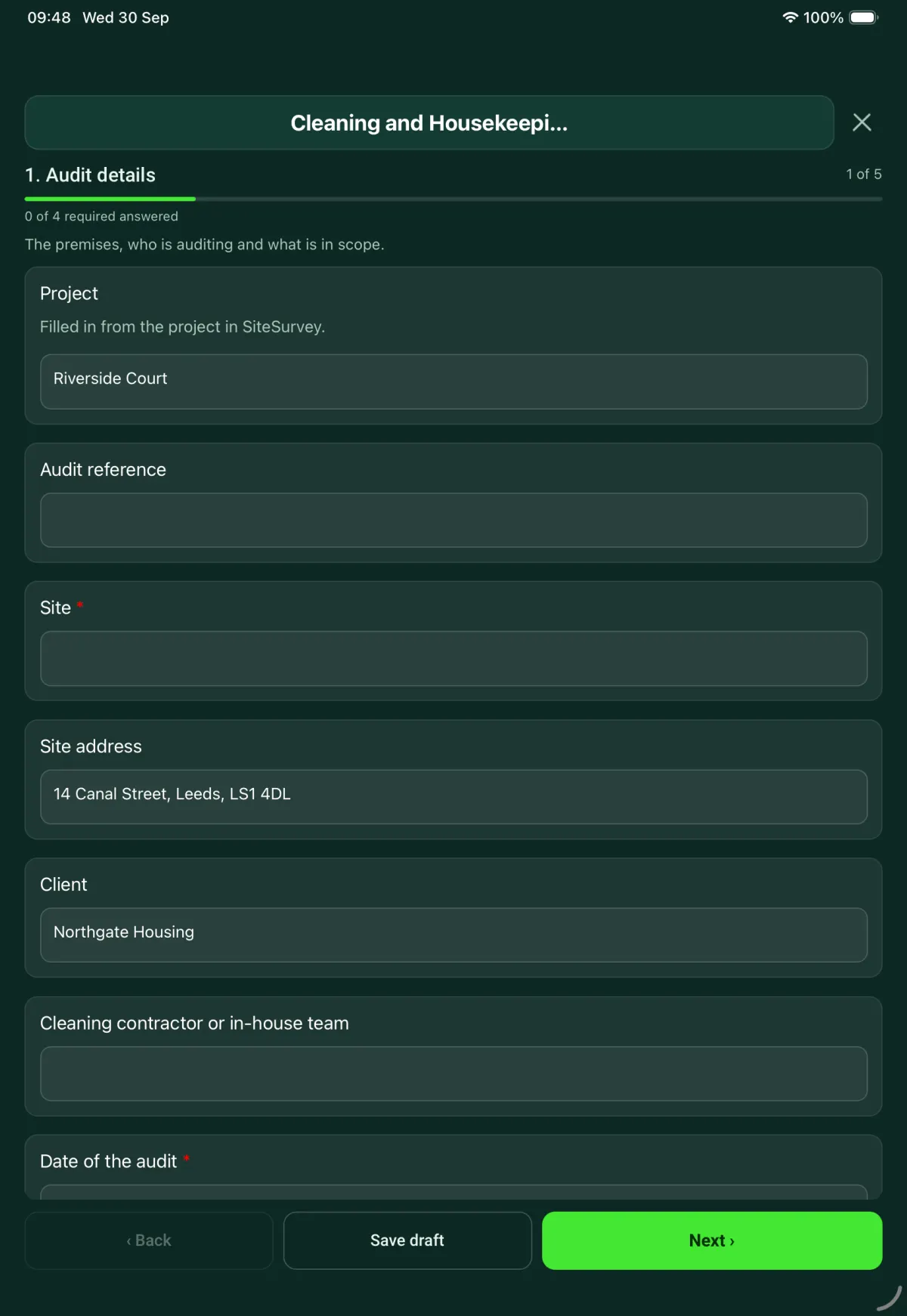
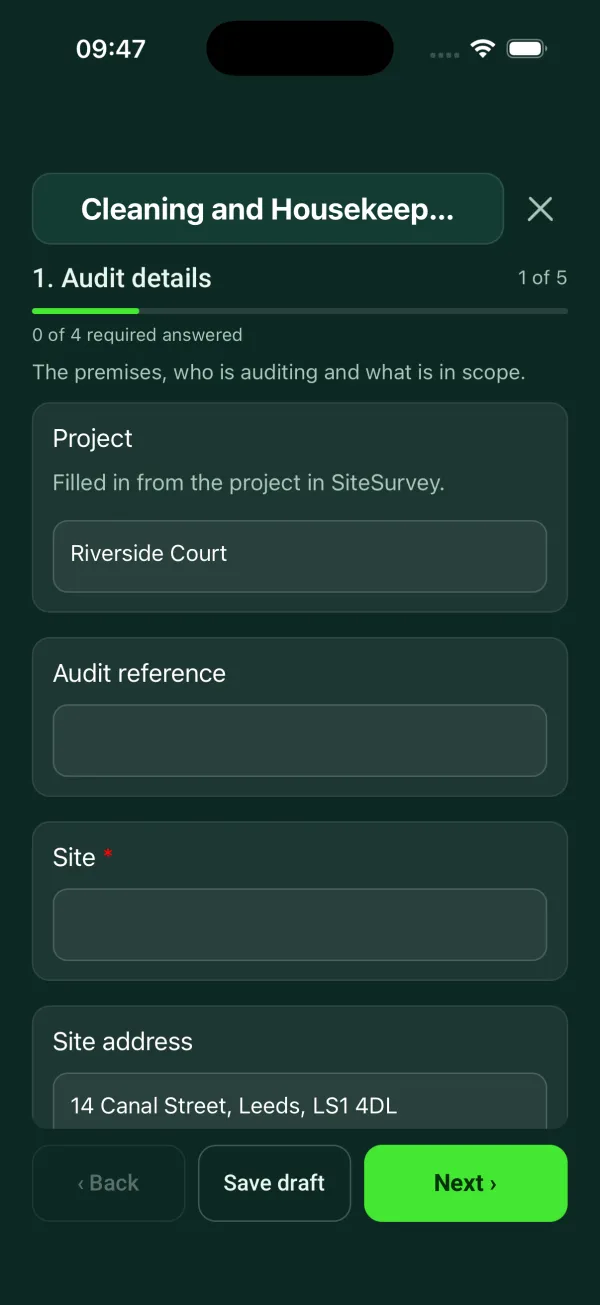
Your team completes the cleaning and housekeeping audit on site in the SiteSurvey app on iPhone, iPad and Android phones and tablets. The project name and address fill in for them, it works without signal, and it syncs when the device is back online with photos kept against the question they answer.
Customers and subcontractors do not need the app: send them a link and they can fill it in from any browser.
Every question in the cleaning audit template
A cleaning quality audit and housekeeping inspection, area by area, with a pass score, chemical and waste checks, actions and sign-off by the auditor and the cleaning supervisor. 5 sections and 81 questions. Follow-up questions and guidance appear only when an answer calls for them, so the person on site never sees the ones that do not apply.
Details you only enter once
Add this form to a project in SiteSurvey and it fills in what the project already knows, so nobody on site retypes it and every form on the job uses the same names. Anything filled in can still be changed.
- Project: the project name
- Site: the site, when the form is opened for a space or a product
- Site address: the site address, from the space or the project
- Client: the project's customer
Audit details
The premises, who is auditing and what is in scope.
- ProjectShort answerFills in from the project name
- Audit referenceShort answer
- Site*Short answerFills in from the site, when the form is opened for a space or a product
- Site addressShort answerFills in from the site address, from the space or the project
- ClientShort answerFills in from the project's customer
- Cleaning contractor or in-house teamShort answer
- Date of the audit*Date
- TimeTime
- Auditor name and roleShort answer
- Cleaning supervisor presentShort answer
- Premises type*Choose one
- Office
- Communal areas of a housing block
- Warehouse or logistics site
- Construction site welfare
- School or public building
- Retail or leisure
- Other (describe)
- GuidanceConstruction sites. The Workplace (Health, Safety and Welfare) Regulations 1992 do not apply to a construction site where the only activity is construction work, apart from a few regulations. Welfare there is covered by Schedule 2 of the Construction (Design and Management) Regulations 2015, which also requires toilets to be kept clean and orderly and washing facilities to have soap and a means of drying.Shown when “Premises type” is “Construction site welfare”
- Type of auditChoose one
- Routine audit
- Follow-up of a previous audit
- Complaint or incident
- Contract start or handover
- Overall score at the previous audit (%)NumberShown when “Type of audit” is “Follow-up of a previous audit”
- What was the complaint or incident?NotesShown when “Type of audit” is “Complaint or incident”
- Areas in scopeTick all that apply
- Offices and meeting rooms
- Reception and entrances
- Corridors, stairs and lifts
- Washrooms and toilets
- Kitchens and tea points
- Warehouse and loading areas
- Welfare facilities
- Bin stores and external areas
- Other (describe)
- Pass mark for an area (%)Number
Areas inspected
One entry for each area. Mark each item Pass, Fail or Not applicable as you find it.
- GuidanceHow the score works. Each item marked Pass or Fail counts. Not applicable items are left out. The area score is the share of items passed. Photograph every failure so the cleaning team can see exactly what was found.
- AreasRepeat for each area. Each one asks:
- Area name or location*Short answer
- Area typeChoose one
- Office or open plan
- Meeting room
- Reception or entrance
- Corridor, stairs or lift lobby
- Washroom or toilets
- Kitchen or tea point
- Warehouse floor or loading bay
- Welfare cabin or site welfare
- Bin store
- Other (describe)
- Floors clean, free of debris and stainsChoose one
- Pass
- Fail
- Not applicable
- Surfaces and touch points clean (handles, switches, handrails, lift buttons)Choose one
- Pass
- Fail
- Not applicable
- Bins emptied, liners fitted, not overflowingChoose one
- Pass
- Fail
- Not applicable
- CheckSo far as is reasonably practicable, waste materials must not be allowed to accumulate in a workplace except in suitable receptacles. Regulation 9(3) of the 1992 Regulations.Shown when “Bins emptied, liners fitted, not overflowing” is “Fail”
- Glass, mirrors and partitions free of smearsChoose one
- Pass
- Fail
- Not applicable
- Toilets, urinals, basins and taps cleanChoose one
- Pass
- Fail
- Not applicable
Shown only when the answers above make it relevant - Soap available at every basinChoose one
- Pass
- Fail
- Not applicable
Shown only when the answers above make it relevant - Paper towels or hand dryer workingChoose one
- Pass
- Fail
- Not applicable
Shown only when the answers above make it relevant - WarningSoap or drying missing. Washing facilities must include soap or other suitable means of cleaning, and towels or other suitable means of drying. Workplace (Health, Safety and Welfare) Regulations 1992, regulation 21. On a construction site the same applies under Schedule 2 of the Construction (Design and Management) Regulations 2015. Restock before you leave if you can.Shown only when the answers above make it relevant
- Toilet roll stocked in every cubicleChoose one
- Pass
- Fail
- Not applicable
Shown only when the answers above make it relevant - CheckSanitary conveniences and the rooms containing them must be kept in a clean and orderly condition. Workplace (Health, Safety and Welfare) Regulations 1992, regulation 20.Shown when “Toilets, urinals, basins and taps clean” is “Fail”
- Kitchen or tea point clean: sink, worktops, fridge, microwaveChoose one
- Pass
- Fail
- Not applicable
Shown only when the answers above make it relevant - Walkways and exit routes clearChoose one
- Pass
- Fail
- Not applicable
- CheckRegulation 12(3) of the 1992 Regulations. So far as is reasonably practicable, every floor and traffic route must be kept free from obstructions and from any article or substance which may cause a person to slip, trip or fall.Shown when “Walkways and exit routes clear” is “Fail”
- No trailing cables across walkwaysChoose one
- Pass
- Fail
- Not applicable
- CheckHSE guidance on trailing cables. People trip over cables and wires, particularly on pedestrian routes. Permanently wire equipment to avoid trailing cables, or use cable covers. Where necessary, restrict access so people do not have to cross them.Shown when “No trailing cables across walkways” is “Fail”
- No spillages, and no wet floor left without a signChoose one
- Pass
- Fail
- Not applicable
- WarningSpillage or wet floor. HSE guidance is to remove spillages promptly, and to leave smooth floors dry after cleaning or keep people off them until they are dry. Use warning signs while the floor is wet, and remove them once it is clean and dry. Record what was done before you left.Shown when “No spillages, and no wet floor left without a sign” is “Fail”
- What was done about it before you left?NotesShown when “No spillages, and no wet floor left without a sign” is “Fail”
- Storage tidy, no clutter or items stacked unsafelyChoose one
- Pass
- Fail
- Not applicable
- Items checkedWorked out by the form
- Items passedWorked out by the form
- Items failedWorked out by the form
- Area score (% of items passed)Worked out by the formShown only when the answers above make it relevant
- Counts as below standardWorked out by the form
- CheckBelow the pass mark. This area scored under the pass mark set on page 1. Describe each failure below and raise an action on page 5.Shown only when the answers above make it relevant
- Overall standard of this areaRating 1 to 5 (Unacceptable to Excellent)
- Photos of the failuresPhotosShown only when the answers above make it relevant
- What was foundNotesShown only when the answers above make it relevant
- Action neededNotesShown only when the answers above make it relevant
- General photos of the areaPhotos
Chemicals, equipment and waste
Checks for the site as a whole.
- Cleaning chemicals are stored securely in a cool, dry, ventilated placeChoose one
- Yes
- No
- Not seen
- CheckHSE guidance for manual cleaning (COSHH Essentials SR4) is to store products securely in a cool, dry, ventilated, dark place, in a way that can retain any spills, and to store only the amount you need.Shown when “Cleaning chemicals are stored securely in a cool, dry, ventilated place” is “No”
- Every container is labelled, including anything decantedChoose one
- Yes
- No
- Not seen
- WarningUnlabelled container. Nobody can tell what is in it, how to use it or what to do after a splash. Take it out of use until it is identified and labelled. Never add other chemicals to a product containing bleach: HSE warns this can give off chlorine gas.Shown when “Every container is labelled, including anything decanted” is “No”
- Photos of the chemical storePhotos
- A COSHH assessment covers the cleaning products in useChoose one
- Yes
- No
- Not seen
- WarningCOSHH regulation 6. An employer must not carry out work liable to expose employees to a substance hazardous to health unless a suitable and sufficient assessment of the risk has been made and the steps it identifies have been put in place.Shown when “A COSHH assessment covers the cleaning products in use” is “No”
- Safety data sheets are available for the products in useChoose one
- Yes
- No
- Not seen
- CheckSafety data sheets. Suppliers must provide an up to date safety data sheet for a chemical that is dangerous for supply. Ask the supplier for any that are missing. HSE is clear that a safety data sheet is not a risk assessment: use it to help make your own.Shown when “Safety data sheets are available for the products in use” is “No”
- Protective gloves are provided and being wornChoose one
- Yes
- No
- Not seen
- Colour-coded cloths, mops and buckets are in useChoose one
- Yes
- No
- Not seen
- Colour scheme in use, and where it was not followedNotesShown when “Colour-coded cloths, mops and buckets are in use” is “Yes”
- CheckHSE guidance for manual cleaning is to use colour-coded cloths, mops and buckets to minimise cross-contamination. Keep washroom equipment apart from kitchen equipment.Shown when “Colour-coded cloths, mops and buckets are in use” is “No”
- Wet floor signs are available and used during cleaningChoose one
- Yes
- No
- Not seen
- Cleaning schedule is displayed in each washroom and kitchenChoose one
- Yes
- No
- Not seen
- The schedule is signed off for every visit this weekChoose one
- Yes
- No
- Not seen
Shown when “Cleaning schedule is displayed in each washroom and kitchen” is “Yes” - Which visits are missing?NotesShown when “The schedule is signed off for every visit this week” is “No”
- Waste is kept in suitable bins, not left to build upChoose one
- Yes
- No
- Not seen
- CheckSo far as is reasonably practicable, waste must not be allowed to accumulate in a workplace except in suitable receptacles. Workplace (Health, Safety and Welfare) Regulations 1992, regulation 9(3).Shown when “Waste is kept in suitable bins, not left to build up” is “No”
- Recycling is separated and bins are labelledChoose one
- Yes
- No
- Not seen
- Bin store is tidy, lids close and nothing is dumped around itChoose one
- Yes
- No
- Not seen
- Photos of waste and recyclingPhotosShown only when the answers above make it relevant
Results
Worked out from the areas on page 2.
- Areas inspectedWorked out by the form
- Items checkedWorked out by the form
- Items passedWorked out by the form
- Items failedWorked out by the form
- Overall score (% of items passed)Worked out by the formShown only when the answers above make it relevant
- Areas below the pass markWorked out by the form
- Change since the previous audit (percentage points)Worked out by the formShown only when the answers above make it relevant
- GuidanceNo items have been marked yet. Go back to page 2 and record a result for each item you checked.Shown only when the answers above make it relevant
- CheckOne or more areas are below the pass mark. Each one needs an action on page 5, with an owner and a due date.Shown only when the answers above make it relevant
- GuidanceEvery area met the pass mark on the day. An audit is a sample, so keep the schedule of checks going.Shown only when the answers above make it relevant
- Overall resultChoose one
- Meets the specification
- Meets the specification with actions
- Does not meet the specification
- Summary for the clientNotes
Actions and sign-off
Every failure needs an action, an owner and a due date.
- ActionsRepeat for each action. Each one asks:
- AreaShort answer
- PriorityChoose one
- Immediate
- Within 7 days
- Next scheduled clean
- ActionNotes
- OwnerShort answer
- Due dateDate
- StatusChoose one
- Open
- Closed on the day
- Actions still openWorked out by the form
- Date of the next auditDate
- Auditor nameShort answer
- Auditor signatureSignature
- Cleaning supervisor nameShort answer
- Cleaning supervisor commentsNotes
- Cleaning supervisor signatureSignature
- Date signedDate
Cleaning audit template questions
What does the law say about workplace cleanliness?
The Workplace (Health, Safety and Welfare) Regulations 1992 say that, so far as is reasonably practicable, waste must not be allowed to accumulate except in suitable receptacles (regulation 9(3)), and floors and traffic routes must be kept free from obstructions and anything that may cause a slip, trip or fall (regulation 12(3)). Toilets must be kept clean and orderly (regulation 20), and washing facilities must include soap and a means of drying (regulation 21).
How is the cleaning audit scored?
Each item in an area is marked Pass, Fail or Not applicable. Not applicable items are left out, and the area score is the share of items passed. An area under the pass mark you set on page 1 is counted as below standard and needs an action. The results page adds up the areas, gives an overall score and, on a follow-up audit, the change since the previous one.
Can I use it as an office cleaning or housekeeping checklist?
Yes, for a workplace. Add one entry per area, such as an open plan office, meeting room, reception, washroom or tea point, and the washroom and kitchen items appear only where they apply. The housekeeping items cover clear walkways and exit routes, trailing cables, spillages and tidy storage. It is written for auditing cleaning at work premises and communal areas, not as a home cleaning list.
What chemical and hygiene checks does it include?
It checks chemical storage, labels on every container including anything decanted, a COSHH assessment, safety data sheets, gloves, colour-coded cloths, mops and buckets, wet floor signs and cleaning schedules. Under COSHH regulation 6 an employer must not carry out work liable to expose employees to a hazardous substance without a suitable and sufficient risk assessment. HSE is clear that a safety data sheet is not a risk assessment.
Does it work for construction site welfare?
Yes. The Workplace Regulations do not apply to a construction site where the only activity is construction work, apart from a few regulations. Welfare there is covered by Schedule 2 of the Construction (Design and Management) Regulations 2015, which also requires toilets to be kept clean and orderly and washing facilities to have soap and a means of drying. The form shows this note when you choose construction site welfare.
Who signs the cleaning audit?
The auditor and the cleaning supervisor both sign on the device, and the supervisor can add comments. Every action has a priority, an owner, a due date and a status, and the form counts the actions still open. In the SiteSurvey app it works offline with photos against each failure, and the report goes out as a PDF or a share link.
Related
Related templates
Templates that go with the cleaning audit form
Workplace audit with walkways, first aid, fire equipment and records, findings and corrective actions, closing meeting.
Internal audit of a quality, health and safety or environmental management system, a 5S area or a procedure, with findings, corrective actions and sign-off.
One issue, fast: where, what, photo, priority, who owns it.
Planned maintenance visit: records seen, asset by asset tasks, water temperatures, work done and next visit.
Use this cleaning audit form with your team
Add it from the form library in one click, change any question, and every completed form becomes a branded PDF report.
Start your trial →