Form library
Logistics and supply chain forms
Warehouse, racking, forklift, HGV, trailer, container, loading and stock take checks for warehouse and transport teams. See every question, try the live form, then use it in SiteSurvey.
What do logistics and supply chain forms record?
They record the checks at each handover from goods-in to delivery: warehouse and racking inspections, forklift and vehicle checks, container and loading checks, and stock takes. Goods vehicle operators must keep safety inspection and maintenance records for at least 15 months, and drivers must do a walkaround check before first use each day, which the HGV daily check sheet records.
Sources: GOV.UK: maintaining your vehicles and HSE: warehousing and storage.
- Forms
- 21 forms in 3 types
- Main UK rules
- Goods vehicle operator licence duties, PUWER 1998, HSE warehousing guidance
- Used by
- Fleet, warehouse and transport teams
- Every form
- See every question and try it live before you sign up, then edit it to suit your team.
Most used
Start with the most used logistics and supply chain forms
All logistics and supply chain forms by type
Search by name or topic, or jump to a type. Open any form to see every question and try it live.
21 forms
Vehicles and drivers 7
Daily walkaround and vehicle checks, trailer inspections, condition at handover, maintenance history, driver assessments and journey plans with check-ins.
- Logistics and supply chain
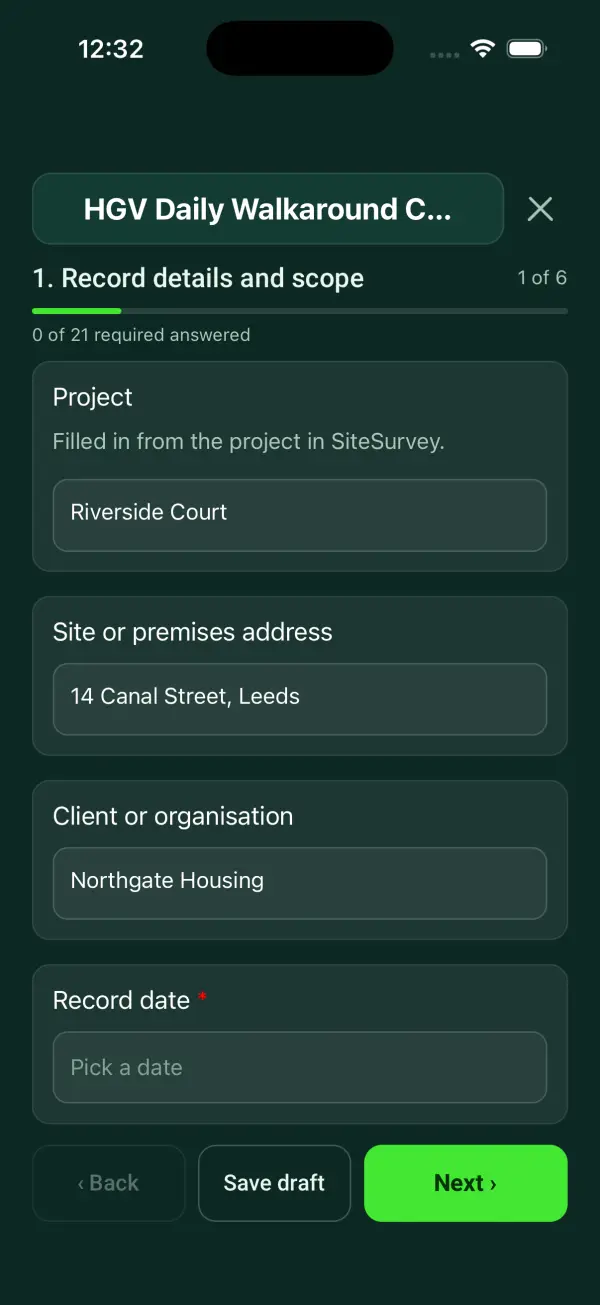
HGV daily check sheet
An HGV walkaround record covering vehicle and trailer identification, driver checks, defect reporting, restrictions and authorised rectification references.
6 sections52 questionsPhotosSignaturesSee every question → - Logistics and supply chain
Vehicle inspection checklist
A daily vehicle inspection checklist and defect report for vans and cars: walkaround checks, mileage, tyre tread, photos of each side, defects graded safe or not to drive, and fleet sign-off.
4 sections68 questionsPhotosSignaturesSee every question → - Logistics and supply chain
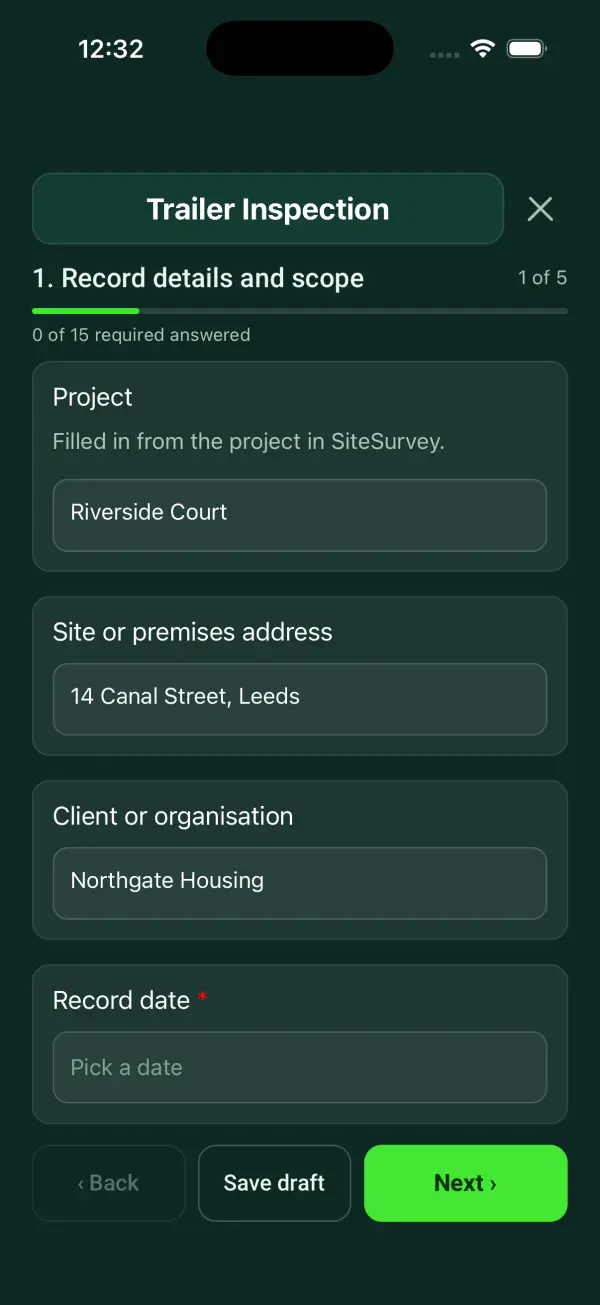
Trailer inspection checklist
A trailer walkaround record covering identification, coupling, braking connections, wheels, lights, bodywork, loading and defect reporting.
5 sections50 questionsPhotosSignaturesSee every question → - Logistics and supply chain
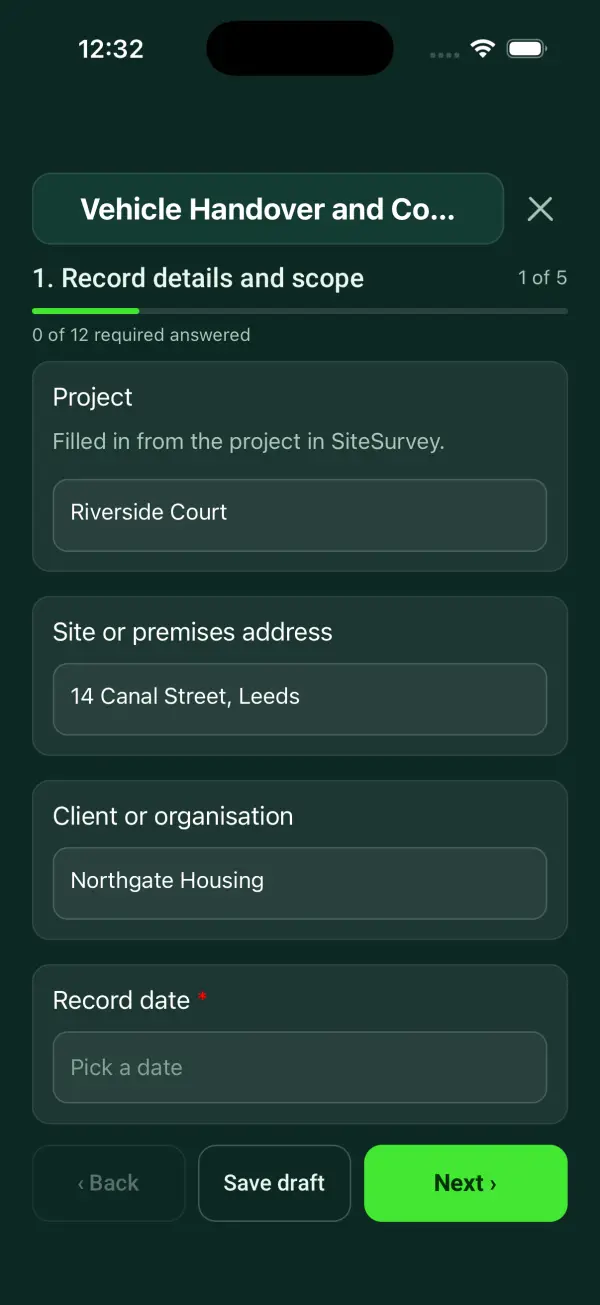
Vehicle handover form
A vehicle custody record with mileage, fuel or charge, existing damage, equipment and documents, handover terms and both parties acknowledgement.
5 sections36 questionsPhotosSignaturesSee every question → - Logistics and supply chain
Vehicle maintenance log template
A maintenance log for one vehicle: VIN or fleet number by label scan, registration and odometer, the safety inspection interval and MOT date, then every safety inspection, service, repair, MOT, tyre job and driver-reported defect with date, odometer, who did it, job reference, defects, rectification with a signed roadworthiness declaration, cost and photos. Calculates total cost, open defects, days since the last safety inspection against the interval and days overdue, plus a ten-item record review with a score.
5 sections104 questionsPhotosSignaturesSee every question → - Logistics and supply chain
Driver assessment checklist
An on-road and yard assessment of a driver who drives for work: licence categories and how they were seen, penalty points, entitlement, Driver CPC and tachograph card, eyesight at 20 metres and fitness, the vehicle and route with GPS points, then 22 observations scored 1 to 4: walkaround and cab drill, height, load, coupling, reversing with a banksman, mirrors, speed, following distance, junctions, positioning, hazards, controls, signals, distraction, parking, drivers' hours, tachograph, load moving, breakdowns and defect reporting. Total, percentage, suggested and final outcome, training needs and sign-off.
8 sections113 questionsPhotosSignaturesSee every question → - Logistics and supply chain
Journey management plan template
A journey management plan for one work journey by road: driver, vehicle, height and drivers' hours rules, the need for the journey, route stages with GPS points, times, driving minutes, breaks, hazards (low bridges against the vehicle height, weight limits, level crossings, weather, night driving) and check-ins, calculated driving time and breaks with notes against the Highway Code and drivers' hours limits, missed check-in escalation steps, twelve pre-departure checks with approval, and completion with actual times, arrival GPS, check-ins and issues.
7 sections120 questionsPhotosSignaturesSee every question →

Warehouse, racking and handling equipment 7
Warehouse safety walk rounds, racking and pallet inspections, forklift and pallet truck pre-use checks, conveyors and dock levellers.
- Logistics and supply chain
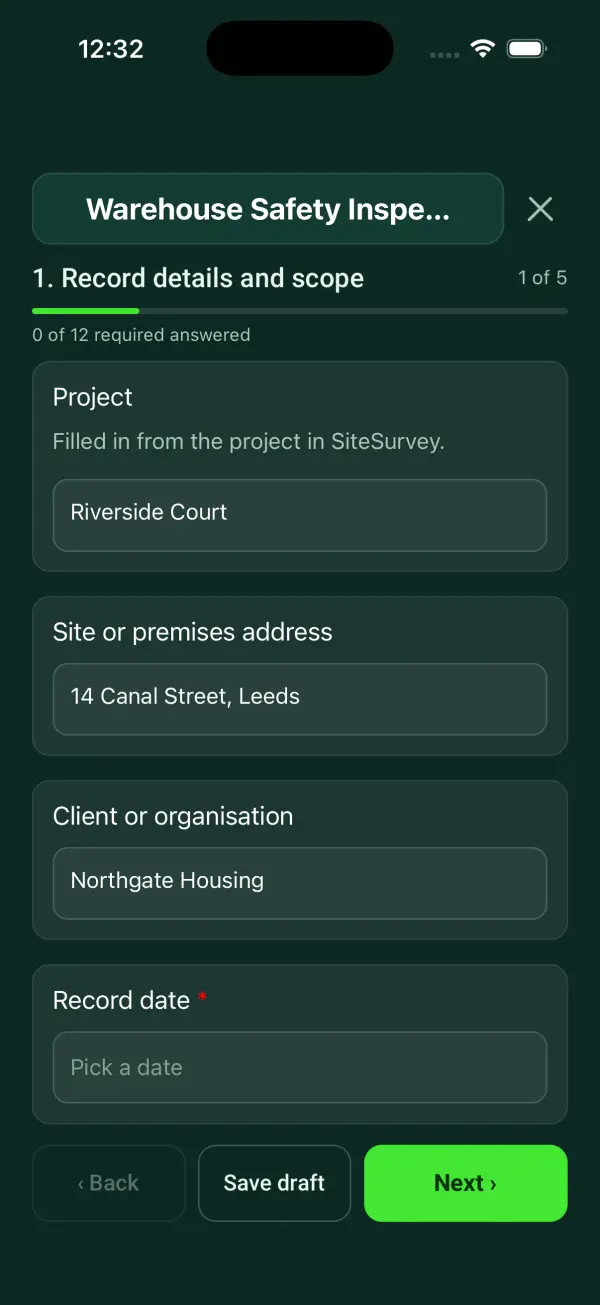
Warehouse safety checklist
A warehouse walk-through covering aisles, storage, pedestrian routes, loading areas, handling, emergency access and corrective actions.
5 sections61 questionsPhotosSignaturesSee every question → - Logistics and supply chain
Pallet racking inspection checklist
A pallet racking inspection: damage by aisle, bay and level with green, amber and red ratings, offload actions, general checks and the date of the last expert inspection.
4 sections67 questionsPhotosSignaturesSee every question → - Logistics and supply chain
Damaged pallets inspection checklist
A pallet inspection record: the stock or bay checked, each damaged pallet with its type, faults such as broken or missing boards, split blocks and protruding nails, the decision, photos, the withdrawn area and actions.
3 sections29 questionsPhotosSignaturesSee every question → - Logistics and supply chain
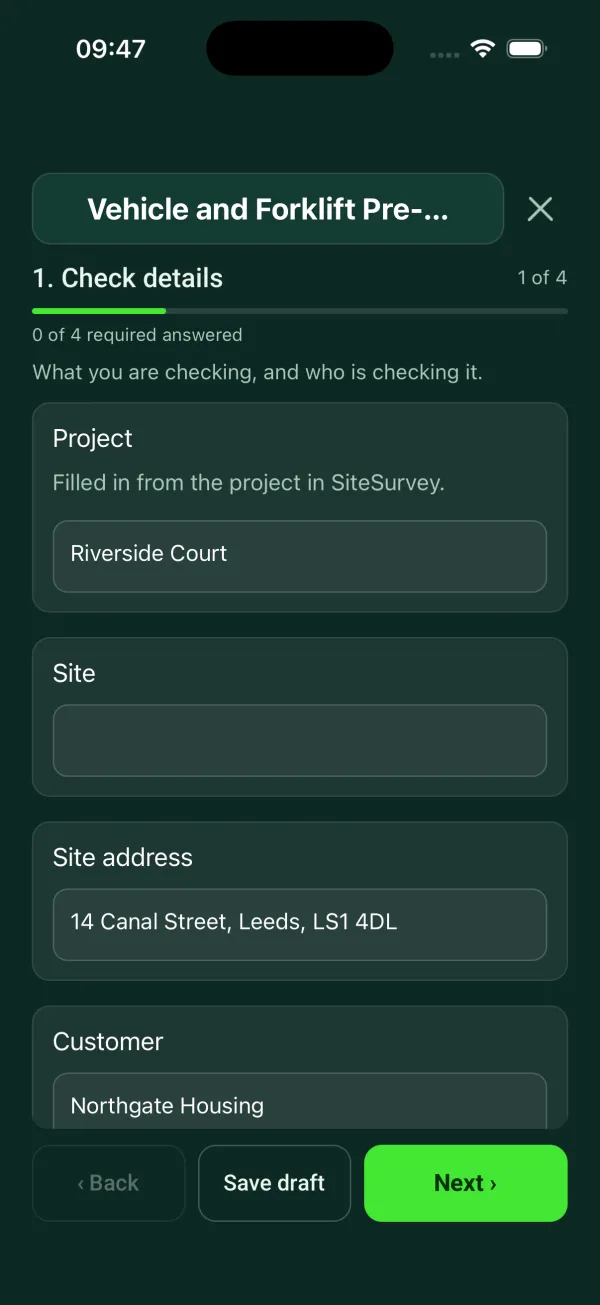
Forklift inspection checklist
Daily check before using a van, car, forklift or other mobile plant. Failed items get a photo and a note, with the result, who it was reported to and a supervisor sign-off.
6 sections71 questionsPhotosSignaturesSee every question → - Logistics and supply chain
Conveyor belt inspection checklist
A belt conveyor inspection: whether it was running or isolated, belt surface, edges, tracking and joints, rollers and drums, spillage, guards, pull cords and emergency stops, result, photos and repair actions.
3 sections54 questionsPhotosSignaturesSee every question → - Logistics and supply chain
Dock leveller and loading bay inspection
A dock leveller and loading bay inspection: each bay's leveller, lip, hydraulics, toe guards, dock shelter and door, vehicle restraint or chocks, lights and signals, bumpers, markings, result and photos.
3 sections46 questionsPhotosSignaturesSee every question → - Logistics and supply chain
Pallet truck inspection checklist
A pre-use check for a hand pallet truck or a powered pedestrian pallet truck: asset number and capacity plate by label scan, the heaviest load against the rated capacity, then named checks for the forks and tips, load and entry rollers, steering wheels, hydraulic pump and seals, lift and lowering control, handle and return spring, chassis welds and plate, battery, belly button and tiller brake on powered trucks, and the route. Result tiles, safe to use or do not use, actions and sign-off.
8 sections114 questionsPhotosSignaturesSee every question →




Stock, loading and containers 7
Stock takes and inventory control audits, purchase approvals, loading and container checks, and the checks on a consignment before it leaves.
- Logistics and supply chain
Stock take template
A stocktake record with count locations, item references, book and physical quantities, calculated variances, recounts and adjustment approval.
5 sections41 questionsPhotosSignaturesSee every question → - Logistics and supply chain
Loading unloading checklist
A loading and unloading readiness record covering vehicle position, segregation, load information, equipment, communication and controlled departure.
5 sections42 questionsPhotosSignaturesSee every question → - Logistics and supply chain
Container inspection checklist (7-point)
A 7-point container and trailer inspection: container and seal numbers, safety approval plate, undercarriage, doors, sides, front wall, roof and floor, reefer fan housing, cleanliness, accept or reject, photos and sign-off.
3 sections40 questionsPhotosSignaturesSee every question → - Logistics and supply chain
Inventory audit checklist
An inventory audit checklist for the controls behind the stock record: 20 named checks on goods in and returns, storage, rotation and quarantine, location accuracy, cycle counting, adjustment approval and system access, then sample counts by zone with the SKU from a label scan, system and counted quantity and the variance. Shows a control score with a rating, sample accuracy and the absolute variance, with actions and sign-off.
7 sections103 questionsPhotosSignaturesSee every question → - Logistics and supply chain
Procurement checklist
A procurement checklist for approving a purchase: the request, budget code and value, quotes received with price, lead time and compliance, the lowest compliant quote and the saving against budget, declarations of interest, 13 approval checks, the value against the approver's delegated limit, and the approval decision with sign-off.
6 sections102 questionsPhotosSignaturesSee every question → - Logistics and supply chain
Pre-shipment inspection report
A pre-shipment inspection report for finished, packed goods: order and supplier, the sampling plan with lot size, sample size and acceptance numbers from the buyer's plan, 12 checks on quantity, packing, shipping marks and labels with a carton label scan, 5 product checks, dimensions against the specification with measure from photo, defects graded critical, major or minor with photos, the counts against the acceptance numbers and a calculated pass, hold or fail.
7 sections115 questionsPhotosSignaturesSee every question → - Logistics and supply chain
Dispatch checklist
A dispatch checklist for one consignment: order references, pick checks, pallets with SSCC or label scan, weight, dimensions and four checks each, 12 vehicle and load checks at the bay with the registration and seal number scanned, paperwork, the release decision and the carrier handover with GPS, time and driver signature. Shows pallets, total weight and checks failed.
6 sections123 questionsPhotosSignaturesSee every question →

Smart fields
Smart fields in these logistics and supply chain forms
These forms do more than tick boxes. Pick a field type to see it on the phone, and which forms already use it. You can add any of them to a form you edit.
01 / 07
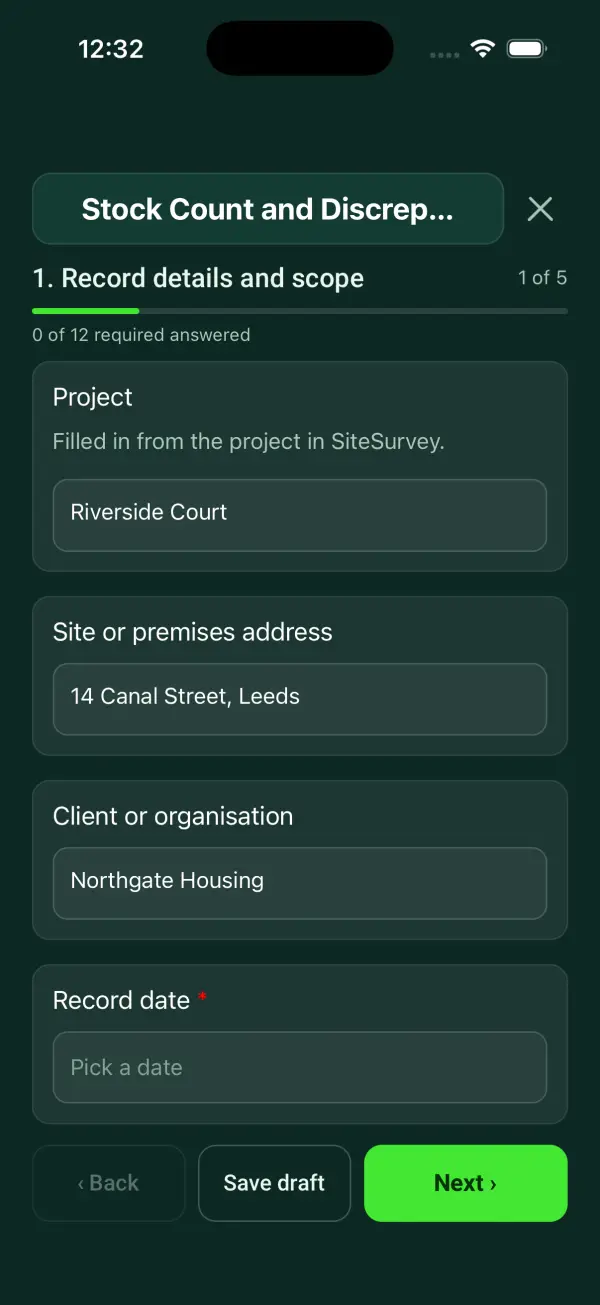
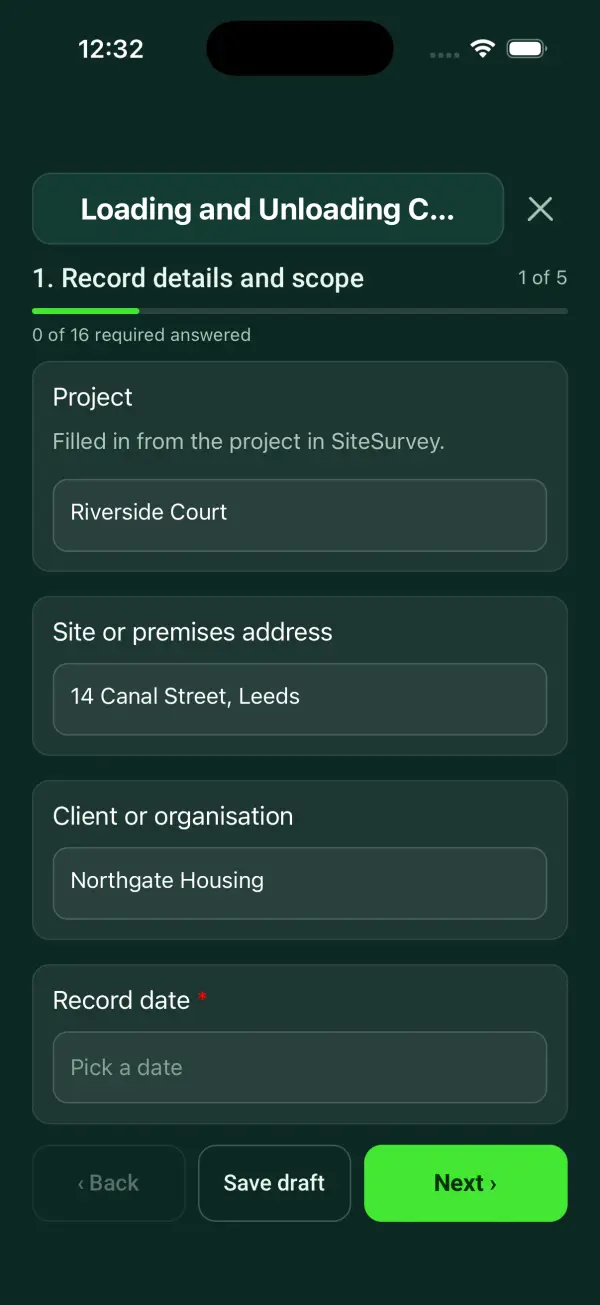
Calculated tiles
Totals, scores and pass rates work themselves out as you fill the form in, shown as live tiles.
Change an answer and the score and priority tiles update straight away.
Already in these 20 forms
- Forklift inspection checklist
- Stock take template
- Trailer inspection checklist
- Warehouse safety checklist
- HGV daily check sheet
- Loading unloading checklist
- Pallet racking inspection checklist
- Vehicle inspection checklist
- +12 more
02 / 07
GPS location
One tap fills in latitude, longitude, OS grid reference and accuracy.
One tap fills latitude, longitude, grid reference and accuracy.
Already in these 12 forms
- Warehouse safety checklist
- HGV daily check sheet
- Dock leveller and loading bay inspection
- Conveyor belt inspection checklist
- Vehicle maintenance log template
- Pallet truck inspection checklist
- Inventory audit checklist
- Journey management plan template
- +4 more
03 / 07
Label scanner
Scan equipment labels, serial numbers and barcodes straight into the form.
Point at the label, tap the barcode you want, choose the field it fills.
Already in these 9 forms
- Vehicle inspection checklist
- Container inspection checklist (7-point)
- Vehicle maintenance log template
- Pallet truck inspection checklist
- Inventory audit checklist
- Pre-shipment inspection report
- Procurement checklist
- Driver assessment checklist
- +1 more
04 / 07
Walk Cam
A guided video route: one short clip per inspection point, with live voice-to-text into the answer.
One short clip per point, with what you say typed into the answer.
Already in these 7 forms
- Warehouse safety checklist
- Vehicle handover form
- Pallet racking inspection checklist
- Dock leveller and loading bay inspection
- Damaged pallets inspection checklist
- Conveyor belt inspection checklist
- Dispatch checklist
05 / 07
Size from photo
Tap a known reference and the thing you are measuring in one photo, and the height or width fills in.
Tap the person, tap the tree, and the height goes into the answer.
Already in these 5 forms
- Warehouse safety checklist
- Pallet racking inspection checklist
- Conveyor belt inspection checklist
- Pre-shipment inspection report
- Dispatch checklist
06 / 07
Rooms as spaces
Add a room, area or item as many times as you need, and each one becomes its own space with its photos and answers.
Add Room 1, Room 2 and on. Each one is a space with its own photos and answers.
Already in this form
How rooms become spaces →07 / 07
Products and assets
Each asset you list on the form is saved as a product in its space, so the next visit starts from the same list.
Each asset is saved in its space, ready for the next visit.
Already in this form
How products and assets work →Guide
What do logistics and supply chain forms cover?
A distribution operation runs on a chain of handovers: goods arrive, are stored, picked, checked, loaded and driven to the customer. Each handover is a point where something can be missed, and each one is where a written check earns its keep. If a pallet goes out short, a vehicle breaks down or a stock adjustment cannot be explained, the record from that handover is the first thing anyone asks for.
The forms here follow that chain. In the warehouse, a warehouse safety checklist, pallet racking inspection, pallet inspection, conveyor belt inspection and dock leveller inspection. For vehicles, a forklift and vehicle inspection checklist, HGV daily check sheet, trailer inspection, vehicle inspection checklist and vehicle handover form. For goods, a stock take template, loading and unloading checklist and container inspection checklist.
Delivery notes and damage reports, which installers and removal firms use too, are in general forms.
Each form records the result of every check, keeps unresolved items visible with an owner and a due date, and ends with a decision and a signature. Fail answers are flagged as findings, so a defect or a discrepancy cannot be ticked past.
Vehicle maintenance records for goods vehicle operators
If you hold a goods vehicle operator's licence, GOV.UK is clear that you must keep your vehicles safe and in good condition at all times, and that you are still responsible for their condition when someone else maintains them. If a contractor does the work, you must give the traffic commissioner a copy of the maintenance contract.
Records must cover every safety inspection and all maintenance, whoever carries it out, and you must keep them for at least 15 months. Drivers must also do a walkaround check before driving a vehicle for the first time each day. The vehicle maintenance log keeps the inspection and service history, the defects put right and the signed declaration together; the daily check itself belongs on an HGV daily walkaround check.
- Vehicle details
- Registration or fleet number, the maintenance schedule it follows, and the odometer or hour-meter reading at each entry.
- What was inspected and by whom
- The work done, who did it, the date, and the job or invoice reference.
- Results and defects
- What was found, and whether any further work or evidence is still outstanding.
- Defects put right
- GOV.UK says records you keep yourself must include a declaration that any defects have been properly fixed.
Source: GOV.UK: being a goods vehicle operator, maintaining your vehicles.
Warehouse safety: vehicles, people and manual handling
HSE's warehousing guidance names manual handling as the main cause of reportable accidents in road freight, with back injuries the most common result. Roll cages come up often, especially when they are badly loaded, unsecured or pushed over uneven delivery surfaces.
Vehicle movements are the other big risk. HSE says they need careful management, that visiting drivers add to the risk, and that where pedestrians and vehicles must share a route they should be separated by physical barriers where reasonably practicable. Busy periods such as shift changes are when accidents are more likely.
Handling equipment needs its own checks. Forklifts, pallet trucks and racking are work equipment, so they must be kept in good repair and taken out of use when they are not safe. The pallet truck inspection checklist records the pre-use check and the do-not-use decision. For lift trucks, racking and the warehouse as a whole, use the vehicle and forklift pre-use check, pallet racking inspection and warehouse safety inspection. Machinery, electrical and plant checks are in health and safety.
Sources: HSE: warehousing and storage and regulation 5 of the Provision and Use of Work Equipment Regulations 1998 (maintenance).
Planning journeys and assessing drivers
HSE's guidance on driving for work starts with a simple question: is the journey necessary? If it is, plan a route that suits the vehicle, check for restrictions such as low bridges, and work out journey times that allow safe driving within the speed limit. Company policy should not put drivers under pressure to hit a fixed arrival time.
Fatigue gets particular attention. HSE notes that sleep-related incidents are most likely between 2am and 6am and between 2pm and 4pm, and points to the Highway Code advice of a 15-minute break every two hours. Drivers should not be pressed to travel in exceptionally difficult weather, and should be supported if they cancel a journey because of it.
Training is a legal duty: employers must give employees adequate training for health and safety, when they start and when the risks change. HSE recommends a central register showing each driver's training, needs and the vehicles they are competent to operate, reviewed when vehicles or ways of working change. The driver assessment checklist records what was assessed and the outcome; the journey management plan records route stages, check-ins and what happens if a driver misses one.
Sources: HSE: plan and manage journeys and HSE: workplace transport, initial driver training.
How to inspect a shipping container
Freight containers in international use carry a safety approval plate under the International Convention for Safe Containers (CSC), and they must be examined under an approved scheme. HSE explains that under a periodic examination scheme the first examination must be within five years of manufacture and then at intervals of no more than 30 months; under a continuous scheme the interval between examinations must also not exceed 30 months. Check the plate before you load or accept a container.
The container inspection checklist follows the familiar 7-point approach: front wall, left side, right side, floor, ceiling or roof, inside and outside of the doors (including locking bars and seal), and the outside and undercarriage. Photograph the seal number and any damage, holes or signs of tampering before the doors are closed.
Source: HSE: freight containers (safety approval plates and examination schemes).
Stock takes, loading and handover
Stock errors rarely come from one big mistake. They build up from adjustments nobody approved, receipts that do not match the order, and returns that never get booked back. The stock take template records each count against the system figure, the variance, any recount and who signed it off, so the difference is explained rather than written off.
On the dock, the loading and unloading checklist covers the vehicle, the load and the people around it before anything moves. If something arrives damaged at the other end, the delivery damage report picks up the story.
Facts checked by the SiteSurvey team, 28 October 2026.
Logistics and supply chain forms FAQs
How long must I keep vehicle maintenance records?
If you hold a goods vehicle operator's licence, GOV.UK says you must keep records of safety inspections and maintenance for at least 15 months, whether you or a contractor did the work.
Is a vehicle maintenance log the same as a daily walkaround check?
No. The walkaround check is done by the driver before driving the vehicle for the first time each day. The maintenance log is the history of inspections, servicing and repairs. Use the HGV daily walkaround check for the daily check.
Does a pallet truck need a thorough examination?
A manual pallet truck is work equipment, so it must be kept in good repair and checked before use. Thorough examination under LOLER applies to lifting equipment; ask a competent person whether your equipment is in scope. A pre-use check does not replace a repair or an examination.
How often must a shipping container be examined?
HSE explains that a container on a periodic examination scheme needs its first examination within five years of manufacture and then at intervals of no more than 30 months. Check the safety approval plate before you load it, and record it on the container inspection checklist.
What should a stock take record?
Each count against the system figure, the variance, any recount, and who approved the adjustment. The stock take template keeps those together so a difference is explained rather than written off.
Can I change these forms to match our procedures?
Yes. Every form opens in the SiteSurvey form editor, so you can rename questions, add your own criteria and remove what you do not need before you use it.
Other categories
Put these forms in your team's hands
Works on iPhone, iPad and Android, offline on site, with every completed form turned into a branded PDF report.
Start your trial →