Conveyor line and isolation
Show the whole conveyor from a safe walkway, and confirm whether it is running or isolated before any closer view.
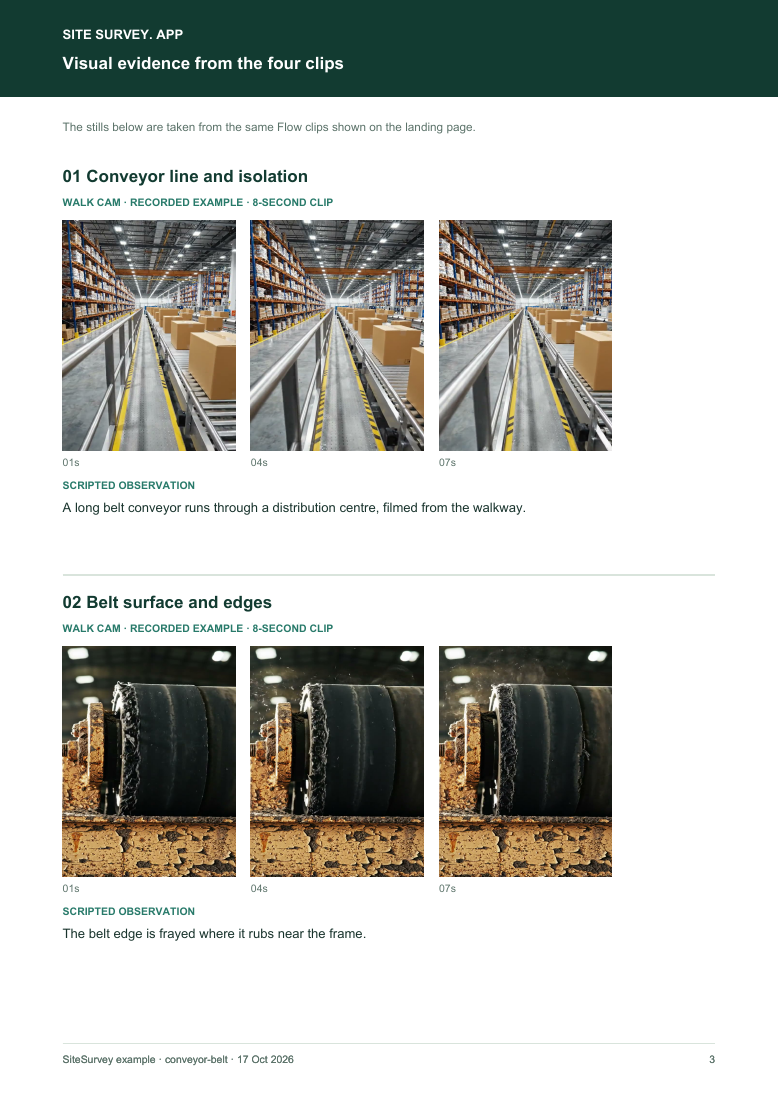
A long belt conveyor runs through a distribution centre, filmed from the walkway.
Form library · Health and safety
A condition and safety inspection of a belt conveyor. Record the conveyor and whether it was running and checked from the walkway, or stopped and isolated with a personal lock. Then check walkways, the belt surface and edges for damage, tracking, the belt joint, rollers and idlers, head and tail drums, spillage, fixed guards, pull cords, emergency stops and the isolation point, each with what is wrong. The form warns on a guard, emergency stop or pull cord defect, takes photos from outside the guards, ends with an optional Walk Cam route, and records the overall result and actions. Every question is listed below, and you can fill the live form in on this page.
Ready to use from the form library, and every question is yours to edit. Trial from £1, cancel any time.
Try it on your phone
Try it on this phone
Fill in the conveyor belt inspection on your phone now
See how the conveyor belt inspection looks on your phone
Scan the code with your phone camera. It opens the real form, no sign-up needed.
Open the live example and fill it in, just as your team would on site. No sign-up needed.
See it on this phoneEvery question is editable. Add this form to your account, then change the wording, add or remove questions and options, and make it fit your own jobs.
Check the belt surface and edges for cuts, tears and fraying, that the belt tracks centrally, the joint, rollers and drums, spillage under the belt, and that fixed guards, pull cords and emergency stops are in place and work. PUWER regulation 11 requires measures to prevent access to dangerous parts of machinery, with fixed guards where practicable, kept in good repair. HSE advises that conveyors are only cleaned or maintained when properly isolated and locked off with a personal lock.
Last updated . Facts checked by the SiteSurvey team on 17 October 2026 against regulation 11 of the Provision and Use of Work Equipment Regulations 1998 (dangerous parts of machinery), regulation 16 of the Provision and Use of Work Equipment Regulations 1998 (emergency stop controls), HSE: inspection of work equipment (PUWER regulation 6) and HSE: quarries hard target, guarding of conveyors and fixed plant.
Answer a few questions and watch it adapt. Your answers are not saved, and any photos you add are deleted within the hour.
Open the completed example to see fictional readings, notes, photos and calculations. Choose Blank form to try entering your own answers.
Want to see one filled in? See a completed conveyor belt inspection report (PDF), made by SiteSurvey from a fictional site visit.
Walk Cam route · four guided clips
Walk the conveyor from the walkway, then film the belt, rollers, spillage and guards without reaching in or removing anything.
Record the line, section, date and whether it was running or isolated. Film from outside the guards. The four AI-generated clips illustrate one route, not a real site.
Show the whole conveyor from a safe walkway, and confirm whether it is running or isolated before any closer view.
A long belt conveyor runs through a distribution centre, filmed from the walkway.
Film the belt surface and edges for cuts, fraying and tracking off centre, from outside the guards.
The belt edge is frayed where it rubs near the frame.
Show the rollers and the floor beneath for seized rollers, build-up and spillage.
Debris has built up on the floor under the conveyor rollers.
Film the guards, pull cord and emergency stop buttons in place. Do not remove a guard for the camera.
A yellow mesh guard and a red emergency stop button are in place.
A fictional six-page example with the four points, twelve stills from the clips, observations, follow-up actions and the limits of a visual record.
View the visual evidence (PDF) ↗ · Download the full sample report

Video records visible condition. It does not check belt tension, bearing temperature or that guards and stops work, and hands-on checks only happen when the conveyor is isolated and locked off. Example footage was generated in Google Flow and the observations are scripted; no real site is shown. Walk Cam works inside any form in the app. How Walk Cam works · All visual inspections
A belt conveyor inspection: whether it was running or isolated, belt surface, edges, tracking and joints, rollers and drums, spillage, guards, pull cords and emergency stops, result, photos and repair actions. 3 sections and 55 questions. Follow-up questions and guidance appear only when an answer calls for them, so the person on site never sees the ones that do not apply.
This is a starting point, not a fixed form. Once it is in your SiteSurvey account you can reword any question, add or remove questions, sections and answer options, and add your own logo, so it fits the way your team works and the jobs you do.
Add this form to a project in SiteSurvey and it fills in what the project already knows, so nobody on site retypes it and every form on the job uses the same names. Anything filled in can still be changed.
Optional. Mark the head end or the point you inspected from, so a site with several conveyors has a clear record.
Optional. With the belt stopped and isolated, measure along the belt from a photo using a known length in the same plane, such as the belt width, or use a tape.
Optional. Film the four guided points on the SiteSurvey app; each clip keeps its spoken note.
PUWER 1998 regulation 6 requires inspection at suitable intervals where the conveyor is exposed to conditions causing deterioration. The interval is set by the duty holder from the risk assessment and the manufacturer instructions.
A routine condition and guarding check. It is not a design review, a guarding conformity assessment or a substitute for the manufacturer's maintenance schedule.
Defects found and isolation used
Say whether the conveyor was running or isolated, and with which lock. Describe each defect by its position on the conveyor so it can be found again.
Stopped and locked off at the head end isolator. Belt edge frayed over about 2 m near roller 18 and return roller 22 seized.
Fictional example of record wording. Use the actual evidence and approved arrangements for your job; this is not a completed report or an instruction to carry out the work.
A completed conveyor belt inspection report, made by SiteSurvey from a fictional site visit: every answer, the photos, the guidance that applied and the sign-off, ready to send as a PDF.
No. HSE advises, in its quarries guidance, that pull wires are not an alternative to fixed guards but additional protection, and that they must extend to the head and tail end and work whichever direction they are pulled.
Only from the walkway and outside the guards. HSE advises that cleaning and maintenance of conveyors must only be done when the conveyor is properly isolated and the isolator locked with a personal lock and key. The form records which way the inspection was done and the lock used.
PUWER regulation 6 requires inspection at suitable intervals where equipment is exposed to deterioration that could cause danger. HSE says the frequency should be set by risk assessment, taking account of the manufacturer's recommendations, and that the result should be recorded and kept at least until the next inspection.
PUWER regulation 16 requires one or more readily accessible emergency stop controls where appropriate. The form warns when a stop or pull cord is faulty so it is reported before the conveyor is used.
An optional step on the SiteSurvey app: four short guided clips of the conveyor line and isolation, the belt surface and edges, rollers and spillage, and guards and emergency stops, each with a spoken note. None needs a guard removed.
Maintenance engineers, distribution and fulfilment centres, manufacturers, quarries, recycling sites and food factories.
Related templates
A machine guarding record covering guard identity, visible condition, approved interlock checks, access risks, defects and restrictions on machine use.
An isolation record linking equipment, energy sources, isolation points, locks, verification evidence, handovers and authorised restoration of service.
A PUWER assessment record covering intended use, equipment hazards, safeguarding evidence, maintenance arrangements, competence and risk-control decisions.
Add it from the form library in one click, change any question, and every completed form becomes a branded PDF report.
Start your trial →