Form library · Health and safety
Forklift inspection checklist
A daily pre-use check for vans, cars, forklifts and other mobile plant such as telehandlers and MEWPs. The questions change with the machine: a walkaround for vehicles, and forks, mast, hydraulics and the thorough examination for lift trucks, then defects with photos, a result and sign-off. Every question is listed below, and you can fill the live form in on this page.
Ready to use from the form library, and editable. Trial from £1, cancel any time.
What should a forklift daily check include?
A forklift daily check should cover the forks and carriage, the mast and lifting chains, hydraulic leaks, tyres and wheels, the service and parking brakes, steering, horn, lights and beacon, the seatbelt, the overhead guard, the controls and the rated capacity plate, plus the battery, LPG or fuel. HSE guidance is that lift trucks may need daily checks before use, as well as the formal thorough examination.
Last updated . Facts checked on 30 September 2026 against regulation 9 of the Provision and Use of Work Equipment Regulations 1998, regulation 9 of the Lifting Operations and Lifting Equipment Regulations 1998, HSE on thorough examination of lift trucks and GOV.UK van drivers' daily walkaround check.
Try the forklift and vehicle check form live
Answer a few questions and watch it adapt. Your answers are not saved, and any photos you add are deleted within the hour.
This is the real form as your team would use it: questions appear as you answer, scores work themselves out and you can add photos and signatures. No sign-up needed.
Fill it in on a phone or tablet
Your team completes the vehicle and forklift pre-use check on site in the SiteSurvey app on iPhone, iPad and Android phones and tablets. The project name and address fill in for them, it works without signal, and it syncs when the device is back online with photos kept against the question they answer.
Customers and subcontractors do not need the app: send them a link and they can fill it in from any browser.
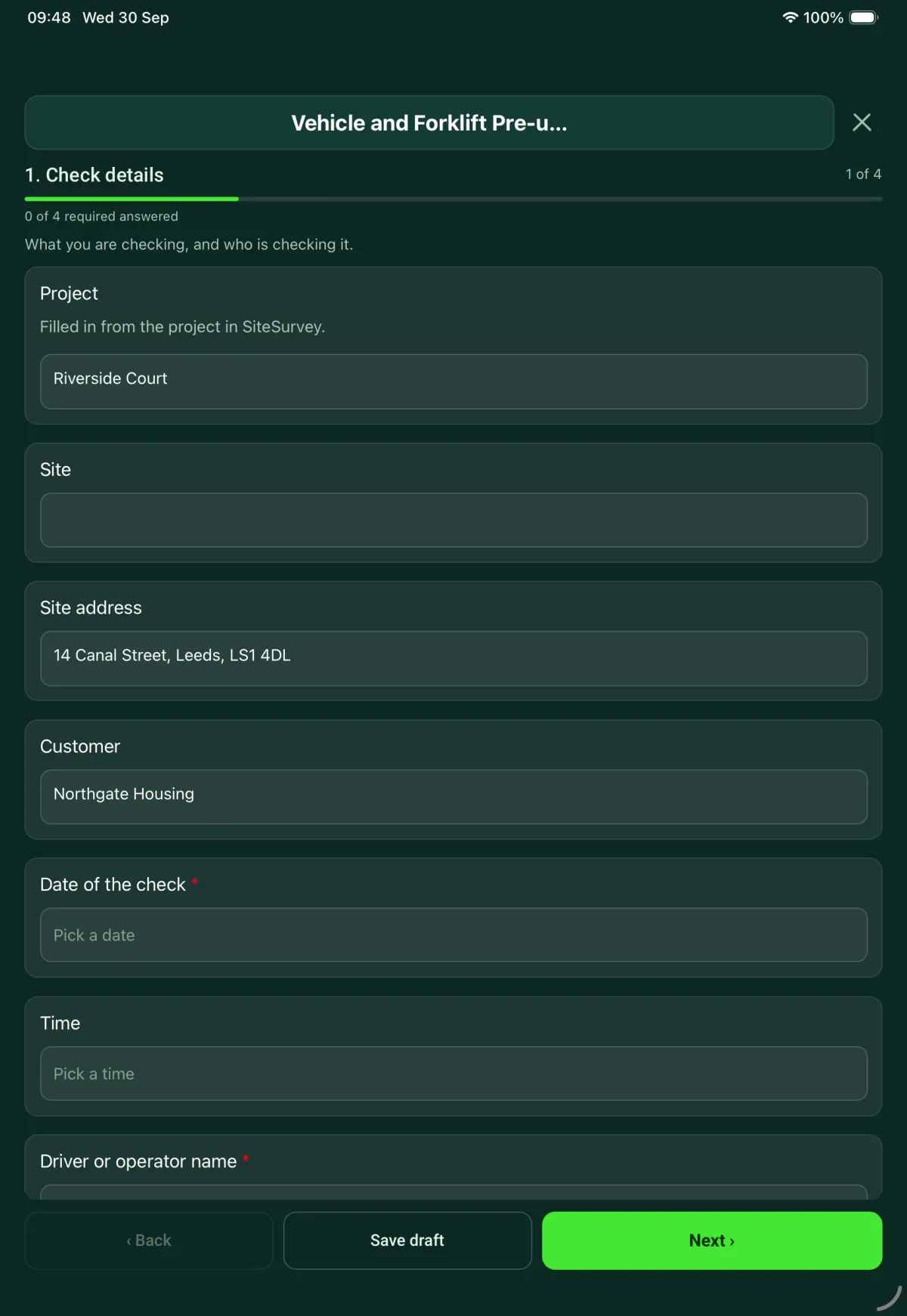
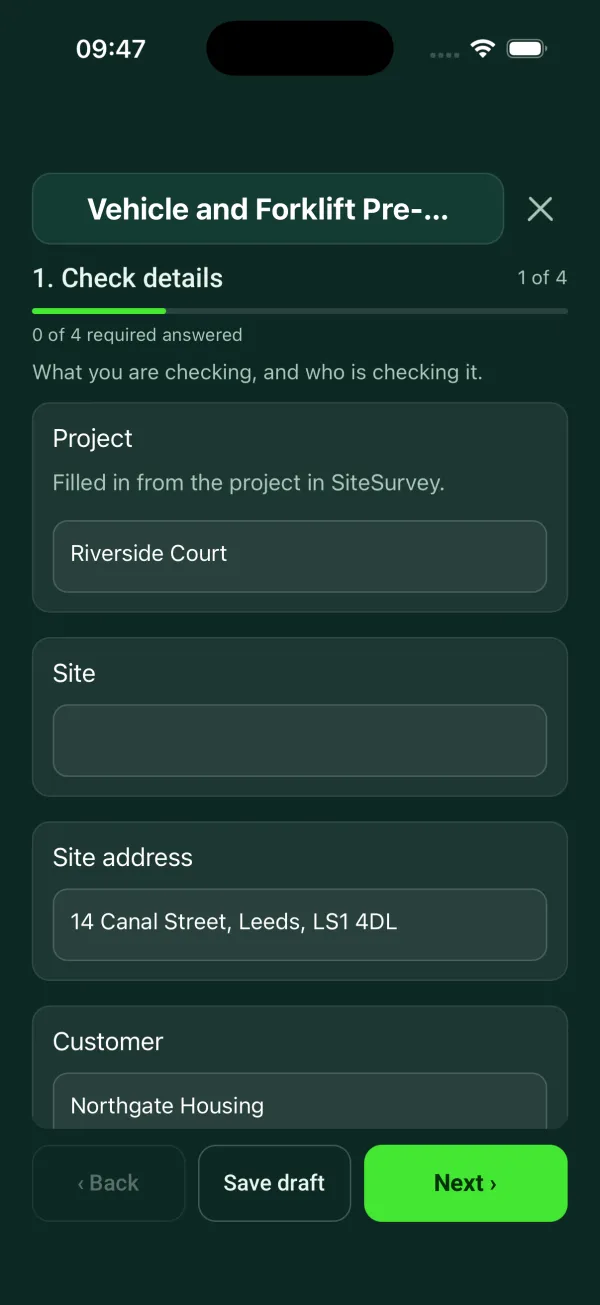
Every question in the forklift and vehicle check template
Daily check before using a van, car, forklift or other mobile plant. Failed items get a photo and a note, with the result, who it was reported to and a supervisor sign-off. 6 sections and 71 questions. Follow-up questions and guidance appear only when an answer calls for them, so the person on site never sees the ones that do not apply.
Details you only enter once
Add this form to a project in SiteSurvey and it fills in what the project already knows, so nobody on site retypes it and every form on the job uses the same names. Anything filled in can still be changed.
- Project: the project name
- Site: the site, when the form is opened for a space or a product
- Site address: the site address, from the space or the project
- Customer: the project's customer
- Vehicle or machine: the product it is opened for
- Manufacturer: the product's manufacturer
- Model: the product's model
Check details
What you are checking, and who is checking it.
- ProjectShort answerFills in from the project name
- SiteShort answerFills in from the site, when the form is opened for a space or a product
- Site addressShort answerFills in from the site address, from the space or the project
- CustomerShort answerFills in from the project's customer
- Date of the check*Date
- TimeTime
- Driver or operator name*Short answer
- What are you checking?*Choose one
- Van or car
- Forklift or lift truck
- Other mobile plant such as a telehandler or MEWP
- Vehicle or machineShort answerFills in from the product it is opened for
- ManufacturerShort answerFills in from the product's manufacturer
- ModelShort answerFills in from the product's model
- Registration numberShort answerShown when “What are you checking?” is “Van or car”
- Odometer reading (miles)NumberShown when “What are you checking?” is “Van or car”
- Type of plantChoose one
- Telehandler
- Mobile elevating work platform (MEWP)
- Dumper
- Excavator
- Other (describe)
Shown when “What are you checking?” is “Other mobile plant such as a telehandler or MEWP” - Fleet or serial numberShort answerShown only when the answers above make it relevant
- Hours meter readingNumberShown only when the answers above make it relevant
- Power sourceChoose one
- Battery electric
- LPG
- Diesel or petrol
Shown only when the answers above make it relevant - Does it lift loads or people?Yes or NoShown when “What are you checking?” is “Other mobile plant such as a telehandler or MEWP”
- Is it used to lift people?Yes or NoShown only when the answers above make it relevant
- Are you trained on this type of truck or machine and authorised by your employer to use it?Yes or NoShown only when the answers above make it relevant
- WarningDo not operate it. Employers must make sure everyone who uses work equipment has had adequate training (regulation 9 of the Provision and Use of Work Equipment Regulations 1998). HSE guidance is that nobody should operate a lift truck without written authorisation from their employer, except a trainee under close supervision.Shown only when the answers above make it relevant
Vehicle checks
Walk round the vehicle, then check inside with the engine running.
- GuidanceBefore you drive. GOV.UK guidance says the driver is responsible for making sure the vehicle is safe to drive, and should carry out a walkaround check before the journey. Report any defect in writing.
- Lights, indicators, reflectors and number platesChoose one
- Pass
- Fail
- Tyre tread depthChoose one
- Pass
- Fail
- WarningTread depth. The Highway Code says cars, light vans and light trailers must have at least 1.6 mm of tread across the central three-quarters of the tread and around the whole circumference. Large vehicles must have at least 1 mm across three-quarters of the tread. Do not drive on a tyre below the limit.Shown only when the answers above make it relevant
- Tyres free from cuts, bulges and damage, and pressures look rightChoose one
- Pass
- Fail
- Mirrors in place, not cracked and adjustedChoose one
- Pass
- Fail
- Windscreen clear of cracks in your view, and wipers workingChoose one
- Pass
- Fail
- Washer fluid topped up and washers workingChoose one
- Pass
- Fail
- Brakes, including the parking brakeChoose one
- Pass
- Fail
- WarningDo not drive this vehicle. A brake fault is a dangerous defect. Report it now and get it fixed before the vehicle is used.Shown only when the answers above make it relevant
- SteeringChoose one
- Pass
- Fail
- HornChoose one
- Pass
- Fail
- SeatbeltsChoose one
- Pass
- Fail
- No fuel, oil, coolant or other fluid leaks under the vehicleChoose one
- Pass
- Fail
- Bodywork free from new damage and sharp edgesChoose one
- Pass
- Fail
- No warning lights on the dashboard once the engine is runningChoose one
- Pass
- Fail
- CheckThe Highway Code says to understand every warning display on the instrument panel and not to ignore it. Check the handbook and report it before you set off.Shown only when the answers above make it relevant
- Load secureChoose one
- Pass
- Fail
- Not applicable
- First aid kit and fire extinguisher present and in dateChoose one
- Pass
- Fail
- Not applicable
Truck or plant checks
Walk round with the machine parked and lowered, then test the controls.
- GuidanceDaily checks. HSE guidance says lift trucks may need checks on a daily basis before use, as well as the formal thorough examination. Check with the engine off and the forks or platform lowered, then test the controls.
- Forks, carriage or attachmentChoose one
- Pass
- Fail
- WarningDo not lift with it. Cracked or bent forks can fail under load. Take the machine out of use and report it.Shown only when the answers above make it relevant
- Mast, boom or lifting arm, and lifting chainsChoose one
- Pass
- Fail
- No hydraulic leaks from hoses, rams or fittingsChoose one
- Pass
- Fail
- Tyres and wheelsChoose one
- Pass
- Fail
- Service brake and parking brakeChoose one
- Pass
- Fail
- WarningDo not use this machine. A brake fault is a dangerous defect. Park it safely, remove the key and report it.Shown only when the answers above make it relevant
- SteeringChoose one
- Pass
- Fail
- Horn, lights and beaconChoose one
- Pass
- Fail
- Seatbelt or operator restraintChoose one
- Pass
- Fail
- Overhead guard and cab free from damageChoose one
- Pass
- Fail
- All controls work and return to neutralChoose one
- Pass
- Fail
- Rated capacity plate in place and readableChoose one
- Pass
- Fail
- Battery charged, connector and cables undamaged, no leaksChoose one
- Pass
- Fail
Shown when “Power source” is “Battery electric” - LPG cylinder secure, valve and hose undamaged, no smell of gasChoose one
- Pass
- Fail
Shown when “Power source” is “LPG” - WarningSmell of gas or a damaged cylinder. Close the cylinder valve if it is safe to do so, keep ignition sources away and report it. Do not start the machine.Shown only when the answers above make it relevant
- Fuel level and no fuel leaksChoose one
- Pass
- Fail
Shown when “Power source” is “Diesel or petrol” - Platform guardrails, gate and harness anchor pointsChoose one
- Pass
- Fail
Shown when “Is it used to lift people?” is Yes - GuidanceThorough examination. Under regulation 9 of the Lifting Operations and Lifting Equipment Regulations 1998, lifting equipment for lifting people must be thoroughly examined at least every 6 months, and other lifting equipment at least every 12 months, unless it is examined under a written examination scheme. The report must give the latest date for the next examination.Shown only when the answers above make it relevant
- Have you seen the current thorough examination report or certificate?Yes or NoShown only when the answers above make it relevant
- Date of the last thorough examinationDateShown only when the answers above make it relevant
- Next examination due byDateShown only when the answers above make it relevant
- WarningThorough examination overdue. The date on the report for the next thorough examination has passed. Do not use it for lifting until it has been examined, and tell your supervisor.Shown only when the answers above make it relevant
- CheckAsk your supervisor to confirm the thorough examination is in date before you lift with it.Shown only when the answers above make it relevant
Defects
Every failed item, with a photo.
- Items failedWorked out by the form
- WarningAt least one item failed. Add each defect below with a photo and a note.Shown only when the answers above make it relevant
- GuidanceNo items failed.Shown only when the answers above make it relevant
- Is there anything else wrong that is not on the checklist?Yes or No
- DefectsRepeat for each defect. Each one asks:Shown only when the answers above make it relevant
- Which item?Choose one
- Lights, indicators, reflectors and number plates
- Tyre tread depth
- Tyres free from cuts, bulges and damage, and pressures look right
- Mirrors in place, not cracked and adjusted
- Windscreen clear of cracks in your view, and wipers working
- Washer fluid topped up and washers working
- Brakes, including the parking brake
- Steering
- Horn
- Seatbelts
- No fuel, oil, coolant or other fluid leaks under the vehicle
- Bodywork free from new damage and sharp edges
- No warning lights on the dashboard once the engine is running
- Load secure
- First aid kit and fire extinguisher present and in date
- Forks, carriage or attachment
- Mast, boom or lifting arm, and lifting chains
- No hydraulic leaks from hoses, rams or fittings
- Tyres and wheels
- Service brake and parking brake
- Steering
- Horn, lights and beacon
- Seatbelt or operator restraint
- Overhead guard and cab free from damage
- All controls work and return to neutral
- Rated capacity plate in place and readable
- Battery charged, connector and cables undamaged, no leaks
- LPG cylinder secure, valve and hose undamaged, no smell of gas
- Fuel level and no fuel leaks
- Platform guardrails, gate and harness anchor points
- Other (describe)
- What is wrong?Notes
- Photos of the defectPhotos
- How serious is it?Choose one
- Dangerous, do not use
- Can be used with a restriction
- Minor, report for repair
- WarningTake it out of use and report it now. Record what you did on the next page.Shown when “How serious is it?” is “Dangerous, do not use”
Result
Can it be used today?
- Result of the check*Choose one
- Safe to use
- Use with restriction
- NOT safe to use
- WarningYou have recorded it as safe to use, but a brake fault or a dangerous defect was recorded. Check the defects or change the result.Shown only when the answers above make it relevant
- CheckYou have recorded it as safe to use with items failed. Make sure each defect is minor and has been reported.Shown only when the answers above make it relevant
- WarningThe thorough examination is overdue. It should not be used for lifting.Shown only when the answers above make it relevant
- What is the restriction?NotesShown when “Result of the check” is “Use with restriction”
- WarningTake it out of use. Guidance from HSE for lifting equipment, and from GOV.UK for commercial vehicles, is that equipment with a dangerous defect must not be used until the defect is put right.Shown when “Result of the check” is “NOT safe to use”
- What have you done to stop it being used?Tick all that apply
- Parked in a safe place
- Key removed
- Out of use sign or tag fitted
- Battery isolated or LPG valve closed
- Other (describe)
Shown when “Result of the check” is “NOT safe to use” - Who has the key?Short answerShown when “Result of the check” is “NOT safe to use” and “What have you done to stop it being used?” includes “Key removed”
- Reported toShort answerShown only when the answers above make it relevant
- Time reportedTimeShown only when the answers above make it relevant
Sign-off
- GuidanceBy signing you confirm you carried out the checks on this page before use, and reported every defect found.
- Driver or operator signatureSignature
- Has a supervisor seen the defects?Yes or NoShown only when the answers above make it relevant
- Supervisor nameShort answerShown when “Has a supervisor seen the defects?” is Yes
- Action taken or arrangedNotesShown when “Has a supervisor seen the defects?” is Yes
- Repair due byDateShown when “Has a supervisor seen the defects?” is Yes
- Supervisor signatureSignatureShown when “Has a supervisor seen the defects?” is Yes
- CheckTell a supervisor about the defects before the end of your shift.Shown when “Has a supervisor seen the defects?” is No
Forklift and vehicle check template questions
How often does a forklift need a thorough examination?
Under regulation 9 of the Lifting Operations and Lifting Equipment Regulations 1998, lifting equipment for lifting people must be thoroughly examined at least every 6 months, and other lifting equipment at least every 12 months, unless it is examined under a written examination scheme. The report must give the latest date for the next examination. The form asks whether you have seen the current report, records the dates and flags an examination that is overdue.
Who is allowed to operate a forklift?
Employers must make sure everyone who uses work equipment has had adequate training, under regulation 9 of the Provision and Use of Work Equipment Regulations 1998. HSE guidance is that nobody should operate a lift truck without written authorisation from their employer, except a trainee under close supervision. The form asks the operator to confirm they are trained and authorised, and tells them not to operate it if they are not.
What does the daily vehicle inspection checklist cover?
For a van or car it checks lights and number plates, tyre tread and condition, mirrors, the windscreen and wipers, washers, brakes, steering, horn, seatbelts, fluid leaks, bodywork, dashboard warning lights, the load, and the first aid kit and fire extinguisher. GOV.UK guidance says the driver is responsible for making sure the vehicle is safe to drive, should carry out a walkaround check before the journey and should report any defect in writing.
What is the minimum tyre tread depth?
The Highway Code says cars, light vans and light trailers must have at least 1.6 mm of tread across the central three-quarters of the tread and around the whole circumference. Large vehicles must have at least 1 mm across three-quarters of the tread. A failed tread check on the form shows this note and the item goes on the defect list.
What happens when an item fails?
Each failed item goes on the defect list with what is wrong, photos and how serious it is. The result is safe to use, use with a restriction, or not safe to use. Not safe asks what was done to stop it being used, such as removing the key or fitting an out of use tag, and who it was reported to. The form flags a result of safe to use when a brake fault or other dangerous defect was recorded.
Can the driver and supervisor sign it on the device?
Yes. The driver or operator signs to confirm the checks were done and every defect reported, and a supervisor who has seen the defects records the action and a repair date and signs too. In the SiteSurvey app the check works offline, and the vehicle or machine fills in automatically when the check is opened for a product. The report goes out as a PDF or a share link.
Related
Related templates
Templates that go with the forklift and vehicle check form
Inspection round for plant: asset condition, refrigerant and leak checks, pressure vessels, next due dates.
Hazards, who might be harmed, controls and risk scores, with a briefing record and review date.
Record an accident, injury, near miss, dangerous occurrence, ill health or damage, with people involved, witness statements, RIDDOR checks, investigation and actions.
Construction site safety walk: perimeter, work at height, welfare, housekeeping, plant, hazards and actions.
Use this forklift and vehicle check form with your team
Add it from the form library in one click, change any question, and every completed form becomes a branded PDF report.
Start your trial →