Hazards and control measures
Vehicle and mobile plant hazards and control measures
The hazards of vehicles and mobile plant on sites and in workplaces, who gets hurt and how, and the controls HSE expects: people and vehicles kept apart, reversing avoided or controlled, plant checked daily, drivers trained and authorised. With a worked example from a completed RAMS.
What are the main hazards from vehicles and mobile plant at work?
The main hazards are people being knocked down, run over or crushed by a moving vehicle, most often one that is reversing, and people falling while getting on or off vehicles or loading them. Being struck by a moving vehicle killed 24 of the 126 workers who died at work in Great Britain in 2025/26. The controls are to keep people and vehicles apart, avoid reversing where you can, keep vehicles maintained and fitted with reversing aids, and use only trained, supervised drivers.
Last updated . Facts checked by the SiteSurvey team on 24 October 2026 against HSE: Introduction to workplace transport safety, HSE: Separating pedestrians and vehicles, HSE: Work-related fatal injuries in Great Britain and Construction (Design and Management) Regulations 2015, regulation 27.
What counts as a vehicle hazard
HSE calls this workplace transport: any vehicle or piece of mobile equipment used at work, from HGVs, lift trucks and tractors to plant and trailers, and the loading, unloading and climbing on and off that goes with them. On a building site it is the excavator, the dumper, the telehandler and the delivery lorry. In a warehouse it is the forklift and the delivery van at the dock. At an event it is the trucks and lifts on the build, and for a grounds team it is the ride-on mower and the tractor.
The hazard is the same everywhere: a heavy machine and a person in the same space, with the driver unable to see them. Reversing is the classic case, because the view behind a vehicle is often poor and loads block the line of sight. Excavators slew into people standing in the swing radius. Plant runs into open trenches, which is where this page meets excavation hazards. Drivers and loaders also fall from cabs, trailer beds and loads.
Who is harmed, and how
HSE's fatal injury figures put being struck by a moving vehicle second only to falls from height. In 2025/26, 24 of the 126 workers killed in Great Britain were struck by a moving vehicle, and those figures are provisional. HSE's examples of workplace transport accidents include a maintenance engineer struck by a reversing dumper and people crushed against fixed parts by a vehicle.
The people hurt are mostly on foot: the labourer walking behind the dumper, the banksman standing where the driver cannot see them, the warehouse worker stepping out between racking into an aisle, the visitor who does not know the site rules. Members of the public are at risk wherever site traffic meets a pavement or a shared drive, which is why the worked example on this page keeps the family off the drive whenever the dumper is moving.
What the law expects
On construction work, regulation 27 of the Construction (Design and Management) Regulations 2015 says the site must be organised so pedestrians and vehicles can move around safely. Routes must be suitable and big enough, vehicles and pedestrians separated, and where separation is not reasonably practicable people must be protected and warned of an approaching vehicle. Every loading bay needs at least one exit for pedestrians only. Outside construction, regulation 17 of the Workplace Regulations 1992 sets the same aim. HSE groups the controls into a safe site, a safe vehicle and a safe driver.
In hierarchy order, first design the risk out: separate routes or pavements for pedestrians, one-way systems so vehicles do not have to reverse, and pedestrians kept away from where vehicles work unless they need to be there. Then guard it: barriers at entrances and corners, marked crossings, good lighting, and reversing aids such as cameras on the vehicle. Then control it: where reversing cannot be avoided, a system to manage it, plant checked daily, and drivers trained, authorised and supervised, including visiting drivers. High visibility clothing comes last. In SiteSurvey, the RAMS template records the controls for each hazard and warns when only PPE is ticked, and the Suggested controls list follows the same order.
Suggested controls
Vehicles and mobile plant: control measures, most effective first
These are the 6 controls the SiteSurvey RAMS and risk assessment forms offer for this hazard as a tick list, grouped by their level in the hierarchy of controls. They are a starting point from HSE guidance, not an assessment of your job: tick what applies and say how it works on your site. If only personal protective equipment is ticked, the form says so. How suggested controls work and the hierarchy of controls explained.
Keep people away from the hazard with a physical measure: a guardrail, a barrier, extraction, isolation.
- Pedestrians and vehicles kept apart with fenced routes and crossings
- Plant with working alarms, mirrors or cameras, checked daily
Change the way the work is done: a permit, a check, training, supervision, timing.
- Banksman for every reversing or blind movement
- Drivers trained and authorised for the plant they use
- Speed limits and one-way routes agreed and signed
Protect the person as the last line: a harness, hard hat, gloves or respirator. Never the only control.
- High visibility clothing worn by everyone on site
Offered to: Construction and building work, Roofing, scaffolding and work at height, Facilities, cleaning and maintenance, Events, exhibitions and staging, Grounds, landscaping and tree work.
Try it
Build the controls for vehicles and mobile plant
Tick the controls you would put in place, see which levels of the hierarchy they reach, and score the risk before and after. Or fill in the example from a completed RAMS to see how one crew did it.
Interactive
Try it: vehicles and mobile plant
Works the same way as the RAMS form. Nothing you tick is saved or sent anywhere.
Your controls, by level
- Eliminateno control at this level for this hazard
- Substituteno control at this level for this hazard
- Engineeringnot ticked
- Adminnot ticked
- PPEnot ticked
Nothing ticked yet.
3. Score the risk with these controls
What the law says
- Construction (Design and Management) Regulations 2015, regulation 27
- Construction sites organised so pedestrians and vehicles move safely: suitable routes, vehicles and pedestrians separated or pedestrians protected and warned, a pedestrian exit from loading bays, routes signed, checked and kept clear.
- Workplace (Health, Safety and Welfare) Regulations 1992, regulation 17
- Other workplaces organised so pedestrians and vehicles circulate safely, with suitable routes, vehicles kept apart from doors and pedestrian routes, and routes marked where needed.
- Management of Health and Safety at Work Regulations 1999, regulation 3
- The suitable and sufficient risk assessment that identifies the vehicles, the people at risk and the controls.
Worked example
Vehicles and mobile plant in a completed RAMS
The hazard entry exactly as it was recorded in one of our completed example RAMS: the controls ticked from the list, how they apply on that job, and the score before and after the further action.
Construction and building work
22 Wonford Mead, Exeter: extension foundations and drainage
- Hazard
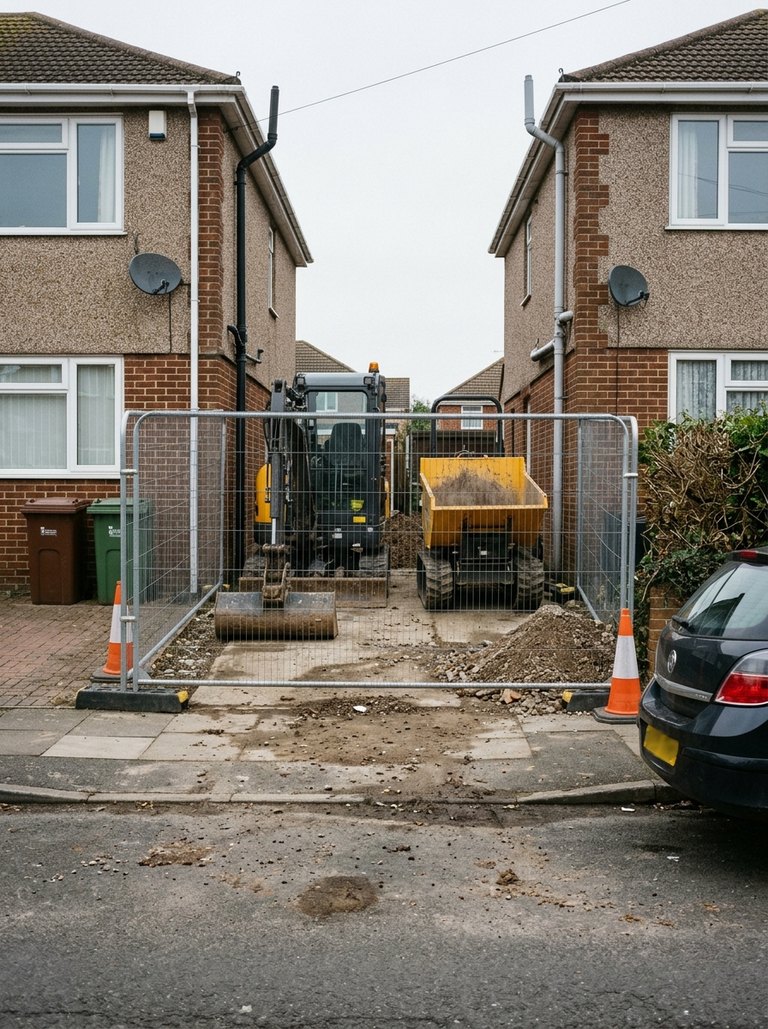
- Vehicles and mobile plant: 1.7 t mini excavator and 1 t high-tip dumper on the 3.2 m side drive and in the rear garden; muck-away and concrete lorries on Wonford Mead
- What could happen, and to whom
- Crew or a family member struck by the dumper reversing along the narrow drive, the excavator slewing in the tight garden, or a lorry on the road. Plant running into an open trench. The crew, the family and passers-by on the pavement.
- Controls ticked
- Pedestrians and vehicles kept apart with fenced routes and crossings
- Banksman for every reversing or blind movement
- Plant with working alarms, mirrors or cameras, checked daily
- Drivers trained and authorised for the plant they use
- High visibility clothing worn by everyone on site
- How they apply on this job
- The drive is a plant-only route while the dumper is moving: the crew stand clear behind the garden fence line and nobody walks the drive with the dumper. A. Dunne acts as banksman for every dumper movement on the drive and for every lorry reversing on the road, in high visibility clothing and in sight of the driver at all times. The householder's car is off the drive before 08:00. The excavator and dumper are checked by K. Trevithick each morning: reversing alarm, mirrors, lights, tracks and quick hitch. Only K. Trevithick drives the excavator and only K. Trevithick or A. Dunne drives the dumper. Stop blocks at every trench edge, and the excavator tracks stay on the mats at the garden end of the drive.
- Risk with these controls (likelihood x severity)
- 3 x 4 = 12 (Medium)
- Further action
- Daily plant check sheet kept in the van. Lorry arrivals booked for 10:00 and 14:00 so the road is quiet, with A. Dunne at the kerb before each one. Owner: A. Dunne.
- Residual risk
- 1 x 4 = 4 (Low)
A fictional job, filled in as a worked example. The form and the report are real.
It also appears in outdoor stage and rig for a christmas lights switch-on, dismantling a storm-damaged ash near an 11 kv line, pump replacement in a foul water chamber, independent scaffold on a seafront hotel and pallet racking in a live warehouse. All eleven completed RAMS.
Vehicles and mobile plant: common questions
Do we need a banksman for every reversing movement?
HSE's first answer is to avoid reversing where you can, with one-way systems and turning areas. Where reversing cannot be avoided, HSE says there must be an effective system to control it. On a tight site that usually means a banksman who stays in the driver's sight. Reversing cameras and alarms help but do not replace keeping people out of the way. The worked example uses a banksman for every dumper movement on a shared drive.
Is high visibility clothing enough to keep people safe?
No. HSE treats it as something you may need on top of separation, not instead of it. A driver who cannot see behind the vehicle will not see a hi-vis vest either. Separate routes, barriers and keeping pedestrians away from working vehicles come first, which is why the RAMS template warns when PPE is the only control ticked.
Who can drive plant on site?
Only people trained for that machine. HSE expects lift truck operators to be trained and reassessed from time to time, other drivers to be trained to a similar standard, and all drivers to be supervised, including visiting drivers. The RAMS should name who drives each machine. The worked example limits the excavator to one named operator.
What should we check on plant each day?
A pre-use check covers the things that protect people around the machine: reversing alarm, mirrors or cameras, lights, brakes, tyres or tracks, and any quick hitch or attachment. Faults are reported and the machine is kept out of use until they are fixed. The excavator, telehandler and vehicle pre-use check templates record that check each morning.
Last updated . See every hazard in the library.
Write the RAMS with these controls already listed.
Pick the hazard, tick its controls, score it and brief the crew, on a phone or laptop. The report goes to the client as one PDF.