Hazards and control measures
Excavation hazards and control measures
The hazards of excavation work, from trench collapse and falls to buried gas and electricity services, who gets hurt and how, and the control measures HSE expects: plans, a cable locator and trial holes, supported sides, edge protection and inspection every shift.
What are the main hazards of excavation work?
The main excavation hazards are the sides collapsing on someone in the trench, people or plant falling in, undermining nearby walls, water flooding in, fumes collecting, and striking a buried gas pipe or electricity cable. A cubic metre of soil can weigh more than 1.5 tonnes, and a struck live cable typically causes severe burns to the hands, face and body. The control measures are to locate services with plans, a cable locator and trial holes before digging, support or batter the sides, keep people and plant back from the edge, and have a competent person inspect at the start of every shift.
Last updated . Facts checked by the SiteSurvey team on 24 October 2026 against HSE: Excavations, HSE: Avoiding danger from underground services (HSG47), Construction (Design and Management) Regulations 2015, regulation 22 and Construction (Design and Management) Regulations 2015, regulation 25.
What counts as an excavation hazard
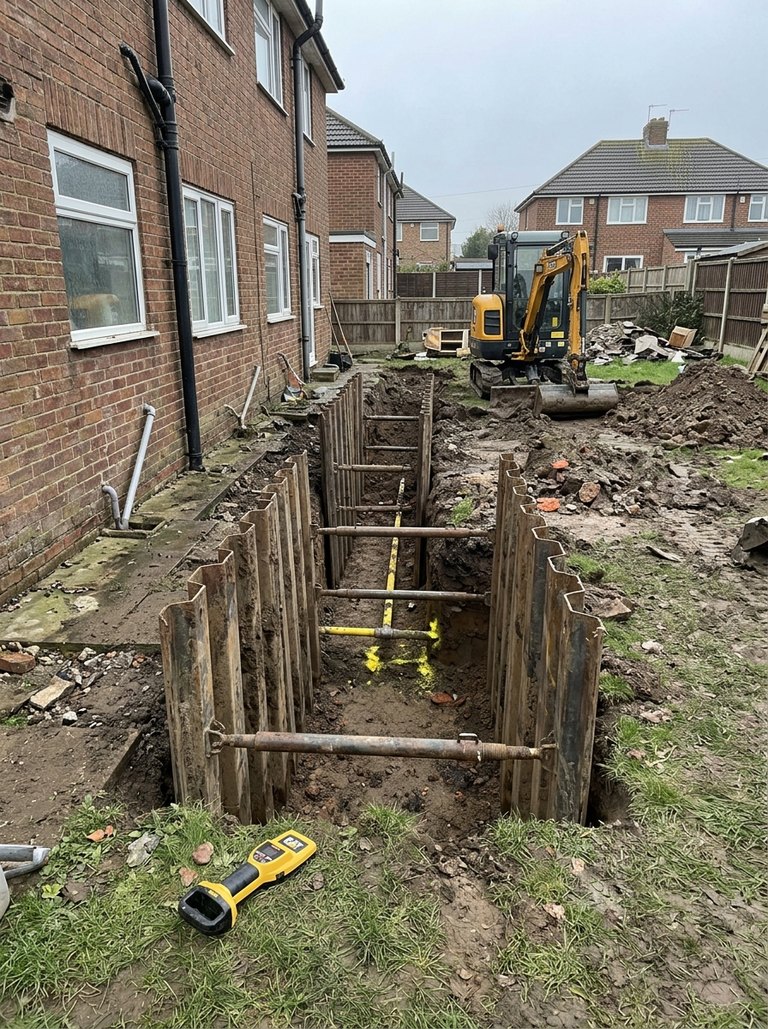
An excavation is any trench, pit or hole dug in the ground: a foundation trench, a drainage run, a pit for a cable joint or a soakaway. Groundworkers and builders dig them every day, but so do electricians running a supply to an outbuilding, EV charger and telecoms installers, landscapers and grounds staff. The hazards are the same whatever the trade. The sides can collapse, people and plant can fall in, and the bucket or the spade can hit a buried service.
HSE lists the ways it goes wrong. No ground can be relied on to stand unsupported in all circumstances. Plant and vehicles parked close to the edge add load and make the sides more likely to collapse. Many garden and boundary walls have shallow foundations that even a small trench can undermine. Water can flow into any excavation below the natural groundwater level, and exhaust fumes from petrol or diesel engines can collect in it. Under all of it are the services: HSG47 says to assume they are present unless it has been shown otherwise.
Who is harmed, and how
HSE says people are killed or seriously injured every year by collapses and falling material in excavations. A cubic metre of soil can weigh more than 1.5 tonnes, so even a shallow collapse can trap and crush a person kneeling in a trench. Falls put others at risk too: the labourer walking backwards at the edge, the member of the public on a footpath beside an open trench, the child in a garden where the work has been left overnight.
Buried services harm people in a different way. When a live electricity cable is cut by a tool or crushed by a bucket, the arcing current typically causes severe, potentially fatal burns to the hands, face and body. HSG47 describes a worker who died after damage to an 11,000 volt live cable in an excavation, with burns over 60% of his body; his employer had not told the workers the live cables were there. A damaged gas pipe can leak straight away or some time later, and the gas can travel along a service pipe into a building.
What the law expects
The Construction (Design and Management) Regulations 2015 require all practicable steps to stop an excavation collapsing or burying anyone, steps to stop people, equipment and material falling in, and no work that puts an underground service at risk until suitable steps have been taken. In practice that follows the hierarchy. First avoid: move the route or change the design so the dig misses the services or nobody needs to enter the trench. Then locate: HSG47 sets out planning the work, locating and identifying the services, and safe excavation. Service plans guide the search but are not always drawn to scale, so the line is pinpointed with a cable locator and signal generator, known on site as a CAT and Genny, and confirmed by hand dug trial holes. Every service is treated as live, and the locator is used repeatedly as the dig goes down.
Then the physical controls: sides supported or battered back before anyone goes in, barriers where people could fall, and plant, vehicles and spoil kept back from the edge. Engines are not run in the excavation unless the fumes are ducted away. A competent person inspects the excavation at the start of every shift and after anything that could affect its stability, and the inspection is recorded. In SiteSurvey, the RAMS template asks whether underground services have been located with plans and a CAT and Genny scan, and the Suggested controls list follows the same order.
Suggested controls
Excavation and underground services: control measures, most effective first
These are the 6 controls the SiteSurvey RAMS and risk assessment forms offer for this hazard as a tick list, grouped by their level in the hierarchy of controls. They are a starting point from HSE guidance, not an assessment of your job: tick what applies and say how it works on your site. If only personal protective equipment is ticked, the form says so. How suggested controls work and the hierarchy of controls explained.
Take the hazard away altogether, usually by doing the job a different way or from a different place.
- Route changed to avoid the services or the excavation
Keep people away from the hazard with a physical measure: a guardrail, a barrier, extraction, isolation.
- Sides supported or battered back before anyone enters
- Edge barriers and stop blocks for plant
Change the way the work is done: a permit, a check, training, supervision, timing.
- Service plans obtained and the area scanned with a CAT and Genny before and during digging
- Hand digging only within the safe distance of a located service
- Inspected by a competent person at the start of each shift
Offered to: Construction and building work, Electrical and M&E, Grounds, landscaping and tree work.
Try it
Build the controls for excavation and underground services
Tick the controls you would put in place, see which levels of the hierarchy they reach, and score the risk before and after. Or fill in the example from a completed RAMS to see how one crew did it.
Interactive
Try it: excavation and underground services
Works the same way as the RAMS form. Nothing you tick is saved or sent anywhere.
Your controls, by level
- Eliminatenot ticked
- Substituteno control at this level for this hazard
- Engineeringnot ticked
- Adminnot ticked
- PPEno control at this level for this hazard
Nothing ticked yet.
3. Score the risk with these controls
What the law says
- Construction (Design and Management) Regulations 2015, regulation 22
- Prevent collapse with support or battering, stop people, equipment and material falling in, stop the edge being overloaded, and have a competent person inspect at the start of each shift and after any event affecting stability.
- Construction (Design and Management) Regulations 2015, regulation 25(4)
- No construction work that risks damaging or disturbing an underground service until suitable and sufficient steps have been taken to prevent the danger.
- HSG47: Avoiding danger from underground services
- HSE guidance on planning the work, locating and identifying buried services with plans, locators and trial holes, and safe digging near them.
- Management of Health and Safety at Work Regulations 1999, regulation 3
- The suitable and sufficient risk assessment that identifies the excavation, the services and the controls.
Worked example
Excavation and underground services in a completed RAMS
The hazard entry exactly as it was recorded in one of our completed example RAMS: the controls ticked from the list, how they apply on that job, and the score before and after the further action.
Construction and building work
22 Wonford Mead, Exeter: extension foundations and drainage
- Hazard
- Excavation and underground services: Foundation trenches 1.0 m deep across the lawn; drainage run 0.6 to 1.1 m deep along the side of the house
- What could happen, and to whom
- Striking the gas service that runs along the side of the house at about 450 mm depth and crosses the drainage run, striking the water service, and the trench sides collapsing on anyone in the trench. The Hadleigh clay holds up when dry but slumps after rain. The crew, and the family if gas is released.
- Controls ticked
- Service plans obtained and the area scanned with a CAT and Genny before and during digging
- Hand digging only within the safe distance of a located service
- Sides supported or battered back before anyone enters
- Edge barriers and stop blocks for plant
- Inspected by a competent person at the start of each shift
- How they apply on this job
- Gas and water plans obtained from the network operators by Teign Valley Builders and attached to permit to dig PTD-HG-2026-041. The whole work area scanned with a CAT and Genny by K. Trevithick before any digging and again at each change of depth; the gas service was located crossing the drainage line 2.1 m from the side gate and its line is marked on the ground and on the drawing. Hand digging only within 500 mm either side of the marked gas line and within 500 mm of the water service. Trench sheets and props fitted to the foundation trenches before anyone enters, stop blocks and edge barriers 1 m back from every trench edge, spoil kept 1 m back. K. Trevithick inspects every open trench at the start of each shift and after rain and records it on the excavation register.
- Risk with these controls (likelihood x severity)
- 4 x 5 = 20 (High)
- Further action
- Permit to dig PTD-HG-2026-041 signed by K. Trevithick and the Teign Valley Builders site manager at the step 1 hold point, with the service plans and the CAT scan result attached. Trench supports on site before step 3 and the inspection before entry recorded each shift. Owner: K. Trevithick.
- Residual risk
- 1 x 5 = 5 (Medium)
A fictional job, filled in as a worked example. The form and the report are real.
Excavation and underground services: common questions
How close to a buried service can we use power tools or a digger?
HSG47 says that where practicable, hand-held power tools used to break a hard surface should stay 500 mm or more from the indicated line of a service, and the service is then found by careful hand digging. Dig alongside the service rather than on top of it, ease spades in with gentle foot pressure rather than spiking them, and use insulated tools near cables. Mechanical excavation near services needs a second person watching into the trench and warning the driver. The permit to dig records the safe distance agreed for the job.
Can we rely on the utility plans?
No. HSG47 says plans are not always drawn accurately to scale and should not be relied on for distances or depths. Kerb lines move, ground levels change and cables get moved without the owner knowing. Gas service connections are not normally shown at all, so assume one runs from the meter into the building. Use the plans to guide the cable locator and signal generator, then confirm with trial holes.
How often must an excavation be inspected?
A competent person must inspect a supported or battered excavation at the start of every shift, after any event likely to have affected its strength or stability, and after any accidental fall of material. If they are not satisfied it is safe, nobody works in it until the problem is put right. HSE expects the inspections to be recorded and any faults corrected straight away. The excavation inspection checklist template keeps that record shift by shift.
What should the operator do if the excavator hits a cable?
Stay in the cab. HSG47 warns that a driver who climbs down may be electrocuted. The area is isolated and secured, and nobody goes into the excavation or near the machine or the cable until the cable owner has made it safe. The RAMS should name who calls the owner and keeps people back, so the crew is not working it out on the day.
Last updated . See every hazard in the library.
Write the RAMS with these controls already listed.
Pick the hazard, tick its controls, score it and brief the crew, on a phone or laptop. The report goes to the client as one PDF.