An inspection record for timber and plastic pallets, so damaged pallets are found and taken out of use. Record the area checked and how many pallets were checked, then add each damaged pallet with its type, faults such as a missing or broken board, a split block, a twisted block or a protruding nail, the decision and photos. The form shows the EPAL exchange faults for Euro pallets and the HSE rule for one-way pallets, counts pallets withdrawn for repair and for destruction, records where withdrawn pallets are kept and the likely causes, and ends with an optional Walk Cam route and actions. Every question is listed below, and you can fill the live form in on this page.
✎Every question is editable. Add this form to your account, then change the wording, add or remove questions and options, and make it fit your own jobs.
Prefer paper? Download a printable copy: PDF or Word
How often should pallets be inspected?
HSE's HSG76 says all pallets should be inspected each time before use to make sure they are in a safe condition, that you should have an effective system for pallet inspection, and that damaged pallets should be withdrawn for suitable repair or destruction. HSE lists the continued use of a damaged pallet among the six main sources of accidents with flat timber pallets. A dated record of each stock check shows that the system is working.
Film the stack, then each board and block, and finish where damaged pallets are taken out of use.
Record the site, bay, date and who checked. Show each pallet whole before any damage. The four AI-generated clips illustrate one route, not a real warehouse.
POINT 01
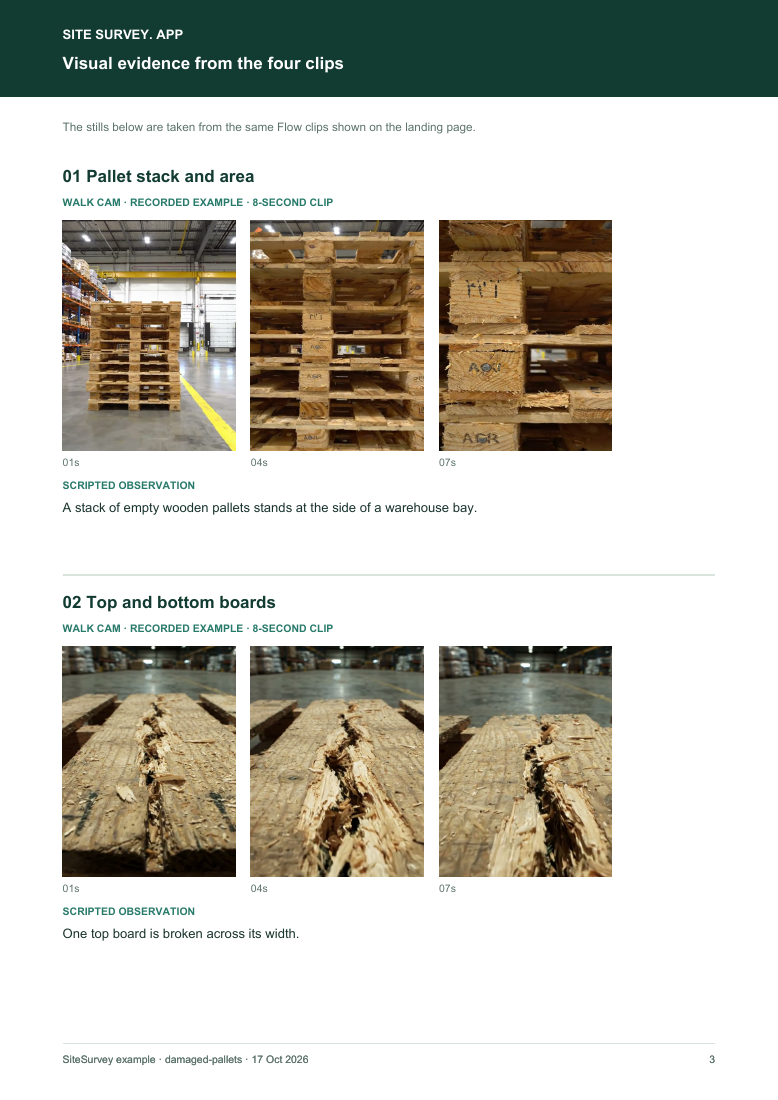
Pallet stack and area
Show the stack or bay of empty pallets and where it is, before any single pallet.
A stack of empty wooden pallets stands at the side of a warehouse bay.
POINT 02
Top and bottom boards
Film each board for breaks, missing pieces and splits, keeping the pallet in view.
One top board is broken across its width.
POINT 03
Blocks and nails
Show the blocks and any protruding nails or twisted blocks along each side.
A corner block is split and a nail shank protrudes.
POINT 04
Withdrawn pallets
End at the place damaged pallets go, so it is clear they are out of use.
Damaged pallets are set aside in a marked area.
See the footage in a report
A fictional six-page example with the four points, twelve stills from the clips, observations, follow-up actions and the limits of a visual record.
Video records visible damage. It does not decide whether a pallet can be repaired, rate its load capacity or replace a hands-on check before each use. Example footage was generated in Google Flow and the observations are scripted; no real site is shown. Walk Cam works inside any form in the app. How Walk Cam works · All visual inspections
Every question in the pallet inspection template
A pallet inspection record: the stock or bay checked, each damaged pallet with its type, faults such as broken or missing boards, split blocks and protruding nails, the decision, photos, the withdrawn area and actions. 3 sections and 30 questions. Follow-up questions and guidance appear only when an answer calls for them, so the person on site never sees the ones that do not apply.
✎
Make it your own: every question is editable
This is a starting point, not a fixed form. Once it is in your SiteSurvey account you can reword any question, add or remove questions, sections and answer options, and add your own logo, so it fits the way your team works and the jobs you do.
Details you only enter once
Add this form to a project in SiteSurvey and it fills in what the project already knows, so nobody on site retypes it and every form on the job uses the same names. Anything filled in can still be changed.
Project: the project name
Client: the project's customer
Site: the site, when the form is opened for a space or a product
Site address: the site address, from the space or the project
1
Check
ProjectShort answer
Fills in from the project name
ClientShort answer
Fills in from the project's customer
Site*Short answer
Fills in from the site, when the form is opened for a space or a product
Site addressShort answer
Fills in from the site address, from the space or the project
Date*Date
TimeTime
Checked by*Short answer
Area or bay checkedShort answer
CheckChoose one
Routine check of the pallet stock
Goods-in
After a report of damage
GuidanceHSE HSG76 says you should have an effective system for pallet inspection, all pallets should be inspected each time before use to make sure they are in a safe condition, and damaged pallets should be withdrawn for suitable repair or destruction. It lists the continued use of a damaged pallet among the main sources of accidents with flat timber pallets.
2
Pallets
Pallets checkedNumber
Were any damaged pallets found?Yes or No
Damaged pallets
Repeat for each damaged pallet. Each one asks:
Shown when “Were any damaged pallets found?” is Yes
Pallet location or reference*Short answer
TypeChoose one
EPAL Euro pallet
Pooled or hire pallet
Other timber pallet
One-way (expendable) pallet
Plastic pallet
Faults*Tick all that apply
Board missing
Board broken across or diagonally
Board splintered with nail shanks showing
Block missing or split
Twisted block
Protruding nail
Rotten or decayed timber
Contaminated (spill or soiling)
Cracked or broken plastic
CheckEPAL: a Euro pallet is not exchangeable if a board is missing or broken across or diagonally, a block is missing or split or a board splintered so that more than one nail shank is visible, or a twisted block protrudes more than 10 mm. EPAL Euro pallets may only be repaired by licensed repair operations.
Shown when “Type” is “EPAL Euro pallet”
CheckHSE HSG76: expendable pallets, designed for one delivery only, should be clearly marked, are not normally suitable for storing on racking and should not be reused.
Shown when “Type” is “One-way (expendable) pallet”
Decision*Choose one
Withdrawn for repair
Withdrawn for destruction
Returned to the pool or hire company
PhotosPhotos
Withdrawn for repairWorked out by the form
Shown when “Were any damaged pallets found?” is Yes
Withdrawn for destructionWorked out by the form
Shown when “Were any damaged pallets found?” is Yes
Are withdrawn pallets kept in a marked area away from usable stock?Yes or No
WhereShort answer
Shown when “Are withdrawn pallets kept in a marked area away from usable stock?” is Yes
Likely causes seenTick all that apply
Dragged, dropped or thrown
Forks too short or misaligned
Pallet truck wheels hitting base boards
Strapping pulling boards
Overloaded or uneven load
None obvious
GuidanceHSE HSG76: empty pallets should be handled carefully and not dragged or thrown about, forks should extend into the pallet at least three quarters of its depth, and strapping can pull deck boards from the bearers.
Shown only when the answers above make it relevant
Walk Cam: pallet inspectionWalk Cam video with voice-to-text
Optional. Film the four guided points on the SiteSurvey app; each clip keeps its spoken note.
3
Actions and sign-off
Are further actions needed?Yes or No
Further actions
Repeat for each action. Each one asks:
Shown when “Are further actions needed?” is Yes
What needs doing?*Notes
Who will do it?Short answer
Due dateDate
StatusChoose one
Open
In progress
Completed
Inspector name*Short answer
Position or companyShort answer
Inspector signatureSignature
CheckSigning records what was found on the day. It does not make unsafe equipment safe or replace a thorough examination, design check or service by a competent person.
Scope and responsibility
A record of pallet condition and withdrawal. It is not a racking inspection, a load rating or a repair to EPAL's technical regulations.
What a useful entry looks like
Faults found and the decision
Tick each fault you can see and record whether the pallet is withdrawn for repair, destruction or return. Say where withdrawn pallets are kept.
Euro pallet with a deck board broken across its width, withdrawn for repair by the licensed repairer and kept in the marked area by bay 6.
Fictional example of record wording. Use the actual evidence and approved arrangements for your job; this is not a completed report or an instruction to carry out the work.
See it filled in
A completed pallet inspection report, made by SiteSurvey from a fictional site visit: every answer, the photos, the guidance that applied and the sign-off, ready to send as a PDF.
Look for missing or broken boards, split or missing blocks, twisted blocks, protruding nails, rot and contamination. For Euro pallets, EPAL says a pallet is not exchangeable if a board is missing or broken across or diagonally, a block is missing or split or a board splintered so that more than one nail shank shows, or a twisted block protrudes more than 10 mm.
Can we repair Euro pallets ourselves?
No. EPAL says EPAL Euro pallets may only be repaired by licensed repair operations. The form records whether each pallet is withdrawn for repair, withdrawn for destruction or returned to the pool or hire company.
Can one-way pallets be reused?
HSE's HSG76 says expendable pallets, designed for one delivery only, should be clearly marked, are not normally suitable for storing on racking and should not be reused.
What causes pallet damage?
HSG76 says empty pallets should be handled carefully and not dragged or thrown about, forks should go in at least three quarters of the pallet depth, pallet truck wheels can damage base boards and strapping can pull deck boards off. The form records the likely causes so you can deal with them.
Is this the same as a racking inspection?
No. This form covers the pallets themselves. Use the pallet racking inspection checklist for the racking.
Who uses this?
Warehouse and goods-in teams, distribution centres, manufacturers, retailers' back-of-house teams and pallet pool users.