Form library · Facilities and maintenance
PAT testing sheet and record template
A PAT testing sheet for portable appliance inspection and test records. List each appliance with its ID, location and class, record the visual inspection and any test readings, mark it pass or fail and say what was done with a failure. The form counts passes and fails, and the customer signs on the device. Every question is listed below, and you can fill the live form in on this page.
Ready to use from the form library, and every question is yours to edit. Trial from £1, cancel any time.
Try it on your phone
Try it on this phone
Fill in the PAT testing record on your phone now
See how the PAT testing record looks on your phone
Scan the code with your phone camera. It opens the real form, no sign-up needed.
Open the live example and fill it in, just as your team would on site. No sign-up needed.
See it on this phoneEvery question is editable. Add this form to your account, then change the wording, add or remove questions and options, and make it fit your own jobs.
Prefer paper? Download a printable copy: PDF or Word
Download a blank PAT testing sheet as a printable PDF or editable Word document, or inspect the fictional completed appliance record below. View the completed example (PDF)
What should a PAT testing record include?
A PAT testing sheet records each appliance identifier, location and class, the visual inspection, any tests performed and readings, the result and follow-up action. This PAT testing record template keeps those appliance rows together with the person carrying out the work, instrument details and sign-off.
Last updated . Facts checked by the SiteSurvey team on 5 October 2026 against HSE portable appliance testing FAQs, HSE INDG236, Maintaining portable electric equipment in low-risk environments and regulation 4 of the Electricity at Work Regulations 1989.
How to make this record useful
Appliance result and follow-up action
Appliance A-018, office kettle, first-floor kitchen: visual inspection records damage to the cable near the plug. Result and action are entered against A-018, with a photo reference and a note that the site contact was informed. No electrical test readings are invented to complete empty boxes.
Fictional example. Record the actual evidence and approved arrangements for your job.
A common recording mistake
A certificate heading or a total number of passes does not replace the individual appliance records. Distinguish checks that were carried out from those that were not, and keep any failed item identifiable.
What happens next
Review the sheet for missing identifiers and unresolved actions before sharing it. Keep the appliance-level evidence with the summary, and record subsequent work or rechecks as dated entries.
Try the PAT testing record form live
Answer a few questions and watch it adapt. Your answers are not saved, and any photos you add are deleted within the hour.
This is the real form as your team would use it: questions appear as you answer, scores work themselves out and you can add photos and signatures. No sign-up needed.
Want to see one filled in? See a completed PAT testing record report (PDF), made by SiteSurvey from a fictional site visit.
Fill it in on a phone or tablet
Your team completes the pat testing record on site in the SiteSurvey app on iPhone, iPad and Android phones and tablets. The project name and address fill in for them, it works without signal, and it syncs when the device is back online with photos kept against the question they answer.
Customers and subcontractors do not need the app: send them a link and they can fill it in from any browser.
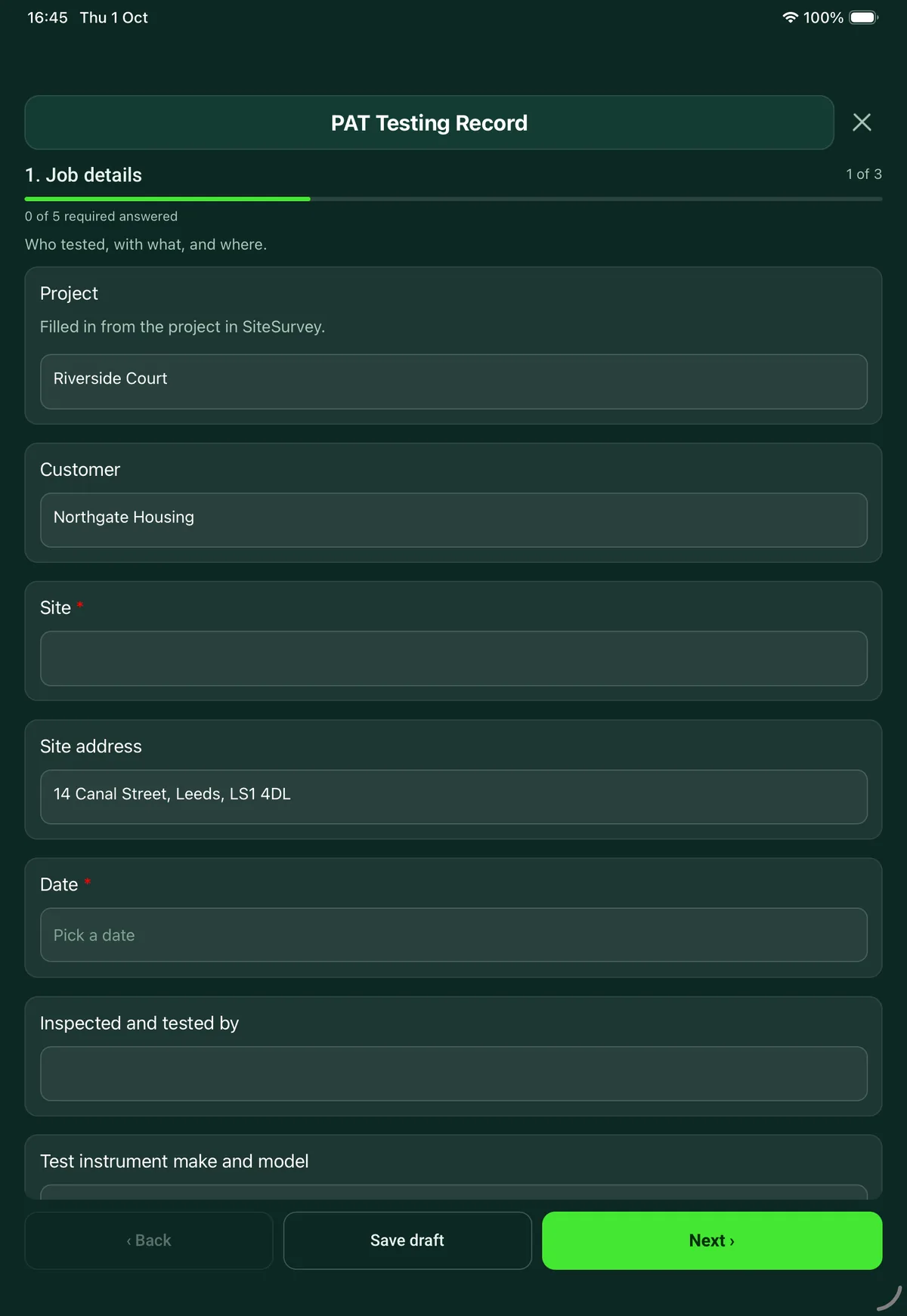
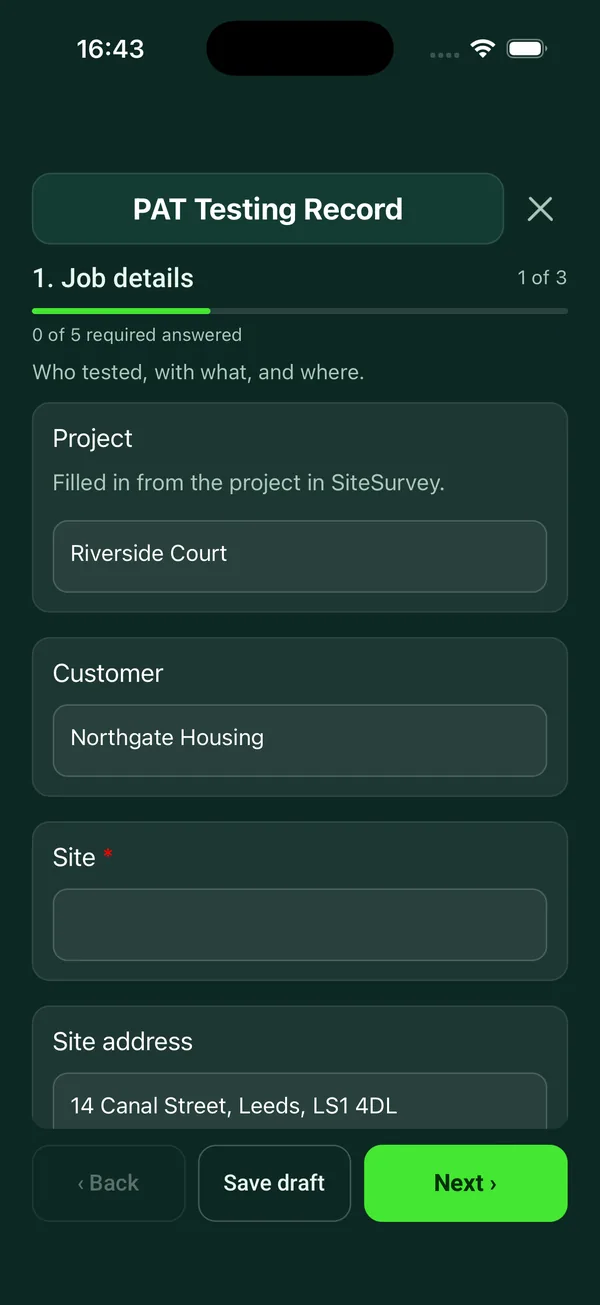
Every question in the PAT testing record template
Portable appliance inspection and test record: each appliance with its ID, location, class, visual checks, test readings, pass or fail and the action taken. 3 sections and 40 questions. Follow-up questions and guidance appear only when an answer calls for them, so the person on site never sees the ones that do not apply.
Make it your own: every question is editable
This is a starting point, not a fixed form. Once it is in your SiteSurvey account you can reword any question, add or remove questions, sections and answer options, and add your own logo, so it fits the way your team works and the jobs you do.
Details you only enter once
Add this form to a project in SiteSurvey and it fills in what the project already knows, so nobody on site retypes it and every form on the job uses the same names. Anything filled in can still be changed.
- Project: the project name
- Customer: the project's customer
- Site: the site, when the form is opened for a space or a product
- Site address: the site address, from the space or the project
Job details
Who tested, with what, and where.
- ProjectShort answer
Filled in from the project in SiteSurvey.
Fills in from the project name - CustomerShort answerFills in from the project's customer
- Site*Short answerFills in from the site, when the form is opened for a space or a product
- Site addressShort answerFills in from the site address, from the space or the project
- Date*Date
- Inspected and tested byShort answer
- Test instrument make and modelShort answer
- Serial numberShort answer
- Calibration dateDate
- Areas coveredShort answer
Note any rooms or equipment you could not get to.
- GuidanceWhat the law asks for. HSE says the law does not make inspection or testing of electrical appliances a legal requirement, nor require it every year. Equipment must be maintained so it is safe, and how often it is checked depends on the type of equipment and where it is used. There is no legal requirement to label equipment or keep records, but HSE says both can be a useful management tool.
Appliances
One entry for each appliance. Unplug it and look before you test.
- AppliancesRepeat for each appliance. Each one asks:
- Appliance IDShort answer
- Description*Short answer
- LocationShort answer
- ClassChoose one
- Class I: earthed
- Class II: double insulated
- Lead or extension only
- Check carried outChoose one
- Visual inspection only
- Visual inspection and test
- Visual inspection*Choose one
- Pass
- Fail
- What is wrong?Tick all that apply
- Damaged cable
- Damaged plug
- Wrong fuse
- Cable not gripped in the plug
- Cracked or damaged casing
- Signs of overheating
- Taped or non-standard joint
- Wet or contaminated
- Other (describe)
Shown when “Visual inspection” is “Fail” - Fuse fitted (A)Number
- Earth continuity (ohms)NumberShown only when the answers above make it relevant
- Insulation resistance (megohms)NumberShown only when the answers above make it relevant
- Polarity and wiring correct?Choose one
- Correct
- Incorrect
- Not applicable
Shown only when the answers above make it relevant - Functional checkChoose one
- Pass
- Fail
- Not done
- Result*Choose one
- Pass
- Fail
- Action takenChoose one
- Removed from use and labelled
- Repaired and retested: pass
- Disposed of
- Left in use: customer informed
Shown when “Result” is “Fail” - WarningA failed appliance has been left in use. The person told is recorded below.Shown when “Action taken” is “Left in use: customer informed”
- Suggested next checkDate
- Photos of defectsPhotos
- Appliances checkedWorked out by the form
- PassedWorked out by the form
- FailedWorked out by the form
Summary and sign-off
What the customer needs to know.
- Have all failed appliances been taken out of use?Yes or No
- Who was told about the failed appliances?Short answer
- RecommendationsNotes
For example more frequent checks for equipment that is moved a lot or used in harsh conditions.
- GuidanceHSE says the person doing the testing needs to be competent to do it. In many low-risk environments a sensible member of staff can do the visual inspections if they have enough knowledge and training.
- Is the customer or their representative available to sign?Yes or No
- Why not, and who will you send the report to?Short answerShown when “Is the customer or their representative available to sign?” is No
- Customer nameShort answerShown when “Is the customer or their representative available to sign?” is Yes
- PositionShort answerShown when “Is the customer or their representative available to sign?” is Yes
- Customer commentNotesShown when “Is the customer or their representative available to sign?” is Yes
- Customer signatureSignatureShown when “Is the customer or their representative available to sign?” is Yes
- Tester nameShort answer
- Tester signatureSignature
See it filled in
A completed PAT testing record report, made by SiteSurvey from a fictional site visit: every answer, the photos, the guidance that applied and the sign-off, ready to send as a PDF.
PAT testing record FAQs
Is PAT testing a legal requirement?
HSE says the law does not make inspection or testing of electrical appliances a legal requirement, nor require it every year. Regulation 4 of the Electricity at Work Regulations 1989 requires electrical systems to be maintained, as far as necessary, to prevent danger, and HSE says how often equipment is checked depends on its type and where it is used.
Do I have to keep PAT records or label appliances?
HSE says there is no legal requirement to label equipment that has been inspected or tested, nor to keep records, but that a record and labelling can be a useful management tool. This form is that record, with a suggested next check date for each appliance.
Who can do PAT testing?
HSE says the person doing the testing needs to be competent to do it. In many low-risk environments a sensible member of staff can do the visual inspections if they have enough knowledge and training. The form records whether each appliance had a visual inspection only or an inspection and test.
What is recorded for each appliance?
The ID, description, location and class (earthed, double insulated, or a lead or extension), the visual inspection result with what is wrong on a failure, the fuse fitted, earth continuity and insulation resistance where tested, polarity for leads, a functional check, the result and photos of defects. The form does not set pass limits: use the ones in the guidance you test to.
What happens when an appliance fails?
The action is recorded as removed from use and labelled, repaired and retested, disposed of, or left in use with the customer informed. Left in use shows a warning, and the summary page asks whether all failed appliances are out of use and who was told.
How many appliances fit on one record?
Up to 250. The form counts the appliances checked, passed and failed. In the SiteSurvey app it works offline, and the record goes out as a PDF or a share link.
Related
Related templates
Templates that go with the PAT testing record form
Site record for a periodic inspection: installation details, extent and limitations, supply and earthing, boards, schedule of circuits and test results, coded observations with photos, and the overall assessment.
Planned maintenance visit: records seen, asset by asset tasks, water temperatures, work done and next visit.
Build or update an asset register: asset records with make, model, serial, condition and photos, changes to the register.
Job sheet for a reactive or planned job: safety before starting, work done, parts used, tests, outcome and customer sign-off.
Use this PAT testing record form with your team
Add it from the form library in one click, change any question, and every completed form becomes a branded PDF report.
Start your trial →