Form library · Facilities and maintenance
EICR template
A site record for an electrical installation condition report. Record the installation, the extent and limitations agreed, the supply and earthing arrangements, each board, the test results for every circuit, and each observation with its classification code and photos. The form warns you if the overall assessment does not match the codes you recorded. The formal report must meet BS 7671, and registered electricians usually issue it from their scheme's or their certification software: this form is the site record and the photos behind it. Every question is listed below, and you can fill the live form in on this page.
Ready to use from the form library, and every question is yours to edit. Trial from £1, cancel any time.
Try it on your phone
Try it on this phone
Fill in the EICR site record on your phone now
See how the EICR site record looks on your phone
Scan the code with your phone camera. It opens the real form, no sign-up needed.
Open the live example and fill it in, just as your team would on site. No sign-up needed.
See it on this phoneEvery question is editable. Add this form to your account, then change the wording, add or remove questions and options, and make it fit your own jobs.
What does an electrical installation condition report include?
An electrical installation condition report (EICR) records the condition of an existing installation against BS 7671. It sets out the extent of the installation covered and any limitations, with the reasons and who agreed them, the supply and earthing arrangements, the inspection and the test results for each circuit, each observation with a classification code, an overall assessment of satisfactory or unsatisfactory, and the recommended date of the next inspection.
Last updated . Facts checked by the SiteSurvey team on 5 October 2026 against The Electrical Safety Standards in the Private Rented Sector and Social Rented Sector (England) Regulations 2020, regulation 3, GOV.UK: Electrical safety standards in the private and social rented sectors: guidance and Electrical Safety First: Best Practice Guide 4, electrical installation condition reporting.
Try the EICR site record form live
Answer a few questions and watch it adapt. Your answers are not saved, and any photos you add are deleted within the hour.
This is the real form as your team would use it: questions appear as you answer, scores work themselves out and you can add photos and signatures. No sign-up needed.
Want to see one filled in? See a completed EICR site record report (PDF), made by SiteSurvey from a fictional site visit.
Fill it in on a phone or tablet
Your team completes the electrical installation condition report on site in the SiteSurvey app on iPhone, iPad and Android phones and tablets. The project name and address fill in for them, it works without signal, and it syncs when the device is back online with photos kept against the question they answer.
Customers and subcontractors do not need the app: send them a link and they can fill it in from any browser.
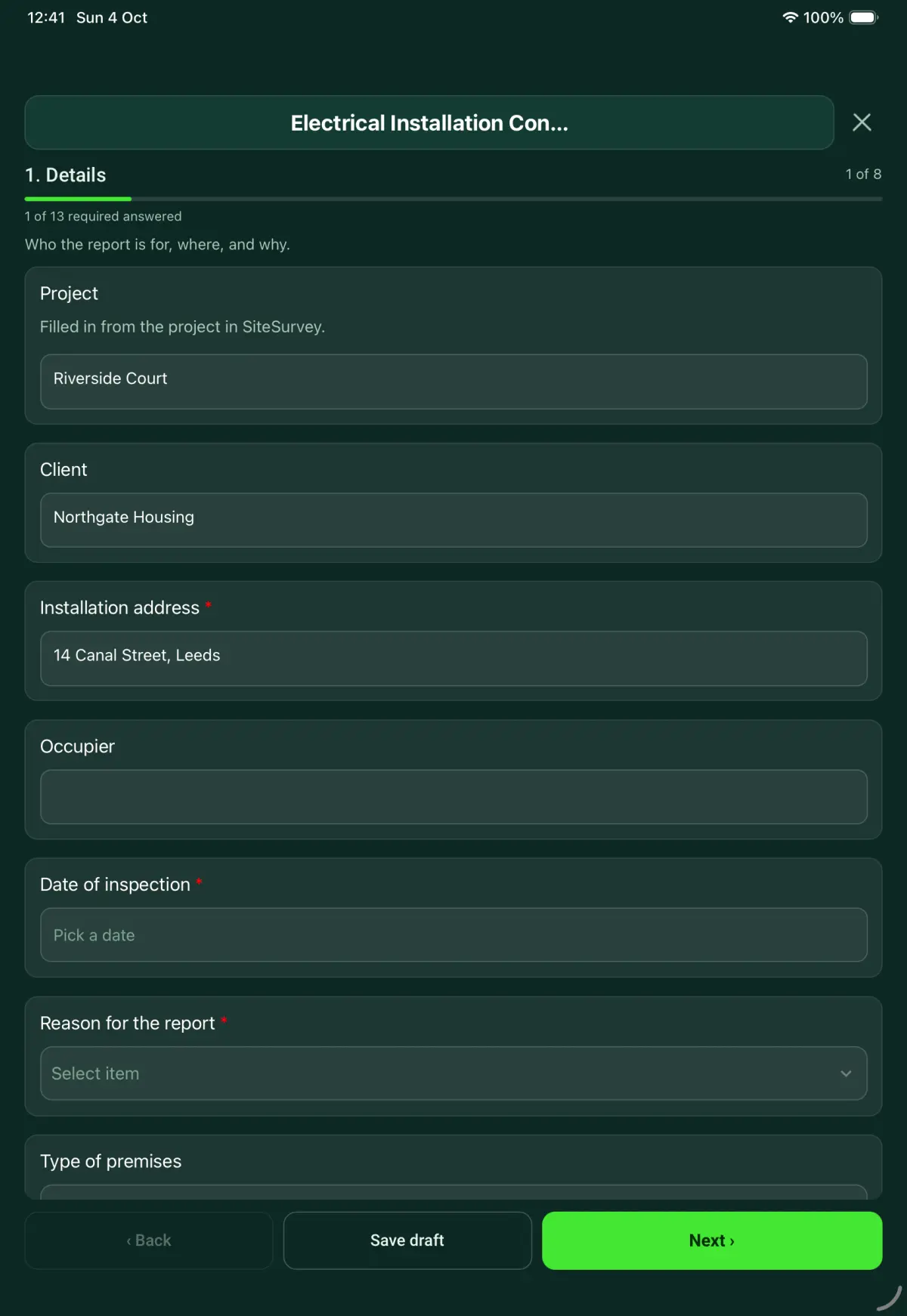
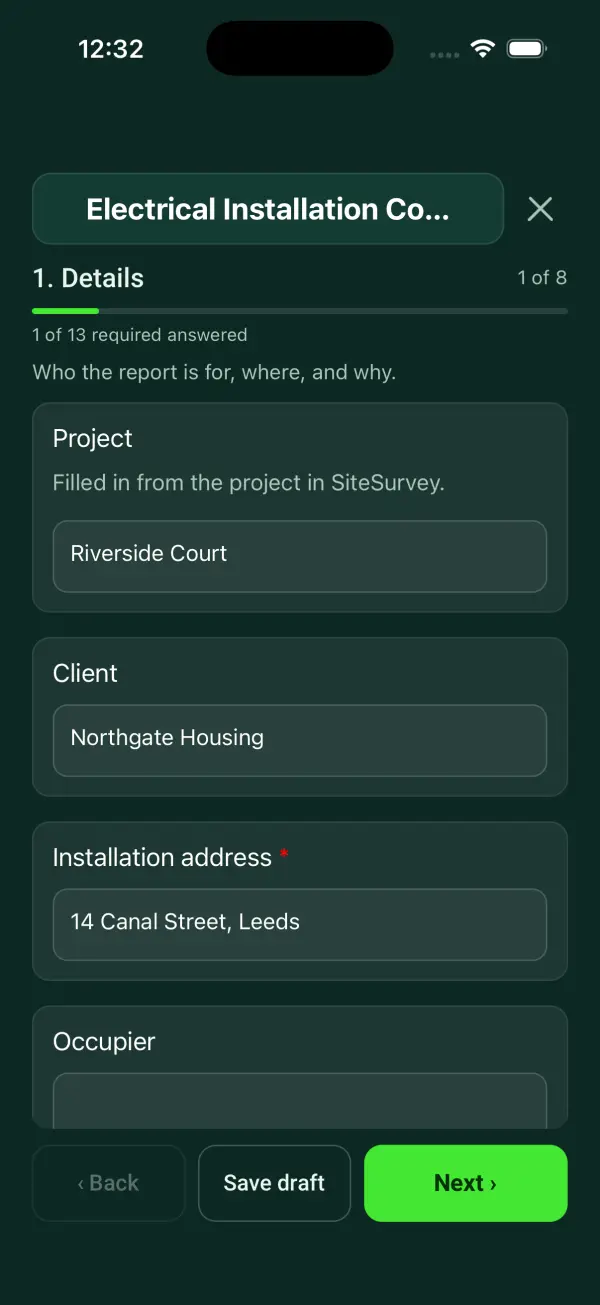
Every question in the EICR site record template
Site record for a periodic inspection: installation details, extent and limitations, supply and earthing, boards, schedule of circuits and test results, coded observations with photos, and the overall assessment. 8 sections and 111 questions. Follow-up questions and guidance appear only when an answer calls for them, so the person on site never sees the ones that do not apply.
Make it your own: every question is editable
This is a starting point, not a fixed form. Once it is in your SiteSurvey account you can reword any question, add or remove questions, sections and answer options, and add your own logo, so it fits the way your team works and the jobs you do.
Details you only enter once
Add this form to a project in SiteSurvey and it fills in what the project already knows, so nobody on site retypes it and every form on the job uses the same names. Anything filled in can still be changed.
- Project: the project name
- Client: the project's customer
- Installation address: the site address, from the space or the project
Details
Who the report is for, where, and why.
- ProjectShort answer
Filled in from the project in SiteSurvey.
Fills in from the project name - ClientShort answerFills in from the project's customer
- Installation address*Short answerFills in from the site address, from the space or the project
- OccupierShort answer
- Date of inspection*Date
- Reason for the report*Choose one
- Periodic inspection
- Rented property: landlord requirement
- Change of occupancy
- Before sale or purchase
- Insurance or mortgage requirement
- After damage, such as flood or fire
- Change of use
- Other (describe)
- Type of premisesChoose one
- Domestic
- Rented domestic
- House in multiple occupation
- Commercial
- Industrial
- Public building
- Other (describe)
- Estimated age of the installation (years)Number
- Evidence of additions or alterations?Choose one
- Yes
- No
- Not apparent
- Estimated age of the alterations (years)NumberShown when “Evidence of additions or alterations?” is “Yes”
- Date of the last inspectionDate
Leave blank if not known.
- Records availableChoose one
- Previous report seen
- Installation certificate seen
- None available
- Previous report or certificate referenceShort answerShown only when the answers above make it relevant
- GuidanceWhat this form is. The formal Electrical Installation Condition Report must meet BS 7671, and registered electricians usually issue it from their scheme's or their certification software. Use this form as the site record and the photos behind it: what you inspected, the readings you took and what you found.
- GuidanceRented homes in England. The Electrical Safety Standards in the Private Rented Sector and Social Rented Sector (England) Regulations 2020 require landlords to have the installation inspected and tested by a qualified person at least every 5 years, or sooner if the last report says so. The landlord must give existing tenants a copy of the report within 28 days of the inspection, and give the local council a copy within 7 days of a written request. Remedial or further investigative work the report requires must be done within 28 days, or sooner if the report says so. Wales, Scotland and Northern Ireland have their own rules.Shown only when the answers above make it relevant
Extent and limitations
What was inspected and tested, and what was not.
- Extent of the installation covered*Notes
For example the whole installation, or the ground floor distribution board and its final circuits.
- Agreed limitations, and the reasonsNotes
For example no lifting of fixed floor coverings, or no testing of circuits serving servers.
- Limitations agreed withShort answerShown when “Agreed limitations, and the reasons” is answered
- Operational limitations found on the dayNotes
For example rooms with no access, or circuits that could not be isolated.
- Proportion of the installation inspected (%)Number
Where only a sample of accessories or circuits was inspected.
- GuidanceRecord every limitation, agreed or found on the day, and who agreed it. The more is left out, the less the report can say about the installation.
Supply and earthing
Supply characteristics and earthing arrangements.
- Earthing system*Choose one
TN-C-S is often called PME.
- TN-C-S
- TN-S
- TT
- IT
- Other (describe)
- SupplyChoose one
- Single phase
- Three phase
- Supply polarity confirmed?Choose one
- Yes
- No
- Nominal voltage (V)Number
- External earth fault loop impedance, Ze (ohms)Number
- Prospective fault current (kA)Number
- Main supply protective device: typeShort answer
For example BS 88-3 cartridge fuse.
- Rating (A)Number
- Earth electrode type and locationShort answerShown when “Earthing system” is “TT”
- Electrode resistance to earth (ohms)NumberShown when “Earthing system” is “TT”
- Main switch or RCD: type and ratingShort answer
- Earthing conductor present and connected?Yes or No
- Earthing conductor: material and size (mm²)Short answerShown when “Earthing conductor present and connected?” is Yes
- Main protective bonding present?Yes or No
- Main protective bonding conductors: material and size (mm²)Short answerShown when “Main protective bonding present?” is Yes
- Bonded to water installation pipesChoose one
- Yes
- No
- Not applicable
- Not verified
Shown when “Main protective bonding present?” is Yes - Bonded to gas installation pipesChoose one
- Yes
- No
- Not applicable
- Not verified
Shown when “Main protective bonding present?” is Yes - Bonded to oil installation pipesChoose one
- Yes
- No
- Not applicable
- Not verified
Shown when “Main protective bonding present?” is Yes - Bonded to structural steelChoose one
- Yes
- No
- Not applicable
- Not verified
Shown when “Main protective bonding present?” is Yes - Other extraneous parts bondedShort answerShown when “Main protective bonding present?” is Yes
- CheckNo earthing conductor or main bonding recorded. Check again, and if it stands record it as an observation on page 6.Shown only when the answers above make it relevant
- Photos: intake, meter, earthing and bondingPhotos
Consumer units and distribution boards
One entry for each board.
- BoardsRepeat for each board. Each one asks:
- Board reference*Short answer
For example CU1 or DB-G1.
- LocationShort answer
- Make and modelShort answer
- Supplied fromShort answer
- Number of waysNumber
- EnclosureChoose one
- Non-combustible
- Combustible
- Not known
- Earth fault loop impedance at the board, Zdb (ohms)Number
- Prospective fault current at the board (kA)Number
- Surge protection deviceChoose one
- Fitted
- Not fitted
- Not known
- Circuit chart and labelsChoose one
- Present and correct
- Missing or incorrect
- PhotosPhotos
Cover on and cover off, and the circuit chart.
Schedule of circuits and test results
One entry for each circuit tested.
- CircuitsRepeat for each circuit. Each one asks:
- BoardShort answer
- Circuit number*Short answer
- Description*Short answer
For example ground floor sockets.
- Type of wiringChoose one
- Thermoplastic insulated and sheathed (flat twin and earth)
- Thermoplastic singles in conduit
- Thermoplastic singles in trunking
- Steel wire armoured
- Mineral insulated
- Thermosetting (XLPE) cable
- Other (describe)
- Reference methodChoose one
- A
- B
- C
- D
- E
- F
- G
- 100
- 101
- 102
- 103
- Other (describe)
- Live conductor size (mm²)Number
- Protective conductor size (mm²)Number
- Protective deviceChoose one
- MCB Type B
- MCB Type C
- MCB Type D
- RCBO Type B curve
- RCBO Type C curve
- Cartridge fuse (BS 1361 or BS 88-3)
- Rewireable fuse (BS 3036)
- HRC fuse (BS 88-2)
- MCCB
- Other (describe)
- Rating (A)Number
- Maximum permitted Zs for this device (ohms)Number
- RCD protectionChoose one
- None
- Type AC
- Type A
- Type F
- Type B
- RCD rated residual current (mA)NumberShown only when the answers above make it relevant
- Ring final circuit?Yes or No
- Ring end to end, line r1 (ohms)NumberShown when “Ring final circuit?” is Yes
- Ring end to end, neutral rn (ohms)NumberShown when “Ring final circuit?” is Yes
- Ring end to end, protective r2 (ohms)NumberShown when “Ring final circuit?” is Yes
- Continuity, R1 + R2 (ohms)Number
- Or R2 (ohms)Number
- Insulation resistance test voltage (V)Number
- Insulation resistance, live to live (megohms)Number
- Insulation resistance, live to earth (megohms)Number
- PolarityChoose one
- Correct
- Incorrect
- Not tested
- Measured Zs (ohms)Number
- CheckMeasured Zs is higher than the maximum you entered for this device. Check the reading, and record an observation on page 6 if it stands.Shown only when the answers above make it relevant
- WarningIncorrect polarity. Record it as an observation on page 6 with its code.Shown when “Polarity” is “Incorrect”
- RCD disconnection time (ms)NumberShown only when the answers above make it relevant
- RCD test buttonChoose one
- Operates
- Does not operate
- Not tested
Shown only when the answers above make it relevant - AFDD fitted?Yes or No
- AFDD test buttonChoose one
- Operates
- Does not operate
- Not tested
Shown when “AFDD fitted?” is Yes - RemarksShort answer
- Circuits recordedWorked out by the form
- Test instruments used: make, model and serial numbers*Short answer
Inspection and observations
The schedule of inspections, then one entry for each observation with its classification code.
- GuidanceClassification codes, as set out in GOV.UK guidance for landlords. C1: danger present, risk of injury, immediate remedial action required; the inspector may make it safe before leaving. C2: potentially dangerous, urgent remedial action required. C3: improvement recommended. FI: further investigation required without delay. Give each observation one code, the most serious that applies. Any C1 is reported to the person who ordered the report straight away.
- Intake equipment conditionChoose one
Schedule of inspections. For each item: acceptable, the code of the most serious observation, not verified, a limitation or not applicable.
- Acceptable
- C1
- C2
- C3
- FI
- Not verified
- Limitation
- Not applicable
- Earthing and bonding arrangementsChoose one
- Acceptable
- C1
- C2
- C3
- FI
- Not verified
- Limitation
- Not applicable
- Consumer units and boardsChoose one
- Acceptable
- C1
- C2
- C3
- FI
- Not verified
- Limitation
- Not applicable
- Wiring systems and cable routesChoose one
- Acceptable
- C1
- C2
- C3
- FI
- Not verified
- Limitation
- Not applicable
- Fire barriers and sealingChoose one
- Acceptable
- C1
- C2
- C3
- FI
- Not verified
- Limitation
- Not applicable
- Accessories and switchgearChoose one
- Acceptable
- C1
- C2
- C3
- FI
- Not verified
- Limitation
- Not applicable
- Special locationsChoose one
- Acceptable
- C1
- C2
- C3
- FI
- Not verified
- Limitation
- Not applicable
- Are there observations to record?Yes or No
- ObservationsRepeat for each observation. Each one asks:Shown when “Are there observations to record?” is Yes
- Observation*Notes
- LocationShort answer
Room, board or circuit.
- Classification code*Choose one
- C1: Danger present
- C2: Potentially dangerous
- C3: Improvement recommended
- FI: Further investigation
- Made safe before leaving?Yes or NoShown when “Classification code” is “C1: Danger present”
- PhotosPhotos
- Recommended actionNotes
- C1Worked out by the formShown when “Are there observations to record?” is Yes
- C2Worked out by the formShown when “Are there observations to record?” is Yes
- C3Worked out by the formShown when “Are there observations to record?” is Yes
- FIWorked out by the formShown when “Are there observations to record?” is Yes
Overall assessment
The condition of the installation for continued use.
- Overall assessment of the installation*Choose one
- Satisfactory
- Unsatisfactory
- WarningYou have recorded a C1 or C2 observation. Industry guidance (Electrical Safety First Best Practice Guide 4) says the overall assessment must then be unsatisfactory. Check the codes or the assessment before you issue the report.Shown only when the answers above make it relevant
- CheckYou have recorded an FI observation: a potential safety issue that could not be fully determined. It should be investigated as soon as possible. Check the overall assessment against your scheme guidance before you issue the report.Shown only when the answers above make it relevant
- C1 or C2 findings reported to, and whenShort answerShown only when the answers above make it relevant
- Summary of the condition of the installation*Notes
For example the earthing and bonding, the consumer unit, the wiring and its condition, wear and damage, and any change of use.
- Recommended date of the next inspection*Date
- Reason for that intervalShort answer
- GuidanceFor rented homes in England the next inspection must be no more than 5 years away, or sooner if this report says so.Shown only when the answers above make it relevant
Inspector
Who carried out the inspection and testing.
- Inspector name*Short answer
- CompanyShort answer
- Competent person scheme and registration numberShort answer
If registered.
- Formal report referenceShort answer
The certificate number from your certification software, once issued.
- Inspector signatureSignature
- DateDate
- Received on site byShort answer
- SignatureSignature
See it filled in
A completed EICR site record report, made by SiteSurvey from a fictional site visit: every answer, the photos, the guidance that applied and the sign-off, ready to send as a PDF.
EICR site record FAQs
What do the codes C1, C2, C3 and FI mean?
GOV.UK guidance for landlords sets them out. C1: danger present, risk of injury, and the inspector may make it safe before leaving. C2: potentially dangerous. C3: improvement recommended, and further remedial work is not required for the report to be satisfactory. FI: further investigation required without delay. The form records one code for each observation, with its location, photos and the recommended action, and counts how many of each you have recorded.
When is an EICR unsatisfactory?
GOV.UK guidance says that if C1 or C2 codes are identified the report will state the installation is unsatisfactory for continued use, and Electrical Safety First's Best Practice Guide 4 says the overall assessment must then be unsatisfactory. Where only C3 observations are recorded the report can be satisfactory. If you mark the installation satisfactory with a C1 or C2 recorded, the form shows a red warning. With an FI recorded it shows an amber note to check the assessment against your scheme guidance. It warns but does not stop you.
How often do landlords need an EICR in England?
The Electrical Safety Standards in the Private Rented Sector and Social Rented Sector (England) Regulations 2020 require landlords to have the installation inspected and tested by a qualified person at least every 5 years, or sooner if the last report says so. The landlord must give existing tenants a copy of the report within 28 days of the inspection and the local council a copy within 7 days of a written request, and remedial or further investigative work the report requires must be done within 28 days, or sooner if the report says so. Amendments made in 2025 extended the duties to social landlords. Wales, Scotland and Northern Ireland have their own rules.
Is this the official EICR form?
No. The formal Electrical Installation Condition Report must meet BS 7671, and registered electricians usually issue it from their scheme's or their certification software. This template is the site record: what you inspected, the readings you took, what you found and the photos behind it, completed on a phone or tablet as you go. Copy it into your certificate and record the certificate number on the last page of the form.
What test results does the schedule record?
One entry for each circuit: board, circuit number and description, type of wiring, reference method, live and protective conductor sizes, protective device type and rating, the maximum permitted Zs, RCD type and rated residual current, ring final circuit end to end readings, R1 + R2, insulation resistance with the test voltage, polarity, measured Zs, RCD disconnection time and test button, AFDD if fitted, and remarks. The form flags a measured Zs above the maximum you entered, and incorrect polarity.
Who can carry out an EICR?
For rented homes in England the regulations require a qualified person, meaning someone competent to carry out the inspection and testing in line with the electrical safety standards. The form records the inspector's name, company, competent person scheme and registration number if they have one, and the test instruments used with their serial numbers. In the SiteSurvey app it works offline and syncs when the device is back online, and the record goes out as a PDF or a share link.
Related
Related templates
Templates that go with the EICR site record form
Portable appliance inspection and test record: each appliance with its ID, location, class, visual checks, test readings, pass or fail and the action taken.
Planned maintenance visit: records seen, asset by asset tasks, water temperatures, work done and next visit.
Job sheet for a reactive or planned job: safety before starting, work done, parts used, tests, outcome and customer sign-off.
Hazards, who might be harmed, controls and risk scores, with a briefing record and review date.
Use this EICR site record form with your team
Add it from the form library in one click, change any question, and every completed form becomes a branded PDF report.
Start your trial →