Form library · Facilities and maintenance
HVAC maintenance checklist
An HVAC and air conditioning maintenance record for planned services, reactive call-outs and return visits. Each unit gets its own checks, temperatures, refrigerant details and leak check, then the form covers the F gas records, parts used, the outcome and signatures. Every question is listed below, and you can fill the live form in on this page.
Ready to use from the form library, and editable. Trial from £1, cancel any time.
What should an HVAC maintenance checklist include?
An HVAC maintenance checklist should record the job, any permits and the engineer's F gas certificate. For each unit it covers filters, coils, the condensate drain, fans and belts, electrical connections, supply and return temperatures, the refrigerant, charge and leak check, gas added or recovered, defects and how the unit was left. It ends with the F gas records, parts used, the next service date and signatures.
Last updated . Facts checked on 30 September 2026 against article 4 (leak checks) of Regulation (EU) No 517/2014 as retained in GB law, article 6 (record keeping) of Regulation (EU) No 517/2014 as retained in GB law, GOV.UK on checking F gas equipment for leaks and GOV.UK on recording F gas in equipment you own or service.
Try the HVAC maintenance form live
Answer a few questions and watch it adapt. Your answers are not saved, and any photos you add are deleted within the hour.
This is the real form as your team would use it: questions appear as you answer, scores work themselves out and you can add photos and signatures. No sign-up needed.
Fill it in on a phone or tablet
Your team completes the hvac and air conditioning maintenance on site in the SiteSurvey app on iPhone, iPad and Android phones and tablets. The project name and address fill in for them, it works without signal, and it syncs when the device is back online with photos kept against the question they answer.
Customers and subcontractors do not need the app: send them a link and they can fill it in from any browser.
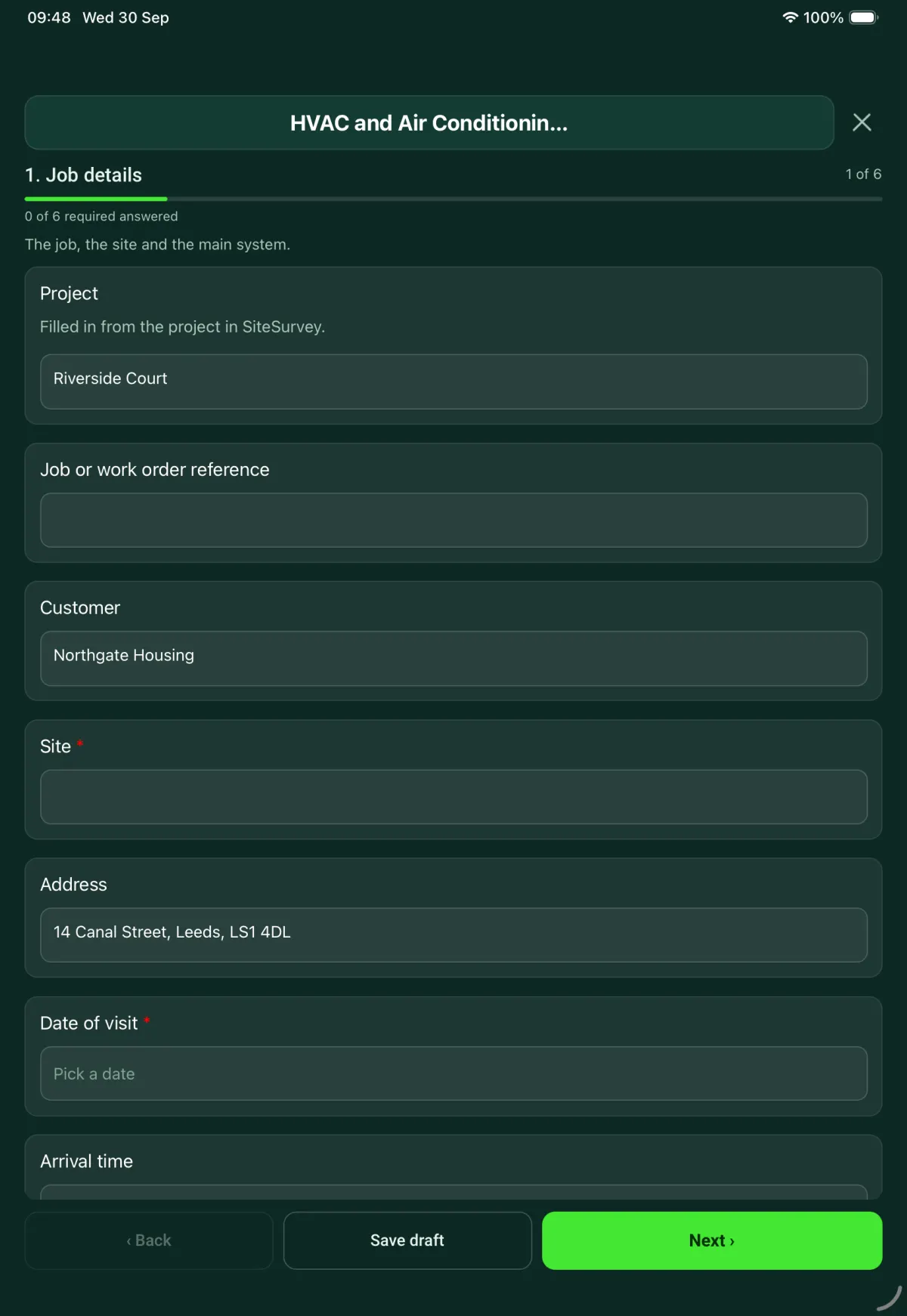
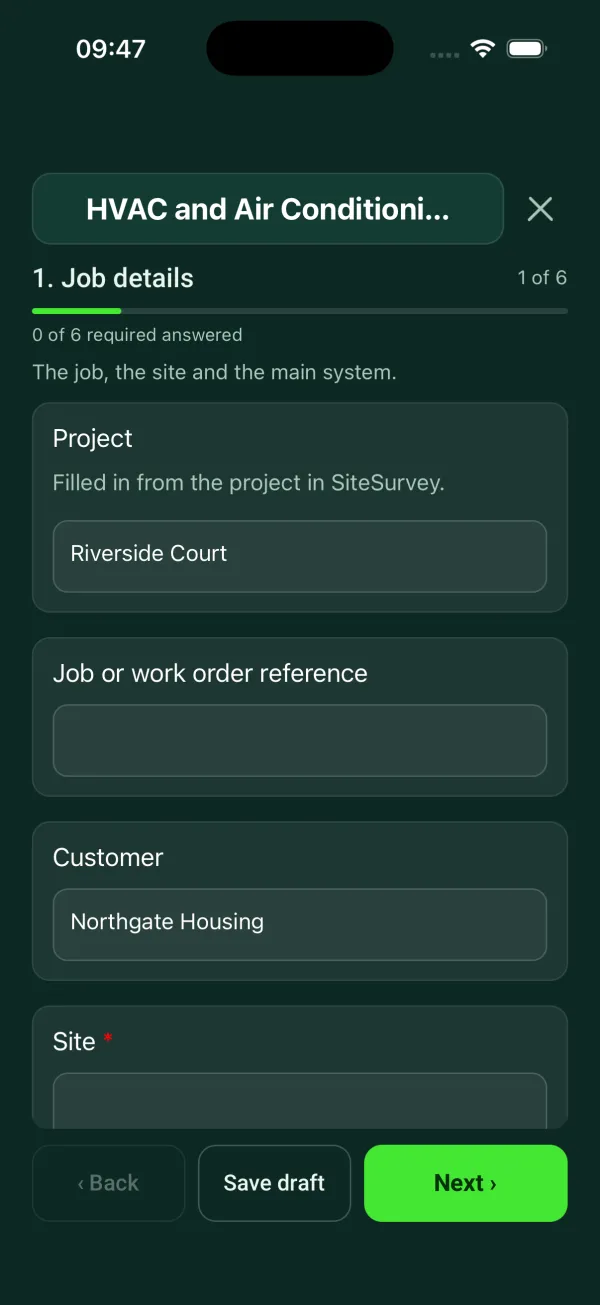
Every question in the HVAC maintenance template
Service visit record for air conditioning, heat pumps, ventilation and air handling units. Unit by unit checks, refrigerant and F gas leak checks, parts used and sign-off. 6 sections and 84 questions. Follow-up questions and guidance appear only when an answer calls for them, so the person on site never sees the ones that do not apply.
Details you only enter once
Add this form to a project in SiteSurvey and it fills in what the project already knows, so nobody on site retypes it and every form on the job uses the same names. Anything filled in can still be changed.
- Project: the project name
- Customer: the project's customer
- Site: the site, when the form is opened for a space or a product
- Address: the site address, from the space or the project
- Manufacturer of the main system: the product's manufacturer
- Model: the product's model
Job details
The job, the site and the main system.
- ProjectShort answerFills in from the project name
- Job or work order referenceShort answer
- CustomerShort answerFills in from the project's customer
- Site*Short answerFills in from the site, when the form is opened for a space or a product
- AddressShort answerFills in from the site address, from the space or the project
- Date of visit*Date
- Arrival timeTime
- Type of visit*Choose one
- Planned service
- Reactive call-out
- Return visit for a defect
- Which planned service is this?Choose one
- Monthly
- Quarterly
- Six monthly
- Annual
Shown when “Type of visit” is “Planned service” - What was reported, and by whom?NotesShown when “Type of visit” is “Reactive call-out”
- Reference of the earlier jobShort answerShown when “Type of visit” is “Return visit for a defect”
- Manufacturer of the main systemShort answerFills in from the product's manufacturer
- ModelShort answerFills in from the product's model
- Serial numberShort answer
- Engineer nameShort answer
- Does any of the work need a permit from the site?Yes or No
- Which permits?Tick all that apply
- Roof access
- Electrical isolation
- Hot work
- Confined space
- Other (describe)
Shown when “Does any of the work need a permit from the site?” is Yes - Permit referencesShort answerShown when “Does any of the work need a permit from the site?” is Yes
F gas competence and site
Certificates for the work, and where the site is.
- Where is the site?Choose one
- England, Scotland or Wales
- Northern Ireland
- GuidanceGreat Britain. The F gas notes in this form follow the rules as they apply in Great Britain: Regulation (EU) No 517/2014 as retained in GB law, with the Fluorinated Greenhouse Gases Regulations 2015.Shown when “Where is the site?” is “England, Scotland or Wales”
- CheckNorthern Ireland. Northern Ireland is part of the EU F gas system, so the Great Britain notes in this form may not match the rules there. Check the current EU requirements for this site.Shown when “Where is the site?” is “Northern Ireland”
- Does the engineer hold a personal F gas certificate for stationary refrigeration, air conditioning and heat pumps?*Yes or No
- Certificate categoryChoose one
- Category 1
- Category 2
- Category 3
- Category 4
Shown when “Does the engineer hold a personal F gas certificate for stationary refrigeration, air conditioning and heat pumps?” is Yes - Certificate numberShort answerShown when “Does the engineer hold a personal F gas certificate for stationary refrigeration, air conditioning and heat pumps?” is Yes
- GuidanceWhat each category covers. Category 1 covers all activities. Category 2 covers installing, maintaining, servicing and recovering refrigerant on systems with less than 3kg of F gas, or less than 6kg if hermetically sealed. Category 3 covers recovery only on those smaller systems. Category 4 covers leak checks that do not break into the refrigeration circuit.Shown when “Does the engineer hold a personal F gas certificate for stationary refrigeration, air conditioning and heat pumps?” is Yes
- WarningNo F gas certificate. It is against the law to work on equipment containing F gas without the correct qualification. Do not check for leaks, recover gas or work on the refrigerant circuit. Record the non refrigerant checks only and book a certified engineer.Shown when “Does the engineer hold a personal F gas certificate for stationary refrigeration, air conditioning and heat pumps?” is No
- Is the company certified to work on F gas equipment for others?Yes or No
- Certification bodyChoose one
- Refcom
- F-Gas Register (Quidos)
- Bureau Veritas
- Other (describe)
Shown when “Is the company certified to work on F gas equipment for others?” is Yes - Company certificate numberShort answerShown when “Is the company certified to work on F gas equipment for others?” is Yes
- CheckA company, including a sole trader, that installs, repairs, maintains or decommissions stationary air conditioning, refrigeration or heat pump equipment operated by others must be certified by an approved body. A company servicing only its own equipment does not need company certification.Shown when “Is the company certified to work on F gas equipment for others?” is No
- Is there a cooling tower or evaporative condenser on this site?Yes or No
- CheckCooling towers and evaporative condensers. The Notification of Cooling Towers and Evaporative Condensers Regulations 1992 require the person in control of the premises to notify the local authority in writing of these devices. HSE guidance is that they need measures to prevent or control the risk of legionella (see HSE L8). This form does not cover that work.Shown when “Is there a cooling tower or evaporative condenser on this site?” is Yes
- Has the client told you the devices are notified to the local authority?Yes or NoShown when “Is there a cooling tower or evaporative condenser on this site?” is Yes
Unit by unit record
One entry for each unit. Checks, temperatures, refrigerant and leak check.
- GuidanceWhat a good photo shows. Stand back to show the whole unit and its rating label, so the refrigerant and charge can be read. Then photograph any defect close up.
- Units servicedRepeat for each unit. Each one asks:
- Type of unit*Choose one
- Split or multi-split air conditioning
- VRF or VRV system
- Packaged unit
- Air handling unit
- Fan coil unit
- Heat pump
- Mechanical ventilation or MVHR
- Chiller
- Unit or asset referenceShort answer
- LocationShort answer
- ManufacturerShort answer
- ModelShort answer
- Serial numberShort answer
- Photos before the workPhotos
- FiltersChoose one
- Cleaned
- Replaced
- Checked, no action needed
- No access
- CoilsChoose one
- Clean
- Cleaned on this visit
- Dirty, needs a deeper clean
- Damaged
- Condensate drain and pumpChoose one
- Clear
- Cleared on this visit
- Blocked or leaking
- Not applicable
- CheckCondensate problem. A blocked drain or failed pump can overflow onto ceilings and electrics. Record it as a defect below and tell the site contact.Shown when “Condensate drain and pump” is “Blocked or leaking”
- Fans and beltsChoose one
- Satisfactory
- Adjusted
- Belt replaced
- Defect found
- Not applicable
- Electrical connections and controlsChoose one
- Satisfactory
- Connections tightened
- Defect found
- Supply air or flow temperature (°C)Number
- Return air or return temperature (°C)Number
- Temperature difference, return minus supply (°C)Worked out by the formShown when “Supply air or flow temperature (°C)” is answered and “Return air or return temperature (°C)” is answered
- Does this unit hold F gas refrigerant?Yes or No
- Refrigerant, from the labelShort answerShown when “Does this unit hold F gas refrigerant?” is Yes
- Charge (kg)NumberShown when “Does this unit hold F gas refrigerant?” is Yes
- Global warming potential of the gasNumberShown when “Does this unit hold F gas refrigerant?” is Yes
- Carbon dioxide equivalent (tonnes)Worked out by the formShown only when the answers above make it relevant
- Is the unit labelled as hermetically sealed?Yes or NoShown when “Does this unit hold F gas refrigerant?” is Yes
- Is a leak detection system fitted?Yes or NoShown when “Does this unit hold F gas refrigerant?” is Yes
- GuidanceUnder 5 tonnes. The F gas rules do not require leak checks for this unit.Shown only when the answers above make it relevant
- GuidanceHermetically sealed and under 10 tonnes. The F gas rules do not require leak checks for this unit, as long as it is labelled as hermetically sealed.Shown only when the answers above make it relevant
- Check5 tonnes or more, under 50. Leak checks are due at least once every 12 months, or every 24 months where a leak detection system is fitted.Shown only when the answers above make it relevant
- Check50 tonnes or more, under 500. Leak checks are due at least once every 6 months, or every 12 months where a leak detection system is fitted.Shown only when the answers above make it relevant
- Warning500 tonnes or more. Leak checks are due at least once every 3 months, or every 6 months with a leak detection system. Equipment of this size must have a leak detection system that alerts the operator or a service company.Shown only when the answers above make it relevant
- Date of the previous leak check, from the F gas recordDateShown when “Does this unit hold F gas refrigerant?” is Yes
- Days since the previous leak checkWorked out by the formShown when “Does this unit hold F gas refrigerant?” is Yes and “Date of the previous leak check, from the F gas record” is answered and “Date of visit” is answered
- Was a leak check done on this visit?Yes or NoShown when “Does this unit hold F gas refrigerant?” is Yes
- Result of the leak checkChoose one
- No leak found
- Leak found and repaired
- Leak found, repair still needed
Shown when “Does this unit hold F gas refrigerant?” is Yes and “Was a leak check done on this visit?” is Yes - Where was the leak?Short answerShown only when the answers above make it relevant
- WarningLeak found. The operator must have the leak repaired without undue delay. Where the unit is subject to leak checks, a certified person must check it within one month of the repair to confirm the repair worked. Tell the site contact today.Shown only when the answers above make it relevant
- Refrigerant added (kg)NumberShown when “Does this unit hold F gas refrigerant?” is Yes
- Refrigerant recovered (kg)NumberShown when “Does this unit hold F gas refrigerant?” is Yes
- Photos after the workPhotos
- Any defects on this unit?Yes or No
- Describe the defectNotesShown when “Any defects on this unit?” is Yes
- PriorityChoose one
- Routine, at the next service
- Soon, before the next service
- Urgent
Shown when “Any defects on this unit?” is Yes - How was the unit left?Choose one
- Running normally
- Running with a defect
- Isolated and labelled out of use
- Units servicedWorked out by the form
- Units with a leak still to repairWorked out by the form
F gas records
What has been recorded for the operator.
- Have the F gas records been updated for every unit that needs them?Yes or No
- Who holds the F gas records for this site?Short answer
- GuidanceF gas records. For equipment that needs leak checks, the operator must keep records of the type and quantity of gas installed and added, the gas recovered, who installed or serviced it, and the dates and results of the leak checks, for at least 5 years. A company doing the work for an operator keeps copies for 5 years too.
- CheckThe records have not been updated. Give the client the refrigerant, charge, leak check result and any gas added or recovered from this form so they can add them.Shown when “Have the F gas records been updated for every unit that needs them?” is No
Outcome and parts
How the visit ended and what was used.
- Outcome of the visit*Choose one
- All units serviced and working
- Serviced, defects to follow up
- Not completed
- What needs doing next, and why?NotesShown only when the answers above make it relevant
- WarningAt least one unit has a leak still to repair. Make sure the client knows and a repair visit is booked.Shown only when the answers above make it relevant
- RecommendationsNotes
- Did you use any parts or materials?Yes or No
- Parts and materials usedRepeat for each part. Each one asks:Shown when “Did you use any parts or materials?” is Yes
- ItemShort answer
- Part numberShort answer
- QuantityNumber
- Total quantity usedWorked out by the formShown when “Did you use any parts or materials?” is Yes
- Next service dueDate
- Days until the next serviceWorked out by the formShown when “Next service due” is answered and “Date of visit” is answered
- Departure timeTime
Sign-off
The customer signs for the visit. The engineer signs for the work.
- Is the customer or their representative available to sign?Yes or No
- Why not, and who will you send the report to?Short answerShown when “Is the customer or their representative available to sign?” is No
- Customer nameShort answerShown when “Is the customer or their representative available to sign?” is Yes
- PositionShort answerShown when “Is the customer or their representative available to sign?” is Yes
- Customer commentNotesShown when “Is the customer or their representative available to sign?” is Yes
- Customer signatureSignatureShown when “Is the customer or their representative available to sign?” is Yes
- Engineer nameShort answer
- Engineer signatureSignature
HVAC maintenance template questions
How often does air conditioning need an F gas leak check?
It depends on the charge in tonnes of carbon dioxide equivalent, which the form works out from the charge and the global warming potential on the label. Under 5 tonnes, no leak checks are required, nor for a unit labelled hermetically sealed under 10 tonnes. From 5 to under 50 tonnes it is every 12 months, from 50 to under 500 every 6 months, and 500 tonnes or more every 3 months, with longer intervals where a leak detection system is fitted.
What F gas records must be kept?
For equipment that needs leak checks, the operator must keep records of the type and quantity of gas installed and added, the gas recovered, who installed or serviced it, and the dates and results of the leak checks, for at least 5 years. A company doing the work for an operator keeps copies for 5 years too. The form asks whether the records have been updated and who holds them.
Which F gas certificate does an engineer need?
It is against the law to work on equipment containing F gas without the correct qualification. Category 1 covers all activities, Category 2 covers work on systems under 3kg, or 6kg if hermetically sealed, Category 3 is recovery only on those, and Category 4 is leak checks that do not break into the circuit. A company working on others' equipment must also be certified by an approved body.
What happens if a leak is found?
The operator must have the leak repaired without undue delay. Where the unit is subject to leak checks, a certified person must check it within one month of the repair to confirm the repair worked. The form records where the leak was and whether it was repaired, counts the units with a leak still to repair and prompts you to make sure a repair visit is booked.
Does it apply in Northern Ireland, and does it cover cooling towers?
The F gas notes follow the rules in Great Britain: Regulation (EU) No 517/2014 as retained in GB law. Northern Ireland is part of the EU F gas system, so check the current EU requirements there. Cooling towers and evaporative condensers must be notified to the local authority in writing and need legionella controls, but the form does not cover that work.
Can the customer sign the service record on site?
Yes. The customer gives their name, position and a comment and signs on the device, and the engineer signs for the work. If nobody is there to sign, the form records why and who gets the report. In the SiteSurvey app it works offline, with before and after photos against each unit, and the report goes out as a PDF or a share link.
Related
Related templates
Templates that go with the HVAC maintenance form
Planned maintenance visit: records seen, asset by asset tasks, water temperatures, work done and next visit.
Job sheet for a reactive or planned job: safety before starting, work done, parts used, tests, outcome and customer sign-off.
Build or update an asset register: asset records with make, model, serial, condition and photos, changes to the register.
Inspection round for plant: asset condition, refrigerant and leak checks, pressure vessels, next due dates.
Use this HVAC maintenance form with your team
Add it from the form library in one click, change any question, and every completed form becomes a branded PDF report.
Start your trial →