POINT 01
Boundary line
Walk the fence line from a start point you can find again, such as a gate or corner.
A timber panel fence runs along a site boundary from a corner gate.
Form library · Facilities and maintenance
A walk of a fence line or site boundary to find fence damage before it lets people in or animals out. Record why the boundary is there, whether it is a construction site perimeter and whether a public right of way crosses it, then add each section with its type and length and check posts, panels, gaps, anything that helps people climb over and barbed wire. Record the result, how a breach was made safe and photos. The form totals the length walked, counts sections needing repair and breaches, checks each gate's hinges, latch and lock, and ends with an optional Walk Cam route and actions. Every question is listed below, and you can fill the live form in on this page.
Ready to use from the form library, and every question is yours to edit. Trial from £1, cancel any time.
Try it on your phone
Try it on this phone
Fill in the fence inspection on your phone now
See how the fence inspection looks on your phone
Scan the code with your phone camera. It opens the real form, no sign-up needed.
Open the live example and fill it in, just as your team would on site. No sign-up needed.
See it on this phoneEvery question is editable. Add this form to your account, then change the wording, add or remove questions and options, and make it fit your own jobs.
Walk the line from a start point you can find again and check each section: posts upright and firm, panels, rails or mesh intact, no gaps under or through, nothing next to it that helps people climb over, and any barbed or razor wire. Check each gate closes, latches and locks. Under section 2 of the Occupiers' Liability Act 1957, an occupier must take reasonable care to see that visitors will be reasonably safe, and must be prepared for children to be less careful than adults.
Last updated . Facts checked by the SiteSurvey team on 17 October 2026 against section 2 of the Occupiers' Liability Act 1957 (common duty of care), section 1 of the Occupiers' Liability Act 1984 (duty to people other than visitors), HSE: protecting the public from construction work and Leeds City Council: landowner responsibilities for public rights of way.
Answer a few questions and watch it adapt. Your answers are not saved, and any photos you add are deleted within the hour.
Open the completed example to see fictional readings, notes, photos and calculations. Choose Blank form to try entering your own answers.
Want to see one filled in? See a completed fence inspection report (PDF), made by SiteSurvey from a fictional site visit.
Walk Cam route · four guided clips
Walk the boundary from a fixed start point and stop on leaning posts, broken panels, gaps and gates that do not close.
Record the site, boundary section, start point and date. Keep the next posts in frame so lean is easy to see. The four AI-generated clips illustrate one route, not a real site.
Walk the fence line from a start point you can find again, such as a gate or corner.
A timber panel fence runs along a site boundary from a corner gate.
Stop on any post that leans, rocks or is broken, keeping the next posts in frame for comparison.
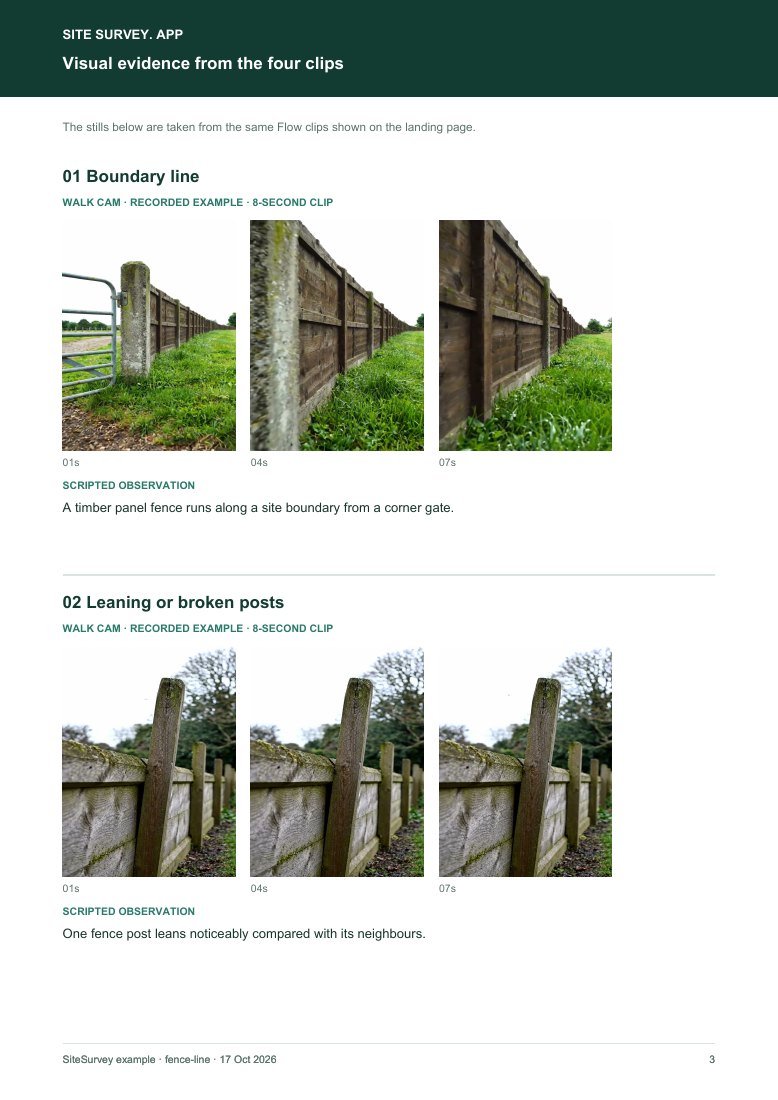
One fence post leans noticeably compared with its neighbours.
Film broken panels, gaps under the fence and anything that would let people or animals through.
A broken fence panel leaves a gap at ground level.
Show the gate, hinges and latch, and whether it closes and stays shut.
A timber gate hangs on its hinges with the latch in view.
A fictional six-page example with the four points, twelve stills from the clips, observations, follow-up actions and the limits of a visual record.
View the visual evidence (PDF) ↗ · Download the full sample report
Video records visible condition. It cannot confirm a boundary keeps people or animals out, show post rot below ground or settle who owns the fence. Example footage was generated in Google Flow and the observations are scripted; no real site is shown. Walk Cam works inside any form in the app. How Walk Cam works · All visual inspections
A fence and boundary inspection: what the boundary is for, each section with its type, posts, panels, gaps and climbing aids, gates with hinges, latches and locks, breaches made safe, photos and repair actions. 3 sections and 61 questions. Follow-up questions and guidance appear only when an answer calls for them, so the person on site never sees the ones that do not apply.
This is a starting point, not a fixed form. Once it is in your SiteSurvey account you can reword any question, add or remove questions, sections and answer options, and add your own logo, so it fits the way your team works and the jobs you do.
Add this form to a project in SiteSurvey and it fills in what the project already knows, so nobody on site retypes it and every form on the job uses the same names. Anything filled in can still be changed.
Record estimated current conditions and add what you observe on site.
Optional. From the site plan, the client's specification or your security risk assessment. The form compares each section with it.
Optional. Mark both ends, so the repair team finds the section.
By tape, pacing or the site plan.
Optional. Use a tape, or measure from a photo taken square on with something of known size in the same plane, such as a standard 1.83 m (6 ft) panel width.
Optional. Film the four guided points on the SiteSurvey app; each clip keeps its spoken note.
Set by the owner's own inspection regime. Also inspect after storms and reports of damage.
A condition record of a fence or boundary. It is not a legal boundary survey, a structural check of a wall or a security risk assessment.
Damage found and how a breach was made safe
Name the section by fixed points, say what is damaged and how a breach was made safe on the day. Set the permanent repair as an action.
Post 14 leaning after the storm and the panel beside it broken with a gap at ground level. Temporary mesh clipped across and the post propped.
Fictional example of record wording. Use the actual evidence and approved arrangements for your job; this is not a completed report or an instruction to carry out the work.
A completed fence inspection report, made by SiteSurvey from a fictional site visit: every answer, the photos, the guidance that applied and the sign-off, ready to send as a PDF.
HSE says construction sites need measures to manage access across defined boundaries and steps to exclude unauthorised people, and that you should plan the perimeter, provide the fencing and maintain it. In populated areas, HSE says this will typically mean a two-metre high small mesh fence or hoarding.
Leeds City Council's guidance for landowners says gates and stiles on rights of way are the landowner's to maintain, barbed wire must not be strung across a right of way, and the council's consent is needed before an electric fence is put across one. Check your own council's rules.
Section 1 of the Occupiers' Liability Act 1984 can give an occupier a duty to people other than visitors, where the occupier knows of a danger, has reason to believe someone may come near it and could reasonably be expected to offer some protection. A boundary record shows what was checked and done.
Make it safe straight away, for example with temporary mesh panels, record how, and set a repair action with an owner and date. The form counts breaches separately from repairs.
An optional step on the SiteSurvey app: four short guided clips of the boundary line, leaning or broken posts, damaged panels and gaps, and the gate and latch, each with a spoken note.
Facilities and estates teams, depot and site managers, schools, housing associations, landowners and site security contractors.
Related templates
A security patrol record covering the assigned route, timed checkpoint observations, access restrictions, incidents, escalation and shift handover.
A park and open space inspection: paths, benches, bins, signs, fencing and gates, trees, water features, lighting, litter and hazards, each issue with risk, photos and action.
A grounds maintenance visit record: each area with tasks done, photos and issues, weed control, nesting bird checks before hedge work, waste removed, and the client's sign-off as proof of visit.
Add it from the form library in one click, change any question, and every completed form becomes a branded PDF report.
Start your trial →