A surface inspection of manhole and inspection chamber covers, done without lifting a cover or entering a chamber. Add each cover with its location, what uses it, the drain and who is likely responsible, then check the cover for cracks and missing pieces, whether it sits level, the frame and surround, and any standing water, silt or sewage staining. Record the result, how a dangerous cover was made safe and photos from above. The form counts covers needing repair and dangerous covers, and ends with an optional Walk Cam route, who it was reported to and actions. Every question is listed below, and you can fill the live form in on this page.
✎Every question is editable. Add this form to your account, then change the wording, add or remove questions and options, and make it fit your own jobs.
Prefer paper? Download a printable copy: PDF or Word
What does a manhole inspection check?
A surface manhole inspection checks where each cover is and what traffic uses it, the cover for cracks, breaks and missing pieces, whether it rocks or sits proud, the frame and the paving or tarmac around it, and signs of blockage such as standing water, silt or sewage staining. It is done from above. HSE INDG258 lists sewers and enclosed drains as confined spaces and says the first duty is to avoid entry, so lifting a cover or going into a chamber needs the right competence, equipment and controls.
Film each cover from above with its location in frame: cracks, gaps, sinking around the frame and signs of blockage.
Record the site, cover location and what passes over it. Film from the surface only. The four AI-generated clips illustrate one route, not a real site.
POINT 01
Cover location
Show where the cover is in relation to the building, path or road, and any traffic or pedestrian use over it.
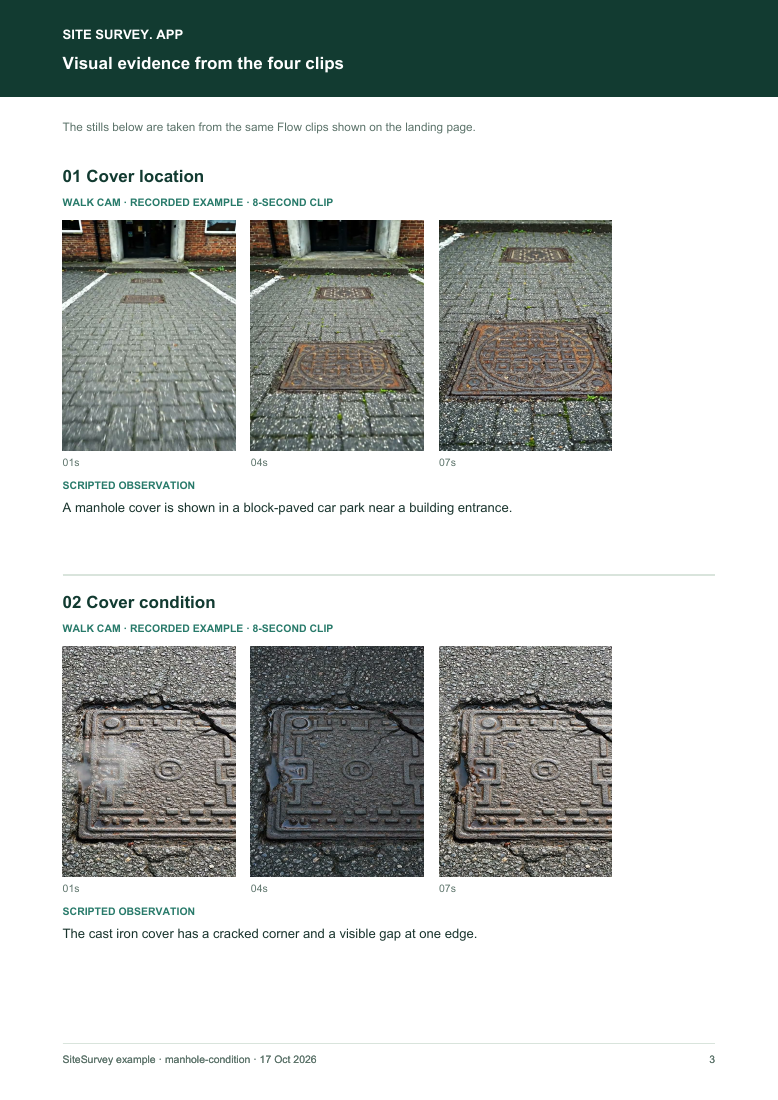
A manhole cover is shown in a block-paved car park near a building entrance.
POINT 02
Cover condition
Film the cover from above: cracks, missing pieces, rocking or a gap around it. Do not lift it.
The cast iron cover has a cracked corner and a visible gap at one edge.
POINT 03
Frame and surround
Show the frame and the paving or tarmac around it for sinking, cracking or loose blocks.
Block paving around the frame has sunk and cracked.
POINT 04
Signs of blockage or flooding
Look for standing water, silt or sewage staining around the cover. Never open or enter the chamber for the clip.
Silt and water staining surround the cover after rain.
See the footage in a report
A fictional six-page example with the four points, twelve stills from the clips, observations, follow-up actions and the limits of a visual record.
Video shows the surface condition of the cover and surround. It does not show the chamber or the drain, and nobody should lift a cover or enter a manhole without the right competence and controls. Example footage was generated in Google Flow and the observations are scripted; no real site is shown. Walk Cam works inside any form in the app. How Walk Cam works · All visual inspections
Every question in the manhole inspection template
A surface inspection of manhole and inspection chamber covers: location and use, cover, seating, frame and surround, signs of blockage or flooding, who is responsible, risk, photos and actions. No covers lifted. 3 sections and 56 questions. Follow-up questions and guidance appear only when an answer calls for them, so the person on site never sees the ones that do not apply.
✎
Make it your own: every question is editable
This is a starting point, not a fixed form. Once it is in your SiteSurvey account you can reword any question, add or remove questions, sections and answer options, and add your own logo, so it fits the way your team works and the jobs you do.
Details you only enter once
Add this form to a project in SiteSurvey and it fills in what the project already knows, so nobody on site retypes it and every form on the job uses the same names. Anything filled in can still be changed.
Project: the project name
Client: the project's customer
Site: the site, when the form is opened for a space or a product
Site address: the site address, from the space or the project
1
Site
ProjectShort answer
Fills in from the project name
ClientShort answer
Fills in from the project's customer
Site*Short answer
Fills in from the site, when the form is opened for a space or a product
Site addressShort answer
Fills in from the site address, from the space or the project
Inspection date*Date
TimeTime
Inspector*Short answer
Reason for the inspectionChoose one
Routine
After a report of a damaged cover
After flooding or heavy rain
Trip intervention level for this site (mm)Number
From your site or estate maintenance policy, or the highway authority's for covers in a road or footway. The form compares each cover with it; it does not set a level.
WarningThis is a surface check. Do not lift a cover or enter a chamber without the right competence, equipment and controls. HSE INDG258 lists sewers and enclosed drains as confined spaces, says poisonous gas can build up in sewers and manholes, and says the first duty under the Confined Spaces Regulations 1997 is to avoid entry, for example by doing the work from outside the space.
GuidanceIn England, since 1 October 2011 private sewers (drains shared by two or more properties) and lateral drains (serving one property but outside its own grounds) are the responsibility of the water and sewerage company. A drain serving one property within its own grounds stays the owner's responsibility (Defra).
Weather captureAnswer
Record estimated current conditions and add what you observe on site.
2
Covers
Covers by area of the site
Repeat for each entry. Each one asks:
Area of the site*Short answer
For example Car park, Rear yard or Footpath by block B
Covers in this area
Repeat for each cover. Each one asks:
Cover reference*Short answer
Position in this areaShort answer
Position (GPS)Short answer
Stand at the cover and tap Mark current location, so the repair crew or the water company finds the same cover. Mark current location works on web forms today; the app version is on its way.
Used byChoose one
Pedestrians only
Car park or yard vehicles
Road traffic
Inside a building
Load class marked (BS EN 124)Choose one
A15
B125
C250
D400
E600
F900
Not marked or unreadable
CheckThe marked load class looks low for where this cover is. BS EN 124 classes covers from A15 (pedestrians and cyclists) to F900. Carriageways normally need at least D400, and car parks and yards at least B125. Check what traffic actually crosses it.
Shown only when the answers above make it relevant
DrainChoose one
Foul
Surface water
Combined
Not known
Likely responsibilityChoose one
Site owner
Water and sewerage company
Highway authority
Not known
Cover: no cracks, breaks or missing piecesChoose one
OK
Defect
Sits level and does not rockChoose one
OK
Defect
Frame and surround: no sinking, cracking or loose blocksChoose one
OK
Defect
No standing water, silt or sewage stainingChoose one
OK
Defect
Clear opening length (mm)Number
Inside the frame. Photograph the cover from straight above with something of known size lying flat beside it, such as an A4 sheet (297 mm long), and measure from the photo. Check with a tape before ordering a replacement.
Clear opening width (mm)Number
Step between the cover and the surround (mm)Number
The largest step up or down at the edge of the frame, with a straight edge and rule.
Step against the trip levelWorked out by the form
Shown only when the answers above make it relevant
c_trip_flagWorked out by the form
c_report_flagWorked out by the form
Sewage smell?Yes or No
Result*Choose one
Safe
Repair needed
Dangerous: made safe and kept clear
What is wrong?Short answer
Shown only when the answers above make it relevant
How it was made safe (barrier, cones, temporary cover)Short answer
Shown only when the answers above make it relevant
Photos (from above, without lifting the cover)Photos
This area: covers inspectedWorked out by the form
This area: covers needing repairWorked out by the form
This area: dangerous coversWorked out by the form
This area: steps at or over the trip levelWorked out by the form
This area: defects to report to the water company or highway authorityWorked out by the form
Covers inspectedWorked out by the form
Covers needing repairWorked out by the form
Dangerous coversWorked out by the form
Steps at or over the trip levelWorked out by the form
Defects to report to the water company or highway authorityWorked out by the form
WarningA broken, missing or rocking cover is a fall and trip hazard. HSE's guidance on protecting the public says people can be injured falling into manholes and that barriers or covers are needed. Keep people away and report it straight away.
Shown only when the answers above make it relevant
CheckSome defective covers are likely to belong to the water and sewerage company or the highway authority. Report them and record the reference under Reported to.
Shown only when the answers above make it relevant
Walk Cam: manhole inspectionWalk Cam video with voice-to-text
Optional. Film the four guided points on the SiteSurvey app; each clip keeps its spoken note.
3
Actions and sign-off
Reported to (owner, water company or highway authority) and referenceShort answer
Next inspection dueDate
Set by the site owner or duty holder.
Days to the next inspectionWorked out by the form
Shown when “Inspection date” is answered and “Next inspection due” is answered
CheckThe next inspection date is before the inspection date. Check the date.
Shown only when the answers above make it relevant
Are further actions needed?Yes or No
Further actions
Repeat for each action. Each one asks:
Shown when “Are further actions needed?” is Yes
What needs doing?*Notes
PriorityChoose one
Urgent
High
Medium
Low
Who will do it?Short answer
Due dateDate
StatusChoose one
Open
In progress
Completed
Inspector name*Short answer
Position or companyShort answer
Inspector signatureSignature
CheckSigning records what was found on the day. It does not make unsafe equipment safe or replace a thorough examination, design check or service by a competent person.
Scope and responsibility
A surface condition record only. It is not a confined space entry permit, a CCTV drain survey, a structural assessment of the chamber or a load rating for the cover.
What a useful entry looks like
Cover condition and how it was made safe
Describe what can be seen from above without lifting the cover. Say how a dangerous cover was made safe and who it was reported to.
Cover corner cracked off and the cover rocks under load. Bay coned off and a barrier placed over it; reported to the centre manager.
Fictional example of record wording. Use the actual evidence and approved arrangements for your job; this is not a completed report or an instruction to carry out the work.
See it filled in
A completed manhole inspection report, made by SiteSurvey from a fictional site visit: every answer, the photos, the guidance that applied and the sign-off, ready to send as a PDF.
Not as part of this check. HSE says poisonous gas can build up in sewers and manholes, and the Confined Spaces Regulations 1997 put avoiding entry first, for example by doing the work from outside. Lifting covers and working in chambers should be planned by someone competent with a safe system of work and emergency arrangements.
Who is responsible for a manhole?
In England, since 1 October 2011, private sewers shared by two or more properties and lateral drains outside a property's grounds have been the water and sewerage company's responsibility. A drain serving one property within its own grounds stays the owner's. The form records the likely owner for each cover.
What if a cover is broken or missing?
Treat it as dangerous: keep people and vehicles off it with barriers or cones, record how it was made safe and report it. HSE's guidance on protecting the public says people can be injured falling into manholes and that barriers or covers are needed.
Does the form give load ratings for covers?
No. It records what traffic uses the cover, such as pedestrians, car park vehicles or road traffic, so a supplier or engineer can choose the right replacement.
What is the Walk Cam route?
An optional step on the SiteSurvey app: four short guided clips of the cover location, the cover, the frame and surround, and signs of blockage, each with a spoken note. None of them needs the cover lifted.
Who uses this?
Estates and facilities teams, retail park and car park managers, housing associations, schools and drainage contractors doing a first look before a CCTV survey.