Form library · Health and safety
Confined space risk assessment template
For people assessing work associated with a confined space. Record space and alternatives, hazards and controls and safe system references. Try the form below, see every question or download a blank PDF or Word copy.
Ready to use from the form library, and every question is yours to edit. Trial from £1, cancel any time.
Try it on your phone
Try it on this phone
Fill in the confined space risk assessment on your phone now
See how the confined space risk assessment looks on your phone
Scan the code with your phone camera. It opens the real form, no sign-up needed.
Open the live example and fill it in, just as your team would on site. No sign-up needed.
See it on this phoneEvery question is editable. Add this form to your account, then change the wording, add or remove questions and options, and make it fit your own jobs.
What is the first decision for confined-space work?
HSE states that entry should be avoided where possible. Where entry is unavoidable, a safe system of work and suitable emergency arrangements are required. Assess the space and task before deciding the controls.
Last updated . Facts checked by the SiteSurvey team on 6 October 2026 against HSE confined space legal duties and HSE confined spaces brief guide.
Try the confined space risk assessment form live
Answer a few questions and watch it adapt. Your answers are not saved, and any photos you add are deleted within the hour.
This is the real form as your team would use it: questions appear as you answer, scores work themselves out and you can add photos and signatures. No sign-up needed.
Want to see one filled in? See a completed confined space risk assessment report (PDF), made by SiteSurvey from a fictional site visit.
Fill it in on a phone or tablet
Your team completes the confined space risk assessment on site in the SiteSurvey app on iPhone, iPad and Android phones and tablets. The project name and address fill in for them, it works without signal, and it syncs when the device is back online with photos kept against the question they answer.
Customers and subcontractors do not need the app: send them a link and they can fill it in from any browser.
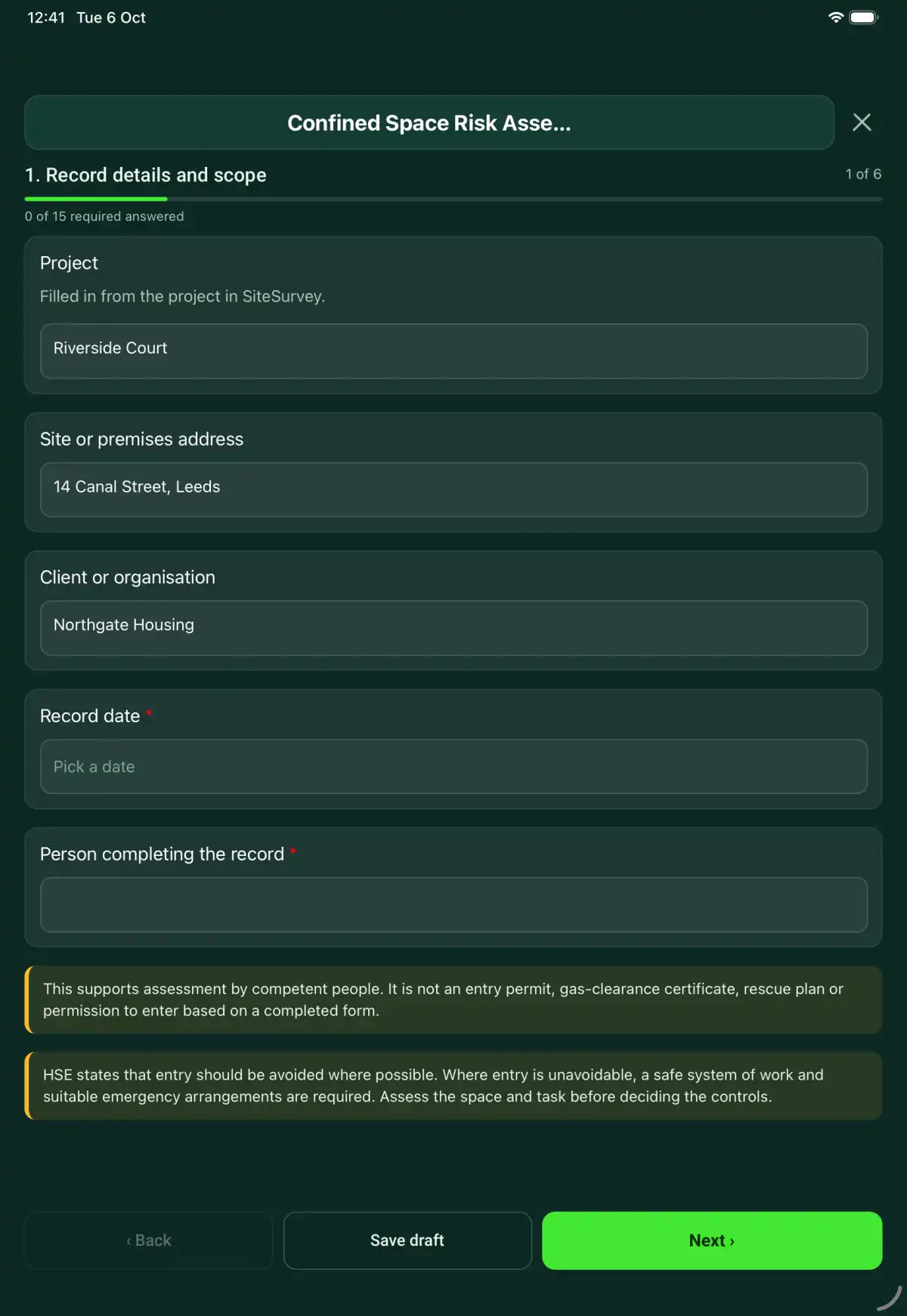
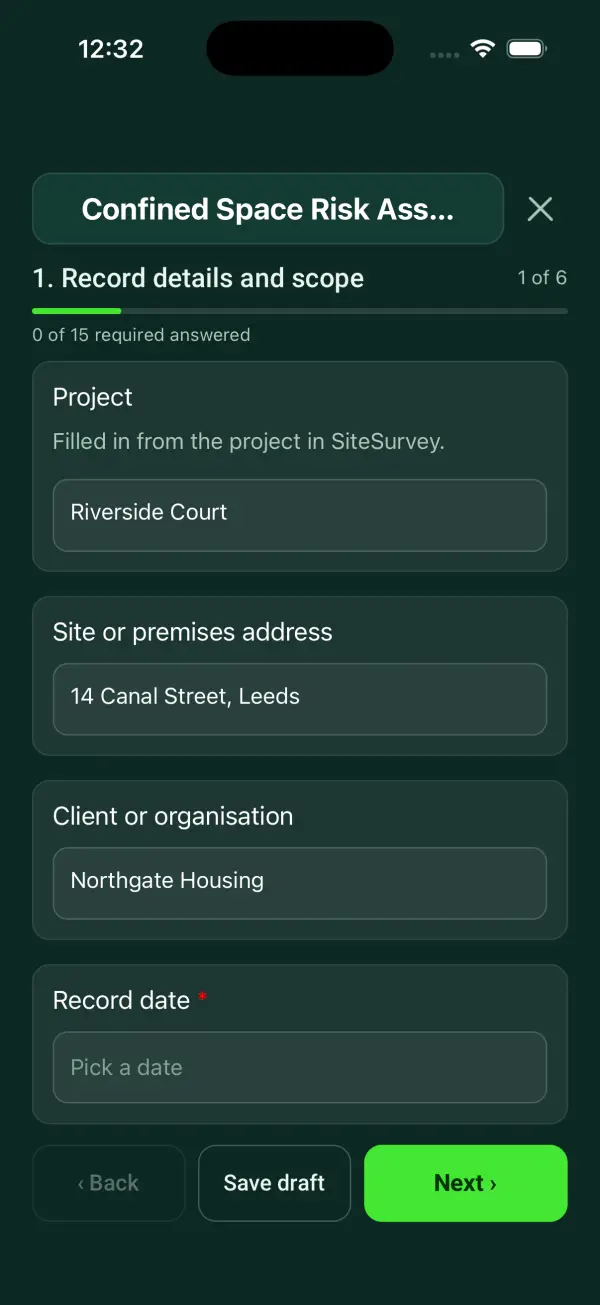
Every question in the confined space risk assessment template
A confined space assessment recording the task, alternatives to entry, specified hazards, controls, safe-system references and rescue planning requirements. 6 sections and 31 questions. Follow-up questions and guidance appear only when an answer calls for them, so the person on site never sees the ones that do not apply.
Make it your own: every question is editable
This is a starting point, not a fixed form. Once it is in your SiteSurvey account you can reword any question, add or remove questions, sections and answer options, and add your own logo, so it fits the way your team works and the jobs you do.
Details you only enter once
Add this form to a project in SiteSurvey and it fills in what the project already knows, so nobody on site retypes it and every form on the job uses the same names. Anything filled in can still be changed.
- Project: the project name
- Site or premises address: the site address, from the space or the project
- Client or organisation: the project's customer
- Space ID, location and task: the space it is opened for
Record details and scope
- ProjectShort answer
Filled in from the project in SiteSurvey.
Fills in from the project name - Site or premises addressShort answerFills in from the site address, from the space or the project
- Client or organisationShort answerFills in from the project's customer
- Record date*Date
- Person completing the record*Short answer
- CheckThis supports assessment by competent people. It is not an entry permit, gas-clearance certificate, rescue plan or permission to enter based on a completed form.
- CheckHSE states that entry should be avoided where possible. Where entry is unavoidable, a safe system of work and suitable emergency arrangements are required. Assess the space and task before deciding the controls.
Space and alternatives
- Space ID, location and task*Short answerFills in from the space it is opened for
- Contents, connected plant and previous use*Notes
- How entry could be avoided and evaluation of alternatives*Notes
Describe alternatives to entry and the evidence behind the chosen approach. Do not start from an assumption that entry is necessary.
- Assessment outcome*Choose one
- Entry avoided
- Further planning needed
- Entry considered unavoidable
Hazards and controls
- HazardRepeat for each hazard. Each one asks:
- Specified risk and task-related hazard*Short answer
- People affected and exposure route*Notes
- Isolation, atmosphere, ingress or other controls*Notes
- How effectiveness will be verified*Notes
Safe system references
- Approved safe system and permit process referenceShort answer
- Atmospheric monitoring plan and competent reviewerShort answer
- Separate rescue plan and readiness evidenceShort answer
- Communication, supervision, training and equipment needsNotes
Assessment review
- Unresolved issues and conditions preventing entry*Notes
- Competent assessment reviewer*Short answer
- Changes requiring reassessmentNotes
Actions and review
- Are further actions required?*Choose one
- Yes
- No
- Further actionRepeat for each further action. Each one asks:Shown when “Are further actions required?” is “Yes”
- Action and evidence reference*Notes
- Person responsible*Short answer
- Target dateDate
- Action status*Choose one
- Open
- In progress
- Completed
- Completion evidence*NotesShown when “Action status” is “Completed”
- Outstanding limitations and information to pass onNotes
- Record status*Choose one
- Ready for review
- Further work needed
- Work or use stopped
- Reviewed byShort answer
- Review dateDate
- Author signature*Signature
- CheckSigning records the information entered. It does not itself certify legal compliance, remove a limitation or authorise unsafe work.
Scope and responsibility
This supports assessment by competent people. It is not an entry permit, gas-clearance certificate, rescue plan or permission to enter based on a completed form.
What a useful entry looks like
How entry could be avoided and evaluation of alternatives
Describe alternatives to entry and the evidence behind the chosen approach. Do not start from an assumption that entry is necessary.
Remote cleaning option reviewed against the task requirements. The assessment records what it can achieve and the unresolved work before any entry decision.
Fictional example of record wording. Use the actual evidence and approved arrangements for your job; this is not a completed report or an instruction to carry out the work.
See it filled in
A completed confined space risk assessment report, made by SiteSurvey from a fictional site visit: every answer, the photos, the guidance that applied and the sign-off, ready to send as a PDF.
Confined Space Risk Assessment FAQs
How should I record “How entry could be avoided and evaluation of alternatives”?
Describe alternatives to entry and the evidence behind the chosen approach. Do not start from an assumption that entry is necessary.
Is this the same as the rescue plan?
No. It identifies risks and required controls and references the separate rescue plan.
Does a single gas reading authorise entry?
No. Entry depends on the approved safe system and all necessary controls, including monitoring and rescue readiness.
Can the public emergency services be the whole rescue plan?
No. Suitable rescue arrangements must be established for the task; do not rely solely on calling emergency services.
What are the limits of this template?
This supports assessment by competent people. It is not an entry permit, gas-clearance certificate, rescue plan or permission to enter based on a completed form.
Can I complete this form on site and share the record?
In the SiteSurvey app the form works offline, with signatures recorded against the questions. Share the completed record as a PDF or a link. Dates and action owners are recorded fields; this form does not send reminders or update other systems.
Related
Related templates
Templates that go with the confined space risk assessment form
A site-specific rescue planning record covering the space, credible emergencies, isolation, rescuers, communications, equipment readiness and practice.
A work-at-height rescue planning record linking credible scenarios, competent responders, approved methods, equipment readiness and briefing evidence.
Use this confined space risk assessment form with your team
Add it from the form library in one click, change any question, and every completed form becomes a branded PDF report.
Start your trial →