Form library · Housing and property
Roof inspection checklist
A roof inspection report form for pitched and flat roofs. Decide how the roof can be seen safely, record each slope or area with its covering, condition and defects, check the details where roofs usually leak, look inside the roof space, then list each repair with a priority, an estimated cost and photos. Every question is listed below, and you can fill the live form in on this page.
Ready to use from the form library, and every question is yours to edit. Trial from £1, cancel any time.
Try it on your phone
Try it on this phone
Fill in the roof inspection on your phone now
See how the roof inspection looks on your phone
Scan the code with your phone camera. It opens the real form, no sign-up needed.
Open the live example and fill it in, just as your team would on site. No sign-up needed.
See it on this phoneEvery question is editable. Add this form to your account, then change the wording, add or remove questions and options, and make it fit your own jobs.
What should a roof inspection checklist include?
A roof inspection checklist should record how the roof was inspected and what could not be seen, the covering and condition of each slope or area, and the details where leaks start: ridges, valleys, flashings, chimneys, verges, gutters, rooflights and penetrations. It should cover the roof space and ceilings for signs of water, then list each defect with a priority and a recommended repair.
Last updated . Facts checked by the SiteSurvey team on 5 October 2026 against HSE guidance on roof work and regulation 9 of the Work at Height Regulations 2005 (fragile surfaces).
Try the roof inspection form live
Answer a few questions and watch it adapt. Your answers are not saved, and any photos you add are deleted within the hour.
This is the real form as your team would use it: questions appear as you answer, scores work themselves out and you can add photos and signatures. No sign-up needed.
Want to see one filled in? See a completed roof inspection report (PDF), made by SiteSurvey from a fictional site visit.
Fill it in on a phone or tablet
Your team completes the roof inspection on site in the SiteSurvey app on iPhone, iPad and Android phones and tablets. The project name and address fill in for them, it works without signal, and it syncs when the device is back online with photos kept against the question they answer.
Customers and subcontractors do not need the app: send them a link and they can fill it in from any browser.
Every question in the roof inspection template
Roof inspection report: safe access, coverings by area, flashings, chimneys, gutters and rooflights, the roof space, defects with priorities, costs and photos. 6 sections and 61 questions. Follow-up questions and guidance appear only when an answer calls for them, so the person on site never sees the ones that do not apply.
Make it your own: every question is editable
This is a starting point, not a fixed form. Once it is in your SiteSurvey account you can reword any question, add or remove questions, sections and answer options, and add your own logo, so it fits the way your team works and the jobs you do.
Details you only enter once
Add this form to a project in SiteSurvey and it fills in what the project already knows, so nobody on site retypes it and every form on the job uses the same names. Anything filled in can still be changed.
- Project: the project name
- Customer: the project's customer
- Property: the site, when the form is opened for a space or a product
- Address: the site address, from the space or the project
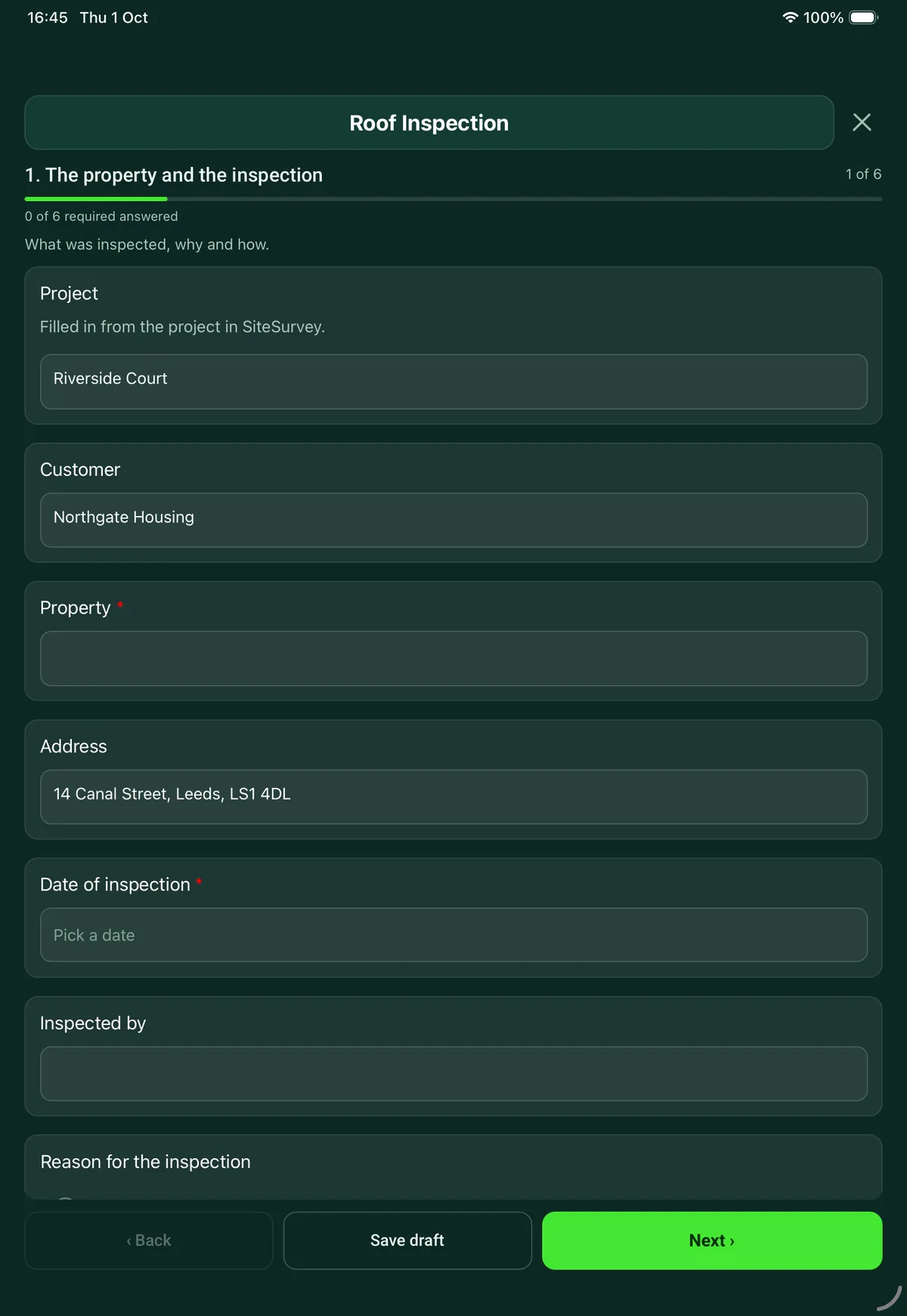
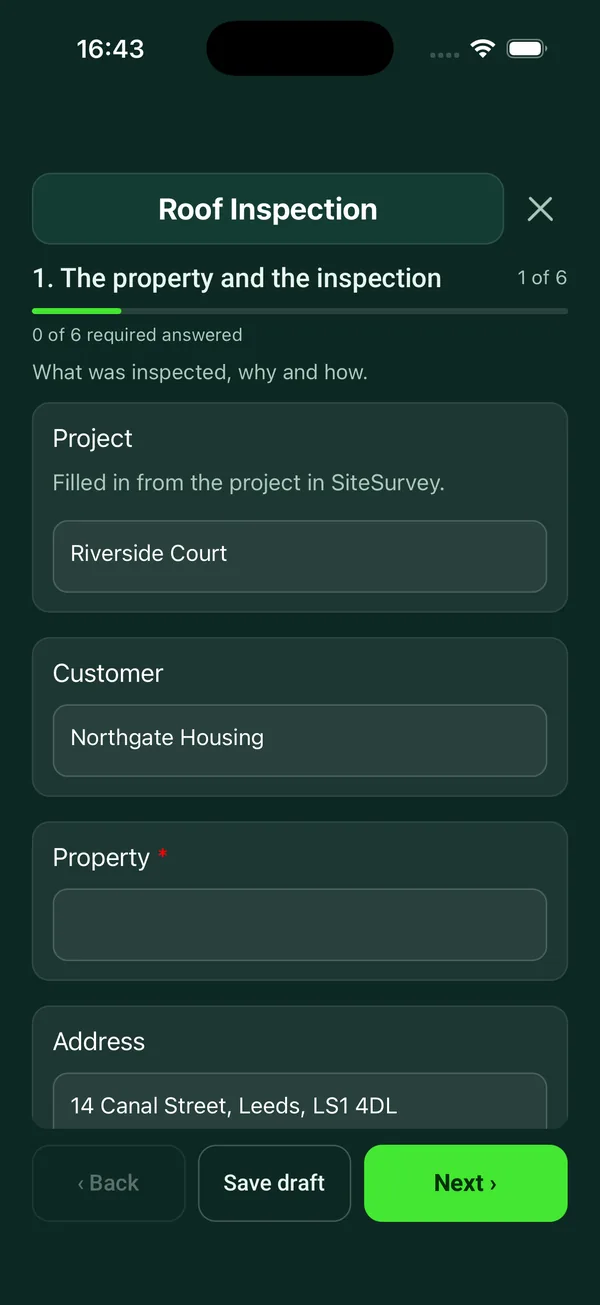
The property and the inspection
What was inspected, why and how.
- ProjectShort answer
Filled in from the project in SiteSurvey.
Fills in from the project name - CustomerShort answerFills in from the project's customer
- Property*Short answerFills in from the site, when the form is opened for a space or a product
- AddressShort answerFills in from the site address, from the space or the project
- Date of inspection*Date
- Inspected byShort answer
- Reason for the inspectionChoose one
- Routine or planned
- Reported leak
- After a storm
- Before purchase or lease
- Before other work, such as solar panels
- Types of roofTick all that apply
- Pitched: tiles
- Pitched: slates
- Flat: felt or membrane
- Flat: asphalt
- Metal sheet
- Fibre cement sheet
- Glazed
- Green roof
- Other (describe)
- Approximate age of the roofShort answer
- WeatherChoose one
- Dry
- Wet
- Windy
- Frost or snow
Safe access
Decide how you will see the roof before you go near it.
- Is the roof, or any part of it, fragile?*Choose one
- No: confirmed by a competent person
- Yes
- Not confirmed
- WarningFragile roofs. HSE says all roofs should be treated as fragile until a competent person has confirmed they are not. Do not rely on any sheeted roof to bear your weight. Fragile rooflights are a particular hazard: some are hard to see in certain light and others may be hidden by paint.Shown only when the answers above make it relevant
- Who confirmed it is not fragile, and on what basis?Short answer
For example the deck type checked from below.
Shown when “Is the roof, or any part of it, fragile?” is “No: confirmed by a competent person” - How was the roof inspected?Tick all that apply
- From the ground
- From windows or neighbouring buildings
- From a ladder at the eaves
- Pole camera or drone
- From a tower, scaffold or MEWP
- On the roof, with edge protection
- From inside the roof space
- Edge protection or access equipment used, and risk assessment referenceShort answerShown only when the answers above make it relevant
- What could not be seen, and why?Notes
A reader needs to know which slopes, areas or details the report does not cover.
Roof coverings
One entry for each slope or roof area.
- Roof areasRepeat for each area. Each one asks:
- Slope or area*Short answer
For example front slope, rear flat roof over the kitchen.
- CoveringChoose one
- Clay or concrete tiles
- Natural slate
- Artificial slate
- Felt
- Single ply membrane
- Liquid applied
- Asphalt
- Lead
- Metal sheet
- Fibre cement sheet
- Other (describe)
- Condition*Choose one
- Good
- Fair
- Poor
- Failed
- Defects seenTick all that apply
- Slipped, cracked or missing tiles or slates
- Moss or plant growth
- Ponding water
- Blisters, splits or open laps
- Corrosion
- Loose or missing fixings
- Sagging or deflection
- Previous patch repairs
- Other (describe)
- Estimated remaining life (years)Number
- NotesNotes
- PhotosPhotos
- Areas inspectedWorked out by the form
- Poor or failedWorked out by the form
Details and drainage
The places roofs usually leak.
- Ridges and hipsChoose one
- Good
- Fair
- Poor
- Not applicable
- ValleysChoose one
- Good
- Fair
- Poor
- Not applicable
- Flashings and leadworkChoose one
- Good
- Fair
- Poor
- Not applicable
- Chimney stacks and potsChoose one
- Good
- Fair
- Poor
- Not applicable
- Verges and eavesChoose one
- Good
- Fair
- Poor
- Not applicable
- Fascias, soffits and bargeboardsChoose one
- Good
- Fair
- Poor
- Not applicable
- Gutters and downpipesChoose one
- Good
- Fair
- Poor
- Not applicable
- Are any gutters or outlets blocked?Yes or No
- Rooflights and roof windowsChoose one
- Good
- Fair
- Poor
- Not applicable
- Parapets, copings and upstandsChoose one
- Good
- Fair
- Poor
- Not applicable
- Vents, pipes and other penetrationsChoose one
- Good
- Fair
- Poor
- Not applicable
- Solar panels, aerials and other fixturesChoose one
- Good
- Fair
- Poor
- Not applicable
- PhotosPhotos
Roof space and ceilings
What the inside tells you.
- Was the roof space inspected?Yes or No
- Why not?Short answerShown when “Was the roof space inspected?” is No
- Signs of water getting inChoose one
- None
- Old staining, now dry
- Damp or active leak
Shown when “Was the roof space inspected?” is Yes - Is daylight visible through the roof?Yes or NoShown when “Was the roof space inspected?” is Yes
- CheckDaylight can mean a gap that lets water in.Shown when “Is daylight visible through the roof?” is Yes
- Roof timbersChoose one
- Sound
- Stained
- Rot, beetle or damage seen
Shown when “Was the roof space inspected?” is Yes - Insulation depth (mm)NumberShown when “Was the roof space inspected?” is Yes
- Ventilation and condensationChoose one
- Dry and ventilated
- Condensation or mould seen
Shown when “Was the roof space inspected?” is Yes - Stains on ceilings in the rooms below?Yes or No
- PhotosPhotos
Defects and recommendations
One entry for each repair.
- Did you find any defects?Yes or No
- DefectsRepeat for each defect. Each one asks:Shown when “Did you find any defects?” is Yes
- Where*Short answer
- What is wrong?Notes
- Priority*Choose one
- Urgent: make safe or watertight now
- Within 3 months
- Within 12 months
- Monitor
- Recommended repairNotes
- Estimated cost (£)Number
- PhotosPhotos
- DefectsWorked out by the formShown when “Did you find any defects?” is Yes
- UrgentWorked out by the formShown when “Did you find any defects?” is Yes
- Estimated cost in total (£)Worked out by the formShown when “Did you find any defects?” is Yes
- Overall condition of the roof*Choose one
- Good
- Fair
- Poor
- Summary and recommendationsNotes
- Inspector nameShort answer
- Inspector signatureSignature
- Date signedDate
See it filled in
A completed roof inspection report, made by SiteSurvey from a fictional site visit: every answer, the photos, the guidance that applied and the sign-off, ready to send as a PDF.
Roof inspection FAQs
Is it safe to walk on a roof to inspect it?
HSE says all roofs should be treated as fragile until a competent person has confirmed they are not, and not to rely on any sheeted roof to bear a person's weight. Fragile rooflights are a particular hazard: some are hard to see and others may be hidden by paint. Regulation 9 of the Work at Height Regulations 2005 says no one at work should go on or near a fragile surface where the work can reasonably be done safely without it, so the form asks whether the roof is fragile first and offers inspection from the ground, a platform, a pole camera or drone, or the roof space.
Does it work for flat roofs as well as pitched roofs?
Yes. Each slope or area has its own entry with the covering, from tiles and slates to felt, single ply membrane, asphalt, lead and metal or fibre cement sheet. Defects include slipped or missing tiles, ponding water, blisters, splits and open laps, corrosion and sagging.
What details does it check?
Ridges and hips, valleys, flashings and leadwork, chimney stacks and pots, verges and eaves, fascias and soffits, gutters and downpipes, rooflights, parapets and copings, vents and other penetrations, and fixtures such as solar panels. Each is marked good, fair, poor or not applicable.
Does it include the roof space?
Yes, where it can be inspected: signs of water getting in, whether daylight is visible through the roof, the condition of the timbers, insulation depth, and ventilation and condensation. It also asks about stains on ceilings in the rooms below.
How are defects prioritised?
Each defect is marked urgent (make safe or watertight now), within 3 months, within 12 months or monitor, with a recommended repair, an estimated cost and photos. The form counts the defects and the urgent ones and adds up the estimated cost. The priority bands are the form's own.
Does the report say what was not inspected?
Yes. The form records how the roof was inspected and asks what could not be seen and why, so a reader knows which slopes or details the report does not cover. An estimated remaining life can be recorded for each area.
Related
Related templates
Templates that go with the roof inspection form
Condition survey of a building: limits of inspection, element by element record, services and risks, further investigations.
Elements, lifecycles and renewal years, kitchen and bathroom, heating and electrics, hazards and recommended work for each property.
Record building insulation locations, product references, specified and observed thickness, gaps and evidence before work is covered.
Photographic record of condition before works or at the start of a lease, room by room.
Use this roof inspection form with your team
Add it from the form library in one click, change any question, and every completed form becomes a branded PDF report.
Start your trial →