Estate overview and route
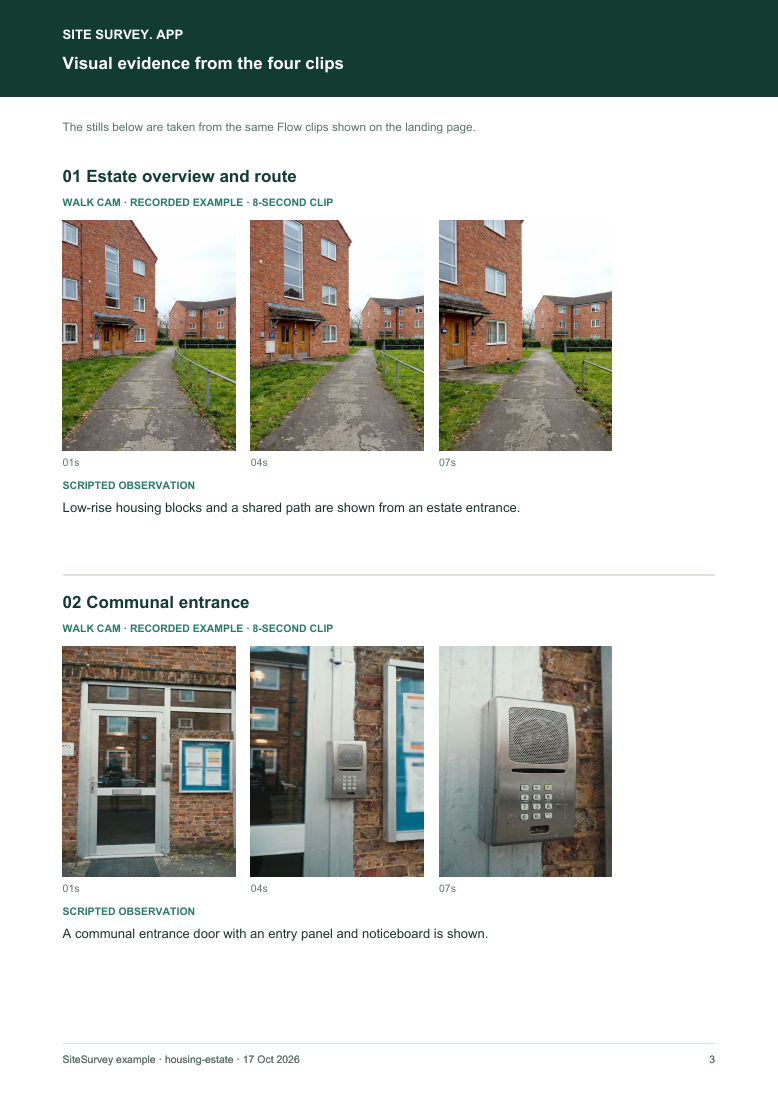
Start at a named entrance and show the blocks, paths and open space on the route.
Low-rise housing blocks and a shared path are shown from an estate entrance.
Form library · Housing and property
An estate inspection or walkabout record for social landlords and housing officers. Record the estate, the type of inspection, who attended and the blocks covered, then check communal entrances, lighting, noticeboards, stairs, bin stores, fly-tipping, graffiti, paths, grounds, play areas, parking, drainage, boundaries and pests. Add each issue with its location, priority, who is responsible, a job reference and photos; the form counts urgent issues. Record residents' comments and an action plan with owners and due dates, then sign. Every question is listed below, and you can fill the live form in on this page.
Ready to use from the form library, and every question is yours to edit. Trial from £1, cancel any time.
Try it on your phone
Try it on this phone
Fill in the estate inspection on your phone now
See how the estate inspection looks on your phone
Scan the code with your phone camera. It opens the real form, no sign-up needed.
Open the live example and fill it in, just as your team would on site. No sign-up needed.
See it on this phoneEvery question is editable. Add this form to your account, then change the wording, add or remove questions and options, and make it fit your own jobs.
An estate inspection is a walk round the outside and communal areas of a housing estate to find repairs, cleaning and safety issues. Croydon Council describes its estate walkabouts as an inspection of the exterior and communal grounds with residents, tenancy and repairs officers and caretakers, taking an hour to two and a half hours, followed by an action plan with the issue, what will happen next and the time frame. The Regulator of Social Housing's Safety and Quality Standard requires landlords to understand and fulfil their maintenance responsibilities for communal areas.
Last updated . Facts checked by the SiteSurvey team on 17 October 2026 against Regulator of Social Housing: Safety and Quality Standard, Regulator of Social Housing: Neighbourhood and Community Standard and Croydon Council: estate walkabouts.
Answer a few questions and watch it adapt. Your answers are not saved, and any photos you add are deleted within the hour.
Open the completed example to see fictional readings, notes, photos and calculations. Choose Blank form to try entering your own answers.
Want to see one filled in? See a completed estate inspection report (PDF), made by SiteSurvey from a fictional site visit.
Walk Cam route · four guided clips
Walk the estate on a set route: entrances, communal areas, bin stores and open space, with each issue tied to a place.
Record the estate, route, date and who walked it, such as residents, the housing officer and the caretaker. Film places, not people. The four AI-generated clips illustrate one route, not a real estate.
Start at a named entrance and show the blocks, paths and open space on the route.
Low-rise housing blocks and a shared path are shown from an estate entrance.
Film the communal door, entry system, lighting and noticeboard from outside and just inside.
A communal entrance door with an entry panel and noticeboard is shown.
Show the bin store, overflowing bins and anything dumped nearby.
Overflowing bins and a dumped mattress are by the bin store.
Finish with the open space, paths, lighting columns and any play area, noting hazards and good condition.
A small fenced play area and lighting column are on the green.
A fictional six-page example with the four points, twelve stills from the clips, observations, follow-up actions and the limits of a visual record.
View the visual evidence (PDF) ↗ · Download the full sample report

Video records visible condition on the day. It is not a stock condition survey, fire risk assessment or play equipment inspection. Example footage was generated in Google Flow and the observations are scripted; no real site is shown. Walk Cam works inside any form in the app. How Walk Cam works · All visual inspections
An estate inspection or walkabout for social landlords: who attended, communal entrances, lighting, bin stores, fly-tipping, paths, grounds and play areas, each issue with photos and who is responsible, and an action plan. 3 sections and 79 questions. Follow-up questions and guidance appear only when an answer calls for them, so the person on site never sees the ones that do not apply.
This is a starting point, not a fixed form. Once it is in your SiteSurvey account you can reword any question, add or remove questions, sections and answer options, and add your own logo, so it fits the way your team works and the jobs you do.
Add this form to a project in SiteSurvey and it fills in what the project already knows, so nobody on site retypes it and every form on the job uses the same names. Anything filled in can still be changed.
Record estimated current conditions for this visit. Keep your observations, visibility and local site conditions in the existing field below.
Optional. From the last inspection of this estate, to show the change.
Checks OK as a share of the checks that applied.
Optional. Mark the spot, so the repairs or caretaking team goes straight to it.
Optional. For graffiti to remove, or a damaged wall, fence or surface. Measure from a photo taken square on, with something of known size in the same plane: a standard brick course is 75 mm, so eight courses are about 600 mm.
Optional. Film the four guided points on the SiteSurvey app; each clip keeps its spoken note.
Set by the landlord's own inspection programme.
This is an estate inspection record, not a fire risk assessment, a stock condition survey of each home or a play equipment inspection by a specialist.
Issues, owners and the action plan
Record each issue where it was seen, who is responsible and the job reference. Give every action an owner and a due date, and note what residents raised.
Barwell House entry door does not latch. Raised as urgent repair R-48213, repaired the next day. Action plan posted on the block noticeboards.
Fictional example of record wording. Use the actual evidence and approved arrangements for your job; this is not a completed report or an instruction to carry out the work.
A completed estate inspection report, made by SiteSurvey from a fictional site visit: every answer, the photos, the guidance that applied and the sign-off, ready to send as a PDF.
The Safety and Quality Standard (England, from 1 April 2024) requires registered providers to give an effective, efficient and timely repairs and maintenance service for homes and communal areas, and to understand and fulfil their maintenance responsibilities for communal areas. It does not set an inspection frequency; a dated estate inspection is one way to show what was seen and done.
Croydon Council's walkabouts normally involve a small group of residents, tenancy and repairs officers and caretakers, with local councillors invited. The form records who attended.
Produce an action plan. Croydon's sets out each issue, what will happen next and the time frame to resolve it. The form gives each action an owner, a due date and a status, and records whether the plan will be shared with residents.
The Regulator's Neighbourhood and Community Standard asks landlords to work with tenants, other landlords and relevant organisations to take all reasonable steps to ensure the safety of shared spaces. Record who is responsible for each issue, such as the council for fly-tipping or highways.
Yes. The form ends its checks with an optional Walk Cam route on the SiteSurvey app: the estate overview, a communal entrance, the bin store and the grounds and play area, each clip with its spoken note.
Yes. Mark each issue's priority and the form counts the urgent health and safety issues and shows a warning, with a question on whether each was made safe on the day.
Housing associations, council housing teams, neighbourhood and tenancy officers, caretakers and resident groups.
Related templates
A fly-tipping report for land and estate managers: location, waste types and size, hazards, evidence, photos, council or Environment Agency reports, and clearance by a registered waste carrier with the transfer note.
A routine playground visual inspection: area checks, then each item pinned by GPS with its fall height measured from a photo against the surfacing's rated critical fall height, loose-fill depth against the minimum, restrictions and repair follow-up, with counts.
Fire door checks for blocks of flats under the Fire Safety (England) Regulations 2022: the building's top storey height, quarterly communal and annual flat entrance door checks, self-closers, gaps, seals and damage, counts of doors passed and needing repair, access attempts and resident information.
Add it from the form library in one click, change any question, and every completed form becomes a branded PDF report.
Start your trial →