Form library · Health and safety
COSHH assessment template
A COSHH assessment form built around the task, not just the product. Record each substance from its label and safety data sheet, who could be exposed and how, the controls in place, protective equipment, storage and emergency steps, then any further actions and a review date. Every question is listed below, and you can fill the live form in on this page.
Ready to use from the form library, and every question is yours to edit. Trial from £1, cancel any time.
Try it on your phone
Try it on this phone
Fill in the COSHH assessment on your phone now
See how the COSHH assessment looks on your phone
Scan the code with your phone camera. It opens the real form, no sign-up needed.
Open the live example and fill it in, just as your team would on site. No sign-up needed.
See it on this phoneEvery question is editable. Add this form to your account, then change the wording, add or remove questions and options, and make it fit your own jobs.
What should a COSHH assessment include?
A COSHH assessment should describe the task, list each hazardous substance used or created, say who could be exposed and how (breathing in, skin, eyes or swallowing), and record the controls in place. HSE's steps are to identify the hazards from labels and safety data sheets, assess the risks and control them. It should also cover storage, emergencies, further actions and when it will be reviewed.
Last updated . Facts checked by the SiteSurvey team on 5 October 2026 against regulation 6 of the Control of Substances Hazardous to Health Regulations 2002, HSE on COSHH assessment and regulation 9 of the Control of Substances Hazardous to Health Regulations 2002.
Try the COSHH assessment form live
Answer a few questions and watch it adapt. Your answers are not saved, and any photos you add are deleted within the hour.
This is the real form as your team would use it: questions appear as you answer, scores work themselves out and you can add photos and signatures. No sign-up needed.
Want to see one filled in? See a completed COSHH assessment report (PDF), made by SiteSurvey from a fictional site visit.
Fill it in on a phone or tablet
Your team completes the coshh assessment on site in the SiteSurvey app on iPhone, iPad and Android phones and tablets. The project name and address fill in for them, it works without signal, and it syncs when the device is back online with photos kept against the question they answer.
Customers and subcontractors do not need the app: send them a link and they can fill it in from any browser.
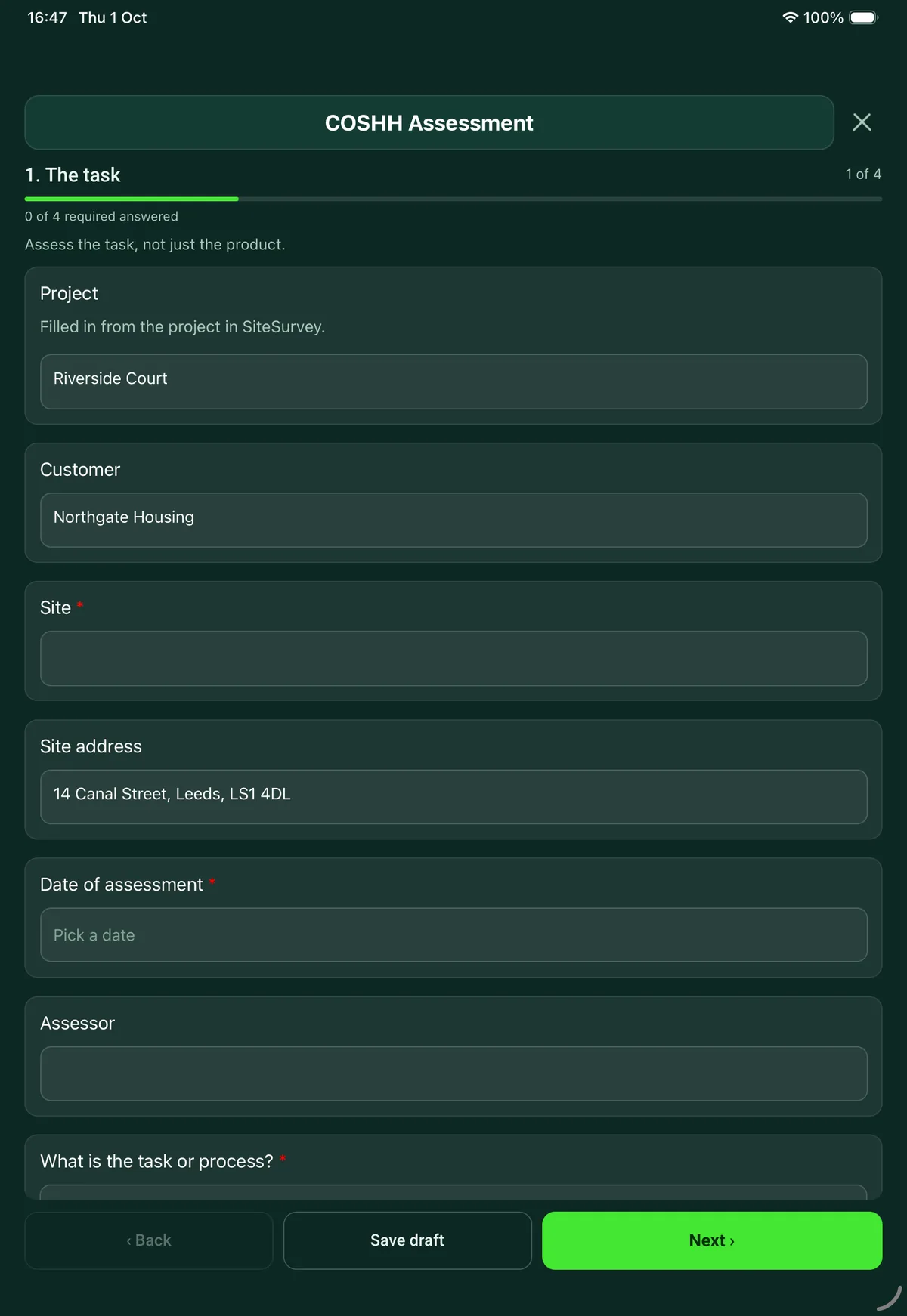
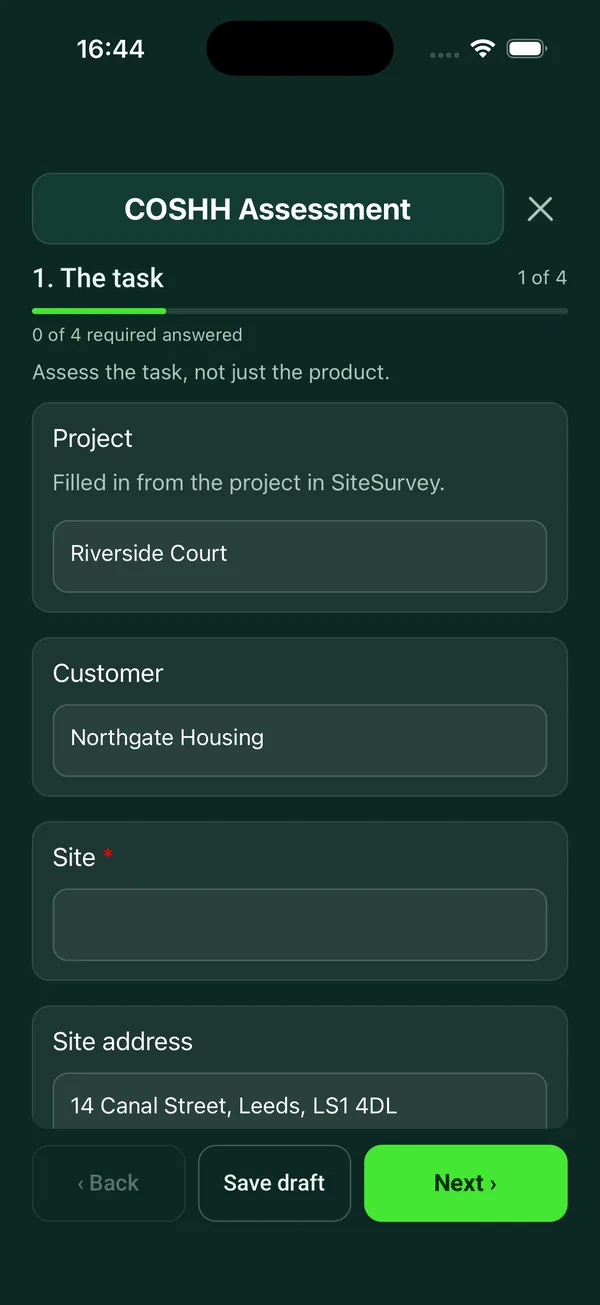
Every question in the COSHH assessment template
Assessment for a task that uses or creates hazardous substances: products and hazard symbols, who is exposed and how, controls, PPE, emergencies and review. 4 sections and 50 questions. Follow-up questions and guidance appear only when an answer calls for them, so the person on site never sees the ones that do not apply.
Make it your own: every question is editable
This is a starting point, not a fixed form. Once it is in your SiteSurvey account you can reword any question, add or remove questions, sections and answer options, and add your own logo, so it fits the way your team works and the jobs you do.
Details you only enter once
Add this form to a project in SiteSurvey and it fills in what the project already knows, so nobody on site retypes it and every form on the job uses the same names. Anything filled in can still be changed.
- Project: the project name
- Customer: the project's customer
- Site: the site, when the form is opened for a space or a product
- Site address: the site address, from the space or the project
The task
Assess the task, not just the product.
- ProjectShort answer
Filled in from the project in SiteSurvey.
Fills in from the project name - CustomerShort answerFills in from the project's customer
- Site*Short answerFills in from the site, when the form is opened for a space or a product
- Site addressShort answerFills in from the site address, from the space or the project
- Date of assessment*Date
- AssessorShort answer
- What is the task or process?*Notes
- Where is it done?Short answer
- How often?Choose one
- Several times a day
- Daily
- Weekly
- Monthly
- Occasionally
- How long each time?Short answer
- Who could be exposed?Tick all that apply
- The people doing the task
- Others working nearby
- Cleaners and maintenance staff
- Contractors
- Visitors or the public
- Young, pregnant or sensitised workers
- GuidanceCOSHH regulation 6. An employer must not carry out work liable to expose employees to a substance hazardous to health unless a suitable and sufficient assessment of the risk has been made and the steps it identifies have been put in place.
Substances
One entry for each product used. Read the label and the safety data sheet.
- GuidanceHSE says to identify which substances are harmful by reading the product labels and safety data sheets. Ask the supplier for the data sheet if you do not have it.
- SubstancesRepeat for each substance. Each one asks:
- Product name*Short answer
- SupplierShort answer
- Have you read the safety data sheet?Yes or No
- FormChoose one
- Liquid
- Powder or dust
- Gas
- Vapour or fume
- Mist or spray
- Solid or paste
- Hazard symbols on the labelTick all that apply
- Explosive
- Flammable
- Oxidising
- Gas under pressure
- Corrosive
- Acute toxicity (skull and crossbones)
- Health hazard (exclamation mark)
- Serious health hazard
- Hazardous to the environment
- No symbol
- How could it get into or onto the body?Tick all that apply
- Breathing it in
- Skin contact
- Eye contact
- Swallowing
- Through a cut or puncture
- Does the data sheet give a workplace exposure limit?Yes or No
- LimitShort answerShown when “Does the data sheet give a workplace exposure limit?” is Yes
- Amount used each timeShort answer
- Photo of the labelPhotos
- Does the task itself create dust, fume, vapour or mist?Yes or No
For example wood dust, silica dust, welding fume, solder fume. These have no label.
- What is created, and how much?NotesShown when “Does the task itself create dust, fume, vapour or mist?” is Yes
- Could substances react together or be used together?Notes
For example acid and chlorine products, or two products used on the same surface.
Controls
Work down the list: safer substance first, protective equipment last.
- Can a safer substance or a different method be used?Yes or No
- What, and when will it change?Short answerShown when “Can a safer substance or a different method be used?” is Yes
- Controls in placeTick all that apply
- Enclosure or containment
- Local exhaust ventilation
- General ventilation
- Smaller quantities or shorter time
- Safe storage
- Cleaning and spill procedures
- Training and instruction
- Health surveillance
- Protective equipment
- Other (describe)
- Date local exhaust ventilation was last thoroughly examined and testedDate
- Days since that testWorked out by the formShown when “Date local exhaust ventilation was last thoroughly examined and tested” is answered and “Date of assessment” is answered
- Is air monitoring needed?Choose one
- Yes
- No
- What monitoring and the results, or why it is not neededNotesShown when “Is air monitoring needed?” is answered
- Is health surveillance needed?Yes or No
- What, and who arranges itShort answerShown when “Is health surveillance needed?” is Yes
- Protective equipment neededTick all that apply
- Gloves
- Eye protection
- Face shield
- Respirator or mask
- Overalls or apron
- Safety footwear
- Other (describe)
- Type of glove, from the data sheetShort answer
- Have the wearers of tight-fitting masks been face fit tested?Yes or No
- How and where is it stored?Short answer
- First aid, spills and fireNotes
What to do, from section 4 to 6 of the safety data sheet.
- Risk with the current controlsChoose one
- High
- Medium
- Low
- Is more needed to control the risk?Yes or No
- Further actionsRepeat for each action. Each one asks:Shown when “Is more needed to control the risk?” is Yes
- Action*Short answer
- WhoShort answer
- By whenDate
- Risk once the actions are doneChoose one
- High
- Medium
- Low
Shown when “Is more needed to control the risk?” is Yes
Record and review
Tell the people doing the task, and set a review.
- GuidanceHSE says that if you have 5 or more employees you must record your assessment, and that it makes sense to write it down even if you have fewer.
- Have the people doing the task been told the findings?Yes or No
- Review dateDate
- GuidanceReview it sooner if the product, the process, the equipment or the people change, if someone raises a problem, or after an incident.
- Assessor nameShort answer
- Assessor signatureSignature
- Manager nameShort answer
- Manager signatureSignature
See it filled in
A completed COSHH assessment report, made by SiteSurvey from a fictional site visit: every answer, the photos, the guidance that applied and the sign-off, ready to send as a PDF.
COSHH assessment FAQs
Is a COSHH assessment a legal requirement?
Yes. Under regulation 6 of the Control of Substances Hazardous to Health Regulations 2002, an employer must not carry out work liable to expose employees to a substance hazardous to health unless a suitable and sufficient assessment of the risk has been made and the steps it identifies have been put in place.
Do I have to write a COSHH assessment down?
HSE says that if you have 5 or more employees you must record your assessment, and that it makes sense to write it down even if you have fewer. The form records the assessment, the further actions with an owner and a date, and whether the people doing the task have been told the findings.
Does it cover dust and fumes that have no label?
Yes. As well as the products used, the form asks whether the task itself creates dust, fume, vapour or mist, such as wood dust, silica dust or welding fume, and what is created.
What does it record for each substance?
The product and supplier, whether the safety data sheet has been read, its form (liquid, powder, gas, vapour, mist or solid), the hazard symbols on the label, how it could get into or onto the body, any workplace exposure limit from the data sheet, the amount used and a photo of the label.
How does it deal with controls and PPE?
It asks first whether a safer substance or method can be used, then records the controls in place, from enclosure and local exhaust ventilation to training and health surveillance. Protective equipment comes last: the type of glove from the data sheet, and whether wearers of tight-fitting masks have been face fit tested. It also records when local exhaust ventilation was last thoroughly examined and tested, which regulation 9 of COSHH requires at least once every 14 months for most systems.
When should a COSHH assessment be reviewed?
HSE says the assessment must be kept up to date. The form records a review date and says to review sooner if the product, process, equipment or people change, if someone raises a problem, or after an incident.
Related
Related templates
Templates that go with the COSHH assessment form
Hazards, who might be harmed, controls and risk scores, with a briefing record and review date.
How a task will be done safely: scope, crew and competence, numbered work steps with hazards and controls, permits, emergency arrangements, briefing and approval. Links to the risk assessment by reference.
A professional grounds pesticide record covering the treatment area, authorised product, application details, weather, exposure controls and follow-up.
Legionella risk assessment for a hot and cold water system: who is responsible, tanks and heaters, outlet temperatures, little-used outlets, findings and actions.
Use this COSHH assessment form with your team
Add it from the form library in one click, change any question, and every completed form becomes a branded PDF report.
Start your trial →