Form library · Health and safety
Method statement template
A method statement form that sets out how a task will be done safely: the scope, the crew and their competence, each step in order with its hazards and controls, then permits, emergency arrangements, the crew briefing and approval. It links to the risk assessment by reference, so the two make up your RAMS. Every question is listed below, and you can fill the live form in on this page.
Ready to use from the form library, and editable. Trial from £1, cancel any time.
What should a method statement include?
A method statement should set out the scope of the work, the site and dates, who supervises and who does the work, then each step in order with its hazards and controls. It should also cover plant, materials and PPE, permits, first aid, emergency and rescue arrangements, and waste. HSE describes it as setting out, in a logical sequence, how a job will be carried out safely.
Last updated . Facts checked on 30 September 2026 against HSE on construction health and safety paperwork, the Construction (Design and Management) Regulations 2015, regulation 3 of the Management of Health and Safety at Work Regulations 1999 and section 2 of the Health and Safety at Work etc. Act 1974.
Try the method statement form live
Answer a few questions and watch it adapt. Your answers are not saved, and any photos you add are deleted within the hour.
This is the real form as your team would use it: questions appear as you answer, scores work themselves out and you can add photos and signatures. No sign-up needed.
Fill it in on a phone or tablet
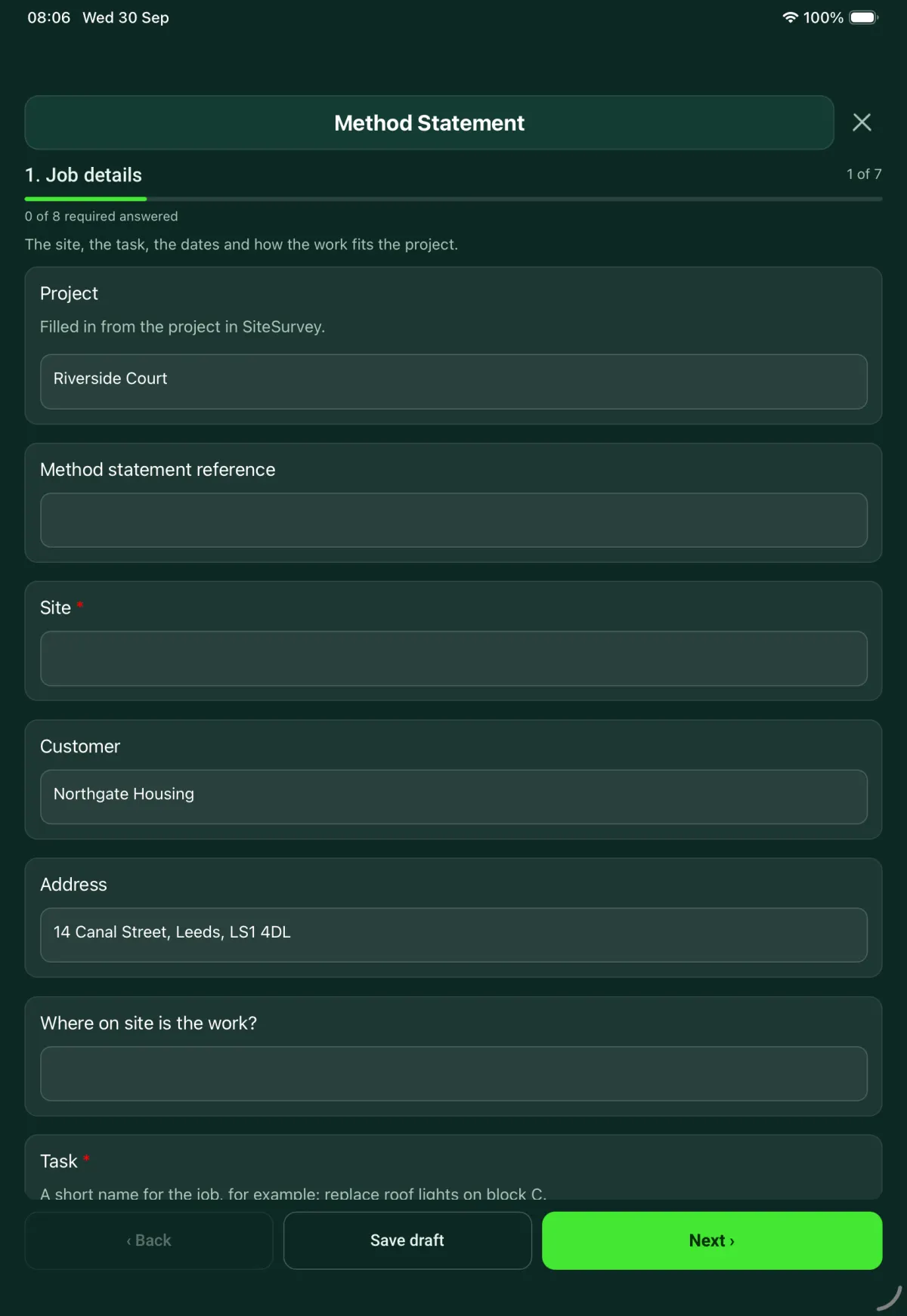
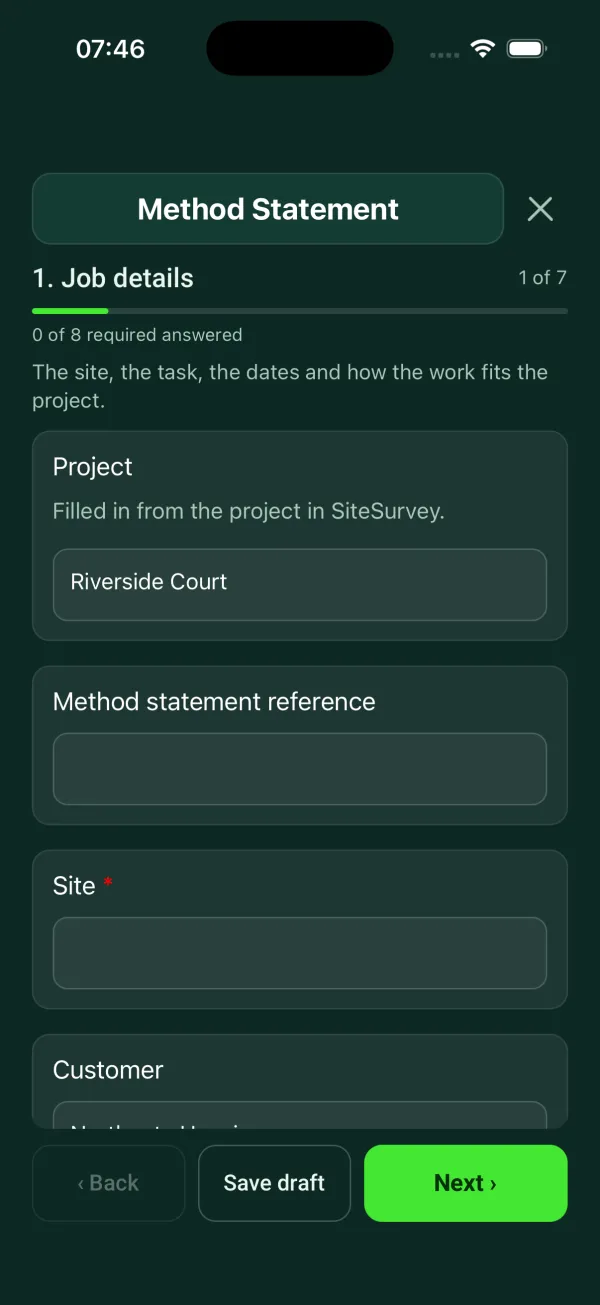
Your team completes the method statement on site in the SiteSurvey app on iPhone, iPad and Android phones and tablets. The project name and address fill in for them, it works without signal, and it syncs when the device is back online with photos kept against the question they answer.
Customers and subcontractors do not need the app: send them a link and they can fill it in from any browser.
Every question in the method statement template
How a task will be done safely: scope, crew and competence, numbered work steps with hazards and controls, permits, emergency arrangements, briefing and approval. Links to the risk assessment by reference. 7 sections and 85 questions. Follow-up questions and guidance appear only when an answer calls for them, so the person on site never sees the ones that do not apply.
Details you only enter once
Add this form to a project in SiteSurvey and it fills in what the project already knows, so nobody on site retypes it and every form on the job uses the same names. Anything filled in can still be changed.
- Project: the project name
- Site: the site, when the form is opened for a space or a product
- Customer: the project's customer
- Address: the site address, from the space or the project
Job details
The site, the task, the dates and how the work fits the project.
- ProjectShort answerFills in from the project name
- Method statement referenceShort answer
- Site*Short answerFills in from the site, when the form is opened for a space or a product
- CustomerShort answerFills in from the project's customer
- AddressShort answerFills in from the site address, from the space or the project
- Where on site is the work?Short answer
- Task*Short answer
- Scope of the workNotes
- Start date*Date
- Expected finish dateDate
- Calendar days, including the start and finishWorked out by the formShown only when the answers above make it relevant
- CheckThe finish date is before the start date. Check the dates.Shown only when the answers above make it relevant
- Working hoursShort answer
- Will the building or area be in use while the work is done?Yes or No
- How are occupants and the public kept away from the work?NotesShown when “Will the building or area be in use while the work is done?” is Yes
- GuidanceWhat a method statement is for. HSE describes a method statement as setting out, in a logical sequence, how a job will be carried out safely, including the control measures. It is not required by law for most work. The legal duties are a suitable and sufficient risk assessment (regulation 3 of the Management of Health and Safety at Work Regulations 1999) and safe systems of work with the information, instruction, training and supervision needed (section 2 of the Health and Safety at Work etc. Act 1974). A method statement is a practical way to show how you meet them.
- Is this construction work under CDM 2015?Yes or No
- Your role on this projectChoose one
- Principal contractor
- Contractor working for a principal contractor
- The only contractor on the project
Shown when “Is this construction work under CDM 2015?” is Yes - Construction phase plan referenceShort answerShown when “Is this construction work under CDM 2015?” is Yes
- GuidanceCDM 2015, regulation 12. A construction phase plan must be drawn up before the construction site is set up. It sets out the health and safety arrangements and site rules. This method statement should follow it.Shown only when the answers above make it relevant
- Does the work include demolition or dismantling of a structure?Yes or NoShown when “Is this construction work under CDM 2015?” is Yes
- WarningWritten arrangements required. The arrangements for demolition or dismantling must be recorded in writing before the work begins. CDM 2015, regulation 20. Use the sequence of work on this form to record them.Shown when “Is this construction work under CDM 2015?” is Yes and “Does the work include demolition or dismantling of a structure?” is Yes
People and competence
Who supervises, who does the work, and what they hold.
- Supervisor on site*Short answer
- Supervisor phone numberShort answer
- CrewRepeat for each person. Each one asks:
- NameShort answer
- CompanyShort answer
- Cards and training heldTick all that apply
- CSCS
- CPCS or NPORS
- IPAF
- PASMA
- SMSTS or SSSTS
- First aid at work
- Asbestos awareness
- Manufacturer training for the equipment
- Other (describe)
- Earliest expiry date of the cards needed for this jobDateShown when “Cards and training held” is answered
- WarningA card or training needed for this job expires before the work starts. Check it before this person is put on the job.Shown only when the answers above make it relevant
- Has this person the skills, knowledge, training and experience for the tasks given to them?Yes or No
- WarningDo not give this person the task yet. Employers must take account of people's capabilities when giving them tasks (regulation 13 of the Management of Health and Safety at Work Regulations 1999). On construction work, a contractor must not employ anyone without the skills, knowledge, training and experience to do the task safely (CDM 2015, regulation 15). Record the training or supervision that will be provided.Shown when “Has this person the skills, knowledge, training and experience for the tasks given to them?” is No
- Training or supervision to be providedNotesShown when “Has this person the skills, knowledge, training and experience for the tasks given to them?” is No
- People on the crewWorked out by the form
- Are any subcontractors doing part of this work?Yes or No
- Which companies, and who supervises them?Short answerShown when “Are any subcontractors doing part of this work?” is Yes
Sequence of work
The linked risk assessment, then each step in order with its hazards and controls.
- Is there a risk assessment for this work?*Choose one
- Yes
- Being written
- No
- Risk assessment referenceShort answerShown when “Is there a risk assessment for this work?” is “Yes”
- Date of the risk assessmentDateShown when “Is there a risk assessment for this work?” is “Yes”
- WarningRisk assessment needed. Every employer must make a suitable and sufficient assessment of the risks to their employees and to others affected by the work. Regulation 3 of the Management of Health and Safety at Work Regulations 1999. The method statement shows how the controls from that assessment are put into practice. It does not replace it.Shown only when the answers above make it relevant
- GuidanceOne entry per step, in the order the work is done. Include setting up, the work itself, and clearing away. Keep each step short enough to brief.
- Sequence of workRepeat for each step. Each one asks:
- What is done at this step*Short answer
- How it is doneNotes
- Hazards at this stepTick all that apply
- Work at height
- Hazardous substances or dust
- Electricity
- Hot works
- Manual handling
- Plant and vehicles
- Noise or vibration
- Members of the public nearby
- Other (describe)
- CheckWork at Height Regulations 2005, regulation 4. Work at height must be properly planned, appropriately supervised and carried out as safely as is reasonably practicable. Say here how the work is reached and how falls are prevented.Shown when “Hazards at this step” includes “Work at height”
- CheckRecord the COSHH assessment reference for this substance on page 4.Shown when “Hazards at this step” includes “Hazardous substances or dust”
- CheckHot works are listed at this step. Record the permit on page 5.Shown when “Hazards at this step” includes “Hot works”
- Controls at this stepNotes
- Photos or drawings for this stepPhotos
- Counts as a hot works stepWorked out by the form
- Is there a hold point before the next step?Yes or No
- What is checked, and by whom?Short answerShown when “Is there a hold point before the next step?” is Yes
- Steps recordedWorked out by the form
Plant, materials and PPE
What is used to do the job, and what people wear.
- Plant and power toolsTick all that apply
- Hand tools only
- Cordless power tools
- 110 V power tools
- Cutting or grinding equipment
- Drilling or breaking equipment
- Generator
- Forklift or telehandler
- Excavator or dumper
- Other (describe)
- Access equipmentTick all that apply
- No work at height
- Stepladder or ladder
- Podium steps
- Mobile tower
- Mobile elevating work platform
- Fixed scaffold
- Roof edge protection
- Other (describe)
- CheckWork at height is planned. The Work at Height Regulations 2005, regulation 4, require it to be properly planned and appropriately supervised, and done only when the weather does not put people at risk. Planning includes emergencies and rescue. Record the rescue plan on page 5.Shown only when the answers above make it relevant
- Will equipment be checked before each use, and faults reported?Yes or No
- CheckSay how equipment will be checked and how faulty equipment is taken out of use.Shown when “Will equipment be checked before each use, and faults reported?” is No
- Materials delivered and usedNotes
- Will any hazardous substances be used or produced?Yes or No
- Hazardous substancesRepeat for each substance. Each one asks:Shown when “Will any hazardous substances be used or produced?” is Yes
- Product or substanceShort answer
- Has a COSHH assessment been made for this work?Yes or No
- COSHH assessment referenceShort answerShown when “Has a COSHH assessment been made for this work?” is Yes
- WarningCOSHH assessment needed first. An employer must not carry out work liable to expose employees to a substance hazardous to health unless they have made a suitable and sufficient assessment of the risk and put in place the measures it identifies. Control of Substances Hazardous to Health Regulations 2002, regulation 6.Shown when “Has a COSHH assessment been made for this work?” is No
- Could the work disturb materials that may contain asbestos?Yes or No
- Asbestos survey or register referenceShort answerShown when “Could the work disturb materials that may contain asbestos?” is Yes
- WarningCheck the asbestos survey or register for the area before this work starts. If there is none, or the materials are not covered, stop and get advice before disturbing them.Shown only when the answers above make it relevant
- PPE to be wornTick all that apply
- Safety helmet
- Safety boots
- High visibility clothing
- Gloves
- Eye protection
- Hearing protection
- Respiratory protective equipment
- Fall arrest harness
- Other (describe)
- CheckPPE is the last option in HSE's order of controls. Check the steps on page 3 say what is done first to remove or reduce the hazard, and that the people wearing this equipment have been trained to use it.Shown only when the answers above make it relevant
Permits, emergencies and environment
Permits, first aid, emergency and rescue arrangements, and waste.
- Permits neededTick all that apply
- None
- Hot works permit
- Permit to work
- Electrical isolation
- Confined space entry
- Permit to dig
- Other (describe)
- Hot works permit referenceShort answerShown when “Permits needed” includes “Hot works permit”
- Permit to work referenceShort answerShown when “Permits needed” includes “Permit to work”
- What is isolated, where, and how is it locked off?NotesShown when “Permits needed” includes “Electrical isolation”
- CheckA permit covers the steps it names. Work on those steps should not start until the permit has been issued, and it should be closed when the work is done.Shown only when the answers above make it relevant
- WarningA step on page 3 lists hot works, but no hot works permit is recorded here. Check the permit arrangements.Shown only when the answers above make it relevant
- First aider on site*Short answer
- Where is the first aid kit?Short answer
- GuidanceHealth and Safety (First-Aid) Regulations 1981, regulation 3. Employers must provide equipment and facilities that are adequate and appropriate in the circumstances so first aid can be given to employees who are injured or become ill at work.
- Nearest hospital with an emergency departmentShort answer
- Fire assembly pointShort answer
- What happens in an emergencyNotes
- GuidanceSerious and imminent danger. Employers must set up appropriate procedures for serious and imminent danger. Regulation 8 of the Management of Health and Safety at Work Regulations 1999.
- Rescue plan for work at heightNotesShown only when the answers above make it relevant
- Waste producedTick all that apply
- General waste
- Inert waste such as rubble
- Metal
- Packaging
- Hazardous waste
- Other (describe)
- Will waste be taken off site?Yes or NoShown when “Waste produced” is answered
- Waste carrierShort answerShown when “Waste produced” is answered and “Will waste be taken off site?” is Yes
- GuidanceDuty of care for waste. Waste may only be passed to an authorised person, with a written description of it. Environmental Protection Act 1990, section 34.Shown when “Waste produced” is answered and “Will waste be taken off site?” is Yes
- Noise, dust, spills and neighboursNotes
Briefing
Everyone doing the work is taken through it before they start.
- Has the crew been briefed on this method statement?Yes or No
- WarningBrief the crew before work starts. Employers must provide the information, instruction, training and supervision needed for health and safety at work (section 2 of the Health and Safety at Work etc. Act 1974). On construction work, contractors must give each worker appropriate supervision, instructions and information (CDM 2015, regulation 15).Shown when “Has the crew been briefed on this method statement?” is No
- Briefed byShort answerShown when “Has the crew been briefed on this method statement?” is Yes
- DateDateShown when “Has the crew been briefed on this method statement?” is Yes
- Does anyone need the briefing in another language or format?Yes or NoShown when “Has the crew been briefed on this method statement?” is Yes
- What was provided?Short answerShown when “Has the crew been briefed on this method statement?” is Yes and “Does anyone need the briefing in another language or format?” is Yes
- Has the crew been told to stop and report if the work or conditions change from this method statement?Yes or NoShown when “Has the crew been briefed on this method statement?” is Yes
- CheckTell the crew what to do if the job cannot be done as written: stop, make safe and speak to the supervisor before carrying on.Shown when “Has the crew been briefed on this method statement?” is Yes and “Has the crew been told to stop and report if the work or conditions change from this method statement?” is No
- Questions or points raised by the crewNotesShown when “Has the crew been briefed on this method statement?” is Yes
- Crew briefed and signedRepeat for each signature. Each one asks:Shown when “Has the crew been briefed on this method statement?” is Yes
- NameShort answer
- SignatureSignature
- People signedWorked out by the formShown when “Has the crew been briefed on this method statement?” is Yes
- CheckFewer people have signed than are listed on the crew. Brief and sign the rest before they start.Shown only when the answers above make it relevant
Approval sign-off
- WarningNo risk assessment reference is recorded on page 3. Link the risk assessment before this method statement is approved.Shown only when the answers above make it relevant
- Written by*Short answer
- Date writtenDate
- Author signatureSignature
- Has someone other than the author checked and approved it?Yes or No
- CheckNo approver is recorded. Have the method statement checked by the manager responsible for the work before it is used.Shown when “Has someone other than the author checked and approved it?” is No
- Approved byShort answerShown when “Has someone other than the author checked and approved it?” is Yes
- Date approvedDateShown when “Has someone other than the author checked and approved it?” is Yes
- CheckThe approval date is after the start date. Check that work did not start before it was approved.Shown only when the answers above make it relevant
- Approver signatureSignatureShown when “Has someone other than the author checked and approved it?” is Yes
- Review dateDate
- Days from writing to reviewWorked out by the formShown when “Review date” is answered and “Date written” is answered
- CheckThe review date is before the date written. Check the dates.Shown only when the answers above make it relevant
- GuidanceReview the method statement if the method, the crew, the equipment or the site conditions change, after an incident or near miss, and when the linked risk assessment is revised.
Method statement template questions
Is a method statement a legal requirement?
Not for most work. HSE says a method statement is not required by law for most work. The legal duties are a suitable and sufficient risk assessment, under regulation 3 of the Management of Health and Safety at Work Regulations 1999, and safe systems of work with the information, instruction, training and supervision needed, under section 2 of the Health and Safety at Work etc. Act 1974. A method statement is a practical way to show how you meet them.
What is the difference between a risk assessment and a method statement?
The risk assessment identifies the hazards and the controls. The method statement shows how those controls are put into practice, step by step, and does not replace the assessment. Together they are often called RAMS. This form asks for the risk assessment reference and flags one that is missing before approval, and it pairs with our risk assessment template.
Can I use it as a job safety analysis template?
Yes. The sequence of work breaks the job into steps in order, and each step records how it is done, the hazards, such as work at height, electricity, hot works or manual handling, and the controls. You can add photos or drawings to a step and set a hold point that must be checked before work moves on.
Are there times when it must be written down?
On construction work, the arrangements for demolition or dismantling a structure must be recorded in writing before the work begins, under regulation 20 of CDM 2015. The form asks whether the work includes demolition and uses the sequence of work to record those arrangements. It also asks for the construction phase plan reference, which regulation 12 requires before the site is set up.
How is the crew briefed?
The briefing section records who briefed the crew and when, any language or format needs, and that the crew has been told to stop and report if the work or conditions change. Each person signs on the phone or tablet, and the form flags fewer signatures than people on the crew. In the SiteSurvey app it works offline.
When should a method statement be reviewed?
Review it if the method, the crew, the equipment or the site conditions change, after an incident or near miss, and when the linked risk assessment is revised. The form records a review date, and asks for someone other than the author to check and approve it before it is used.
Related
Related templates
Templates that go with the method statement form
Hazards, who might be harmed, controls and risk scores, with a briefing record and review date.
Record a toolbox talk: topic, key points, attendees with signatures.
Construction site safety walk: perimeter, work at height, welfare, housekeeping, plant, hazards and actions.
Record an accident, injury, near miss, dangerous occurrence, ill health or damage, with people involved, witness statements, RIDDOR checks, investigation and actions.
Use this method statement form with your team
Add it from the form library in one click, change any question, and every completed form becomes a branded PDF report.
Start your trial →