Form library · Health and safety
Incident report template
An incident and accident report form for injuries, near misses, dangerous occurrences, work-related ill health and damage. It records what happened, the people involved, witness statements, whether it is reportable under RIDDOR, the causes and the actions. Every question is listed below, and you can fill the live form in on this page.
Ready to use from the form library, and editable. Trial from £1, cancel any time.
What should an incident report include?
An incident report should record when and where it happened, what kind of incident it was, what happened in order and photos of the scene. It should list everyone involved and any injury, take witness statements, and say whether it is reportable under RIDDOR. It ends with the immediate and root causes, and actions with an owner and a due date.
Last updated . Facts checked on 30 September 2026 against the Reporting of Injuries, Diseases and Dangerous Occurrences Regulations 2013 (RIDDOR), HSE on RIDDOR reporting and regulation 25 of the Social Security (Claims and Payments) Regulations 1979.
Try the incident report form live
Answer a few questions and watch it adapt. Your answers are not saved, and any photos you add are deleted within the hour.
This is the real form as your team would use it: questions appear as you answer, scores work themselves out and you can add photos and signatures. No sign-up needed.
Fill it in on a phone or tablet
Your team completes the incident and accident report on site in the SiteSurvey app on iPhone, iPad and Android phones and tablets. The project name and address fill in for them, it works without signal, and it syncs when the device is back online with photos kept against the question they answer.
Customers and subcontractors do not need the app: send them a link and they can fill it in from any browser.
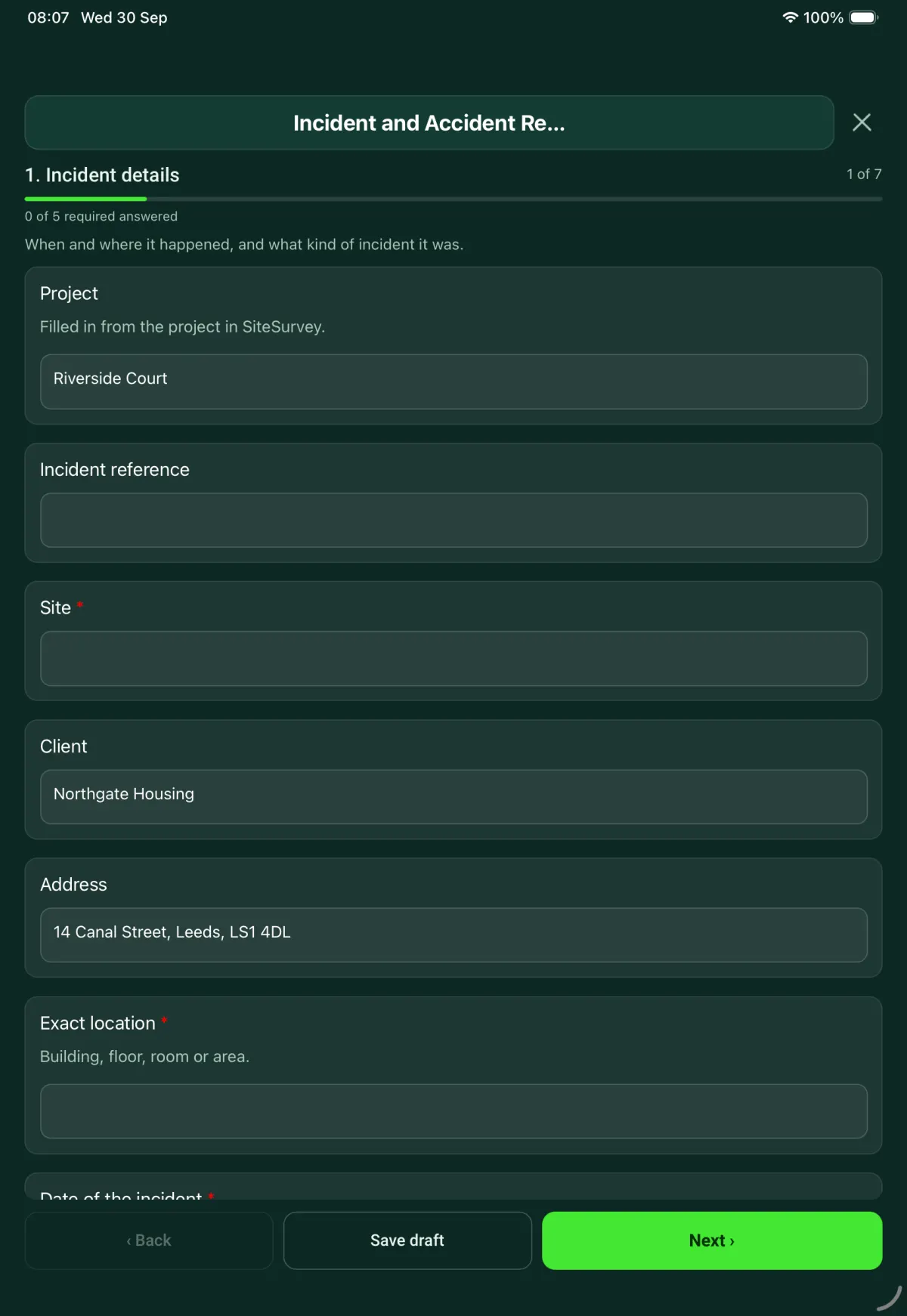
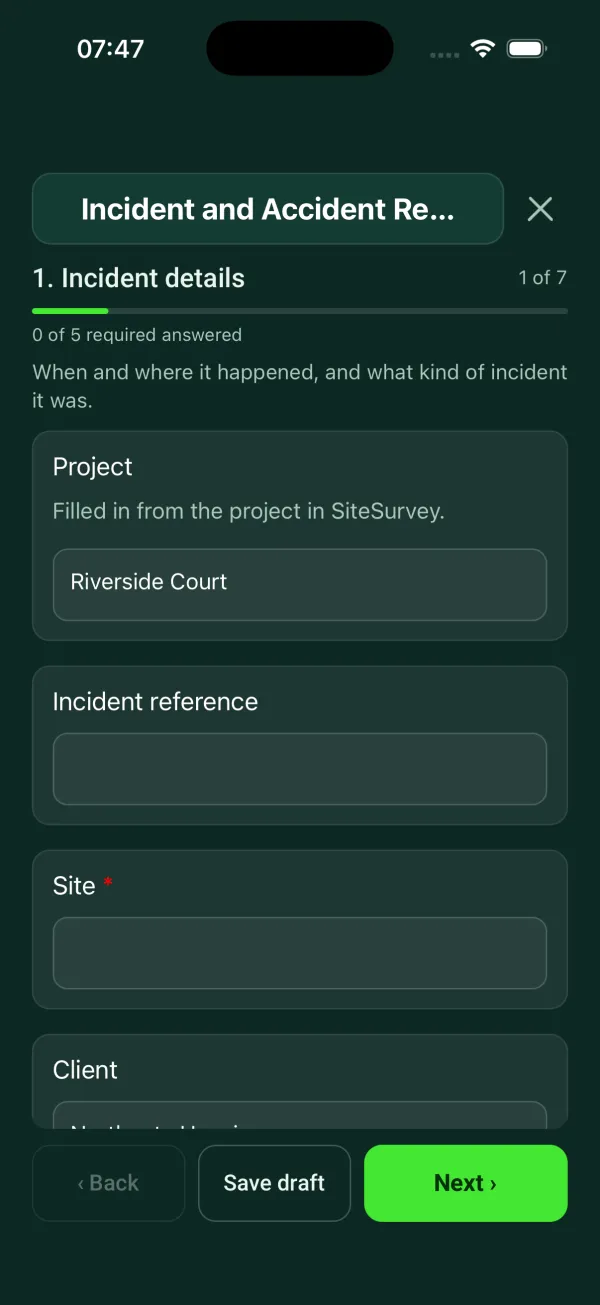
Every question in the incident report template
Record an accident, injury, near miss, dangerous occurrence, ill health or damage, with people involved, witness statements, RIDDOR checks, investigation and actions. 7 sections and 93 questions. Follow-up questions and guidance appear only when an answer calls for them, so the person on site never sees the ones that do not apply.
Details you only enter once
Add this form to a project in SiteSurvey and it fills in what the project already knows, so nobody on site retypes it and every form on the job uses the same names. Anything filled in can still be changed.
- Project: the project name
- Site: the site, when the form is opened for a space or a product
- Client: the project's customer
- Address: the site address, from the space or the project
Incident details
When and where it happened, and what kind of incident it was.
- ProjectShort answerFills in from the project name
- Incident referenceShort answer
- Site*Short answerFills in from the site, when the form is opened for a space or a product
- ClientShort answerFills in from the project's customer
- AddressShort answerFills in from the site address, from the space or the project
- Exact location*Short answer
- Date of the incident*Date
- TimeTime
- What kind of incident was it?*Tick all that apply
- Injury
- Near miss
- Dangerous occurrence
- Work-related ill health
- Damage to property or equipment
- GuidanceFirst things first. Make the area safe, get first aid or call 999, and where it is safe to do so leave the scene as it is until photos have been taken.
- GuidanceNear miss. Nobody was hurt this time, but it could have happened. Recording it lets you fix the cause before someone is.Shown when “What kind of incident was it?” includes “Near miss”
- WarningDangerous occurrence. If the event is one of those listed in Schedule 2 of RIDDOR 2013, the responsible person must notify the enforcing authority by the quickest practicable means without delay, and send a report within 10 days, whether or not anyone was hurt. Regulation 7 and Schedule 1.Shown when “What kind of incident was it?” includes “Dangerous occurrence”
- CheckWork-related ill health. Certain occupational diseases are reportable under RIDDOR 2013 when they are likely to have been caused or made worse by the work. HSE guidance is to report as soon as the responsible person receives the diagnosis.Shown when “What kind of incident was it?” includes “Work-related ill health”
- Your name and roleShort answer
- Date of this reportDate
- Days from the incident to this reportWorked out by the formShown when “Date of the incident” is answered and “Date of this report” is answered
- CheckThe date of this report is before the date of the incident. Check the dates.Shown only when the answers above make it relevant
- Has the site manager or supervisor been told?Yes or No
- Who, and when?Short answerShown when “Has the site manager or supervisor been told?” is Yes
- CheckTell the person in charge of the site now. They may need to stop work, make the area safe or report the incident.Shown when “Has the site manager or supervisor been told?” is No
What happened
The facts, in order. Take the photos before anything is moved.
- What was being done at the time?Notes
- What happened?*Notes
- What kind of event was it?Choose one
- Slip, trip or fall on the same level
- Fall from height
- Struck by a moving or falling object
- Struck against something fixed
- Lifting, carrying or handling
- Contact with moving machinery
- Contact with electricity
- Hit by a moving vehicle
- Exposure to a harmful substance
- Fire or explosion
- Physical assault or abuse
- Other (describe)
- Height of the fall (metres)NumberShown when “What kind of event was it?” is “Fall from height”
- Conditions at the timeTick all that apply
- Wet or icy surface
- Poor lighting
- Untidy or obstructed area
- Bad weather
- Noisy area
- Nothing unusual
- Photos of the scenePhotos
- Was any equipment, tool, plant or vehicle involved?Yes or No
- What was it?Short answerShown when “Was any equipment, tool, plant or vehicle involved?” is Yes
- Photos of the equipmentPhotosShown when “Was any equipment, tool, plant or vehicle involved?” is Yes
- Has it been taken out of use and labelled?Yes or NoShown when “Was any equipment, tool, plant or vehicle involved?” is Yes
- CheckKeep the equipment out of use until it has been checked. It may be needed for the investigation.Shown when “Was any equipment, tool, plant or vehicle involved?” is Yes and “Has it been taken out of use and labelled?” is No
- What was damaged, and how badly?NotesShown when “What kind of incident was it?” includes “Damage to property or equipment”
- Estimated cost of the damage (£)NumberShown when “What kind of incident was it?” includes “Damage to property or equipment”
- Has the area been made safe?Yes or No
- How?NotesShown when “Has the area been made safe?” is Yes
- WarningKeep people away and stop any work that could repeat the incident until the area is safe.Shown when “Has the area been made safe?” is No
People involved
One entry for each person injured, taken ill or directly involved.
- GuidanceAdd everyone who was hurt or directly involved. Witnesses go on the next page.
- People involvedRepeat for each person. Each one asks:
- NameShort answer
- Who are they?Choose one
- Employee
- Agency worker
- Contractor or subcontractor
- Self-employed
- Visitor
- Resident or tenant
- Member of the public
- Other (describe)
- Employer or companyShort answer
- Phone or emailShort answer
- Were they at work at the time?Yes or No
- Were they injured or taken ill?Yes or No
- Type of injuryChoose one
- Cut or graze
- Bruise
- Sprain or strain
- Fracture
- Burn or scald
- Head injury
- Eye injury
- Crush injury
- Amputation
- Electric shock
- Breathing difficulty
- Loss of consciousness
- Other (describe)
Shown when “Were they injured or taken ill?” is Yes - Part of the bodyTick all that apply
- Head
- Face or eyes
- Neck
- Back
- Chest or abdomen
- Arm
- Hand or fingers
- Leg
- Foot or toes
Shown when “Were they injured or taken ill?” is Yes - Describe the injuryNotesShown when “Were they injured or taken ill?” is Yes
- GuidanceSpecified injuries, RIDDOR 2013 regulation 4. A fracture diagnosed by a doctor, other than to a finger, thumb or toe. Amputation of an arm, hand, finger, thumb, leg, foot or toe. An injury likely to cause permanent loss of sight or reduced sight in one or both eyes. A crush injury to the head or torso causing damage to the brain or internal organs. A burn covering more than 10% of the body, or significantly damaging the eyes, respiratory system or other vital organs. Any scalping needing hospital treatment. Loss of consciousness caused by head injury or asphyxia. An injury from working in an enclosed space that leads to hypothermia or heat-induced illness, or needs resuscitation or more than 24 hours in hospital.Shown when “Were they injured or taken ill?” is Yes and “Were they at work at the time?” is Yes
- Is the injury one of the specified injuries listed above?Yes or NoShown when “Were they injured or taken ill?” is Yes and “Were they at work at the time?” is Yes
- Was first aid given?Yes or NoShown when “Were they injured or taken ill?” is Yes
- By whom?Short answerShown when “Were they injured or taken ill?” is Yes and “Was first aid given?” is Yes
- Further treatmentChoose one
- None beyond first aid
- Went to hospital or a doctor later
- Taken from the scene to hospital for treatment
- Not known yet
Shown when “Were they injured or taken ill?” is Yes - Did the person die as a result?Yes or NoShown when “Were they injured or taken ill?” is Yes
- WarningDeath. A death resulting from a work-related accident is reportable. The responsible person must notify the enforcing authority by the quickest practicable means without delay, and send a report within 10 days. RIDDOR 2013, regulation 6 and Schedule 1. HSE's phone line for deaths and specified injuries to workers is 0345 300 9923.Shown when “Were they injured or taken ill?” is Yes and “Did the person die as a result?” is Yes
- WarningSpecified injury. This is reportable. The responsible person must notify the enforcing authority by the quickest practicable means without delay, and send a report within 10 days. RIDDOR 2013, regulation 4 and Schedule 1. Report online, or by phone on 0345 300 9923.Shown only when the answers above make it relevant
- How long have they been unable to do their normal work?Choose one
- Not off work
- Up to 3 days
- More than 3 days, up to 7
- More than 7 days
- Still off, not known yet
Shown when “Were they injured or taken ill?” is Yes and “Were they at work at the time?” is Yes and “Did the person die as a result?” is No - CheckOver-7-day injury. A worker unable to do their normal work for more than seven consecutive days, not counting the day of the accident, must be reported within 15 days of the accident. RIDDOR 2013, regulation 4(2).Shown when “Were they injured or taken ill?” is Yes and “Were they at work at the time?” is Yes and “How long have they been unable to do their normal work?” is “More than 7 days”
- GuidanceOver-3-day injury. This does not need reporting, but it must be recorded. HSE guidance is that an entry in the accident book is enough. RIDDOR 2013, regulation 12. If the absence goes past seven days it becomes reportable within 15 days of the accident.Shown when “Were they injured or taken ill?” is Yes and “Were they at work at the time?” is Yes and “How long have they been unable to do their normal work?” is “More than 3 days, up to 7”
- CheckKeep counting. If the absence goes past seven consecutive days, not counting the day of the accident, it must be reported within 15 days of the accident.Shown when “Were they injured or taken ill?” is Yes and “Were they at work at the time?” is Yes and “How long have they been unable to do their normal work?” is “Still off, not known yet”
- WarningReportable. A person not at work who is injured in a work-related accident and taken from the scene to hospital for treatment must be reported. Notify the enforcing authority without delay, and send a report within 10 days. RIDDOR 2013, regulation 5 and Schedule 1.Shown when “Were they injured or taken ill?” is Yes and “Were they at work at the time?” is No and “Further treatment” is “Taken from the scene to hospital for treatment”
- RIDDOR flagWorked out by the form
- Has the person agreed to photos of the injury?Yes or NoShown when “Were they injured or taken ill?” is Yes
- Photos of the injuryPhotosShown when “Were they injured or taken ill?” is Yes and “Has the person agreed to photos of the injury?” is Yes
- Their account of what happenedNotes
- Signature of the person involvedSignature
Witnesses
Statements in the witness's own words, taken as soon as possible.
- Did anyone see what happened?Yes or No
- GuidanceTaking a statement. Ask each witness to describe what they saw in their own words. Write it down, read it back to them, and ask them to sign it.Shown when “Did anyone see what happened?” is Yes
- Witness statementsRepeat for each witness. Each one asks:Shown when “Did anyone see what happened?” is Yes
- NameShort answer
- Who are they?Choose one
- Employee
- Agency worker
- Contractor or subcontractor
- Self-employed
- Visitor
- Resident or tenant
- Member of the public
- Other (describe)
- Phone or emailShort answer
- Where were they, and what could they see?Short answer
- StatementNotes
- Date of the statementDate
- Witness signatureSignature
Reporting and records
Whether it goes to the enforcing authority, and where it is recorded.
- People recordedWorked out by the form
- Injured or taken illWorked out by the form
- WarningAt least one entry on the People involved page points to a RIDDOR reportable outcome. Check the notes there.Shown only when the answers above make it relevant
- GuidanceRIDDOR 2013. The responsible person, usually the employer or whoever controls the premises, must report: deaths from a work-related accident; specified injuries to workers; injuries that stop a worker doing their normal work for more than seven consecutive days; injuries to people not at work who are taken from the scene to hospital for treatment; certain occupational diseases; and dangerous occurrences. HSE takes reports online.
- Is this incident reportable under RIDDOR?Choose one
- Yes
- No
- Not sure yet
- CheckYou have recorded that it is not reportable, but an entry on the People involved page suggests it may be. Check before closing the report.Shown only when the answers above make it relevant
- CheckCheck with your health and safety adviser now. Deaths, specified injuries, injuries to people not at work taken to hospital, and dangerous occurrences need notifying without delay and a report within 10 days. Over-7-day injuries need a report within 15 days of the accident.Shown when “Is this incident reportable under RIDDOR?” is “Not sure yet”
- Why is it reportable?Tick all that apply
- Death
- Specified injury to a worker
- Over-7-day injury to a worker
- Injury to a person not at work taken to hospital
- Occupational disease
- Dangerous occurrence
Shown when “Is this incident reportable under RIDDOR?” is “Yes” - Has it been reported?Yes or NoShown when “Is this incident reportable under RIDDOR?” is “Yes”
- WarningReport it now. Deaths, specified injuries, injuries to people not at work taken to hospital, and dangerous occurrences must be notified without delay, with a report within 10 days. Over-7-day injuries must be reported within 15 days of the accident.Shown when “Is this incident reportable under RIDDOR?” is “Yes” and “Has it been reported?” is No
- Report referenceShort answerShown when “Is this incident reportable under RIDDOR?” is “Yes” and “Has it been reported?” is Yes
- Date reportedDateShown when “Is this incident reportable under RIDDOR?” is “Yes” and “Has it been reported?” is Yes
- How was it reported?Choose one
- Online
- By phone
Shown when “Is this incident reportable under RIDDOR?” is “Yes” and “Has it been reported?” is Yes - Days from the incident to the reportWorked out by the formShown when “Is this incident reportable under RIDDOR?” is “Yes” and “Has it been reported?” is Yes and “Date of the incident” is answered and “Date reported” is answered
- CheckThis report was made more than 10 days after the incident. For this kind of incident the report is due within 10 days. Record the reason below.Shown only when the answers above make it relevant
- CheckThis report was made more than 15 days after the accident. Over-7-day injuries must be reported within 15 days. Record the reason below.Shown only when the answers above make it relevant
- Reason for the delayNotesShown only when the answers above make it relevant
- Does the employer normally have 10 or more people working at the same time at these premises?Yes or NoShown when “What kind of incident was it?” includes “Injury”
- Has it been entered in the accident book?Yes or NoShown when “What kind of incident was it?” includes “Injury”
- CheckAccident book. An employer who normally employs 10 or more people at the same time at the same premises must keep an accident book, on paper or electronic, and keep each entry for at least 3 years. Social Security (Claims and Payments) Regulations 1979, regulation 25.Shown when “What kind of incident was it?” includes “Injury” and “Does the employer normally have 10 or more people working at the same time at these premises?” is Yes and “Has it been entered in the accident book?” is No
- GuidanceKeep the records. RIDDOR records, including injuries that stop a worker doing their normal work for more than three consecutive days, must be kept for at least three years. RIDDOR 2013, regulation 12.
- Who else has been told?Tick all that apply
- Client
- Principal contractor
- Landlord or managing agent
- Insurer
- Police
- Next of kin
- Safety representative
- Other (describe)
Investigation and actions
Why it happened, and what will stop it happening again.
- Investigated byShort answer
- Date of the investigationDate
- Immediate causeNotes
- What contributed?Tick all that apply
- No risk assessment or method statement
- Risk assessment or method statement not followed
- Lack of training or experience
- Lack of supervision
- Equipment faulty or unsuitable
- PPE not provided or not worn
- Poor housekeeping
- Poor lighting or weather
- Time pressure
- Fatigue
- Poor communication
- Other (describe)
- Underlying or root causeNotes
- Was there a risk assessment covering this work?Choose one
- Yes
- No
- Not known
- Risk assessment referenceShort answerShown when “Was there a risk assessment covering this work?” is “Yes”
- Does it need reviewing after this incident?Yes or NoShown when “Was there a risk assessment covering this work?” is “Yes”
- GuidanceRegulation 3 of the Management of Health and Safety at Work Regulations 1999. An assessment must be reviewed if there is reason to suspect it is no longer valid, or there has been a significant change in the matters it relates to. Where changes are needed, they must be made.Shown when “Was there a risk assessment covering this work?” is “Yes” and “Does it need reviewing after this incident?” is Yes
- CheckNo risk assessment is recorded for this work. Make one before the work starts again.Shown when “Was there a risk assessment covering this work?” is “No”
- Could it happen again?Choose one
- Unlikely
- Possible
- Likely
- WarningLikely to happen again. Put interim controls in place now, before the actions below are complete.Shown when “Could it happen again?” is “Likely”
- ActionsRepeat for each action. Each one asks:
- What needs doing?Notes
- OwnerShort answer
- Due dateDate
- PriorityChoose one
- High
- Medium
- Low
- StatusChoose one
- Open
- Done
- CheckThe due date is before the date of the investigation. Check the date.Shown only when the answers above make it relevant
- Actions recordedWorked out by the form
- Actions still openWorked out by the form
- Lessons to shareNotes
Sign-off
- WarningThis incident may be reportable under RIDDOR and is not recorded as reported. Check the Reporting page before signing.Shown only when the answers above make it relevant
- Investigator nameShort answer
- Investigator signatureSignature
- Manager nameShort answer
- DateDate
- Manager signatureSignature
- Can this incident be closed?Yes or No
- CheckActions are still open. Close the incident once they are done, or record who is following them up.Shown only when the answers above make it relevant
- Who is following it up, and by when?Short answerShown when “Can this incident be closed?” is No
Incident report template questions
Which incidents must be reported under RIDDOR?
Under RIDDOR 2013 the responsible person, usually the employer or whoever controls the premises, must report deaths from a work-related accident and specified injuries to workers. They must also report injuries that stop a worker doing their normal work for more than seven consecutive days, injuries to people not at work who are taken from the scene to hospital for treatment, certain occupational diseases and dangerous occurrences. HSE takes reports online.
How quickly does a RIDDOR report have to be made?
Deaths, specified injuries, injuries to people not at work taken to hospital, and dangerous occurrences must be notified by the quickest practicable means without delay, with a report within 10 days. An over-7-day injury must be reported within 15 days of the accident. The seven days are consecutive, do not count the day of the accident, and include weekends and rest days. The form counts the days from the incident to the report and flags a late one.
Should near misses be reported?
Record them. A near miss is an event where nobody was hurt this time but could have been, and recording it lets you fix the cause before someone is. Some events are dangerous occurrences listed in Schedule 2 of RIDDOR 2013, and those must be reported whether or not anyone was hurt.
Do I still need an accident book?
An employer who normally employs 10 or more people at the same time at the same premises must keep an accident book, on paper or electronic, and keep each entry for at least 3 years. That is regulation 25 of the Social Security (Claims and Payments) Regulations 1979. An injury that keeps a worker off their normal work for more than three days must be recorded, and HSE guidance is that an accident book entry is enough. The form asks whether the entry has been made.
Can I use it as an incident investigation form?
Yes. The investigation section records the immediate cause, what contributed, and the underlying or root cause, found by asking why until you reach something the organisation controls. It asks whether a risk assessment covered the work and whether it needs reviewing, then lists each action with an owner, a due date, a priority and a status.
Can witnesses sign their statements on site?
Yes. Each witness gives a statement in their own words, which is read back to them and signed on the phone or tablet. The person involved can sign their own account too. In the SiteSurvey app the form works offline, and injury photos are only taken when the person agrees.
Related
Related templates
Templates that go with the incident report form
Hazards, who might be harmed, controls and risk scores, with a briefing record and review date.
Construction site safety walk: perimeter, work at height, welfare, housekeeping, plant, hazards and actions.
Record a toolbox talk: topic, key points, attendees with signatures.
One issue, fast: where, what, photo, priority, who owns it.
Use this incident report form with your team
Add it from the form library in one click, change any question, and every completed form becomes a branded PDF report.
Start your trial →