Form library · Health and safety
Legionella risk assessment template
A legionella risk assessment form for a hot and cold water system in an office, rented home, school, care setting or other building. Record who is responsible, follow the water from tank to tap, take outlet temperatures against HSE's guidance figures, and list the actions with an owner and a date. Every question is listed below, and you can fill the live form in on this page.
Ready to use from the form library, and every question is yours to edit. Trial from £1, cancel any time.
Try it on your phone
Try it on this phone
Fill in the legionella risk assessment on your phone now
See how the legionella risk assessment looks on your phone
Scan the code with your phone camera. It opens the real form, no sign-up needed.
Open the live example and fill it in, just as your team would on site. No sign-up needed.
See it on this phoneEvery question is editable. Add this form to your account, then change the wording, add or remove questions and options, and make it fit your own jobs.
What should a legionella risk assessment include?
A legionella risk assessment should name the duty holder and the person managing the risk, describe the water system (storage tanks, how hot water is made, showers, little-used outlets and dead legs), and say whether any users are more at risk. It should record water temperatures, the overall risk and the actions needed. HSE guidance is to store hot water at 60 °C or more and keep cold water below 20 °C.
Last updated . Facts checked by the SiteSurvey team on 5 October 2026 against HSE Legionnaires' disease: keeping records, HSE L8, Legionnaires' disease: the control of legionella bacteria in water systems, HSE HSG274, Legionnaires' disease: technical guidance (Part 2, hot and cold water systems) and HSE: hot and cold water systems, things to consider.
Try the legionella risk assessment form live
Answer a few questions and watch it adapt. Your answers are not saved, and any photos you add are deleted within the hour.
This is the real form as your team would use it: questions appear as you answer, scores work themselves out and you can add photos and signatures. No sign-up needed.
Want to see one filled in? See a completed legionella risk assessment report (PDF), made by SiteSurvey from a fictional site visit.
Fill it in on a phone or tablet
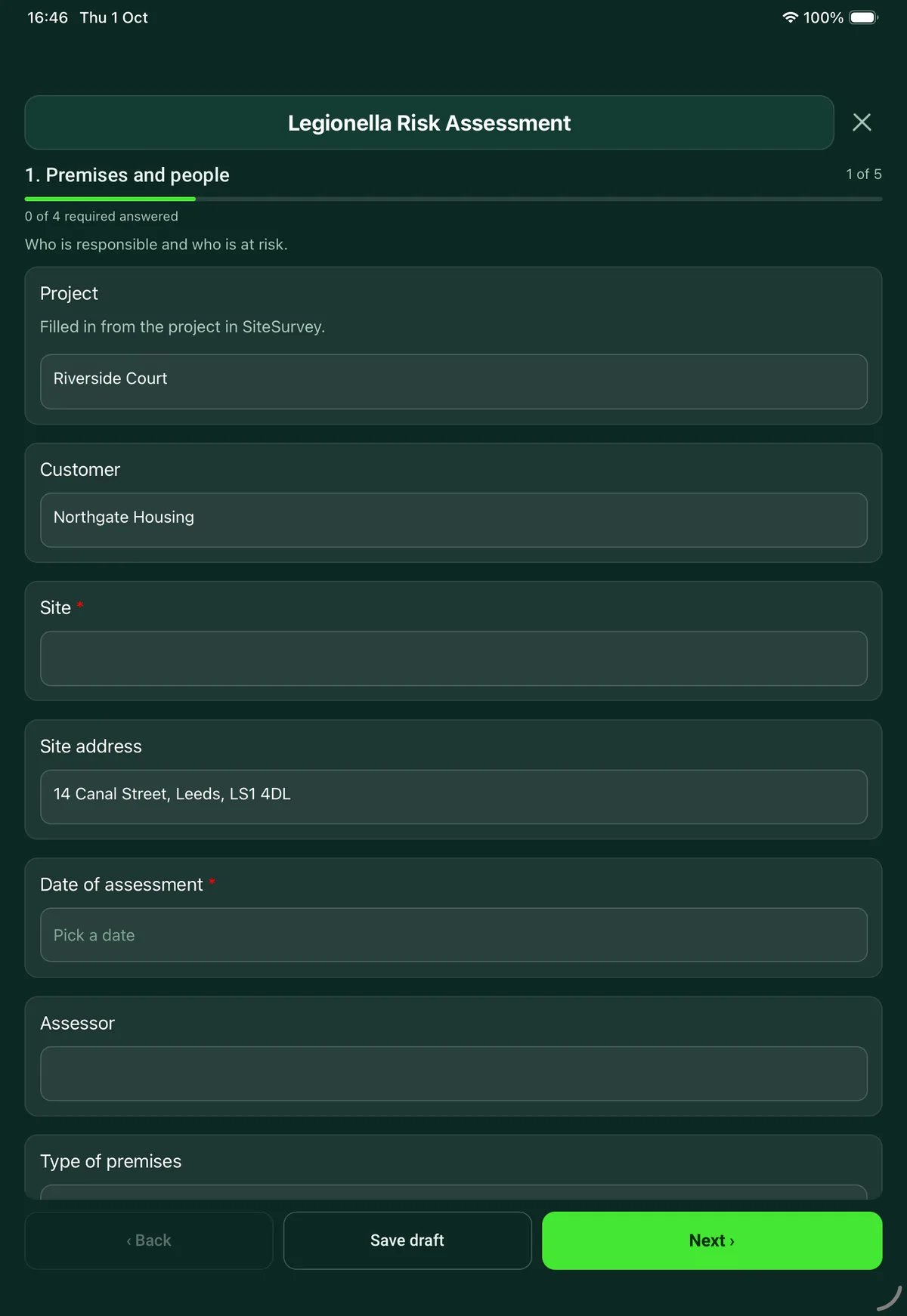
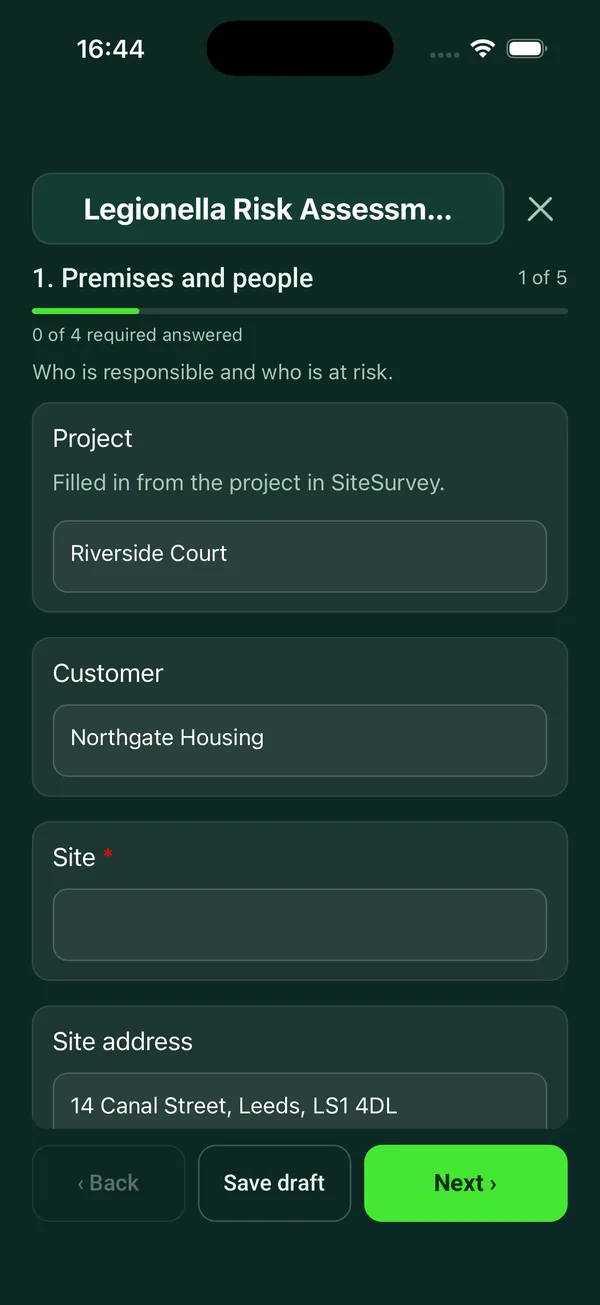
Your team completes the legionella risk assessment on site in the SiteSurvey app on iPhone, iPad and Android phones and tablets. The project name and address fill in for them, it works without signal, and it syncs when the device is back online with photos kept against the question they answer.
Customers and subcontractors do not need the app: send them a link and they can fill it in from any browser.
Every question in the legionella risk assessment template
Legionella risk assessment for a hot and cold water system: who is responsible, tanks and heaters, outlet temperatures, little-used outlets, findings and actions. 5 sections and 54 questions. Follow-up questions and guidance appear only when an answer calls for them, so the person on site never sees the ones that do not apply.
Make it your own: every question is editable
This is a starting point, not a fixed form. Once it is in your SiteSurvey account you can reword any question, add or remove questions, sections and answer options, and add your own logo, so it fits the way your team works and the jobs you do.
Details you only enter once
Add this form to a project in SiteSurvey and it fills in what the project already knows, so nobody on site retypes it and every form on the job uses the same names. Anything filled in can still be changed.
- Project: the project name
- Customer: the project's customer
- Site: the site, when the form is opened for a space or a product
- Site address: the site address, from the space or the project
Premises and people
Who is responsible and who is at risk.
- ProjectShort answer
Filled in from the project in SiteSurvey.
Fills in from the project name - CustomerShort answerFills in from the project's customer
- Site*Short answerFills in from the site, when the form is opened for a space or a product
- Site addressShort answerFills in from the site address, from the space or the project
- Date of assessment*Date
- AssessorShort answer
- Type of premisesChoose one
- Office
- Rented home
- Block of flats: communal systems
- School or nursery
- Care home or healthcare
- Hotel or leisure
- Factory or warehouse
- Shop
- Other (describe)
- Duty holderShort answer
The employer, or the person in control of the premises, such as the landlord.
- Person appointed to manage the risk day to dayShort answer
- Has the appointed person had legionella awareness or control training?Yes or No
- Are any users more at risk?Yes or No
For example older people, people who are ill or have a weakened immune system.
- Date of the previous assessmentDate
- Is there a written scheme for controlling the risk?Yes or No
- Is there an up-to-date schematic diagram of the water system?Yes or No
- Are monitoring records kept?Yes or No
- GuidanceHSE guidance says the duty holder must assess the risk from legionella and keep records of the checks. If you have 5 or more employees you have to record any significant findings, including the people identified as being particularly at risk and the steps taken to prevent or control the risks.
- GuidanceHSE says records should be retained for as long as they remain current and for at least 2 years after that. Records of monitoring, inspection and tests should be kept for at least 5 years.Shown when “Are monitoring records kept?” is No
The water system
Follow the water from where it comes in to where it comes out.
- Water supplyChoose one
- Mains
- Private supply
- Both
- Is there a cold water storage tank?Yes or No
- Close-fitting lid and insect screens fitted?Yes or NoShown when “Is there a cold water storage tank?” is Yes
- Clean inside, with no sediment, scale or debris?Yes or NoShown when “Is there a cold water storage tank?” is Yes
- Tank and pipework insulated?Yes or NoShown when “Is there a cold water storage tank?” is Yes
- Temperature of the stored cold water (°C)NumberShown when “Is there a cold water storage tank?” is Yes
- CheckAbove 20 °C. HSE guidance is to keep cold water below 20 °C. Check insulation, turnover and nearby heat sources.Shown only when the answers above make it relevant
- Photos of the tank, inside and outPhotosShown when “Is there a cold water storage tank?” is Yes
- How is hot water made?Choose one
- Stored: cylinder or calorifier
- Combination boiler, no storage
- Instant point of use heaters
- A mix
- Other (describe)
- Stored hot water temperature (°C)NumberShown only when the answers above make it relevant
- CheckBelow 60 °C. HSE guidance is to store hot water at 60 °C or more.Shown only when the answers above make it relevant
- Calorifier return temperature (°C)NumberShown only when the answers above make it relevant
- CheckBelow 50 °C. HSE guidance (HSG274 Part 2) is for the return to the calorifier to be at least 50 °C, or 55 °C in healthcare premises.Shown only when the answers above make it relevant
- Are thermostatic mixing valves fitted?Yes or No
- Are there showers, spray taps or other outlets that make a spray?Yes or No
- Are there little-used outlets?Yes or No
Spare rooms, empty flats, outside taps, a shower nobody uses.
- How are they flushed, how often, and who records it?Short answerShown when “Are there little-used outlets?” is Yes
- Any dead legs or redundant pipework?Yes or No
- Other systems on siteTick all that apply
- Cooling tower or evaporative condenser
- Spa pool or hot tub
- Humidifier
- Water feature or fountain
- Vehicle wash
- Irrigation or misting
- Other (describe)
- CheckCooling towers and evaporative condensers. The Notification of Cooling Towers and Evaporative Condensers Regulations 1992 require the person in control of the premises to notify the local authority in writing of these devices. This form does not cover them: they need their own assessment.Shown when “Other systems on site” includes “Cooling tower or evaporative condenser”
Outlet temperatures
The nearest and furthest outlets on each system, and any others you choose.
- GuidanceHSE guidance on legionella is to store hot water at 60 °C or more, to reach 50 °C at the outlets within 1 minute (55 °C in healthcare premises) and to keep cold water below 20 °C. This is guidance: the written scheme sets what is checked and how often.
- Outlets testedRepeat for each outlet. Each one asks:
- Location*Short answer
- OutletChoose one
- Tap
- Shower
- Mixer tap with mixing valve
- Outside tap
- Other (describe)
- Hot, after 1 minute (°C)Number
- Cold, after 2 minutes (°C)Number
- CheckHot water below 50 °C at the outlet after 1 minute.Shown only when the answers above make it relevant
- CheckCold water above 20 °C.Shown only when the answers above make it relevant
- ConditionChoose one
- Clean
- Scale or dirt on the outlet
- Not working
- Outlets testedWorked out by the form
- Hot below 50 °CWorked out by the form
- Cold above 20 °CWorked out by the form
Risk and actions
What needs doing, by whom and by when.
- Overall risk*Choose one
- High
- Medium
- Low
- Why?Notes
- Is any action needed?Yes or No
- ActionsRepeat for each action. Each one asks:Shown when “Is any action needed?” is Yes
- Issue*Short answer
- What needs doing?Notes
- PriorityChoose one
- Now
- Within a month
- Within three months
- At the next review
- WhoShort answer
- By whenDate
- PhotosPhotos
- ActionsWorked out by the formShown when “Is any action needed?” is Yes
Review and sign-off
When it will be looked at again.
- Review dateDate
- GuidanceHSE says to review the assessment regularly, and whenever something changes in the system or the way the building is used.
- Assessor nameShort answer
- Assessor signatureSignature
- Signed for the duty holder byShort answer
- Signature for the duty holderSignature
See it filled in
A completed legionella risk assessment report, made by SiteSurvey from a fictional site visit: every answer, the photos, the guidance that applied and the sign-off, ready to send as a PDF.
Legionella risk assessment FAQs
What temperatures should the water be?
HSE guidance on legionella is to store hot water at 60 °C or more, to reach 50 °C at the outlets within 1 minute (55 °C in healthcare premises) and to keep cold water below 20 °C. The form flags stored hot water under 60 °C, an outlet under 50 °C and cold water over 20 °C, and counts the outlets outside those figures. This is guidance: the site's written scheme sets what is checked and how often.
Who is responsible for the legionella risk assessment?
HSE guidance says the duty holder, meaning the employer or the person in control of the premises such as a landlord, must assess the risk from legionella and keep records of the checks. The form records the duty holder and the person appointed to manage the risk day to day.
Does it have to be written down?
HSE says that if you have 5 or more employees you have to record any significant findings, including the people identified as particularly at risk and the steps taken to prevent or control the risks. Records should be kept for as long as they remain current and at least 2 years after, and records of monitoring, inspection and tests for at least 5 years.
Does it cover cooling towers?
No. If there is a cooling tower or evaporative condenser on site, the form notes that the person in control of the premises must notify the local authority in writing under the Notification of Cooling Towers and Evaporative Condensers Regulations 1992, and that these systems need their own assessment.
What does it check on the system?
The cold water storage tank (lid, cleanliness, insulation and temperature, with photos), how hot water is made and stored, thermostatic mixing valves, showers and spray outlets, little-used outlets and how they are flushed, dead legs, and other systems such as spa pools and humidifiers. For stored hot water it records the calorifier return temperature and flags one under 50 °C, the HSG274 Part 2 figure (55 °C in healthcare premises).
How often should it be reviewed?
HSE says to review the assessment regularly, and whenever something changes in the system or the way the building is used. The form records a review date and is signed by the assessor and for the duty holder.
Related
Related templates
Templates that go with the legionella risk assessment form
Planned maintenance visit: records seen, asset by asset tasks, water temperatures, work done and next visit.
Assessment for a task that uses or creates hazardous substances: products and hazard symbols, who is exposed and how, controls, PPE, emergencies and review.
Service visit record for air conditioning, heat pumps, ventilation and air handling units. Unit by unit checks, refrigerant and F gas leak checks, parts used and sign-off.
Hazards, who might be harmed, controls and risk scores, with a briefing record and review date.
Use this legionella risk assessment form with your team
Add it from the form library in one click, change any question, and every completed form becomes a branded PDF report.
Start your trial →