Form library · Fire safety
Fire risk assessment template
A fire risk assessment form that follows the five steps in GOV.UK guidance: identify the fire hazards, identify the people at risk, evaluate the precautions, record and plan, and review. Each precaution is judged adequate or not, and each finding gets a risk, an action, an owner and a date. Every question is listed below, and you can fill the live form in on this page.
Ready to use from the form library, and every question is yours to edit. Trial from £1, cancel any time.
Try it on your phone
Try it on this phone
Fill in the fire risk assessment on your phone now
See how the fire risk assessment looks on your phone
Scan the code with your phone camera. It opens the real form, no sign-up needed.
Open the live example and fill it in, just as your team would on site. No sign-up needed.
See it on this phoneEvery question is editable. Add this form to your account, then change the wording, add or remove questions and options, and make it fit your own jobs.
What should a fire risk assessment include?
GOV.UK sets out five steps: identify the fire hazards, identify people at risk, evaluate, remove or reduce the risks, record your findings, prepare an emergency plan and provide training, and review and update the assessment regularly. It should consider escape routes, detection and warning, firefighting equipment, dangerous substances, the evacuation plan, the needs of vulnerable people, and staff information and training.
Last updated . Facts checked by the SiteSurvey team on 5 October 2026 against GOV.UK fire safety in the workplace: fire risk assessments, GOV.UK guidance on section 156 of the Building Safety Act 2022 and article 17 of the Regulatory Reform (Fire Safety) Order 2005.
Try the fire risk assessment form live
Answer a few questions and watch it adapt. Your answers are not saved, and any photos you add are deleted within the hour.
This is the real form as your team would use it: questions appear as you answer, scores work themselves out and you can add photos and signatures. No sign-up needed.
Want to see one filled in? See a completed fire risk assessment report (PDF), made by SiteSurvey from a fictional site visit.
Fill it in on a phone or tablet
Your team completes the fire risk assessment on site in the SiteSurvey app on iPhone, iPad and Android phones and tablets. The project name and address fill in for them, it works without signal, and it syncs when the device is back online with photos kept against the question they answer.
Customers and subcontractors do not need the app: send them a link and they can fill it in from any browser.
Every question in the fire risk assessment template
Fire risk assessment following the five steps in GOV.UK guidance: hazards, people at risk, fire precautions, emergency plan and training, findings with actions and review. 7 sections and 68 questions. Follow-up questions and guidance appear only when an answer calls for them, so the person on site never sees the ones that do not apply.
Make it your own: every question is editable
This is a starting point, not a fixed form. Once it is in your SiteSurvey account you can reword any question, add or remove questions, sections and answer options, and add your own logo, so it fits the way your team works and the jobs you do.
Details you only enter once
Add this form to a project in SiteSurvey and it fills in what the project already knows, so nobody on site retypes it and every form on the job uses the same names. Anything filled in can still be changed.
- Project: the project name
- Customer: the project's customer
- Premises: the site, when the form is opened for a space or a product
- Address: the site address, from the space or the project
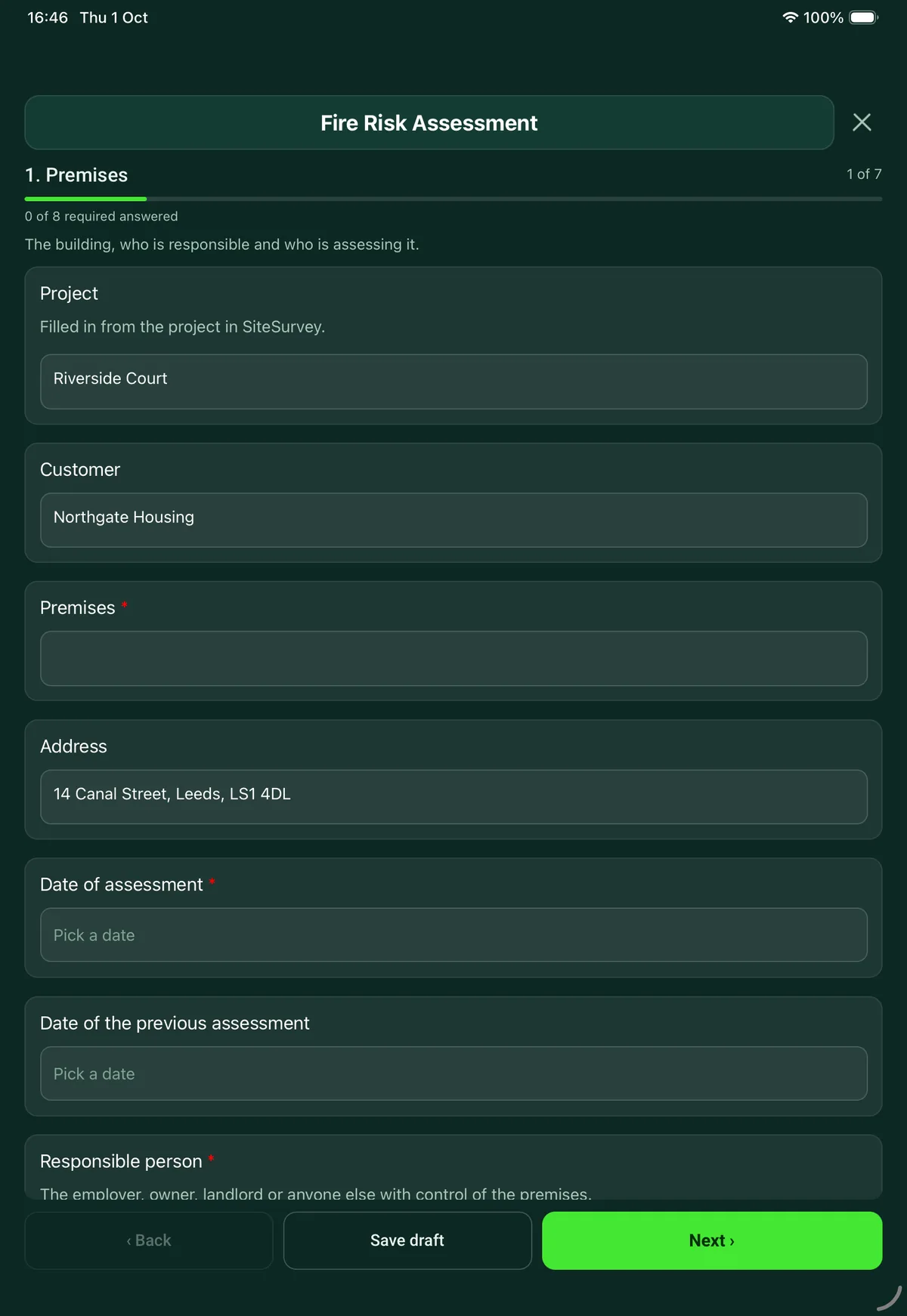
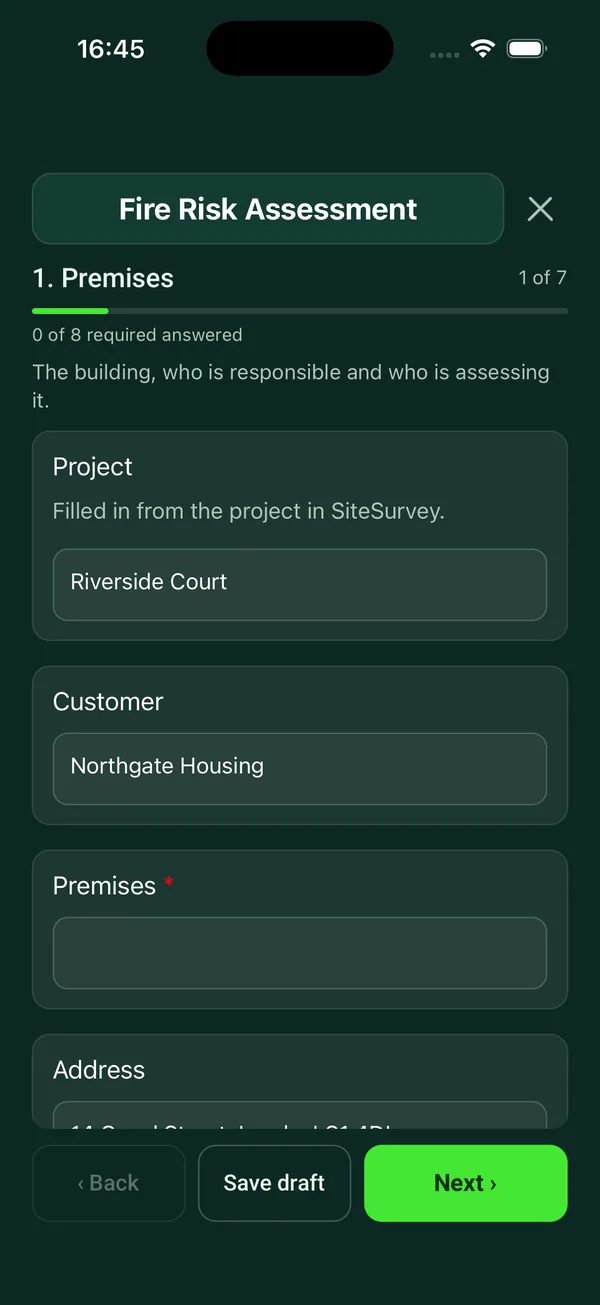
Premises
The building, who is responsible and who is assessing it.
- ProjectShort answer
Filled in from the project in SiteSurvey.
Fills in from the project name - CustomerShort answerFills in from the project's customer
- Premises*Short answerFills in from the site, when the form is opened for a space or a product
- AddressShort answerFills in from the site address, from the space or the project
- Date of assessment*Date
- Date of the previous assessmentDate
- Responsible person*Short answer
The employer, owner, landlord or anyone else with control of the premises.
- Other responsible persons for these premisesNotes
For example the landlord or other occupiers: their UK address for notices, and the part of the premises each controls.
- Assessor name*Short answer
- Assessor organisationShort answer
- GuidanceWhat must be recorded. Since 1 October 2023 every responsible person must record the fire risk assessment in full, including all the findings, and their fire safety arrangements. Where someone is engaged to help with the assessment, their name and organisation must be recorded too. This applies to non-domestic premises and the non-domestic parts of blocks of flats, such as corridors, stairways and plant rooms.
- GuidanceThis form follows the Regulatory Reform (Fire Safety) Order 2005, which applies in England and Wales. Scotland and Northern Ireland have their own fire safety law.
- What is the building used for?Choose one
- Office
- Shop
- Factory or warehouse
- School or nursery
- Care home
- Hotel, hostel or other sleeping accommodation
- Block of flats: common parts
- Pub, restaurant or venue
- Community hall or place of worship
- Other (describe)
- Number of floorsNumber
- Most people in the building at one timeNumber
- Does anyone sleep on the premises?Yes or No
- Brief description of the building and how it is usedNotes
Step 1: fire hazards
What could start a fire, and what could burn.
- Sources of ignitionTick all that apply
- Electrical equipment and wiring
- Portable heaters
- Cooking
- Smoking
- Hot work by contractors
- Arson
- Battery charging, including e-bikes and scooters
- Plant and machinery
- Candles or naked flames
- Other (describe)
- Things that could burnTick all that apply
- Paper and cardboard
- Waste and recycling
- Furniture and furnishings
- Flammable liquids
- Gas cylinders
- Packaging and stock
- Displays and decorations
- Wall and ceiling linings
- Other (describe)
- Are there oxygen cylinders or oxidising chemicals?Yes or No
- Housekeeping and wasteChoose one
- Adequate
- Needs improvement
- Not adequate
- Electrical installation and equipment checksChoose one
- In date
- Overdue
- No record
- Security against arsonChoose one
Bins away from the building, doors and windows secure, no rubbish against walls.
- Adequate
- Needs improvement
- Not adequate
- Notes on the hazardsNotes
- PhotosPhotos
Step 2: people at risk
Who is in the building, and who would need help to get out.
- Who uses the building?Tick all that apply
- Employees
- Visitors or the public
- Contractors
- Lone workers
- People sleeping
- Children
- Older people
- Disabled people
- People who do not know the building
- GuidanceGOV.UK guidance says the assessment must consider the needs of vulnerable people, for example the elderly, young children or those with disabilities.
- Would anyone need help to leave the building?Yes or No
- Does each of them have a personal emergency evacuation plan?Yes or NoShown when “Would anyone need help to leave the building?” is Yes
- CheckAgree a personal emergency evacuation plan with each person and record it as an action on page 6.Shown when “Would anyone need help to leave the building?” is Yes and “Does each of them have a personal emergency evacuation plan?” is No
- NotesNotes
Step 3: evaluate the precautions
For each one, is what is in place enough for this building and these people?
- Escape routes and exitsChoose one
Enough of them, short enough, clear, and doors open easily in the direction of escape.
- Adequate
- Needs improvement
- Not adequate
- Not applicable
- What did you find?NotesShown only when the answers above make it relevant
- Fire doors and the walls and floors that hold back fireChoose one
Doors close fully, are not wedged open, and there are no unsealed holes for pipes and cables.
- Adequate
- Needs improvement
- Not adequate
- Not applicable
- What did you find?NotesShown only when the answers above make it relevant
- Emergency lightingChoose one
- Adequate
- Needs improvement
- Not adequate
- Not applicable
- What did you find?NotesShown only when the answers above make it relevant
- Fire exit signs and noticesChoose one
- Adequate
- Needs improvement
- Not adequate
- Not applicable
- What did you find?NotesShown only when the answers above make it relevant
- Fire detection and warningChoose one
Can everyone in the building be warned in time?
- Adequate
- Needs improvement
- Not adequate
- Not applicable
- What did you find?NotesShown only when the answers above make it relevant
- Fire extinguishers and other firefighting equipmentChoose one
- Adequate
- Needs improvement
- Not adequate
- Not applicable
- What did you find?NotesShown only when the answers above make it relevant
- Storage of dangerous substancesChoose one
- Adequate
- Needs improvement
- Not adequate
- Not applicable
- What did you find?NotesShown only when the answers above make it relevant
- Testing and maintenance recordsChoose one
Alarm tests, emergency lighting tests, extinguisher servicing.
- Adequate
- Needs improvement
- Not adequate
- Not applicable
- What did you find?NotesShown only when the answers above make it relevant
- GuidanceRegulatory Reform (Fire Safety) Order 2005, article 17. The responsible person must make sure the premises and the fire safety equipment are subject to a suitable system of maintenance, and are kept in efficient working order and in good repair. Home Office guidance is that fire warning systems should be tested once a week.Shown only when the answers above make it relevant
Step 4: plan and train
The emergency plan, training and drills.
- Is there a written emergency plan?Yes or No
- Do staff know what to do if they find a fire or hear the alarm?Yes or No
- Evacuation strategyChoose one
- Everyone leaves at once
- Phased or staged
- Stay put (flats)
- Progressive horizontal (care)
- Not defined
- Have staff had fire safety training?Yes or No
- Are there trained fire wardens or marshals?Yes or No
- Date of the last fire drillDate
- Days since the last drillWorked out by the formShown when “Date of the last fire drill” is answered and “Date of assessment” is answered
- CheckGOV.UK guidance says you should carry out at least one fire drill per year and record the results.Shown only when the answers above make it relevant
- Assembly pointShort answer
Findings and actions
One entry for each thing that needs putting right.
- FindingsRepeat for each finding. Each one asks:
- Where*Short answer
- What is wrong?*Notes
- Risk*Choose one
- High
- Medium
- Low
- Action neededNotes
- WhoShort answer
- By whenDate
- PhotosPhotos
- FindingsWorked out by the form
- High riskWorked out by the form
- Overall risk to life from fire in this building*Choose one
- High
- Medium
- Low
- GuidanceHigh, Medium and Low are this form's own scale. The law asks for a suitable and sufficient assessment, not a particular scoring method.
- Summary for the responsible personNotes
Step 5: review and sign-off
Keep it up to date.
- Review dateDate
- GuidanceGOV.UK guidance is to review and update the fire risk assessment regularly. Review it sooner after a fire or near miss, building work, a change of use or layout, or a change in who uses the building.
- GuidanceYou can do the assessment yourself with the help of the standard guides. If you do not have the expertise or the time, GOV.UK says you need to appoint a competent person, such as a professional risk assessor.
- Have employees been told the risks found, the measures in place and the emergency procedures?Yes or No
- Assessor nameShort answer
- Assessor signatureSignature
- Responsible person nameShort answer
- Responsible person signatureSignature
See it filled in
A completed fire risk assessment report, made by SiteSurvey from a fictional site visit: every answer, the photos, the guidance that applied and the sign-off, ready to send as a PDF.
Fire risk assessment FAQs
Does a fire risk assessment have to be written down?
Yes. GOV.UK says you must keep a written record of your fire risk assessment. Since 1 October 2023 every responsible person must record the assessment in full, including all the findings, along with their fire safety arrangements. Where someone is engaged to help with the assessment, their name and organisation must be recorded too.
Who can carry out a fire risk assessment?
GOV.UK says you can do it yourself with the help of the standard guides. If you do not have the expertise or the time, you need to appoint a competent person, such as a professional risk assessor. The form records the responsible person, the assessor and the assessor's organisation.
Which buildings does this template suit?
Offices, shops, factories and warehouses, schools, care homes, sleeping accommodation, the common parts of blocks of flats, venues and community buildings. It follows the Regulatory Reform (Fire Safety) Order 2005, which applies in England and Wales. Scotland and Northern Ireland have their own fire safety law.
How does it rate the risk?
Each precaution is marked adequate, needs improvement, not adequate or not applicable, and each finding is rated High, Medium or Low. The form counts the findings and the high risk ones and asks for an overall rating. That scale is the form's own: the law asks for a suitable and sufficient assessment, not a particular scoring method.
Does it cover people who need help to get out?
Yes. Step 2 records who uses the building and whether anyone would need help to leave. If they do and have no personal emergency evacuation plan, the form prompts an action to agree one. The library has a separate PEEP form for that plan.
How often should fire drills and alarm tests happen?
GOV.UK guidance says you should carry out at least one fire drill per year and record the results. The form works out the days since the last drill and flags one more than a year old. Home Office guidance is that fire warning systems should be tested once a week, and article 17 of the Fire Safety Order requires a suitable system of maintenance.
Related
Related templates
Templates that go with the fire risk assessment form
A PEEP for one person who would need help to leave a building in a fire: how they are warned, their route, refuges, equipment, helpers, practice and review.
Routine fire safety checks: extinguishers, emergency lighting tests, the weekly alarm test, escape routes, signs and fire drills, with actions.
Door by door checks (gaps, seals, closers, signage, glazing), 12 month flat entrance door record and remedial work list.
Hazards, who might be harmed, controls and risk scores, with a briefing record and review date.
Use this fire risk assessment form with your team
Add it from the form library in one click, change any question, and every completed form becomes a branded PDF report.
Start your trial →