Form library · Fire safety
PEEP template
A personal emergency evacuation plan for one person, written with them. It records what makes leaving difficult, how they will know there is a fire, their route, any refuge and equipment, the named helpers and their cover, and when the plan was practised and will be reviewed. It works for employees, visitors, pupils and residents. Every question is listed below, and you can fill the live form in on this page.
Ready to use from the form library, and every question is yours to edit. Trial from £1, cancel any time.
Try it on your phone
Try it on this phone
Fill in the PEEP on your phone now
See how the PEEP looks on your phone
Scan the code with your phone camera. It opens the real form, no sign-up needed.
Open the live example and fill it in, just as your team would on site. No sign-up needed.
See it on this phoneEvery question is editable. Add this form to your account, then change the wording, add or remove questions and options, and make it fit your own jobs.
What should a PEEP include?
A personal emergency evacuation plan should record what makes leaving difficult for the person, how they will be warned of a fire, their escape route step by step, any refuge and how they call for help from it, the equipment needed and where it is kept, the named helpers and who covers for them, and where they go once outside. It should be agreed with the person, practised, and reviewed.
Last updated . Facts checked by the SiteSurvey team on 5 October 2026 against GOV.UK Residential PEEPs factsheet, the Fire Safety (Residential Evacuation Plans) (England) Regulations 2025 and GOV.UK fire safety risk assessment: means of escape for disabled people.
Try the PEEP form live
Answer a few questions and watch it adapt. Your answers are not saved, and any photos you add are deleted within the hour.
This is the real form as your team would use it: questions appear as you answer, scores work themselves out and you can add photos and signatures. No sign-up needed.
Want to see one filled in? See a completed PEEP report (PDF), made by SiteSurvey from a fictional site visit.
Fill it in on a phone or tablet
Your team completes the personal emergency evacuation plan on site in the SiteSurvey app on iPhone, iPad and Android phones and tablets. The project name and address fill in for them, it works without signal, and it syncs when the device is back online with photos kept against the question they answer.
Customers and subcontractors do not need the app: send them a link and they can fill it in from any browser.
Every question in the PEEP template
A PEEP for one person who would need help to leave a building in a fire: how they are warned, their route, refuges, equipment, helpers, practice and review. 4 sections and 44 questions. Follow-up questions and guidance appear only when an answer calls for them, so the person on site never sees the ones that do not apply.
Make it your own: every question is editable
This is a starting point, not a fixed form. Once it is in your SiteSurvey account you can reword any question, add or remove questions, sections and answer options, and add your own logo, so it fits the way your team works and the jobs you do.
Details you only enter once
Add this form to a project in SiteSurvey and it fills in what the project already knows, so nobody on site retypes it and every form on the job uses the same names. Anything filled in can still be changed.
- Project: the project name
- Building: the site, when the form is opened for a space or a product
- Address: the site address, from the space or the project
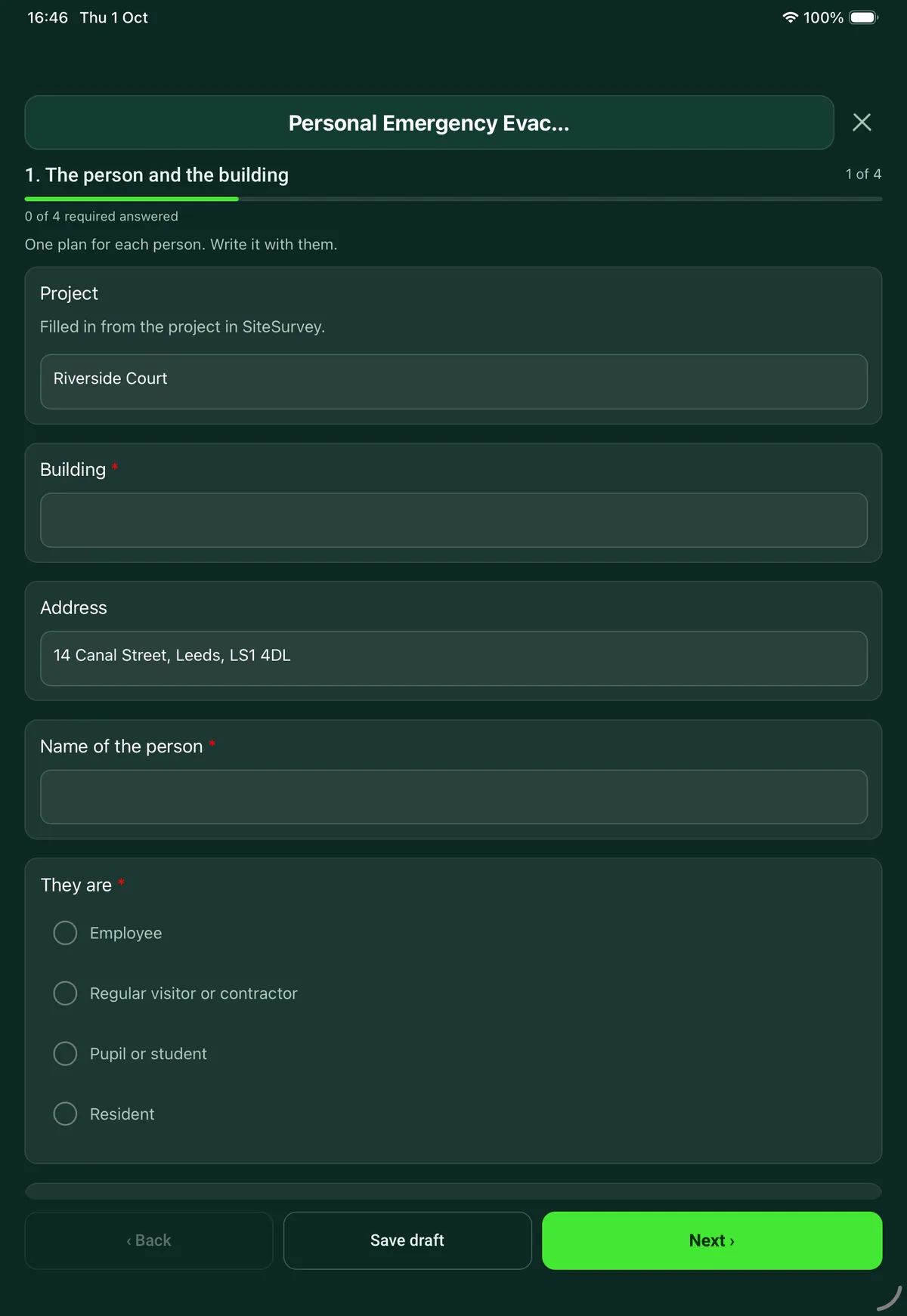
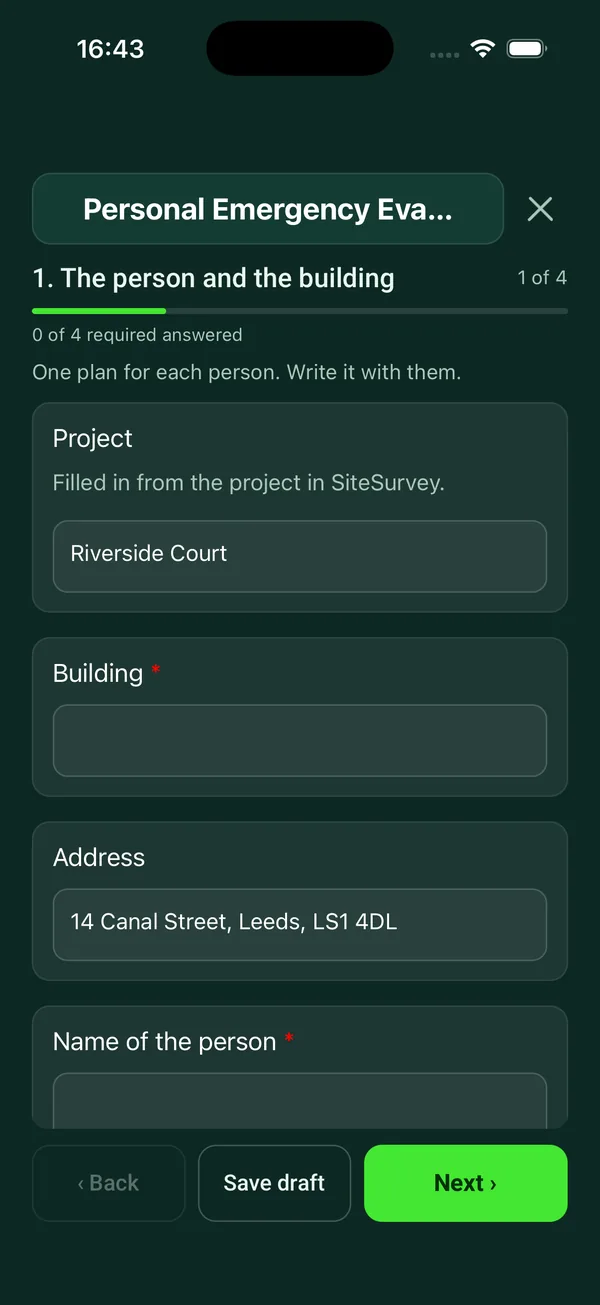
The person and the building
One plan for each person. Write it with them.
- ProjectShort answer
Filled in from the project in SiteSurvey.
Fills in from the project name - Building*Short answerFills in from the site, when the form is opened for a space or a product
- AddressShort answerFills in from the site address, from the space or the project
- Name of the person*Short answer
- They are*Choose one
- Employee
- Regular visitor or contractor
- Pupil or student
- Resident
- Where they usually areShort answer
Floor, room, desk or flat number.
- Days and times they are in the buildingShort answer
- Date of this plan*Date
- Completed byShort answer
- Does the person agree to this plan and to it being shared with the people who will help?Yes or No
- CheckDo not record or share the plan without their agreement. Note the conversation and offer it again later.Shown when “Does the person agree to this plan and to it being shared with the people who will help?” is No
- GuidanceResidential PEEPs. The Fire Safety (Residential Evacuation Plans) (England) Regulations 2025 came into force on 6 April 2026. They apply to residential buildings in England that are at least 18 metres high or have at least seven storeys, or that are over 11 metres high with a simultaneous evacuation strategy. The responsible person must use reasonable endeavours to identify residents who would have difficulty getting out, offer a person-centred fire risk assessment, agree what the resident should do in a fire, and review it at least every 12 months. The resident decides whether to take part, and their information is shared with the fire and rescue service only with their explicit agreement.Shown when “They are” is “Resident”
- Has the resident agreed to their information being shared with the fire and rescue service?Yes or NoShown when “They are” is “Resident”
What makes leaving difficult
Ask the person. They know best.
- Can they hear the fire alarm?Choose one
- Yes
- Only with a hearing aid
- No
- Can they see the route and read the signs?Choose one
- Yes
- With difficulty
- No
- Would they know what the alarm means and what to do?Choose one
- Yes
- With prompting
- No
- Moving through the buildingChoose one
- Walks unaided
- Walks slowly or with an aid
- Uses a wheelchair
- Would need carrying or equipment
- StairsChoose one
- Can use them unaided
- Can use them slowly or with a handrail
- Can use them with help
- Cannot use them
- Is this temporary?Yes or No
For example an injury, an operation or late pregnancy.
- Expected to last untilDateShown when “Is this temporary?” is Yes
- Anything else that mattersNotes
Medication, an assistance dog, anxiety in crowds, equipment that must go with them.
The plan
What happens from the moment the alarm sounds.
- How will they know there is a fire?Tick all that apply
- Standard alarm
- Flashing beacon
- Vibrating pager or pillow pad
- Told in person by a named helper
- Text or phone call
- Other (describe)
- Their escape routeNotes
Step by step, from where they usually are to the final exit.
- Does the plan use a refuge?Yes or No
- Which refuge, and how do they call for help from it?Short answerShown when “Does the plan use a refuge?” is Yes
- GuidanceA refuge is a place to wait for a short time while help comes. The plan must say who comes and how the person is brought out: getting people out is the job of the people managing the building, not the fire and rescue service.Shown when “Does the plan use a refuge?” is Yes
- EquipmentTick all that apply
- Evacuation chair
- Evacuation sledge or mat
- Evacuation lift
- Extra handrail
- None
- Other (describe)
- Where is the equipment kept?Short answer
- When was the equipment last checked or serviced?Short answerShown only when the answers above make it relevant
- Does the person need helpers?Yes or No
- HelpersRepeat for each helper. Each one asks:Shown when “Does the person need helpers?” is Yes
- Name*Short answer
- Where they work or how to reach themShort answer
- Trained in the equipment and the plan?Yes or No
- Date trainedDateShown when “Trained in the equipment and the plan?” is Yes
- Who helps when the named helpers are away?Short answerShown when “Does the person need helpers?” is Yes
- What happens, step by stepNotes
- Where they go once outsideShort answer
- What is different at night, at weekends or when working alone?Short answer
- Who has a copy of this plan?Short answer
For example reception, the fire warden, each helper and the person.
Practice, review and signatures
A plan that has not been tried is a guess.
- Has the plan been practised?Yes or No
- DateDateShown when “Has the plan been practised?” is Yes
- What was learnt?NotesShown when “Has the plan been practised?” is Yes
- Review dateDate
- GuidanceFor a resident covered by the 2025 Regulations, the review must be no later than 12 months after the plan was agreed, and every 12 months after that.Shown when “They are” is “Resident”
- GuidanceReview it sooner if the person's needs, where they work or live, the building or the helpers change.
- Name of the person, or who signs for themShort answer
- Their signatureSignature
- Manager or responsible personShort answer
- Manager or responsible person signatureSignature
See it filled in
A completed PEEP report, made by SiteSurvey from a fictional site visit: every answer, the photos, the guidance that applied and the sign-off, ready to send as a PDF.
PEEP FAQs
Who needs a PEEP?
Anyone who would need help to leave the building in a fire: someone who cannot hear the alarm, cannot see the route, would not know what the alarm means, uses a wheelchair or cannot manage stairs unaided. The need can be temporary, such as an injury or late pregnancy, and the form records an end date for that.
What are Residential PEEPs?
The Fire Safety (Residential Evacuation Plans) (England) Regulations 2025 came into force on 6 April 2026. They apply to residential buildings in England that are at least 18 metres high or have at least seven storeys, or that are over 11 metres high with a simultaneous evacuation strategy. The responsible person must use reasonable endeavours to identify residents who would have difficulty evacuating, offer a person-centred fire risk assessment and agree what the resident should do in a fire.
Does a resident have to take part?
No. The government's factsheet says the decision lies with the resident, who cannot be compelled to engage, and that their information is shared with the fire and rescue service only with their explicit agreement. The form records consent to the plan and, for residents, consent to sharing with the fire and rescue service.
How often should a PEEP be reviewed?
For a resident covered by the 2025 Regulations, the review must be no later than 12 months after the plan was agreed and every 12 months after that. For anyone else the form records a review date and says to review sooner if the person's needs, where they work or live, the building or the helpers change.
Can a refuge be part of the plan?
Yes, but a refuge is a place to wait for a short time, not the end of the plan. The form asks which refuge is used, how the person calls for help from it, who comes and what equipment is used. It reminds you that getting people out is the job of the people managing the building: GOV.UK guidance on means of escape for disabled people says an evacuation plan should not rely on the fire and rescue service to make it work.
Who signs the plan?
The person, or someone signing for them, and their manager or the responsible person, both on the phone or tablet. In the SiteSurvey app the plan works offline and goes out as a PDF or a share link.
Related
Related templates
Templates that go with the PEEP form
Fire risk assessment following the five steps in GOV.UK guidance: hazards, people at risk, fire precautions, emergency plan and training, findings with actions and review.
Routine fire safety checks: extinguishers, emergency lighting tests, the weekly alarm test, escape routes, signs and fire drills, with actions.
Door by door checks (gaps, seals, closers, signage, glazing), 12 month flat entrance door record and remedial work list.
Fire emergency plan for a building and a record of each drill: raising the alarm, escape routes, wardens, people who need help, evacuation time and actions.
Use this PEEP form with your team
Add it from the form library in one click, change any question, and every completed form becomes a branded PDF report.
Start your trial →