Form library · Fire safety
Fire safety checklist
A routine fire safety checks form that covers the fire extinguishers, emergency lighting, the weekly fire alarm test, escape routes, exit doors, signs and the fire drill in one visit. Each fault gets a photo and an action with an owner and a due date. Every question is listed below, and you can fill the live form in on this page.
Ready to use from the form library, and editable. Trial from £1, cancel any time.
What should a fire safety checklist include?
A routine fire safety checklist should cover the fire extinguishers, emergency lighting tests, the weekly fire alarm test, escape routes, exit doors, fire doors and signs, and the date of the last fire drill. Each fault needs a photo, an action, an owner and a due date. Home Office guidance is a weekly alarm test and monthly checks of extinguishers and emergency lighting.
Last updated . Facts checked on 30 September 2026 against the Regulatory Reform (Fire Safety) Order 2005, gov.uk on workplace fire safety, the Home Office guide Fire safety risk assessment: offices and shops and regulation 7 of the Fire Safety (England) Regulations 2022.
Try the fire safety checks form live
Answer a few questions and watch it adapt. Your answers are not saved, and any photos you add are deleted within the hour.
This is the real form as your team would use it: questions appear as you answer, scores work themselves out and you can add photos and signatures. No sign-up needed.
Fill it in on a phone or tablet
Your team completes the fire safety checks on site in the SiteSurvey app on iPhone, iPad and Android phones and tablets. The project name and address fill in for them, it works without signal, and it syncs when the device is back online with photos kept against the question they answer.
Customers and subcontractors do not need the app: send them a link and they can fill it in from any browser.
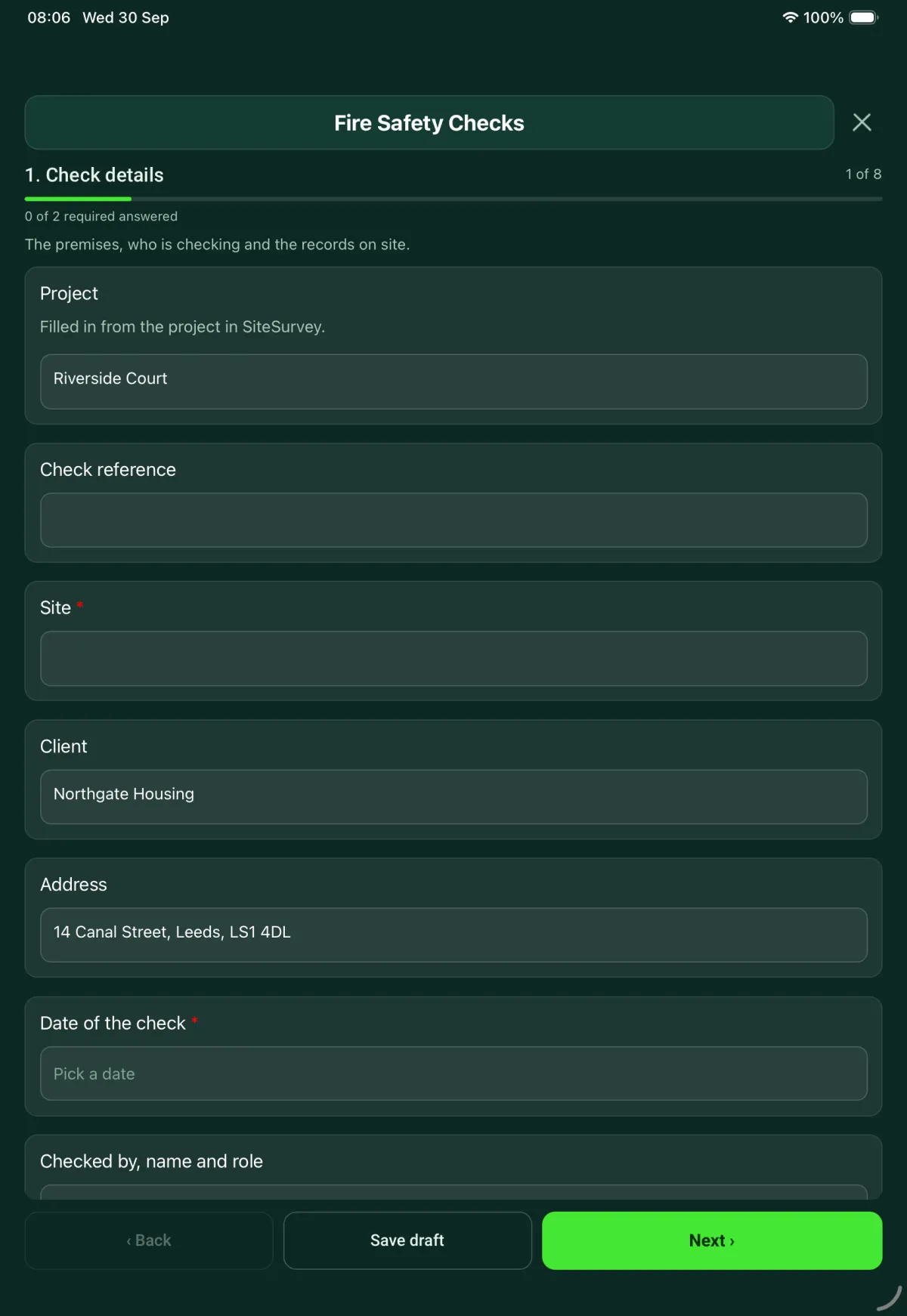
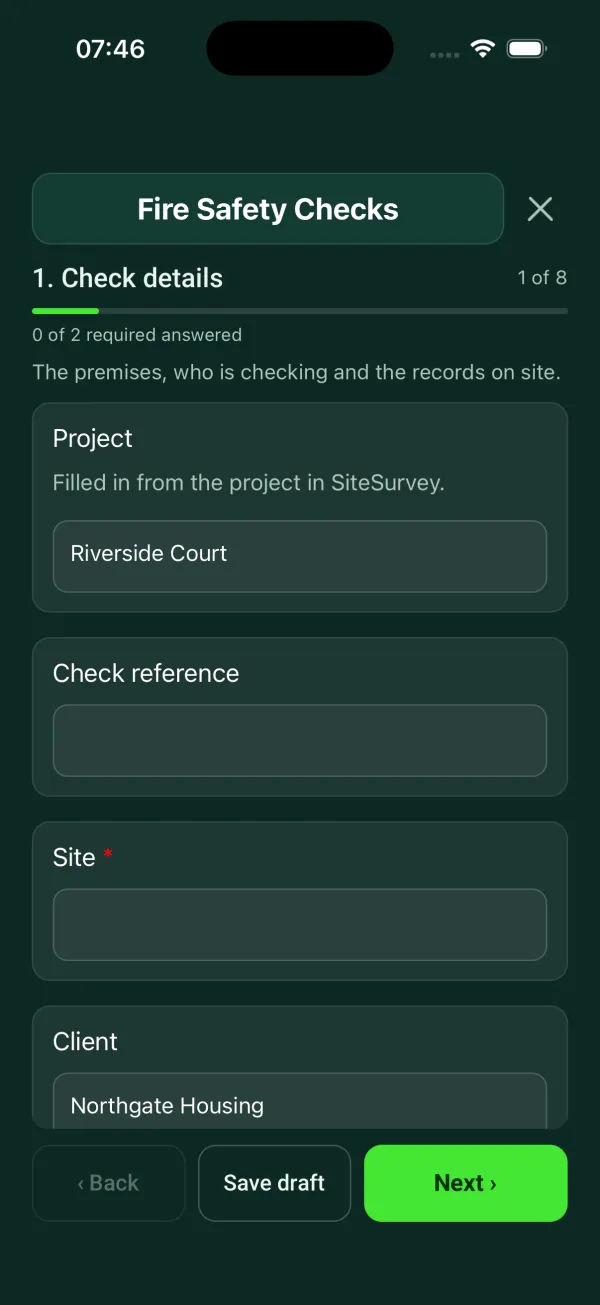
Every question in the fire safety checks template
Routine fire safety checks: extinguishers, emergency lighting tests, the weekly alarm test, escape routes, signs and fire drills, with actions. 8 sections and 92 questions. Follow-up questions and guidance appear only when an answer calls for them, so the person on site never sees the ones that do not apply.
Details you only enter once
Add this form to a project in SiteSurvey and it fills in what the project already knows, so nobody on site retypes it and every form on the job uses the same names. Anything filled in can still be changed.
- Project: the project name
- Site: the site, when the form is opened for a space or a product
- Client: the project's customer
- Address: the site address, from the space or the project
Check details
The premises, who is checking and the records on site.
- ProjectShort answerFills in from the project name
- Check referenceShort answer
- Site*Short answerFills in from the site, when the form is opened for a space or a product
- ClientShort answerFills in from the project's customer
- AddressShort answerFills in from the site address, from the space or the project
- Date of the check*Date
- Checked by, name and roleShort answer
- Responsible person, or who acts for them on siteShort answer
- Type of premisesChoose one
- Office or shop
- Factory or warehouse
- School or college
- Block of flats, common parts
- Hotel or other sleeping accommodation
- Other (describe)
- Is the building at least 18 metres high, or at least seven storeys?Yes or NoShown when “Type of premises” is “Block of flats, common parts”
- GuidanceFire Safety (England) Regulations 2022, regulation 7. In a high-rise residential building, meaning one with two or more sets of domestic premises that is at least 18 metres high or has at least seven storeys, the responsible person must check lifts for use by firefighters, evacuation lifts and essential fire-fighting equipment every month, and make the record of those checks accessible to residents. A fault that cannot be put right within 24 hours must be reported to the local fire and rescue authority by electronic means.Shown when “Type of premises” is “Block of flats, common parts” and “Is the building at least 18 metres high, or at least seven storeys?” is Yes
- GuidanceRegulatory Reform (Fire Safety) Order 2005, article 17. In England and Wales, the responsible person must make sure the premises and the fire safety equipment and devices provided are subject to a suitable system of maintenance, and are kept in efficient working order and in good repair, where that is needed to keep people safe. This form records routine checks that form part of that system.
- Did you see the fire safety log book?Yes or No
- CheckThe Home Office guide for offices and shops says you will find it of benefit to keep a log book of all maintenance and testing, and gov.uk says faults in systems and equipment should be recorded. Record the results here and tell the responsible person the log book could not be found.Shown when “Did you see the fire safety log book?” is No
- Did you see the fire risk assessment for the premises?Yes or No
- CheckThe responsible person must carry out a fire risk assessment of the premises and review it regularly. It sets what should be checked and how often. Tell the responsible person that you could not find it.Shown when “Did you see the fire risk assessment for the premises?” is No
Fire extinguishers
One entry for each extinguisher. Look at it, do not discharge it.
- Are you checking the fire extinguishers on this visit?Yes or No
- GuidanceHome Office guidance. Carry out brief checks to make sure extinguishers remain serviceable. In normal conditions a monthly check should be enough. Maintenance by a competent person should be carried out annually. Fire safety risk assessment: offices and shops.Shown when “Are you checking the fire extinguishers on this visit?” is Yes
- Extinguishers checkedRepeat for each extinguisher. Each one asks:Shown when “Are you checking the fire extinguishers on this visit?” is Yes
- Extinguisher numberShort answer
- LocationShort answer
- TypeChoose one
- Water
- Foam
- Carbon dioxide (CO2)
- Dry powder
- Wet chemical
- Water mist
- Other (describe)
- In its place, easy to see and easy to reach?Yes or No
- CheckAn extinguisher that is missing or blocked cannot be reached quickly. Put it back or clear the way to it before you leave, and record where it was.Shown when “In its place, easy to see and easy to reach?” is No
- Has it been used, or is the pin or tamper seal missing or broken?Yes or No
- WarningUsed or seal broken. Treat this extinguisher as out of service. Replace it with a working one, or have a competent person recharge or service it, and record the fault in the log book.Shown when “Has it been used, or is the pin or tamper seal missing or broken?” is Yes
- Pressure gaugeChoose one
- In the green
- Outside the green
- No gauge fitted
- CheckThe pressure is outside the operating range. The Home Office maintenance checklist asks each month whether the pressure in stored pressure extinguishers is correct. Take it out of service and have a competent person look at it.Shown when “Pressure gauge” is “Outside the green”
- Any damage, corrosion, leaks or a damaged hose or horn?Yes or No
- Date on the service labelDate
- Days since the last serviceWorked out by the formShown when “Date on the service label” is answered and “Date of the check” is answered
- CheckService overdue. The service label is more than 12 months old. The Home Office guide says maintenance by a competent person should be carried out annually. Raise an action.Shown only when the answers above make it relevant
- ResultChoose one
- Pass
- Fail
- Photos of the faultPhotosShown only when the answers above make it relevant
- What was done, and what is still needed?NotesShown only when the answers above make it relevant
Emergency lighting
Record each luminaire or each circuit, whichever the log book uses.
- Are you testing the emergency lighting on this visit?Yes or No
- Which test?Choose one
- Monthly functional test
- Annual full duration test
Shown when “Are you testing the emergency lighting on this visit?” is Yes - GuidanceHome Office guidance. Testing typically includes a monthly function test, operating the test facility for long enough to make sure each emergency lamp lights, and an annual full discharge test. It is good practice to keep a record of tests. Fire safety risk assessment: offices and shops.Shown when “Are you testing the emergency lighting on this visit?” is Yes
- CheckAfter a full duration test. Batteries typically take 24 hours to recharge after a full discharge test. The Home Office guide says the premises should not be re-occupied until the emergency lighting is fully working, unless other arrangements have been made. It also says the emergency lighting should be tested and maintained by a competent person each year.Shown when “Are you testing the emergency lighting on this visit?” is Yes and “Which test?” is “Annual full duration test”
- Rated duration of the system (hours)NumberShown when “Are you testing the emergency lighting on this visit?” is Yes and “Which test?” is “Annual full duration test”
- How long did the test run? (minutes)NumberShown when “Are you testing the emergency lighting on this visit?” is Yes and “Which test?” is “Annual full duration test”
- WarningTest not complete. The test did not run for the full rated duration. The Home Office checklist asks whether all luminaires operate on test for their full rated duration. Record the test as incomplete and book it again.Shown only when the answers above make it relevant
- Are other arrangements in place until the batteries have recharged?Yes or NoShown when “Are you testing the emergency lighting on this visit?” is Yes and “Which test?” is “Annual full duration test”
- WarningDo not let people back into the areas covered until the lights have recharged or other arrangements are in place.Shown when “Are you testing the emergency lighting on this visit?” is Yes and “Which test?” is “Annual full duration test” and “Are other arrangements in place until the batteries have recharged?” is No
- Record the results forChoose one
- Each luminaire
- Each circuit
Shown when “Are you testing the emergency lighting on this visit?” is Yes - Luminaires or circuits testedRepeat for each entry. Each one asks:Shown when “Are you testing the emergency lighting on this visit?” is Yes
- Luminaire or circuit referenceShort answer
- LocationShort answer
- Charge indicatorChoose one
- Lit
- Not lit
- No indicator fitted
- ResultChoose one
- Pass
- Fail
- What was wrong?Choose one
- Did not light
- Went out before the end of the test
- Dim
- Charge indicator not lit
- Damaged or missing diffuser
- Other (describe)
Shown only when the answers above make it relevant - WarningFailed. Record the fault in the log book and tell the responsible person before you leave. The area this covers may not be lit if the normal lighting fails.Shown only when the answers above make it relevant
- Photos of the faultPhotosShown only when the answers above make it relevant
Fire alarm weekly test
One call point per test, a different one each week.
- Are you doing the weekly fire alarm test on this visit?Yes or No
- GuidanceHome Office guidance. All types of fire warning system should be tested once a week. For electrical systems, operate a manual call point with the test key, using a different call point for each successive test. It is good practice to test the alarm at the same time each week. Fire safety risk assessment: offices and shops.Shown when “Are you doing the weekly fire alarm test on this visit?” is Yes
- Is the alarm connected to an alarm receiving centre?Yes or NoShown when “Are you doing the weekly fire alarm test on this visit?” is Yes
- Was the centre told before the test?Yes or NoShown when “Are you doing the weekly fire alarm test on this visit?” is Yes and “Is the alarm connected to an alarm receiving centre?” is Yes
- CheckThe Home Office guide says that where a system is connected to a monitoring centre, arrangements should be made before testing to avoid unwanted false alarms. Call the centre now and check that no call was passed to the fire and rescue service.Shown when “Are you doing the weekly fire alarm test on this visit?” is Yes and “Is the alarm connected to an alarm receiving centre?” is Yes and “Was the centre told before the test?” is No
- Call point used today (number and location)Short answerShown when “Are you doing the weekly fire alarm test on this visit?” is Yes
- Call point used at the last weekly testShort answerShown when “Are you doing the weekly fire alarm test on this visit?” is Yes
- CheckThis is the same call point as the last test. The guide says to use a different call point for each successive test.Shown only when the answers above make it relevant
- Did the panel show the call point you operated?Yes or NoShown when “Are you doing the weekly fire alarm test on this visit?” is Yes
- Did the sounders operate?Yes or NoShown when “Are you doing the weekly fire alarm test on this visit?” is Yes
- Did staff and other people hear the alarm?Yes or NoShown when “Are you doing the weekly fire alarm test on this visit?” is Yes
- Did linked systems operate, such as door holders releasing?Choose one
- Yes
- No
- None linked
Shown when “Are you doing the weekly fire alarm test on this visit?” is Yes - Was the panel back to normal after it was reset?Yes or NoShown when “Are you doing the weekly fire alarm test on this visit?” is Yes
- WarningAlarm fault. Record the fault in the log book and tell the responsible person now. Arrange for a competent person to attend.Shown only when the answers above make it relevant
- What was wrong, and where?NotesShown only when the answers above make it relevant
- Photos of the panel or the faultPhotosShown only when the answers above make it relevant
- Date of the last service by a competent personDateShown when “Are you doing the weekly fire alarm test on this visit?” is Yes
- Days since the last serviceWorked out by the formShown when “Are you doing the weekly fire alarm test on this visit?” is Yes and “Date of the last service by a competent person” is answered and “Date of the check” is answered
- CheckService may be overdue. The Home Office guide says six-monthly servicing and preventive maintenance should be carried out by a competent person. The last service was more than six months ago.Shown only when the answers above make it relevant
Escape routes, exits, fire doors and signs
Walk each route from the working areas to the final exit.
- Routes to the exitsChoose one
- Clear
- Obstructed
- What is in the way, and where?NotesShown when “Routes to the exits” is “Obstructed”
- Was it cleared before you left?Yes or NoShown when “Routes to the exits” is “Obstructed”
- WarningFire Safety Order, article 14. Where needed to keep people safe, routes to emergency exits and the exits themselves must be kept clear at all times. Tell the person in charge of the area today.Shown when “Routes to the exits” is “Obstructed”
- Photos of the obstructionPhotosShown when “Routes to the exits” is “Obstructed”
- Are combustible materials stored on an escape route?Yes or No
- CheckThe Home Office guide asks whether people understand the importance of not storing combustible materials within escape routes. Have them moved.Shown when “Are combustible materials stored on an escape route?” is Yes
- Fire exit doorsChoose one
- All open easily
- One or more hard to open
- One or more locked or fastened shut
- Which doors, and what is wrong?NotesShown only when the answers above make it relevant
- WarningFire Safety Order, article 14. Emergency doors must not be so locked or fastened that they cannot be easily and immediately opened by anyone who may need to use them in an emergency. Have the lock or fastening removed before you leave.Shown when “Fire exit doors” is “One or more locked or fastened shut”
- Checkgov.uk says regular checks should make sure all fire escapes can be opened easily. Raise an action for the door.Shown when “Fire exit doors” is “One or more hard to open”
- Photos of the doorsPhotosShown only when the answers above make it relevant
- Is the way from the final exits to the assembly point clear and safe?Yes or No
- GuidanceFire doors in passing. Check that fire doors are in good working order, closing correctly, and that frames and seals are intact. For a door by door record of gaps, seals and closers, use the Fire Door Inspection form.
- Did you find a fire door wedged or propped open?Yes or No
- WarningA fire door only holds back fire and smoke when it is closed. Remove the wedge, close the door and tell the person in charge of the area.Shown when “Did you find a fire door wedged or propped open?” is Yes
- Did the fire doors you passed close fully into their frames?Yes or No
- Did you see damage to any door, frame, seal or closer?Yes or No
- Which doors, and what did you find?NotesShown only when the answers above make it relevant
- Photos of the doorsPhotosShown only when the answers above make it relevant
- Exit and escape route signsChoose one
- In place and legible
- Missing, damaged or hard to see
- CheckFire Safety Order, article 14. Where needed to keep people safe, emergency routes and exits must be indicated by signs. Record where a sign is missing or damaged.Shown when “Exit and escape route signs” is “Missing, damaged or hard to see”
- Which signs, and where?NotesShown when “Exit and escape route signs” is “Missing, damaged or hard to see”
- Photos of the signsPhotosShown when “Exit and escape route signs” is “Missing, damaged or hard to see”
- Are any exit signs text only, with no running man pictogram?Yes or No
- CheckThe Home Office guide says a sign must be pictographic to comply with the safety signs regulations. Text can be added to a pictogram, but a safety sign must not use text only.Shown when “Are any exit signs text only, with no running man pictogram?” is Yes
Fire drill
Record a drill held today, or check the date of the last one.
- Was a fire drill held on this visit?Yes or No
- Guidancegov.uk guidance. You should carry out at least one fire drill per year and record the results, and keep them as part of your fire safety and evacuation plan. The Home Office guide adds that drills may be needed more often, as the fire risk assessment decides or where staff turnover is high.
- Date of the last drill on recordDateShown when “Was a fire drill held on this visit?” is No
- Days since the last drillWorked out by the formShown when “Was a fire drill held on this visit?” is No and “Date of the last drill on record” is answered and “Date of the check” is answered
- CheckDrill overdue. The last drill on record is more than 12 months ago. Raise an action to hold one.Shown only when the answers above make it relevant
- People evacuatedNumberShown when “Was a fire drill held on this visit?” is Yes
- Time to clear the building (minutes)NumberShown when “Was a fire drill held on this visit?” is Yes
- Target time in the fire risk assessment or evacuation plan (minutes)NumberShown when “Was a fire drill held on this visit?” is Yes
- CheckThe building took longer to clear than the target you entered. Look at why in the debrief and record the actions.Shown only when the answers above make it relevant
- Was anyone unaccounted for at the roll call?Yes or NoShown when “Was a fire drill held on this visit?” is Yes
- WarningNot accounted for. The Home Office guide says to note anyone unaccounted for. In a real evacuation this information would need to be passed to the fire and rescue service on arrival. Find out why they were missed.Shown when “Was a fire drill held on this visit?” is Yes and “Was anyone unaccounted for at the roll call?” is Yes
- Issues seen during the drillTick all that apply
- Roll call was slow or incomplete
- People used their usual route, not the nearest exit
- A final exit door was hard to open
- Difficulties for disabled people
- Fire wardens unsure of their role
- People stopped to collect belongings
- Someone tried to use a lift
- Doors and windows left open
- Other (describe)
Shown when “Was a fire drill held on this visit?” is Yes - CheckThe Home Office guide says conclusions and remedial actions from a drill should be recorded and put into effect. Add each one to the actions in section 7.Shown when “Was a fire drill held on this visit?” is Yes and “Issues seen during the drill” is answered
- Debrief notesNotesShown when “Was a fire drill held on this visit?” is Yes
Summary and actions
What was found, who will put it right and by when.
- Extinguishers checkedWorked out by the formShown when “Are you checking the fire extinguishers on this visit?” is Yes
- Luminaires or circuits testedWorked out by the formShown when “Are you testing the emergency lighting on this visit?” is Yes
- Areas with a faultWorked out by the form
- WarningAt least one fault was recorded. Each one needs an action below, with an owner and a due date.Shown only when the answers above make it relevant
- GuidanceNo faults were recorded in the areas checked.Shown only when the answers above make it relevant
- Are any actions needed?Yes or No
- A fault is recorded but no action. Why?NotesShown only when the answers above make it relevant
- ActionsRepeat for each action. Each one asks:Shown when “Are any actions needed?” is Yes
- AreaChoose one
- Fire extinguishers
- Emergency lighting
- Fire alarm
- Escape routes and exits
- Fire doors
- Signs and notices
- Fire drill
- Other (describe)
- What needs to be done?Notes
- PriorityChoose one
- Immediately
- Within a week
- Within a month
- OwnerShort answer
- Due dateDate
- CheckThe due date is before the date of the check. Check the dates.Shown only when the answers above make it relevant
- Who was told the results before you left?Short answer
- Next routine check dueDate
Checked by
- WarningFaults were found on this check. Make sure each one has an action with an owner and a due date.Shown only when the answers above make it relevant
- NameShort answer
- Checked by signatureSignature
Fire safety checks template questions
How often should fire extinguishers be checked?
Home Office guidance is brief checks to make sure extinguishers remain serviceable, and in normal conditions a monthly check should be enough. Maintenance by a competent person should be carried out annually. The form records each extinguisher's location, type, seal, gauge and damage, and flags a service label more than 12 months old.
How do you test emergency lighting?
Home Office guidance describes a monthly function test, operating the test facility long enough to make sure each emergency lamp lights, and an annual full discharge test. Batteries typically take 24 hours to recharge afterwards, and the premises should not be re-occupied until the lighting is fully working unless other arrangements are in place. The form records each luminaire or each circuit and flags a test that stopped short of the rated duration.
How often should the fire alarm be tested?
Home Office guidance is that all fire warning systems should be tested once a week. For electrical systems, operate a manual call point with the test key, using a different call point for each test, and tell any alarm receiving centre first. The form flags a call point that was also used at the last test, and a last service more than six months ago.
How often should you hold a fire drill?
gov.uk guidance is at least one fire drill per year, with the results recorded and kept as part of your fire safety and evacuation plan. The Home Office guide adds that drills may be needed more often, as the fire risk assessment decides or where staff turnover is high. The form records the people evacuated, the time to clear against your target, anyone unaccounted for and the issues seen.
What does the law say about fire exits and escape routes?
In England and Wales, article 14 of the Fire Safety Order says that, where needed to keep people safe, routes to emergency exits and the exits themselves must be kept clear and indicated by signs. Emergency doors must not be locked or fastened so that they cannot be easily and immediately opened. Article 17 requires the fire safety equipment to be maintained and kept in efficient working order, and this form records routine checks that are part of that. In the SiteSurvey app it works offline, with photos against each fault.
Are there extra checks for high-rise flats?
Yes, in England. In a residential building with two or more sets of domestic premises that is at least 18 metres high or has at least seven storeys, the responsible person must check firefighting lifts, evacuation lifts and essential fire-fighting equipment every month and make the records accessible to residents. A fault that cannot be put right within 24 hours must be reported to the fire and rescue authority electronically. That is regulation 7 of the Fire Safety (England) Regulations 2022.
Related
Related templates
Templates that go with the fire safety checks form
Door by door checks (gaps, seals, closers, signage, glazing), 12 month flat entrance door record and remedial work list.
Workplace audit with walkways, first aid, fire equipment and records, findings and corrective actions, closing meeting.
Hazards, who might be harmed, controls and risk scores, with a briefing record and review date.
Planned maintenance visit: records seen, asset by asset tasks, water temperatures, work done and next visit.
Use this fire safety checks form with your team
Add it from the form library in one click, change any question, and every completed form becomes a branded PDF report.
Start your trial →