Form library · Care
Medication audit template
A medicines audit for a care home, with notes that quote NICE guideline SC1. Check storage and disposal, sample residents' administration records for gaps and missing details, check the controlled drugs register and balances, and confirm that staff who give medicines are trained and assessed as competent. Findings carry a risk, an action and an owner. Every question is listed below, and you can fill the live form in on this page.
Ready to use from the form library, and every question is yours to edit. Trial from £1, cancel any time.
Try it on your phone
Try it on this phone
Fill in the medication audit on your phone now
See how the medication audit looks on your phone
Scan the code with your phone camera. It opens the real form, no sign-up needed.
Open the live example and fill it in, just as your team would on site. No sign-up needed.
See it on this phoneEvery question is editable. Add this form to your account, then change the wording, add or remove questions and options, and make it fit your own jobs.
What should a care home medication audit check?
A care home medication audit should check that medicines are stored securely and at the right temperature, that administration records are complete, legible and signed, that the controlled drugs register is signed by the person administering and a trained witness and that balances are correct, that medicines for disposal are recorded, and that staff who give medicines are trained and assessed as competent.
Last updated . Facts checked by the SiteSurvey team on 5 October 2026 against NICE guideline SC1, Managing medicines in care homes (recommendations) and CQC: covert administration of medicines.
Try the medication audit form live
Answer a few questions and watch it adapt. Your answers are not saved, and any photos you add are deleted within the hour.
This is the real form as your team would use it: questions appear as you answer, scores work themselves out and you can add photos and signatures. No sign-up needed.
Want to see one filled in? See a completed medication audit report (PDF), made by SiteSurvey from a fictional site visit.
Fill it in on a phone or tablet
Your team completes the medication audit on site in the SiteSurvey app on iPhone, iPad and Android phones and tablets. The project name and address fill in for them, it works without signal, and it syncs when the device is back online with photos kept against the question they answer.
Customers and subcontractors do not need the app: send them a link and they can fill it in from any browser.
Every question in the medication audit template
Medicines audit for a care home: storage, a sample of administration records, controlled drugs, staff training and competence, incidents and findings with actions. 6 sections and 64 questions. Follow-up questions and guidance appear only when an answer calls for them, so the person on site never sees the ones that do not apply.
Make it your own: every question is editable
This is a starting point, not a fixed form. Once it is in your SiteSurvey account you can reword any question, add or remove questions, sections and answer options, and add your own logo, so it fits the way your team works and the jobs you do.
Details you only enter once
Add this form to a project in SiteSurvey and it fills in what the project already knows, so nobody on site retypes it and every form on the job uses the same names. Anything filled in can still be changed.
- Project: the project name
- Provider: the project's customer
- Home or service: the site, when the form is opened for a space or a product
- Address: the site address, from the space or the project
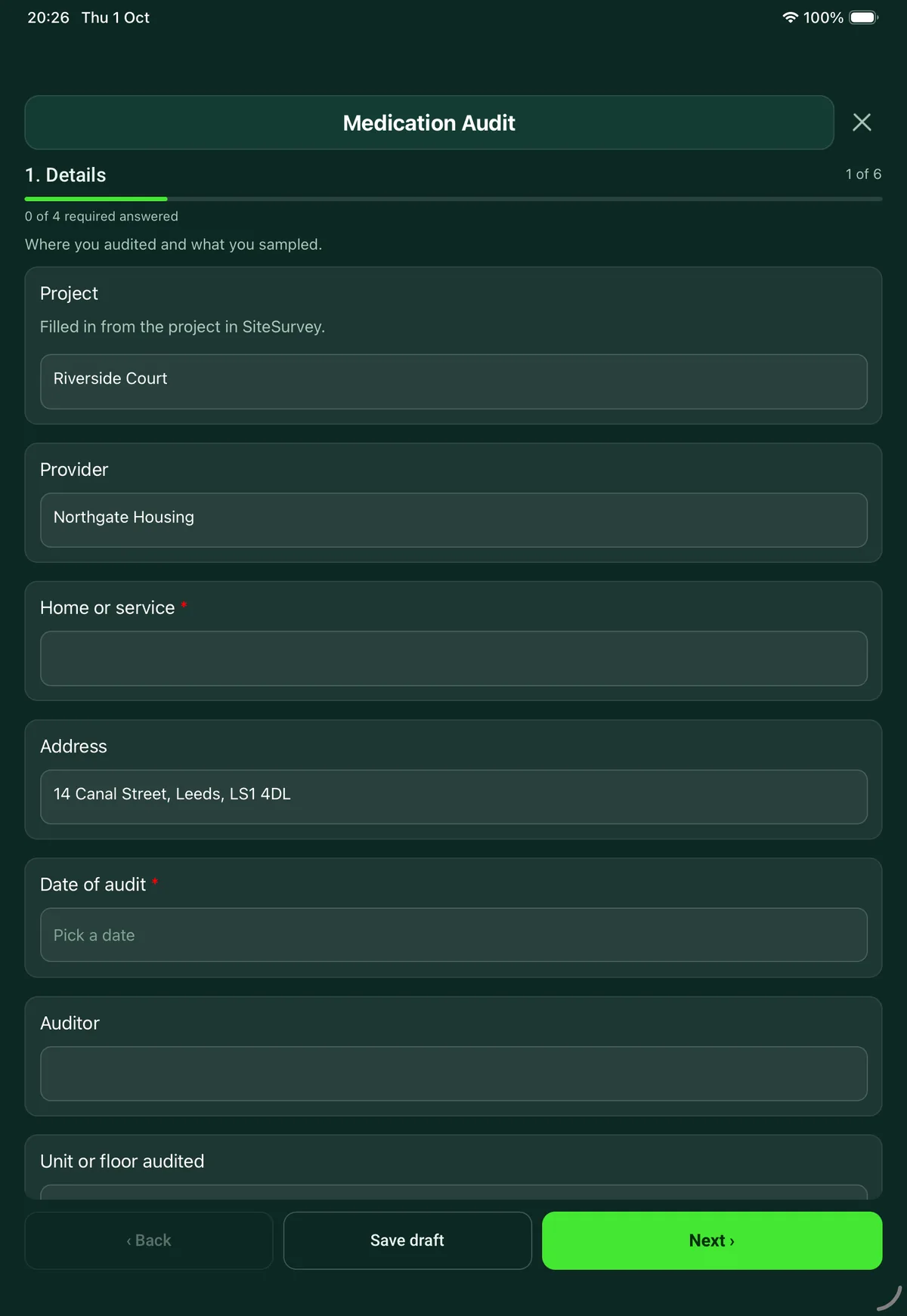
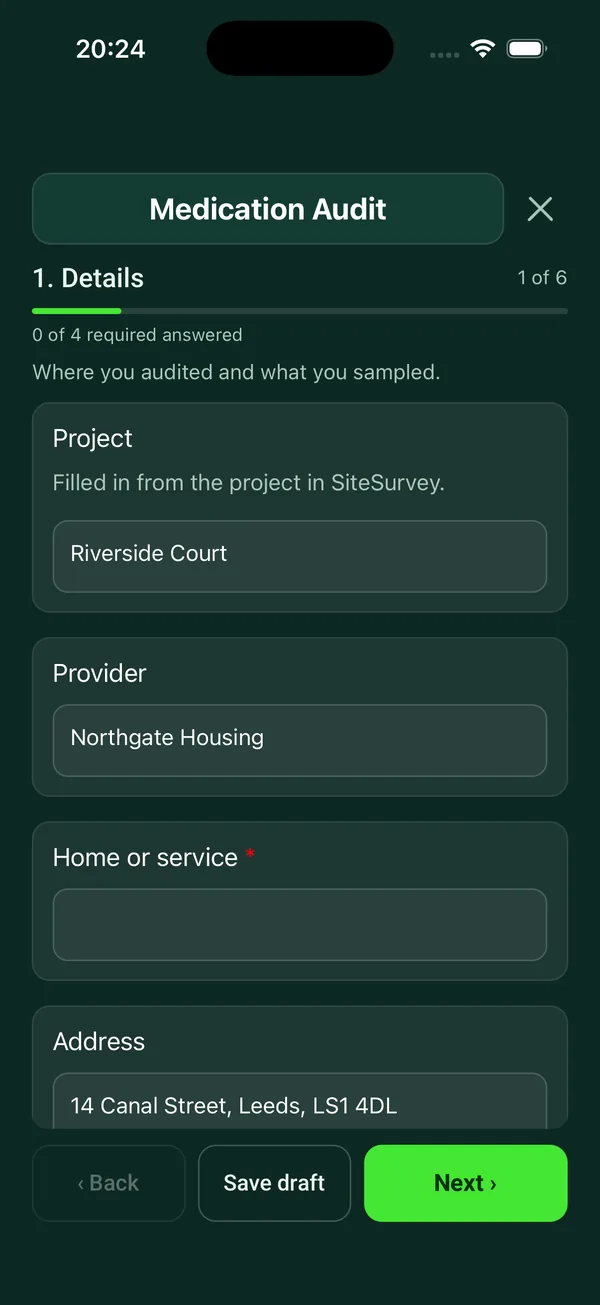
Details
Where you audited and what you sampled.
- ProjectShort answer
Filled in from the project in SiteSurvey.
Fills in from the project name - ProviderShort answerFills in from the project's customer
- Home or service*Short answerFills in from the site, when the form is opened for a space or a product
- AddressShort answerFills in from the site address, from the space or the project
- Date of audit*Date
- AuditorShort answer
- Unit or floor auditedShort answer
- Medicines administration recordsChoose one
- Paper
- Electronic
- Both
- Number of residents whose records were sampledNumber
- GuidanceThe notes in this form quote NICE guideline SC1, Managing medicines in care homes.
- GuidanceRecord residents by room or reference, not by name.
Storage and disposal
Cupboards, trolleys, fridge and returns.
- Medicines are stored in locked cupboards or trolleysChoose one
- Yes
- Partly
- No
- Not applicable
- Keys are held only by authorised staffChoose one
- Yes
- Partly
- No
- Not applicable
- Room temperature where medicines are kept is checked and recordedChoose one
- Yes
- Partly
- No
- Not applicable
- The medicines fridge temperature is recorded every day, and is within the range the home's policy setsChoose one
- Yes
- Partly
- No
- Not applicable
- The medicines fridge holds only medicinesChoose one
- Yes
- Partly
- No
- Not applicable
- Liquids, creams and eye drops are marked with the date openedChoose one
- Yes
- Partly
- No
- Not applicable
- No expired medicines are in stockChoose one
- Yes
- Partly
- No
- Not applicable
- Medicines for disposal are kept securely and recordedChoose one
- Yes
- Partly
- No
- Not applicable
- GuidanceNICE says care home providers should keep records of medicines, including controlled drugs, that have been disposed of or are waiting for disposal, and store them securely in a tamper-proof container within a cupboard until they are collected (recommendation 1.12.6).
- NotesNotes
Administration records
One entry for each resident sampled.
- GuidanceNICE says medicines administration records should be legible, signed, clear and accurate, factual, have the correct date and time, and be completed as soon as possible after administration (recommendation 1.14.7). They should include the resident's full name and date of birth, details of each medicine, and known allergies and reactions (recommendation 1.14.8).
- Records sampledRepeat for each record. Each one asks:
- Room or reference*Short answer
- Full name and date of birth on the recordChoose one
- Yes
- No
- Allergies and reactions recordedChoose one
- Yes
- No
- Every dose signed for, or a reason recordedChoose one
- Yes
- Gaps found
- Number of gapsNumberShown when “Every dose signed for, or a reason recorded” is “Gaps found”
- Handwritten or amended entries checked by a second personChoose one
- Yes
- No
- None
- Clear instructions for "when required" medicinesChoose one
- Yes
- No
- None prescribed
- Stock count matches the recordChoose one
- Yes
- No
- Not counted
- What needs correcting?Short answer
- Records sampledWorked out by the form
- Records with gapsWorked out by the form
- Gaps in totalWorked out by the form
Controlled drugs
Cupboard, register and balances.
- Are controlled drugs held?Yes or No
- Stored in a controlled drugs cupboardChoose one
- Yes
- No
Shown when “Are controlled drugs held?” is Yes - Every entry in the register signed by the person administering and a trained witnessChoose one
- Yes
- No
Shown when “Are controlled drugs held?” is Yes - GuidanceNICE says the care home staff responsible for administering the controlled drug and a trained witness should sign the controlled drugs register, and the staff member administering it should also sign the medicines administration record (recommendation 1.14.16).Shown when “Are controlled drugs held?” is Yes
- Balances checked on this auditChoose one
- All correct
- Discrepancy found
- Not checked
Shown when “Are controlled drugs held?” is Yes - Controlled drugs whose balance was checked (by item, no resident names)Short answerShown only when the answers above make it relevant
- Checked withShort answerShown only when the answers above make it relevant
- What was the discrepancy, and who has been told?NotesShown when “Balances checked on this audit” is “Discrepancy found”
- WarningReport it to the manager now, and to the controlled drugs accountable officer for your area if it cannot be resolved. A controlled drug discrepancy that cannot be explained must be followed up under the home's medicines policy.Shown when “Balances checked on this audit” is “Discrepancy found”
Staff, policy and incidents
Who gives medicines, and what happens when something goes wrong.
- Every member of staff who gives medicines has been trained and assessed as competentChoose one
- Yes
- Partly
- No
- Not applicable
- Each has had a review of their knowledge, skills and competencies in the last yearChoose one
- Yes
- Partly
- No
- Not applicable
- There is a medicines policy that staff can findChoose one
- Yes
- Partly
- No
- Not applicable
- Medicines errors and near misses are recorded and reviewedChoose one
- Yes
- Partly
- No
- Not applicable
- Staff know when a medicines incident must be reported to safeguarding and to the regulatorChoose one
- Yes
- Partly
- No
- Not applicable
- Residents who look after their own medicines have a risk assessmentChoose one
- Yes
- Partly
- No
- Not applicable
- Any covert administration is backed by a mental capacity assessment and a recorded best interests decisionChoose one
- Yes
- Partly
- No
- Not applicable
- GuidanceNICE says care home providers must ensure that designated staff administer medicines only when they have had the necessary training and are assessed as competent (recommendation 1.17.1), and should ensure all care home staff have an annual review of their knowledge, skills and competencies relating to managing and administering medicines (recommendation 1.17.5).
- NotesNotes
Findings and actions
One entry for each thing to put right.
- Are there findings to record?Yes or No
- FindingsRepeat for each finding. Each one asks:Shown when “Are there findings to record?” is Yes
- Area*Choose one
- Storage
- Administration records
- Controlled drugs
- Training and competence
- Policy
- Incidents
- Ordering and supply
- Other (describe)
- RiskChoose one
- High
- Medium
- Low
- What did you find?*Notes
- ActionNotes
- WhoShort answer
- By whenDate
- PhotosPhotos
Do not photograph residents or anything that identifies them.
- ToldTick all that apply
- GP
- Pharmacist
- Safeguarding
- CQC
- Family
- Not needed
- Date completedDate
- FindingsWorked out by the formShown when “Are there findings to record?” is Yes
- High riskWorked out by the formShown when “Are there findings to record?” is Yes
- Overall*Choose one
- Good: minor points only
- Needs improvement
- Serious concerns: act now
- SummaryNotes
- Next audit dueDate
- Auditor nameShort answer
- Auditor signatureSignature
- Manager nameShort answer
- Manager signatureSignature
See it filled in
A completed medication audit report, made by SiteSurvey from a fictional site visit: every answer, the photos, the guidance that applied and the sign-off, ready to send as a PDF.
Medication audit FAQs
What should a medicines administration record include?
NICE says medicines administration records should be legible, signed, clear and accurate, factual, have the correct date and time, and be completed as soon as possible after administration (recommendation 1.14.7). They should include the resident's full name and date of birth, details of each medicine, and known allergies and reactions (recommendation 1.14.8). The form samples records against these points.
How are gaps in the records counted?
For each resident sampled, the form asks whether every dose is signed for or has a reason recorded. Gaps found opens a count. The form adds up the records sampled, the records with gaps and the gaps in total. Residents are recorded by room or reference, not by name.
What does it check on controlled drugs?
That they are stored in a controlled drugs cupboard, that every register entry is signed by the person administering and a trained witness, and that balances checked on the audit are correct. NICE says the staff member administering a controlled drug and a trained witness should sign the register, and the person administering should also sign the medicines administration record (recommendation 1.14.16). A discrepancy asks who has been told and shows a note to report it to the manager now, and to the controlled drugs accountable officer if it cannot be resolved.
What does NICE say about staff competence?
Care home providers must ensure that designated staff administer medicines only when they have had the necessary training and are assessed as competent (recommendation 1.17.1), and should ensure all care home staff have an annual review of their knowledge, skills and competencies relating to managing and administering medicines (recommendation 1.17.5).
Does it cover covert administration and self-administration?
Yes. It asks whether any covert administration is backed by a mental capacity assessment and a recorded best interests decision, and whether residents who look after their own medicines have a risk assessment. NICE says medicines should not be given covertly to a resident who has capacity to make decisions about their treatment and care (recommendation 1.15.1), and CQC says covert administration must be the least restrictive option after trying all other options.
What about medicines waiting for disposal?
NICE says care home providers should keep records of medicines, including controlled drugs, that have been disposed of or are waiting for disposal, and store them securely in a tamper-proof container within a cupboard until they are collected (recommendation 1.12.6). The form checks both.
Related
Related templates
Templates that go with the medication audit form
Manager's quality audit of a care home, set out under CQC's five key questions: safe, effective, caring, responsive and well-led, with findings and actions.
Infection control audit for a care home or clinic: management, cleanliness, hand hygiene, protective equipment, sharps and waste, laundry, equipment and outbreaks.
Falls assessment record for an older person in a care home or at home: falls history, the risk factors NICE lists, the environment, and actions with referrals. No score.
Observation audit using WHO's five moments: each opportunity, the staff group, what was done, a compliance percentage, facilities and feedback to the team.
Use this medication audit form with your team
Add it from the form library in one click, change any question, and every completed form becomes a branded PDF report.
Start your trial →