Form library · Care
Falls risk assessment template
A falls assessment record for an older person in a care home or at home. It records their falls history, each of the risk factors NICE lists for a comprehensive falls assessment, practical checks of their room, and an action for every risk found, with referrals. It gives no score, because NICE says not to use tools that predict the risk of falling. Every question is listed below, and you can fill the live form in on this page.
Ready to use from the form library, and every question is yours to edit. Trial from £1, cancel any time.
Try it on your phone
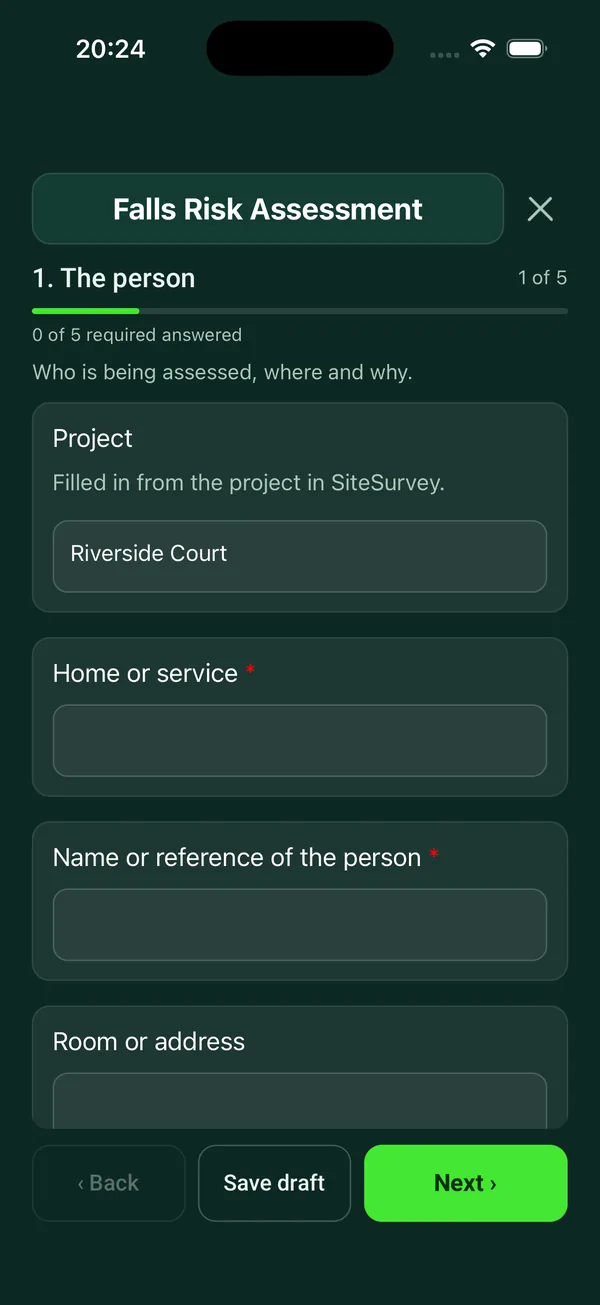
Try it on this phone
Fill in the falls risk assessment on your phone now
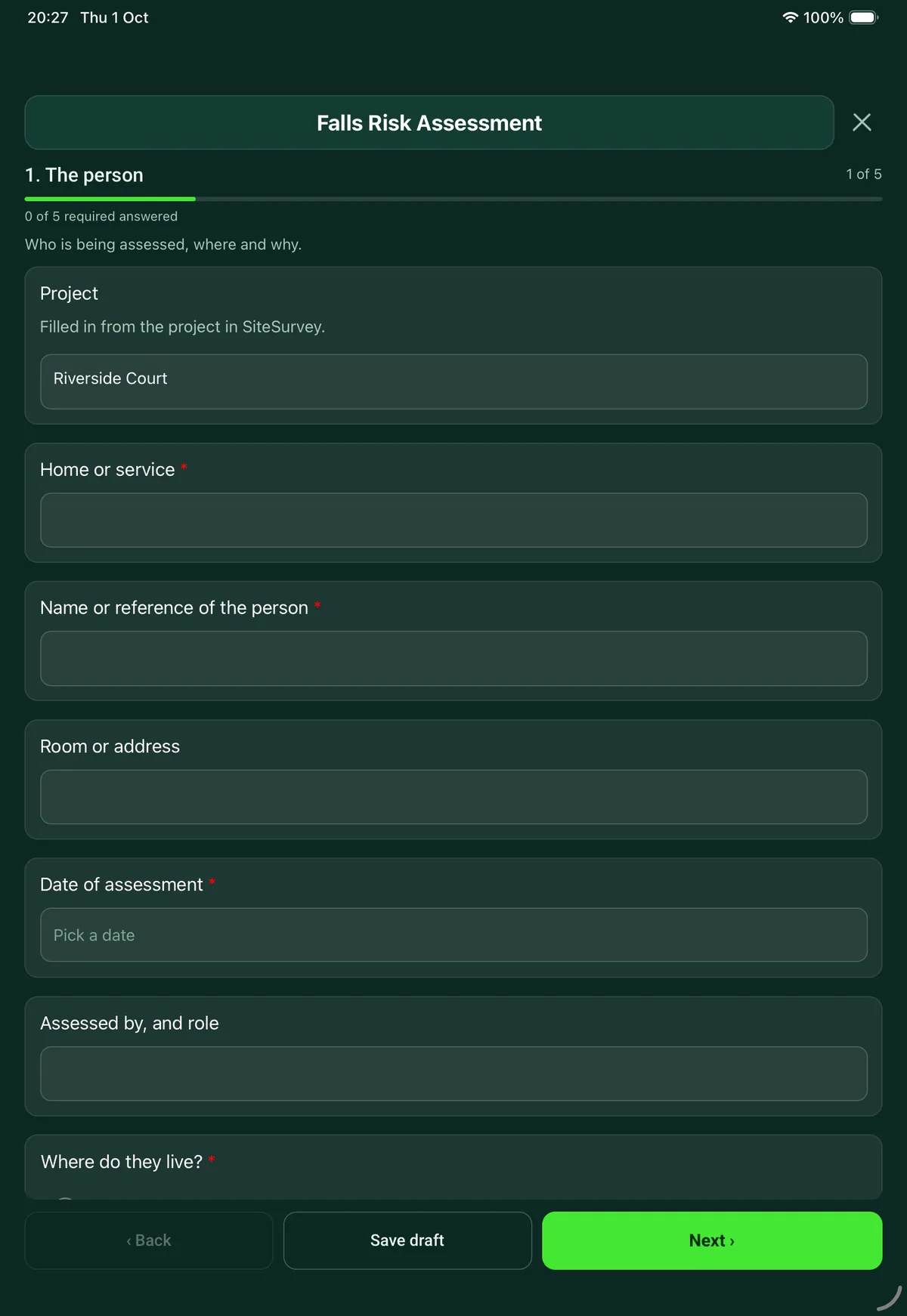
See how the falls risk assessment looks on your phone
Scan the code with your phone camera. It opens the real form, no sign-up needed.
Open the live example and fill it in, just as your team would on site. No sign-up needed.
See it on this phoneEvery question is editable. Add this form to your account, then change the wording, add or remove questions and options, and make it fit your own jobs.
What should a falls risk assessment include?
NICE guideline NG249 (recommendation 1.2.2) lists what a comprehensive falls assessment should include, where appropriate: alcohol misuse, a cardiovascular examination with lying and standing blood pressure, cognition and mood, delirium (in hospital and residential care), diet, fluid intake and weight loss, dizziness, footwear and foot condition, functional ability, gait, balance, mobility and muscle strength, hearing, long-term conditions, a medication review, a neurological examination, osteoporosis risk, urinary continence and vision.
Last updated . Facts checked by the SiteSurvey team on 5 October 2026 against NICE guideline NG249, Falls: assessment and prevention in older people and in people 50 and over at higher risk (recommendations) and section 4 of the Mental Capacity Act 2005 (best interests).
Try the falls risk assessment form live
Answer a few questions and watch it adapt. Your answers are not saved, and any photos you add are deleted within the hour.
This is the real form as your team would use it: questions appear as you answer, scores work themselves out and you can add photos and signatures. No sign-up needed.
Want to see one filled in? See a completed falls risk assessment report (PDF), made by SiteSurvey from a fictional site visit.
Fill it in on a phone or tablet
Your team completes the falls risk assessment on site in the SiteSurvey app on iPhone, iPad and Android phones and tablets. The project name and address fill in for them, it works without signal, and it syncs when the device is back online with photos kept against the question they answer.
Customers and subcontractors do not need the app: send them a link and they can fill it in from any browser.
Every question in the falls risk assessment template
Falls assessment record for an older person in a care home or at home: falls history, the risk factors NICE lists, the environment, and actions with referrals. No score. 5 sections and 73 questions. Follow-up questions and guidance appear only when an answer calls for them, so the person on site never sees the ones that do not apply.
Make it your own: every question is editable
This is a starting point, not a fixed form. Once it is in your SiteSurvey account you can reword any question, add or remove questions, sections and answer options, and add your own logo, so it fits the way your team works and the jobs you do.
Details you only enter once
Add this form to a project in SiteSurvey and it fills in what the project already knows, so nobody on site retypes it and every form on the job uses the same names. Anything filled in can still be changed.
- Project: the project name
- Home or service: the site, when the form is opened for a space or a product
The person
Who is being assessed, where and why.
- ProjectShort answer
Filled in from the project in SiteSurvey.
Fills in from the project name - Home or service*Short answerFills in from the site, when the form is opened for a space or a product
- Name or reference of the person*Short answer
- Room or addressShort answer
- Date of assessment*Date
- Assessed by, and roleShort answer
- Where do they live?*Choose one
- A care home
- Their own home or the community
- Hospital
- Why now?Choose one
- On moving in or admission
- After a fall
- Planned review
- Change in health or medicines
- GuidanceThis form does not give a score. NICE guideline NG249 (recommendation 1.1.1) says: do not use falls risk prediction tools to predict a person's risk of falling. NICE recommends a comprehensive falls assessment that identifies the person's individual risk factors, each of which is then addressed. This form records those factors and the actions agreed.
- GuidanceNICE recommends offering a comprehensive falls assessment and comprehensive falls management to people in hospital inpatient settings and residential care settings (recommendation 1.1.7).Shown only when the answers above make it relevant
- GuidanceSeveral of the checks on page 3 are clinical examinations. Record who carried each one out at the end of page 3, and refer to the GP or falls service for any you are not trained to do.
Falls history
Ask the person, and check the records.
- Falls in the last yearNumber
- Date of the most recent fallDate
- What happened? Where, when, doing what, and any injuryNotesShown only when the answers above make it relevant
- Were they injured in a fall and needed medical treatment?Yes or NoShown only when the answers above make it relevant
- Did they lose consciousness?Yes or NoShown only when the answers above make it relevant
- Were they unable to get up on their own?Yes or NoShown only when the answers above make it relevant
- Are they living with frailty?Yes or No
- GuidanceFor people in community settings, NICE recommends offering a comprehensive falls assessment to those who have fallen in the last year and who are living with frailty, were injured and needed medical treatment, lost consciousness, could not get up independently, or have had 2 or more falls in the last year (recommendation 1.1.3).Shown only when the answers above make it relevant
- Are they worried about falling?Yes or No
Individual risk factors
The assessments NICE lists for a comprehensive falls assessment (recommendation 1.2.2), where appropriate.
- Blood pressure, lyingShort answer
- Blood pressure, standingShort answer
- Cardiovascular examination, including lying and standing blood pressureChoose one
- No concern
- Concern
- Not assessed
- What is the concern?Short answerShown when “Cardiovascular examination, including lying and standing blood pressure” is “Concern”
- Alcohol useChoose one
- No concern
- Concern
- Not assessed
- What is the concern?Short answerShown when “Alcohol use” is “Concern”
- Cognition and moodChoose one
- No concern
- Concern
- Not assessed
- What is the concern?Short answerShown when “Cognition and mood” is “Concern”
- Signs of deliriumChoose one
- No concern
- Concern
- Not assessed
- What is the concern?Short answerShown when “Signs of delirium” is “Concern”
- Diet, fluid intake and weight lossChoose one
- No concern
- Concern
- Not assessed
- What is the concern?Short answerShown when “Diet, fluid intake and weight loss” is “Concern”
- DizzinessChoose one
- No concern
- Concern
- Not assessed
- What is the concern?Short answerShown when “Dizziness” is “Concern”
- Footwear and foot conditionChoose one
- No concern
- Concern
- Not assessed
- What is the concern?Short answerShown when “Footwear and foot condition” is “Concern”
- Functional ability, and their own concerns about fallingChoose one
- No concern
- Concern
- Not assessed
- What is the concern?Short answerShown when “Functional ability, and their own concerns about falling” is “Concern”
- Gait, balance, mobility and muscle strengthChoose one
- No concern
- Concern
- Not assessed
- What is the concern?Short answerShown when “Gait, balance, mobility and muscle strength” is “Concern”
- HearingChoose one
- No concern
- Concern
- Not assessed
- What is the concern?Short answerShown when “Hearing” is “Concern”
- Long-term conditions that affect daily life, such as arthritis, dementia, diabetes or Parkinson's diseaseChoose one
- No concern
- Concern
- Not assessed
- What is the concern?Short answerShown when “Long-term conditions that affect daily life, such as arthritis, dementia, diabetes or Parkinson's disease” is “Concern”
- Neurological examinationChoose one
- No concern
- Concern
- Not assessed
- What is the concern?Short answerShown when “Neurological examination” is “Concern”
- Osteoporosis riskChoose one
- No concern
- Concern
- Not assessed
- What is the concern?Short answerShown when “Osteoporosis risk” is “Concern”
- Urinary continenceChoose one
- No concern
- Concern
- Not assessed
- What is the concern?Short answerShown when “Urinary continence” is “Concern”
- VisionChoose one
- No concern
- Concern
- Not assessed
- What is the concern?Short answerShown when “Vision” is “Concern”
- Date of the last medication reviewDate
- Medication reviewChoose one
- No concern
- Concern
- Not assessed
- What is the concern?Short answerShown when “Medication review” is “Concern”
- GuidanceFor people in residential care, NICE recommends a structured medication review to identify any medicines that may increase the risk of falls and to consider adjusting them (recommendation 1.3.21).
- Who carried out the blood pressure, neurological and other clinical checks, and their roleNotes
Their room and surroundings
Practical checks. These are this form's own, not a NICE list.
- Call bell within reach, and they know how to use itChoose one
- Yes
- No
- Not applicable
- Bed and chair at a height they can get up fromChoose one
- Yes
- No
- Not applicable
- Lighting, including at night on the way to the toiletChoose one
- Good
- Poor
- Floor clear of clutter, loose rugs and trailing leadsChoose one
- Yes
- No
- Walking aid within reach and in good conditionChoose one
- Yes
- No
- Not applicable
- Glasses and hearing aids within reach and wornChoose one
- Yes
- No
- Not applicable
- What needs changing?Notes
Actions and review
Each risk factor needs an action. NICE says they should be addressed promptly.
- ActionsRepeat for each action. Each one asks:
- Risk factor*Short answer
- What will be done?Notes
- ReferralChoose one
- None needed
- GP
- Pharmacist
- Physiotherapist
- Occupational therapist
- Falls service
- Optician
- Audiology
- Podiatry
- Continence service
- Other (describe)
- WhoShort answer
- By whenDate
- Done onDate
- OutcomeShort answer
- Could the person take part in and agree to this plan?Choose one
- Yes
- No: best interests decision recorded
- Not assessed
- Has the plan been discussed and agreed with the person, and their family or representative where appropriate?Yes or No
- Review dateDate
- GuidanceReview after any fall, and whenever their health, medicines or surroundings change.
- Assessor nameShort answer
- Assessor signatureSignature
- The person, or who signs for themShort answer
- Their signatureSignature
See it filled in
A completed falls risk assessment report, made by SiteSurvey from a fictional site visit: every answer, the photos, the guidance that applied and the sign-off, ready to send as a PDF.
Falls risk assessment FAQs
Why does this falls risk assessment not give a score?
NICE guideline NG249, recommendation 1.1.1, says: do not use falls risk prediction tools to predict a person's risk of falling. NICE recommends identifying each person's individual risk factors and addressing them. So this form records each factor as no concern, concern or not assessed, and asks for an action against every concern.
Who should have a falls assessment?
NICE recommends offering a comprehensive falls assessment and comprehensive falls management to people in hospital inpatient settings and residential care settings (recommendation 1.1.7). In the community it recommends offering one to people who have fallen in the last year and who are living with frailty, were injured and needed medical treatment, lost consciousness, could not get up independently, or have had 2 or more falls in the last year (recommendation 1.1.3).
Can care staff complete it on their own?
Not all of it. Several of the checks are clinical examinations, such as the cardiovascular and neurological examinations. The form says to record who carried each one out and to refer to the GP or falls service for any that staff are not trained to do. It is a record, not a substitute for clinical judgement.
Does it cover medication?
Yes. It records the date of the last medication review and whether there is a concern. For people in residential care, NICE recommends a structured medication review to identify any medicines that may increase the risk of falls and to consider adjusting them (recommendation 1.3.21).
What does it check in the person's room?
Whether the call bell is within reach, the bed and chair are at a height they can get up from, the lighting at night, clutter and trailing leads, and whether walking aids, glasses and hearing aids are within reach. These practical checks are the form's own, not a NICE list.
What happens after the assessment?
Each risk factor gets an action, an owner, a date and any referral, for example to the GP, a pharmacist, a physiotherapist or the falls service, and NICE says risk factors should be promptly addressed (recommendation 1.2.3). The form records whether the plan was agreed with the person, or whether a best interests decision under the Mental Capacity Act 2005 was recorded because they could not take part, and sets a review date with a prompt to review after any fall. The assessor and the person, or someone signing for them, sign it.
Related
Related templates
Templates that go with the falls risk assessment form
Manager's quality audit of a care home, set out under CQC's five key questions: safe, effective, caring, responsive and well-led, with findings and actions.
A PEEP for one person who would need help to leave a building in a fire: how they are warned, their route, refuges, equipment, helpers, practice and review.
Medicines audit for a care home: storage, a sample of administration records, controlled drugs, staff training and competence, incidents and findings with actions.
Observation audit using WHO's five moments: each opportunity, the staff group, what was done, a compliance percentage, facilities and feedback to the team.
Use this falls risk assessment form with your team
Add it from the form library in one click, change any question, and every completed form becomes a branded PDF report.
Start your trial →