Form library · Health and safety
Lifting plan template for UK construction sites
Create a job-specific lifting plan for a crane, lorry loader, telehandler or other lifting operation. This free UK template records the load and how its weight is known, equipment capacity at the working radius, lifting accessories, ground and nearby hazards, the lifting team, communication and the lift sequence. Download the blank PDF or Word copy, or complete the live form on this page.
Ready to use from the form library, and every question is yours to edit. Trial from £1, cancel any time.
Try it on your phone
Try it on this phone
Fill in the lifting plan on your phone now
See how the lifting plan looks on your phone
Scan the code with your phone camera. It opens the real form, no sign-up needed.
Open the live example and fill it in, just as your team would on site. No sign-up needed.
See it on this phoneEvery question is editable. Add this form to your account, then change the wording, add or remove questions and options, and make it fit your own jobs.
Prefer paper? Download a printable copy: PDF or Word
Choose the blank PDF or editable Word lift plan for your job-specific record. The completed example illustrates the format; it is not an approved plan for your operation. View the completed example (PDF)
What is a lifting plan?
A lifting plan is the job-specific record of how a lifting operation will be carried out safely. It identifies the load and its verified weight, the lifting equipment and rated capacity at the working radius, accessories, ground conditions, nearby hazards, the lifting team, communication method and lift sequence. Under LOLER, every lifting operation involving lifting equipment must be properly planned by a competent person, appropriately supervised and carried out safely.
Last updated . Facts checked by the SiteSurvey team on 13 October 2026 against regulation 8 of the Lifting Operations and Lifting Equipment Regulations 1998, regulation 9 of the same Regulations and HSE: planning and organising lifting operations.
How to make this record useful
Operation sequence and supporting references
Lift LP-014, roof delivery: the load schedule and equipment configuration are referenced to the approved job plan, revision C. Briefing record BR-014 identifies the team and revision discussed. A change to the delivery position is recorded for review before the plan is reissued.
Fictional example. Record the actual evidence and approved arrangements for your job.
A common recording mistake
Copying an earlier lift record without checking its equipment, location and revision can leave the wrong basis in the new record. A completed sample is an illustration of record keeping, not a plan approved for your lift.
What happens next
Have the responsible person review the job-specific plan and supporting information. Record revisions and the briefing against the version used. Keep approval and specialist calculations with their references rather than substituting the template for them.
Try the lifting plan form live
Answer a few questions and watch it adapt. Your answers are not saved, and any photos you add are deleted within the hour.
This is the real form as your team would use it: questions appear as you answer, scores work themselves out and you can add photos and signatures. No sign-up needed.
Want to see one filled in? See a completed lifting plan report (PDF), made by SiteSurvey from a fictional site visit.
Fill it in on a phone or tablet
Your team completes the lifting plan on site in the SiteSurvey app on iPhone, iPad and Android phones and tablets. The project name and address fill in for them, it works without signal, and it syncs when the device is back online with photos kept against the question they answer.
Customers and subcontractors do not need the app: send them a link and they can fill it in from any browser.
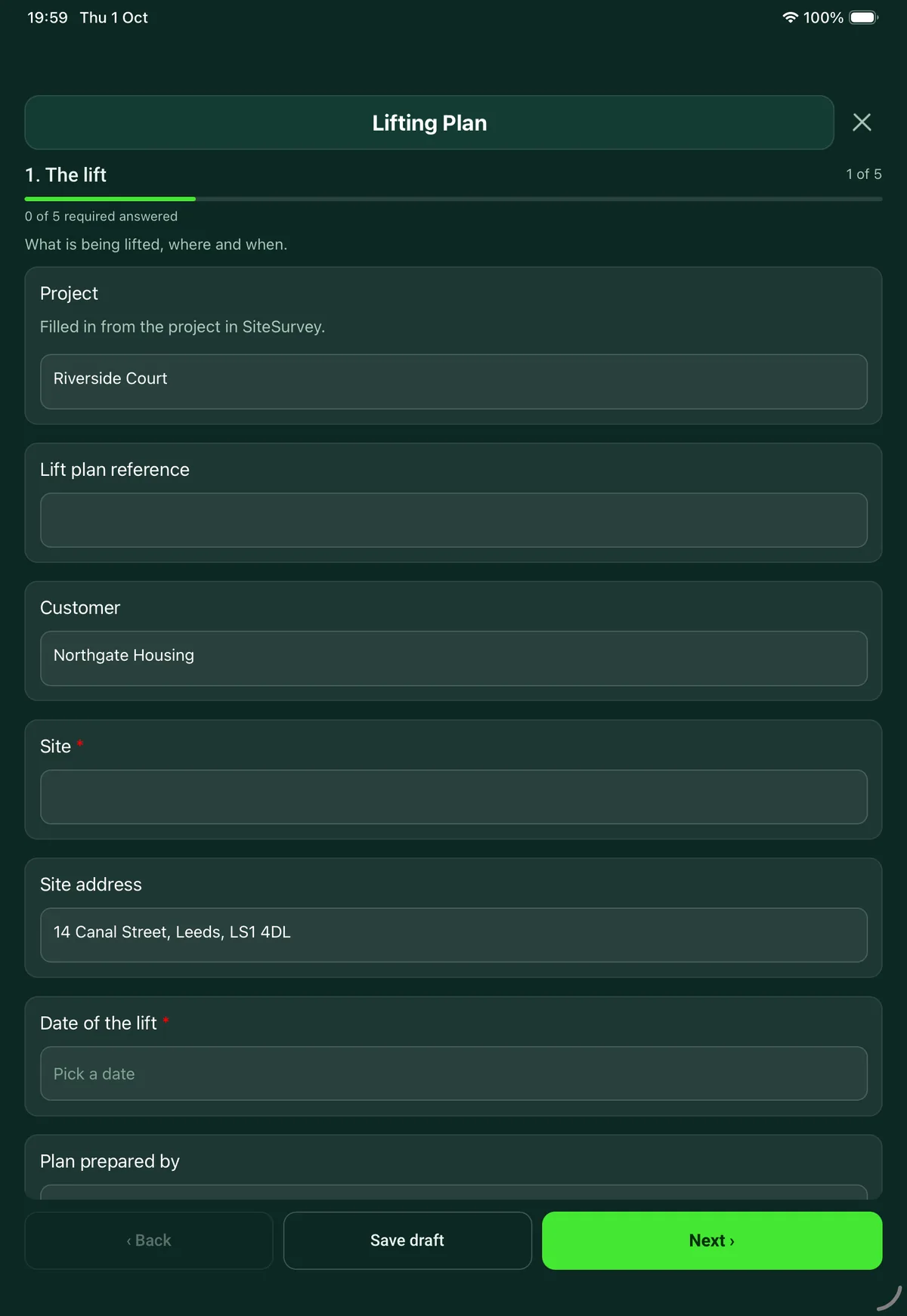
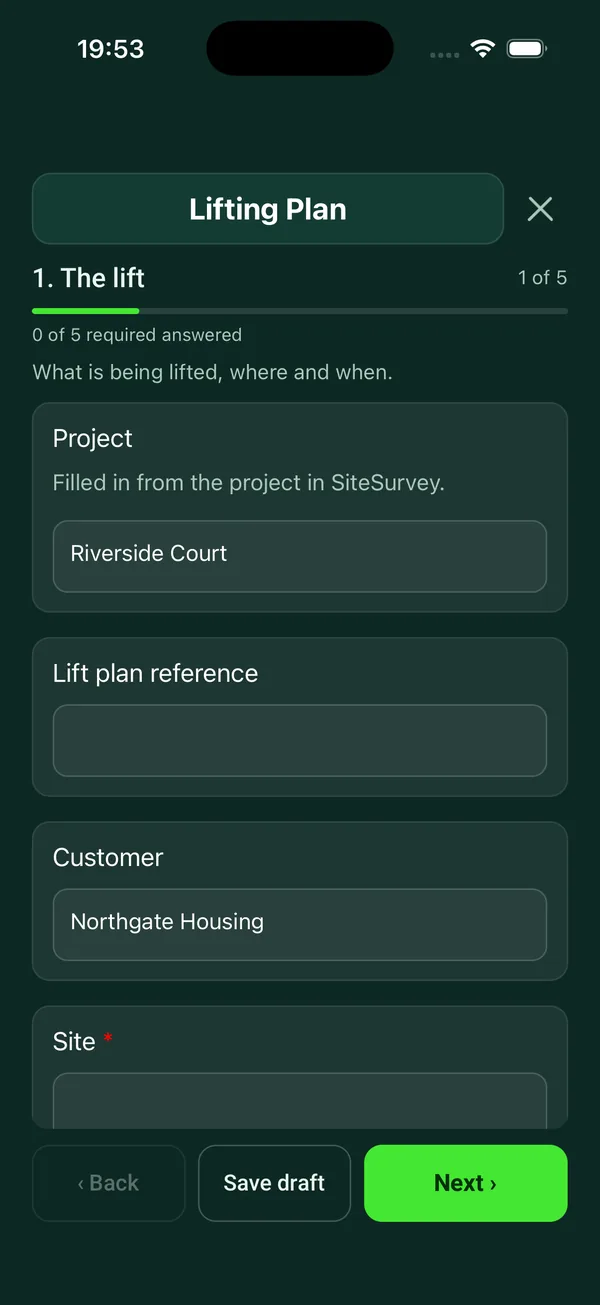
Every question in the lifting plan template
Lift plan for a crane or other lifting operation: the load, equipment and capacity, accessories, ground and site hazards, the lifting team, sequence and briefing. 5 sections and 47 questions. Follow-up questions and guidance appear only when an answer calls for them, so the person on site never sees the ones that do not apply.
Make it your own: every question is editable
This is a starting point, not a fixed form. Once it is in your SiteSurvey account you can reword any question, add or remove questions, sections and answer options, and add your own logo, so it fits the way your team works and the jobs you do.
Details you only enter once
Add this form to a project in SiteSurvey and it fills in what the project already knows, so nobody on site retypes it and every form on the job uses the same names. Anything filled in can still be changed.
- Project: the project name
- Customer: the project's customer
- Site: the site, when the form is opened for a space or a product
- Site address: the site address, from the space or the project
The lift
What is being lifted, where and when.
- ProjectShort answer
Filled in from the project in SiteSurvey.
Fills in from the project name - Lift plan referenceShort answer
- CustomerShort answerFills in from the project's customer
- Site*Short answerFills in from the site, when the form is opened for a space or a product
- Site addressShort answerFills in from the site address, from the space or the project
- Date of the lift*Date
- Date the plan was preparedDate
- Appointed person who planned the liftShort answer
- GuidanceLifting Operations and Lifting Equipment Regulations 1998, regulation 8. Every lifting operation involving lifting equipment must be properly planned by a competent person, appropriately supervised and carried out in a safe manner.
- How demanding is the lift?Choose one
- Basic: known weight, no hazards nearby
- Intermediate: hazards nearby or restricted space
- Complex: more than one crane, over people or live plant, or unusual load
- Describe the lift*Notes
From where, to where, and how many lifts.
The load
Weight, size and where it is slung from.
- What is the load?Short answer
- Weight of the load (kg)*Number
- How is the weight known?Choose one
- Marked on the load
- Drawings or data sheet
- Weighed
- Estimated
- CheckAn estimated weight is the weakest part of a lift plan. Say how it was estimated and allow a margin.Shown when “How is the weight known?” is “Estimated”
- DimensionsShort answer
- Is the centre of gravity known and central?Yes or No
- Lifting points and how the load is slungShort answer
- Weight of slings, hooks and other accessories (kg)Number
- Total weight on the hook (kg)Worked out by the formShown when “Weight of the load (kg)” is answered and “Weight of slings, hooks and other accessories (kg)” is answered
Equipment and capacity
The crane and the accessories.
- Lifting equipmentChoose one
- Mobile crane
- Tower crane
- Lorry loader
- Crawler crane
- Telehandler
- Excavator used for lifting
- Forklift
- Chain hoist or gantry
- Other (describe)
- Make and modelShort answer
- Maximum radius of the lift (m)Number
- Rated capacity at that radius (kg)Number
- Share of rated capacity used (%)Worked out by the formShown only when the answers above make it relevant
- WarningThe load is more than the rated capacity at this radius. Do not lift. Change the equipment, the radius or the load.Shown only when the answers above make it relevant
- Have you seen the current report of thorough examination for the equipment?Yes or No
- Date of that examinationDateShown when “Have you seen the current report of thorough examination for the equipment?” is Yes
- GuidanceUnder regulation 9 of the same Regulations, lifting equipment for lifting people and lifting accessories must be thoroughly examined at least every 6 months, and other lifting equipment at least every 12 months, unless it is examined under a written examination scheme.
- Lifting accessoriesRepeat for each accessory. Each one asks:
- Type*Choose one
- Chain sling
- Webbing sling
- Wire rope sling
- Shackle
- Spreader or lifting beam
- Eyebolt
- Hook block
- Lifting cage or bag
- Other (describe)
- ID or serial numberShort answer
- Safe working load (kg)Number
- Examination in date?Yes or No
- Date of last thorough examinationDate
Site and people
The ground, what is nearby and who does what.
- Ground under the crane or equipmentChoose one
- Checked and suitable
- Needs mats or preparation
- Not yet checked
- Mats, plates or other measuresShort answerShown when “Ground under the crane or equipment” is “Needs mats or preparation”
- Are there overhead power lines or other overhead obstructions?Yes or No
- WarningKeep the crane, the load and the people well clear of overhead power lines. Speak to the line owner before the lift and record what was agreed.Shown when “Are there overhead power lines or other overhead obstructions?” is Yes
- Other hazards near the liftTick all that apply
- Underground services or voids
- Public or other workers below the path of the load
- Buildings or structures in the slew path
- Other cranes
- Roads or railway
- Excavations
- Other (describe)
- How is the area under the load kept clear?Short answer
- Wind speed at which lifting stops, from the crane and load dataNumber
- Lift supervisorShort answer
- Crane or equipment operatorShort answer
- Slinger or signallerShort answer
- How will they communicate?Choose one
- Hand signals
- Radio
- Both
Sequence and briefing
How the lift will be done, step by step.
- Sequence of the liftNotes
- What happens if the weather changes, the equipment fails or the load cannot be landed?Notes
- Sketch or photos of the lift areaPhotos
- Has everyone in the lifting team been briefed on this plan?Yes or No
- Signature of the appointed person who planned the liftSignature
- Lift supervisorShort answer
- Lift supervisor signatureSignature
See it filled in
A completed lifting plan report, made by SiteSurvey from a fictional site visit: every answer, the photos, the guidance that applied and the sign-off, ready to send as a PDF.
Lifting plan FAQs
Can I download this lifting plan template for free?
Yes. Download the blank lifting plan as a printable PDF or editable Word document from this page. You can also inspect every question and try the live form before creating an account. The template is a starting point for a competent person to adapt to the actual lifting operation; it is not an approved plan for a particular lift.
Is a lifting plan a legal requirement?
Regulation 8 of the Lifting Operations and Lifting Equipment Regulations 1998 requires every lifting operation involving lifting equipment to be properly planned by a competent person, appropriately supervised and carried out in a safe manner. How much is written down depends on the lift. This form records the plan for one lift or a series of the same lifts.
How does it check the crane's capacity?
Enter the load weight and the weight of the accessories and the form adds them. Enter the rated capacity at the maximum radius and it shows the share of capacity used. If the total is more than the rated capacity, it shows a warning not to lift and to change the equipment, the radius or the load.
How often must lifting equipment be examined?
Under regulation 9, lifting equipment for lifting people and lifting accessories must be thoroughly examined at least every 6 months, and other lifting equipment at least every 12 months, unless it is examined under a written examination scheme. The form asks whether the current report has been seen and whether each accessory is in date.
What site hazards does it cover?
The ground under the crane and any mats needed, overhead power lines, underground services, people below the path of the load, structures in the slew path, other cranes, roads and excavations, how the area under the load is kept clear, and the wind speed at which lifting stops.
Who is named on the plan?
The appointed person who planned the lift, the lift supervisor, the operator and the slinger or signaller, with how they will communicate. The form asks whether the whole lifting team has been briefed, and the planner and the supervisor sign on the device. In the SiteSurvey app it works offline and syncs when the device is back online, and the record goes out as a PDF or a share link.
How detailed does a lift plan need to be?
HSE says planning should be proportionate to the risks: a straightforward, common lift may need only a generic plan, while a complex one, such as a tandem lift with more than one crane, needs a written plan from someone with specific competence. The form asks whether the lift is basic, intermediate or complex, and those categories are the form's own.
Related
Related templates
Templates that go with the lifting plan form
How a task will be done safely: scope, crew and competence, numbered work steps with hazards and controls, permits, emergency arrangements, briefing and approval. Links to the risk assessment by reference.
Permit for hot work, work at height, confined space entry and other high risk jobs: precautions, isolations, authorisation, hand-back and close-out.
Daily check before using a van, car, forklift or other mobile plant. Failed items get a photo and a note, with the result, who it was reported to and a supervisor sign-off.
A telehandler daily record covering configuration, attachment compatibility, tyres, visibility, stabilisers, approved function checks and defect handover.
Use this lifting plan form with your team
Add it from the form library in one click, change any question, and every completed form becomes a branded PDF report.
Start your trial →