Form library · Health and safety
Permit to work template
A permit form for hot work, work at height, confined space entry, electrical work, excavation and other high risk jobs. Choose the type and the precautions change to match: fire watch and combustibles for hot work, access and fragile surfaces for height, gas tests and rescue for confined spaces. The issuer and the person in charge sign before work starts. At the end the person in charge signs the hand-back and the person closing the permit signs it off. Every question is listed below, and you can fill the live form in on this page.
Ready to use from the form library, and every question is yours to edit. Trial from £1, cancel any time.
Try it on your phone
Try it on this phone
Fill in the permit to work on your phone now
See how the permit to work looks on your phone
Scan the code with your phone camera. It opens the real form, no sign-up needed.
Open the live example and fill it in, just as your team would on site. No sign-up needed.
See it on this phoneEvery question is editable. Add this form to your account, then change the wording, add or remove questions and options, and make it fit your own jobs.
What should a permit to work include?
A permit to work should say exactly what the work is, where, who is doing it and when the permit is valid. It should list the hazards and the precautions that must be in place first, including isolations, and name the person who issues it and the person in charge of the work. It should end with a hand-back, confirming the area is safe and isolations are removed, and a signed close.
Last updated . Facts checked by the SiteSurvey team on 5 October 2026 against HSE guidance on permit to work systems, regulation 6 of the Work at Height Regulations 2005, regulation 12 of the Work at Height Regulations 2005, HSE introduction to working in confined spaces and HSE guidance on roof work.
Try the permit to work form live
Answer a few questions and watch it adapt. Your answers are not saved, and any photos you add are deleted within the hour.
This is the real form as your team would use it: questions appear as you answer, scores work themselves out and you can add photos and signatures. No sign-up needed.
Want to see one filled in? See a completed permit to work report (PDF), made by SiteSurvey from a fictional site visit.
Fill it in on a phone or tablet
Your team completes the permit to work on site in the SiteSurvey app on iPhone, iPad and Android phones and tablets. The project name and address fill in for them, it works without signal, and it syncs when the device is back online with photos kept against the question they answer.
Customers and subcontractors do not need the app: send them a link and they can fill it in from any browser.
Every question in the permit to work template
Permit for hot work, work at height, confined space entry and other high risk jobs: precautions, isolations, authorisation, hand-back and close-out. 4 sections and 67 questions. Follow-up questions and guidance appear only when an answer calls for them, so the person on site never sees the ones that do not apply.
Make it your own: every question is editable
This is a starting point, not a fixed form. Once it is in your SiteSurvey account you can reword any question, add or remove questions, sections and answer options, and add your own logo, so it fits the way your team works and the jobs you do.
Details you only enter once
Add this form to a project in SiteSurvey and it fills in what the project already knows, so nobody on site retypes it and every form on the job uses the same names. Anything filled in can still be changed.
- Project: the project name
- Site: the site, when the form is opened for a space or a product
- Site address: the site address, from the space or the project
The job
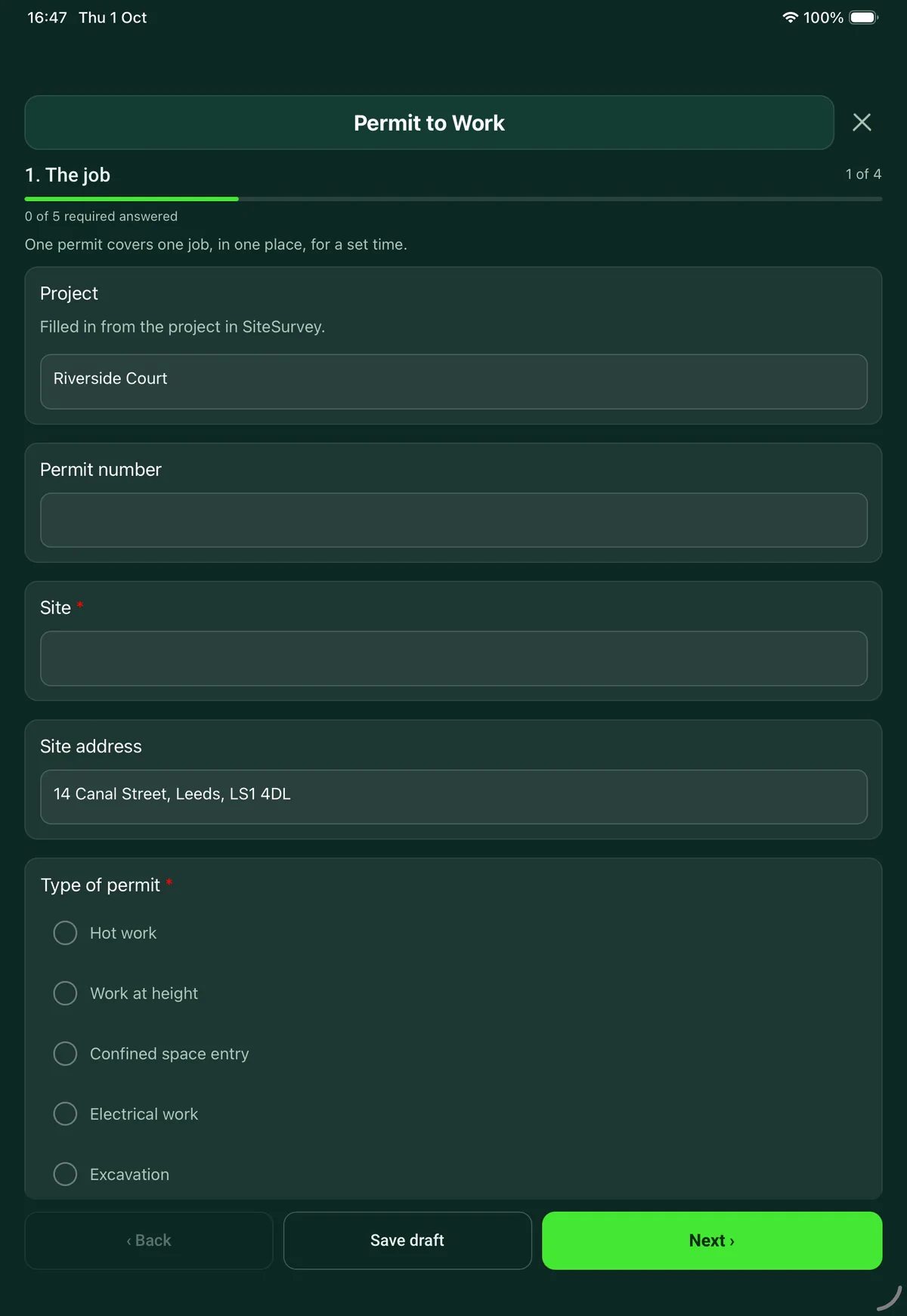
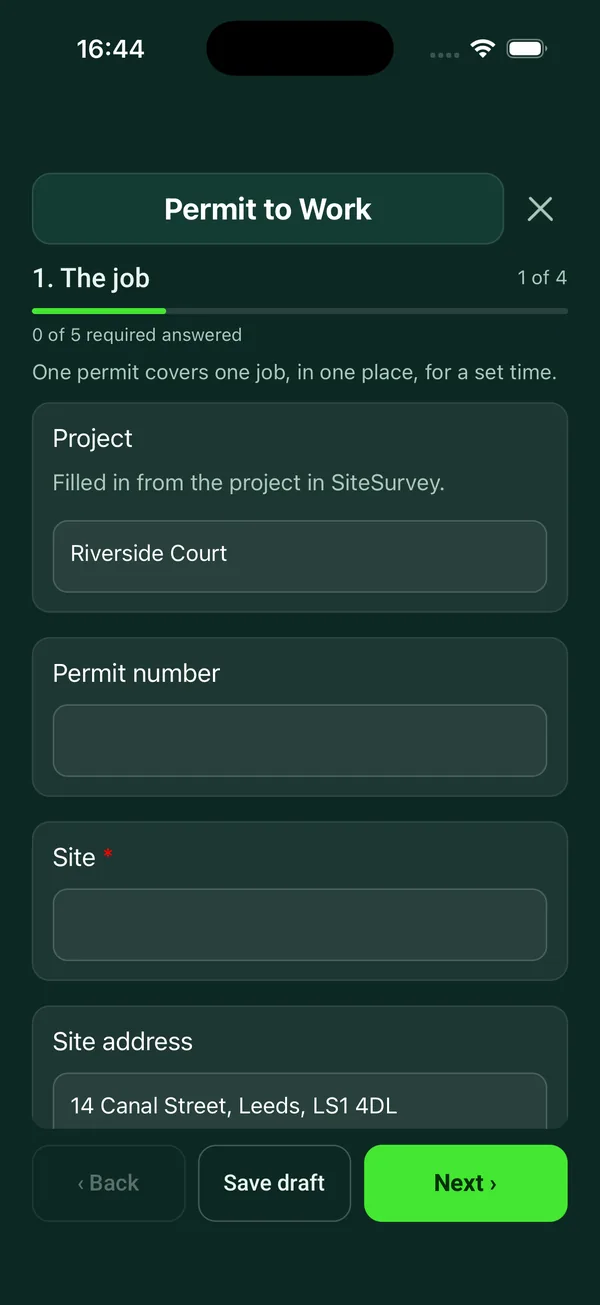
One permit covers one job, in one place, for a set time.
- ProjectShort answer
Filled in from the project in SiteSurvey.
Fills in from the project name - Permit numberShort answer
- Site*Short answerFills in from the site, when the form is opened for a space or a product
- Site addressShort answerFills in from the site address, from the space or the project
- Type of permit*Choose one
- Hot work
- Work at height
- Confined space entry
- Electrical work
- Excavation
- Other high risk work
- What is the work?*Notes
- Exactly where?*Short answer
- Company doing the workShort answer
- Number of peopleNumber
- Date the permit is valid*Date
- FromTime
- ToTime
- GuidanceIssue a new permit if the work, the place, the people or the day changes. A permit covers the steps it names. Work on those steps should not start until the permit has been issued.
- Risk assessment and method statement referenceShort answer
- Has the person issuing the permit read them?Yes or No
- WarningDo not issue the permit until the risk assessment and method statement have been read and agreed.Shown when “Has the person issuing the permit read them?” is No
Precautions
What must be in place before the work starts.
- Does anything need isolating?Yes or No
Electricity, gas, water, steam, machinery, alarms.
- What is isolated, where, and how is it locked off?NotesShown when “Does anything need isolating?” is Yes
- Is the area barriered off and signed?Yes or No
- Protective equipment neededTick all that apply
- Hard hat
- Eye protection
- Gloves
- Hearing protection
- Respiratory protection
- Harness
- Flame-resistant clothing
- Hi-vis
- Other (describe)
- Other permits linked to this jobShort answer
- Could the job be done without heat, or away from the building?Yes or NoShown when “Type of permit” is “Hot work”
- CheckDo it that way. Hot work on site should be the last choice.Shown when “Type of permit” is “Hot work” and “Could the job be done without heat, or away from the building?” is Yes
- Combustible materials near the workChoose one
- Removed from the area
- Covered with fire-resistant sheets
- Cannot be removed or covered
Shown when “Type of permit” is “Hot work” - WarningDo not issue the permit. Find another method or another place for the work.Shown when “Type of permit” is “Hot work” and “Combustible materials near the work” is “Cannot be removed or covered”
- Have the other side of walls, the floor below and any voids been checked?Yes or NoShown when “Type of permit” is “Hot work”
- Do any fire detectors or sprinklers need isolating for the work?Yes or NoShown when “Type of permit” is “Hot work”
- Which, and who has been told?Short answerShown when “Type of permit” is “Hot work” and “Do any fire detectors or sprinklers need isolating for the work?” is Yes
- Is a suitable extinguisher at the work area?Yes or NoShown when “Type of permit” is “Hot work”
- Who is keeping the fire watch?Short answerShown when “Type of permit” is “Hot work”
- Fire watch after the work stops (minutes)NumberShown when “Type of permit” is “Hot work”
- CheckMany insurers and site rules ask for a fire watch of at least 60 minutes after hot work stops. Check the site's own rule before you issue the permit.Shown only when the answers above make it relevant
- Can the work be done safely without working at height?Yes or NoShown when “Type of permit” is “Work at height”
- CheckWork at Height Regulations 2005, regulation 6. Work must not be carried out at height where it is reasonably practicable to carry it out safely another way.Shown when “Type of permit” is “Work at height” and “Can the work be done safely without working at height?” is Yes
- How will the work be reached?Choose one
- Scaffold
- Mobile tower
- MEWP or scissor lift
- Podium steps
- Ladder or stepladder
- Roof with edge protection
- Harness and lanyard
- Other (describe)
Shown when “Type of permit” is “Work at height” - Has the scaffold been inspected in the last 7 days?Yes or NoShown when “Type of permit” is “Work at height” and “How will the work be reached?” is “Scaffold”
- WarningA working platform used for construction work, from which a person could fall 2 metres or more, must not be used unless it has been inspected in that position within the previous 7 days. Work at Height Regulations 2005, regulation 12.Shown when “Type of permit” is “Work at height” and “How will the work be reached?” is “Scaffold” and “Has the scaffold been inspected in the last 7 days?” is No
- Is any roof or surface in the work area fragile?Choose one
- No: confirmed by a competent person
- Yes
- Not confirmed
Shown when “Type of permit” is “Work at height” - WarningHSE says all roofs should be treated as fragile until a competent person has confirmed they are not. Fragile rooflights are a particular hazard: some are hard to see and others may be hidden by paint. Record the covers, barriers or staging to be used.Shown only when the answers above make it relevant
- How would someone be rescued after a fall?Notes
Planning work at height includes planning for emergencies and rescue.
Shown when “Type of permit” is “Work at height” - Is the weather suitable?Yes or NoShown when “Type of permit” is “Work at height”
- Can the work be done without anyone going in?Yes or NoShown when “Type of permit” is “Confined space entry”
- CheckHSE says that wherever possible you should avoid carrying out tasks in confined spaces. Do the work from outside.Shown when “Type of permit” is “Confined space entry” and “Can the work be done without anyone going in?” is Yes
- Which risks are foreseeable in this space?Tick all that apply
- Fire or explosion
- Loss of consciousness from gas, fume, vapour or lack of oxygen
- Drowning
- Asphyxiation from a free-flowing solid
- Loss of consciousness from heat
Shown when “Type of permit” is “Confined space entry” - Has the atmosphere been tested?Yes or NoShown when “Type of permit” is “Confined space entry”
- Oxygen (%)NumberShown when “Type of permit” is “Confined space entry” and “Has the atmosphere been tested?” is Yes
- Flammable gas (% of lower explosive limit)NumberShown when “Type of permit” is “Confined space entry” and “Has the atmosphere been tested?” is Yes
- Toxic gas readingsShort answerShown when “Type of permit” is “Confined space entry” and “Has the atmosphere been tested?” is Yes
- Monitoring during the workChoose one
- Continuous personal monitors
- Repeat tests at set times
- None
Shown when “Type of permit” is “Confined space entry” - VentilationShort answerShown when “Type of permit” is “Confined space entry”
- Who stays outside to keep watch?Short answerShown when “Type of permit” is “Confined space entry”
- How do they keep in contact?Short answerShown when “Type of permit” is “Confined space entry”
- Emergency and rescue arrangementsNotes
Who raises the alarm, how the person is brought out, what equipment is at the entry point.
Shown when “Type of permit” is “Confined space entry” - GuidanceThe Confined Spaces Regulations 1997 cover this work. HSE guidance is to assess the risks of the particular space, plan how to control them, and have emergency arrangements in place before anyone goes in. Calling 999 is not a rescue plan on its own.Shown when “Type of permit” is “Confined space entry”
- How will the work be done?Choose one
- Dead: isolated, locked off and proved dead
- Live: dead working is unreasonable and precautions are in place
Shown when “Type of permit” is “Electrical work” - Proved dead by, with what testerShort answerShown only when the answers above make it relevant
- Have underground services been located from plans and traced with a cable locator?Yes or NoShown when “Type of permit” is “Excavation”
- How are the sides supported and the edge protected?Short answerShown when “Type of permit” is “Excavation”
Issue and acceptance
Signed before the work starts.
- Permit issued byShort answer
- PositionShort answer
- Time issuedTime
- Signature of the person issuingSignature
- GuidanceI have read this permit and the risk assessment and method statement. I understand the precautions, I will brief everyone doing the work, and I will stop and report if conditions change.
- Person in charge of the workShort answer
- Signature of the person in charge of the workSignature
Hand-back and close
Completed when the work stops, finished or not.
- The work isChoose one
- Complete
- Stopped, not complete
- Suspended: permit to be reissued
- Time the work stoppedTime
- Has the area been left safe, clean and clear of tools and materials?Yes or No
- IsolationsChoose one
- Removed and systems back in service
- Still in place
- None were used
- What is still isolated, and who knows?Short answerShown when “Isolations” is “Still in place”
- Time of the final fire checkTimeShown when “Type of permit” is “Hot work”
- Have detectors and sprinklers been put back in service?Yes or NoShown when “Type of permit” is “Hot work” and “Do any fire detectors or sprinklers need isolating for the work?” is Yes
- WarningDetection is still isolated. Tell the person responsible for fire safety before you leave.Shown when “Type of permit” is “Hot work” and “Do any fire detectors or sprinklers need isolating for the work?” is Yes and “Have detectors and sprinklers been put back in service?” is No
- Handed back byShort answer
- Signature of the person in charge of the workSignature
- Permit closed byShort answer
- Date closedDate
- Time closedTime
- Signature of the person closing the permitSignature
- GuidanceHSE guidance on permits is that there should be a formal procedure for handing plant and equipment back, in a safe condition, when the work is completed or the permit is cancelled.
See it filled in
A completed permit to work report, made by SiteSurvey from a fictional site visit: every answer, the photos, the guidance that applied and the sign-off, ready to send as a PDF.
Permit to work FAQs
What does the hot work permit cover?
Whether the job could be done without heat or away from the building, what has been done about combustible materials, checks on the other side of walls and the floor below, any fire detectors or sprinklers isolated, an extinguisher at the work area, who keeps the fire watch and for how long after the work stops. At close-out it records the time of the final fire check and that detection is back in service.
How long should a fire watch last after hot work?
The form records the number of minutes and shows a reminder if it is under 60. Many insurers and site rules ask for a fire watch of at least 60 minutes after hot work stops, so check the site's own rule before the permit is issued. That figure is common practice, not a legal limit.
What does the working at height permit ask?
Whether the work can be done without working at height, how it will be reached, whether any roof or surface is fragile, how someone would be rescued after a fall and whether the weather is suitable. Under regulation 6 of the Work at Height Regulations 2005, work must not be carried out at height where it is reasonably practicable to do it safely another way. A scaffold must have been inspected within the previous 7 days.
What does the confined space permit include?
Whether the work can be done without anyone going in, which risks are foreseeable, atmosphere test readings for oxygen, flammable gas and toxic gas, monitoring during the work, ventilation, who stays outside, how they keep in contact, and the emergency and rescue arrangements. HSE says that wherever possible you should avoid carrying out tasks in confined spaces.
When does a permit need to be reissued?
The form treats a permit as covering one job, in one place, for a set time. It says to issue a new permit if the work, the place, the people or the day changes. That is this form's rule, and your own permit procedure may set others.
How is the permit closed?
The person in charge of the work records whether it is complete, stopped or suspended, confirms the area is safe and clear, and records the state of any isolations. They sign the hand-back, and the person closing the permit records the date and time and signs. HSE guidance is that there should be a formal procedure for handing plant back in a safe condition when work is completed or a permit is cancelled.
Related
Related templates
Templates that go with the permit to work form
How a task will be done safely: scope, crew and competence, numbered work steps with hazards and controls, permits, emergency arrangements, briefing and approval. Links to the risk assessment by reference.
Hazards, who might be harmed, controls and risk scores, with a briefing record and review date.
Inspection record for a scaffold, ladder, harness and lanyard or pallet racking. The checks change with the equipment, with defects, photos and a result.
Construction site safety walk: perimeter, work at height, welfare, housekeeping, plant, hazards and actions.
Use this permit to work form with your team
Add it from the form library in one click, change any question, and every completed form becomes a branded PDF report.
Start your trial →