Form library · Health and safety
Scaffold, ladder, harness and racking inspection checklist
One inspection form for four kinds of work equipment. Choose scaffold, ladder or stepladder, harness and lanyard, or pallet racking, and the checks change to match. Record defects with photos, give a result of safe to use, restricted or do not use, and sign. Every question is listed below, and you can fill the live form in on this page.
Ready to use from the form library, and every question is yours to edit. Trial from £1, cancel any time.
Try it on your phone
Try it on this phone
Fill in the work equipment inspection on your phone now
See how the work equipment inspection looks on your phone
Scan the code with your phone camera. It opens the real form, no sign-up needed.
Open the live example and fill it in, just as your team would on site. No sign-up needed.
See it on this phoneEvery question is editable. Add this form to your account, then change the wording, add or remove questions and options, and make it fit your own jobs.
What should a scaffold inspection checklist include?
A scaffold inspection checklist should cover the ground and base plates, standards, ledgers and bracing, ties, platforms and boards, guardrails and toe boards, access, loading and protection for the public. It should record the date of the last inspection, the defects found and whether the scaffold is safe to use. A working platform used for construction work must be inspected within the previous 7 days.
Last updated . Facts checked by the SiteSurvey team on 5 October 2026 against regulation 12 of the Work at Height Regulations 2005, HSE: how to check your ladder is safe before you use it, HSE INDG367, Inspecting fall arrest equipment made from webbing or rope, HSE HSG76, Warehousing and storage and regulation 6 of the Provision and Use of Work Equipment Regulations 1998.
Try the work equipment inspection form live
Answer a few questions and watch it adapt. Your answers are not saved, and any photos you add are deleted within the hour.
This is the real form as your team would use it: questions appear as you answer, scores work themselves out and you can add photos and signatures. No sign-up needed.
Want to see one filled in? See a completed work equipment inspection report (PDF), made by SiteSurvey from a fictional site visit.
Fill it in on a phone or tablet
Your team completes the work equipment inspection on site in the SiteSurvey app on iPhone, iPad and Android phones and tablets. The project name and address fill in for them, it works without signal, and it syncs when the device is back online with photos kept against the question they answer.
Customers and subcontractors do not need the app: send them a link and they can fill it in from any browser.
Every question in the work equipment inspection template
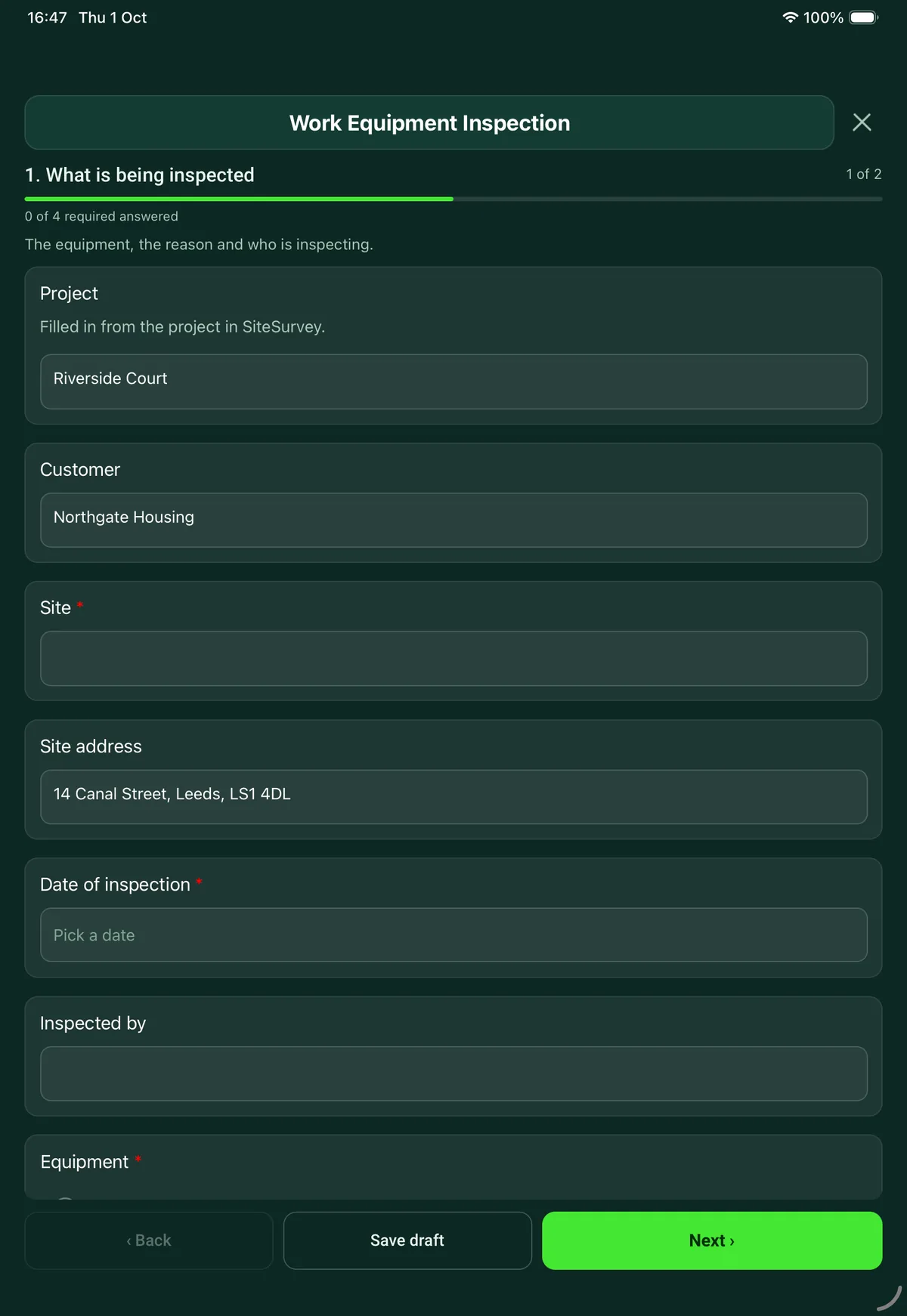
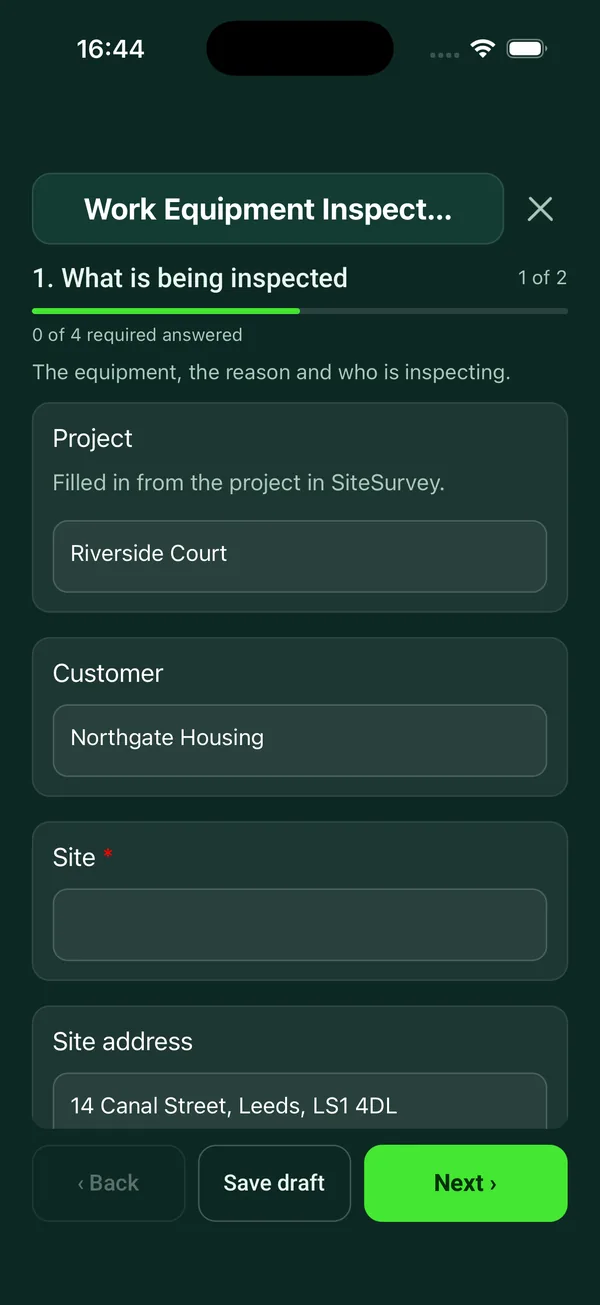
Inspection record for a scaffold, ladder, harness and lanyard or pallet racking. The checks change with the equipment, with defects, photos and a result. 6 sections and 74 questions. Follow-up questions and guidance appear only when an answer calls for them, so the person on site never sees the ones that do not apply.
Make it your own: every question is editable
This is a starting point, not a fixed form. Once it is in your SiteSurvey account you can reword any question, add or remove questions, sections and answer options, and add your own logo, so it fits the way your team works and the jobs you do.
Details you only enter once
Add this form to a project in SiteSurvey and it fills in what the project already knows, so nobody on site retypes it and every form on the job uses the same names. Anything filled in can still be changed.
- Project: the project name
- Customer: the project's customer
- Site: the site, when the form is opened for a space or a product
- Site address: the site address, from the space or the project
What is being inspected
The equipment, the reason and who is inspecting.
- ProjectShort answer
Filled in from the project in SiteSurvey.
Fills in from the project name - CustomerShort answerFills in from the project's customer
- Site*Short answerFills in from the site, when the form is opened for a space or a product
- Site addressShort answerFills in from the site address, from the space or the project
- Date of inspection*Date
- Time of inspectionTime
- Inspected byShort answer
- Inspector's positionShort answer
- Equipment*Choose one
- Scaffold
- Ladder or stepladder
- Harness and lanyard
- Pallet racking
- Reference, tag or serial numberShort answer
- LocationShort answer
- Why is it being inspected?Choose one
- Routine inspection
- Before first use or after installation
- After alteration
- After an event that could have affected its safety
- What happened?Short answerShown when “Why is it being inspected?” is “After an event that could have affected its safety”
Scaffold
Walk the whole scaffold, from the base up.
- Type of scaffoldChoose one
- Independent tied
- Putlog
- Birdcage
- Mobile tower
- System scaffold
- Loading bay
- Other (describe)
- Have you seen the handover certificate?Yes or No
- Date of the last recorded inspectionDate
- Days since the last inspectionWorked out by the formShown when “Date of the last recorded inspection” is answered and “Date of inspection” is answered
- WarningInspection overdue. A working platform used for construction work, from which a person could fall 2 metres or more, must not be used unless it has been inspected in that position within the previous 7 days. Work at Height Regulations 2005, regulation 12.Shown only when the answers above make it relevant
- GuidanceIt must also be inspected again after any event that could have affected its safety, such as high wind, impact or alteration.
- Ground, sole boards and base platesChoose one
- OK
- Defect
- Not applicable
- Standards, ledgers, transoms and bracingChoose one
- OK
- Defect
- Not applicable
- Ties and anchorsChoose one
- OK
- Defect
- Not applicable
- Platforms fully boarded, boards sound and securedChoose one
- OK
- Defect
- Not applicable
- Guardrails, mid rails and toe boardsChoose one
- OK
- Defect
- Not applicable
- Ladders, stairs and access gatesChoose one
- OK
- Defect
- Not applicable
- Loading: not overloaded, materials stacked safelyChoose one
- OK
- Defect
- Not applicable
- Protection for the public: fans, netting, lighting, base protectionChoose one
- OK
- Defect
- Not applicable
- Scaffold tag or status sign up to dateChoose one
- OK
- Defect
- Not applicable
Ladder or stepladder
Pre-use checks, done by the person using the ladder.
- TypeChoose one
- Leaning ladder
- Stepladder
- Platform stepladder
- Combination ladder
- Telescopic ladder
- Roof ladder
- Other (describe)
- GuidanceHSE says the person using the ladder should check it at the beginning of the working day, and again after something has changed, such as the ladder being dropped or moved from a dirty area to a clean one.
- Stiles: not bent or damagedChoose one
- OK
- Defect
- Feet: none missing, worn or damagedChoose one
- OK
- Defect
- Rungs: none bent, worn, missing or looseChoose one
- OK
- Defect
- Locking mechanisms: working, not bent or wornChoose one
- OK
- Defect
- Not applicable
- Stepladder platform: not split or buckledChoose one
- OK
- Defect
- Not applicable
- Steps or treads: clean, fixings tightChoose one
- OK
- Defect
- Not applicable
- Will the ladder be used for more than 30 minutes at a time?Yes or No
- CheckHSE guidance is that if a task needs a ladder or stepladder for more than 30 minutes at a time, other equipment should be considered.Shown when “Will the ladder be used for more than 30 minutes at a time?” is Yes
- Can it be tied, footed or otherwise stopped from slipping?Yes or No
Harness and lanyard
Webbing, stitching and metal parts.
- Type of inspection*Choose one
- Pre-use check
- Detailed inspection
- Interim inspection
- Make and modelShort answer
- Date of manufacture, from the labelShort answer
- Date of the last detailed inspectionDate
- Days since the last detailed inspectionWorked out by the formShown when “Date of the last detailed inspection” is answered and “Date of inspection” is answered
- GuidanceHSE guidance (INDG367) recommends a detailed inspection at least every six months, and at least every three months for frequently used lanyards, particularly in arduous environments such as demolition, steel erection and scaffolding. Detailed inspections should be recorded.
- CheckMore than six months since the last detailed inspection. Arrange one by a competent person before the equipment is used again.Shown only when the answers above make it relevant
- Webbing: no cuts, abrasion or frayingChoose one
- OK
- Defect
- Stitching: none broken or pulledChoose one
- OK
- Defect
- No damage from chemicals, heat, paint or sunlightChoose one
- OK
- Defect
- Buckles, D rings and adjustersChoose one
- OK
- Defect
- Energy absorber: not deployed or damagedChoose one
- OK
- Defect
- Not applicable
- Connectors: gates close and lockChoose one
- OK
- Defect
- Not applicable
- Label readable, with a unique identificationChoose one
- OK
- Defect
Pallet racking
Walk every aisle. Record each damaged component.
- Are load notices displayed and readable?Yes or No
- Date of the last inspection by a racking specialistDate
- Days since that inspectionWorked out by the formShown when “Date of the last inspection by a racking specialist” is answered and “Date of inspection” is answered
- CheckHSE guidance on warehousing (HSG76) recommends an inspection by a technically competent person at intervals of not more than 12 months, as well as regular in-house inspections like this one.Shown only when the answers above make it relevant
- Did you find any damage?Yes or No
- DamageRepeat for each damage. Each one asks:Shown when “Did you find any damage?” is Yes
- Aisle, bay and level*Short answer
- ComponentChoose one
- Upright
- Beam
- Bracing
- Base plate or floor fixing
- Beam connector or safety lock
- Decking
- Column guard or barrier
- Other (describe)
- What is the damage?Notes
- Risk category*Choose one
- Green: watch
- Amber: repair soon
- Red: offload now
- CheckAmber. Do not put new loads on this rack once it is emptied, and have it repaired. Under the SEMA classification that HSG76 follows, amber damage not repaired within four weeks becomes red.Shown when “Risk category” is “Amber: repair soon”
- WarningRed. Offload the affected racking immediately and keep it out of use until it has been repaired.Shown when “Risk category” is “Red: offload now”
- Repair by (who and date)Short answerShown only when the answers above make it relevant
- PhotosPhotos
- Amber itemsWorked out by the formShown when “Did you find any damage?” is Yes
- Red itemsWorked out by the formShown when “Did you find any damage?” is Yes
- Floor fixings and floor conditionChoose one
- OK
- Defect
- Not applicable
- Beam safety locks in placeChoose one
- OK
- Defect
- Not applicable
- Pallets sound and loads stableChoose one
- OK
- Defect
- Not applicable
- Aisles clear, barriers and guards in placeChoose one
- OK
- Defect
- Not applicable
Defects and result
What you found and whether it can be used.
- Did you find any defects?Yes or No
- Describe each defect and where it isNotesShown when “Did you find any defects?” is Yes
- Photos of the defectsPhotosShown when “Did you find any defects?” is Yes
- Action taken at the timeNotesShown when “Did you find any defects?” is Yes
- Further action neededNotesShown when “Did you find any defects?” is Yes
- Result*Choose one
- Safe to use
- Safe to use with a restriction
- Do not use
- What is the restriction?Short answerShown when “Result” is “Safe to use with a restriction”
- What was done to stop it being used, and who was told?Notes
For example tagged, removed from site, access blocked, bays offloaded.
Shown when “Result” is “Do not use” - WarningHSE says that if you find a problem, do not use the ladder and tell the person in charge of the work.Shown when “Equipment” is “Ladder or stepladder” and “Result” is “Do not use”
- Next inspection dueDate
- GuidanceWhere the law requires work equipment to be inspected, the result must be recorded and kept until the next inspection is recorded.
- Inspector nameShort answer
- Inspector signatureSignature
See it filled in
A completed work equipment inspection report, made by SiteSurvey from a fictional site visit: every answer, the photos, the guidance that applied and the sign-off, ready to send as a PDF.
Work equipment inspection FAQs
How often must a scaffold be inspected?
Under regulation 12 of the Work at Height Regulations 2005, a working platform used for construction work, from which a person could fall 2 metres or more, must not be used unless it has been inspected in that position within the previous 7 days. It must also be inspected again after any event that could have affected its safety. The form works out the days since the last inspection and flags one that is overdue.
What does the ladder inspection checklist cover?
The pre-use checks in HSE guidance: stiles not bent or damaged, feet not missing or worn, rungs not bent, missing or loose, locking mechanisms working, the stepladder platform not split or buckled, and steps or treads clean. HSE says the person using the ladder should check it at the beginning of the working day and after something has changed. If there is a problem, do not use it and tell the person in charge.
How often should a harness and lanyard be inspected?
HSE guidance (INDG367) describes pre-use checks, detailed inspections and interim inspections. It recommends a detailed inspection at least every six months, and at least every three months for frequently used lanyards, particularly in arduous environments such as demolition, steel erection and scaffolding. Detailed inspections should be recorded. The form flags a detailed inspection that is more than six months old.
How does the racking inspection checklist rate damage?
Each damaged component is rated green, amber or red, following the SEMA classification used in HSE's warehousing guidance (HSG76). Red means offload the racking immediately and keep it out of use until repaired. Amber means do not reload it once emptied and repair it soon: amber damage not repaired within four weeks becomes red. The form counts the amber and red items.
How often does pallet racking need an expert inspection?
HSG76 recommends an inspection by a technically competent person at intervals of not more than 12 months, on top of regular in-house inspections. The form records the date of the last specialist inspection and flags it when more than a year has passed.
What happens when equipment fails?
The result is safe to use, safe to use with a restriction, or do not use. Do not use asks what was done to stop it being used, such as a tag, removal from site or offloading bays, and who was told. Where the law requires work equipment to be inspected, regulation 6 of the Provision and Use of Work Equipment Regulations 1998 says the result must be recorded and kept until the next inspection is recorded.
Related
Related templates
Templates that go with the work equipment inspection form
Construction site safety walk: perimeter, work at height, welfare, housekeeping, plant, hazards and actions.
Daily check before using a van, car, forklift or other mobile plant. Failed items get a photo and a note, with the result, who it was reported to and a supervisor sign-off.
Permit for hot work, work at height, confined space entry and other high risk jobs: precautions, isolations, authorisation, hand-back and close-out.
Hazards, who might be harmed, controls and risk scores, with a briefing record and review date.
Use this work equipment inspection form with your team
Add it from the form library in one click, change any question, and every completed form becomes a branded PDF report.
Start your trial →