Form library · Health and safety
Manual handling risk assessment template
A manual handling assessment built on task, individual, load and environment. Ask first whether the handling can be avoided, tick the risk factors that apply, choose the handling aids and other changes, rate the risk before and after, and set actions with an owner and a date. Every question is listed below, and you can fill the live form in on this page.
Ready to use from the form library, and every question is yours to edit. Trial from £1, cancel any time.
Try it on your phone
Try it on this phone
Fill in the manual handling risk assessment on your phone now
See how the manual handling risk assessment looks on your phone
Scan the code with your phone camera. It opens the real form, no sign-up needed.
Open the live example and fill it in, just as your team would on site. No sign-up needed.
See it on this phoneEvery question is editable. Add this form to your account, then change the wording, add or remove questions and options, and make it fit your own jobs.
What should a manual handling risk assessment include?
A manual handling risk assessment should ask whether the handling can be avoided, then look at the task (twisting, stooping, reaching, carrying distance, repetition), the individual, the load (weight, bulk, grip, stability) and the environment (space, floors, steps, lighting). It should record the handling aids and other changes that reduce the risk, and the actions still to do.
Last updated . Facts checked by the SiteSurvey team on 5 October 2026 against HSE: manual handling at work and regulation 4 of the Manual Handling Operations Regulations 1992.
Try the manual handling risk assessment form live
Answer a few questions and watch it adapt. Your answers are not saved, and any photos you add are deleted within the hour.
This is the real form as your team would use it: questions appear as you answer, scores work themselves out and you can add photos and signatures. No sign-up needed.
Want to see one filled in? See a completed manual handling risk assessment report (PDF), made by SiteSurvey from a fictional site visit.
Fill it in on a phone or tablet
Your team completes the manual handling risk assessment on site in the SiteSurvey app on iPhone, iPad and Android phones and tablets. The project name and address fill in for them, it works without signal, and it syncs when the device is back online with photos kept against the question they answer.
Customers and subcontractors do not need the app: send them a link and they can fill it in from any browser.
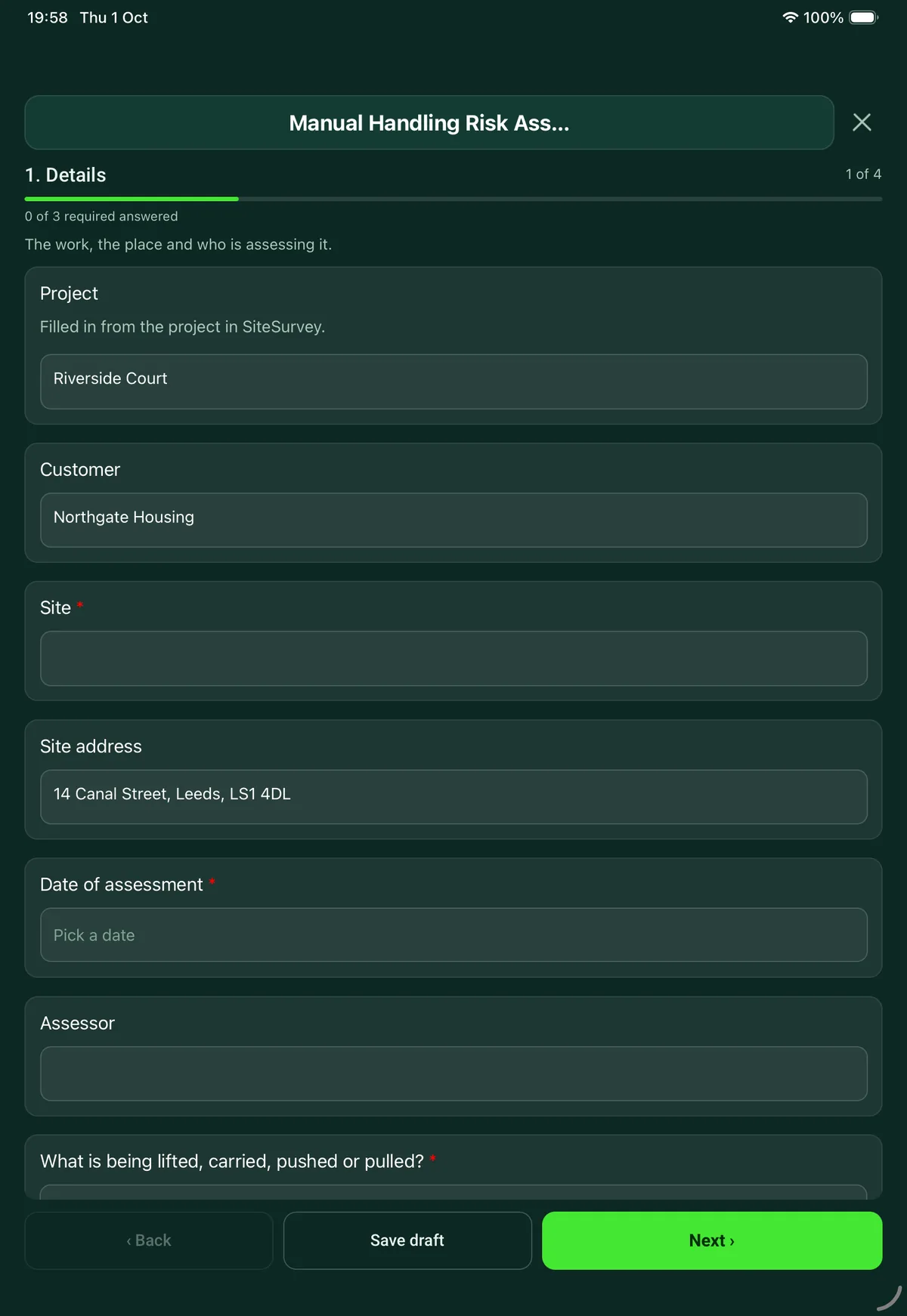
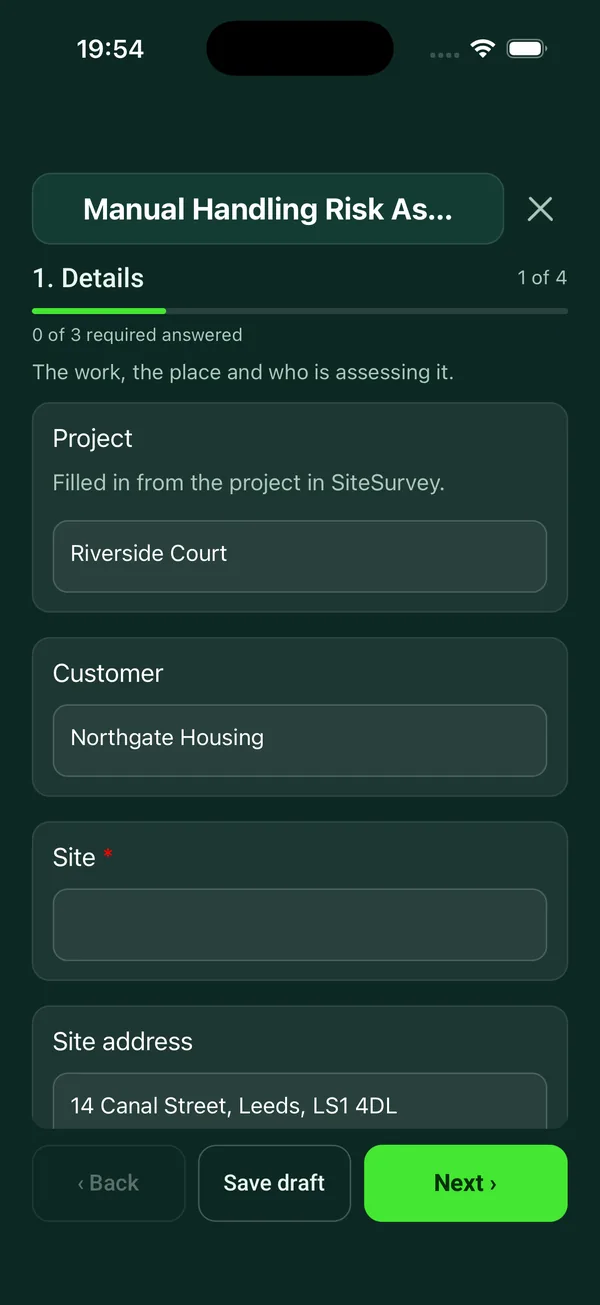
Every question in the manual handling risk assessment template
Manual handling assessment using task, individual, load and environment: can it be avoided, risk factors, handling aids, controls and actions. 4 sections and 33 questions. Follow-up questions and guidance appear only when an answer calls for them, so the person on site never sees the ones that do not apply.
Make it your own: every question is editable
This is a starting point, not a fixed form. Once it is in your SiteSurvey account you can reword any question, add or remove questions, sections and answer options, and add your own logo, so it fits the way your team works and the jobs you do.
Details you only enter once
Add this form to a project in SiteSurvey and it fills in what the project already knows, so nobody on site retypes it and every form on the job uses the same names. Anything filled in can still be changed.
- Project: the project name
- Customer: the project's customer
- Site: the site, when the form is opened for a space or a product
- Site address: the site address, from the space or the project
Details
The work, the place and who is assessing it.
- ProjectShort answer
Filled in from the project in SiteSurvey.
Fills in from the project name - CustomerShort answerFills in from the project's customer
- Site*Short answerFills in from the site, when the form is opened for a space or a product
- Site addressShort answerFills in from the site address, from the space or the project
- Date of assessment*Date
- AssessorShort answer
- What is being lifted, carried, pushed or pulled?*Notes
- Where, from and to?Short answer
- How often?Short answer
- Who does the task (names or roles, and how many)?Short answer
- Can the handling be avoided, or done by machine?Yes or No
- How, and when will that change?Short answerShown when “Can the handling be avoided, or done by machine?” is Yes
- GuidanceManual Handling Operations Regulations 1992. HSE sets out three duties: avoid hazardous manual handling so far as reasonably practicable, assess the risk of injury from any that cannot be avoided, and reduce that risk to as low as reasonably practicable.
Task, individual, load, environment
Tick what applies. Each tick is something to reduce on the next page.
- The task involvesTick all that apply
- Holding the load away from the body
- Twisting
- Stooping
- Reaching upwards
- Lifting from the floor or above shoulder height
- Carrying over a long distance
- Repeating the same handling often
- Strenuous pushing or pulling
- Not enough rest
- Weight of the load (kg)Number
- GuidanceHSE says the weight of a load is important, though the law does not set specific weight limits. The risk depends on the task, the person and the place as well as the weight.
- The load isTick all that apply
- Heavy
- Bulky or awkward
- Hard to grip
- Unstable or likely to shift
- Sharp, hot or otherwise harmful
- A person or an animal
- The place hasTick all that apply
- Not enough space to move freely
- Uneven, slippery or unstable floors
- Steps or slopes
- Poor lighting
- Heat, cold or wind
- Other people or vehicles in the way
- The jobTick all that apply
- Needs unusual strength or height
- Is done by someone pregnant or with a health condition
- Is done by a new or young worker
- Needs training they have not had
- Is made harder by clothing or protective equipment
- Photos of the taskPhotos
Reduce the risk
What will change.
- Handling aidsTick all that apply
- Trolley or sack truck
- Pallet truck
- Hoist or lifting equipment
- Conveyor or chute
- Handles or grips added
- None
- Other (describe)
- Are the people doing the work told the weight of each load, and which side is heavier?Yes or No
- Other changesTick all that apply
- Smaller or lighter loads
- Two-person lift
- Store at waist height
- Shorter carrying distance
- Clear and level route
- More rest or job rotation
- Training
- Other (describe)
- Risk as the task is done nowChoose one
- High
- Medium
- Low
- Risk once the changes are madeChoose one
- High
- Medium
- Low
- Are there actions to complete?Yes or No
- ActionsRepeat for each action. Each one asks:Shown when “Are there actions to complete?” is Yes
- Action*Short answer
- WhoShort answer
- By whenDate
Briefing, review and sign-off
Tell the people doing the work, and set a review.
- Have the people doing the work been briefed on this assessment?Yes or No
- Review dateDate
- GuidanceReview it sooner if the work, the place, the equipment or the people change, or after an incident or near miss.
- Assessor nameShort answer
- Assessor signatureSignature
- Manager or supervisor nameShort answer
- Manager or supervisor signatureSignature
See it filled in
A completed manual handling risk assessment report, made by SiteSurvey from a fictional site visit: every answer, the photos, the guidance that applied and the sign-off, ready to send as a PDF.
Manual handling risk assessment FAQs
What does the law require?
HSE sets out three duties under the Manual Handling Operations Regulations 1992: avoid hazardous manual handling so far as reasonably practicable, assess the risk of injury from any that cannot be avoided, and reduce that risk to as low as reasonably practicable.
Is there a maximum weight a person can lift at work?
HSE says the weight of a load is important, though the law does not set specific weight limits. The risk depends on the task, the person and the place as well as the weight, which is why the form records all four.
What does TILE stand for?
Task, individual, load and environment. The form lists common risk factors under each, such as holding the load away from the body, a bulky or unstable load, uneven floors, or a job done by someone pregnant or new to the work.
What controls does it suggest?
Handling aids such as a trolley, sack truck, pallet truck, hoist or conveyor, and other changes: smaller loads, a two-person lift, storing at waist height, a shorter carrying distance, a clear and level route, more rest or rotation, and training.
How is the assessment signed off?
It records whether the people doing the work have been briefed, a review date, and the signatures of the assessor and a manager or supervisor. In the SiteSurvey app it works offline and syncs when the device is back online, and the record goes out as a PDF or a share link.
Do workers need to be told the weight of a load?
Regulation 4 of the Manual Handling Operations Regulations 1992 requires employers to give general indications and, where reasonably practicable, precise information on the weight of each load and its heaviest side if the weight is off centre. The form asks whether people are told this, and records the load weight.
Related
Related templates
Templates that go with the manual handling risk assessment form
Hazards, who might be harmed, controls and risk scores, with a briefing record and review date.
Risk assessment for someone working alone: the work and place, violence, health, high risk tasks, check-in arrangements, what happens if contact is lost and scored hazards.
Assessment for a task that uses or creates hazardous substances: products and hazard symbols, who is exposed and how, controls, PPE, emergencies and review.
A crane operator pre-use record covering machine identification, manufacturer checks, visible condition, safety devices, defects and handover.
Use this manual handling risk assessment form with your team
Add it from the form library in one click, change any question, and every completed form becomes a branded PDF report.
Start your trial →