Form library · Health and safety
Lone working risk assessment template
A risk assessment for people who work by themselves, on site, on the road, in customers' homes or out of hours. It covers the risks HSE asks employers to think about, how the person keeps in touch, and what happens when a check-in is missed, then scores the hazards that remain. Every question is listed below, and you can fill the live form in on this page.
Ready to use from the form library, and every question is yours to edit. Trial from £1, cancel any time.
Try it on your phone
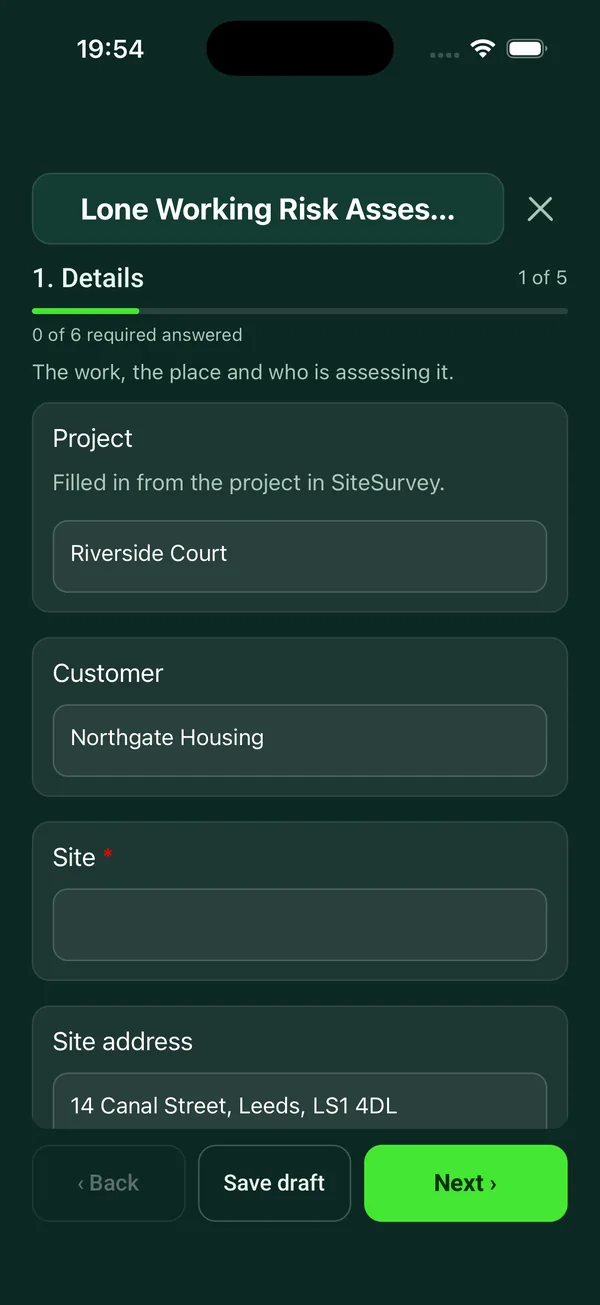
Try it on this phone
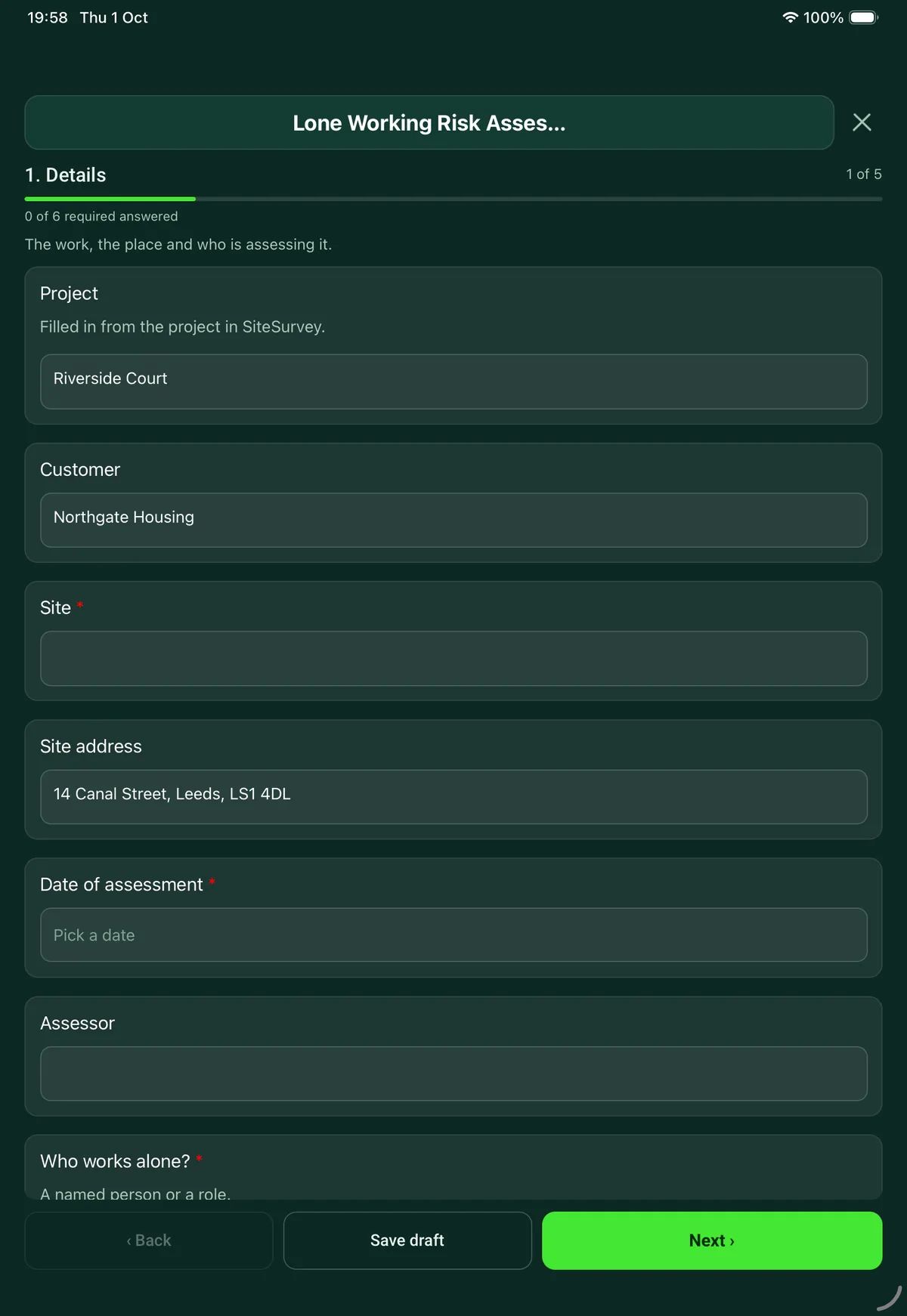
Fill in the lone working risk assessment on your phone now
See how the lone working risk assessment looks on your phone
Scan the code with your phone camera. It opens the real form, no sign-up needed.
Open the live example and fill it in, just as your team would on site. No sign-up needed.
See it on this phoneEvery question is editable. Add this form to your account, then change the wording, add or remove questions and options, and make it fit your own jobs.
What should a lone working risk assessment include?
A lone working risk assessment should describe the work and where it is done, then consider violence, stress and mental health, medical suitability and the workplace itself. It should record how the person keeps in touch, who is watching for their check-ins, what happens if one is missed, how they raise the alarm, and their training. HSE says these risks must be managed before people work alone.
Last updated . Facts checked by the SiteSurvey team on 5 October 2026 against HSE: lone working, protect those working alone, HSE: manage the risks of working alone and regulation 3 of the Management of Health and Safety at Work Regulations 1999.
Try the lone working risk assessment form live
Answer a few questions and watch it adapt. Your answers are not saved, and any photos you add are deleted within the hour.
This is the real form as your team would use it: questions appear as you answer, scores work themselves out and you can add photos and signatures. No sign-up needed.
Want to see one filled in? See a completed lone working risk assessment report (PDF), made by SiteSurvey from a fictional site visit.
Fill it in on a phone or tablet
Your team completes the lone working risk assessment on site in the SiteSurvey app on iPhone, iPad and Android phones and tablets. The project name and address fill in for them, it works without signal, and it syncs when the device is back online with photos kept against the question they answer.
Customers and subcontractors do not need the app: send them a link and they can fill it in from any browser.
Every question in the lone working risk assessment template
Risk assessment for someone working alone: the work and place, violence, health, high risk tasks, check-in arrangements, what happens if contact is lost and scored hazards. 5 sections and 48 questions. Follow-up questions and guidance appear only when an answer calls for them, so the person on site never sees the ones that do not apply.
Make it your own: every question is editable
This is a starting point, not a fixed form. Once it is in your SiteSurvey account you can reword any question, add or remove questions, sections and answer options, and add your own logo, so it fits the way your team works and the jobs you do.
Details you only enter once
Add this form to a project in SiteSurvey and it fills in what the project already knows, so nobody on site retypes it and every form on the job uses the same names. Anything filled in can still be changed.
- Project: the project name
- Customer: the project's customer
- Site: the site, when the form is opened for a space or a product
- Site address: the site address, from the space or the project
Details
The work, the place and who is assessing it.
- ProjectShort answer
Filled in from the project in SiteSurvey.
Fills in from the project name - CustomerShort answerFills in from the project's customer
- Site*Short answerFills in from the site, when the form is opened for a space or a product
- Site addressShort answerFills in from the site address, from the space or the project
- Date of assessment*Date
- AssessorShort answer
- Who works alone?*Short answer
A named person or a role.
- What work do they do alone?*Notes
- Where?Choose one
- On a fixed site, out of sight of others
- Visiting customers or members of the public
- Travelling between sites
- Remote or outdoor locations
- At home
- On site out of hours
- Days and timesShort answer
- GuidanceHSE says employers must manage any health and safety risks before people can work alone. That applies to anyone contracted to work for you, including self-employed people. It means assessing the risks, training, supervising and monitoring lone workers, keeping in touch with them and responding to any incident.
What could go wrong
The risks HSE asks you to think about, and the work itself.
- Could they meet violence, threats or abuse?Yes or No
Handling cash, enforcement, visiting homes, working late.
- From whom, and what is known about them beforehand?NotesShown when “Could they meet violence, threats or abuse?” is Yes
- Does anyone have a medical condition that makes working alone less safe?Yes or No
- What adjustments are in place?Short answerShown when “Does anyone have a medical condition that makes working alone less safe?” is Yes
- Does the work include high risk tasks?Yes or No
Work at height, confined spaces, live electrical work, hazardous substances, machinery.
- Which, and can they be done safely by one person?NotesShown when “Does the work include high risk tasks?” is Yes
- WarningSome work should not be done by one person. Check the rules for the task, such as confined space entry, before deciding it can be done alone.Shown when “Does the work include high risk tasks?” is Yes
- Can one person safely handle everything that has to be lifted or moved?Yes or No
- Is there driving for work?Yes or No
- What driving, and how is it controlled (hours, breakdown, fatigue)?NotesShown when “Is there driving for work?” is Yes
- Are there places with no phone signal?Yes or No
- Could isolation or the nature of the work affect their stress or mental health?Yes or No
- How would help reach them, and how long would it take?Short answer
Keeping in touch
How you know they are safe, and what happens when you do not.
- How do they keep in touch?*Choose one
- Calls or messages at set times
- Lone worker device or app
- Buddy system
- Shared calendar of visits only
- Nothing in place
- WarningThere is no way of knowing they are safe. Put a check-in arrangement in place before the work carries on.Shown when “How do they keep in touch?” is “Nothing in place”
- How often?Short answerShown only when the answers above make it relevant
- Who is watching for the check-ins?Short answerShown only when the answers above make it relevant
- What happens if a check-in is missed?Notes
Who calls, who goes, and when the emergency services are called.
- How do they raise the alarm?Short answer
- Are they trained for the work and for what to do if something goes wrong?Yes or No
- Do they know they can leave or stop if they feel unsafe?Yes or No
- First aid arrangementsShort answer
Hazards and scores
One entry for each hazard that remains.
- HazardsRepeat for each hazard. Each one asks:
- Hazard*Short answer
- Who could be harmed, and how?Short answer
- Controls in placeNotes
- Likelihood of harm with these controlsChoose one
- 1. Very unlikely
- 2. Unlikely
- 3. Possible
- 4. Likely
- 5. Almost certain
- Severity of the harmChoose one
- 1. Minor injury, no time off
- 2. Injury needing first aid
- 3. Injury needing time off work
- 4. Major injury
- 5. Death
- Risk scoreWorked out by the formShown when “Likelihood of harm with these controls” is answered and “Severity of the harm” is answered
- RiskWorked out by the formShown when “Likelihood of harm with these controls” is answered and “Severity of the harm” is answered
- Further action, who and by whenNotesShown only when the answers above make it relevant
- PhotosPhotos
- Hazards recordedWorked out by the form
- Highest scoreWorked out by the form
- GuidanceLikelihood times severity: 1 to 4 is Low, 5 to 12 is Medium and 15 to 25 is High. Scoring is a common way to rank hazards, but it is not required by law and the bands are this form's own.
Briefing, review and sign-off
Tell the people doing the work, and set a review.
- Have the people doing the work been briefed on this assessment?Yes or No
- Who was briefed, and on what date?Short answerShown when “Have the people doing the work been briefed on this assessment?” is Yes
- Review dateDate
- GuidanceReview it sooner if the work, the place, the equipment or the people change, or after an incident or near miss.
- Assessor nameShort answer
- Assessor signatureSignature
- Manager or supervisor nameShort answer
- Manager or supervisor signatureSignature
See it filled in
A completed lone working risk assessment report, made by SiteSurvey from a fictional site visit: every answer, the photos, the guidance that applied and the sign-off, ready to send as a PDF.
Lone working risk assessment FAQs
Is it legal to work alone?
HSE says employers must manage any health and safety risks before people can work alone, and that this applies to anyone contracted to work for you, including self-employed people. That means assessing the risks, training, supervising and monitoring lone workers, keeping in touch with them and responding to any incident.
Who counts as a lone worker?
HSE describes lone workers as those who work by themselves without close or direct supervision. Its examples include delivery drivers, health workers, engineers, security staff, cleaners, warehouse workers and people working from home.
What check-in arrangements does the form record?
How the person keeps in touch (calls or messages at set times, a lone worker device or app, a buddy system, or only a shared calendar of visits), how often, who is watching for the check-ins, and what happens if one is missed: who calls, who goes and when the emergency services are called. Nothing in place shows a warning to fix that before the work carries on.
Does it cover high risk tasks?
It asks whether the work includes tasks such as work at height, confined spaces, live electrical work, hazardous substances or machinery, and whether they can be done safely by one person. HSE says certain high-risk work needs at least one other person, including work in a confined space and near exposed live electricity conductors.
Does it cover violence and stress?
Yes. It asks whether the person could meet violence, threats or abuse and what is known beforehand, whether isolation or the work could affect stress or mental health, and whether a medical condition makes working alone less safe. These are the risks HSE says particularly affect lone workers.
Does a lone working risk assessment have to be written down?
If you employ five or more people, the Management of Health and Safety at Work Regulations 1999 require you to record the significant findings of your risk assessment. The form records them with a review date and the signatures of the assessor and a manager or supervisor.
Related
Related templates
Templates that go with the lone working risk assessment form
Hazards, who might be harmed, controls and risk scores, with a briefing record and review date.
Manual handling assessment using task, individual, load and environment: can it be avoided, risk factors, handling aids, controls and actions.
Risk assessment for a task at height: can it be avoided, how falls are prevented, access equipment, fragile surfaces, falling objects, rescue and scored hazards.
Assessment for a task that uses or creates hazardous substances: products and hazard symbols, who is exposed and how, controls, PPE, emergencies and review.
Use this lone working risk assessment form with your team
Add it from the form library in one click, change any question, and every completed form becomes a branded PDF report.
Start your trial →