Form library · Health and safety
Working at height risk assessment template
A risk assessment for a task at height. It starts with whether the work can be done another way, then records how it is reached, what stops or limits a fall, fragile surfaces, falling objects and the rescue plan, and scores the hazards that remain. Every question is listed below, and you can fill the live form in on this page.
Ready to use from the form library, and every question is yours to edit. Trial from £1, cancel any time.
Try it on your phone
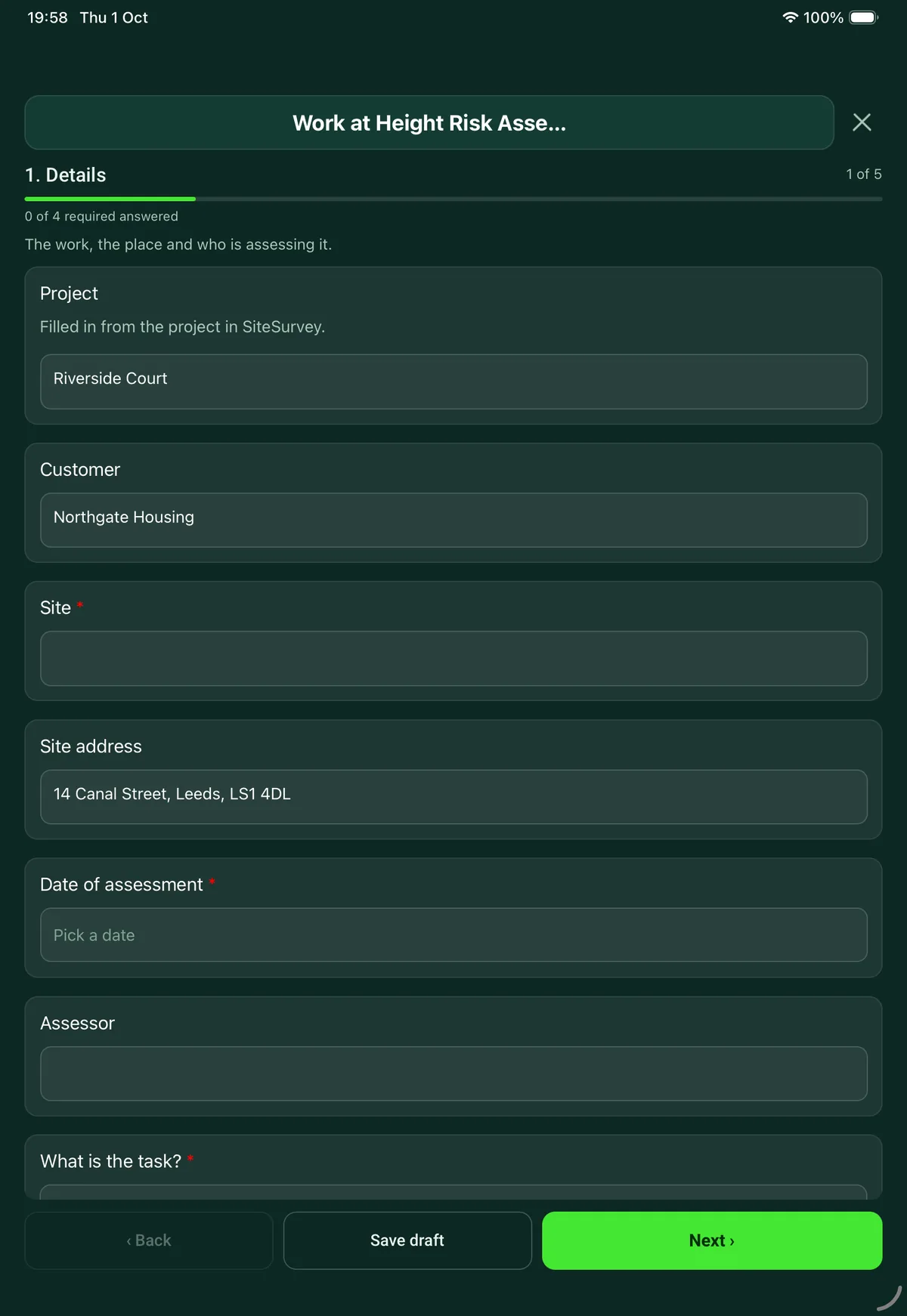
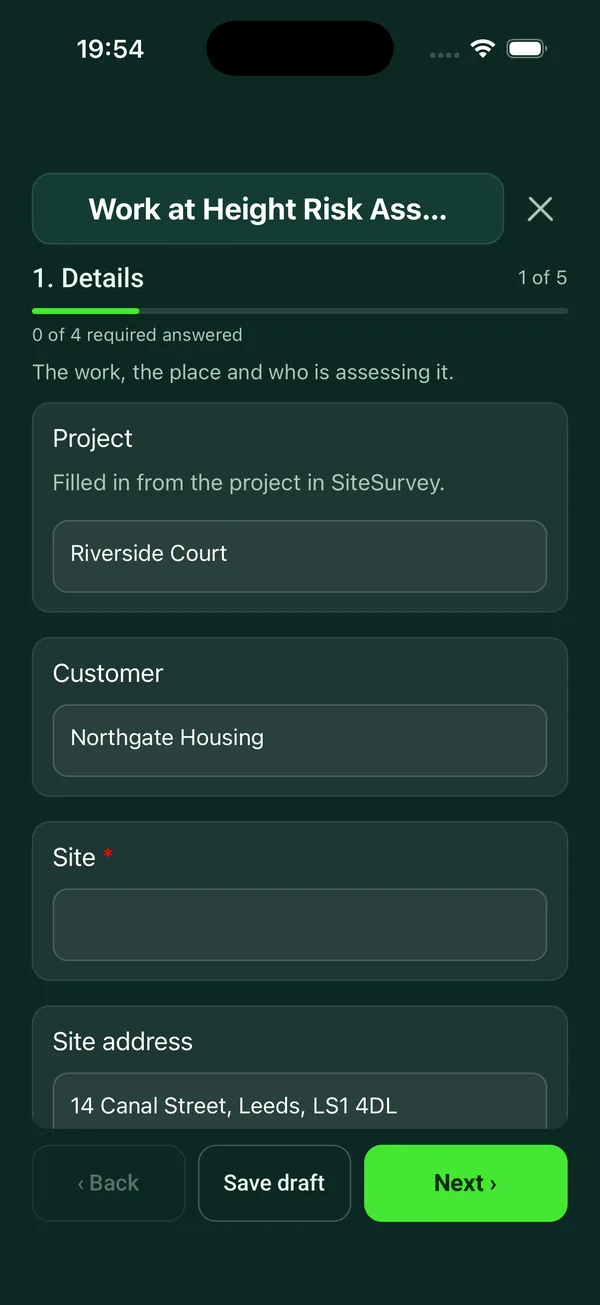
Try it on this phone
Fill in the working at height risk assessment on your phone now
See how the working at height risk assessment looks on your phone
Scan the code with your phone camera. It opens the real form, no sign-up needed.
Open the live example and fill it in, just as your team would on site. No sign-up needed.
See it on this phoneEvery question is editable. Add this form to your account, then change the wording, add or remove questions and options, and make it fit your own jobs.
What should a working at height risk assessment include?
A working at height risk assessment should first ask whether the work can be done without working at height. If not, it should record how the work is reached, what prevents a fall or limits its distance, whether any surface is fragile, how falling objects are controlled, the weather limits, the competence of the people and how someone would be rescued after a fall.
Last updated . Facts checked by the SiteSurvey team on 5 October 2026 against regulation 6 of the Work at Height Regulations 2005, regulation 4 of the Work at Height Regulations 2005, regulation 7 of the Work at Height Regulations 2005, regulation 12 of the Work at Height Regulations 2005, HSE guidance on roof work and HSE: when and how to use ladders safely.
Try the working at height risk assessment form live
Answer a few questions and watch it adapt. Your answers are not saved, and any photos you add are deleted within the hour.
This is the real form as your team would use it: questions appear as you answer, scores work themselves out and you can add photos and signatures. No sign-up needed.
Want to see one filled in? See a completed working at height risk assessment report (PDF), made by SiteSurvey from a fictional site visit.
Fill it in on a phone or tablet
Your team completes the work at height risk assessment on site in the SiteSurvey app on iPhone, iPad and Android phones and tablets. The project name and address fill in for them, it works without signal, and it syncs when the device is back online with photos kept against the question they answer.
Customers and subcontractors do not need the app: send them a link and they can fill it in from any browser.
Every question in the working at height risk assessment template
Risk assessment for a task at height: can it be avoided, how falls are prevented, access equipment, fragile surfaces, falling objects, rescue and scored hazards. 5 sections and 45 questions. Follow-up questions and guidance appear only when an answer calls for them, so the person on site never sees the ones that do not apply.
Make it your own: every question is editable
This is a starting point, not a fixed form. Once it is in your SiteSurvey account you can reword any question, add or remove questions, sections and answer options, and add your own logo, so it fits the way your team works and the jobs you do.
Details you only enter once
Add this form to a project in SiteSurvey and it fills in what the project already knows, so nobody on site retypes it and every form on the job uses the same names. Anything filled in can still be changed.
- Project: the project name
- Customer: the project's customer
- Site: the site, when the form is opened for a space or a product
- Site address: the site address, from the space or the project
Details
The work, the place and who is assessing it.
- ProjectShort answer
Filled in from the project in SiteSurvey.
Fills in from the project name - CustomerShort answerFills in from the project's customer
- Site*Short answerFills in from the site, when the form is opened for a space or a product
- Site addressShort answerFills in from the site address, from the space or the project
- Date of assessment*Date
- AssessorShort answer
- What is the task?*Notes
- Where exactly?Short answer
- Height of the work (m)Number
- How long will it take, and how often is it done?Short answer
- Number of peopleNumber
Avoid, prevent, minimise
Work down the order: avoid first, then prevent falls, then limit how far and how hard.
- Can the work be done safely without working at height?Yes or No
For example from the ground with long-reach tools, or by assembling at ground level.
- CheckWork at Height Regulations 2005, regulation 6. Work must not be carried out at height where it is reasonably practicable to carry it out safely another way.Shown when “Can the work be done safely without working at height?” is Yes
- How will the work be reached?Choose one
- An existing safe place, with permanent guardrails
- Scaffold
- Mobile tower
- MEWP or scissor lift
- Podium steps
- Ladder or stepladder
- Roof with edge protection
- Rope access
- Other (describe)
- Why is that the right choice for this job?Notes
- What stops a fall, or limits it?Choose one
- Guardrails or other protection for everyone
- Personal restraint or fall arrest
- Nets or airbags
- Nothing beyond the equipment itself
- Anchor points and who checked themShort answerShown when “What stops a fall, or limits it?” is “Personal restraint or fall arrest”
- CheckProtection that covers everyone, such as guardrails, comes before protection that relies on each person, such as a harness. Record why guardrails are not practicable.Shown only when the answers above make it relevant
- Will anyone be on a ladder for more than 30 minutes at a time?Yes or NoShown when “How will the work be reached?” is “Ladder or stepladder”
- CheckHSE guidance is that if a task needs a ladder or stepladder for more than 30 minutes at a time, other equipment should be considered.Shown when “Will anyone be on a ladder for more than 30 minutes at a time?” is Yes
- Has the scaffold or tower been inspected in the last 7 days?Yes or NoShown only when the answers above make it relevant
- Date of the last inspection, and who did itShort answerShown only when the answers above make it relevant
- WarningA working platform used for construction work, from which a person could fall 2 metres or more, must not be used unless it has been inspected in that position within the previous 7 days. Work at Height Regulations 2005, regulation 12.Shown when “Has the scaffold or tower been inspected in the last 7 days?” is No
Surfaces, objects and rescue
What is underfoot, what could fall and how someone would be brought down.
- Is any roof or surface in the work area fragile?Choose one
- No: confirmed by a competent person
- Yes
- Not confirmed
- WarningHSE says all roofs should be treated as fragile until a competent person has confirmed they are not. Fragile rooflights are a particular hazard: some are hard to see and others may be hidden by paint.Shown only when the answers above make it relevant
- Covers, barriers or staging to be usedShort answerShown only when the answers above make it relevant
- What stops tools and materials falling on people below?Tick all that apply
- Toe boards
- Brick guards or netting
- Tool lanyards
- Exclusion zone below
- Covered walkway
- Nothing needed
- Other (describe)
- Weather that would stop the workShort answer
- Are the people doing the work trained and competent for this equipment?Yes or No
- How would someone be rescued after a fall?Notes
Who, with what equipment, and how quickly.
- GuidanceWork at Height Regulations 2005, regulation 4. Work at height must be properly planned, appropriately supervised and carried out as safely as is reasonably practicable. Planning includes emergencies and rescue.
Hazards and scores
One entry for each hazard that remains.
- HazardsRepeat for each hazard. Each one asks:
- Hazard*Short answer
- Who could be harmed, and how?Short answer
- Controls in placeNotes
- Likelihood of harm with these controlsChoose one
- 1. Very unlikely
- 2. Unlikely
- 3. Possible
- 4. Likely
- 5. Almost certain
- Severity of the harmChoose one
- 1. Minor injury, no time off
- 2. Injury needing first aid
- 3. Injury needing time off work
- 4. Major injury
- 5. Death
- Risk scoreWorked out by the formShown when “Likelihood of harm with these controls” is answered and “Severity of the harm” is answered
- RiskWorked out by the formShown when “Likelihood of harm with these controls” is answered and “Severity of the harm” is answered
- Further actionNotesShown only when the answers above make it relevant
- WhoShort answerShown only when the answers above make it relevant
- By whenDateShown only when the answers above make it relevant
- PhotosPhotos
- Hazards recordedWorked out by the form
- Highest scoreWorked out by the form
- GuidanceLikelihood times severity: 1 to 4 is Low, 5 to 12 is Medium and 15 to 25 is High. Scoring is a common way to rank hazards, but it is not required by law and the bands are this form's own.
Briefing, review and sign-off
Tell the people doing the work, and set a review.
- Have the people doing the work been briefed on this assessment?Yes or No
- Who was briefed, and on what date?Short answerShown when “Have the people doing the work been briefed on this assessment?” is Yes
- Review dateDate
- GuidanceReview it sooner if the work, the place, the equipment or the people change, or after an incident or near miss.
- Assessor nameShort answer
- Assessor signatureSignature
- Manager or supervisor nameShort answer
- Manager or supervisor signatureSignature
See it filled in
A completed working at height risk assessment report, made by SiteSurvey from a fictional site visit: every answer, the photos, the guidance that applied and the sign-off, ready to send as a PDF.
Working at height risk assessment FAQs
What does the law say about working at height?
Under regulation 6 of the Work at Height Regulations 2005, work must not be carried out at height where it is reasonably practicable to carry it out safely another way. Regulation 4 requires work at height to be properly planned, appropriately supervised and carried out as safely as is reasonably practicable, and planning includes emergencies and rescue.
When can a ladder be used?
The form asks whether anyone will be on a ladder for more than 30 minutes at a time. HSE guidance is that if a task needs a ladder or stepladder for more than 30 minutes at a time, other equipment should be considered.
Should guardrails come before a harness?
Yes. Regulation 7 of the Work at Height Regulations 2005 requires employers selecting equipment for work at height to give collective protection measures priority over personal protection measures. If the form records a harness or no extra protection, it asks you to record why guardrails are not practicable.
How does it deal with fragile roofs?
It asks whether any roof or surface is fragile. HSE says all roofs should be treated as fragile until a competent person has confirmed they are not, and that fragile rooflights are a particular hazard. If the answer is yes or not confirmed, the form asks for the covers, barriers or staging to be used.
Does a scaffold or tower need to be inspected first?
A working platform used for construction work, from which a person could fall 2 metres or more, must not be used unless it has been inspected in that position within the previous 7 days, under regulation 12. The form asks the question when a scaffold or mobile tower is the access chosen.
How are the hazards scored?
Each hazard gets a likelihood and a severity from 1 to 5 and the form multiplies them: 1 to 4 is Low, 5 to 12 is Medium and 15 to 25 is High. A Medium or High score asks for further action. Scoring is not required by law and the bands are the form's own.
Related
Related templates
Templates that go with the working at height risk assessment form
Hazards, who might be harmed, controls and risk scores, with a briefing record and review date.
Permit for hot work, work at height, confined space entry and other high risk jobs: precautions, isolations, authorisation, hand-back and close-out.
Inspection record for a scaffold, ladder, harness and lanyard or pallet racking. The checks change with the equipment, with defects, photos and a result.
Roof inspection report: safe access, coverings by area, flashings, chimneys, gutters and rooflights, the roof space, defects with priorities, costs and photos.
Use this working at height risk assessment form with your team
Add it from the form library in one click, change any question, and every completed form becomes a branded PDF report.
Start your trial →