POINT 01
Bike and fleet number
Show the whole bike in its stand with its fleet number or frame mark in view.
A pool bike is shown in a cycle stand with an asset tag on the frame.
Form library · Health and safety
A safety and condition check for pool, hire and fleet bicycles. Record the check, then each bike by fleet number: scan its tag, its type and stand, then the M check of tyres, wheels, hubs, brakes, cables, gears, steering, frame, saddle, pedals, chain and suspension, plus lights and reflectors, each with what is wrong. Mark each bike safe, safe with a minor fault or out of use, tag it out, add photos, and the form counts bikes out of use. Set repair actions and sign. Every question is listed below, and you can fill the live form in on this page.
Ready to use from the form library, and every question is yours to edit. Trial from £1, cancel any time.
Try it on your phone
Try it on this phone
Fill in the bicycle inspection on your phone now
See how the bicycle inspection looks on your phone
Scan the code with your phone camera. It opens the real form, no sign-up needed.
Open the live example and fill it in, just as your team would on site. No sign-up needed.
See it on this phoneEvery question is editable. Add this form to your account, then change the wording, add or remove questions and options, and make it fit your own jobs.
The M check is Cycling UK's quick way to check a bike is safe to ride before every trip: start at the rear tyre and follow the shape of the letter M, taking in the saddle and the brakes. It covers tyres free from glass, thorns and nails and inflated, wheels spinning freely and straight, no loose spokes, tight axle nuts or quick releases with no play in the hubs, brakes fitted securely and working, a frame free from rust damage and cracks, free steering, a secure saddle and the right reflectors.
Last updated . Facts checked by the SiteSurvey team on 17 October 2026 against Cycling UK: bike maintenance before you set off, including the M check (PDF), the Highway Code: rules for cyclists (59 to 82) and regulation 5 of the Provision and Use of Work Equipment Regulations 1998 (maintenance).
Answer a few questions and watch it adapt. Your answers are not saved, and any photos you add are deleted within the hour.
Open the completed example to see fictional readings, notes, photos and calculations. Choose Blank form to try entering your own answers.
Want to see one filled in? See a completed bicycle inspection report (PDF), made by SiteSurvey from a fictional site visit.
Walk Cam route · four guided clips
Give each bike its own record: fleet number, wheels and tyres, brakes, and the frame, lights and reflectors.
Record the fleet number, location, date and who checked. Film the bike in a stand. The four AI-generated clips illustrate one route, not a real bike.
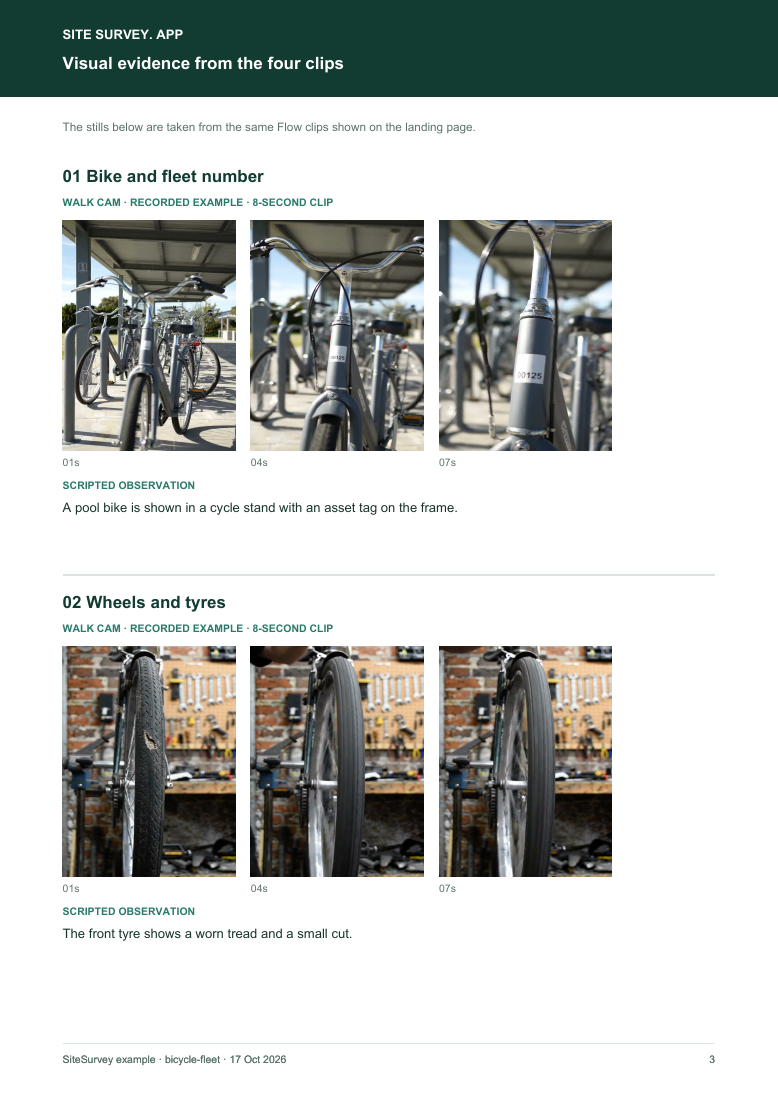
Show the whole bike in its stand with its fleet number or frame mark in view.
A pool bike is shown in a cycle stand with an asset tag on the frame.
Film both tyres for cuts, wear and pressure, and the spokes and wheel fixings.
The front tyre shows a worn tread and a small cut.
Show brake levers, cables and pads. Squeeze tests and adjustments are done by hand, not shown as proof on video.
Brake pads and the cable are visible at the rear wheel.
Film the frame for cracks or rust, and the lights and reflectors the bike must carry.
Front light and pedal reflectors are fitted; light rust shows on the chain.
A fictional six-page example with the four points, twelve stills from the clips, observations, follow-up actions and the limits of a visual record.
View the visual evidence (PDF) ↗ · Download the full sample report
Video records visible condition. It does not prove brakes work, bearings are sound or a bike is safe to ride; check by hand and use a qualified mechanic for repairs. Example footage was generated in Google Flow and the observations are scripted; no real site is shown. Walk Cam works inside any form in the app. How Walk Cam works · All visual inspections
A bicycle inspection for pool, hire and fleet bikes: each bike by fleet number with the M check of tyres, wheels, brakes, gears, steering and frame, lights and reflectors, defects with photos, and bikes taken out of use. 3 sections and 59 questions. Follow-up questions and guidance appear only when an answer calls for them, so the person on site never sees the ones that do not apply.
This is a starting point, not a fixed form. Once it is in your SiteSurvey account you can reword any question, add or remove questions, sections and answer options, and add your own logo, so it fits the way your team works and the jobs you do.
Add this form to a project in SiteSurvey and it fills in what the project already knows, so nobody on site retypes it and every form on the job uses the same names. Anything filled in can still be changed.
Optional. Scan the label or tag to capture its numbers.
Optional. Film the four guided points on the SiteSurvey app; each clip keeps its spoken note.
Set by the fleet maintenance schedule or the manufacturer. PUWER 1998 regulation 6 leaves the interval to the employer, based on use and risk.
This is a pre-use and fleet condition check, not a mechanic's service, a manufacturer's e-bike inspection or a test of a bike to a British Standard.
Result for each bike and what is wrong
Check each bike by its fleet number and say exactly what is wrong. Take a failed bike out of use and tag it until it is repaired and rechecked.
PB-04: front tyre worn with a cut in the sidewall and rear brake pads worn. Tagged out of use; new tyre and pads booked.
Fictional example of record wording. Use the actual evidence and approved arrangements for your job; this is not a completed report or an instruction to carry out the work.
A completed bicycle inspection report, made by SiteSurvey from a fictional site visit: every answer, the photos, the guidance that applied and the sign-off, ready to send as a PDF.
The Provision and Use of Work Equipment Regulations 1998 cover any machinery, appliance, apparatus, tool or installation for use at work, and regulation 5 requires employers to make sure work equipment is maintained in an efficient state, in efficient working order and in good repair. A dated check for each bike shows what was found and fixed.
Highway Code rule 60: at night a cycle must have white front and red rear lights lit, and must be fitted with a red rear reflector (and amber pedal reflectors, if made after 1 October 1985). The form checks both and shows the rule when either is a defect.
Cycling UK says to check a bike before every trip. Set a scheduled fleet inspection interval in your own risk assessment, and check again after a fault report or incident. The form records which kind of check it was.
Mark it out of use until repaired, tag it and take it off the stand. The form counts bikes out of use and those with a minor fault, and repair actions get an owner and a due date. If unsure about a repair, Cycling UK advises asking a qualified mechanic.
Yes. Tag each bike with its fleet number and scan it on the SiteSurvey app, and add an optional Walk Cam route: the bike and fleet number, wheels and tyres, brakes and cables, and frame, lights and reflectors.
Yes. Choose electric bike (EAPC) as the type. The checks are the same M check; follow the manufacturer's instructions for the motor and battery.
Related templates
A daily vehicle inspection checklist and defect report for vans and cars: walkaround checks, mileage, tyre tread, photos of each side, defects graded safe or not to drive, and fleet sign-off.
Inspection round for plant: asset condition, refrigerant and leak checks, pressure vessels, next due dates.
A PUWER assessment record covering intended use, equipment hazards, safeguarding evidence, maintenance arrangements, competence and risk-control decisions.
Add it from the form library in one click, change any question, and every completed form becomes a branded PDF report.
Start your trial →