Risk assessment, row by row
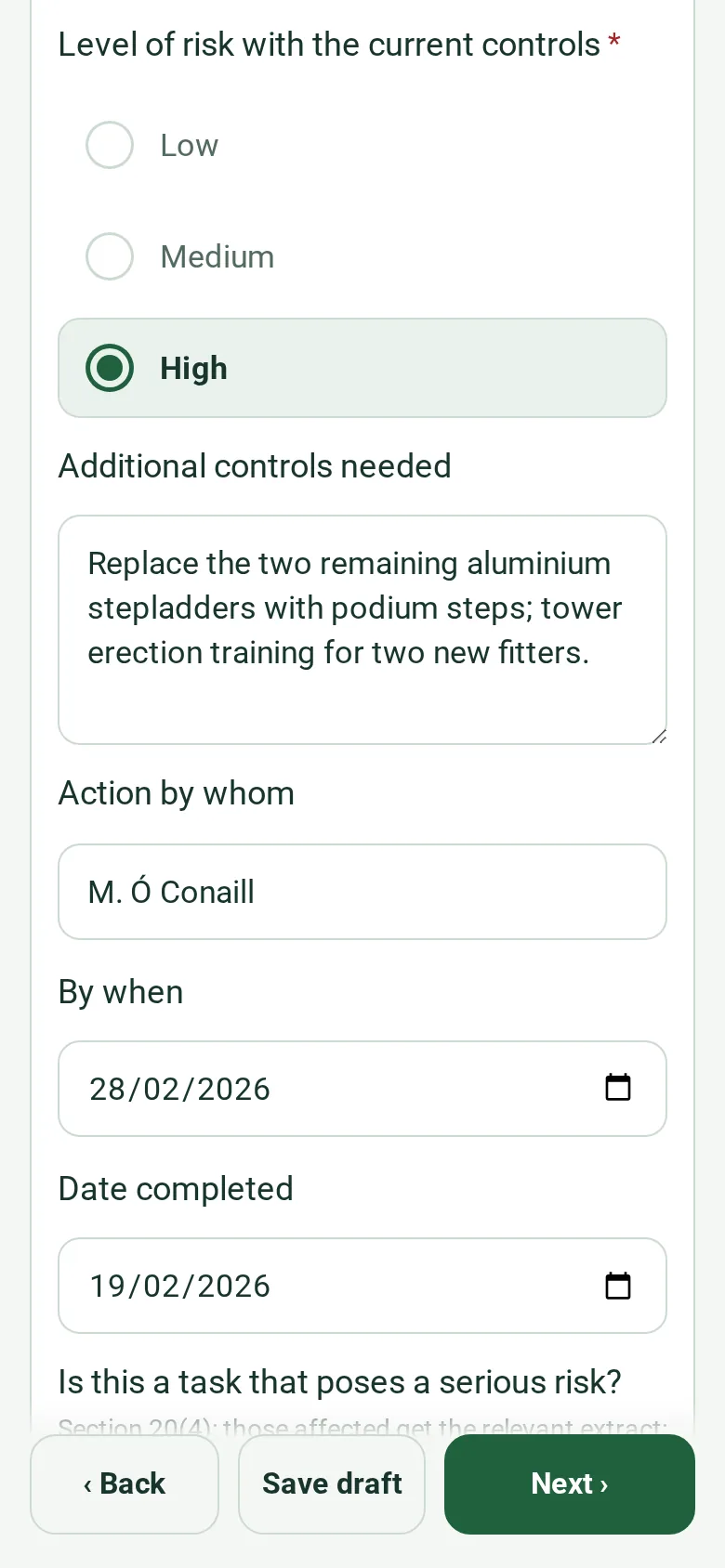
The level of risk is the HSA guide's Low, Medium or High. Each control is tagged with the general principles of prevention in Schedule 3 of the 2005 Act, and a row that relies on PPE alone is flagged.
Form library · Health and safety
A safety statement for an employer in Ireland, in the order section 20 of the Safety, Health and Welfare at Work Act 2005 sets out. It starts from your own section 19 risk assessment, rated Low, Medium or High as in the Health and Safety Authority's guide, then records the measures, the emergency plan, the people responsible, how employees are consulted and told, and the review. If you do construction work, an extra section covers the PSDP and PSCS, Safe Pass and your Safe System of Work Plans. It is written to Irish law, so it is not the UK risk assessment template or RAMS.
For employers and the self-employed in Ireland who need a written safety statement, and for contractors whose client or PSCS asks for theirs or an extract from it.
Ready to use from the form library, and every question is yours to edit. Try it for a small trial fee, cancel any time.
Under section 20 of the Safety, Health and Welfare at Work Act 2005, every employer must have a written safety statement, based on the hazard identification and risk assessment required by section 19, that specifies how the safety, health and welfare of employees will be secured and managed. It must specify the hazards identified and risks assessed, the protective and preventive measures and resources provided, the plans for an emergency or serious and imminent danger, the duties of employees, the names and job titles of the people responsible for tasks under it, and the arrangements for safety representatives and consultation. It must be brought to employees' attention at least once a year and reviewed when things change.
Last updated . Facts checked by the SiteSurvey team on 25 October 2026 against section 19 of the Safety, Health and Welfare at Work Act 2005 (risk assessment), section 20 of the Safety, Health and Welfare at Work Act 2005 (safety statement), section 11 of the 2005 Act (emergencies and serious and imminent dangers), section 25 of the 2005 Act (safety representatives), section 26 of the 2005 Act (consultation and safety committees), Health and Safety Authority, A Guide to Risk Assessments and Safety Statements (updated December 2016), Health and Safety Authority, Safety Statement and Risk Assessment FAQs, Health and Safety Authority, Safe System of Work Plan FAQs and Safety, Health and Welfare at Work (Construction) Regulations 2013 (S.I. No. 291 of 2013).
These follow the HSA guide and the form's pages. The statement has to fit your workplace; the HSA says a generic one is not compliant with sections 19 and 20.
Start with a declaration signed at senior management level: the commitment to a workplace as safe and healthy as reasonably practicable, how safety and health is managed, and this year's objectives. Name the director or senior manager responsible.
Walk each place of work and look at the activities, equipment, substances and people. Think about those not always there: cleaners, visitors, contractors and the public, and vulnerable groups such as young persons and pregnant employees.
For each hazard, record who is at risk, what you already do and the level of risk left: Low, Medium or High. Add further controls with a name and a date for anything that is not low, working through the general principles of prevention, with PPE last.
Record the protective and preventive measures and resources, the emergency plan with the people designated for it, the names and job titles of the people responsible for each task, the duties of employees, and how employees and their safety representative are consulted.
Go through it with employees in a form and language they understand, at least once a year and after every change; with new employees when they start; and with others exposed to a specific risk. Keep a copy or extract at or near every place of work.
Review it at least once a year, when something significant changes, when there is reason to think it is no longer valid, and within 30 days if an inspector directs you to amend it. Record what changed and sign the new version.
In Ireland the safety statement is the employer's own document for the whole workplace. The others sit under it or alongside it on a construction project.
| What it is | Who prepares it | Required by | |
|---|---|---|---|
| Safety statement | How the employer secures and manages safety and health: hazards and risks, measures, emergency plans, named people, consultation | Every employer (and the self-employed) | Section 20 of the 2005 Act |
| Risk assessment | The written identification of hazards and assessment of risks the safety statement is based on | Every employer | Section 19 of the 2005 Act |
| Safe System of Work Plan (SSWP) | An HSA form that applies the safety statement to one construction activity before it starts, ticking hazards and controls | Usually the supervisor, foreman or self-employed person | HSA guidance; it does not replace the safety statement |
| Safety and health plan | The project plan the PSDP prepares and the PSCS develops, with site rules and measures for particular risks | PSDP, then PSCS | Regulations 12 and 16 of the Construction Regulations 2013 |
Sources: section 19 of the Safety, Health and Welfare at Work Act 2005 (risk assessment), section 20 of the Safety, Health and Welfare at Work Act 2005 (safety statement), Health and Safety Authority, Safe System of Work Plan FAQs and Safety, Health and Welfare at Work (Construction) Regulations 2013 (S.I. No. 291 of 2013).
Brackloon Fit-Out Ltd, a 14-person joinery and shop fit-out contractor, Rev 4 dated 12 January 2026. Eight hazards assessed across the workshop and its sites: work at height rated High with the current controls, so the further action (podium steps to replace the last stepladders, tower training for two new fitters) has a name and a date and was completed on 19 February. Every row has a control other than PPE, the safety representative is named, employees were taken through Rev 4 on 15 January with a Polish extract for two fitters, and on the pharmacy fit-out the company is PSCS with two signed Safe System of Work Plans, so the page reads zero points to resolve.
Fictional example. Record the actual evidence and approved arrangements for your job.
Buying a generic statement and changing the company name: the HSA says that is not compliant with sections 19 and 20. The other common gap is a statement that was right when written and never brought back to employees: section 20(3) needs at least once a year and after every change.
Bring the signed version to every employee's attention, keep a copy or extract at or near each place of work, and give the relevant extract to any PSCS you work under. Diary the next review and revisit it sooner after an accident or a significant change.
Each hazard gets its own row with who is at risk, what you already do and a Low, Medium or High level, and anything not low needs a further action with a name and a date. The last page counts the gaps section 20 cares about, from a missing name to a year since employees were last told, and the construction section keeps the PSCS, Safe Pass and Safe System of Work Plans with the statement they apply.
The level of risk is the HSA guide's Low, Medium or High. Each control is tagged with the general principles of prevention in Schedule 3 of the 2005 Act, and a row that relies on PPE alone is flagged.
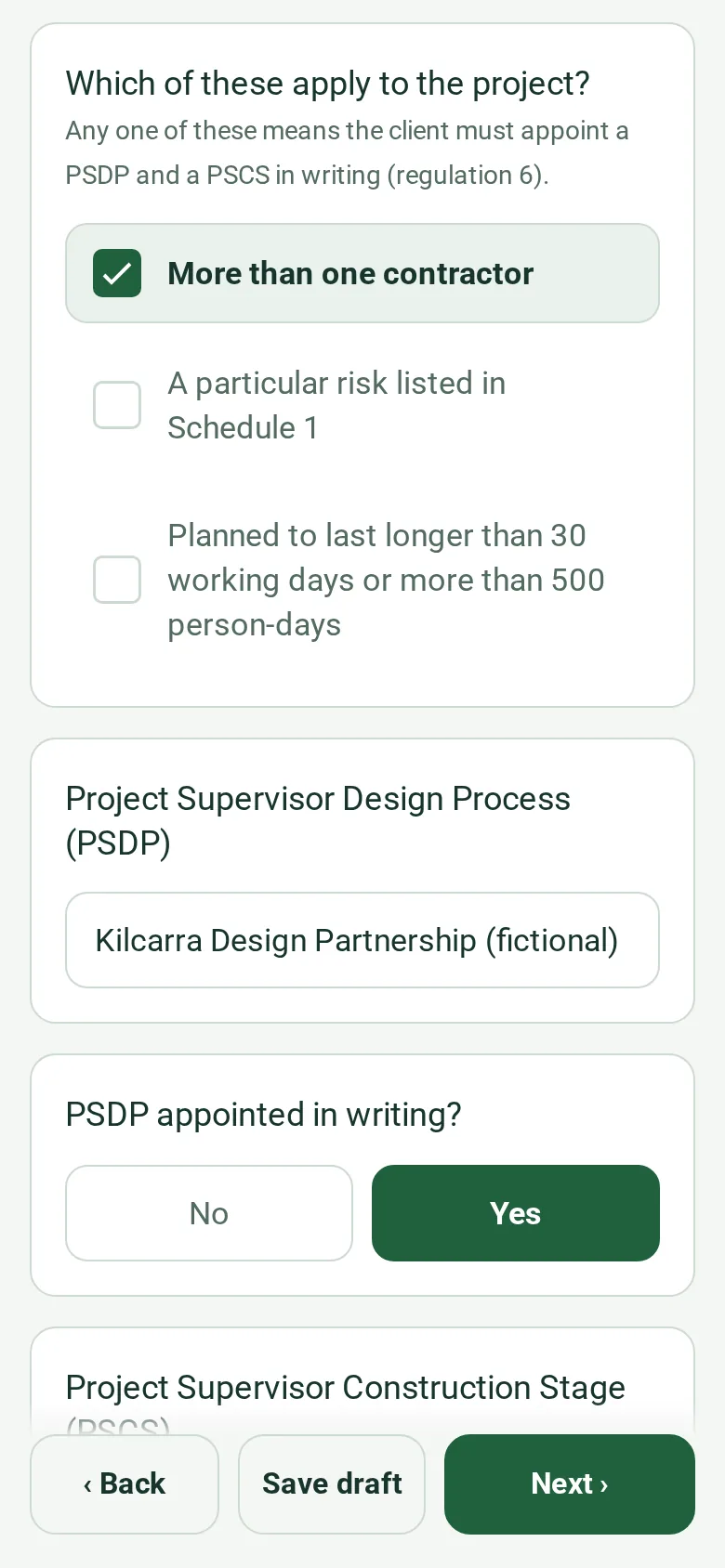
Tick what applies to the project and the form asks for the PSDP and PSCS appointments, the extract for the PSCS when you are a contractor, Safe Pass, the safety officer above 20 people on site, and a log of signed SSWPs.
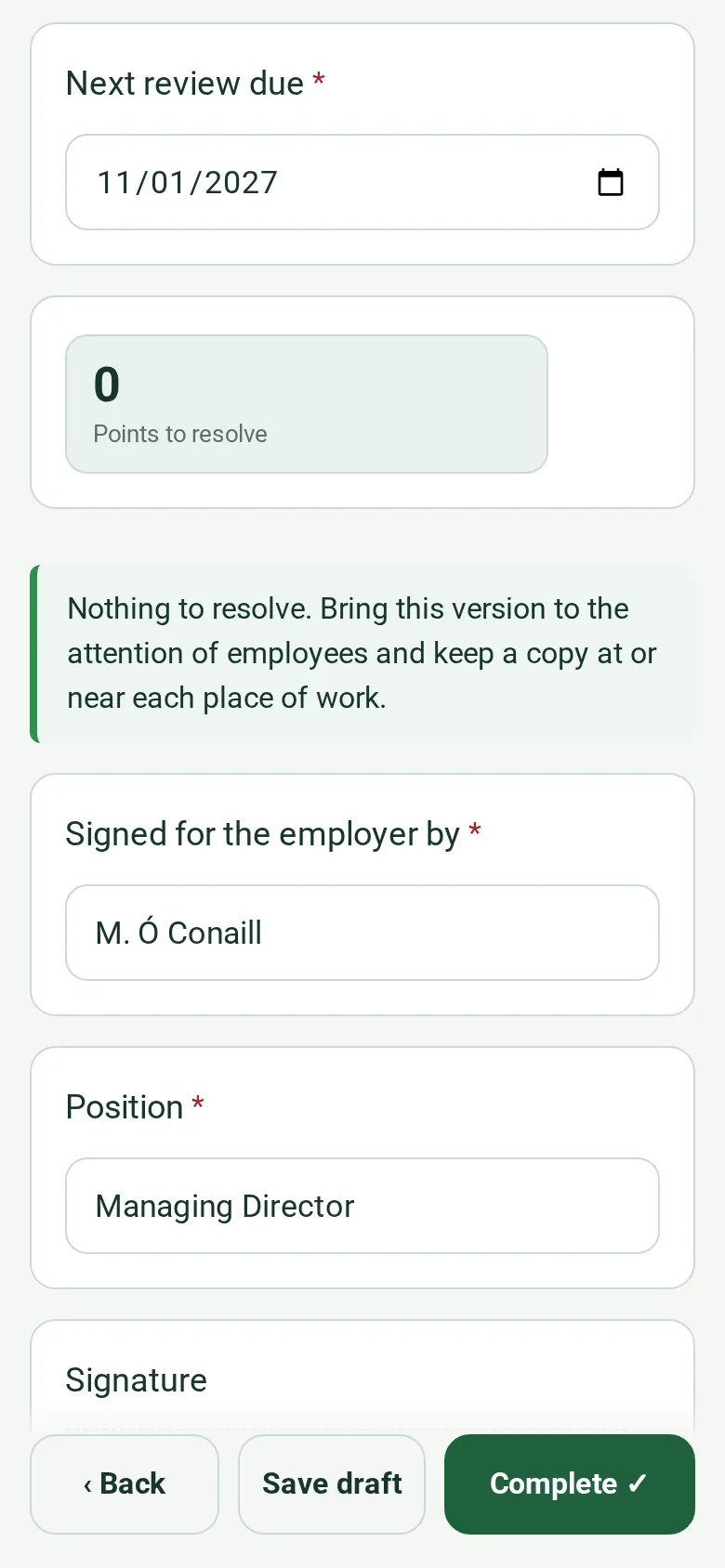
No senior manager named, a high risk with no further controls, PPE alone, a serious risk extract not given, no assembly point, more than a year since employees were told, or a construction item missing: each adds one to the count.
How calculated fields work →Brackloon Fit-Out Ltd (fictional), a 14-person joinery and shop fit-out contractor with a workshop and client sites: Rev 4 signed by the Managing Director, eight hazards assessed with work at height rated High and its further action done, three designated emergency people, the safety representative named, employees taken through it on 15 January with a Polish extract for two fitters, and a pharmacy fit-out where the company is PSCS with two signed Safe System of Work Plans.
Answer a few questions and watch it adapt. Your answers are not saved, and any photos you add are deleted within the hour.
This is the real form as your team would use it: questions appear as you answer, scores work themselves out and you can add photos and signatures. No sign-up needed. Or open a completed example to see every answer, photo and score filled in.
Want to see one filled in? See a completed safety statement report (PDF), made by SiteSurvey from a fictional site visit.
A safety statement for employers in Ireland under section 20 of the Safety, Health and Welfare at Work Act 2005: policy, the section 19 risk assessment rated Low, Medium or High, protective and preventive measures, emergency plans, named responsible people, consultation and the safety representative, how it is brought to employees’ attention, and review. Optional construction section with the PSDP, PSCS, Safe Pass and Safe System of Work Plans. 10 sections and 116 questions. Follow-up questions and guidance appear only when an answer calls for them, so the person on site never sees the ones that do not apply.
This is a starting point, not a fixed form. Once it is in your SiteSurvey account you can reword any question, add or remove questions, sections and answer options, and add your own logo, so it fits the way your team works and the jobs you do.
Add this form to a project in SiteSurvey and it fills in what the project already knows, so nobody on site retypes it and every form on the job uses the same names. Anything filled in can still be changed.
Each section opens on its own. The first is open; tap a heading to see the rest.
For example, Safety Statement 2026, Main office and depot.
What you do, in a few words. The statement has to fit this work, not a generic one.
Section 20(7): at or near every place of work it relates to.
Opens the construction section: PSDP and PSCS, Safe Pass and the Safe System of Work Plan.
Short, measurable targets. For example: every new starter inducted on day one; manual handling training for the warehouse team by March.
The HSA says this name is the minimum the statement must include.
The general principles of prevention in Schedule 3 of the 2005 Act. Personal protective equipment is the last resort.
Section 20(4): those affected get the relevant extract: the risk, the assessment and the measures.
The HSA asks you to write down which activities need a permit, for example confined spaces or isolating machinery for repair.
For example safety data sheets, manufacturer instructions, procedures. The statement can refer to them rather than repeat them.
Budget, time, equipment and outside help for safety and health.
Garda station, gas and electricity emergency numbers, out-of-hours contact.
Section 11(3): nobody is penalised for leaving a place of serious, imminent and unavoidable danger.
Translated extracts or an interpreter where English is not the first language.
Any one of these means the client must appoint a PSDP and a PSCS in writing (regulation 6).
Regulation 24(1)(c): site specific information, including any relevant extract from your safety statement.
Regulation 26: a contractor who normally has more than 20 persons on a site, or 30 in construction work.
The HSA says the completed SSWP stays at the work location with the people doing the work.
Section 20(5) and HSA guidance: at least annually, and on significant change, another reason to believe it is no longer valid, or an inspector’s direction.
A completed safety statement report, made by SiteSurvey from a fictional site visit: every answer, the photos, the guidance that applied and the sign-off, ready to send as a PDF.
Yes. Section 20 of the Safety, Health and Welfare at Work Act 2005 requires every employer to prepare a written safety statement, and section 19 requires the written risk assessment it is based on. The Health and Safety Authority says those required to prepare them are all employers, those who control workplaces to any extent, those who provide workplaces for use by others, and the self-employed. The HSA does not pre-approve safety statements, but an inspector may review yours and direct you to revise it within 30 days.
Sources: section 20 of the Safety, Health and Welfare at Work Act 2005 (safety statement), section 19 of the Safety, Health and Welfare at Work Act 2005 (risk assessment), Health and Safety Authority, Safety Statement and Risk Assessment FAQs and Health and Safety Authority, A Guide to Risk Assessments and Safety Statements (updated December 2016).
Section 20(8) says an employer with 3 or fewer employees complies by observing a code of practice on safety statements for their type of work, where one exists. The HSA has prepared codes for sectors including construction, agriculture and fishing; the construction code is used with the Safe System of Work Plan forms. Where no code covers your work you need a safety statement, and a written risk assessment is needed in every case.
Sources: section 20 of the Safety, Health and Welfare at Work Act 2005 (safety statement), Health and Safety Authority, Safety Statement and Risk Assessment FAQs and Health and Safety Authority, Safe System of Work Plan FAQs.
No. The HSA says a safety statement is specific and unique to each place of work, and an employer using a generic one would not be compliant with sections 19 and 20. A template like this one, or the HSA's free BeSMART.ie tool, is a starting point: the hazards, controls, names and arrangements have to be your own. The form counts the gaps, such as a high risk with no further controls or a hazard relying on PPE alone.
Sources: Health and Safety Authority, Safety Statement and Risk Assessment FAQs and Health and Safety Authority, A Guide to Risk Assessments and Safety Statements (updated December 2016).
Section 20(3) requires you to bring it to the attention of employees at least annually and after any amendment, of new employees when they start, and of others at the workplace exposed to a specific risk it covers, in a form, manner and language they are likely to understand. Section 20(5) requires a review when there has been a significant change, when there is another reason to believe it is no longer valid, or when an inspector directs it to be amended within 30 days; the HSA recommends reviewing it at least once a year. It does not have to be displayed, but a copy or relevant extract must be kept at or near every place of work it covers.
Sources: section 20 of the Safety, Health and Welfare at Work Act 2005 (safety statement) and Health and Safety Authority, A Guide to Risk Assessments and Safety Statements (updated December 2016).
Section 20(2)(c) asks for the plans and procedures for an emergency or serious and imminent danger, in line with sections 8 and 11. Section 11 covers first aid, fire-fighting and evacuation, contacts with the emergency services, and designating employees to carry out the plan, with enough of them, trained and equipped. In a serious, imminent and unavoidable danger employees must be able to stop work and go to a safe place without being penalised. The form records the assembly point, alarm, first aid kit, nearest emergency department, the designated people and the last drill.
Sources: section 11 of the 2005 Act (emergencies and serious and imminent dangers) and section 20 of the Safety, Health and Welfare at Work Act 2005 (safety statement).
The employer does not appoint one: under section 25, employees may select and appoint a safety representative from among themselves. If they have, the safety statement must name them, and the members of the safety committee if there is one (section 20(2)(f)). Either way, section 26 requires you to consult employees, in advance and in good time, on matters including the risk assessment and the preparation of the safety statement.
Sources: section 25 of the 2005 Act (safety representatives), section 26 of the 2005 Act (consultation and safety committees) and section 20 of the Safety, Health and Welfare at Work Act 2005 (safety statement).
Under the Construction Regulations 2013, a client appoints a Project Supervisor Design Process (PSDP) and a Project Supervisor Construction Stage (PSCS) in writing where there is more than one contractor, a particular risk listed in Schedule 1, or the work is planned to last longer than 30 working days or more than 500 person-days. A contractor must give the PSCS any relevant extract from its safety statement (regulation 24). The section records those appointments, the extract, Safe Pass cards, the safety officer where you normally have more than 20 people on a site (regulation 26), and a log of your Safe System of Work Plans.
Source: Safety, Health and Welfare at Work (Construction) Regulations 2013 (S.I. No. 291 of 2013).
No. The HSA says the SSWP complements the safety statement but does not replace it. It applies the statement to one construction activity: the person planning the work ticks the hazards and the controls, confirms the controls are in place with the workers before the work starts, and signs it off. A new SSWP is needed when a new hazard is identified, the task changes or the environment changes, and the completed form stays at the work location with the people doing the work.
Source: Health and Safety Authority, Safe System of Work Plan FAQs.
Related templates
One document for the job: hazards with suggested controls and 1 to 5 scores, the sequence of work with hold points, crew cards and competence, plant, COSHH, permits, emergency and rescue, briefing signatures and approval. Tailored to construction, electrical, AV and IT, roofing, facilities, events or grounds work.
Hazards, who might be harmed, controls and risk scores, with a briefing record and review date.
Site induction for a worker, contractor or new starter: topics covered, competence cards and training with expiry dates, PPE issued, questions and signatures.
Record a toolbox talk: topic, key points, attendees with signatures.
Add it from the form library in one click, change any question, and every completed form becomes a branded PDF report.
Start your trial →