Front and registration
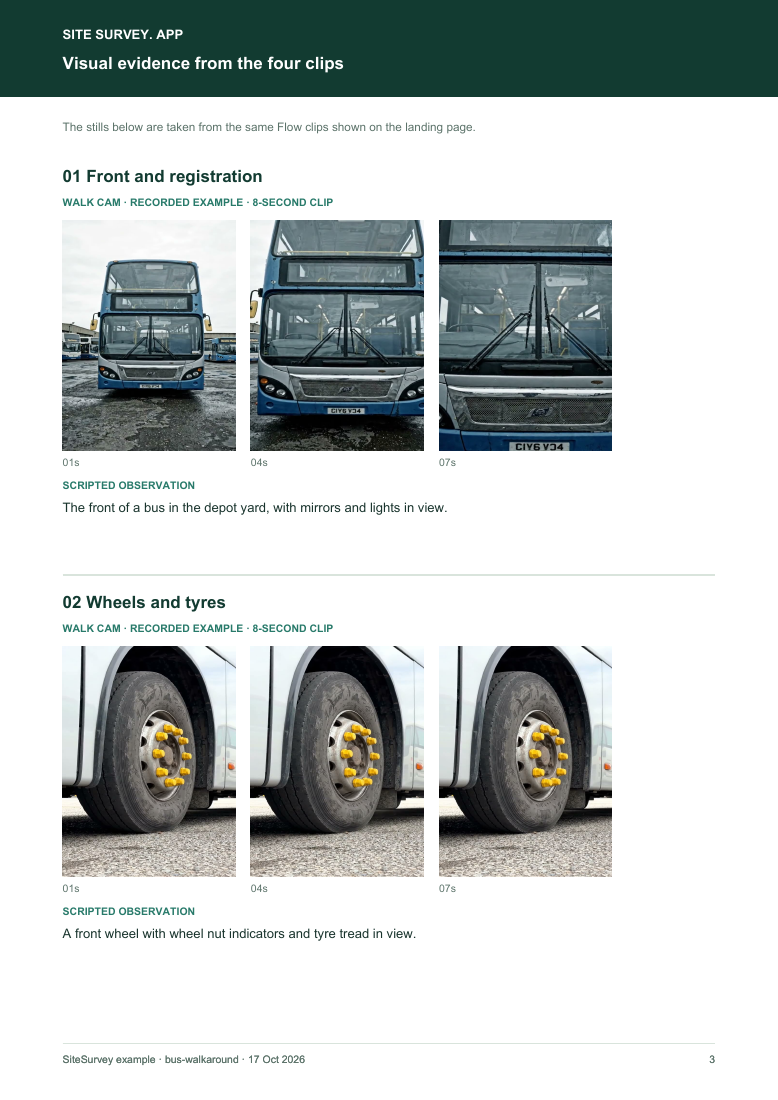
Start at the front: registration plate, windscreen, wipers, mirrors and lights, from a safe position in the yard.
The front of a bus in the depot yard, with mirrors and lights in view.
Form library · Health and safety
A daily walkaround check and defect report for buses, coaches and other PSVs, following DVSA's 29 checks. Record the vehicle registration, fleet number, type, odometer and who did the check, then the checks from the driver's seat, inside the vehicle and outside, each with what is wrong. Record the lowest tread depth and wheel nut indicators, then each defect graded dangerous or not with photos, who it was reported to and when, the vehicle status, the repair and both signatures. Every question is listed below, and you can fill the live form in on this page.
Ready to use from the form library, and every question is yours to edit. Trial from £1, cancel any time.
Try it on your phone
Try it on this phone
Fill in the bus walkaround check on your phone now
See how the bus walkaround check looks on your phone
Scan the code with your phone camera. It opens the real form, no sign-up needed.
Open the live example and fill it in, just as your team would on site. No sign-up needed.
See it on this phoneEvery question is editable. Add this form to your account, then change the wording, add or remove questions and options, and make it fit your own jobs.
DVSA's bus or coach daily walkaround check has 29 items: from the driver's seat (front view, wipers, warning lamps, steering, horn, brakes and air, height marker, ticket machine, seat belt), inside (doors and exits, accessibility equipment, seats, bells and signs, ventilation, exit hammers, fire extinguisher, first aid kit, interior) and outside (tyres with at least 1mm tread, wheel fixings, lights, number plate, bodywork, leaks, smoke, AdBlue, battery, ancillary equipment, high voltage cut-off and alternative fuel). Report defects in writing.
Last updated . Facts checked by the SiteSurvey team on 17 October 2026 against DVSA: carry out bus or coach daily walkaround checks and DVSA: guide to maintaining roadworthiness, commercial goods and passenger carrying vehicles.
Answer a few questions and watch it adapt. Your answers are not saved, and any photos you add are deleted within the hour.
Open the completed example to see fictional readings, notes, photos and calculations. Choose Blank form to try entering your own answers.
Want to see one filled in? See a completed bus walkaround check report (PDF), made by SiteSurvey from a fictional site visit.
Walk Cam route · four guided clips
Walk round the bus in the same order every day, then film inside the saloon, with each defect tied to its position.
Record the fleet number, registration, depot, date and driver. Film in the depot yard away from moving vehicles. The four AI-generated clips illustrate one route, not a real bus.
Start at the front: registration plate, windscreen, wipers, mirrors and lights, from a safe position in the yard.
The front of a bus in the depot yard, with mirrors and lights in view.
Walk down the nearside filming each wheel, tyre and wheel nut indicator.
A front wheel with wheel nut indicators and tyre tread in view.
Film the side, doors and emergency exit markings for damage.
A scrape is visible on the bus side panel near the rear wheel.
Inside, film the floor, seats, handrails and the emergency exit equipment.
The saloon aisle, seats and handrails are shown.
A fictional six-page example with the four points, twelve stills from the clips, observations, follow-up actions and the limits of a visual record.
View the visual evidence (PDF) ↗ · Download the full sample report

Video supports the driver's written defect report. It does not replace the walkaround check itself, safety inspections or the operator's maintenance system. Example footage was generated in Google Flow and the observations are scripted; no real site is shown. Walk Cam works inside any form in the app. How Walk Cam works · All visual inspections
A bus and coach (PSV) daily walkaround check and defect report: the 29 DVSA checks from the driver's seat, inside and outside, tyre tread, each defect graded dangerous or not with photos, who it was reported to, and repair. 6 sections and 92 questions. Follow-up questions and guidance appear only when an answer calls for them, so the person on site never sees the ones that do not apply.
This is a starting point, not a fixed form. Once it is in your SiteSurvey account you can reword any question, add or remove questions, sections and answer options, and add your own logo, so it fits the way your team works and the jobs you do.
Add this form to a project in SiteSurvey and it fills in what the project already knows, so nobody on site retypes it and every form on the job uses the same names. Anything filled in can still be changed.
Optional. Film the four guided points on the SiteSurvey app; each clip keeps its spoken note.
This is a driver's daily walkaround check and defect report, not a safety inspection, an annual test or a first use inspection.
Defects, assessment and who they were reported to
Describe each defect, grade it dangerous or not, and record who it was reported to and when. A dangerous defect stops the vehicle until it is fixed.
Offside body scrape ahead of the rear wheel, no jagged edges: not dangerous, reported to the depot engineer at 05:52 and booked for the body shop.
Fictional example of record wording. Use the actual evidence and approved arrangements for your job; this is not a completed report or an instruction to carry out the work.
A completed bus walkaround check report, made by SiteSurvey from a fictional site visit: every answer, the photos, the guidance that applied and the sign-off, ready to send as a PDF.
DVSA's guide to maintaining roadworthiness says at least one walkaround check must be done every day, or once in each 24-hour period, that the vehicle is used. DVSA says to carry it out before the journey.
DVSA says to record the vehicle registration or identification mark, the date, details of the defects or symptoms, your assessment (for example dangerous), your name and who you reported it to, using a form that lists the items checked. Record nil defects if there are none.
DVSA says you must get dangerous defects fixed before you continue the journey, and using a PSV in a dangerous condition can lead to an unlimited fine and a prison sentence. The form counts dangerous defects and shows a warning.
DVSA's guide to maintaining roadworthiness says drivers' defect reports used to record faults and rectification work must be kept for at least 15 months.
The bus check adds the passenger items: doors and emergency exits, accessibility equipment, seats and belts, bell pushes and signs, exit hammers, fire extinguisher, first aid kit and the saloon interior. Use the HGV daily check sheet for lorries.
Yes. DVSA says operators can delegate the check to a responsible person, and the driver then needs to see evidence it was done and the vehicle is free from safety defects. The form records who did it, and an optional Walk Cam route on the SiteSurvey app films the front, wheels, bodywork and saloon.
Related templates
An HGV walkaround record covering vehicle and trailer identification, driver checks, defect reporting, restrictions and authorised rectification references.
A daily vehicle inspection checklist and defect report for vans and cars: walkaround checks, mileage, tyre tread, photos of each side, defects graded safe or not to drive, and fleet sign-off.
One issue, fast: where, what, photo, priority, who owns it.
Add it from the form library in one click, change any question, and every completed form becomes a branded PDF report.
Start your trial →