Form library · Construction and handover
Snagging list template
A snag list form for handover walks, new home inspections, practical completion and the end of the rectification period. Record each snag where you stand, with the room, element, photos, trade, priority and status, then the checks that passed, the totals and the re-inspection. Every question is listed below, and you can fill the live form in on this page.
Ready to use from the form library, and editable. Trial from £1, cancel any time.
What should a snagging list include?
A snagging list should give each snag its room and exact location, the element affected, a description and photos, the trade to put it right, a priority and a target date, and a status through to closed with a photo of the finished work. It should also record the conditions of the inspection, what could not be checked, who received the list and when it will be re-inspected.
Last updated . Facts checked on 26 September 2026 against the New Homes Quality Code (Version 2) and NHQB: which Code applies.
Try the snagging form live
Answer a few questions and watch it adapt. Your answers are not saved, and any photos you add are deleted within the hour.
This is the real form as your team would use it: questions appear as you answer, scores work themselves out and you can add photos and signatures. No sign-up needed.
Fill it in on a phone or tablet
Your team completes the snagging inspection on site in the SiteSurvey app on iPhone, iPad and Android phones and tablets. The project name and address fill in for them, it works without signal, and it syncs when the device is back online with photos kept against the question they answer.
Customers and subcontractors do not need the app: send them a link and they can fill it in from any browser.
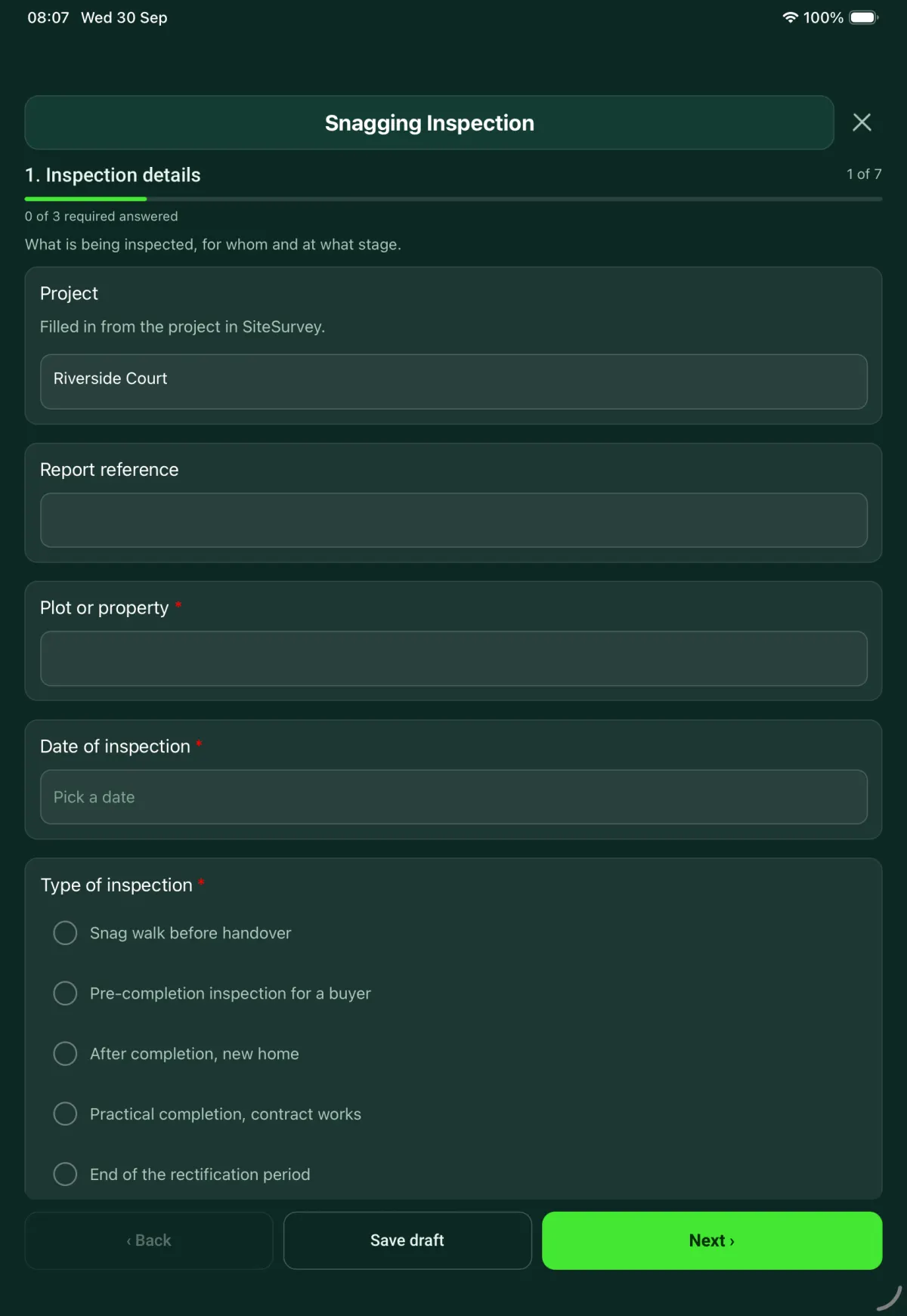
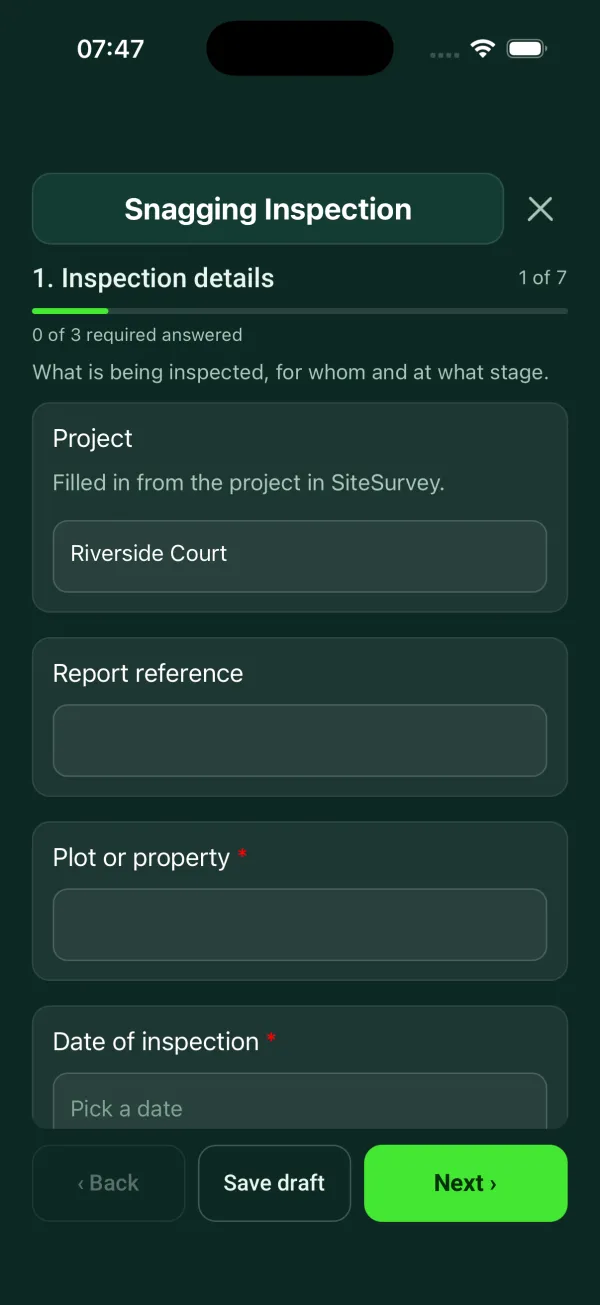
Every question in the snagging template
Snag by snag record with room, element, photo and priority, checks with no snag, totals and re-inspection. 7 sections and 81 questions. Follow-up questions and guidance appear only when an answer calls for them, so the person on site never sees the ones that do not apply.
Details you only enter once
Add this form to a project in SiteSurvey and it fills in what the project already knows, so nobody on site retypes it and every form on the job uses the same names. Anything filled in can still be changed.
- Project: the project name
Inspection details
What is being inspected, for whom and at what stage.
- ProjectShort answerFills in from the project name
- Report referenceShort answer
- Plot or property*Short answer
- Date of inspection*Date
- Type of inspection*Choose one
- Snag walk before handover
- Pre-completion inspection for a buyer
- After completion, new home
- Practical completion, contract works
- End of the rectification period
- Planned handover dateDateShown when “Type of inspection” is “Snag walk before handover”
- Days until handoverWorked out by the formShown only when the answers above make it relevant
- GuidancePre-completion inspection. The New Homes Quality Code says the inspection must be carried out and recorded in line with the NHQB Pre-Completion Inspection Checklist. This form is a snag record. It does not replace that checklist.Shown when “Type of inspection” is “Pre-completion inspection for a buyer”
- Has the notice to complete been served?Yes or NoShown when “Type of inspection” is “Pre-completion inspection for a buyer”
- Date the notice to complete was servedDateShown when “Type of inspection” is “Pre-completion inspection for a buyer” and “Has the notice to complete been served?” is Yes
- CheckThe Code says the inspection should take place after the notice to complete has been served, or earlier if the developer and the buyer both agree. Record that agreement.Shown when “Type of inspection” is “Pre-completion inspection for a buyer” and “Has the notice to complete been served?” is No
- Have the developer and the buyer both agreed to an earlier inspection?Yes or NoShown when “Type of inspection” is “Pre-completion inspection for a buyer” and “Has the notice to complete been served?” is No
- Legal completion dateDateShown only when the answers above make it relevant
- Inspector's professional body and membership numberShort answerShown when “Type of inspection” is “Pre-completion inspection for a buyer”
- Date the snags were reported to the developerDateShown when “Type of inspection” is “After completion, new home”
- Days since the snags were reportedWorked out by the formShown only when the answers above make it relevant
- CheckMore than 30 days have passed since the snags were reported. The Code says that in most situations a registered developer must settle an after-sales issue within 30 days. If there is a delay, the buyer must be told why and updated at least once a month.Shown only when the answers above make it relevant
- When was the home reserved?Choose one
- Before 2 March 2026
- On or after 2 March 2026
- Not known
Shown only when the answers above make it relevant - GuidanceVersion 2 of the New Homes Quality Code applies, if the developer is registered with the New Homes Quality Board.Shown when “When was the home reserved?” is “On or after 2 March 2026”
- GuidanceVersion 1 of the New Homes Quality Code applies, if the developer is registered with the New Homes Quality Board. Check the wording of that version.Shown when “When was the home reserved?” is “Before 2 March 2026”
- Contract and projectShort answerShown only when the answers above make it relevant
- Date of practical completionDateShown when “Type of inspection” is “End of the rectification period”
- Date the rectification period endsDateShown when “Type of inspection” is “End of the rectification period”
- GuidanceThe length of the rectification period, and how and when defects must be notified, are set by the contract. Check the contract particulars before you issue the list.Shown only when the answers above make it relevant
- Inspector name and roleShort answer
- Developer or contractorShort answer
- Walk Cam: Snagging walkWalk Cam video with voice-to-text
Conditions and limits
How the inspection was carried out, and anything that could not be checked.
- GuidanceViewing distances in the NHQB checklist guidance. Internal walls, ceilings and paintwork: daylight, from at least 2 m, without shining a light on the surface. Kitchens and fitted furniture: from 0.5 m. External walls: from at least 10 m.
- Was there natural daylight in every room?Yes or No
- Which rooms had no daylight?Short answerShown when “Was there natural daylight in every room?” is No
- CheckWhere there is no natural daylight, the guidance is to inspect with a single light source. Do not shine a light along the surface. Record this as a limit of the inspection.Shown when “Was there natural daylight in every room?” is No
- WeatherChoose one
- Dry
- Rain during the inspection
- Rain earlier in the day
- Frost or snow
- GuidanceGutters, downpipes and water butts cannot be checked for leaks in dry weather. Record this as a limit of the inspection.Shown when “Weather” is “Dry”
- Could every room and area be inspected?Yes or No
- Which areas were not inspected, and why?NotesShown when “Could every room and area be inspected?” is No
- LoftChoose one
- Inspected
- Not inspected
- No loft
- Why was the loft not inspected?Choose one
- No fixed ladder
- Not safe to enter
- Hatch could not be opened
- Other (describe)
Shown when “Loft” is “Not inspected” - Were water, power and heating on?Yes or No
- Which were off?Tick all that apply
- Water
- Electricity
- Gas
- Heating
Shown when “Were water, power and heating on?” is No - CheckAnything that needs a service that was off could not be tested. List it in the areas not inspected or come back to it at the re-inspection.Shown when “Were water, power and heating on?” is No
- Rooms and areas inspectedTick all that apply
- Hall
- Living room
- Dining room
- Kitchen
- Utility
- WC
- Stairs and landing
- Bedroom 1
- Bedroom 2
- Bedroom 3
- Bathroom
- En-suite
- Garage
- Front outside area
- Rear outside area
- Other (describe)
Snags
One entry for each snag. Record it while you are standing in front of it.
- GuidanceWhat a good snag photo shows. Step back far enough to show where it is in the room, then get close enough to show what is wrong.
- SnagsRepeat for each snag. Each one asks:
- Room or areaChoose one
- Hall
- Living room
- Dining room
- Kitchen
- Utility
- WC
- Stairs and landing
- Bedroom 1
- Bedroom 2
- Bedroom 3
- Bathroom
- En-suite
- Garage
- Outside
- Other (describe)
- Exactly where?Short answer
- What is it?Choose one
- Walls and ceilings
- Floors
- Windows and glazing
- Doors
- Skirting and joinery
- Kitchen and fitted furniture
- Tiles
- Sanitaryware
- Services
- Appliances
- Outside
- Which looks most like what you can see?Choose one
- Damaged plaster or paint
- Door or unit out of line
- Cracked tile or open joint
- What is wrong with the wall or ceiling?Tick all that apply
- Paint patchy or uneven
- Plaster chipped or damaged
- Filler left rough
- Paint or filler on a switch or socket
- Crack
- Fixing showing through
- Other (describe)
Shown only when the answers above make it relevant - What is wrong with the unit?Tick all that apply
- Door out of line
- Door does not close flush
- Gaps uneven
- Handle loose or not square
- Scratched or chipped
- Shelf missing or loose
- Other (describe)
Shown only when the answers above make it relevant - What is wrong with the tiling?Tick all that apply
- Tile cracked
- Tile chipped or scratched
- Grout missing
- Joint not straight
- Sealant missing or untidy
- Other (describe)
Shown when “What is it?” is “Tiles” - Is it next to a bath, shower or basin?Yes or NoShown when “What is it?” is “Tiles”
- CheckAn open joint or cracked tile in a wet area lets water get behind the tiles. Put it right before the bath or shower is used.Shown when “What is it?” is “Tiles” and “Is it next to a bath, shower or basin?” is Yes
- Is it a fire door?Yes or NoShown when “What is it?” is “Doors”
- Largest gap at the head or sides (mm)NumberShown when “What is it?” is “Doors” and “Is it a fire door?” is Yes
- Gap at the base (mm)NumberShown when “What is it?” is “Doors” and “Is it a fire door?” is Yes
- CheckA gap is outside the figures in the NHQB checklist. It says gaps at the head and sides of a fire door need to be between 2 and 4 mm, and the gap at the base no more than 4 mm.Shown only when the answers above make it relevant
- Gap between skirting and floor (mm)NumberShown only when the answers above make it relevant
- Over the 5 mm in the checklist by (mm)Worked out by the formShown only when the answers above make it relevant
- Does it affect safety, or is water leaking?Yes or NoShown only when the answers above make it relevant
- WarningTell the site manager now. Do not wait for the list to be issued. The New Homes Quality Code treats emergency issues separately from snags.Shown when “Does it affect safety, or is water leaking?” is Yes
- Describe the snagNotes
- Photos of the snagPhotos
- Trade to put it rightChoose one
- Decorator
- Plasterer
- Joiner
- Kitchen fitter
- Tiler
- Plumber
- Electrician
- Flooring
- Glazier
- Groundworker
- Cleaner
- Other (describe)
- PriorityChoose one
- Urgent
- Before handover
- After handover
- WarningUrgent. Report it by phone today as well as on the list, and record who you told.Shown when “Priority” is “Urgent”
- Who was told, and when?Short answerShown when “Priority” is “Urgent”
- Why can it wait until after handover?NotesShown when “Priority” is “After handover”
- Target dateDate
- Days from inspection to targetWorked out by the formShown only when the answers above make it relevant
- CheckThe target date is after the planned handover, but the priority is before handover. Change one of them.Shown only when the answers above make it relevant
- StatusChoose one
- Open
- Fixed, waiting for a check
- Closed
- GuidanceCheck the work yourself and photograph it before you close the item.Shown when “Status” is “Fixed, waiting for a check”
- Photo of the finished workPhotosShown when “Status” is “Closed”
- Date closedDateShown when “Status” is “Closed”
- Closed byShort answerShown when “Status” is “Closed”
Checks with no snag
What was tested and found working. It shows the item was looked at.
- Sockets tested with a plug testerChoose one
- All tested, no fault
- Fault found
- Not tested
- CheckAdd the socket fault to the snag list with the room and which socket it is.Shown when “Sockets tested with a plug tester” is “Fault found”
- Smoke, heat and carbon monoxide detectorsChoose one
- Present and sounded on test
- Present, did not sound
- Missing
- Not tested
- WarningA detector is missing or did not sound. Add it to the snag list as urgent.Shown only when the answers above make it relevant
- Heating and hot waterChoose one
- Working
- Fault found
- Not tested
- What is wrong with it?Short answerShown when “Heating and hot water” is “Fault found”
- Bath and basins filled to the overflow and drainedChoose one
- No leaks or movement
- Leak or movement found
- Not tested
- Where is the leak or movement?Short answerShown when “Bath and basins filled to the overflow and drained” is “Leak or movement found”
- Windows and outside doors open, close and lockChoose one
- Yes, keys present
- Fault found
- Keys missing
- Which window or door, and what is wrong?Short answerShown when “Windows and outside doors open, close and lock” is “Fault found”
- What was not tested, and why?NotesShown only when the answers above make it relevant
- Overall standard of finishRating 1 to 5 (Poor to Very good)
Totals
Worked out from the snags you entered.
- Snags recordedWorked out by the form
- UrgentWorked out by the form
- Before handoverWorked out by the form
- After handoverWorked out by the form
- ClosedWorked out by the form
- Share closed (%)Worked out by the formShown only when the answers above make it relevant
- WarningThere is at least one urgent item. Check that each one has been reported by phone.Shown only when the answers above make it relevant
- GuidanceEvery snag is closed. Check that each one has a photograph of the finished work.Shown only when the answers above make it relevant
Actions and re-inspection
Who gets the list and when it is checked again.
- List issued toTick all that apply
- Each trade
- Site manager
- Contracts manager
- Customer care
- Buyer or client
- Contract administrator
- Other (describe)
- GuidanceThe NHQB checklist guidance says a completed pre-completion checklist should go to the buyer and to the developer.Shown when “Type of inspection” is “Pre-completion inspection for a buyer” and “List issued to” includes “Buyer or client”
- Is a re-inspection needed?Yes or No
- Re-inspection dateDateShown when “Is a re-inspection needed?” is Yes
- What will be checked again?NotesShown when “Is a re-inspection needed?” is Yes
- CheckThe re-inspection is after the planned handover date.Shown only when the answers above make it relevant
- Has the buyer or client been told about items left until after handover?Yes or NoShown only when the answers above make it relevant
- Other notesNotes
Inspector sign-off
- WarningThis inspection has urgent items. Check that who was told, and when, is filled in for each one.Shown only when the answers above make it relevant
- NameShort answer
- Inspector signatureSignature
Snagging template questions
Is a snagging list the same as a punch list?
Yes. Punch list is the name used in the US and in some contracts for the same thing: a list of defects and unfinished work to put right before handover. This template works as a punch list, with a photo, location and owner against each item.
Can I use this for a new build snagging inspection?
Yes, as a snag record. For a pre-completion inspection with a developer registered with the New Homes Quality Board, the Code says the inspection must use the NHQB Pre-Completion Inspection Checklist. This form does not replace that checklist, and it says so when you choose that type of inspection.
When should a new build pre-completion inspection happen?
The New Homes Quality Code says the inspection should take place after the notice to complete has been served, or earlier if the developer and the buyer both agree. The form asks whether the notice has been served and records the agreement if it has not.
How long does a developer have to fix snags after completion?
The New Homes Quality Code says that in most situations a registered developer must settle an after-sales issue within 30 days, and if there is a delay the buyer must be told why and updated at least once a month. The form counts the days since the snags were reported and flags anything over 30.
Which version of the New Homes Quality Code applies?
Version 2 applies to homes reserved from a registered developer on or after 2 March 2026, and Version 1 to homes reserved before that date. The form asks when the home was reserved and shows which version applies.
How close should I stand when checking walls and paintwork?
The NHQB checklist guidance says internal walls, ceilings and paintwork are viewed in daylight from at least 2 m, without shining a light on the surface. Kitchens and fitted furniture are viewed from 0.5 m and external walls from at least 10 m.
Can the snag list be shared with trades?
Yes. In the SiteSurvey app the form works offline, attaches photos to each snag and produces a PDF report or share link. The form records who the list was issued to, such as each trade, the site manager or the buyer.
Related
Related templates
Templates that go with the snagging form
Customer acceptance at handover: work completed, outstanding items, customer name and signature.
One issue, fast: where, what, photo, priority, who owns it.
Site visit report: weather, labour, progress against programme, area by area record, tests, queries and instructions.
Use this snagging form with your team
Add it from the form library in one click, change any question, and every completed form becomes a branded PDF report.
Start your trial →